About this episode
99% Invisible is made possible by:
This episode is sponsored by Claude. For problems worth solving, get started with Claude at Claude.ai.
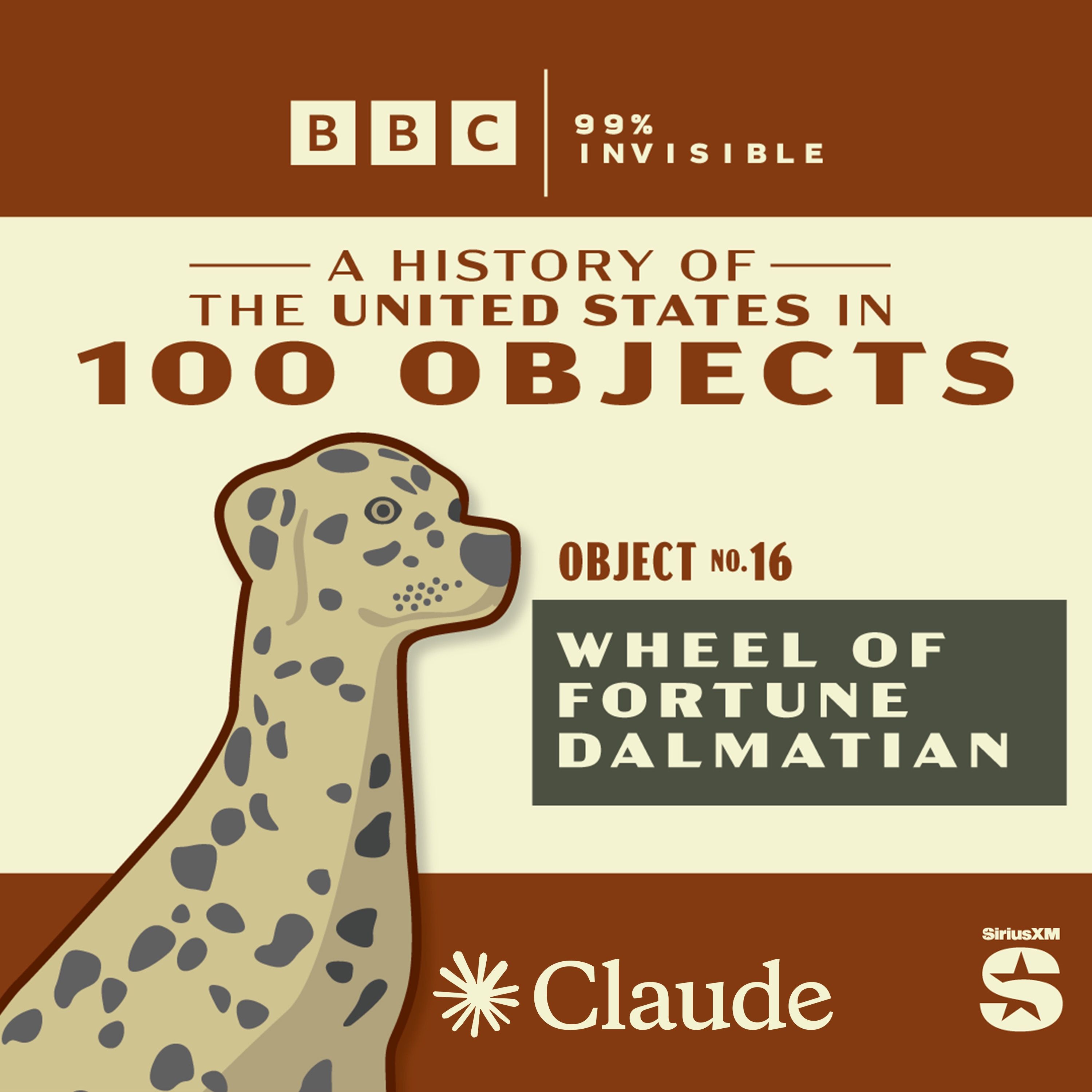
If you watched Wheel of Fortune in the 1980s, you probably remember one prize more than all the others: the ceramic Dalmatian. For a brief moment, that prize—perhaps the ultimate useless object—became the mascot for one of America's most popular game shows, appearing on tens of millions of TV screens, night after night, all across the country. But…why?
Game show historian Adam Nedeff and ceramic Dalmatian owner Terry Eldrige join Roman Mars to tell the story of why audiences loved that dog, and what the fascinating history of game shows—and game show prizes—tells us about the changing definition of the American dream.
A History of the United States in 100 Objects is a production of 99% Invisible and BBC Studios.
Subscribe to SiriusXM Podcasts+ to listen to new episodes of 99% Invisible ad-free and a whole week early.
Start a free trial now on Apple Podcasts or by visiting siriusxm.com/podcastsplus.
Hosted by Simplecast, an AdsWizz company. See pcm.adswizz.com for information about our collection and use of personal data for advertising.
Get every episode summarized
Each time 99% Invisible publishes, we email you a written briefing from the transcript — the topics, who appeared, and any specific claims, with the ad reads skipped.
Email me new episodesFree for 3 shows. No card needed.
Hosts & guests
Transcript ready
539 searchable segments. Every word is indexed and playable.
Full transcript
99% Invisible — 100 Objects #16: Wheel of Fortune Dalmatian. Machine-transcribed; use the interactive transcript above to jump the player to any line.
This episode of 100 Objects is brought to you by Anthropic, the team behind Claude. Claude is the AI for minds that don't stop at good enough. It's the collaborator that actually understands your entire workflow and thanks with you. Whether you're debugging code at midnight or strategizing your next business move, Claude extends your thinking to tackle the problems that matter. Build interactive tools and apps by describing what you need. Custom calculators, data visualization dashboards, even prototypes, all without writing a single line of code. For problems worth solving, get started with Claude at claw.ai. That's claw.ai. The year is 1988. After decades of political tensions, the Cold War is finally beginning to thaw out. But despite this, we start our story underground in a windowless room. It was literally called the bomb shelter. This is Terry Eldridge. It was a basement space, just this wide open room.
On this particular winter afternoon, Terry found himself hunkered down in the bomb shelter. But he wasn't taking cover from an incoming missile or nuclear fallout. The bomb shelter was just a rec room in a dorm where Terry went to college. He and some classmates had gathered there because Terry had recently received a phone call from his dad Roy. And he told Terry to make sure he was going to be near a TV in just a few days time. Because something really good was going to be on. Over $76,000 just waiting to be won today on We The Fortune. And now there's your host. I'm Steve A. Me and a bunch of friends sat and watched my dad on We The Fortune and it was really surreal. Did it surprise you to learn that he was going to be on TV? What was this out of character for him? Oh, absolutely. He was a retired cop. He had been a Denver cop for years. Roy Eldridge from Brueilfield, Colorado.
What do you do back there? I'm chief physical security for a large government facility. Sounds kind of secretive, Roy. Not really. All right. How about you, ma'am? It turns out Terry's dad was good at the game. Roy was the biggest earner of the day and qualified to play the bonus round for a pretty sweet prize. Roy, you're going to be playing for the Jeep Wrangler Open Air Model with room for four retail value $12,765. He won this beautiful red Jeep Wrangler. 15 seconds to talk it out. Good luck. Maternity leave. I knew you could. Sure. And I'm thinking you got this 19 or 20 year old kid in college. You don't need a Jeep Wrangler, but I would love one. I was so excited thinking I am getting a Jeep. Terry wouldn't get the Jeep, but there was another thing. At the time, Wheel of Fortune had a segment called the shopping round. You got there by spending the wheel, of course, solving the puzzle and hopefully winning thousands of dollars.
But you didn't get to take any of that cash home. Instead, contestants had to spend it all right there during the shopping round, where they forced you to buy random things that filled the stage. Jet skis, vacation packages, you got whatever you could afford. And every episode, the announcer would hype up those very prizes that you'd been forced to buy. My dad bought these horrible gold plated sunglasses. The Kazeil 951 sports system sunglasses in an attractive presentation kit. That looked like something straight out of the Elvis wardrobe. Retail value $300. And he also bought what at the time was a very pretty crystal peacock. Crystal large peacock handcrafted, the finest 32% lead Austrian crystal, $800. Towards the end of the round, once people got down to less than $200, there wasn't much left to buy. Except for for about $150, there was always this ceramic dog.
Top honors go to our favorite mascot. Wheel of Fortune ceramic Dalmatian, a medium sized dog we've all learned to love $154. A life-sized black and white polka dot dog made out of baked clay. It was kind of a consolation prize. Here's what you get with whatever money you have left that isn't enough to buy anything else on the set. Except for this dog. It was truly just the thing you got when you couldn't afford anything else. Terry doesn't even really remember seeing his dad buy one, but he did. And like so many people who went on Wheel of Fortune in the 1980s, a ceramic Dalmatian ended up back at Roy's house. After the excitement of watching his dad on Wheel of Fortune, Terry finished college, moved, bought a home, got married, and started a family of his own. His father kept the dog all that time, and then one day he pulled Terry aside. And he said, hey, take the dog home with you.
So he has sat in our house guarding the top of the stairs for the past 20 plus years. Thanks to his dad, Terry is the proud owner of perhaps the ultimate useless object. The Wheel of Fortune ceramic Dalmatian has no discernible purpose whatsoever. Functionally, nothing would change in Terry's life if he got rid of it. But he insists he never, ever will. And it's not just beloved to Terry. For a brief moment, it became the mascot for one of America's most popular game shows, appearing on tens of millions of TV screens, night after night, all across the country. If you watched Wheel of Fortune in the 1980s, I bet you big money you remember the ceramic Dalmatian. But why did this fake, useless dog capture the fleeting attention of our nation? From 99% invisible and BBC studios, this is a history of the United States in 100 objects.
I'm Roman Mars. And today, why the Wheel of Fortune ceramic Dalmatian is the perfect symbol of the game show, and what the fascinating history of game shows and game show prizes tells us about the changing definition of the American dream. One of the things that fascinates me about game shows is the prizes. I've probably seen thousands of hours of game shows in my life. Growing up, I remember skipping school to watch Wheel of Fortune or the prizes right. But I wasn't just into solving puzzles or guessing the price of a bottle of dish soap. Like millions of other Americans watching along with me, I wanted to see the stuff people won. Prizes are central to a game show. They are the reason viewers keep tuning in, imagining we could be the ones driving home in that brand new car. And those prizes have been there since the very start before they were even called game shows.
As far as we know, the quiz show is an American invention. It appears that the first one on the air was a show on the radio around 1924 called Brooklyn Daily Eagle Quiz on current events. Catchy. Rolls right off the tongue. This is Adam Niedef, author, historian, and researcher for the National Archives of Game Show History. The Brooklyn Daily Eagle was a newspaper in New York and they have these events called current events bees. These events were kind of like a spelling bee for topical issues. Give a correct answer, you stayed in the contest. And the final person standing won both bragging rights and a small cash prize. And whenever Brooklyn Daily Eagle ran a current events bee, they would run a special edition of the paper where they printed all of the questions and all of the correct answers and always sold a lot of extra copies. So Brooklyn Daily Eagle had the idea that hey, we can sell copies of the paper with these things. Let's start putting the current events bee on radio.
So that was the idea originally the first game show was invented to sell newspapers around the same time. Another radio show emerged called Vox Pop. It started out with hosts asking random people on the street their opinions on things happening in the news. You read the paper today? Well, I got about halfway through it. You did. Well, that's fine. I'm going to see how well you did about it. And eventually they came upon the idea. Let's do a segment of the show where we see what people actually know about these subjects. We'll ask them questions about what's going on in the news. I want you to give me three prominent items that were featured in the newspaper this week. And people didn't want to participate in this segment because they didn't want to risk looking foolish on the radio. So the hosts have this idea, well, let's take a lot of money with us. And we'll give people a dollar if they give the correct answer. Look at this dollar. Don't you want that dollar? All right. Give us one for each correct answer. A single dollar for a correct answer was all the incentive many needed. After all, this was the middle of the Great Depression. Quiz shows quickly became a potent form of distraction.
Swaths of listeners who couldn't afford other entertainment could fantasize about winning a dollar for knowing a factor too. These first quiz shows were also the perfect snapshot of a quintessentially American idea. If you applied yourself and you were smart, you could really achieve something like winning a cash prize. These shows were always modest affairs. During World War II, the feds actually asked a lot of the shows to shut down for fear that an audience member would leak war secrets live on the air. But a few quiz shows stuck around, like one called Information Please, where the prizes included a $25 defense bond, practical and patriotic. Then the war ended. Quiz shows had never been about big giveaways anyways. The idea of boy, wouldn't it be great to win on a quiz show? That would solve all my problems. No, that never happened until the end of World War II. When, all of a sudden, they turned on the money faucet.
That money faucet would change quiz shows forever. And it started thanks to the post-war boom in manufacturing. Word needed get out that goods were being produced again. And so that led to big giveaways on radio because giving away your furniture or your appliances from your factory was a good way to let Americans know, hey, we're up and running full speed again. We have so many things coming out of our factory that we can just give away a refrigerator on this radio show. So go out and buy a refrigerator this weekend at the department store. As a nation, the US was becoming increasingly more wealthy. Not only could more people now afford consumer goods, they wanted them. Keeping up with the Joneses really became a big deal through the end of World War II. There was this dream that you were being sold of. It's not just about being able to provide for your family. It's about having nice stuff for your family. And quiz shows had evolved to a point where they suddenly fit into that American dream. At the same time that Americans are trying to acquire stuff,
that's when the quiz shows all of a sudden are giving stuff away in massive quantities. So these radio shows evolved in the same direction that the country at large was evolving. Quiz shows became a kind of mirror of American society. As consumer culture took off, quiz shows became more and more popular. What it started 30 years before, as a way to sell some newspapers, was exploding into a full-blown American phenomenon. TV played a huge role in this, turning the radio quiz show into a visual spectacle with dramatic studio lighting, on-screen countdowns, and glit-seasets. But it wasn't just the over-the-top production that made these quiz shows so successful. Many of them continued to push that core American value that you can have all the stuff you want. You can get that American dream by working hard and using your own wits. A new program called itself, the show, where, quote, knowledge is king, and the reward is king size. You see, as everything else got bigger, more shows, wider audiences, bigger sponsors,
the prizes they were offering grew too. And those king-sized rewards, they were literally a thousand times bigger than what had come before. The explosion of massive cash prizes began in the 1950s, when a producer named Lewis Cohen decided to reimagine a hit radio quiz show called Take It Or Leave It. The heart of Take It Or Leave It was the $64 question, an opportunity for contestants to gamble the $32 they had already won for $64. If they could successfully answer the hardest category of question on the show. But in his version, which would be made for TV, Lewis Cohen wanted to raise the stakes considerably. And so he pitched a new show called the $64,000 question.
The $64,000 question is the monster hit of television in 1955. And of course, imitation is the sincerest form of television. So the shows that are already on the air start introducing big money elements. Beat the clock introduces the super bonus stunt, which is worth $64,000 or even more. The grand prize on name that tune had been $1600, and all of a sudden they were offering $25,000. Suddenly, quiz shows were offering way more money than they ever had. But the people who were actually paying for these massive prizes still wanted a return on their investment. In fact, they expected bigger returns than ever. And to guarantee big returns, these shows look to replicate what was already working elsewhere. The $64,000 question is a big hit show and it has an isolation booth.
So producers Jack Berry and Dan and I have this idea. Let's do a quiz show with two isolation booths. The promise of 21 was simple. Two contestants answered trivia questions in isolation booths. Neither of them knew how the other one was doing. Questions were worth up to 11 points each. Whoever got the closest to 21 without going over one. It's basically Blackjack mixed with your standard issue general knowledge quiz. Gentlemen, welcome back to 21. That thunderous reception from our studio audience indicates that both of you are well-liked and having a hard job deciding who they want to win on their lose on this program. As 21 became more successful, the producers wanted to do more with the show than just build dazzling sets and give away insane cash prizes. They wanted to push the boundaries of what defined a quiz show by elevating the average Americans that you'd see on these programs and making the contestants larger than life. Dan and right kind of cast his contestants. Not cast them just in the sense that
game shows cast contestants now, which is, oh, these people have engaging personalities that you want to see on television. No, Dan and right would actually cast contestants as in they were characters to him. Enrite was casting 21 as if it was a movie. In every good movie, needs a star. For ten points, name the second, third, fourth, and fifth wives of Henry VIII and describe their fate. The producers found that star in a contestant named Charles Vandoren. Oh my goodness. He won't be to name the second, third, for fifth wives and what happened to all of them? That's right. I'll have to think a minute. Charles Vandoren was from a very famous family. His relatives were authors and poets and critics and professors. And Vandoren himself as a professor, very good looking guy, incredibly charismatic, incredibly engaging, incredibly likable. Charlie incidentally, I've had a lot of questions about you,
well whether or not you're married or single, I'm single. You are. And along with all that charisma and those good looks, Vandoren was intelligent too. So intelligent, in fact, that he went on a winning streak that lasted 14 weeks. Our current winner, Charles Vandoren, has so far won $46,500. In just a moment, Mr. Vandoren can conceitably bring his total winnings up to $88,500. Vandoren's winning streak catapulted him from an Ivy League English lecturer to national TV celebrity. Charles Vandoren makes the cover of Time magazine. Charles Vandoren makes the cover of TV guide. Charles Vandoren becomes a star in a way that quiz show contestants don't normally become stars. It was like a fairy tale, the charming, handsome, intelligent, academic, plucked out of obscurity and transformed into a national superstar. In fact, it was a little too much like a fairy tale.
This show was totally rigged. Charles Vandoren didn't win 14 straight weeks in a row, at least not legitimately. The producers of 21 had hand selected him as their champion before he even went on the air. They told Vandoren and all the other previous hand picked winners all of the answers ahead of time. And this wasn't just 21 and Vandoren. Pretty much all of the big money quizzes in the late 50s, not all of them, but the vast majority of them were fixed. But at some point, to keep the drama going and viewers hooked wanting more even hand picked winners had to eventually lose. And the producers of 21 were deciding that too. Not only did they tell him to throw the match, but how and on which question. But Vandoren had been such a success that NBC didn't want to let him go. When he was set to lose and leave 21, NBC decided to find him another gig that would keep him on the network. They made him what they called the cultural correspondent for the day show.
But not everybody was happy about this. Previous contestants were looking at Charles Vandoren's soft landing and thinking, hang on. Where was my television gig after I agreed to lose? These were just everyday people and you can pull them off the street and say, you can't tell anybody what we're doing. You've got to keep this a secret. You can tell people that, but realistically, they're going to tell their spouse. They're going to tell their best friend for every one contestant that you rig. Five people are going to find out what's happening behind the scenes. And when you have this many shows that are operating this way, it's only a matter of time before the word gets out. And where did eventually get out? In August of 1958, the successful quiz show, Dotto, was unceremoniously yanked off the air. And for days, nobody knew why. And then the press got word of a story. A few months earlier, a man who was due to appear on the show found another contestant's notebook backstage. It was filled with all the answers for that evening show. Answers to questions she couldn't have known yet.
The contestant who found the notebook leaked it to the papers. And here's the thing. Technically, rigging a game show wasn't illegal. As in, there weren't really any laws that said you couldn't. But that technicality didn't stop the scandal from dividing the public. As the news that quiz shows were being investigated got out, many were upset and felt they had been deceived. The reaction to rigged quiz shows was so great that federal lawmakers started to investigate. It is pretty amazing to think of Congress getting involved in quiz shows. What do you think that says about how important they are and that the presentation is truthful? There's a cynical answer in why Congress wanted to be involved with the quiz show scandals, which basically 1958 was a re-election year. So the idea of having something to police was a good look
or the congressman who were up for re-election. And Charles Vandoren was at the center of those congressional hearings. Charles Vandoren arrives to apologize and attempt to explain to the millions whose friendship and respect he had won. What really hit the scales was a letter that I got from a woman who'd seen me on today. And in it she said, you must, in order to live with yourself, tell the truth. At the only way a man can live with a truth. As a result of the congressional hearings, Vandoren was fired from NBC and forced to leave his job at Columbia University. He had gone from celebrity to the face of a scandal he would never escape. As for the TV programs themselves, after dazzling us with the drama of impossible questions, charismatic contestants, incredible feats of human intelligence, and giant cash prizes, the era of the great American quiz show was over. All these shows, $64,000 question, 21,
Dotto, all of these rigged quiz shows are off the air by the autumn of 1958, because okay, now we have our proof that these quiz shows rigged. Maybe the worst part of all this was the scandals left to many of us kind of brokenhearted. I think it does say something about quiz shows that people were this upset. The American public was hurt to learn this stuff wasn't real. A lot of that hurt came from the fact that the story quiz show fans had been sold, that the most knowledgeable, hardest working person would win the game, that story was a lie. And in the wake of the scandals, everything about quiz shows seemed tainted. All of a sudden, you needed to come up with new ideas for what to do on these shows. And quiz was a dirty word and had this negative connotation, which is how we ended up with the term game show. These game shows that weren't quizzes became popular in the 1960s. And you started looking for other things that people can do to win money.
This wasn't just a rebrand. It was a whole new approach to the format. The chance to win simply with quiz show style book smarts, that was out. Instead, these new game shows relied on motor skills, everyday knowledge, and something anybody could have, even if they had nothing else. Look. And you need a lot of it if you wanted to win the new game show that was about to sweep the nation. Let's take a break to talk about our sponsor for today's episode, Anthropic, the team behind Claude. Have you ever wished you could hand off a task to someone while you're on the go? Claude is the collaborator that actually understands your entire workflow and things with you. Integrate Claude into any part of your project, keeping you focused on solutions. As your research assistant, Claude's research capabilities are comprehensive, reliable analysis with proper citations, turning hours of research into minutes. Claude becomes your command center by connecting to your professional tools like GitHub, Gira HubSpot, Notion, and Google Workspace. Build interactive tools and apps by describing
what you need. Delegate tasks big and small with co-work so you can handle other work while Claude runs. It even has checkpoints that lets you save progress and roll back to any previous state instantly. And when all the work is done, Claude can help you create a polished document, spreadsheet, or presentation directly in your file system. No need to worry about rough drafts that need heavy editing. For problems worth solving, get started with Claude at claw.ai. That's claw.ai. In the 1970s, the game show industry was moving away from hard knowledge-based programs. Instead, TV producers were designing new shows that were more physical and leaned on common sense. This shift was led by a guy named Merv Griffin. Merv Griffin was the singer and talk show host who also dabbled in making game shows. And for somebody who dabbled, Merv was pretty good at it. He was the brain behind the hit 60s show
Jeopardy, which had aspects of the old school quiz shows tailored for the Charles Van Doren's of the world. But now, a decade later, he was developing a new idea that was a blend of luck and common knowledge instead. At the heart of Merv's new vision, were two of his fondest childhood memories. His family used to go on road trips during the summer, and he and his sister would play Hangman with pencil and paper in the backseat to entertain themselves during the car trip. The other memory was he went to a carnival once, and he was enamored by the big carnival wheel that people were spinning for prizes. And so he came up with this idea that you would play Hangman, but you spun the wheel before every letter you called and what the wheel landed on determined what the letters were worth. So Merv pitched the show to an NBC executive who insisted on one change in order to make it more appealing to a female audience. She had this idea to do a shopping game show. And what she described in Merv Griffin was we have prizes all over the stage and contestants take their money and they just immediately buy prizes every time they solve the puzzle.
Merv didn't exactly love this tweak, but he wanted to get the show on the air. So they developed it into this format initially called shoppers bizarre. And they shoot this pilot and the pilot kind of sucks. All right, now ladies remember you must earn enough money to pay for your gifts and solve a puzzle in order to take them home. The pilot is confusing. I mean, you may select any letter you wish or buy a vowel. Now if you select a letter that does not appear in the puzzle, you lose your turn. So let's continue the puzzle we were playing the wheel is spinning and I believe Marilyn, you have the most to play for us so you go first. All right. Oh, okay, stop the wheel. Even the contestants seem confused. They had to pre-select prizes. There was an accounting department to make sense of who was in profit and who was in debt. The contestants didn't even spend the wheel themselves. They just shouted stop the wheel and usually before the wheel even started spinning, it didn't work. So they tried again, except this time they subbed out the upright carnival wheel and replaced it with a giant horizontal roulette style wheel big enough to
practically fill the whole studio floor. The wheel was so big in fact that the producers decided that they really ought to make it the centerpiece of the whole show. Look at this studio filled with beautiful and imaginative gifts which can be purchased today on wheel of fortune. Wheel of Fortune debuted on NBC in 1975, but even though it was a major upgrade from shoppers bizarre, one innovation stuck. The contestants took their winnings and shopped for prizes right there on the show. So there's this boutique of prizes all over the stage and there are the usual game show goodies. So you can buy furniture, you can buy a boat, you can buy a car if you've done really well with the puzzle and if you landed on the big money spaces. The quiz shows of old were built around the fantasy that being book smart could make you rich. Wheel of Fortune was different.
For one thing, it was more physical, require contestants to spin that giant glittery wheel. It felt almost like gambling, like spinning a roulette wheel with fingers crossed that you wouldn't land on lose a turn or bankrupt. But you needed a little knowledge to solve the hangman puzzles too. Yes, one roulette roulette with a ball, $850 and you solve this puzzle. Ho time mine. I'm sorry that's incorrect. We go to Randy. Co Chi men. Yes, that's it. You had to be just clever enough and lucky enough. It was a game that felt less like a classroom and more like a casino. But despite Wheel of Fortune's huge mesmerizing wheel and its studio filled with beautiful and imaginative gifts, the ratings were just fine, like pretty good. The first 8 and a half years on the air were hardly earth shattering. Then in early 1983, CBS ended its insanely
popular show, Mash, which had been airing at 8 p.m. NBC saw a golden opportunity to win a lot of new viewers. Alongside their daytime offering, they were going to debut a new night time version that would premiere at 730 right before prime time. And it worked. All of a sudden, everyone was watching. There was a staff that I heard once and I love it. And I hope it's true. In the year of 1986, on an average day, more people saw an episode of Wheel of Fortune than saw Star Wars in 1977. Night after night, millions of Americans were now tuning into Wheel of Fortune from the comfort of their homes. But they weren't just shouting answers at their TV screens. You know, if they had enough money, you'd be saying, you'll go get the jet skis, go get the vacation package, do this. This is Terry Eldridge again. I think a lot of people I included really watched the show more to see what people were buying in the shopping round rather than how they did in the puzzle rounds.
I heard lots of nice things. Oh God, we're 1453. I like the aqua poco trip. For my mother, I'd love the grandfather clock. He isn't her motorcycle. For 250, my dad needs a suit. All right. And you have enough for either a food dehydrator or a pig. I can't hold without a pig. Well, you're probably good, but I guess you're wrong. He was more just watch the shopping and say, oh, if I had that money, I would be I would be buying this here. Yeah. Yeah. I grew up with pretty limited means. And to me, the idea of having a nice TV was so overwhelming, so seductive that I'd be like, why would you get a vacation? And now as an older man, I'm like, I would take the vacation. In a way, the shopping round was kind of its own puzzle. Contestants might try to do the mental math and game it so they could spend all their money only on big things that they really want. But often enough, they'd end up with just enough cash to buy something they didn't really want. Let's say you have $5,000 and you've bought the boat
and you've bought the weekend vacation in Las Vegas. Okay. So you still have $350 left. What's on the stage that you can buy for $350? And that's where it gets kind of fun because what they had on Wheel of Fortune was a hand card nightstand that resembled an elephant or you could buy a Gucci calculator. I didn't know that Gucci made calculators until they gave one away on Wheel of Fortune. Prizes like that really odd, really weird, really eccentric junk. And one of the cheapest items on the show was the most eccentric of all. The ceramic Dalmatian. NBC had a team of people who acquired prizes for all of their game shoes. So you would just go to the prize department and say we need this for the next day from the Wheel of Fortune. And one of the people who worked in the prize department was a guy named Sheldon Link. And the apocryphal story is that Sheldon Link was enamored with this ceramic Dalmatian and bought a bulk order of them like 100 ceramic Dalmatians. More than the show was ever going to need. The ceramic Dalmatian was even more useless than most
of the other prizes on Wheel of Fortune. You can't put a lamp on it. You can't solve math problems with it. It's purely ornamental. But it definitely wasn't a piece of art either. You should have almost $3800. Oh. For my co-workers, the $154, the ceramic Dalmatian. I promised it. Well, you're too generous. And to top it off at more than $150 bucks a piece, it was like kind of expensive and it took up a lot of space too. He is about 2.5 to 3 feet tall and probably a total front to back 18 inches. So he's sizable. And a strange thing happened when Wheel of Fortune exploded. And suddenly a massive audience was seen that porcelain pooch in the shopping round every night. If you watch those show in the 1980s and the contestants are shopping for prizes, what you'll notice is the studio audience will
sometimes burst into a round of applause when a contestant says I'll buy the ceramic Dalmatian. And not quite finished here. You have $356. Guess what you can get. Oh, I would really love this ceramic Dalmatian. They don't applaud for the speedboat. They don't applaud for the trip to Acapulco. They applaud for the ceramic Dalmatian. It was a total accident, but the ceramic Dalmatian was the signature prize of Wheel of Fortune during a period where Wheel of Fortune sort of suddenly became a pop culture phenomenon. People went crazy for the consolation prize that the game forced you to buy when you couldn't afford to buy anything else. The Dalmatian became such a hit that over time it even got a name. Sheldon, after the prize coordinator, who first put it on stage. Okay, so the ceramic dog became known as Sheldon. Yes. How did that get out? How did average people know? Honestly, this is going to sound self-grandalizing. I think I'm the reason
that people know that now. Because the one year that I worked at Wheel of Fortune for Christmas, everybody who was employed by Wheel of Fortune got a small tabletop-sized ceramic Dalmatian. And it comes with a tag and it mentioned that the Dalmatian's name was Sheldon. And I had never heard that and I did what any Game Show fan would do. I promptly ran to the internet and told every Game Show fan on Earth what I had just learned. As popular as Sheldon was, his time on the show was pretty short-lived. Viewers may have loved Wheel of Fortune, but the shopping round was kind of anachronistic. Its quaint nature suited a homely daytime show. But in prime time, with an audience of millions watching, the makers of the show, including host Pat Sayjak, felt that the shopping round only ate up time that could be used playing more puzzles. So in 1987, the show tried something new. Instead of making contestants spend their winnings on the show, Wheel of Fortune just let them keep
the cash. And as you can imagine, everyone preferred money over buying stuff they didn't really want. We love you Sheldon, but I'll keep my 200 bucks. Thank you very much. By 1989, just six years after Wheel of Fortune moved to its prime time slot, the shopping round was gone. No more Gucci calculator, no more Jetskis, or Sandals vacation packages. And no more two-foot tall decorative ceramic domations. Today, Sheldon lives on as an icon under glass. When you first walk into the Wheel of Fortune studio, you see him immediately, enshrined in a display case. And every now and then, he comes out for anniversaries and special events. Otherwise, Sheldon just sits there, like a good dog. And I, for one, am glad Sheldon's been preserved, because even though he was only on the show for less than a decade, I think that medium-sized ceramic domation actually has a lot to teach us about this elusive, complicated thing that we call the American Dream. Okay, I know it's a big
but bear with me here. I'm going to get to it. Back when Game Shows first really took off, back when they were still called Quiz Shows. Many of those programs were based on this old American ideal that just using their smarts was enough to win big. $64,000 big. The idea was that a contestant could potentially change their whole life just by using what they knew and winning fair and square. But it turned out the Quiz Shows weren't fair at all. There was no true meritocracy. The fix was in. And then the industry pivoted from Quiz Shows to Game Shows. No more can-doism and winning big on your own steam. Now you need it common sense and lots of luck. But maybe the biggest change wasn't how you won, but what you won. Instead of life-changing cash, the new game shows offered us our own lives, but slightly better. If you're lucky appearing on Wheel of Fortune, you might get you a new car or a holiday or even a statement piece like a ceramic delmation. Small prizes that can improve your life slightly.
I think a ceramic delmation points to the desire to just have enough money in the bank that you can buy crap. The idea that all of your essentials are taken care of and you can just spend $154 on a ceramic delmation to keep in the corner of your house. That is a good feeling that you've got stuff taken care of enough that you can have stuff just for the sake of having it. In a lot of ways, the delmation was like a microdose of the American dream. And that dream was conspicuous consumption, the freedom and financial security to buy a obnoxious crap without a purpose. To be seen to have the money to own an ostentatious, motionless pet dog. But at the same time, the Wheel of Fortune was becoming wildly popular. American television was also offering other competing visions of what it meant to make it in the United States. Super popular shows like Notz Landing and Dylas and Lifestyles of the Rich and Famous flaunted an ultra-wealthy lifestyle. I mean, we're millionaires a hundred times over. I called Les at the bank and asked him to transfer
$12 million from the account. So what? We got a hundred times that much. TV was showing Americans what it looked like to live with ridiculous amounts of cash. And we loved what it looked like. Soon, our new dreams started to reflect those lifestyles. No more consolation prices. We wanted more than a delmation. We wanted really big money. And so the game shows changed again. They got bigger again. The settings, the drama, the stakes, everything grew. I think what you're seeing now is just how our sense of what we want has changed a little bit. Because game shows now are presented in a bigger way. You have Mr. Beast, Beast Games, which is a gigantic, enormous production. Are you all ready? Start the timer. Or deal or no deal, Island, where now instead of a TV studio, they're in this sweeping expanse of nature. The banker is back with a vengeance. It's a prepared-of-face, the most dramatic
and unpredictable twist ever. We want the entertainment to be bigger. We want it to be grander. We want it to be more intense. And we want to see bigger money, too. Once again, the old money faucet started flowing. I am standing on five million dollars, the grand prize of the most insane competition show you've ever seen. This is by far the highest offer in deal or no deal history. Five million eight hundred thousand dollars. In Beast Games, contestants compete for five million dollars. That kind of money doesn't just offer you a slightly better version of your own life. It offers you an entirely new one. And that is the point. So not only do I think that America wouldn't cheer the Stramac Dalmatian if it was a prize on Wheel of Fortune now, I think we wouldn't tolerate it at all. Remember, back in the Great Depression, people willing to look like a fool in the radio for a single dollar. But by the time the Stramac Dalmatian graced the stage of Wheel of Fortune,
that must have seemed like a staggeringly small level of ambition and insult almost. Much like how the Stramac Dalmatian seems to us now. Well, most of us anyway. As a collector of Game Show memorabilia, I will tell you, I have never come across the Stramac Dalmatian on eBay or anywhere else. And I think what happened is the people who won them genuinely cherished it. That is something that you can keep in your home and point to it and say, my dad was on Wheel of Fortune. I was on Wheel of Fortune and I won that Stramac Dalmatian. It's not just a prize. It's a trophy. Tell me about your dad. Did he pass other things down to you? Like other sentimental items or was the Dalmatian kind of... You know, he didn't pass a lot down. By the time he passed away, his belongings were quite meager. He had been in a medical facility for dementia and some physical ailments in that for years. So every time he moved his physical belongings got smaller and
smaller. But really, the Dalmatian is, you know, I kind of look at it as a physical reminder of him. And I always joke that he's guarding our upstairs hallway, which is, you know, my dad was in law enforcement. So, you know, having a dog to guard our house that's a reminder of him is kind of appropriate. Yeah. Seeing the Dalmatian atop his stairs doesn't just remind Terry of his father. It takes him back to that wintry afternoon in the bombshelter, going wild with all of his friends, thinking he was about to be driving to college in a brand new beautiful red Jeep Wrangler. Can I ask you a question that might be loaded, but like, of the two prizes, the one you have to this day is the ceramic Dalmatian. Are you happy about that? Heck no, I would have loved to have the
Jeep. Come on. That was a college kid. And I, well, I would have loved to have had the Jeep Wrangler. But the ceramic Dalmatian, I'm sure, holds a more dear place in my heart and kind of in the lower of our family. Yeah. Yeah. Turns out despite everything, the ceramic Dalmatian is still the consolation prize. After all. Adam Nevef is a game show author and researcher for the National Archives of Game Show History. If you enjoyed this episode, you should check out his book, Game Show's FAQ, which explores even more of the fascinating history of American game shows that we didn't have time for in this episode. And Terry Eldridge remains the proud owner of the ceramic Dalmatian, which he and his family call Sage-Jack. If you like the idea of having a Sage-Jack in your own home and you're
thinking, hey, maybe I can get a ceramic Dalmatian from my house, Terry assures me that Sage-Jack is not for sale and probably never will be. Sorry guys, I asked already. A History of the United States and 100 Objects is a production of 99% of visible and BBC studios. It's hosted and curated by me, Roman Mars. This episode was produced by Isaac Fisher. Our other producers are Ellie Lightfoot, Brenna Daldorf, and Priscilla Alabe. This episode was edited by Christopher Johnson. This series was edited by Annie Brown and Courtney Herald. Mixed by Iver Manley, fact-checking by Amy Bracken. Our theme song is by Swan Rial. From 99% of visible, our executive producer is Kathy too. From BBC Studios, our executive producers are Annie Brown and Courtney Herald. Our production coordinator is Shan Palais, and the production
manager is Mabel Finnegan Wright, artwork by Stefan Lawrence. 99% of visible is part of the serious XM podcast family, Headquartered in Beautiful, Uptown, Oakland, California, and BBC Studios is Headquartered in Beautiful, White City, West London. If you want to get in touch or have an object for us to consider, email us at 100objects at 99pi.org. This episode featured audio from Sony's Wheel of Fortune. You also heard audio from the Quisho scandal Senate hearings, plus excerpts of Freementals Beat the Clock, prestige entertainment groups name that tune, NBC Universal's 21, Merve Griffin Entertainment's Merve Griffin show, Warner Brothers, Not's Landing, and Dallas, Beast Industries, Beast Games, Benjay Entertainment's Deal or No Deal Island, and Voxpav and Take It or Leave It, which both aired on CBS Radio. If you've enjoyed the podcast, share the show with your friends, listen on BBC Sounds or wherever you get your podcasts.
Thank you again to the sponsor of today's episode, Anthropic, the team behind Claude. Claude is the collaborator making your day-to-day life easier. Set up workflows with co-work to run on a schedule like daily reports and weekly summaries. Claude can scan your slack and email to build you a prioritized action list. That's how you use it for this project, actually. It takes all the suggestion emails and puts them in this spreadsheet for me so I can check them all out and share them. You can build interactive tools and apps by describing what you need. Like custom calculators, data visualization dashboards, even prototypes, all without writing a single line of code. For problems worth solving, get started with Claude at Claude.ai. That's Claude.ai.
More episodes


