About this episode
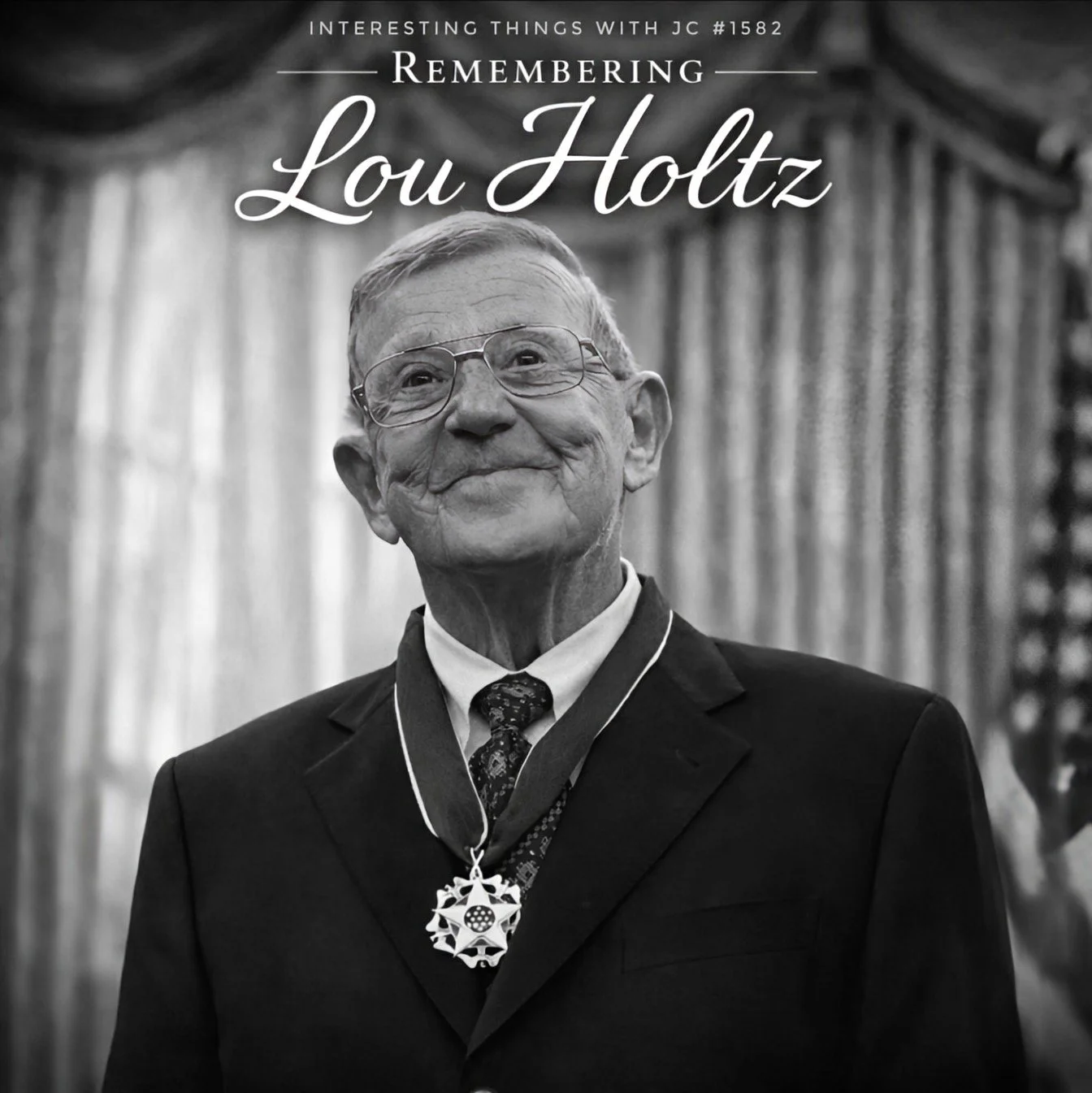
Interesting Things with JC #1582: "Remembering Lou Holtz" – A boy from a crowded basement apartment in a steel town refused to accept the limits others placed on him. Decades later his words echoed through one of college football’s most famous tunnels, reminding generations that champions are not built tomorrow. They are built today.
Get every episode summarized
Each time Interesting Things with JC publishes, we email you a written briefing from the transcript — the topics, who appeared, and any specific claims, with the ad reads skipped.
Email me new episodesFree for 3 shows. No card needed.
Hosts & guests

Transcript ready
116 searchable segments. Every word is indexed and playable.
Full transcript
Interesting Things with JC — 1582: "Remembering Lou Holtz". Machine-transcribed; use the interactive transcript above to jump the player to any line.
Lou Holtz, he started life in a place where success was never guaranteed. He was born January 6th, 1937 in Fulensby, West Virginia, a steel town of about 3,000 people along the Ohio River. Mills ran day and night, men worked long shifts, families stretched every paycheck. His father Andrew Holtz drove buses and worked at the steel mill. His mother Ann Marie kept the household together with discipline and faith. When the family later moved to East Liverpool, Ohio, they lived in a cramped basement apartment. They did not have indoor plumbing. Subdural relatives lived there together. Lou even shared a bed just to make space. Those early conditions shaped who he was. As a boy, Lou talked constantly. Teachers and classmates called him Louie the Lep instead of shrinking from the nickname,
he turned and embraced it. Confidence was something that he carried everywhere. At East Liverpool High School, he loved football, but he did not look like a typical player. Lou stood about 5'10", roughly 1.78 meters and weighed about 150 pounds, 68 kg. Coaches they often kept him on the bench. Holtz, he refused to accept that as the end of the story. In 1956, he walked onto the football team at Ken State University in Kent, Ohio. There was no scholarship waiting for him. Within two seasons, he earned one through persistence and became a starting linebacker. And while playing football, he studied history and joined the ROTC, learning discipline and leadership that later defined his coaching. During those years at Ken State, he met a young woman named Path Parkus.
They met on campus in the late 1950s, while both were students. Path understood what coaching life demanded, long hours, the pay that was going to be uncertain, and how quickly jobs change. She stood beside Lou through every move as they raised four children and built their life together. Lou often said later that marrying Path was the smartest decision he ever made. Holtz graduated in 1959 and briefly served in the United States Army Reserve before beginning the climb through the coaching ranks. Early jobs, they paid almost nothing. In 1960, he worked as a graduate assistant of the University of Iowa under head coach Forest Avachevsky. The pay was small and the hours were long. He later coached at William & Mary from 1961 through 1963 and at the University of Connecticut
from 64 to 65. In 1968, he joined Woody Hayes at Ohio State. That Buckeye team they finished the season as national champions. Holtz was only 32 years old when he became the head coach at William & Mary in 1969. In one year, the program won the Southern Conference Championship in 1970. It became a pattern that followed him for decades. At North Carolina State from 72 to 75, he led the Wolf Pack to four bowl games on the top 10 national ranking in 74. In 77, he took over the University of Arkansas. His razor bags ran the wishbone offense, a triple option attacked the Punished Offences with constant running plays. In the 1978 Orange Bowl, Arkansas stunned Oklahoma 31 to 6. Six bowl appearances followed during his Arkansas's years, but Lou Holtz became a national
figure when he arrived at the University of Notre Dame in South Bend, Indiana in 1986. The program had slipped from its historic dominance. Holtz introduced strict accountability, built around what he called the Do Right Philosophy. Do right academically, do right on the field, do right in life. That same season, he revived a small tradition inside Notre Dame Stadium. Above the player's tunnel, he hung a sign that read, play like a champion today. The phrase had appeared decades earlier during the era of Notre Dame coach Frank Leahy in the 1940s, but Holtz, he brought it back. He placed it about 10 feet above the tunnel floor, roughly 3.05 meters high. Every player running onto the field reached up and slapped that sign on the way out and
the message, it was pretty simple. Champions are not built tomorrow. Players who ran through that tunnel carried the message with them. Decades later, Notre Dame athletes still reach up and tap that sign before stepping on to the field. It's a tradition that traces directly back to Holtz's leadership. Two seasons later, the results were absolutely undeniable. January 2nd, 1989, the Irish defeated West Virginia 34 to 21 in the fiesta bowl to win the national championship. The team finished 12 and 0. It remains Notre Dame's most recent national title. Holtz finished his Notre Dame career with 100 victories, multiple top five national finishes, and players who became legends of the sport. Tim Browne, he won the high-spin trophy in 87. Raheeb Rocket, a hischmael, one of the fastest and most electric players, college football
had ever seen. Holtz also became known for his preparation. Before every game, he carried a small note card. It had four questions that he believed every person needs to ask themselves. Do people trust you? Are you committed to excellence? Do you care about the people around you? And are you doing the right thing? Those questions shaped his teams, and later shaped thousands of audiences who heard him speak. After leaving Notre Dame in 1996, Holtz returned to coaching at the University of South Carolina in 1999. The game cocks had finished 0 and 11 the year before he arrived, and within two seasons, they were winning the outback bowl. They repeated that victory the following year. Holtz retired from coaching in 2004, with 249 career victories.
In 2008, he was inducted into the college football Hall of Fame. After coaching, he spent a decade as a college football analyst on ESPN from 2005 to 2015. Viewers often noticed his distinctive speech. Holtz had a noticeable list, something he had battled since childhood. When he was younger, he practiced speaking with marbles in his mouth. He did that to strengthen his diction. That determination helped turn him into one of the most respected motivational speakers in America. His books included winning every day, and wins, losses, and lessons. His wife, Beth, who had stood beside him through the long climb of his coaching career. She passed away June 30, 2020. The University of Notre Dame honored both of them by dedicating the Beth and Luholtz family
grand reading room in the Hezberg library in 2021. A March 4, 2026, Luholtz left us. He passed away at the age of 89 at his home in Orlando, Florida, joining his beloved wife, Beth, in eternal rest. His children, his family, they were all with him during those final days as hospice provided support. A boy who once slept in a crowded basement apartment without plumbing grew up to coach national champions and influence generations of players. And every Saturday in South Bend, Indiana, players still reach up and tap that sign above the tunnel. Play like a champion today. These are interesting things with JC.
More episodes
More from Interesting Things with JC

1770: "When a Parasite Rewires Behavior to Spread Itself"
Interesting Things with JC

1769: "Football Brain Injury Cover Up"
Interesting Things with JC

1768: "The Science of Jealousy"
Interesting Things with JC

1767: "The Spider-Man of Paris"
Interesting Things with JC