About this episode
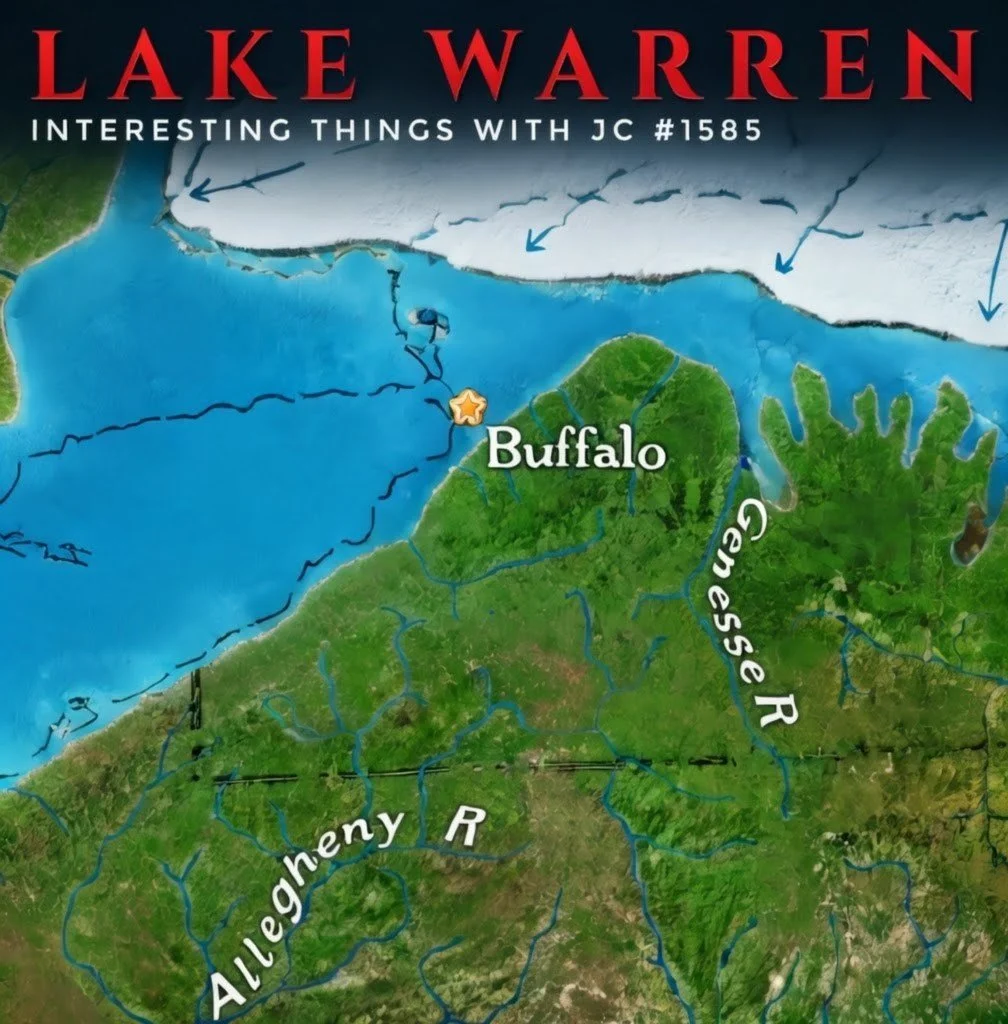
Interesting Things with JC #1585: "Lake Warren" – Long before modern Lake Erie, a much larger glacial lake cut the bluffs, shaped the beaches, and left old shorelines miles inland. The land still carries the mark of water that disappeared 13,000 years ago.
Get every episode summarized
Each time Interesting Things with JC publishes, we email you a written briefing from the transcript — the topics, who appeared, and any specific claims, with the ad reads skipped.
Email me new episodesFree for 3 shows. No card needed.
Hosts & guests
Transcript ready
45 searchable segments. Every word is indexed and playable.
Full transcript
Interesting Things with JC — 1585: "Lake Warren". Machine-transcribed; use the interactive transcript above to jump the player to any line.
About 13,000 years ago, the shoreline of Lake Uri sat in a very different place. The water stood much higher than it does today. Roughly 200 feet higher, that's about 61 meters. The land that now forms the southern shore of Lake Uri was once the edge of a much larger glacial lake called Lake Warren. This happened near the end of the last ice age. Huge continental glaciers, it covered much of North America. In places that the ice reached more than one mile thick, about 5,280 feet or 1.6 kilometers, was very thick. Temperatures they slowly warmed, the glaciers began retreating northward. And when that ice melted, it released enormous amounts of water. The melt water pulled along the southern edge of the glacier and formed a series of temporary lakes. One of the earliest and largest of these was Lake Warren. At its height, Lake Warren stretched across parts of present-day Michigan, Ohio, Pennsylvania,
and New York. The lake extended hundreds of miles along the ice front and covered thousands of square miles of land that is now dry ground. For long periods, the water remained high and stable. Waves worked against the shoreline year after year. They pushed sand inland and cut into the softer earth along the coast. Blue's waves built wide sandy beaches and carved steep bluffs that still line parts of Lake Eerie today. In several places those bluffs, they rise close to 100 feet, about 30.5 meters. These cliffs marked the ancient edge of Lake Warren. Geologists can still trace the shoreline today. Old beach ridges created by Lake Warren, they run inland across northern Ohio and western New York. These ridges are very long narrow bans of sand and gravel left behind by wave action. And in some places those former beaches, they sit several miles inland from modern shorelines. Roads, farms, and entire towns now rest on what used to be the edge of that ancient lake.
As the glaciers continued retreating, new drainage outlets, they opened towards the east. Water from Lake Warren slowly escaped through these lower channels. For thousands of years, the lake level dropped several stages before settling into what we know now as Lake Eerie. But the landscape still carries the marks of that earlier lake. The sandy beaches along Lake Eerie today, they were first shaped by Lake Warren. The high bluffs above the water, they were cut by its waves. Creeks, like 18 mile creek, they still follow valley's form during those glacial years before flowing into Lake Eerie. And along the Lake Eerie shoreline today, and you're looking across a basin at once held a much larger lake. And the ground beneath your feet, well it was part of a beach that formed more than 13,000 years ago. These are interesting things with J.C.
More episodes
More from Interesting Things with JC

1770: "When a Parasite Rewires Behavior to Spread Itself"
Interesting Things with JC

1769: "Football Brain Injury Cover Up"
Interesting Things with JC

1768: "The Science of Jealousy"
Interesting Things with JC

1767: "The Spider-Man of Paris"
Interesting Things with JC