About this episode
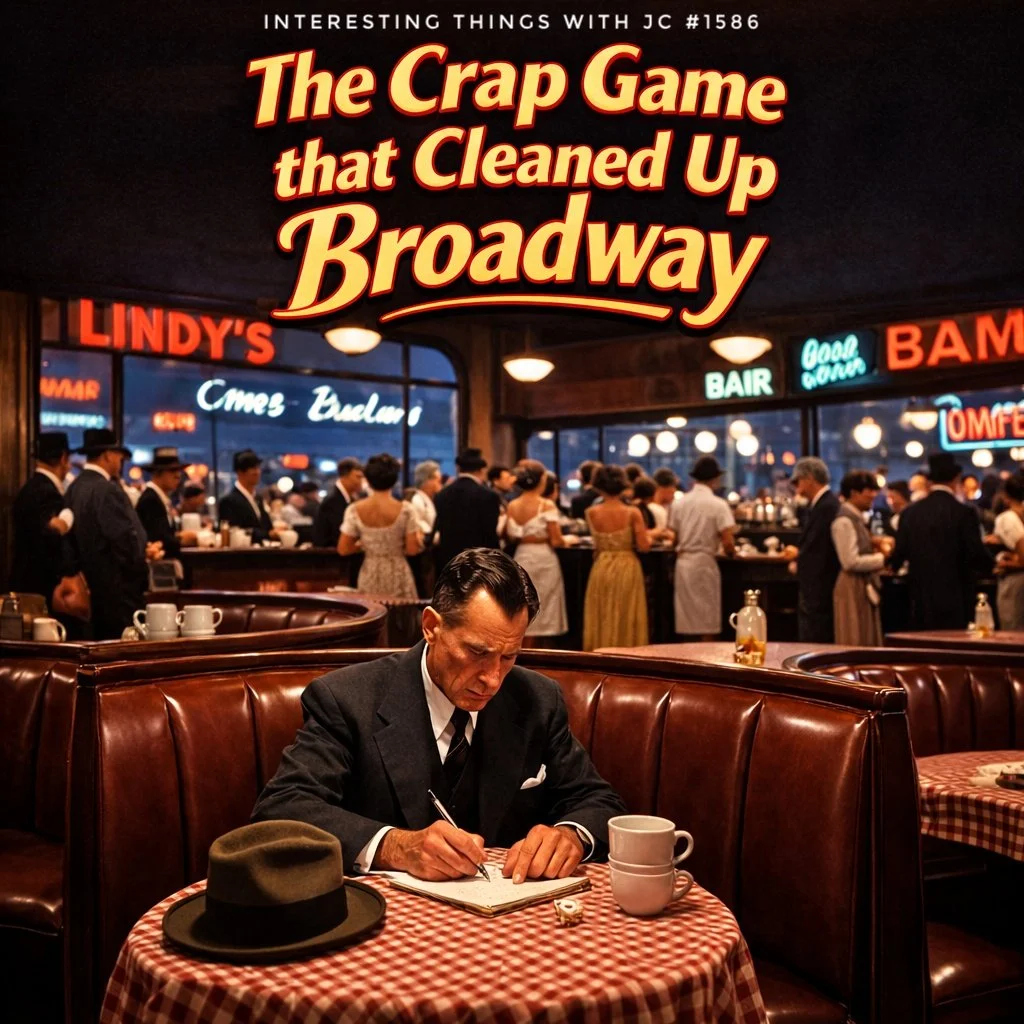
Interesting Things with JC #1586: "The Crap Game That Cleaned Up Broadway" - A Broadway reporter sits at Lindys drinking cup after cup of coffee while gamblers and hustlers talk. Their slang and street stories become the world behind Guys and Dolls. Damon Runyon created it all but never lived to see the curtain rise.
Get every episode summarized
Each time Interesting Things with JC publishes, we email you a written briefing from the transcript — the topics, who appeared, and any specific claims, with the ad reads skipped.
Email me new episodesFree for 3 shows. No card needed.
Hosts & guests

Transcript ready
40 searchable segments. Every word is indexed and playable.
Full transcript
Interesting Things with JC — 1586: "The Crap Game That Cleaned Up Broadway". Machine-transcribed; use the interactive transcript above to jump the player to any line.
In 1930, if you stepped inside Lindy's home Broadway, you might have found a thin man at a corner table drinking coffee, one cup after another, and listening harder than he talked. Damon Runyon. He was said to drink often forty cups or more a day. He sat there gathering stories from gamblers, hustlers, chorus girls, and bookmakers who operated just out of the reach of the law. He was born Alfred Damon Runyon, October 4, 1880, in Manhattan, Kansas. A type-setter once misspelled his last name as Runyon with an O. He kept it. After his mother passed away, he grew up in Pueblo, Colorado. He left school after the fourth grade and went to work at a newspaper at age 15. In 1898, at 17 years old, he enlisted in the Spanish-American War and later served in the Philippines. He wrote for army publications there, surrounded by card games, soldiers, and the kind of sharp talk he would later capture on paper.
By the 1910s and 1920s, he became a leading reporter for William Randolph Hearst's New York American and later the evening journal. He covered prizefights baseball and crime. He spent time around men like Arnold Rothstein, long associated with the Fixed 1919 World series. Runyon's writing style became so distinct that it earned its own name, Runyonese. He wrote it in present tense. He avoided contractions. He blended polished language with street slang. A gun was a rascal, a grenade, a pineapple. His dialogue sounded overheard, not invented. Two short stories, the idol of Miss Sarah Brown in 1933 and Blood Pressure in 1935 introduced gamblers with soft spots and women with backbone. In 1949, producers Saifur and Ernest Martin, they paid $10,000, roughly $120,000 today for the rights.
They hired Frank Lawsir who had written more than 200 songs for American servicemen during World War II to compose both music and lyrics, something still uncommon on Broadway at the time. Guys and Dolls opened on November 24th, 1950 at the 46th Street Theater in Manhattan, a house with about 1,467 seats. It ran 1,200 performances nearly three years, closing November 28th, 1953. In 1951, it won five Tony Awards including Best Musical, Best Actor in a Musical for Robert Alda, Best featured actress in a musical for Isabel Bigley, Best Director for George S. Kaufman and Best Choreography for Michael Kid. In 1990, that same theater was renamed the Richard Rogers Theater linking one era of Broadway to the next. And here's something that most people miss.
Damon Runyon never saw the show. He died of throat cancer December 10th, 1946, four years before opening night. His funeral at St. Bartholomew's church in Manhattan drew crowds of admirers. Later, his ashes they were scattered over Times Square from an airplane piloted by his friend, Eddie Rickenbacher, the World War I flying ace. Broadway had been his beat in life. It became his final address in death. The floating crap games in the show were based on real operations that moved from basement to basement to dodge police raids. The slang, it was real. The risk, it was real. And what the musical did was give those men a second act. It let them sing. Runyon wrote about people who lived on odds and nerve. Broadway turned that into music. And even now, when dice roll across the
stage, they still echo the sound of a reporter who listened first. These are interesting things with Jay's C.
More episodes
More from Interesting Things with JC

1770: "When a Parasite Rewires Behavior to Spread Itself"
Interesting Things with JC

1769: "Football Brain Injury Cover Up"
Interesting Things with JC

1768: "The Science of Jealousy"
Interesting Things with JC

1767: "The Spider-Man of Paris"
Interesting Things with JC