About this episode
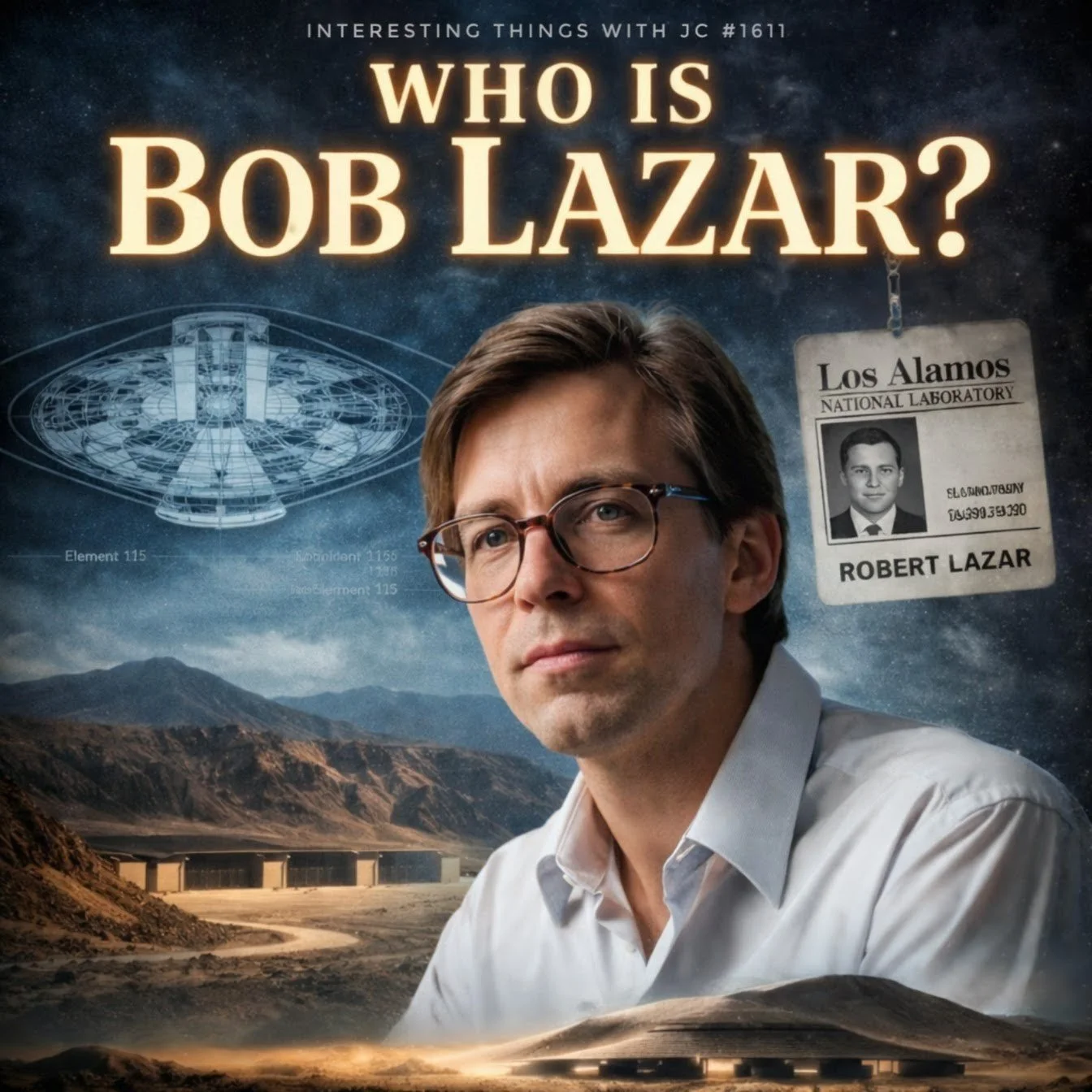
Interesting Things with JC #1611: "Who Is Bob Lazar?" – A physicist, a fraud, a whistleblower, a storyteller? One man stepped forward with a claim too big to prove and too dangerous to ignore.
Get every episode summarized
Each time Interesting Things with JC publishes, we email you a written briefing from the transcript — the topics, who appeared, and any specific claims, with the ad reads skipped.
Email me new episodesFree for 3 shows. No card needed.
Hosts & guests
Transcript ready
69 searchable segments. Every word is indexed and playable.
Full transcript
Interesting Things with JC — 1611: "Who Is Bob Lazar?". Machine-transcribed; use the interactive transcript above to jump the player to any line.
In May of 1989, a man appeared in Las Vegas on TV with his face hidden and his voice disguised. He said the United States was not only studying unidentified flying objects, he said it already had them. He claimed that he walked into a secure site in the Nevada desert and seen craft that were not built by any nation on earth that he knew of. His name, Bob Lazar. Lazar said that he worked at a place called S4, a site he described as being near Papu's Lake, south of the better known installation commonly called Area 51. Groom Lake and the test site later known publicly as Area 51 were established in 1955 for the Lockheed YouTube program. The facility sits roughly 120 miles 193 kilometers northwest of Las Vegas. For decades, the government did not publicly confirm the name
Area 51, even while the site's existence had become part of American folklore. That official silence gave the place unusual power directly in the public mind long before he classified records acknowledged it. He said that he had studied at the Massachusetts Institute of Technology and the California Institute of Technology. No verified public academic records from either institution have confirmed that claim. He also said that he had been hired into a compartmentalized program where teams were separated and where no one person saw the whole picture. That part does fit the known logic of classified work. During the Manhattan project more than 100,000 people worked across multiple sites, but many knew only a narrow part of the larger effort. The same basic principles shaped later Cold War aerospace programs. People were often
trusted with tasks, not with the full truth. Then, Lazar described what he said he actually saw. He claimed the facility housed nine disc-shaped craft. He described one of them as roughly 52 feet, 15.8 meters across. Inside, he said the services look smooth and continuous. Without the seams, rivets and visible fasteners that a person would expect in ordinary aerospace construction. He said the seats appeared small, as if designed for beings smaller than adult humans. That image fixed itself in culture, but the part that made his account famous was not the shape of the craft. It was the engine. Lazar said the propulsion system relied on element 115. In 1989, element 115 had not yet been synthesized and confirmed in the laboratory.
He later claimed a stable form of it could be used to generate and amplify gravity, allowing a craft to bend spacetime and move without wings, propellers, or visible exhaust. That claim runs against established physics. Gravity is understood through general relativity is the effect of mass and energy on spacetime. Modern physics does not provide a verified mechanism for a machine to generate control gravity fields for propulsion in the way that Lazar described. No publicly verified experiment has demonstrated that capability. And when element 115 was later produced in the laboratory, through work linked to Dubna, Russia, and collaborating researchers, the result did not match Lazar's account. The element was formally recognized in the next decade and officially named Muscovium
in 2016. The isotopes observed were highly unstable and they decayed almost immediately. That's a long way from Lazar's description of a stable material that could power a craft. His background, it drew scrutiny too. No verified public records ever confirmed his employment at S4 or Area 51. His educational claims they remain unverified. In the late 1980s, a lost Alamos phone directory listed a KM next to his name. A detail that supporters have cited for years as evidence that he held at least some technical role connected to the laboratory environment. Critics note though that this falls well short of proving the claims he later made about reverse engineering alien craft. In 1990, he was sentenced to probation on a pandering charge in Nevada, a fact that became part of nearly every serious reassessment of his story.
That mix of partial traces and major gaps is one reason that the Lazar story has lasted. He attached his claims to a place that turned out to be very real. Area 51, not fantasy. It was a secret testing ground where the US developed some of the most important aircraft in the Cold War, including the U2 and later the A12 Oxcart. Real secrecy gave his larger story a kind of shelter. Once the public learns that one extraordinary thing was hidden for years, it becomes so much easier to believe that something even more extraordinary, it might be hidden beside it. And that's why the comparison to Daniel Ellsberg stands out. In June of 1971, the New York Times began publishing material for what became known as the Pentagon Papers. A classified defense department study leaked by Ellsberg.
A record could be examined, challenged, and authenticated directly in public. Lazar gave the world something different. He gave it testimony without documents, claims without recovered hardware, and a mystery without proof. So after more than three decades, two facts still stand. The United States does have a long documented history of highly classified aerospace work in the Nevada desert. And there's still no verified public evidence as of April 2026 that the government recovered and reverse engineered the alien spacecraft. Bob Lizard remains suspended between those two facts. And that is why some people still see him as a whistleblower and others see him as a fabulous. And to others see him as something harder to classify, a man whose story survived because it
entered a country already trained to suspect that the biggest secrets are always being kept somewhere just beyond the fence line. And that may be the lasting pull of Lazar. It's not only about aliens, it's about trust, it's about absence, and the strange durability of a claim that cannot be proved but will not go away. In the American desert, where so much real machinery was hidden from public view, one unverified story found the perfect ground to live on. These are interesting things with J.C.
More episodes
More from Interesting Things with JC

1775: "The Signal Einstein Thought We Might Never Hear"
Interesting Things with JC

1774: "Uncle Sam Day"
Interesting Things with JC

1773: "The Clock Behind Instant Replay"
Interesting Things with JC

1772: "Staten Island Remembers"
Interesting Things with JC