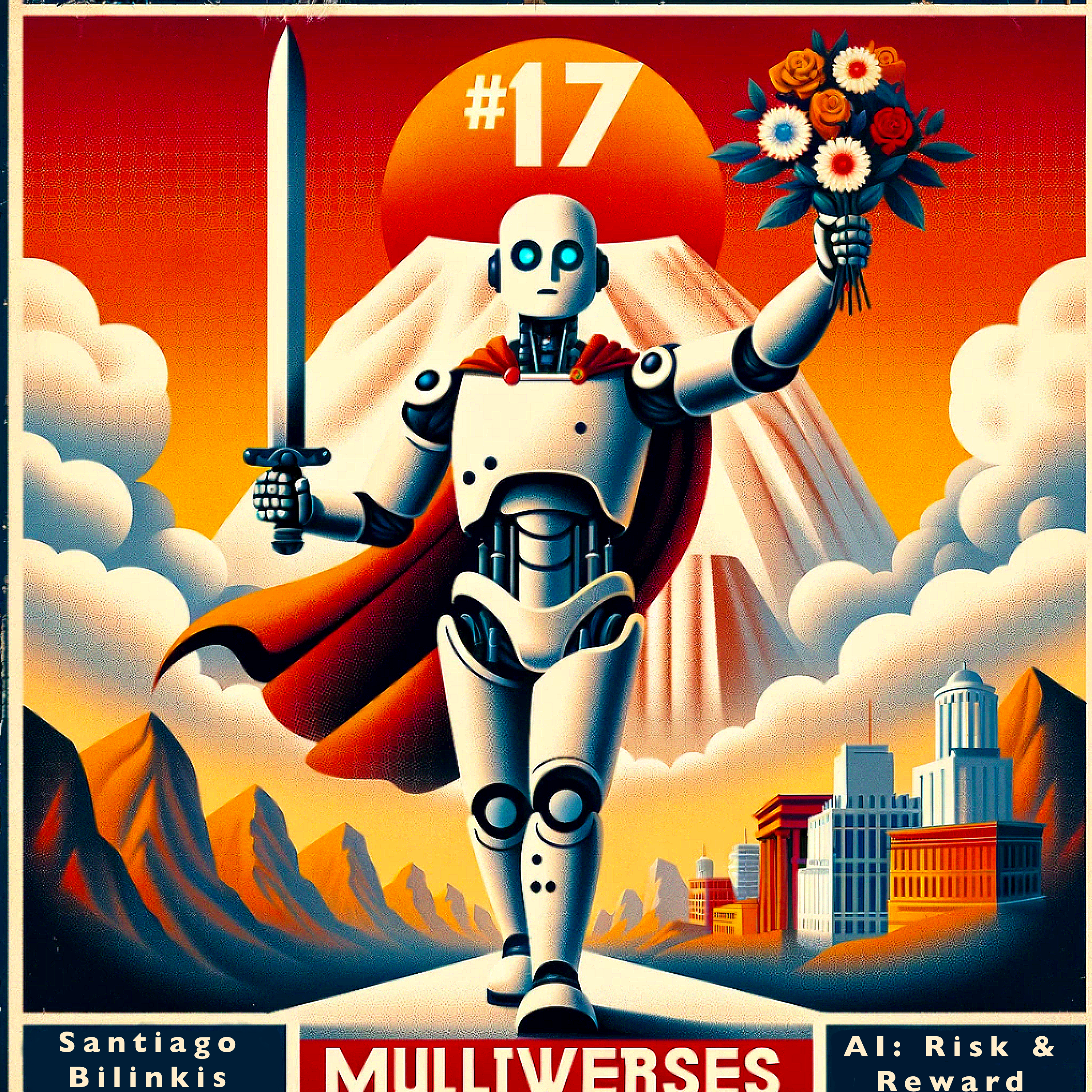
17| Santiago Bilinkis — Artificial Intelligence: Risks & Rewards
About this episode
Could AI's ability to make us fall in love with be our downfall? Will AI be like cars, machines that encourage us to be sedentary, or will we use it like a cognitive bicycle — extending our intellectual range while still exercising our minds?
These are some of the questions raised by this week's guest Santiago Bilinkis. Santiago is a serial entrepreneur who's written several books about the interaction between humanity and technology. Artificial, his latest book, has just been released in Spanish.
It's startling to reflect on how human intelligence has shaped the Earth. AI's effects may be much greater.
Links:
Outline:
(00:00) Intro
(2:31) Start of conversation — a decade of optimism and pessimism
(4:45) The coming AI tidal wave
(7:45) The right reaction to the AI rollercoaster: we should be excited and afraid
(9:45) Nuclear equilibrium was chosen, but the developer of the next superweapon could prevent others from developing it
(12:35) OpenAI has created a kind of equilibrium by putting AI in many hands
(15:45) The prosaic dangers of AI
(17:05) Hacking the human love system: AI’s greatest threat?
(19:45) Humans falling in love may not only be possible but inevitable
(21:15) The physical manifestations of AI have a strong influence over our view of it
(23:00) AI bodyguards to protect us against AI attacks
(23:55) Awareness of our human biases may save use
(25:00) Our first interactions with sentient AI will be critical
(26:10) A sentient AI may pretend to not be sentient
(27:25) Perhaps we should be polite to ChatGPT (I, for one, welcome our robot overlords)
(29:00) Does AGI have to be conscious?
(32:30) Perhaps sentience in AI can save us? It may make it reasonable
(34:40) An AGI may have a meaningful link to us in virtue of humanity being its progenitor
(37:30) ChatGPT is like a smart employee but with no intrinsic motivation
(42:20) Will more data and more compute continue to pay dividends?
(47:40) Imitating nature may not necessarily be the best way of building a mind
(49:55) Is my job safe? How will AI change the landscape of work?
(52:00) Authorship and authenticity: how to do things meaningfully, without being the best
(54:50) Imperfection can make things more perfect (but machines might learn this)
(57:00) Bernard Suits’ definition of a game: meaning can be related to the means, not ends.
(58:30) The Cognitive Bicycle: will AI make us cognitively sedentary or will it be a new way of exercising our intellect and extending its range?
(1:01:24) Cognitive prosthetics have displaced some intellectual abilities but nurtured others
(1:06:00) Without our cognitive prosthetics, we’re pretty dumb
(1:12:33) Will AI be a leveller in education?
(1:15:00) The business model of exploiting human weaknesses is powerful. This must not happen with AI
(1:24:25) Using AI to backup the minds of people
Get every episode summarized
Each time MULTIVERSES publishes, we email you a written briefing from the transcript — the topics, who appeared, and any specific claims, with the ad reads skipped.
Email me new episodesFree for 3 shows. No card needed.
Hosts & guests
No transcript yet
This episode has not been transcribed. Request it and it moves to the front of the queue.
More episodes
More from MULTIVERSES

A Story For Humanity — Minhyong Kim on Why Maths Will Never End
MULTIVERSES

Molecules & Mirrors —Vanessa Seifert on the Philosophy of Chemistry
MULTIVERSES

Consciousness is not Computation — Christof Koch
MULTIVERSES

Where Does It End? — Adrian Moore on The Infinite
MULTIVERSES