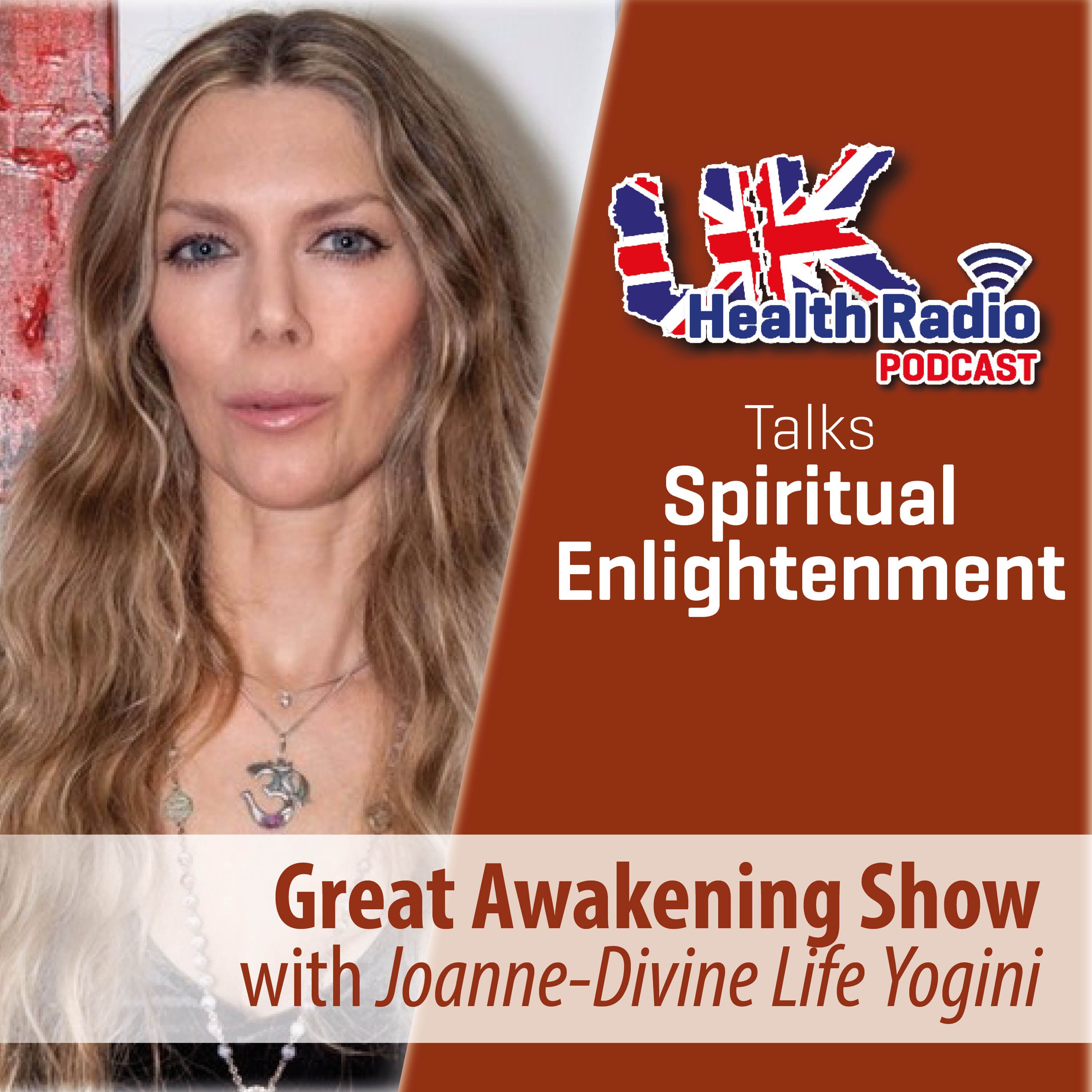
171: Great Awakening Show with Joanne-Divine Life Yogini - Episode 171
About this episode
Disclaimer: Please note that all information and content on the UK Health Radio Network, all its radio broadcasts and podcasts are provided by the authors, producers, presenters and companies themselves and is only intended as additional information to your general knowledge. As a service to our listeners/readers our programs/content are for general information and entertainment only. The UK Health Radio Network does not recommend, endorse, or object to the views, products or topics expressed or discussed by show hosts or their guests, authors and interviewees. We suggest you always consult with your own professional – personal, medical, financial or legal advisor. So please do not delay or disregard any professional – personal, medical, financial or legal advice received due to something you have heard or read on the UK Health Radio Network.
Get every episode summarized
Each time UK Health Radio Podcast publishes, we email you a written briefing from the transcript — the topics, who appeared, and any specific claims, with the ad reads skipped.
Email me new episodesFree for 3 shows. No card needed.
Hosts & guests
Transcript ready
374 searchable segments. Every word is indexed and playable.
Full transcript
UK Health Radio Podcast — 171: Great Awakening Show with Joanne-Divine Life Yogini - Episode 171. Machine-transcribed; use the interactive transcript above to jump the player to any line.
Music Welcome to the Great Awakening Ministry. I am Minister and Yogi Nijio-Anli. And on this week's show we have Phil Kusino. Phil is the author of The Wisdom of the Odyssey and over 40 other books including The Best Selling, The Art of Pilgrimage and The Heroes' Journey, Joseph Campbell on his life and work. Kusino is a writer, teacher, filmmaker, storyteller and cultural historian who has consulted on mythology and story for major studios including
Warner Brothers, Pixar and Lucasfilm and has led mythology travel programmes to Greece for more than three decades. Kusino has been featured on NPRC and N International, the BBC, The Smithsonian and Discovery channels and was the host of PBS and Link TV's Global Spirit. Hey Phil. Good morning. Good morning. Good morning Phil. Thank you. Well thank you for writing this wonderful book, Wisdom of the Odyssey. Absolutely amazing. And just tell us about your book, Wisdom of the Odyssey and what inspired you to write it because it's a fascinating tale. Well first we have to go back to the
roots which is the beginning of all stories, right? And for me I grew up in Detroit, Motown, the car capital of the world in the 1950s and we must have been one of the last families in America to read books out loud together as a family. Wow. I know that's astonishing nowadays because it's hard to get kids away from their phones and parents away from all their responsibilities. But my father worked at Ford Morning Company and yet had a kind of private intellectual life and he was insistent that we would read books and then travel. So we would we actually read the YA, the youth adult version of the Odyssey when I was a kid and then we would go to from Detroit to New York or Boston or Philadelphia if there was an exhibition about Greek history. So this really got into my corpuscles, into my chemistry as a kid and when I left Detroit, excuse me, with a degree in journalism wanting to be a writer, I first went to London as a matter of fact and then
just kept traveling and traveling and ended up in Greece and felt like it was recognizable. It was my second home and I've since discovered that there's a wonderful French phrase to describe this. Everybody knows deja vu of this haunting feeling that we have seen something before but deja lue, l u means you are in a place that you have read about before and that's a thrilling feeling. If you've read travel literature, poetry, or seen a movie and suddenly you're in that place, that's what happened to me when I first went to Greece and for the last few decades then I've been leading tours both to King Arthur's England by the way to Paris to to Ireland but mostly to Greece, walking in the footsteps of Odysseus. Why? Not just as a as a stuffy academic exercise but because I was raised to believe and have increasingly believed it's everybody's story. How is that possible?
Why? Because in a nutshell, a great Greek phrase by the way, it's a story of homecoming. Our hero Odysseus has been away at war as the whole world knows by now at the Trojan War and now he wants to go home to his wife Penelope to his son Telemachus. He wants to go back to an island like you in England and Ireland. He loves Ithaca but he is tormented by war. Tormented by the savagery of warfare and there is no straight line, be line home after someone has been fighting in battle. Why? I'm arguing in my book that there is a great deal of wisdom specifically healing wisdom in this book and in that way it's everybody's story. Why? Because everybody at some level, all around the world for the last 3,000 years has been trying to get home. Either a physical home
if you're an exile or an immigrant or maybe you're moving and you're looking for a second home, a spiritual home and it's very hard to get back there. If you are, I don't think he's lost. It's not like a bad New Yorker cartoon or an English newspaper cartoon in the sun about the great loss navigator. No, he's not lost. He's a lost soul which is why it's a deeply spiritual story. Here is someone who has lost his soul like many of us have. Yes. When we're the other, if we are betrayed or we betray someone else, we are lost and we need to heal if we are to get home again. That's why this story I think appeals to people the world over and has been revived again because on some level, who isn't trying to get home again? Do their authentic, deep self? And that is like the alchemist. When he goes on the journey, you know, Paul Carrero, he wrote
the alchemist and he was looking, what was he looking for? He was looking for the within. The divinist was in. He went to so many places and looked at so many places but it was always within. And that's the hero's journey. Is it not? Well, you know, I'm involved in that. I wrote the hero's journey, the life and work of Joseph Campbell, the movie and the book and coincidentally, my wife who was my first publicist by the way, on that book, we are still together every 30 plus years. And she was also Paul Carrero's publicist for the alchemists. So when I was traveling in South America, I was able to visit him because my wife knew him and we spent a whole evening together in Rio. And it's because I had used a phrase in another one of my books, The Soul of the World. It's an ancient idea that there's an anima moondi, a soul of
the world or a genius lockeye, everywhere we go, South America, North America, Asia Africa, you go to the country, you go to a city, you are in a quest, you're in the hero's journey or you're on pilgrimage. What are you looking for? You're not looking for what's trendy. You're not looking to be hip or cool. If you are a real questing soul, if you're on a spiritual journey, you're looking for the soul of the place. And so Paul, a quote, and I, we had this long, long night of drinking lentiliv in honor of my mentor, excuse me, my mentor Joseph Campbell, comparing notes because he told me, and this is actually very germane to our Odyssey talk this morning, because Paul told me he was first a quite renowned songwriter, a composer. He had many top 10 hits in Brazil,
but he had lost his way. Sound familiar? Like a disius, penelope, everybody loses their way one way or the other. How do you get home again? Hollow told me that he was so lost. He needed a new way he had lost his soul, despite all the money, all the fame. This is heroes' journey material, right? You're at the crossroad of life. What do you do? So he walked the Camino, the long walk from Paris to San Diego to Compostela, and halfway down the path in Spain, like Odysseus, wandering, wandering, wandering, trying to get back to Ithaca. Paul told me that he was all alone on this long stretch of road, and he came across his cave off to the side, and there was a man in a long black robe holding a staff like a Merlin and the King Arthur legends with a crystal on top of the staff, and he just did this. He back into Paulo like this with a finger into the cave, and Paulo followed
him because he was at a crossroad. This is Odysseus material. This is a spiritual journey material, heroes' journey, pilgrimage, and Paulo went in realizing at that point he needed spiritual counseling, guidance, some instruction from above, another dimension, you might say, and he went in, and he reoriented himself, which is a great word for the spiritual journey. In this sense, it's a way to think about what Homer is doing with the Odyssey. If your listeners, if readers remember, the Iliad is about the torment of war. It's one of the great, really anti-war books of all time. It is still being used in war academies, but also peace academies, all around the world after 3,000 years. But the Odyssey is about the repercussions, the consequences of war physically, but also, and this is right in your territory. It's also about
spiritual war. It's about being in bad with yourself. Your inner demons, your inner insecurities. How do you heal from that? Well, one key for me is looking to the, remember, the Italian equivalent of what Jesus is Eulissis. And many people use the names interchangeably. In Latin or old Italian, Eulissis means healed wound or the scar, the healed scar. What that means to me, and this is what I'm writing in my book about the wisdom of the Odyssey, is that people who are tormented by any kind of war. It could be a marriage. It could be your warrior battle at work. Maybe you're in the completely wrong line of work. How do you get out of that? How do you heal? Homer is telling us that his hero, O'Jessis, has to go into the underworld, which is a figurative way of saying,
you might have to go into therapy. You might have to take a pilgrimage. You might have to take some classes which allows you to confront your own darkness. So in some ways, what I'm saying in the wisdom of the Odyssey is the way to get home again in the wise way, in the wise way. Not the cool trip, Henry, anyway, you have to confront your shadow if you're ever to get home again. That's right. That's like all of us go through the dark night of the soul at one point. I believe that we do it individually, but I believe the whole world is going for a collective night at the soul at this time of this awakening. It's like fastening up. The spiritual meaning of the journey of the human soul from confusion, from the ego and the hardship back to the state of unity, divinity and the wisdom within, isn't it? It's like back to that, back to our true self,
knowing, know thyself, back to the true self, because we are human and we are divine in this world of duality that we live in, aren't we? And we all have to experience that dark night of the soul. So beautifully, beautifully put, I think that Homer in this book is actually kind of the, it's the transition between the ancient world of mythology, which says it's all about the gods and leave it up. That's fate. The ancients would have said it's the gods or god later is responsible. Today, people might say it's in my DNA. This is how I was born. It's in my chromosomes. It's my grandfather's fault. Right? And this book is a way of working that out because Odysseus, his name means trouble in Greek. He was born in trouble and he makes trouble everywhere he goes. And he's the first thinker. One of your great writers in London, Edith Hall, says he's the first
conscious person in Western literature. Why? That's an enormous statement. It's because he doesn't rely completely on the divine. The divine is out there. The gods are all around us. But he begins to think he says, I have to make this decision for myself. And I will honor Athena, especially Athena. She is the goddess who is looking over him. And what is she the goddess of wisdom? So the, so homework. And this is such a beautiful ratio. It's in human beings. We have to take responsibility for ourselves. But we have to stop blaming God or the gods for our follies. A great word we should bring back. Yeah. Because it's just easy to say, well, the devil may be doing it. Like they old comedy. God wanted me to do this. And it's all, no, Odysseus is taking divine wisdom as he's such beautifully alluded to a minute ago. He's constantly aware that Athena is looking
over his shoulder. And she is actually personified. I hope your listeners love this. Our word mentor. We love our word mentor, right? But it's a different system than let's say the Indian or the Oriental view of the, of the guru. The guru says, I come from a 9,000 year old tradition. Trust me. This is the way to think, to pray to do your rituals and ceremonies. The Western way that you were raised in, that I was raised in begins with Homer. And when Odysseus goes off to war, he leaves his son who's just been born. He's an infant with his family counselor, almost like a family therapist, whose name is mentor. That's the first reference we have. And a great it means mind maker. This is so startling to me. What it means is you've got to teach here for information. You might have a really great professor at university. But the mentor is the one,
I dig this. I love this. The mentor is the one who helps you make up your own mind. Yes. That's so true. At the end of the day, it's an inward job. You have to go in. You know, you can't rely on even God. It's our free will. We use the divine love, our energy for good or for bad in this world. But it's our choice to do so. I love the way you just put that because besides it being the Odyssey being a great adventure story, it's a kaleidoscopic story of Cyclops, the sirens, Sillin, Correptus, all these monsters. The middle of the book is the one we remember from childhood and maybe from our university years. And it's what Nolan actually emphasizes in his new movie, The Big Blockbuster of the Year. And what that represents is really humanity. Say, all right, how much am I responsible for? Am I really me through dint of sheer will? Because I'm so strong, because I'm a clever woman,
or a clever man, a strong strategist, or are the gods there when I need them? The Odyssey is the first book that I think begins to sort up. The difference between divine will and human will. We are still wrestling with this, aren't we? Yes, it's the ultimate battle within. Beautiful. Beautiful. And I think that's one reason why the entire world right now is resonating, vibing to Christopher Nolan's Odyssey. We don't quite know why. We remember the word, the story vaguely, from when we were young, maybe in a college course, maybe from our travels. But also in another way that I think your viewers might be interested in the Odyssey itself, the template of someone who was lost and has to go into the dark night of the soul, the labyrinth in my mentor, Joe Campbell's idea of the hero's journey, and then brings a gift, finds a gift, the gold, the wisdom, the treasure that the dragon is hoarding, and then bring that
gift back is recognizable all around the world. Yes. Do you know that the Odyssey inspired the Wizard of Oz, Citizen Kane, Jack Kerawax on the road, Stanley Kubrick's 2001 space Odyssey, the most famous western of all time, the searchers. Apparently also inspired Sir Connondoyle with the Sherlock Holmes stories. Why? It's the idea of the quest. There is a secret, there is some wisdom out there that I don't have, or I had it and I lost it. Yeah. Maybe I even betrayed myself. How do I get that wisdom back? Yes. Okay, how's the radio? The station that makes you feel good.
And in the, I was looking at this and you know, like in the last part, the slaughter of the suitors at the end of the Odyssey. You know, what we've been talking about, the final purging, it's like all of the monsters and all of the final battle, it's like the final purging of our inner enemies and the leads to which which are our own demons, our own ego, our own darkness, the darkness within us, that's the final purging before the light of transformation comes in, and you know, we have that enlightenment, all we and wonders with divine source. Oh, beautiful. There's such a beautiful summary for the end of my book because scholars, ordinary readers, viewers, people who like sculpture, the mosaics, these images happen with us since the Greeks, but also through the entire Middle Ages. We go back to these same sources.
Oh, this is going back and waiting for his dog who's been waiting for him for 20 years. His dog, this is one of the great images of devotion of all time. Going back to your family, where your son and your wife are waiting for you, but also the troublesome one as you just beautifully described is what happens when he goes home and Odysseus finds that there are 108 suitors. This is not an accidental number. This is a magical number in Eastern mythology, Eastern Oriental, it's 108 steps to get into any Buddhist or Hindu temple. Hundred-Negg gods in Valhalla. 108 tends to be the symbol that describes suddenly the world is turning around 108 degrees and now we're going in a new direction. What does that mean figuratively? That's why I had to write the book because there are so many baffling numbers and names and places, but there was no accidental number in the Odyssey. No accidental names or incidences
because the world has to be reborn again. When Odysseus comes home, he doesn't even recognize Ithaca. This is a really beautiful, it's kind of an early-depth psychology. This is a pure Carl Jung, you don't, when we go a long way away, we haven't been home for a while, our friends don't recognize this anymore and often we don't recognize our own home and then sometimes we go back and we try to relive our youth. We try to relive the way that we grew up and we find out maybe there's even evil there. Maybe something terrible has happened at home. This is the experience of immigrants all around the world, exiles, people who travel for years and years and so what's called upon here is not just destruction but I like to call it the restoration. He had a powerful home like all of us do. I grew up in Detroit in the middle of America, the birth of Motown, the birth of the cars,
Rhythm and Blues, but it's very, very different now. How do I restore that? How do you go and live in India for 10 years and come home to England? It's going to be different. So what happens is he goes back, Odysseus and he teams together with his son with mentor, the great mentor character and there's six of them they do about and they have to deal with what Nolan calls in his movie. Excuse me. Zeus's law and what that refers to is hospitality and we have an echo of this in the Old Testament, in the New Testament, in sacred literature all around the world. Be alert when you wake up every day. Be aware when you travel. Be aware when someone knocks on your door and says I'm in trouble. It's a mythological moment. It's a threshold moment and the old saying was be kind to the first
person you meet every morning because he or she could be a god or an angel in disguise. And if that code, that means the ancient Greeks said you have to be kind. Take someone in who knocks on your door. Feed them, bathe them, unknowing them, oils. Why? Because divinity, is knocking on your door. Be kind to them. If that code is violated, the world ends. I think this is the way that the whole Greek empire, what we call the miracle of Greece, was born because if you left home, you had to be able to trust the people in the next valley, the next mountain, the next island. If you're going through the Greek islands, that is how finally, after centuries and centuries, Greece amalgamated. But the suitors, 108 of them, who desperately want to marry Penelope when a dentist is away, have violated that code in ancient
times they had to pay a price. Now, you can argue and scholars have was that too destructive. In the book, in the poem, and somewhat in Christopher Nolan's new movie, Odysseus has to deal with this. Why? For catharsis. I think this moment is what gave Aristotle his idea of catharsis, which is the, it's the seed, it's the core of drama. Why is this important? This is not just academic. If you go to a great exhibit at the take gallery, or if you go to an operat in the heart of London, if you go to Florence or Paris, and you have a great encounter with theater, with art, with painting, with sculpture, and you begin to weep. You feel your heart pounding. You feel that free zone that shiver up your back. The ancient Greeks called this catharsis, an outpouring of emotion, which does what? It cleanses you. It purifies you.
To do what? To start your life all over again. Yes. It makes your soul. It makes your soul soul. Oh, beautiful. You know, it's what it's the moments, you know, that make life look beautiful. I love what you say there because the soul can get mired down with depression, with anxiety, with fear. And oh, I love that phrase. It helps your souls or, sorry, that's, that is what happens at the end of the Odyssey. The whole, the world needs to be reborn. Odysseus needs to be reborn. So that, I hope you remember this, that the end of my book, the wisdom of the Odyssey, something glorious, glorious happens. I think it's one of the first and still one of the most romantic moments in all of Western art and literature. Briefly, real briefly. The two of them, they have husband and wife, Odysseus and Penelope. They have not seen each other for 20 years.
This is a long time for lovers, for spouses to be away from each other. And because in the ancient world, there were lots of, many, many imposters. Well, I'm your husband. You just don't recognize me because I'm older or whatever it might be. So they test back and forth just the way that lovers do now. Are you really committed to me? Are you really here for the long run? Lovers do this, eat to this day. They finally recognize each other. It's a beautiful, romantic moment. And then as the translators say in different ways, which Homer is saying, and then they went to bed together and they shared their joy. This is a beautiful element in the poem. It's not quite there in Nolan's movie. There's a lot of yearning and longing, but I don't see the joy in there. That's missing. That's so important to me, but also for spiritual reality. With a spiritual epiphany, there was a burst of joy. So here, now we come to the,
for me, the pinnacle. This is what I write about in the ending to my book. The Queen, Penelope, turns to her long-lost husband, just like in many movies, right, today, or pop songs. It's pure Taylor Swift or Elephan's Gerald. She turns him and says, come tell me of thine or deals. My heart can take it. Oh my gosh. That is so powerful to me. As she said, oh, excuse me, sweetheart, I know you've been through a lot. You've been, you were a war for 10 years. It's taken you 10 years to come home. Tell me whatever happened. Tell me, I am strong enough. This is one of the greatest statements by a female figure in world literature. She is saying, I can take, I am tough to Odysseus. I had to endure you, you know, you're, you're gone. I was alone, you know, my enduring was like, yeah, yeah.
That's what this is building up to. So of course, the man, Odysseus, he's more than happy to tell about his ordeals, his struggles, his beautiful, powerful, mythological victories. But then he does something. Frankly, that a lot of men have forgotten to do over the last couple of thousand years. He turns to her. And now we're in the middle of the night. And he says, sweetheart, how did you endure while I was away? You had to raise our son, telemicas, all alone. What was that like? You had to fend off these monstrous young men who really wanted to murder you to take the palace to take ownership of all of our land. How did you do that? And so then, Penelope, in turn, tells her story. And as the poet Homer says, they spoke until dawn. They helped raise the sun. Good grief. It is so beautiful. It's romantic. It gives you a formula about equality
between men and women who don't just talk. They listen to each other. This gives us a formula, I think, for the next couple of millennia. This is the ideal marriage. And this says, we are all going through. And I don't mean to be a smart ally with this. Everybody goes through hell. Every marriage goes through hell. People leave. People, they check out, as we say here in America. They're not quite present. This is a story about the map of the soul. The soul that has gone missing. And it helps, if you know how to read this in depth, that's why I call this the wisdom. Why book this about the wisdom of the Odyssey? Read it closely and you will find a way to heal yourself because we have all in some way now that we've all gotten lost. And sometimes we, I worked with Robert Johnson,
who is a great psychotherapist, whose mentor was Carl Jung. Now this is kind of the sixth degrees of separation business, right? And Robert once told me in a lecture, we had UCLA in Los Angeles and he said, we all change and we forget to tell each other. True. That's the Odyssey is about profound changes. But then you come back together and you talk, but then you listen, you listen to each other. So there's a beautiful formula there for spiritual healing. Don't you think? Definitely. And that's what, that's what it is. You know, this book, the underlining of it, you know, is the quest of oneself, but the quest of true love. It's got everything in it. That's why it's wonderful blockbuster. You know, it's got all, you've got the war, it's got the suffering, it's got the love, it's got the binding yourself, it's got the divine part, it's got the spiritual part. So and your book is pointing all of that out, you know, in that.
Thank you. Often what happens when you hand it in a book after years, because I've been living with this material since I was a boy, and teaching it in Greece itself, not just in an academic setting, but in Greece. I write this. And then as often happens within hours or sometimes within days, you find something about your topic and you want you call your publisher and say, stop the presses. I just found something. Can I add one more thing? Of course, I say, no, we're already book is off to Hong Kong. We're being able to know. So what I found in this case was elect the lecture, Nobel lecture by Bob Dylan in 2016, after he surprised the world by being given the Nobel Prize for literature, a rock star got the Nobel Prize. And it took him a year to actually write the speech. But when he finally did, right smack dab in the middle of his Nobel
Prize speech, he says, Odysseus was a traveling man, which could be a line in one of his songs, right? Yeah. And then he goes kind of casual and he says, and he went through a lot of struggles. Yeah. He went through a lot of ordeals. He lost himself, but he never gave up. Yes. And then the last line is this, he says, a lot of this has happened to you. That's right. Oh boy. That's amazing. That's it. And you just you just said it because because we all go through the dark night of the soul. We all go in to face our shadow. But and things will always come. But you know, we never give up. We never give in. And when we get knocked down, we rise up again and we persevere until we reach and we make our dream come true. You know, it's the perseverance. It's the passive appearance and then they're never giving up. You know, excuse me, in a word, it is the message of the Odyssey is endure. Enjoy. Yes. I added that in the very last
what they call pass of the book when I'm editing going back and forth with my copy editor. I suddenly realized that this is the great book of endurance of all time. I mean, the man has he's fighting monsters, cannibals, seductresses, people are enchanting him again and again. That's why every temptation in the world is in this book. Yeah. And so in the end, the message is do not let go. Arguably, there is a scene in about two thirds of the way through the book in which he's about to be shipwrecked one more time like all of us. We get shipwrapped, right? And then the question is can you hold on to the boat? Can you hold on to the raft? In other words, can you believe in your lover? Can you believe in your boss? Can you believe in your purpose in life? Yes. Are you going to give up Odysseus? Oh, most let's go of the raft near the end of the book. I am arguing in the book.
The reason he holds up is the reason most of us do if we don't give up and that is love. He remembers. I think he hears Penelope's voice. He has a brief image of his son. Remember, he who he left as an infant? There's no internet. He doesn't really know if his own boy is alive. And he longs for the island, for Ithaca itself. And so he doesn't give up the way I translate this in my book as a life lesson by saying, yeah, let love pull you home again. Okay, how's radio? The station that makes you feel good.
And that that that can be self love. Love by self, which is so important because that's what the demons are. You know, the ultimate, the battle between you know, our ego and our true self, but you know, it's the temptations of the world and going within and knowing myself, loving myself because if we don't love ourselves and accept ourselves from all our misgivings, how can we truly love another? Oh, that's wonderful. Again, in your own tradition, J.R.R. Tolkien has his wonderful essay. Sorry about this. Yes, yes, yes. Tolkien has this wonderful essay on fairy tales. Is the name of it. And in there, he describes a place called the perilous realm, which of course is in the Lord of the Rings, it's in the habit, but also refers wider to all of world folklore in a mysterious way that is in Homer's Odyssey. And that's it. The book begins basically
in reality. We know there was a place called Troy. There were probably eight or nine wars there. And then at the end of the book, he goes back to a place that we recognize as Ithaca, but in the middle of the book, it's all fantasy. It's all folklore imagination, fairy tales. Wow, and why Tolkien writes as a way to understand that. That is where the healing takes place. The healing of the deep soul, the healing of the spiritual wound does not take place in real time. It does not take place in ordinary time. It's what they use sometimes what called the green world, like the green man in the sculptures and all your great Greek, British churches, the green man represents healing. And this is where Odysseus has to go because his wounds are so deep. He is so scarred by war. And so I love your interpretation of this. The Cyclops, the cannibals, the Lestrugonians,
the sirens, the Silicri, Calypso and Cersei. These are all projections of his own inner reality. Yeah, the own demons with the own demons, but also his own projections of different temptations, the temptation for desire with Cersei and Calypso. And he has to learn how to begin to resist temptation if he's ever going to get home again. That sounds familiar for all of us, right? That's like being on the here as journey, the spiritual path, the journey, you know, it's just the self-discipline to find that, you know, to the way that I like that. Again, I love because you're over there in the UK. I keep my mind keeps going back to Greece, to Scotland, Ireland, England. Our work, Dlamour, we have a magazine called Glamour. It's at the heart of the movie industry,
the fashion industry, but also advertising is all based on Glamour. You know, it's an old Scottish word that means spell. It means to enchant. I can't do that. So I'm going to spin your head around and say, if you buy this refrigerator with this beautiful blonde woman, you will get the woman along with the refrigerator. If you buy this car, if you buy this house, or if you go to Spain during the rainy season in England, it's Glamour. The Odyssey is also about enchantment and spells. This is the mature versus the immature way. You cannot become a self-realized human being until you learn how to resist Glamour. Glamour takes us away from our spiritual path. Yes. That's right. So we have to learn to disenchant. Then this is the one that most people
are missing. Because if you stick with the disenchantment, you become cynical. You become sarcastic, snarky. All those new words right to describe this. And so the third stage of this, after you say, okay, I'm not going to succumb to Glamour and the trendiness of the world anymore. I'm going to rediscover my original spiritual path. That's my offering to your listeners. Wow. Well, absolutely amazing. Honestly, feel, you know, and we can get the book, we can get the book on everywhere. Yes. Yes. The book is available. I encourage people to go to your local independent bookstore. Try to pick it up there. It's all over Europe now. It's here. I'm happy and humbled to say my book, The Wisdom of the Odyssey, just hit number one on the Los Angeles Times booksellers list. Because I was just down there in Hollywood. There are a lot of people who
came to my book events in Hollywood wanting to really to know more about the movie. Yeah. They were stunned by the spectacle. But then they so many people wanting to know, is there something else? Is there something more, which is where the wisdom is? Yeah. And so many people then went out to buy the book after they saw the movie. Yeah. Because here in America, there are screenings all long, 1 a.m. 2 a.m. 3 a.m. screenings of the Odyssey. And then people go home, they talk about it. And then they looked it by my book. So try to read my book to gain more understanding about the movie and then go and find a translation that sings to you. And I mean sing, not just as cool. For me, E.V. Rue, who is a London, he was the one who came up with the whole legacy of the Penguin classics. It's E.V. R.I.E.U. 1946. He translated the Odyssey into prose. It's the most
accessible prose version. And he wrote it while the Germans were bombing London. He wrote this because he thought that civilization was ending and he wanted to help preserve the best of civilization. In Christopher Nolan's new movie, he uses this phrase the end of civilization three times. This is a book, the Odyssey, and a movie now that helps us get through hell and see the light, the epiphany that's waiting on the other side. And for those of you who actually want to go to Greece to some of these places, I lead tours every year to Greece in the footsteps of Homer. This year in September in the footsteps of Odysseus and Penelope, we go to the sites. We go to the sites and we talk and we talk. We read from the book and I ask you, what do you feel right now? Not just what do you think. What do you feel right now?
The in here on Ithaca and I'm going to reprise my tour next May, May 2027 because it's a combination. The combination of reading and travel. And the email to the people. My email is sold, cussoul.cous at aol.com. And of course it's filled, cusino.com. My website, you can see all my upcoming lectures there. I'm lecturing in Athens in September again. And once again, with all humility, I said, just use this opportunity. It's a great world cultural moment that can bring people together. People all around the world, 202 countries are looking at this movie right now and going back to read the originals. And what will that do? It will help us feel less alone. That's right. And more one with all the world. That's it. Oh, feel. What can I say? It was just such a pleasure and an honour to listen to you
and you know, and your beautiful book, The Wisdom of the Odyssey. And honestly, I can't wait to see the movie and I'm going to read really in depth of this beautiful book. So I just want to say thank you for being on the Great Awakening Show. Well, thank you for awakening us by making us more aware of our own voices, but also to listen to the voices of others. Your Homeric in a phrase.
More episodes
More from UK Health Radio Podcast

102: Sleep Science Today with Andrew Colsky - Episode 102
UK Health Radio Podcast
95: The Hirschsprung’s Hour with Tom Richard - Episode 95
UK Health Radio Podcast

181: The Relaxback UK Show with Mike Dilke - Episode 181
UK Health Radio Podcast
13: The Smartest Doctor in the Room with Dean Mitchell, MD - Episode 13
UK Health Radio Podcast