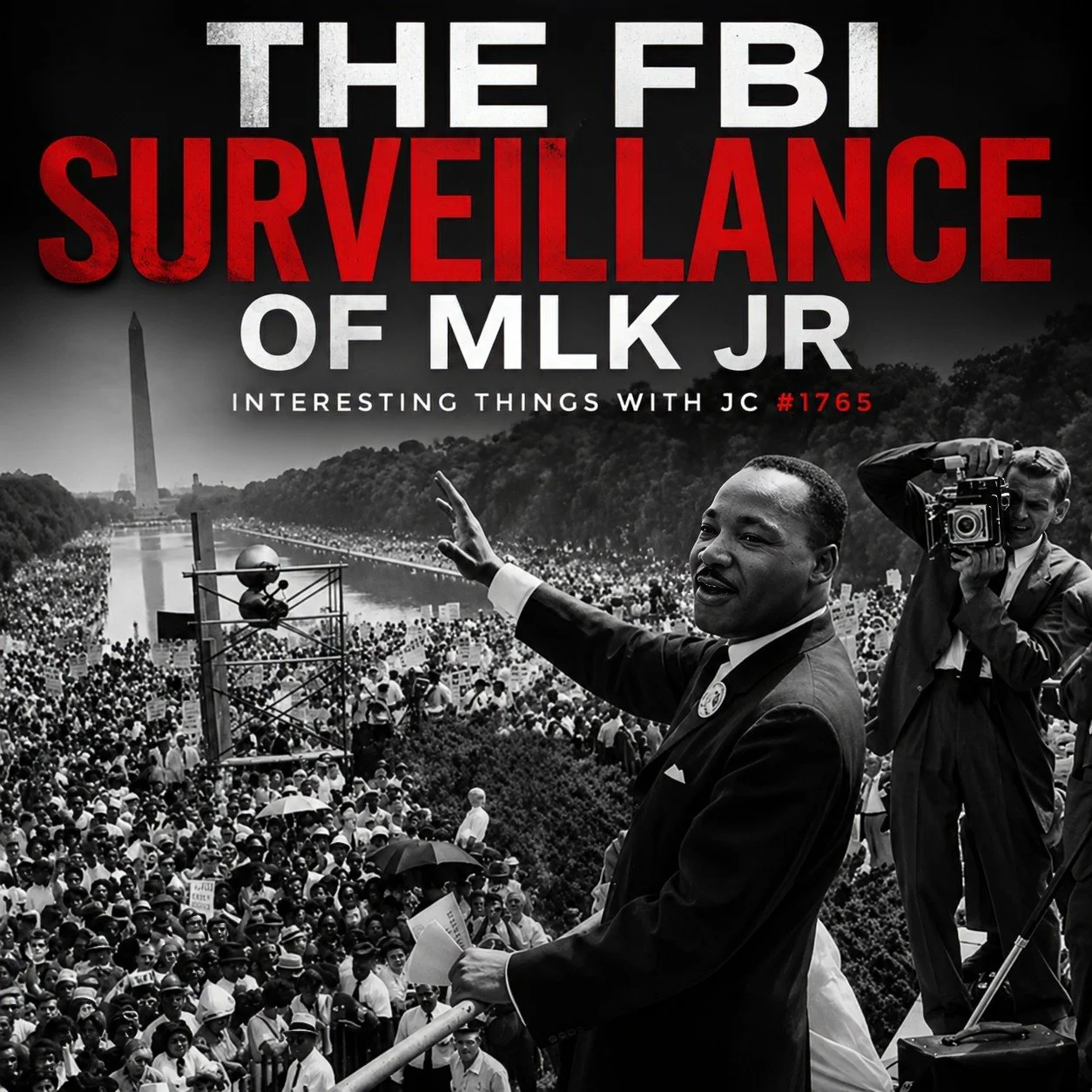
1765: "The FBI Surveillance of Martin Luther King Jr."
About this episode
Interesting Things with JC #1765: "The FBI Surveillance of Martin Luther King Jr." – The FBI wiretapped Martin Luther King Jr. without a criminal charge and failed to establish that he or the SCLC was controlled by communists. The surveillance expanded into hotel microphones and private recordings, and FBI officials began using what they collected in efforts to discredit King and weaken his influence.
Get every episode summarized
Each time Interesting Things with JC publishes, we email you a written briefing from the transcript — the topics, who appeared, and any specific claims, with the ad reads skipped.
Email me new episodesFree for 3 shows. No card needed.
Hosts & guests
Transcript ready
98 searchable segments. Every word is indexed and playable.
Full transcript
Interesting Things with JC — 1765: "The FBI Surveillance of Martin Luther King Jr.". Machine-transcribed; use the interactive transcript above to jump the player to any line.
In October 1963, a five-sentence memorandum, cross-J, agrohovers desk at the FBI, and it went to Attorney General Robert F. Kennedy. It asked for permission to wiretap Martin Luther King, Jr. There was no criminal charge against King, no time limit, proposed for the surveillance, and no geographical limit. Kennedy approved it, and soon the FBI was listening to the telephone of MLK, Jr., in his Atlanta home, and the lines used by the Southern Christian Leadership Conference. The concern was communism. The FBI had been investigating the SCLCs since 1962, because King had advisors with past communist party connections, particularly Stanley Levison. In the Cold War atmosphere of the 1960s, Hoover argued that those relationships they could represent communist influence inside the civil rights movement. But the investigation kept producing a problem for the Bureau. It could not establish the King was a communist,
that the SCLC was controlled by communists, or the King's political program, had been directed by the Communist Party. A later Justice Department review concluded the King posed no threat to domestic security, and that the investigation should have ended with what the FBI had learned by 1963. Instead, 1963 is when it all intensified. Two days after the March on Washington, where King delivered his, I have a dream speech, to a massive national audience. William C. Sullivan, the head of the FBI domestic intelligence division, wrote an internal memorandum about what the Bureau had just witnessed. King, he wrote, stood head and shoulders above other black leaders, and his ability to influence large numbers of people. Sullivan concluded that the FBI needed to mark King, as the most dangerous Negro of the future in this nation.
That memorandum helps explain what happened next, because the FBI's attention increasingly moved beyond King's political associations and directly into his private life. Agents used telephone wiretaps, physical surveillance, informants, and hidden microphones placed in hotel rooms. The recordings produced evidence of alleged extra-meritile relationships, and rather than treating that information as irrelevant to the original national security investigation, officials began looking for ways to use it against him. Hoover's hostility towards King, it eventually became public. In November 1964, Hoover called him, the most notorious liar in the country. By then, the Bureau had already accumulated private recordings of Dr. Barton Luther King Jr. and within weeks, part of that material would be used in a much more directed way. An anonymous package was prepared for King, containing a recording made from the surveillance,
along with the typewritten letter. The writer attacked him as a fraud and a moral failure, and then told him that he was finished and that there was only one way out. King and those around him in the interrogative message as an attempt to pressure him into suicide. The package had been designed to conceal where it came from, but the campaign was eventually traced back to the FBI operation directed against him. The package was not an isolated act. The Bureau circulated the regulatory information about King to government officials, approached members of the press of religious figures, and considered ways of weakening his standing in the civil rights movement. FBI records even documented an effort to identify another Black leader who might replace King as the movement's dominant national figure. By 1967, the FBI begun a broader Cointelbro campaign against organizations it classified as Black nationalist hate groups,
a category that included the SCLC, despite King's commitment to non- violence. In February 1968, the Bureau expanded the program with another objective, prevent the emergence of a Messiah, capable of unifying and electrifying the movement. King was specifically discussed as someone who could become that figure, and in March, barely a month before his assassination, he was formerly named as a Cointelbro target. The surveillance continued until his death, in Memphis, April 4, 1968. Years later, congressional investigators, they gained access to the internal records behind the entire operation. The church committee found that the FBI's activity had moved far beyond intelligence gathering. The Bureau had tried to discredit King, reduce his influence, manipulate public opinion around him, and interfere with his position as a civil rights
leader. A later Justice Department review concluded that continuing the investigation had been unwarranted. Years after wiretaps, microphones, informants, reports, private recordings, and attempts to damage him, the original national security case still wasn't there. Investigators found no evidence the King had been a communist, that the SCLC was a Communist Party organization where that his advisors had turned his civil rights work into a Communist Party program. Much of the sensitive electronic surveillance material still has not entered the public record. A 1977 court order sealed tapes, transcripts, and related records for 50 years. And under that order, those materials are scheduled to remain sealed until 2027. The surviving record leaves a fairly clear progression. The FBI began asking whether people around Martin Luther King, Jr., were influencing him on behalf of the Communist Party.
As the evidence failed to establish that, the investigation didn't simply disappear. It changed purpose. The government learned more about the private life of the man it was watching and parts of the government then tried to turn what they had learned into a weapon against him. The microphones have been installed to discover who is influencing Martin Luther King, Jr. and what the files ultimately documented was how far the FBI itself was willing to go to influence what America thought of him. These are interesting things with JC.
More episodes
More from Interesting Things with JC

1773: "The Clock Behind Instant Replay"
Interesting Things with JC

1772: "Staten Island Remembers"
Interesting Things with JC

1771: "Debut of the Fresh Prince of Bel-Air"
Interesting Things with JC

1770: "When a Parasite Rewires Behavior to Spread Itself"
Interesting Things with JC