About this episode
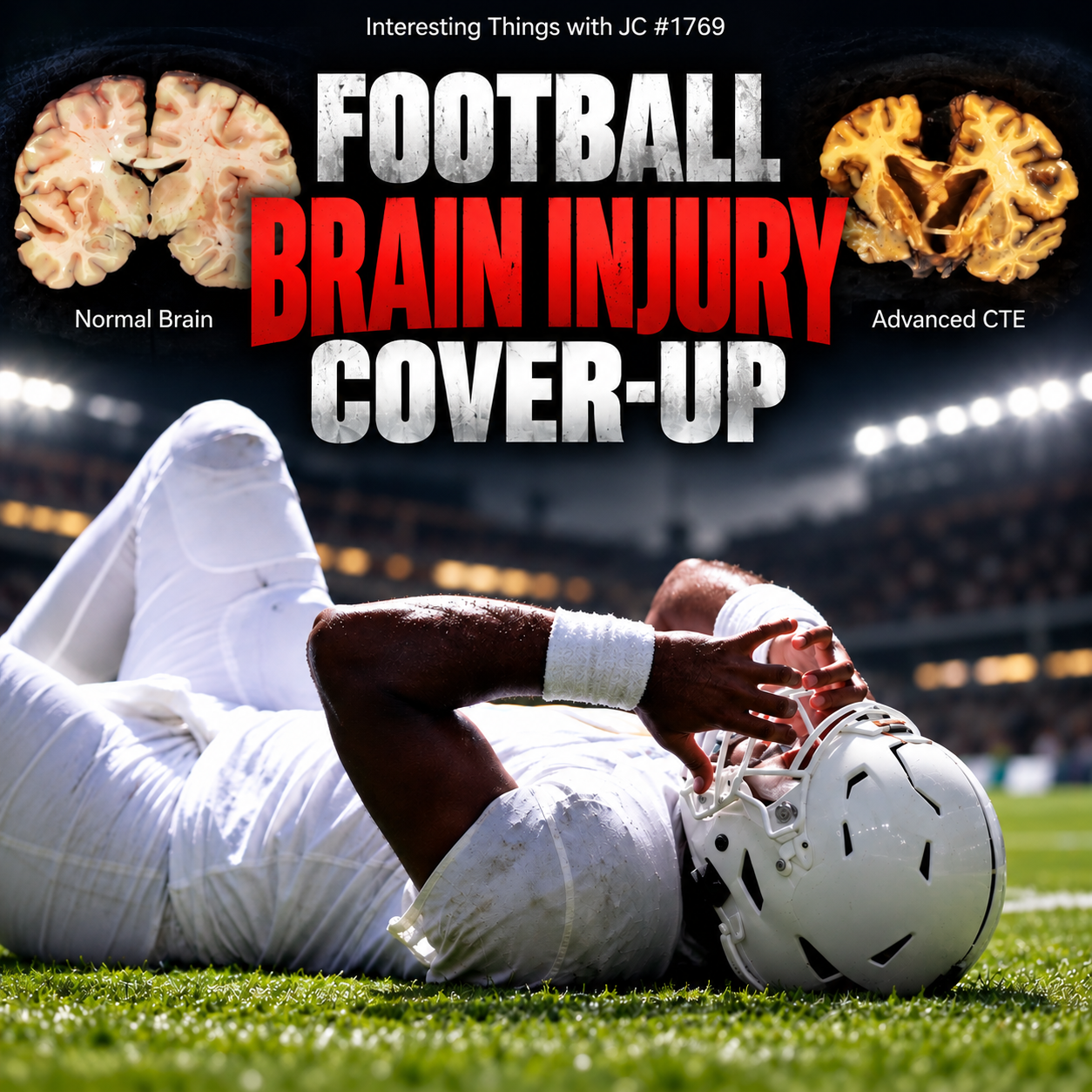
Interesting Things with JC #1769: "Football Brain Injury Cover Up" – Dr. Bennet Omalu found CTE in Mike Webster’s brain, and the NFL’s concussion committee challenged the published finding and called for its retraction. More former players were diagnosed after death, and twelve years later researchers found CTE in 110 of 111 donated brains from former NFL players.
Get every episode summarized
Each time Interesting Things with JC publishes, we email you a written briefing from the transcript — the topics, who appeared, and any specific claims, with the ad reads skipped.
Email me new episodesFree for 3 shows. No card needed.
Hosts & guests
Transcript ready
46 searchable segments. Every word is indexed and playable.
Full transcript
Interesting Things with JC — 1769: "Football Brain Injury Cover Up". Machine-transcribed; use the interactive transcript above to jump the player to any line.
When Mike Webster died in 2002, he was only 50 years old. The former Pittsburgh Stealer Center played 17 years in the NFL, won four Super Bowls and made the Pro Football Hall of Fame. But after Football, things went downhill. Webster struggled with memory loss, depression, confusion, chronic pain, and major changes in his behavior. After his passing forensic pathologist, Dr. Bennett Omalu examined his brain. Under the microscope, Omalu found abnormal accumulations of tau protein that's associated with repeated head trauma. The disease had been seen before, particularly in boxers. But in 2005, Omalu and his colleagues, they published the first report case of chronic traumatic encephalopathy or CTE in an NFL player. The NFL's concussion committee challenged the paper and called for it to be retracted,
but it wasn't. At same year, former Pittsburgh Stealer Terry Long died at 45 years old. Omalu examined his brain and found CTE yet again. And more cases, they followed. Researchers were looking beyond the single hard hit and towards the cumulative effect of repeated impacts over a career. And each one could accelerate and rotate the brain inside the skull. Some caused obvious concussions, but many of them didn't. Repeated head impacts are associated with the abnormal tau pattern that defines CTE. And because CTE can still only be definitively diagnosed after death, much of what researchers were learning came from the brains of former players. Meanwhile, the absence of former players sued the NFL, accusing the league of concealing the long term dangers of head injuries. In 2013, the NFL agreed to a concussion settlement initially valued at $765 million without
admitting wrongdoing. And that same year, Commissioner Roger Gidell was still saying the neurological conditions of facting former players weren't necessarily caused by football. Then in 2016, an NFL executive Jeff Miller was asked during a congressional roundtable with a research show to connection between football and CTE, and his answer was certainly yes. The following year, researchers led by Dr. Ann McKee at Boston University published findings from the donated brains of 111 former NFL players. They found CTE in 110. Now, that doesn't mean the 99% of NFL players developed CTE. This wasn't a random sample. Many of the brains were donated because families already suspected something was wrong. But think about where this started. In 2005, Mike Webster was one case. And the NFL's own concussion committee wanted the paper retracted.
Twelve years later, researchers had found the same disease in 110 out of 111 donated brains from former NFL players. Somewhere between 1 and 110, the question changed. These are interesting things with JC.
More episodes
More from Interesting Things with JC

1773: "The Clock Behind Instant Replay"
Interesting Things with JC

1772: "Staten Island Remembers"
Interesting Things with JC

1771: "Debut of the Fresh Prince of Bel-Air"
Interesting Things with JC

1770: "When a Parasite Rewires Behavior to Spread Itself"
Interesting Things with JC