About this episode
Get every episode summarized
Each time The Rest Is Politics: US publishes, we email you a written briefing from the transcript — the topics, who appeared, and any specific claims, with the ad reads skipped.
Email me new episodesFree for 3 shows. No card needed.
Hosts & guests
Transcript ready
683 searchable segments. Every word is indexed and playable.
Full transcript
The Rest Is Politics: US — 218. Trump’s Wars Have Just Broken the Global Economy. Machine-transcribed; use the interactive transcript above to jump the player to any line.
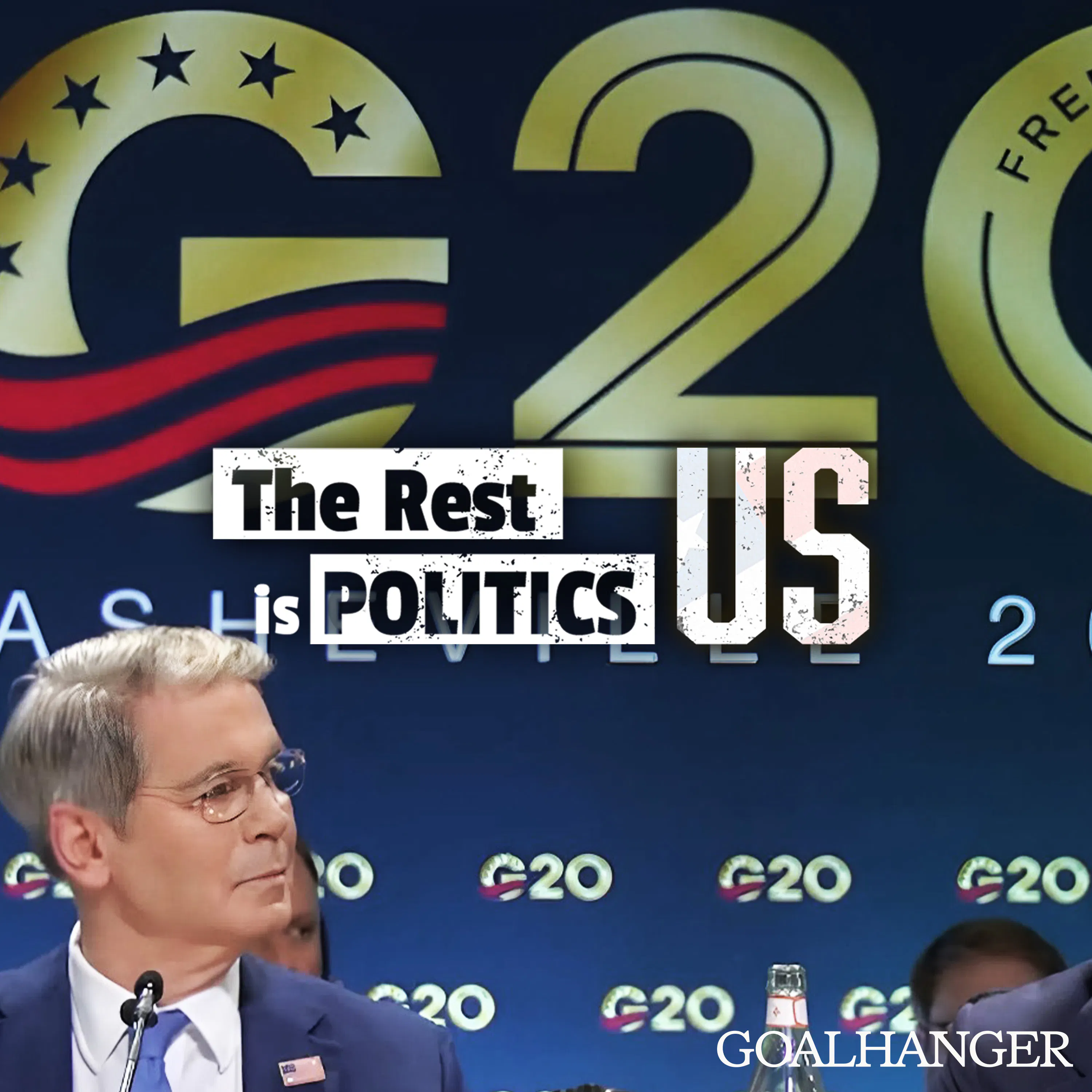
The global economy's warning lights are flashing. G20 Finance Minister's met in North Carolina for what was meant to be a show of unity, but descended into chaos over the mass bond market sell-off rising debt tariffs. Oh yes, and the awkward presence of Russia and China. Cady was at a G1 plus 19. It sort of felt like that. It wasn't really a G20. We need to figure out how we're going to get out of this mess, Cady. And following Ed Markey's primary win in Massachusetts will discuss whether experience will trump youth in the midterms. This episode is brought to you by E. Toro. A tariff of spending plan, a regulatory change, it can all start just as the first line of a speech. But it sets in motion things that can reach far beyond Washington an unfold for years to come. Cady, markets move on expectations, not just events, investors are constantly weighing. What a decision could mean for companies, sectors, and the wider economy.
So E. Toro is an investing platform where you can access a wide range of markets and explore how political and economic developments could affect them. You could also learn from the global community of investors and see how people around the world are interpreting the same news. As with all investing, your capital is at risk. C-E-Toro.com forward slash trip US for full terms. Welcome to the rest is politics US with me, Cady Kaye. And me, Anthony Scaramucci. All getting ready, Anthony, for our big festival in London this weekend. I'm excited. Yeah, B2, yeah, it's going to be fun. We're going to be on stage with Rory and Alistar. So I got to get ready, I got to get my battle arm on. Rory's a lot nicer to me than Alistar's, you know. We need to do a workout beforehand and figure out, you know, have team America goes up. I think we're going, I think we're in for a bit of a bashing. So we need to make sure that we've got a, a game. You're probably wearing American tie to just really send Alistar into orbit, okay?
Okay. I thought the week was very interesting, Anthony, and I want you to get into the ball markets because you understand that much better and how much we should be concerned. I was speaking to a bunch of business leaders in New York yesterday and they were definitely watching it. But I thought you could frame this week in an interesting way that you had this G20 meeting in Asheville, North Carolina with the Secretary of the Treasury, Scott Bessent telling Americans that everything was fine while you had allies not happy with America and saying, hold on a second, yes, the American economy may be booming because of AI largely, but you are doing things that are really hurting our economic growth. And they couldn't even come up with a joint communicate because of the presence of the Chinese. Also allies unhappy that the Russian finance minister was there. So you had this kind of display of disunity in Asheville, North Carolina at the same time that you got Xi Jinping holding a meeting in Kyrgyzstan with India, Iran, Russia and China
looking like the model of stability. And she now turning up in Cairo saying, look, look at the Americans, look at Trump. They are the ones that are not reliable as allies, whereas here we are, the people that you can rely on to keep a steady path because we have a command and control economy largely. But we are the contrast to the US. I mean, it was just a very interesting way of looking at geopolitics during the course of this week. I thought unity versus disunity. I want to add one thing and that is the imagery. And so we are watching the USS Abraham Lincoln head to a docking finally in Thailand. 5,000 sailors unloading into what is known as Sin City, Thailand. That's going to be an interesting four day trip. Yeah. I mean, just because this is a family show, we're just going to leave it right there. We're going to imagine sailors and Thailand. They've been on a ship for nine months. They've got six months of back pay. Oh my God. Would you like to be a bartender in Sin City, Thailand right now or not?
Is the question this weekend? Listen, it could be another hangover movie. But what I didn't like about it is the imagery. And I got in trouble with some veterans. I'm close to who are very defensive about the way the USS Abraham Lincoln looked. OK, it looked like a rust bucket. And perception is reality in our world. As you and I both know, Ronald Reagan do that better than anybody. And so we have a country now. And I started out by saying it's a G1 plus 19 because we're fighting with everybody. We're fighting with our closest allies like Canada. Apparently Trump said from the Oval Office that rushes our friend, but who the real nasty people are is Canada. And so you've got this backdrop where we've crossed over not 40 trillion dollars of debt, Catti, but 40.1 trillion dollars of debt. And if we do a Christmas show, the rest is politics in a few months. We're going to be very close to 41 trillion dollars of debt. It is a free train that isn't stopping.
OK, and so I will tell you something that's going to be very present for Donald Trump at his Republican convention. And that is the bond market, Catti. OK, the bond market doesn't care. It has the real power. It can't be primary. The bond market is not interested in a family photo. But what the bond market is telling you is that the demand for treasuries is not quite meeting the supply. And so what ends up happening is we have to bid up the interest rate to get people to track it to the treasuries. And that is causing a problem around the world because as you know, it's still the world's reserve currency. So if the rates are going up here, it impacts everybody. And just to remind everybody, rates are the financial gravity of financial assets. Higher rates means lower prices. And it makes it harder to do business, Catti. So we're in a little bit of a bind to support it that way. OK, so Scott Bescent at that meeting in Asheville, North Carolina
said that two things I thought was interesting. First of all, he said that the tenure has been flat since Trump came in. But as far as I understand, it's been up 18 basis points since the inauguration. And then he also said that US bonds are the best performing among major countries because we've seen a bond sell off around the world, as you just said. So it seems to me like he's saying one thing that's true and one thing that's not true. How reassuring is Scott Bescent's performance as Treasury Secretary this week when he is out there touting how successfully US economy is underselling the impact of prices and costs to American voters and suggesting that they don't need to worry about that. How much does that reassure bond markets when you have a Treasury Secretary performing as he has done in Asheville this week? And how much does it make them think, hold on a second, have we got grown-ups in charge of this? And are we getting the full picture? You know, he's the best you're going to give him the Trump administration.
He's not a Robert Rubin from the Clinton administration. You know, he's the best that you're going to get. He has to be a sick of fan to the president. He has to say things that are borderline ridiculous. He said on TV the other day that the reason why oil prices are up is that Ukraine is attacking the Russian energy sites. And so that's the reason why oil prices are growing. So you're like looking at them, okay, but they didn't even start the war. What are you even talking about? And then he added as a kind of like a second point, oh well, yes, and maybe around, that's going to end and then prices are going to fall fast after it. We end the Iran war, which was meant to end about three months ago or four months ago. Okay, so those are those are communication talking points from President Trump. He's on the phone. Hey, I'm going on the air. What am I saying here? We'll blame Ukraine for bombing the Russian oil sites because of flats. I'm going to like that. If you do that, it'll make everybody upset in the West. And because it's like an or wellian thing to say something that ridiculous. And then oh, by the way, I mentioned that we're going to end this war very quickly.
So, so listen, you know, when you price our treasuries the way they are. And again, specifically as your question, yes, he did tell a lie, but he also told the truth because we're the tallest of the shortest bonds in the market, right? I mean, that's ultimately what he's trying to say to you. If we're at 4.8, the guilds are at 5.2, the yen, they're in a more or less a deflationary environment in Japan because of the upside down demography. And the yen crossed over 3%. Now, it tightened this morning. As you and I are speaking, there was a little bit of a recoil on the yen, which I think is good news. It took some pressure off of the market. But I think you're asking the seminal question and it can only be answered by exogenous factor. So, the beginning, Scott Bessent has no control over when the Ukraine war is going to end. He has no control over when the Iranian war will and maybe his boss does, but he doesn't.
And so what he's trying to do, he's trying to use moral swation and jaw boning to keep interest rates down. And he's going to take out another credit card. So, you know, it's like if you were, Katty, if you were in a credit card crisis and you're like, oh, okay, I got it. Okay, I just got one more credit card in the mail. Let me take out this credit card and use this one. It's not going to solve the problem, but he's going to borrow some more money to buy the debt of the borrowings to try to push the interest rates down. So, so this is why gold prices went up. This is why Bitcoin went up. And this is why you're in a fight and you can't get a communique out of the G20 that's consistent with the 20 nations. So you write about this in all the wrong moves that your book does just coming out and you talk about the money view of history. And it's such a smart point that you make in that book about one of the catastrophic decisions is basically over leveraging and the impact that that then has on workers and the prices that they pay. And in a sense, that is how we get to Trump.
And that's how we get to populism. But there seem to be two narratives going on about the American economy at the moment. One of the flashing red lights around the bond markets and American debt and tariffs and policy and politics and the competence of the people running it and the kinds of things they're doing, like launching a war in Iran and driving up oil prices that. But then on the other hand, and this is something that Howard Lucknick was off in also in North Carolina at Chapel Hill this week talking about was the boo and Scott Besson was talking about this and other economies recognize this. All of those problems. And at the same time, the American economy is clearly doing better than other global economies because of the AI boom. And Besson said, OK, guys, join me. We've deregulated this is a golden moment for AI. There are some political concerns, although Howard Lucknick dismissed those political concerns around data centers, which I think are popping up in a real way in primaries around the country. But he dismissed that as propaganda from the left. So how do you kind of square those two things? Because Besson's argument is it's all going to be fine because we are going to grow our
way out of this, which has been Kevin Walsh's argument, the Fed Chair's argument, for the last couple of years, we're going to grow our way out of this with AI. But I get the sense, Anthony, that there's some disquiet around that argument that not everybody is agreeing with that argument and not every whatever the benefits of AI and I think there are incredible benefits of AI. I'm not an AI skeptic. I am a little bit on the security side, but much more actually on the security side. But I do think there are big AI benefits. But I'm not seeing everybody, the economist that I speak to anyway saying, yeah, this is how we get feels a little bit Reaganesque. You know, we'll just cut taxes and that'll solve all our problems. Is AI something similar? Or is this going to be the growth spur that everybody is, that people like Walsh and Besson say it's going to be? Well, the first thing I want to do is by publisher, thank you for bringing up the book all the rogue moves because he's yelling at me, telling me I don't bring it up enough. So I appreciate you bringing it up, it's on sale in September. I'm taking a cut of the profits, by the way. Please, please, if you can help me sell the books, you can have all the profits. Although all the profits actually are going to a charity, but here's the point that I
don't want to make, this is very, very important. I put it in all the wrong moves. You want to solve the deficit crisis. I don't want to be overly simplistic, but I just hear me out for a second. If I can grow the economy faster than the governmental spending, well, we'll end up happening in 15 years, Cadi. The GDP will catch up. And so you're sitting here right now, the United States as a nation is at 125% of its national debt to its GDP. Okay, and that is a dangerous light. That's a light flaring. On September the 2nd, we celebrated the 81st anniversary of the armistice with Japan, USS Missouri and Tokyo Bay signing the peace deal or the surrender. At that moment, we were 106% of the GDP. The warning light was on, but we had an intact industrial base. Perhaps the only intact industrial base left on Earth, and we had a baby boom. And rates at that time were primed near 2%.
So we had this explosive economic growth. Ladies and gentlemen, we never paid back the debt from World War II. But what we did do is we grew the economy so fast. Again, think about a household. If I have $3 million of debt, but I'm making $25 million a year, I can manage the debt. And so I say in that book, and I say here to you and everybody listening, this is a totally solvable problem, but the rhetoric is not going to solve the problem. It presents as we can grow our way out of it, worse as we grow our way out of it. They're right, but you have to slow down the spending. Okay, in in 1990, Dick Dorman, who was the chief budget officer for the OMB director for George Herbert Walker Bush, he came up with this legislation called Pego. And I write about it in the book, Bill Clinton adhered to it. Okay. I wanted a tax cut. That's fine. You had to find something in the budget to cut. You wanted to increase social services or defense spending. No problem.
You had to raise taxes. And this was a guard rail system that Dick Gaphart accepted. George Herbert Walker Bush accepted. And believe it or not, Bill, Clinton accepted it. And if you may remember this because we're old enough to remember. In March of 1993, Clinton pushed through the largest tax increase in history. We had to get Al Gore out of the Naval Observatory like OJ and the Bronco. I can remember him on CNN in the car driving up to the Capitol to make the deciding vote. No Republicans voted on the tax increase, but Clinton got it right. And so these guys are not saying what needs to be set. Okay. Now, we can debate the AI whether the AI is going to be it or not. I don't really care, Caddy. I'm telling you about the neural plasticity and the dynamism of the American economy and the lunatics that you and I live with in America entrepreneurs, risk takers, innovators, large capital market systems. So if you develop something like fracking, the money flows into it.
If you just sell, develop something in biotech, there's a venture team money will flow into it. AI, you saw, you know, Claude and Thropic just got a $65 billion injection of capital at a $970 billion valuation. So the country can do this, but it doesn't have the right leadership to do it. And so that's the quagmire that we're in and they're growing the debt, Caddy. I can tell you right now the train is not stopping because the debt is growing faster than the GDP. And this is why somebody like Ray Dalio, friend of mine and a hedge fund industry would say, Hey, guys, you're going to hit a point where the world is going to lose confidence in us and our ability to repay the debt. And I think that's the stuff that people have to really look at. And that's why we had some turmoil at the G20 this week. Right. And that, I mean, that debt has been growing, and particularly actually has grown more under Republican presidents, whatever Republicans say about being fiscal hawks. It has grown more under this century. It has grown more under Republicans than it has under Democrats.
And I think that is why it's interesting to see what Xi Jinping is doing, going to Kyrgyz Stan, going to Cairo, he's in Cairo at the moment. And he is sending a signal. And I think he's sending a signal directly to the White House ahead of his meeting with President Trump in three weeks time. He is sending a signal. Look, I have allies now. And I think the interesting thing about what China is doing, particularly in somewhere like Africa, is that China used to be the country that paid for roads and paid for railways and paid for TV stations. And that's how over the last 20 years, it's expanded its influence across Africa. Now what it's saying is something different. Now it's saying actually it's political influence that China is exuding. And that soft power that China is projecting around the world. And I think it is the chaos of all the things that you've just spoken about and the underlying problems of America and America's economy that is allowing Xi this opportunity. And I don't know what you think, but I mean, maybe it's easy for Xi.
He hasn't got a war fighting exposure in the region to defend. So it's kind of easier to look stable when you're not the one that's going to be dragged into the next conflict. But it feels to me like Xi is going around the world deliberately ahead of this meeting with Donald Trump in order to send a message to the White House. I think that that's correct, but I got to ask you a question. And I want you to I want to frame it as a middle power or somebody that is in the situation of Egyptian president or somebody in Africa. You want help from America? You want help from China? Tell me about China's soft power relative to America. You know, I mean, are you accepting that? Because I think there's an issue there. I think the Americans under Trump, I totally agree completely inconsistent, completely off the rails, very unreliable. But remember something about China, nobody really wants to live in China. Do people still want to come to America as hard as it is with the ice sentiment and all
the other things going on in America? It's still seen differently than China. If I'm wrong about that pushback, because I think China has a problem selling the soft power. They have no problem saying here's the loan, here's the belt and road, here's everything you need. You see what I mean? The problem entirely of the White House's own making. And a lot of countries around Africa had already woken up to the fact that these Chinese loans came with a lot of downside. That yes, they got their roads and yes, they got their railways. And without the all the rules and the governance issues that the United States used to impose around corruption and good governance and democracy, they didn't have to have any human rights. The Chinese didn't impose any of that. They just gave them the money. But now as those loans are coming due, they are finding that the price is pretty high. And there had been certain amount of dissatisfaction with that Chinese intervention. If it had not been, I think, for the Trump administration, the shutting of USAID, which has
had catastore, whatever Donald Trump and Elon Musk say about this, according to the Lancet magazine, some 600,000 people have died across Africa because of the cutting of USAID. I think actually America was poised because of the growing dissatisfaction with China to be in a better position with its soft power. But business leaders, as I spoke to again at this conference in New York this week, they were saying from other countries, look, we don't see America coming back. And yeah, you're right. People do still want to come here, comparative to China, but not in the way that they wanted to come here two years ago or ten years ago. So the decline is real in the perceptions about America around the world. We know that. We've seen all of polling on this. We hear it anecdotally. We see the Canadians not coming across the border to spend money in the American economy. So I don't think the comparison is, do people want to go to China more than they want to go to America? No, that's not the comparison. The comparison is, do people want to come to America in the way that they did pre-Trump
and pre-this explosion of populism? I think that's add to that all of the bigger problems about debt and accountability. You would have been so good on Wall Street. You could have been a Wall Street bond trader. You could have been a Wall Street economist. I mean, yeah, you could have missed your calling here, Kathy. Now I'm just selling your books. There you go. That's my main mission in life at the moment. Trust me. I need help on that because I've been sheepish about the promotion. But I do. I'll just say this to everybody. I tried to write a book. I tried to write a book that would explain what happened in a fun way and you'd learn something about history. But I just want to say this. I know we got to go to a break, but I want you to think about this for a second and react to it. The Chinese have a $1.2 trillion surplus. Their property bust because they overbuilt these cities. Their property bust has caused a consumption crisis in the country and they have some deflation going on because that's what happens when property prices collapse. They have to figure out a way to export the deflation to survive.
One of the cures is consumption, Kathy, but Beijing does not like highly. If you're living too high on the hog in Beijing, they put you in a reformation camp. They're in a box, Kathy. Tell me how you get out of that box if you're Beijing understanding the culture that I'm describing. I think they are in a box and they've clearly got a huge debt crisis and they have a youth unemployment crisis which could come back to hurt them and they need to grow. They've got the same problems in some ways and a very large aging population. They have some of the same problems that America has. If they choose the right policies, they can implement them, however. China could implement a 20-year investment program for, I don't know, technology, AI or biotech, which actually it's doing anyway. They can implement it. The US Congress can't implement a 20-day program on anything because they can't agree on anything. We have a structural problem comparatively.
That would be the speech. If you could get up there and say, hey, listen, I met with the Democrats and I met with the Republicans and here is the 15-year plan. By the way, all of our ankles are tied together. We can't do anything other than follow this spending protocol because I'm telling you in the next 15 years, we're going to have a right sizing of our deficit. That happens in the US right now. Donald Trump is going to speak in Texas next week. Send him the notes for that speech and let's see if he listens to you. We're going to take a break and talk about youth versus experience and near-eye are on the youth side of this equation. Welcome back to the rest's politics US with me Anthony Scaramucci and Cadi Cadi. Cadi you're younger than me as I have pointed out many times on this show. We've got a couple of people here, octogenarians that are older than us and they are still kicking ass Cadi.
Incompet Senator Ed Markey, age 80 beats Seth Moulton, age 47. I think this is a pretty interesting that he was able to pull that off. There are also two other Massachusetts representatives in their 70s that fend it off younger primary opponents, Cadi. What do you think that this says about where America is today? I've suggested to people that we're in an anti-incompancy environment, but the data doesn't say that because these incumbents have a 95% re-election rate. What does it say? I think it's raised by race. I think there is a general anti-incompancy and you see that in some poll in the University of Massachusetts to the poll that show that voters do want younger leaders, but there's a caveat to that. They want younger leaders who also are progressive. I think you have to take the Massachusetts case and Ed Markey as a slightly separate case from perhaps some other races. Ed Markey, 80 yes, but has a long progressive record on things like housing, on green energy.
He's a big supporter of climate change initiatives, education. He's seen as a Bernie Sanders almost like figure and look how much younger voters love Bernie Sanders because he is a tried and true progressive and always has been. He's authentic to that. He hasn't changed his message. If you compare somebody like Ed Markey to Janet Mills, who was the Democrat, who was running for the Senate seat in Maine, who is 79, I think she is, she's getting up there towards 80 and there there was a real anti-incompancy desire for a generational shift. It's why they went after Graham Platner and that all exploded, but it was because Janet Mills came across as a traditional, boring, poll-driven establishment politician and younger voters didn't see her as a progressive. So I wonder if this is not just an age thing and I do think there is a kind of anti-incompancy desire for change. There was another poll from Reuters saying that 62% of Democrats say it's time to change
the older leadership of the party, but it's also about progressivism. If you are a progressive in this environment, I think you have a better chance in the Democratic Party at least of being nominated for the candidacy. But I think what's interesting, Anthony, and I know you wanted to make this link with John Corne who is the senator from Texas who was thrown out largely by Donald Trump in favor of Ken Paxton. Yes, Ken Paxton is younger, but was that an anti-incompancy thing or was that a Trump thing? Well, yeah, the point I wanted to make is that I see Mark in Corne in similarly, meaning if Corne was running against Tallerico, I think he could be Tallerico. He's a popular senator in the Republican Party. He's been there for three decades and his seniority in the Senate would also have helped him in that race. So yes, Paxton's younger than him, not that much younger than him, but I think it's going to be very difficult for the non-incompanpaxon to be Tallerico.
And, Katnie, just look at these numbers. Tallerico is crushing him on the fundraising. He's like almost five to one on the fundraising. So much so that Trump is descending into the area. And this is the greatest stuff. I love this more than you could possibly imagine. Trump has something like a combined $800 million in these two packs that he's been raising money for. They're begging him to let some of that money out. Is he going to do that, Katnie? You think he's going to give any money to Paxton? This week has been amazing because yeah, you're right. Tallerico has more money in the bank than Paxton does. The Republicans are realizing they've got to spend money in Texas. It's an expensive market. It's got a lot of different advertising markets all across the state, big cities where you've got to pay for money. You've got John Thune, the Senate Majority Leader, going on television saying we've got to spend money in Texas. You've got Ted Cruz, the other senator from Texas saying, I'm very worried about Texas. That's his words. The left is energized.
They hate Donald Trump. They're pissed off on the right. He says we're demoralized. We're angry. We're fighting with each other. And if the normies stay home, we're going to have a terrible election. Also saying we're going to have to spend a lot of money. Karl Rove also saying, look, Paxton's a terrible candidate. I was told that this week by a political scientist down in San Antonio. Everyone in Texas is saying Paxton is a terrible candidate. He's not fundraising. He's lazy. He's going off for July 4th weekend, as Karl Rove said on Fox News with his latest girlfriend and he's not raising the money. So they're talking. You think there's not a direct line there to Trump? You've got these senior Republican figures talk about kind of alarm bells ringing saying, Trump, this is your problem, pottery, barn rule. You broke it. You got rid of Paxton. You got rid of Cornen. You fix it. And by the way, we know you have the money and you're sitting on the money to fix it. But Trump doesn't like spending money on other people, Anthony. It's his money. He thinks this is his money. He made it of his name.
He doesn't want to spend it on somebody else. No question. Right? Yeah. This is why all these guys are going to succeed Trump with his help. It's not going to happen. But the funny part is he did squeak out a million and a half dollars, Caddy, on a few ads. And guess what? They were all about him. Did you see the ad? He saw it through the round on the man. I'm, you know, the Republican party's nothing without me. It was nothing on any of the other candidates. It was just like a message, a vote like I'm on the ballot because I'm the most important person in the civilization. But you know, the one thing I want to ask you back is I always talk about the money in America and follow the money. It's like what's interesting here is Markey delivered. Okay. He had the money relative to molten. Okay. And so the incumbents, you can open up the purse strings. Cornen as an incumbent would have had a much easier time raising the money. Talley regals at about 72 million. Paxins like it around 16 million. And so what's also interesting is if you're young like you said earlier and you're progressive
and you're a little bit hip guess what happens? You can get progressive money and you can get a lot of these small donors that will light you up through social media, Instagram, Facebook, etc. That's something I Trump frankly did in 2016. He was super successful at it. Super successful at it. But Talley also has been interesting because he's been up with the rich donors too, right? He's been up in New England over the summer holidays, smoothing with all of the wealthy donors. And the thing I think that is worrying why you've got all of these senior Republicans coming out this week. First of all, watching the polls because a couple of the big organizations like the Cook Political Report this week shifted Texas from lean Republican to toss up. So they're watching those numbers. They are concerned about it. And so they're trying to get Trump and it's Trump has sole sign off on this money is what I'm told. He is the one that's going to decide whether that money is spent or not. So they're talking directly to him. And the problem I think for them and for Trump, even if he decides to spend the money,
is Tannerika has just been dominating the airwaves. I've been looking at some of his ads. They're good. His ads are good. Ken Paxton, there's some weird incident where Ken Paxton, was it an airport and you know how you have those bins and you send them to the security? Somebody left a super expensive pen that their wife had given them in one of the bins. And there's airport security footage of Ken Paxton rummaging through the bins and taking the pen away. So Tannerika comes out saying he's going to steal your money. He's going to steal your inheritance. He's going to steal your children's future. He's even going to steal your pen. So Tannerika has been out there with pretty clever ads all through the summer. And I don't know Anthony. We are now September the 3rd. We're recording this. There's not much longer left. Trump decided to open the floodgates of that pack money to these struggling Republican candidates. Isn't it a little late for him when the opposition candidates have already been defining themselves? It's such a good question.
So obviously I don't know the answer to that. But I do think Trump may have to open the floodgate on Paxton because if you listen to Thune, he's literally on his knees on Fox News saying, hey, if we lose Texas, you're giving me an ass kicking up in Maine, Ohio, and Michigan. Okay. So you started a tariff where you're on the two-inch line. You could assign the deal. Everybody could have had a congratulatory ceremony. But now you're in a tariff where all those tariffs are kicking in on September the 8th. And so you've weakened me in Ohio, Maine, and Michigan. And I'm super weak in Texas. Hey, Mr. President, you got to get down to Texas and help this guy. Now weirdly, Trump may do that. Maybe not going to spend 100 million or anything like that. But could he go down to Texas and start campaigning with Paxton? And I'm still not ruling out Paxton because I know how the machinery works in these parties. You know, they'll get to turn out the vote mechanisms that they know how to do once they're running the machine, the way they run the machine. So Taloriko's ahead. He's got the money.
The Calcy markets have it a lot more narrow than you would look at if he's just looked at the money and you just looked at the messaging. I think you're right that Trump will do it. We're going to see him down in Texas next week for this Trump appelluser. And I think that is all about trying to save Paxton because up against his avariciousness on not wanting to spend his money from his pack on anybody else is the embarrassment factor because I don't think Texas is a blue state. The people I'm talking to are saying this is not about Texas becoming a democratic state. This is purely about Paxton being a terrible candidate. And Trump doesn't want the embarrassment of Texas flipping because of him or the investigation threat. Yeah. Or the investigation threat of the Senate. He's going to try to make 20 to 30 billion dollars in the next two years. It's going to be a lot easier for him if the Republicans are controlling the Senate. And so remember, this will be a money grab for Trump as well. He'll look at everything and say, I better help this guy. I don't want to lose the Senate. And so other reason why I think there's going to get a deal done. Again, I could be wrong.
Despite the rhetoric, the bellicassie, the rhetoric and all the nonsense that Howard Lutnik said on TV yesterday regarding Canada, I still think it's going to get a deal done. I think Trump is going to blink on this. A deal done on Canada, you mean? Yes, or a deal done on Canada because he doesn't want to lose the Senate. And he's putting himself in harm's way. And the number one thing for Trump is Mula. He loses the Senate. It's going to mean less money for him in his pocket. That's an interesting point because we've been saying, actually, I think it's worth us clarifying this. We've been saying over the last six months that Trump doesn't care about the midterms. And a lot of Trump's policies would lead you to believe he doesn't care about the midterms. He's certainly not helping Republicans. With the war in Iran, I think that is where Karl Rove is right and Ted Cruz is right. Normy Republicans are very unhappy about the war in Iran. It was never explained. It's going on way too long. They don't like the gas prices, but they just don't like it. So he's not doing things. The war trade war with Canada is another one. He's not doing things that help Republicans.
And we've been saying he doesn't really care about the midterms. And do you think it's that he doesn't care about the midterms or he doesn't care about the House or he doesn't care about the Senate? Let me rephrase it. He doesn't care about anybody but himself. And he was making the assumption that he was going to keep the Senate. And he could possibly lose the House. And if it lost the House, it'd be a couple of investigations, not that big of a deal. So let me clarify. He doesn't care about the midterms unless they impact him and they impact his wallet. And what would impact him in his wallet is if they flipped over. The Calcy markets again, over 60% that the Republicans are going to lose the House and the Senate. Now, if you'd asked me that on an inauguration day, the 20th of January, 2025, Trump wasn't thinking that at all, which is why he was indifferent to it. But I do think now he's looking at it. He's saying, hey, this is going to cost me money because if they control both chambers, it's going to be nonstop legal fights, nonstop investigations.
All of his buddies are going to go on the barbecue, right? All those buddies are going to get grilled by those guys. And he doesn't care about his buddies, but his buddies are helping him make money, Cadi. That's the thing he cares the most about. Which is why perhaps one last point on Texas commissioners in Tarant County, which is that big fast growing county in Fort Worth approved a plan this week that would lead to 92 fewer election day polling locations compared to the 2022 midterms. That's about a 30% reduction. So they're going to try and win however they can. Also, remember the Save American thing. If you're a woman and you got married, you got to go through a whole nightmare to prove your name. And so that's one of the ways they try to knock out women from running, right? That's why the Republicans want Save America. It's under the guise of proving that you're an American citizen, but they're really trying to knock women out of voting. That's one of the big things they're trying to do. Yeah, and there are a whole bunch of states for which the driving licenses as well won't count as sufficient ID when you're trying to vote. Talking to the midterms, Antonin and I are coming on tour around the states.
We would love to see you come and join us. We'll be talking about the midterms and how they're impacting your area, your members of Congress, your senators, your races. So go to the rest is politicsus.com to get tickets. They're selling fast, but we've got some left to come and join us. We'd love to see you there. Bye, guys. See you next week. Thank you, guys. See you next week.
More episodes
More from The Rest Is Politics: US

220. The Truth Behind Trump’s $5000 Midterm Bribe
The Rest Is Politics: US

219. How Putin Just Played Trump... Again
The Rest Is Politics: US

217. The Secret Pentagon Leak That Terrifies Trump
The Rest Is Politics: US

216. The CIA’s Secret Meeting in Moscow - What’s Trump Hiding?
The Rest Is Politics: US