About this episode
Get every episode summarized
Each time The Joe Rogan Experience publishes, we email you a written briefing from the transcript — the topics, who appeared, and any specific claims, with the ad reads skipped.
Email me new episodesFree for 3 shows. No card needed.
Hosts & guests

Transcript ready
4,100 searchable segments. Every word is indexed and playable.
Full transcript
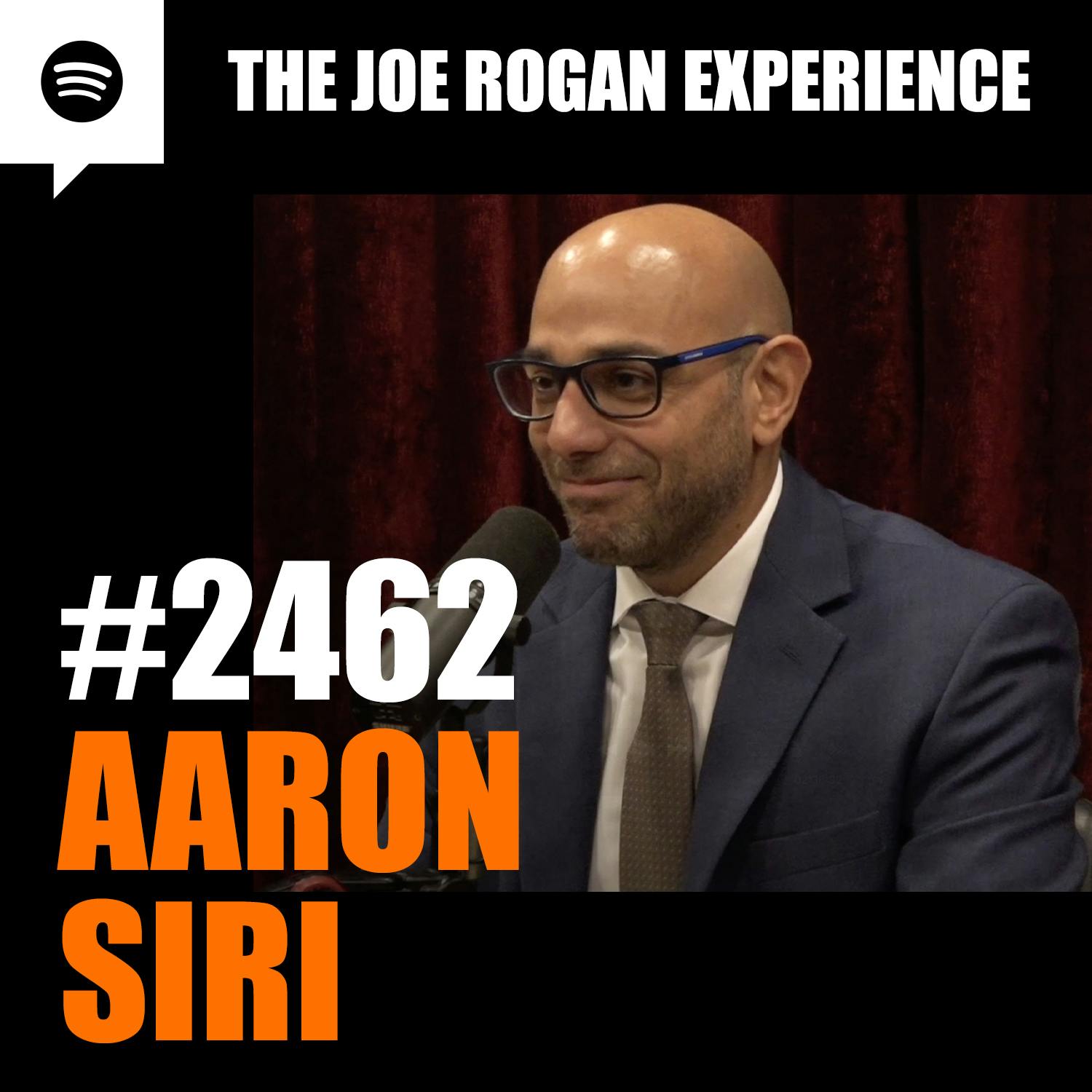
The Joe Rogan Experience — #2462 - Aaron Siri. Machine-transcribed; use the interactive transcript above to jump the player to any line.
The Joe Rogan Experienz So you had a pile of notes and then you just folded them up, like did you commit them to memory? No, I've just these two things. I have the links I sent you guys. Oh, okay. And just some stuff there. I just saw the piece of paper that you folded all the way to there. How did, first of all, I want to talk you through, like, when you were a younger man before you had looked into this, what was your opinions on medical science? What was your opinions on vaccines? Were you skeptical or did you just kind of assume that everything that we're told is exactly how it is and the experts have only the best interests of human beings in mind and not money? I had what you would effectively call the mainstream view. Yeah. Vaccine saved humanity. Me too. We'd all be dead without them. Yep. There was the Bible giving it to Moses outside and then there were vaccines.
Yeah. That's basically, you know, I think it's anybody that didn't consider themselves a fool. You know, you would have to be a fool, like a real fool, to ignore all this medical science, which is the reason why there's so many people alive today that would have died. And a lot of that's true. What penicillin antibiotics, there's a lot of stuff that's saved a lot of people's lives. But the vaccine won until this COVID epidemic, I would have never questioned it. I mocked anti-vaxxers. I was like, these people are silly. Don't they know all the good things that vaccines have done? And there's the blatant propaganda that we were force-fed, like one of those ducks are trying to make fogwaweth. It just made me stop and pause and goes, the whole thing like this, is this whole thing just a dirty money laundering operation? Because it kind of seems like that's at least part of the reason why they were telling people to get boosted when they knew it wasn't working and telling young people that didn't
need it. They wanted to make a lot of money. That's the only reason why you would do any of those things. After a certain amount of information is out, and so it just made me stop and think about the whole thing and go, well, why would I assume that this is the one area where pharmaceutical drug companies, doctors, everybody's been totally honest in this one area, when it's like a religious thing, if you question it, and that's the, well, I love the title of your book. Yes. Vaccines, amen. Yeah. The religion of vaccines. You, that's what it is. It's a religion for secular, intelligent people with a higher education. And it causes incredible cognitive dissonance for anybody out there to come to the conclusion that the CDC and the FDA and our public health authorities and what the entire medical establishment has been telling you may not be accurate about vaccines.
Because like what you just said, the claim that you're a flat-erther, you're an anti-vaxxer and not, they're used as a way to say, you are really out there and dumb, right? They're completely equal in their impact. And so it takes incredible cognitive dissonance to say there are real problems with vaccines, but vaccines really sit in their own little universe. They're unlike any other medical product. They're not like penicillin. They're not like any other drugs. They're not like any other product out there. Any other product in this room, anything out there, for one major reason. Every other product that exists, I can sue the company. I can hold them accountable if that product injures or kills you or your child on the basis that product could remain safer. The only product, and I mean this literally, the only product in America where you cannot
sue to say, how did you made that product safer? My child wouldn't be dead. My child wouldn't be seriously injured. They wouldn't have a neurological disorder. They wouldn't have immunological disorder. They wouldn't have a nervous system disorder. They wouldn't have a cardiac issue or childhood vaccines and child vaccines used by adults. It's the only one. And that's because of a law called the National Childhood Vaccine Injury Act of 1986. They gave pharma companies that incredibly special immunity. Now, just to put that into context, and I'll tie this back in a second as to how we ended up with this notion of this belief, religion, and vaccines because given industry 40 years of unopposed ability to influence, they're going to get pretty dang far and they did with vaccines. And so, you know, a lot of industries face across roads where their products are causing
more harm than good. Gas tanks used to explode. What did they do? They had a better gas tank, all right? Building materials had a spestus caused cancer. What did they do? They make a better building materials, all right? Did they give them immunity? No, of course not. But in the instance of vaccines leading up to 1986, there were only three routine vaccines. That's it. That's all there was. A child following the CDC schedule in 1986 got three injections on it before the first birthday, okay? Those three products were causing so much harm in injury that every manufacturer of them went out of business. And that was the MMR vaccine, the DTP and APV vaccine. Every single one from six down to one or for the peer test vaccine, six down to one from measles, about three down to one from polio. And with one company left for each, instead of forcing them to do what every other industry has to do, like I said, make better building materials without spestus, make better cars
that don't explode, go down the chain of different products out there, Congress did something completely unique. It said, you know what? We're just going to give you immunity. We're going to make it so that no company, excuse me, no individual, no parent, no child can sue you for the injuries and deaths caused by your vaccine products. That is what the National Childhood Vaccine Injury Act in 1986 did. And not only for those three products, but for any other childhood vaccine thereafter. And what that effectively has done is given 40 years for the industry to promote their products, no pushback. When you read about a problem with a car, where you're reading about it from, usually the class action lawsuit in the paper, right? Not going to read about that in vaccines, typically. And because of that, you ended up where we are anyways. There's a lot more detail to up, but I'll stop there for now. No, please keep going. Well, I mean, when you think about what makes products safer, right, because I've got
a law firm with over 100 individuals, I'm the managed partner of the firm. Half my firm does all types of play to decide class actions. You can hold companies accountable for almost anything. Your data. We do hundreds of data breach cases, genetic privacy cases, biometric privacy cases. We do all types of lawsuits like that nature, by the way, and New York Times loves those lawsuits, by the way. That's stuff nobody attacks me for, okay? Oh, making my privacy better, protecting me from cars that explode, oh, thank you. Make vaccine safer. You want to kill everybody? Okay. But that's where it's really weird. But well, here's where I think I'm hoping I can make it make sense without causing cognitive distance. So going back to how we make products safer in America or anywhere, okay? It's not the government. Governments don't make products safer. Look at extremely authoritarian regimes where there was very little free market like the
former USSR. You think products are safe? No. What makes products safe? It's the economic self-interest of the company. It's the economic interest of the company to make the product safer. Why? You probably own stock, right? And where do you want your stock to go up or down? How do you want it to go? You want it to go up? We want to go down. Where do you want it to go? You want it to go up. Okay. So do all the investors. Right. So does everybody who owns that stock? So does Wall Street. So does the CEO. So does the board. So does everybody. The people of the stock, everybody involved. All the employees that have stock options, including them, usually the major ones, everybody wants it to go up. If you lose money, it doesn't go up. So normally, the interest to assure a product is safer is aligned with the profit motive. Because if your product causes injury and harm, then you're going to lose money. So you'll want to know typically. You have an economic self interest as a corporation to know that could you're all
twisted, that could you moral, that could you ethical, just because you have that economic self interest to assure the product is safe before you go to market and after you go to market. Okay. And that exists for every product in America with effectively one exception, vaccines. That's really it. This episode is brought to you by Squarespace, the all-in-one website platform that helps you stand out online. And I can say that because my website is powered by Squarespace. JoeRogan.com is a Squarespace website. Squarespace makes it easy to secure the best name for your business and they provide privacy and security tools to ensure your domain remains protected. Head to Squarespace.com slash Rogan for a free trial. And when you are ready to launch, use the offer code Rogan to save 10% off your first purchase of a website or domain. This episode is brought to you by Zippercrooter. When you want to train your dog, you don't want just any rando off the streets who likes
animals. You want someone with the skills to get your pet where you want them to be. Someone who can help you help them. So why wouldn't you do the same when it comes to hiring for your business? Skill-based hiring is the thing to do right now. And a good way to go about that is Zippercrooter, especially since you can try it for free. At zippercrooter.com. Zippercrooter can help you find the perfect match for your role. Their smart matching technology works fast to find candidates while screening questions help ensure you find quality talent with the skills you're looking for. It even has filters you can use to see who's been recently active on the site. Let Zippercrooter help you find amazing candidates with the skills you seek. Before out of five employers who post on Zippercrooter get a quality candidate within the first day. And now you can try it for free at zippercrooter.com slash rogan.
That zippercrooter.com slash rogan. Meet your match on Zippercrooter. Now, I'm going to show you one result of that in practice, okay? When you think of drugs, and this will help, I think, tie into what you're saying about what happened with COVID, most drugs are licensed based on multi-year placebo control trials. Most of them. Why? Because the FDA requires it, because the FDA is so great, no, nothing to do with the FDA. It's because the company wants to know whether the drug is safe or not before it goes to market, because you know what happens with the drug that they put out that's going to make 40 billion in revenue or 20 billion because it's 100 billion in harm, they end up upside down. So they want to know to a reasonable degree how safe the drug is before it goes to market. In an attempt not to cherry pick, as I did in my book, I found an article that listed
the top four selling profitable drugs by Pfizer as of like 2021 or something 2019, okay? If you look at those four most profitable drugs, as I put in my book, each one has two to seven years of follow up in the clinical trial that was relied upon to license that drug against a placebo control group, just to make sure everybody knows what that means, but that just means a group that gets something in there. So this way, you give it the group the experimental drug, you give a group the placebo, something in there. You track them for multiple years, and then you compare all the outcomes, cardiovascular outcomes, neurological outcomes, and you go down the list, and cancer rates, and you see the difference. You get a real actual sense of the safety between those two for that product. In contrast, for most childhood vaccines, instead of years, it's often days or weeks
of safety review in the clinical trial, a lot about to license them. Not a single, and I know that folks can test all time, but it's in the FDA literature. Not a single routine injected childhood vaccine was licensed based on a placebo control trial, safer the COVID vaccine by the way for children, it's the only one. Not a single one, okay? Nor was the vaccine sometimes uses the control itself licensed based on a placebo control trial, nor anywhere down that chain. Chapter 10 of my book, I go through every vaccine, I go through, I have it all cited to the FDA Leicester documents. You can listen to the talking heads, or you can rely on the primary sources from the FDA, which is why I call my book vaccines amen because there is what they tell you, and then there's what the actual evidence shows, right? So that gives you an example of the outcome of not having an economic self-interest with
drugs, they have it, so they want to know the safety. Can I challenge you on that? What about Lyox? Like the Lyox people knew that there was one of the things that was revealed during the trial, was that they knew that there was going to be issues, but they, I think the quote buzz, we still think we'll do well. And that was one of the damning aspects of the email disclosure, because you got a chance to see how these guys talk about this drug that they're about to release. I think they wound up paying a percentage of the amount of money they made from the drug, but they made way more from the drug than they did the fine. No, I appreciate that challenge, and it's why I said, when I was saying that they do the analysis of whether they're going to have 100 billion in loss or 50, 40 billion in revenue. They're not saying they won't put out a drug that causes harm. You're saying, because they cause too much harm. Exactly. They can't, they don't want to end up upside down. And remember, the whole reason a drug is licensed is because it caused harm.
The crazy thing about the viox one is I think it killed somewhere north of 50,000 people, and they still made profit off of it, which is kind of bananas. They pulled it and made billions in profit. This is the darker aspect of this. If you were talking about companies that never did anything wrong, it had the highest moral and ethical standards, and they're the ones, because it's not about money. It's about saving people's health, and it's about public safety, and we've got to make sure that we do this right. We've got to make sure we squash all the disinformation, but that's not what you're talking about. We're talking about these companies that have been fined billions, billions of dollars in criminal fines for fraud, for all kinds of shit. These are the people, and the idea that they wouldn't lie about vaccines, like this is the one thing that they're going to tell you the truth, ruthless, capitalist, attached to money and drugs. This is the one thing they're going to 100% tell you the truth about.
That seems kind of cookie. That's a hard sell for anybody who's not ideologically captured. That's a hard sell. Yeah, but I don't think you need to go down the road that there's some kind of evil nefariousness there. No. That's what I'm saying. It's a broken economic and regulatory system from my perspective. It's just a completely broken, you know, to your point about viox, right? So in viox, it causes incredible amount of harm, but they still decided that the benefits don't raise the risk. Do you know the story about the cars that you should explode? That's the classic case we learned in law school. And the gas tank and these cars... Was it a Pinto? It was the Pintos. That's right. And a number of them explode every year, burning the people inside them alive to death. Right? Horrible. Way to go. And there was a lawsuit. And in that lawsuit, what they discovered was the company had done an internal calculation in which it did the math. What's going to cost to actually fix all the gas tanks?
That's that dollar number versus what's it going to cost to just pay out for those deaths every year for those people that we burn, knowingly, are going to die and burn to death in those cars. And the calculation was that it was going to cost less to pay out for the deaths. And that is what the internal document showed. And that, by the way, is in part the quintessential case you learned in law school for why they have punitive damages. Because the punitive damages were there to force the company to conform its conduct in exactly that scenario where the economics weren't going to do it. Right? Even in something that horrible when the market forces weren't sufficient, the economic self-interest wasn't there, you had to make it happen. How? Through punitive damages. I know there's a lot of, you know, news about punitive damages, oh, it's successive and so forth. But that's what they're there for. There for that scenario where we're just holding the mechanical and now go back to vaccines.
Think about how incredibly harmful and how much harm these vaccines must do that they cannot survive on the market without this immunity from 1986. Think about that. If you were going to steal me on the argument against that, wouldn't you say, look, these are, we can't have frivolous lawsuits against these people that are providing us the most important medication that's available to humans. The whole reason why we survive smallpox and polio and all these different things, it's these vaccines. Without them, we'd all be dead. This episode is brought to you by Montana Knife Company. I have used their knives for years. They are absolutely fantastic. The company was founded by one of the most experienced master bladesmiths in the world. My friend, Josh Smith, he has been making knives since he was a kid. He's been making knives for 30 years. He made his first hunting knife when he was 11 years old and became a master bladesmith at 19.
This man loves knives, the construction of knives. They are absolutely next level. Everything is made right here in the USA in Montana and these knives are designed, tested, and built by hunters. They come insanely sharp out of the box and are crazy, easy to sharpen. Montana Knife Company is a young company working hard to keep up with demand because these knives sell out in minutes. If you want one, head over to MontanaKnifeCompany.com to see what's available now. Sign up for the email newsletter so you know when they restock and get in on their SMS notifications for special knife drops. My personal favorite blade is the Speed Go 2.0. I use it all the time. It's an amazing knife. Montana Knife Company working knives for working people. Let's just assume that the last part of what you said is true, which we know it's not. But with that said, let's steal man in it. Yeah. Let's steal man in it. Yeah. Easy response. Okay. Okay.
Drugs, drugs that are for very small populations, meaning not a lot of market, not a lot of sales that cause incredible side effects can survive in the market profitably. Think about that for a second. Why? Okay. Here's why. It's a little bit of legal stuff, but it's not that hard. It's not that bad. Okay. The primary claim you would typically bring against a product is the claim that it could have been made safer. It's called a design defect claim. It's a claim where I say, hey, had you put in a two-cent stopper on that gas tank, it wouldn't have exploded. If you had put in a one penny plastic shield on that saw, I'd have my finger, okay? And defect claim. The claim you could have made a product safer. It is the primary claim you would bring for a product, okay, injury claim. So how do you protect against it? You make the product as technologically safe as possible, right?
So if you have a drug that causes incredible side effects that we just talked about, make the drug as safe as possible. Make sure that there are no contaminants. Make sure that you use the best possible ingredients. Make sure the combination, right? The safest adjuvant, go down the road. That's number one. Number two, the second way you hold an account was you bring a claim called a failure to warrant claim. I failed to warn you about the harm that the drug could have caused, okay? And so what do you have to do there to protect yourself? The company has to disclose all the potential harms. If it has it right there in the package insert and you get it and it says, hey, it can cause this, this, this, this, this, you were told you chose to still take the product. They made it as safe as technologically feasible. They disclose the risks and that is how companies typically limit their liability with medical products with drug products, okay? Why can't they do those vaccines? Why can't they just make them as safe as technologically feasible? Can't assume for design defect and disclose all the actual risks in the package insert,
okay? The logical conclusion is that and one other point to that and I'll respond to your steel man, okay? And it's this, all right? It's been 40 years for some of these vaccines. Happy vaccine, for example, licensed in 86 and 89, the two stand-alone. It's been 40 years, you're telling me they still don't know it's safe enough to lift that immunity. You're giving it to millions of kids a year, you're making billions of dollars on the sales of this product and you still don't know it's safe enough to lift that immunity, please. Um, okay, if I was a silly person, okay? I would probably say these vaccines are more important than any medication that's ever existed because they are the reason why we are here because that's how we survive small pox and polio and the measles and everything else. And without them, we would have perished, we would have never achieved the technological states that were out because we wouldn't have been healthy. We would have gone through mass plagues. Okay. I'll respond. So, because of that, it's just important that they stay in business.
Well, a few things were involved. And we trust the science. Trust the science. Trust the science, yes. Belief. Aaron, trust the science. Yes, sir. Amen. Amen. Amen. Yeah, I try not to do too much believing and I try to do a little bit of, you know, evidence based thinking. But any event, look, when it comes to these products, I saved my beliefs for religion, the unanswered bulls. Where do we go when we die? Right. And so forth. I have to take a leap of faith and I do it when I need to, but you don't need to with these products. Okay. So, on the first part of what you said, first of all, there are products probably that are far more important to humanity at the moment. No question about it than vaccines, even assuming it had the results that you just claim which I'll address in a second. Imagine you said you won't look cars are essential. I mean, you can't get an ambulance, you can't get to a hospital. Without cars, you can't get to work, you can't get to kids to school. I mean, it's essential to a functioning site. So, let's give cars and media liability. Intuitively, you'd say that's ridiculous. Right. That is one of the myths.
That is one of the mythologies around vaccines that has developed over time. This notion that everybody in America die without vaccines. In chapter seven of my book, and I lay it out for every single disease. And what I do there is I say, okay, how many deaths were there in America the year before the vaccine was first introduced or widely used or so forth, okay? And any real degree. And what you find is, if you go down the list, there were typically dozens to hundreds maybe a thousand or so deaths from each disease for which we vaccinate. The further back in time you go, the larger the number in that dozens to a thousand or so deaths, okay? For example, measles, the dreaded measles that they say everybody will die from. No measles vaccine we're all going to die, right? That is the impression they give you. Do you have any idea how people died of measles in the years before there was a measles vaccine in the United States? I mean, found 400 a year.
That's it? That's it. 400 a year, died in the United States at a time when everybody had measles which comes out to about one in 450,000 Americans dying of measles that's in the CDC. Anybody listening to this is like, come on, that's not true. CDC mortality documents on the CDC website cited in my book 400. And don't about 50,000 people ever you're dying from the flu? Well, that statistic includes bacterial deaths that they say are potentially the result from having influenza. So your immune system gets weakened and then something else hits you? And that kills you? Is that the idea behind it? Well, that's just the way they gather the data, the way I'll put it. But with influenza, let me if I finish up with the measles, because I think this is important on the measles one and I can deal with influenza as well. But on the measles one, just to really, because you're saying, well, everybody would die
without these. I don't think people think of influenza, by the way. They think of measles. They think of those diseases. Right. I don't have her here. Everybody say to me, well, everybody would die of influenza without influenza vaccines. It's available, everybody can get it. The mortality hasn't changed much. In fact, if you look at the mortality from influenza before influenza vaccines were widespread, we're not doing that great. Okay. Anyway, putting that aside for a moment, not only that, isn't there data that shows that if you get it, you're more likely to get other colds? Yeah, I have a whole giant footnote in my book about this and I've actually tweeted this out and there's stuff stuck about this. A whole series of articles, studies that show that those that have had the influenza vaccines, maybe the studies often reflect have around the same rate of influenza, maybe they have less respiratory influenza infections. But many studies show they have multiple times the rate of other respiratory infections.
So good job. Maybe you reduced your risk of influenza by this much, but you've increased your risk of another different respiratory disease by that much. How much is it? How much of the increase? Depends on the study. Some studies show four times versus some studies. So three times versus, yeah, I mean, little three for, I mean, huge percentages. And they're statistically significant in these studies. And so, you know, when you were looking at, you know, these are all retrospective epidemiological studies. And, but when you do a retrospective epi study, which means you take existing data and then you study it versus saying, okay, we're going to do a study and follow people going forward. Okay. If you find like a 1.3 time, which means 30% increase risk, like that's a public social finding. This is three, 400% increase risk. Yes. And in many of these studies, it's inconvenient data, so obviously it's not talked about. Right. So 400 people is not a whole lot. I'm sure, I mean, it's sad when 400 people die. But it's also one of those diseases that when you're a child, it's much more survivable,
right, than adult adults, it's rough, isn't it? Yeah. So, measles, the ideal age to get it is not when you're an infant, which in the pre-vaccine era infants typically did not get measles because they got maternal immunity from the mother. And you don't want to get it as an adult because it is more likely to cause problems, which again, in the pre-vaccine era, wasn't a problem because everybody virtually got it as a child. Right. Yeah. And when you got it as a child, my recollection of it was the episode of the Brady Bunch. Do you remember? Yeah. Never that episode. Let's watch this. We'll find that clip, but let's watch it because it's so indicative of what measles was actually like in the culture of the people that would get it all the time versus this boogie man of today. I mean, it is, it's so stark, it's so, I mean, it's like, imagine the kid coming home, hey, mom, I've got AIDS. I got to stay home from school.
It's not that, right? It's the way that most folks who've had chicken pox think of chicken pox. Right. But we're told that it's killing people. We're told that it's killing people now. We're told that it's killing, it's always kids, we're told it's killing kids now. Yeah. And, um, look, if anybody dies from measles, I'm very sad, but I want to know, is it with measles? Remember the with COVID or from COVID? Like, what kind of condition would these people in before this hit them? Because some, I mean, that was the thing about COVID. It's like, yeah, it's fatal. If you have four plus comorbidities, that's, it's more, you're more likely to be fatal. That was most of the people that wind up dying from it, right? That's almost certainly the case and I can, I can add another data point to that to help support that, which is that between 1900, and this is again, CDC data, between 1900 and the late 1950s, early 1960s, the mortality from measles declined in the United States by over 98%.
You know what didn't cause that? Vaccines. Yeah. Because it didn't exist. I know. Right. The community had become a herd thing, just like COVID-ish right now. Well, everybody basically has had COVID, or at least it's exposed to it by now. Yeah. Here it is. Watch. Yeah. It's a whole episode. There's multiple clips. I don't know which one is the last one. There's one. Just, just, let's just try. I think it's, he finds out he's coming over, put on your headphones for a second so we could hear this. Aaron. Oh, yeah. Grab your headphones. Thank you. No. Are you sure it's the measles? Well, he certainly got all the symptoms, the slight temperature, a lot of dots, and a great big smile. A great big smile. No school for a few days. You. You've gotten measles. Golly, mothers are supposed to know everything, but do you have to keep proving it? You've got a temperature too. What do you mean too? A peter was sent over to school a little while ago. Oh. What was his temperature? 101.1. Oh, is that all? I'm 101.2.
Oh, great. You want my railroad? I'll be a sport. You can ride on it free. Thanks a lot. It's your turn, peter. I know. So you're having a measles party? Oh, Mr. Yep. Boy, this is the life, isn't it? Yeah. If you have to get sick, you sure can't beat the measles. That's right. No medicine. Insider out. Like shots, I mean. Don't even mention shots. Yeah. Okay. I mean, am I crazy? Or have we gone through one of the wildest gas lightings of anything ever? There's people out there that because of the things that you've said so far about the measles, we'll be 100% freaking out on Twitter, right? But this is a window into how the American public thought, I know it's a television show, I know it's a sitcom, but you can't joke around about stuff that other people wouldn't think is funny. Every people would think that was funny. These kids saying, if you're going to get sick,
you should get the measles and everybody at home be like, oh, I wish I had a day off. Well, that's how they thought of it. Yeah. And to put hard data on it, going back to that statistic, over 98% reduction. Remember, it's not like COVID, Joe, because COVID, there was no immunity in the population, right? Right. Measles has been around for forever, as far as we know, thousands of years. The year 1900 wasn't the beginning of herd immunity. 1900 measles are already endemic. Everybody was getting measles. So every year, there's a few million people cohort that were getting it, and you had the decline. And so you have to ask yourself, what was the decline? It was probably better sanitation, better medical care. I mean, all kinds of things. And you know who could take credit for most of that stuff, better sanitation, better living conditions, better you name it, probably public health authorities. Meaning the improvement in acute care,
the introduction of antibiotics, better living conditions, not having sewage in the street, you name it, right? Probably had a massive contributor to that reduction, but they never point to that. And there's one other really inconvenient data point with measles, and this is really where it gets upsetting for folks out there who you were just saying, we're going to watch the show. And it's this. That would, over 98% reduction in mortality, there's no reason that that curve was not going to continue. Because pockets of the United States in the late 15 or early 60s were like a developing country. In a developing country, kids are going to die of any infectious disease because of extremely poor living conditions. And as those improved, most likely that 400 deaths also would have continued to decline. 4.2 million births in the United States in the late 50s or at least 60s, about 3.8 million births today. So in fact, there's less children being born in America today than there was then. So you have a smaller cohort of babies, young children, to in fact, and final data point, and it's this.
And this is really, I know this is, this is going to cause cognitive dissonance for some. But studies that have looked at those that have had measles versus those that don't find that those that have had measles have a statistically significant greater reduction in deaths from cardiovascular disease and various cancers. So I'll give you an example. There's a 20 year, 22 year prospective study in Japan, funded by the government of Japan and major universities that tracked 100,000 people in Japan for 22 years. And it found that those that had measles and mumps had a 20% statistically significant decline in deaths from cardiovascular disease. Think about that for a second. Just think about that. About 800,000 Americans die of cardiovascular disease. If eliminating measles and mumps has increased cardiovascular deaths in the United States by even 1% on a life years lost basis,
you are still way upside down on your public health benefit by eliminating measles. Can I ask you what the speculation is of how that could be? Why would measles and mumps infection at early age improve your health cardiovascular? Why would it also, those that have not had measles have a 66% increase rate of non-hostile lymphoma and 266% increase rate of Hodgkin's lymphoma, which kills 20,000 people a year. Why would women that have had measles have 50% less ovarian cancer, which kills a lot of women every year? What is it about it? Maybe. And here's the thing. I'm, you know, and you can have a evolutionary biologist to talk about this as well. You've had some on. Think about it this way. Pathogens have come and gone throughout the ages, right? Right. This one didn't. Measles, mumps, rebella, chicken pox. They didn't. It could be, maybe. I'm not saying it is. I'm just saying this is what the data appears to reflect. What I just told you about with cardiovascular disease
and cancer, they're all in PubMed. They're all PubMed studies. They're all in the Published Literature and they're all consistent having the findings that I just described, okay? I'm just a lawyer. I'm just repeating to it the data reflects. It could be that having those furbrow childhood infections conferred a survival advantage overall. And it could be the reason they never actually went away over time, became less obviously pathogenic. This episode is brought to you by Netflix. I loved Peaky Blinders. It is one of my absolute favorite shows of all time. I binge watched the entire season, all the seasons. So when I found out that Netflix was dropping a Peaky Blinders film, I was very excited. Tommy Shelby played by the Academy Award-winning Killian Murphy, of course, must face his own demons and choose whether to confront his legacy or burn it to the ground. It's gritty, it's grimy, it's got that epic gangster edge. We've been hooked on for six seasons. Trust me, you won't want to miss this.
Peaky Blinders, The Immortal Man, is in select theaters, March 6th, and on Netflix, March 20th, rated R. This episode is brought to you by Life Lock. Are you a fraud-paying American? Well, it's a fact that one in four honest, hardworking, tax-paying Americans has been a victim of identity theft. With Life Lock identity theft protection, though, if your identity is stolen, they fix it, guaranteed. And you get your money back. Last year, the IRS flagged over $16 billion in refunds for identity fraud. That's billions of dollars that could come from your salary, overtime, or second job gone. And who pays for that? The fraud-paying Americans. But this year, you don't need to stay a victim. Life Lock monitors hundreds of millions of data points per second for your personal information and alerts you to threats that you could easily miss on your own.
And if your information does fall in the wrong hands, only Life Lock has US-based restoration specialists who are backed by the million dollar protection package. Because this tax season, no one should claim to be a fraud-paying American. Visit lifelock.com slash JRE and save up to 40% your first year. That's 40% off at lifelock.com slash JRE terms apply. So it has like a hermetic effect and it makes you physically stronger somehow or another. It makes your immune system stronger, your cardiovascular, like a stress test. That means not outside the realm of possibility, right? I mean, if lifting weight makes you stronger and studying makes you smarter, would it make sense that some form of infection that you recover from will make you more resilient? It does make sense. It's just like no one wants to say, hey, you should go get measles. Look, fear of relativity. Yeah, fear of relativity is not intuitive.
Why is it as you approach a more massive object or approach the speed of light does time relatively slow down? I don't know if it makes sense or not. It's just what when you put two atomic clocks on a plane, one on the ground, one on the plane, you fly it around the earth. They're not ticking the same. So there it is. You can't pretend that's not there. That is what it is. It doesn't have to make sense to be true. That's a good point. That's just what it is. And I'm just saying what the studies show. Very inconvenient, a lot of cognitive dissonance there, but it could very well be that our whole, this whole program, not only do we, so go back to your whole, go all the way back to your point. You're like, well, they'll say vaccines are so important. We gotta give them this immunity. No, in fact, quite the opposite. Our babies are so precious, are so important. We want to make sure we have the safest possible product you couldn't have. And the way to do that is to make sure the companies have an economic interest to make sure they're as safe as possible. I agree with you entirely, but if I was questioning anything, I would say, okay,
if we don't have genetic immunity anymore, because our parents didn't have it, because our parents are vaccinated against measles, wouldn't it be better to keep vaccinating people rather than let a whole bunch of people with no immunity to measles get it, particularly like older people? So, this is a really important point, actually. I agree with you in the comments. Because here, well, I just thought before we get going, when they mandated vaccines, or when they started giving them to people, was what, in like the early 60s, I believe? For measles vaccines. For measles, 63. Did a lot of people resist it? Was it back then where the hippies opting out, or is there like a group that you could follow and track it, never got it, never got the vaccine, while everybody else did? It has to be, right? I'm sure there is a group out there you can identify, I mean, the Amish. There you go. Right. So, you know, we represent right now, because New York's trying to basically kick them out in New York for not vaccinating. That's great.
We just, we just, in the US Supreme Court, we were just successful in vacating the lower court decisions, just a few weeks ago. Do you remember when Kathy Holtchell was talking about the vaccines, like their gift from God? She believes it. But do you remember how she was saying it? And it's like, in any other business, if you were running a pharmaceutical drug business, if you were running a Chevy, and you're making a new Corvette, and you started talking about how this Corvette is a gift from God, everybody would go, oh, Kathy's cracked. Like, what are you talking about? It's a bunch of engineers, we put together a great car. Like, what are you, it's a gift from God? What? People don't say, I believe in tables, I believe in chairs, I believe in TVs, I believe in wallpaper, but they say I believe in vaccines all the time because it carries a truism. But do they work? Does the measles vaccine prevent people from getting measles? Or is it a leaky vaccine? Is it a completely, so answering that Andrew Pryor question at the same time, sorry. No, no, no, don't be sad. I'm very scattered.
No, that's not all. Is that, is that, is that the measles vaccine, measles, MMR vaccine and chicken box vaccine can prevent transmission. That is not true of most vaccines, but those can't. So, those can. Those can, and so to your, now going back, so that's the differential. And in fact, for most of the other vaccines, like pertussis vaccines, so forth, they make you more likely to spread the pathogen if you're vaccinated, and I can tell you all about that. But before I do that, let me just point out that to your last comment, because measles, MMR vaccine and chicken box vaccine can prevent transmission, you are correct. If measles were to come through society right now, right now, in the current time, it would be problematic because babies who aren't supposed to get it would be more likely to get it because the mothers aren't confirming the same eternal immunity that they did in the pre-vaccine era because the vaccine doesn't confer the same level of immunity anywhere near.
And older folks, because the vaccine is nowhere as efficacious as having had the infection, depending on the study, two to 10% do not zero convert, even after two doses, meaning they are not getting immunity at all, pretty much, or immunity as considered immune. Is this when they take it later in life or when they take it when they're young? This is when they take it when they're young. And that's when there's a measles outbreak, a lot of times you'll hear a call to even have folks who are older get the measles vaccine again, right? There's guidance on that because it doesn't confer. If you've had measles, you're done. You're never need a vaccine. Again, you'll never get measles again, one in done. But so, yes, it would be problematic right now for those, for MMR, measles most rebella and chickenpox to just kind of let it rip. You would have to really have an educational campaign beforehand if you were gonna do that. The other vaccines, happy vaccine,
pertussis vaccine, not a problem. Those vaccines don't stop transmission. And I want to go into that. Kind of crazy that they give that to babies. Kind of crazy. Kind of crazy if the parent aren't individual drug users or whatever, whatever would give them, have be, that you're gonna inject a baby with a vaccine that prevents them from getting a sexually transmitted disease and like, are rarely sick. You gotta be doing something rough, you know? Joe, you just don't understand what goes on in the NICU. Yeah. I mean, yeah, that's it. It just seems crazy. It is. And here, I'll give you another data point, which is in Denmark, okay? There is no happy, universal happy for kids. The only time they give happy in Denmark is if the mother is happy positive. So their happy vaccination rate amongst children is like 0.1% or something to that effect, okay?
So here you go. Two first world countries, American, Denmark. Universal happy here. Virtually zero happy vaccine given there. The rate of happy amongst children not statistically significant. You know, it is different between those two countries. The rate of harm from happy vaccine. That's different. You know what a baby's never died of on the first day of life? Hepatitis B. You know what a baby has died of on the first day of life? Hepatitis B vaccine. In fact, it adjudicated us such not long ago for a newborn that died from a happy vaccine. And I said earlier, you can't sue the manufacturers. You cannot. There is a little program though in the federal government where you can bring a claim if you're injured from a vaccine. That's what I'm talking about right now. I went about that baby that died of happy. Right. It's called the vaccine injury compensation program. I have like 20 folks in my firm that do that work. And you know, it's not like a regular court. You don't get an article three judge, article three of the Constitution of federal judge. You don't get any discoveries of right, which is how you prove harms.
There's a $250,000 statutory cap and pain and suffering and on-dath, which is ridiculous. And it doesn't have, you know, anyways, long story short, it's paid out about $5 billion for damages and so forth from vaccines over the years. But so, so I didn't want people to get confused like when I said, well, how did this baby get adjudicated? Right. Which got adjudicated in this program. Got it. Yeah. So when you have conversations with people and they are the way you used to be and the way I used to be, where you just sort of just assumed that these, the people that are experts in their fields are doing a great job and that's why we're alive. And you start telling them these things. Like are you a real problem at a cocktail party? Like do you ever, have you ever had a conversation that just went completely sideways and they started getting angry at you for quoting things? Yeah. Because that's a, it's not a problem for me because I don't know motions or feelings about the products. They're just products.
They're no different for me, but a lot of folks, there's two things. First, for some like medical professionals, a lot of them seem to drive a lot of their self-schema almost. Their value, their worth in these products, they saved humanity. How could you question them? We are the saviors, right? In some respects, almost like supplanting God, right? What's the only thing that will save us during COVID? Was it God? No, vaccines, that's the only thing. And then for others, they think that they know, okay? But they don't know intellectually. They've never looked at the primary sources. So when you challenge them with evidence, what can they draw from, they intellect? No, they draw from their emotions, they draw from their feelings and that's why they get angry. I get that all the time, but I also often get folks who are just curious and interested to listen. Well, I think there's more of those now than there's ever been before. Absolutely. I think COVID, in that respect, forced the conversation you had,
millions of people who were listening to basic stuff that 10 years ago when I started doing this work, nobody talked about what is a placebo? What's a clinical trial? What's this stuff? Like this became, or even the idea that a vaccine can cause a harm just that notion was totally taboo seven years ago. No more. Yeah, I think you're entirely correct and also credits to YouTube because YouTube doesn't suppress this stuff anymore, which is why I found dozens of interviews with you on YouTube. I mean, before, I mean, I'd seen some of your stuff on social media, but then I've watched a bunch of your stuff now on YouTube, whereas during the pandemic, everything you said, you would have got removed. I was removed. Everything I said was removed. I'll tell you the first thing they ever had posted that got set, it was on Twitter. Yeah, the old Twitter. So we brought this lawsuit against the FDA to get all the documents they relied upon to license Pfizer's COVID-19 vaccine, okay? They licensed it in 42 days and we said, all right, for 42 days,
give us all the documents, right? And they want the forever. They want to produce at a rate of a few hundred pages as much as we were to take in hundreds of years effectively. Got a tranche of those documents. Took some of them. Literally took one of the documents and posted it. And my tweet was just literally quoting from the document effectively, and that was taken down as misinformation. Pfizer's own documents submitted to the FDA. One of the first things that was just, that was mind-jarring. It was stunning. It was stunning to watch people not be outraged too. When information was getting out about different people that were silenced, Jay Bhattacharya and all those different people that were getting attacked, Martin Koldorf, it was stunning how no one was going, hey, what is going on here? This seems really where you're removing posts from guys from MIT and Stanford and banning their accounts. Like, that's fucking crazy. And until Elon purchased Twitter, we really didn't know the extent of it. We didn't really, we really weren't aware
if that it was government involvement. They were stepping in to remove and remove mal information. That was my favorite. They came up with, you know that one? Disinformation, malinformation. Oh, mal's the ball that it's got. It's true information that might cause problems, which is fucking almost everything. As soon as you have a problem with mal information, like you are encouraging the creepiest kind of group think that's available and no one freaked out. Well, a few people freaked out, but not enough. It wasn't, it should have been bipartisan. It should have been a bipartisan freak out. It should have been left and right, but it got politicized in this really stupid way where people on the left were pro-vaccine and pro-pharmaceutical drug company and pro-narrative and people on the right were like, I'm gonna take my chances. And those were the cooks. And, you know, it was this like ideological battle as much as it was a public health crisis. censorship was bad. It was very bad. Real bad. But I'll tell you what made me think people were gonna go
into the street with pitchforks was when the government told everybody stay at home. That wasn't hidden. That wasn't behind the scenes, the stuff you're talking about. They said stay in your house. They didn't say we recommend you stay in your houses. They didn't say we recommend you get this vaccine. We didn't recommend you wear this mask. They said stay in your house. When they had that first order came down. I was like, people are just gonna be outraged. People are going to protest and when they didn't, that's what dismayed me personally. And I'll tell you why, okay? Because when you think about civil and individual rights, first amendment, the right to free speech, the assembly. That was passed and adopted by the states in 1791. What's the first amendment intended to do? It's restrict government from infringing on those rights. You think life was easy in 1791? What do you think life was like in 1791?
You think it was easy? I think it was all honky-dory. Life in 1799 was brutal. Brutal. You took about disease, pestilence, famine, war. You want to talk about a life that is no electricity, no running water, no suit, nothing. And that amendment was passed for times that are more brutal than that. And here comes a virus. And every right you have is basically taken away. And Americans are like, take it, take it away. That is what outraged me because, look, what's the whole point of this country? What is America born out of? In my view, it's born out of the idea that every other government that preceded it got it wrong in the following sense. Your life should not be dictated by a king or a dictator or a polyburo or a central authority.
It's the idea that you are born with an alienable rights. You should be able to choose your destiny, including what risks you want to take. Individual rights come with risks. Letting Joe Rogan say what he wants on this podcast comes with risks. Letting you practice what religion you want, assemble with who you want, especially in Austin. It's a very interesting time yesterday. That comes with risks. Let me tell you, a lot of risks, okay? But the greater risk is always seating that right to the government, because once you do, you don't get it back often. And so, yes, there was that hidden stuff you talk about, and that was bad. Don't get me wrong, that was bad stuff. That's really, really bad. But the stuff they did in the open to me, in some ways, was even worse. And I hope that there's a lesson that folks learned from that, because let me tell you something. Even if you love every vaccine out there, you listen to this, you love every vaccine. You love every mask, right? Great, I support every Americans, right? You're 17, you're 18, you're totally healthy. No comorbidities, and you want to get a vaccine today
where 70 masks and living your basement and a self-imposed day at home order. This is America, I support your right to do, I'll fight for your right to do that. And you're 90, and you're a war veteran, and you want to go to the, you have 16 comorbidities, and you want to go to the coffee shop, with no vaccine and no mask, you should be free to do that, because that's America too, that's freedom also. Just like you can bull rod. And if you don't stand up for that right now, the day comes when there's something, a medical product you don't want, the government says you have to get, because trust me, it is so much cheaper, to lobby to get a medical product required than it is to market to get people to get it. Oh, they've learned that lesson. That's why there's so much lobbying to get mandates, get rid of exemptions across the country, that you don't want, and you can't get a job, and you can't go to school, and you can't leave your house. Then what good are the rest of your rights? They're useless. That's why medical liberty truly is a fundamental right. I'm off my horse. No, it's a great high horse. That was an awesome rant. You're absolutely 100% on the money,
and it's such an important thing to get out there, to get people to understand that you, it's such a natural human inclination to when you're in a place of power of control, any form of government, you want more control, and it's just natural. And what you were talking about when you lose rights, you very rarely get them back. That was so on display in California with the COVID regulations, because they had everybody locked down way past where they had to. A friend of mine's brother worked in one of the COVID, some government office, when they were considering the closing of outdoor dining, and he brought up, but there's no transmission related to outdoor dining. And the woman who was in charge said, yes, but it's all about the optics. So she was willing to, with a wave of her magic wand,
shut down outdoor dining for a bunch of small family businesses that were probably barely staying alive after COVID. Barely. We lost somewhere around 70% of Los Angeles restaurants went under during COVID. That's fucking bananas. And so they finally get outdoor dining. Like, okay, we could kind of pay the bills this month, and then they shut down outdoor dining for optics. So this kind of desire to just put a foot down, control people, keep a boot on their neck, it's normal. Even if it doesn't make sense, everybody knows that from high school. Everybody knows that from, I mean, the Stanford prison experiments. People like to control people. They enjoy it. And when they get a place like becoming the mayor or becoming the governor and being able to tell people, oh, you had to listen to me. I've got rule. Everyone stay inside, be scared. Fucking California, Garcetti literally had a campaign that said, snitches get rewards.
Snitches, snitching on people, having more than one person over your house, standing too close in the backyard. You get money. You get money for ratting out your neighbor. This episode is brought to you by BetterHelp in honor of International Women's Day. BetterHelp is celebrating the women in your life. I think we can all appreciate everything the women in our lives have done for us. And everyone deserves a little self-care. A good way to get that is through therapy. Because not only is therapy a time for you to focus on yourself, it's also a way to create balance and learn how to take care of your needs in your daily life. And BetterHelp as one of the largest online therapy platforms makes it so easy to meet with the right therapist. All you need to do is fill out a short questionnaire. You don't even need to go into an office to meet them. You can chat at home from your couch in your car before you hit the gym or while you're walking your dog. Plus, if you aren't jiving with your first match, you can switch to a different therapist whenever you need.
Your emotional well-being matters, find support and feel lighter in therapy. Sign up and get 10% off at BetterHelp.com slash JRE. That's better, H-E-L-P.com slash JRE. Well, when the government gets it wrong, they always, always double down. Because, and that's the problem with the mandates. Once they've acquired it, they have taken a position and then to admit they're wrong, often what government ends up saying is, oh, well, we're the CDC. If we admit we're wrong about this, that's gonna hurt our ability to influence the public and that's more important than admitting we're wrong on this or correcting course. Because our legitimacy, our ability to influence the public is so important, we have to, you know, we can't admit we're wrong. That's what Bobbi is doing right now when some of these things is, you know, when some of the stuff like the New Autism page on the CDC website, for example, is contrary to anything I've ever seen come out
of the federal health authorities today. But yes, it's disturbing and it's why government should, no public health authority should ever be able to tell you and infringe on your rights. They should be able to recommend, recommend like crazy, but never do it. Because that is the normal course of how tyranny dictators, dictators, bullies, thugs operate. First, they tell you what to do. You don't listen, apply a little pressure. You don't listen, and they mandate. It's still don't listen, they censor you. Still, take away more of your rights. That is the normal progression throughout history and we saw it happen in front of our eyes, which is why it should be a line in the sand. Federal health authorities, state health authorities, should be able to recommend and encourage never mandate, Fauci literally expressed it that way. I'm sure you've heard that recording of him. He said, once people realize they can't go to work,
they'll drop their ideological bullshit and they'll get vaccinated. Like he's essentially telling them, you're gonna make people's life hell and they'll do what you want them to do. Not they will have free will, they will have the ability to choose. No, no, no, you will make them do what you want. Who wants a government that persuades you on the merits? Forget that. But imagine that that is something that someone set out loud. But that, I don't think that what Fauci was saying is anything, Fauci, everything in my view that you saw during COVID is not like some giant leap into some new territory. To me, it's just another natural step in progression from where we've gone over the last 40 years of vaccines. Fauci saying that is no different than school mandates right now to get children. Most states have, 45 states have basically checked the box exemption to send your kids to school.
There's about five that don't. They're trying to eliminate exemptions, right? Clearly they're able to persuade most parents on the merits, but yet they can't take it. They can't take that a two, three, four percent just will not take these products. And I'll tell you about most of these folks are. They're the folks who really need the exemptions because most people who don't choose to take childhood vaccines, they don't typically just wake up and decide to do that for fun. Not many people wake up one day and go, you know what I'm gonna do today? I'm gonna take a socially ostracizing position that might get my kids kicked out of school, me throwing out of my job. My friends call me an anti-this and anti-that. You name it, all the horables that come with not vaccinating. No, most people don't vaccinate, don't vaccinate because they've had a very, very personal or negative experience with these products. They are one of their kids or one of their family members or they've learned stuff they cannot learn about them, okay?
They have a very good reason not to. And yet, as you saw during COVID, it's not about in many respects the medicine to the examples you gave. It's about they cannot stand that somebody is not agreeing with their beliefs. They cannot extend the exceptions. Those who stand up say, no, I've come to a different medical conclusion. They can't let that exist. Right, that is what it is. And it happens for people regardless of their religious status. It's a weird thing. It's like, it is like a religion. I mean, which is why I'm so glad you wrote your book that way because I think there's these natural patterns of group think and of just complying that people automatically fall into. It's very easy. That's why people can get people to join cults. That's why people are a part of like weird Christian sex.
They're like, wait, what do you guys do? Huh? You're like, who's the guy? Who's the head guy? This guy? Can he get some airy everybody? What? Okay. What? Well, that's what happens. It's normal. It's a normal thing. If you scale it outward, it goes to a lot of stuff. There's a lot of stuff that people just have these like climate changes of religion right now. Like there's certain people that if you confront them with like the actual, the ones that are willing to question the narrative that are legitimate clients scientists, they'll tell you like, it is so complicated to figure out what is causing the changes in the earth climate warmth and cold and the fact that it's never been static ever. In human history, never before humans, never billions of years. It's done this crazy thing and involves the precision of the equinoxes and the fucking polar vortex and it's a lot of, and then also stuff we burn. That too. But like what percentage is what, but it doesn't matter. You can't have that conversation. It's like you questioning, you know, whatever Messiah
this person believes in, they'll just lock down and climate change is this, not one climate change prediction of doom has been accurate. Not one, not even in the ballpark. You remember the fucking Al Gore movie? We're supposed to be dead. Meanwhile, they're all buying fucking ocean front houses in Maui, you know, get out of here. Shut the fuck up. This is another thing. This is another thing. Like yeah, we shouldn't pollute. Yeah, we shouldn't release particulates in the atmosphere. Yeah, we should have clean energy. Yeah, but also you guys are crooks. You guys are a bunch of crooks that are making money off of this idea that you're forcing down everybody's throat that everybody's got a green new deal and everybody's got to do renewable this or renewable. And then who's got money invested in all this stuff? A bunch of people who are pushing it. And it's a fucking scam. Just like so many of these things are fucking scams. Doesn't mean we shouldn't be aware of the damage that we're doing to the earth. We should probably stop overfishing the ocean. We should probably stop dumping shit into the rivers.
Of 100%. You know who used to go to court for that? Bobby. RFK Jr. He fucking cranks. The guy who is like cleaning up the East River. That's Bobby Kennedy Jr. He was the guy. And an easy way to identify that somebody's not really coming at you with science and they're coming at you with belief religion is exactly what you just said, which is they're not willing to debate. They're not willing to discuss it. They're not willing to engage because that is antithetical to the scientific method. The whole idea is it's never settled. The whole idea is you push the fringes. You push new theories, you push new ideas. Where would science be if you said this is it? Of course, that is the whole notion of it dispassionately looking at it over and over and over and seeing what more you can learn. And the moment somebody says, no, we need to stop. You can't discuss, you can't debate that. That's when you know you're dealing with a religion, not science. And when I've talked to certain scientists
in different fields that feel very constricted by the academic environment, one of the things that they point to is that the group think involved in that is just like the group think involved into everything and left wing politics, whatever it is. Just figure out whatever it is, right wing politics. Group think in academia is also higher, it's hierarchical. There's tears and you gotta agree with everybody that's above you. You wanna get tenure, you wanna progress, you wanna get grants, it's gotta be, you guys gotta be in line on all this shit. And he's like in anybody thinks out of the box, he's ruthlessly attacked. And even when they turn out to be correct, no one apologizes, they're reluctantly agree that the person was initially correct. But they'll destroy their career if they can. He's like the pissing matches are horrifying. And these are the people that are in charge of telling you what's real in the world. They're just like everybody else. They have ego when there's a fucking social scramble
going on at all times. And people are playing succession and game of thrones. It's like the reality is not what you're being told in the news. What you're being told in the news is a narrative. And when the news has a giant chunk of their money for advertising, it's paid by pharmaceutical drug companies and they never criticizing me like this is wild. Like this is wild, this is America in 2026. And the only way you can find out what's kind of real is on the internet. Yes. And also when it comes to censorship, if I said some totally crazy stupid thing about you, that was totally untrue, like ignore it. If I said that by government they ignore it. When do they censor? They censor when it's true, because that's when they're scared. If you start talking about the government being lizard people, nobody's gonna know. Nobody cares. Nobody comes for you. They're all shape shifters, nobody cares. But when you start talking about something that's true,
that's when it hurts. That's when they, that's when they need to suppress, you think they need to suppress stuff about, I don't know, a certain island with death, where it's not true? No. But if it is true, that's when it gets scary and that's when you need suppression. Right. And also I'll note, I went to Berkeley for law school. So I'm familiar with a little bit of what you're just talking about. I'm not experiencing it. It was two decades ago. It was going strong back then. It was going strong back then, but I feel like it was much more reasonable. Like I used to love San Francisco back then. It was a great town to visit. They were smart. They were cool. They were laid back. People like to drink, but they were fun. They always seem like a smarter L.A. that got out of show business. San Francisco, Berkeley. Yeah, absolutely. We're two different things. I completely agree. And even in, I mean, if, let's go outside the bubble of Berkeley from 20 years ago, look back over 20 years ago, who was fighting for civil individual rights? It was the left, ACLU.
Think about Skokiel in a way, right? Fighting for the neo-Nazis be able to march through a Jewish town to say what they want. Who fought that case? Who protected their right to say that? Democrat, ACLU, liberal lawyers, and liberal judges, and they said protecting their right to say the things they're saying is despicable. Harbles, we might find it, protects all our right to free speech. Could you imagine those same folks today, bringing that case and deciding that way? No way. No way. And what's stunning is that if you asked anybody alive then, if you had ultimate access to information, literally you could pick up your phone and ask at any question about anything and get information instantaneously. Would people be more or less informed? You would say, well, certainly they'll be more informed, so they'll be more understanding of the value of free speech. And they'll know more about that, really, and what a brave stance they took to allow the KKK to march and how it just shows intellectual superiority,
the way to beat a bad idea is not to silence it, is to argue with a much better idea. That you would think by 2026, well, they'll be way better. This would be a super advanced society of flying cars. No, no, no. It's more ideologically captured, more wrapped up in the algorithm, which I think is probably at least 50% fake. 50% is a bunch of bots to eat in a bunch of shit that they don't even believe. They're just trying to rile people up and stir people up and push certain narratives. And then people are locked into it 12 hours a day, so they're really crazy. And no one's considering things like the import, well, let's go back to old cases and let's look at why they did that. And I was like, no, no, no. Everybody's like captured with whatever the fuck is on TikTok today. What's the latest stupid thing you're supposed to be paying attention to? And the fact that now we're at war, right? Okay, great. Social media and the scrolling through those videos,
which is what you're describing, anything is so troubling. But first of all, my understanding is that they just show you stuff that confirms what you already believe because that's what you want to see. You want to see the things that you already agree with. So you just get this incredible confirmation bias that happens, which is antithetical to thinking critically to really opening your mind to it. And then you end up without actually understanding both sides of an argument without really understanding it. I mean, look, I understand the stuff about vaccines that I know which ones stop transmission. And I know which ones don't, right? And I don't have to live in the world of believing, for example, they all do. I know how much death there was before each vaccine. And I know, so I don't have to say, didn't ever save any life. And I don't have to say, millions would die. I just, the data's the data, right? And but you're not, if all you're getting as one viewpoint all the time, you're not, you get this terrible confirmation bias. And did you see this recent study that I just read the abstract, so I didn't delve into it.
Apparently watching social media reduces your IQ over time, just doing all of that scrolling. That's really scary when you think about our current generation. Yeah, imagine if it could make you smarter. How many more people would be interested in doing it? Right? If there was a thing, if you could just stare at your phone for a few hours a day and you get significantly smarter, it's a 10 point jump in IQ. Do you know my wife calls our Wi-Fi at our house? If you find the Wi-Fi, it's called read a book. I'm not kidding. That's funny. That's funny. And then you hear things like you shouldn't have Wi-Fi in your house, because all the signals flying around are bad for you. Like, how bad? Are you sure? Like, what is that? How long have we been doing the Wi-Fi thing? A decade, two decades, three decades? This episode is brought to you by Mando. Most of the odorants out there are basically cologne for your armpits. They don't actually stop odor. They just smother it with a heavy fragrance. It's like blasting heavy metal in your headphones when you're jackhammering to block out the noise. Mando works differently. It goes after the source. Body odor comes from bacteria.
And Mando's aluminum-free formula uses Mandelic acid to shut that process down, basically, before it even starts. The stuff is tested hard, too. Third-party clinical test show, Mando blocks odor all day long. Not most of the day, all day. No mid-day reapplication, no emergency sniff tests. Just put it on once in the morning and you're good. And here's the wild part. Mando isn't just for armpits. It's formulated to be safe anywhere odor shows up. Feet crotch, but whatever. If it smells, don't mask it, Mando it. You can find Mando at Walmart's Target and other retailers across the country. Or you can go to shopmando.com and use the code Rogan for 20% off your first order. This episode is brought to you by Row Nutrition's liposomal liquid creatine. Creatine is one of those things that people have been taking forever. Strength, power, muscle recovery,
even cognitive benefits. The question isn't whether creatine works. We know it does. It's one of the most research supplements out there. The issue is consistency. Powders are messy. You forget scoops and people just fall off. Row nutrition makes creatine in a liquid form that's already mixed. You just take it. No shaker, no scooping. At home, after training on the road, it's stupid, simple. Stability matters too. A lot of creatine liquids and gummies don't actually hold up over time. Row uses liposomal encapsulation and third party testing that shows 21 month stability. That's huge. Because if it's on the label, it should still be in what you're taking. Taken daily, Rose creatine delivers the same benefits creatine is known for. Strength, recovery, mental edge, just in a way that's easier to stick with. If you already believe in creatine, this is the no-brainer way to take it.
Go to rownutritionrhonutrition.com and use the code JRE for 20% off-site-wide. I mean, on the course of the length of humanity, that's not very long. That's not very long. I mean, look, I hope Wi-Fi's not killing us. I really do. It's so convenient. Look at most, listen, obviously, most things that will just kill you get identified. It's not the things that kill you immediately that are a problem, typically, because they killed you. And so you know, it's the things that cause slow issues, ongoing issues. I mean, we know folks who work on high power lines have higher, far higher rates of cancer. Study after study reflects that. For example. Which makes sense. I mean, I mean, I love the iPods bad for you. You know what I mean? I don't. Air pods are bad near airs. Imagine being next to those power lines. What does that do to you? I don't want to go down the rabbit hole because it's not my area per se. But for the whole length of humanity, right? When you think of the spectrum, right?
We were pretty much only exposed to natural light, which is a very narrow light, narrow band of the spectrum, okay? Right? When you think of waves. So as you go down on the left side of the spectrum, the waves get longer like AM raves, really long with them raves, microwaves, natural light, and then above that you get x-rays, cosmic rays. And then anything above natural light, they say, oh, it's really bad. That's just gonna mess you up. And stuff below natural light, they say, well, as long as it doesn't heat up your cells, that's typically the standard our government uses, it's safe. So as long as not heating yourself, but that's not, that's a very old standard, but it's still the one in effect today. So in any event, when you think about microwaves, they sit stay away from even those below natural light, there's, you know, what is the cumulative effect of being, if you put your wife around under your bed every night, your whole life, what is the effect? There are numerous studies that show that it does have certain effects, but anyway, it's not worth going down that road, but yeah.
But it might just be minor, or it might be cumulative, right? Yeah, and then how about cell phone signals? You can't even stop those. They're around you all the time. Yeah? If you can FaceTime someone in New Zealand right now, from your phone, clearly something's going on in the air. I'll put it this way. Every environmental insult has the potential to cause some kind of dysregulation in your body, whether it's microplastics, whether it's, you name it, okay? And the precautionary principle would indicate that until you know it's safe, the onus is on those who wanna expose you to it, and prove to you it is, right? It shouldn't be the other way around. I don't think anybody has to prove to you that Wi-Fi is not safe to say, you know what, based on the precautionary principle, I'm just gonna turn off the Wi-Fi every night in my house because I don't know. Like that doesn't seem unreasonable to me, because humans have been exposed to it forever. I've not seen the studies evaluate that it doesn't cause an issue or large robust studies. And so, you know, but obviously, I think what I just said,
some people might hear and go, well, that sounds crazy. But why? Why would it be crazy? If we found out that there's a particular frequency that's bad for your memory or bad for your brain, and that we're using it to broadcast something, that completely makes sense. Yeah, except that I never think about harms the way you just said it, because that would indicate that we have to find out what harms it causes. Right. To me, when I go into a car dealership, for example, I walk in and the salesman says, all right, this car, okay? And I say, well, is it safe? And the car dealers says to me, proof to me, it's not safe. And I said, well, and I said, well, what do you mean? Well, if you can't prove it, you gotta take this car. By the way, that's how vaccines work, that's how I lie. And that is become a little bit of the, depending on mostly for vaccines, but a little bit for some of these other products, where it's like, you gotta prove it's not safe. No, I don't have to prove it's not safe. I'm not buying this car, you proof to me, it's no.
You proof to me, this vaccine causes harm, or you better take it. That's the way it's approached. It's a little bit like that Wi-Fi, and with 5G and the LTE and all that stuff, it's almost like you proof to me that doing this all day is gonna cause Braze Cancer or else, you're a cook. No, why don't you show me the study shows it doesn't do that. That's the way it should work with products and product safety. That makes sense, so it's very reasonable. Again, I don't know, I'm not saying that it does, but what I'm saying is there's been things that human beings did, and they found it was really bad for you. We've talked about it a few times, but those ladies, they used to test the X-ray machines with their hands, and no one told them, no one told them that X-rays can give you cancer and fuck you up, and these poor ladies every day, when they would show up at the medical office, they would put their hand in the X-ray machine to make sure it worked. And then you see their hands next to each other, it's horrifying. Like they got horrible lesions on their hands, and it's like, it's really creepy. They X-rayed pregnant women, it's all the 70s.
Until the 70s, they were X-raying pregnant women, not with the X-rays of today that are far less radiation exposure, the X-rays of the 70s, which is a lot. They gave the, I believe the Nobel Prize, I'm pretty sure about this for the lobotomy. Yeah, I'm not mistaken. I think they did, I think they did. I think they did. Find that out, Jamie, put that into our sponsorplexity. The Nobel Prize, Peter Berg told me about the origins of it, and I was like, wait, what? There was a guy who made dynamite, and there was a false story about his death, and in the newspaper, they called them the Merchant of Death, and he realized it, and he was like, oh shit, I gotta change my PR. I gotta change my image. And so he came up with the Nobel Prize, instead of awarding this prestigious prize, and then instead of him being connected with blowing people up with dynamite, he became connected with the most prestigious prize, and all of medicine, and all of government, and the Nobel Prize, it's pretty crazy.
It's amazing when you have money, how you can influence the world to think certain things about, in his instance, him, in other certain products, exactly, absolutely. But what's really stunning is you're also allowed to influence the people that actually deliver the news, which is, you know, that's the crazy one. Like, Callie Neens talked about that. Like, they're advertising not because they want to sell their products with the advertisement that they're putting on the air, but they're doing that too. But they're also ensuring that this steady stream of revenue that's going to these networks, they won't be opening up any lines of investigation into the vaccine injuries. It's not going to happen. You're not going to see a giant CNN piece about COVID-19 vaccine injuries. It's not happening. It's not happening. You're not going to hear much about anything. It has to be a big fucking story where they have to say it. Well, they just mention a judgment real quick, and then move on.
Moving on. The Rasmussen poll, I don't know if you remember this one, found that I believe one in four, and I'm not, I think that's right, but I'm not sure 100%. People said they believe they knew somebody that died of COVID vaccine, or knew somebody that died of COVID vaccine. When you have that many people with that lived experience, and yet the mainstream media, as you just said, was still able to continue to push the narrative around COVID vaccines the way they did of the Nobel Prize. Wow. Nobel Prize-related lobotomy refers to 1949 Nobel Prize in physiology or medicine awarded to Antonio Agas-Mones, a Portuguese neurologist for developing the prefrontal lobotomy. I believe that continued until the 60s, by the way. Yeah, imagine that he got that prize in 1949. They're like, good job. Meaning the medical profession has stood in the 60s when measles of vaccines were rolling out. Yeah, still doing this, by the way. I think they stopped lobotomies in 60, was it 67?
He developed something called a Luke, Lucotomy, which was slightly different than what became known as the lobotomy, which we known as the isepic method. Whoa, what was this? It's also called the Lucotomy. So that was just the Freeman. That's the guy who was like, I think they call him even Dr. Death or something like that. For he did a ton of lobotomy all over the country. Unfortunately, today, you don't need a lobotomy, apparently to have a lobotomy. Just spend a lot of time with social media and get your information for certain places, it's so bad for me to be so. You can maybe end up in the same place. It's just hard to recommend a certain amount of it. It's like, how much Twinkies should you eat a day? I don't mind if you eat Twinkies, but if you're eating Twinkies all day long, you're gonna be fucked up, man. And that's how I feel about like social media interactions. But I do think it's an important way to distribute information. It's, if you're, say, if you're working for some corporation, you know something fucked up is going on and you could put it up on Twitter
with details and facts and people could look into it. And you can open up a line of reporters and investigative journalists that are gonna find this, expose it. And you could really break a story that is like, good for everybody. Like having a way to communicate ideas like that is fantastic. Everything else? Like all the arguing, all the shit that people do back and forth, you're just rotting your brain out. And we're all guilty of it if you're on it. I mean, during the COVID pandemic, when all of these government overreaches were occurring, but for the existence of social media, you know, podcasts like yours and other alternative platforms, right? The information and many respects when it would come out, if you didn't have Peter McCullough and Robert Malone on. And if Fox and some, just that little portion of the, I guess more traditional media here wasn't willing for a time period to have folks on. I mean, let's trust me. When I started doing vaccine related work a decade ago,
and I never thought a single outlet, whether it's Fox or CNN would ever have me on. Right. And they had me on numerous times until, you know, vaccines kind of like, all right, let's not touch that again. Was this during, this was during the Biden administration then, and I think part of that was because it was a point of contention between the right and the left, right? It was the right opposing the draconian measures that the left who is in power. And we got to get the right back in power because we're all about freedom. You know, so I think there was a little bit of that going on there, right? For sure, there was some of that going on as you pointed out, I believe in the past, when Trump was promoting the vaccine, we're not taking that vaccine. And in the moment Biden was like, we're taking the vaccine. So, why don't you trust him and whatever his vaccine is like that is so crazy. These people are fake. I mean, if Trump came out tomorrow and said everybody should get every vaccine out there, I, you know, see what would happen. I don't know. That's the way it would stop saying it. Yeah, if he really got into trans kids,
they'd put a band to it immediately. Yeah, it's, it's weird, weird to watch. Weird to watch us so divided and at each other's throats. And I really do think that a giant percentage of the uptick and the craziness is just social media. I don't think people are designed for it. I just thank God Elon bought Twitter because if he didn't, we would not have the kind of access to the actual truth or the real data. It would all be suppressed. You would never find out about it. How would you know about these studies? No one's gonna, you're not gonna go scouring through journals. He knew it if you do. What are you gonna do? You're gonna get on Rumble and talk about it. It's probably the only way you can. And if anybody from Rumble tries to share that on a Twitter, they'll get banned. So it's like, we were in a, we were in a real pickle. It was a bad spot. Yeah. A few years ago, which is nuts. We could have gone a very different direction and I'll use an analogy when they, remember the airlines, you know, because CDC required masks on planes. Yeah. When that got struck down by the courts, okay?
A number of airlines said, we're gonna keep our mass mandate. I don't know if you remember that. You know, they probably came out the CO said, we're gonna keep it. Half of them said they're gonna keep it. The other half immediately lifted the mass mandate on planes. And those that decided to keep it, they dropped it within a day or two, I think, or something like that, really rapidly, because economically, they were losing business. Right. And I think that that changed the center of gravity on that issue. I think Elon buying Twitter X, basically changed the center of gravity on censorship wherever by, without that, they might have all just kept going even in the worst direction. And they saw they were losing market share to X once he bought it and he didn't have censorship. I think that conformed their conduct. Well, it was also, it was indicative of how people actually felt versus what was suppressed. Like, when you realize that there's, well, have you ever seen how people identifying as non-binary and trans dropped off, like, right after purchase of Twitter?
It's because people got a chance to talk about it now. And you can criticize it and people could put up memes and they can call it a mental illness again. And then all of a sudden everybody's like, hey, what are we, what are we supporting? Men with penises in the women's room? Like, did we get hypnotized? Like, what the fuck happened? And now you're seeing even prestigious mainstream media publications talking about the dangers of gender transition for young kids. Wow. Okay, so what happened? What happened? What happened was Elon bought Twitter and people were out there actually accurately gauge what people were willing to tolerate and what they actually want versus what's being shoved down everybody's throats with censorship and with mainstream media narratives. They just keep piping back and forth, pretending everybody agrees with them. That's one piece of it. They are also, by the way, a lot of the hospitals and doctors are getting sued. Right. That's very good. And right on this, in fact, you know, we've, especially after that first ruling, right? We have, you know,
and I can't talk about it, but it's okay. Very, very troubling. Well, there's matters which include suicide and hiding it from parents. Yeah. School districts hide it. I mean, it's really troubling stuff. Do you have children? Yeah, I do. I do too. And one of the things you realize, if you have children is that they are very malleable and they want to fit in and they are subject to social contagions. And that social contagion can be dressing up golf. It could be like, whatever it is. Like they're wanna fit in there and they're experimenting. They're kids. And if you just decide, oh, you're a boy. And then you bring that kid to it and you're giving them all this positive attention. And all you're giving them all this positive feedback. And then you go to school, I'm trans now. And everyone says you're brave. Like for awkward kids, that is absolutely enticing. Yeah. And not only that, they do it in clusters. Like Abigail Schreier has written about this. So this is a lot of these girls have autism and a lot of these girls, they're socially awkward and they're very uncomfortable with their body. And they're going to puberty,
which kind of freaks them out already, freaks out any girl. And then something comes along like this. And now you've been taken to a doctor and had your breasts removed and you're 15. That's fucking crazy. And to say anything in opposition to that, somehow became you're a bigot or you're a Nazi or you're transphobic. This is crazy talk. Like you're talking about very malleable children doing something, you can't even get a fucking tattoo of your 15. Why can you get your breasts removed? That's nuts. Unfortunately, it became a very big business. The number of centers in America that perform these surgeries exploded. And so with that explosion, you need clients. Every business, it needs to feed that business model. And so that is so evil. It's so creepy to think that people are willing to talk people into that just for money. But they've done it with so many other things.
It's not, it's not impossible to believe that it's true. It's scary. A lot of times, if you follow the money trail, you can see how things develop and where they go. It often helps puts in perspective. And look, rare is the person that says, I'm evil, I'm bad. I mean, people find a way to justify things. They find a way to excuse them and find the, well, I'm doing more good than bad. Justification in their minds. Or there's the diffusion of responsibility that comes up being a part of a corporation that's doing something. Hey, look, I'm just an accountant or hey, I'm just an engineer. Or hey, I'm doing, I don't want the company to move in this direction. However, I do on stock. So as it goes up, especially in public-traded companies, which brings us back to the very beginning of the, which is that is what happens in those corporations. Should that be a thing? Like if you could redo the, if you had a magic wand and you could completely redo the economy, would you have the stock market?
I mean, isn't it enough that people just buy things, sell things, your company's worth money because it makes money? Isn't that enough? Why do we have to complicate it? Why do we have a stock market? But this episode is brought to you by Simply Safe. We spend an absurd amount of time on our devices. And some days, there are times, when I can't stand to look or even think about all the notifications that pop up on my phone. But it's not a good idea to ignore everything, like a ping from your security camera. That could be a disaster. There are times when you just can't answer your phone, though, like if you're out in the middle of nowhere, camping or hiking or fishing with little to no cell phone reception. That's why it's important to get a security system that can take action when you can't, like Simply Safe. These guys do a great job of being proactive about your safety and well-being. Because in addition to smart cameras, they also have live monitoring agents at the ready. If an alarm goes off or a camera spots something suspicious, they'll jump in and take action.
And that's not the only thing that makes Simply Safe a good choice. There's no long-term contracts and an anti-theft guarantee. So get peace of mind wherever you are. And right now, listeners of the Joe Rogan experience can get 50% off a new system by visiting SimplySafe.com slash Rogan. That's SimplySafe.com slash Rogan. There's no safe, like Simply Safe. This episode is brought to you by The Farmer's Dog. Recipes, cooking methods, even portioning, it all makes a difference for your dog's health. And The Farmer's Dog is pouring a ton of resources into new research studies. They've also just started sponsoring a residency program at the University of Tennessee's College of Veterinary Medicine, which aims to contribute new research and help shape the future of pet health. You can see their dedication to science-backed dog nutrition in their food. Every recipe is developed by a team of board certified veterinary nutritionists
and they offer tailored plans for dogs of all ages, sizes, and breeds. They do all this on top of offering a high quality product of real meat, fresh vegetables, and essential nutrients. They even portion the food to your dog's specific caloric needs because keeping dogs at a healthy weight can help them live up to two and a half years longer. Try The Farmer's Dog today and get 50% off your first box of fresh, healthy food. Plus, get free shipping. Just go to TheFarmer'sDog.com slash Rogan. This offer is for new customers only. I don't know if the stock market itself is the problem. I mean, stocks, the whole idea is just to find a more efficient way for me to sell you shares in my company. That's all it is. But the underlying problem is not the market in my view. It's not the existence of the stock market. It's the government intervening into the market forces
in a way that do not result in a good outcome. And often that is at the behest of industry. When government, there needs to be some government regulation. So that's the problem. The problem is the corporations have money that can use that money to influence laws, influence government. That is a significant part of the problem because most regulatory agencies are born out of some crisis when you, right? So they often start as a great idea. Like people wanting to do good, members of our Congress wanting to do good. But then who's got the time, money, and inclination to influence that regulatory agency? You, well, you do have some money. But you, me, who? No, it's going to be even with, even with, even wealthy folks don't have it. They're not gonna do it. The very, it's not even the lobbyists per se. It's the very industry. They're trying to regulate. They have the money, time, patience, and inclination to do that, to create the revolving door, right?
Think about like this. Article one of the Constitution creates Congress, right? First article. And what's its purpose, primary purpose is to pass laws, right? How many laws are yours as a past, you think, approximately? Not 200, okay? Are agencies on the federal government? Do you know how many regulations, which have the same executive law, are they passed every year? Can I guess? Yeah, 2000. It depends on the year, but often more. So really? Yes. There's a chart on this, I'm sure it's going to be pulled up, but it's not, but it's something to that effect depends on the year, but somewhere between, let's say, 100, 300, 2000s on the other side. And who are those folks passing? Are they part of the article? Why am the constitutional branch supposed to pass laws that are elected representatives? No, the unelected bureaucrats sitting there and you name your alphabet agency, that you've probably never heard of, that passed these regs at the same force of law. And who's really has, again, the time and inclination
to influence them? It's often the very industry. So it starts as a good idea, but unfortunately, it ends up being what the literature calls. This is the political science literature came out of Harvard and Yale and all those places. They don't want to talk about it today. Captive agencies, okay? That's what they often become. CDC, FDA, and very much are, to varying degrees, depending on what they're doing, are very much captive agencies when you look closely at it and you understand it. That's true of many other parts of the government. And so, well, particularly people don't know, a lot of people don't know, that haven't gone down these rabbit holes, that a lot of these people, it's a revolving door. They leave the FDA and then they go and work for the pharmaceutical drug companies and they make a lot of money. Yes, and just like Julie Gerberding, who was the head of the CDC in the 90s, that oversaw some of the most controversial disputes
about what, whose products, Merck's vaccine products, okay? And then after her, you know, she cleaned all that up, well, left CDC and went to work for who? Merck, making tens of millions of dollars, I believe she's made over the time that she's been there. So, she did good, she got rewarded. You think if she didn't do good, she wouldn't get rewarded, you don't think other people see that in the federal health, of course they know, they all know. Of course. So, it's the golden parachute and everybody's drives for it. If you can get that post, you can get the top of the food chain over at the CDC. Guys, seeing about five years. In five years, you're thinking about your Lamborghini, you've got a yacht in your future. It's just, it's cookie. Yeah, I mean, it's cookie that it's legal. Look, I don't know if it's as nefarious to that in the minds of people in public health. Let's put that way. Can we talk about public health officials? But I think that there, it has a corrupting influence that cannot be detangled
from the fact that they're human. It will influence them. I don't think it's, there's also a precedent. There's a precedent that's been set with many people before them. So, it's something they look forward to. If you get this job, you will likely get a job like this. Afterwards, a bunch of people have, and so you think about that while you're trying to get that job, it's part of the motivation is financial reward. Absolutely. Well, there was a, there's a phyzer executive who was serendipitously recorded, specifically saying that. It's something, I have the exchange in my book. It's something to the effect of, well, you know, those who are working at the FDA, you know, they're eventually gonna come work for industry. So, they don't wanna, you know, hurt industry too much. And the person asking the question says, well, you think that's bad? He goes, yeah, it's bad for America. You know, but not bad for the companies. That's the problem. That's exactly right. Well, this is the thing about having an obligation to your shareholders, which brings me back to the whole stock market thing.
I know this is a cookie thought, but I mean, if we never had the stock market in the first place and you didn't have an obligation to your shareholders to consistently make more money every quarter, if people could just accept the fact that you own this business, this person, you make a certain amount of money, everybody's doing great. Like, why have all these people making money just moving stocks around and saying amounts of wealth, manipulating systems to crash stocks? And there's people that are like in public office that say things that aren't necessarily true, that influence the market. Then it turns out they were totally wrong. And then you find out that they bet on it and they made a bunch of money in the stock market. This is crazy. This is crazy and it's all true. And it's all legal, which is so fucking bizarre that in a time where we are completely aware that all this stuff is taking place. All right, can I put that into three different buckets? Yeah, please. I'm putting in three different buckets. There's the bucket of making products. Right.
Their companies that make products are companies that provide services, including financial services that can be useful. Like, you need a mortgage if you can buy a house. You can't afford it. So mortgage products are a service that are brought to financial industry. And then there is, I think what you're talking about, which is the part of our economy that is finance, and it's just moving money. It's just moving numbers where they've got high speed computers that are trying in micro fractions of a second to beat out the other guy, to basically triage and make money based on that adds no value to our economy. Products and services add value. And to all, everything you see around that we're sitting in right now is made by a company, right? And so, and I'm not aware of a system that has been more efficient at producing products and services that improve the lives of others than the free market system with some regulation. Okay, I'm not aware when socialism doesn't do it,
we've seen that in action. Communism does not do it. We've seen that in action. We need to do it right. We need to make dictators, but so kidding. So clearly, so I wouldn't throw out the whole system as well, I'm saying. What I'm saying is that, I'm not saying that. Yeah, I'm saying that that part of it's good. Now, when you break the alignment of market of economic self interest of the companies, the market interests, to whatever it is protect consumers, that's when you're a problem. And that is the idea, or at least they sell it as the idea from a lot of government regulations. Well, the company is not on its own going to do what's right in this instance so we need government to do it. And if government really only stepped in when it was truly needed, it would be a good system. You're right. But the system often breaks when they step in, when they're not needed and sometimes when they step in and have the opposite effect.
When they're really just protecting the industry at the expense of consumers, which happens too often. Is the benefit of the stock market, and this is again nonsense, right? I'm not an economist clearly, but if we had never invented it, human beings had never come up with this idea. If instead we just had a free market. What has the stock market, what has publicly traded companies, what has the ability to own stocking companies and hedge funds and all that stuff? What has that done for innovation and for progress and for creating more products? Do you think it's encouraged more products and encouraged more activity in the economy and we're further ahead than we would have been if no one had invented it? Because it seems like at the very least, it's a weird opening for people that just moved money around and had no value and extract enormous amounts of wealth. So that seems like you got a hole in your pipe. Like, why are people that aren't even involved?
Why do they get to make all the money on this? Like, what is going on here? It's a, you're doing a weird thing that I don't know if you had to do to achieve the same result that you achieved with a free market capitalist society that doesn't have a stock market that just has a bunch of companies making money and everybody doing the stuff they do is like, is it a necessity is what I'm asking? Well, outside of my air expertise, but definitely outside of mine. I mean, I'll give you my musings, please. So this is just my off-the-cuff musings and that's something I actually really want to think about more. But so when I think about companies going public, it certainly appears to help drive capital to those companies because hedge venture capital funds a lot of times they're exit strategy. So I'm willing to give you all this, I'm a venture capital. I'm willing to give you all this money
to start this company because I know at the, my goal is three to five years from now, it can go public and either venture capital fund can get back ex amount of my money. That's the exit strategy for that investment. Now, if there was no efficient market to do that, meaning you couldn't just have a publicly traded market where it's just easy to sell, to have this public offering. What would that do to venture capital funds? Well, I mean, would they still invest as much? They might and instead they might just focus on hard money returns. They want companies that really just make money cash on cash versus this immediate bubble of equity inflation that happens when you go public because it's now liquid the ownership. Right, market caps. I don't know if that answers your question, but that's like, well, I don't think it does because you know, your question was a good one.
It's far more sophisticated than when I answered because you're saying, what does it contribute to society? Right, I don't think it contributes. I just answered it so narrowly and said, well, it might add some, it might entice venture capitalists. Though, I don't know if, I don't even know what I just said is entirely correct. They might still do it anyway because they'll just might do the best thing. Now, what does it add to side over and have liquid? I mean, it'd be harder to have like a retirement account in the way you have right now to own stock. All right, that would be more difficult to put your money in and buy shares of Coca-Cola. Would you prefer for big corporations to be owned by certain families or would you rather than be owned by the public? I think you should be allowed to keep your company in your family if you own it. Well, you should, well, you certainly can look at New York Times. The New York Times, the family kept control, if I'm not understanding, again, we're outside of my normal area of expertise. But the family, I'm not understanding
has the control of votes in that company, but it's publicly traded as well in New York Times. Yeah, from home staking. I know people that have taken their company public and regretted it. Like, it's too much shit. You deal with too much nonsense afterwards. And they're like, it wasn't worth it. Just for the hassle and the quality of life, I would have never done it if I had known this. I guess it depends what they want. Yeah, I guess it depends what they wanted. But the question is, if a bunch of people are making money that aren't contributing, they're just like siphoning money by moving money around all over the place. Like, isn't that leaky money? Like, if you don't really contribute anything, you don't provide any value and you're extracting extreme wealth, and you have a leak in the pipe, it seems like if that money was just being distributed normally, like the buying and selling of goods and services, that would be a much more honest society. But would it have the same amount of innovation and would it have the same amount of productivity?
Or is that productivity not just enhanced by this flood of capital, but also encouraged? So it stimulates everything. So having these vampires sucking on the pipe, like ultimately, it does move numbers around and it gets more stuff out there, and which also encourages innovation. I don't know. I mean, I think that there's a gray area between the second and third bucket. So we were probably products and services, maybe we'll make that one bucket because those can have value deciding from many of them. And then there are the extreme, there's just triage nonsense that happens. I put my supercomputer as close as possible to the super exchange. The stock exchange. And so I can make money on fractions of a fraction. That's crazy. And then there's that gray zone in between where there's mortgages good, right?
Help the American family achieve their dream of owning a home. Now, mortgage-backed securities? Well, maybe not so good. Mortgage-backed securities that are double triple sliced into all these tranches, getting worse, going down that road, like there's a degree where you're getting further and further away from the very point of that financial instrument that had good. So I think that there is a point that which, yeah, no good. But I think it's hard to talk in generalies in my mind. Like, if you have a specific example, let's go down that road. Well, Bernie made office the best example. Oh, right. Obviously, everybody had to know something with there was some shenanigans taking place because the returns were too crazy. But look out how many intelligent people invested money with them because he was so successful. Just my old office in Manhattan, when I used to work at late in the walk, and just I think three floors above Bernie's office and lipstick building is only 20, 30, there's a 20. Let him do with them.
Anyways, zero. Okay, but Bernie, Bernie just straight up stole. Just stole. I mean, that's not even a thing. Come on, he just, no, no, you're right. He just made, he just stole money and gave out like fake returns as far as I know. Yeah, he had people thinking that they were making all this money. Yeah, he's just a pyramid scheme, basically. 100%. That was eventually gonna fail. I mean, it only came on for so long. Well, I think it fucked up because of the 2008 crisis, right? They think he could have kept it going if there wasn't the crash. It wasn't that what did him in? There's always gonna be a dip, so it was only a matter of time. I mean, he was gonna get it. That was a big one, though, and people wanted their money back and he was like, yikes. Yes, I mean, yeah. That's an incredible, it's an incredible scheme. It's amazing that somebody should even pull that off, frankly. It is crazy and it is incredible, but it just shows you that this is a weird system that you can pretend to be moving money around and you don't have any products. But it corrected?
It did. It's a good point, because he did go to jail. He corrected, he went to jail, and man, he become the post-trial of like, don't do that. Don't do that. Don't do that. He became, don't do that. Yeah. It's just, it's probably a stupid question because I don't know anything about economics, but I was just thinking that like, couldn't we have the same world and not have that? It wouldn't that be more honest and more beneficial? But it would have to have happened from the beginning. It would have to be like, there was never publicly traded companies from the beginning. All right, let's think of a company you like. Like Coca-Cola. You like Coca-Cola? I like a little Diet Coke every now and then when I want some brain fog. All right. I don't want a nice taste in my mouth and an aspartame hangover. Okay, I'll think of another one. I don't know. Chevy. Okay, Chevy, so I don't know without the ability to raise money in liquid capital markets would Chevy have grown to what Chevy became
or at least in the in the in the speed at which it did that then revolutionized what a motive in other industries. Probably not, maybe not. Yeah, maybe not. Maybe not. But you wonder like if people were motivated and people were ambitious and we always have been, you know, like if that wasn't a part of our economy. Yeah, I wonder. I bet it has a pretty big impact. We put it that way and you think about something as big as Chevy, you know. But it's just the motivation of money is always going to be there. And if people ignore it because it's inconvenient and it doesn't align with their ideology, you've been captured. And this is why I think what you're talking about all the time is so hard for people who are truly believers to swallow because it makes you have, you're forced to reformulate your entire world view. If you've been duped that hard by something like the actual data on vaccine efficacy
and, you know, who's really profiting and why it's set up the way it is and what the studies really are, when you realize you've been duped that hard, it's a hard pill to swallow for a lot of people. Absolutely, but I will say this, you don't need to go down a rabbit hole, okay? Because that happens to a lot of people with vaccines. I've seen not the majority, not most, but it happens to some where it's like, oh my goodness, if the government's lying or not telling me the truth about these products, then what can I believe? And I will, and, you know, people, some folks can go down some different alleys. And I would say that I would, really, truly, I've not seen anything like vaccines. Vaccines really are in their own bucket because of that immunity. That's what I call original send in my book. There really is no product, no product that I'm aware of that operates in this kind of landscape. Like I said, every other product, the market force will, to varying degrees with wrinkles,
correct for the issues because there's economic self-interest. They broke that with vaccines. So we've gone from three shots following the 1986, one before the first year of age, at the beginning of 2025. You know how many shots it was that a baby got honorable for the first birthday? To you guess? 72. No, no, that's their whole childhood. 29. 29? The first birthday? Yes, honorable for the first birthday. They went from three to 29 shots, including a new hero. Now with the remission changes, it's down to 19. And the reason I focus on the first year, most of the shots in the first six months of life, is that's when the baby is going through the really critical stages of neurological, immunological development, right? Synapse and think how small a baby is, okay? And so, they're really susceptible to various effects. Also, babies can't express what's going wrong with them, okay? So now, in the normal course, okay, in the normal course, you've got a product,
you've gone from three of them in 1986, by the first year, you're up to 29 beginning of 2025. Now you're at 19 still. And during that period, you've gone, from under 10% of kids had a chronic health issue in the early 1980s, according to the data. You now have over 40%, some data show over 50% of kids having chronic health issues, often multiple times the rate, okay? And what are those chronic health issues that have exploded to be sure, by the way, any environment in soul can cause dysregulation in the body, okay? Including a pharmaceutical product, including vaccines. But when you look at those chronic diseases that have exploded, almost all of them have an etiology relating to some form of immune system dysregulation. Look at asthma, look at atopic issues, look at ticks. Look at ADHD, you know what he thinks about it this way, but if you look at the public and literature, there's immune markers that have gone awry in kids with ADHD, okay?
So you look at that, now I'd say, okay, the lawyers, those who would hold these companies accountable will look at that, and then they would start looking at the data, and I'll show you some of the data shows. We talked about the Amish earlier, for example, okay? The Amish that I represent in New York, there's three schools, the New York Health Department decided that it doesn't like what the Amish beliefs are. It wants the Amish to adopt their beliefs and abandon their real religious beliefs and to give their kids these vaccines. Otherwise, they were gonna impose crushing fines on these three Amish schools, three schools, by the way, which means a room, no electricity, a teacher, you know what I mean? On Amish land, they don't take tax money, they pay taxes, but they refuse to take tax money taught by Amish teachers. And so amongst those families of those three schools, there was like 160 or something kids, and what we did is we did a survey, we asked them. What health conditions do those kids have,
those 160 kids, many of them are already older too, so you would know their health outcomes. And this is all in our court papers, all in a federal docket, anybody can go and read it for themselves, okay? Amongst those children, you would expect to have, because like one in 10 kids approximately have asthma, you would expect to have like nine cases of asthma, you'd expect to have six cases of this, five kids, they have none, zero of the chronic health conditions plaguing kids in America today. And the approximately 10 or so studies that have been done, and I'm bringing this back to my legal point, the approximately 10 or so studies that have done that compared kids with no exposure, meaning zero vaccines, to kids that have had one or more vaccines, show the same outcome. Kids with zero vaccines, almost none of the chronic health issues that face kids today in America, kids with one or more vaccines, multiple rates of the chronic health issues, facing kids today. Now, that data all exists, I put those studies in my book, and if we could read them,
I even put the omission information, my book is all cited, you can go look at it yourself, if you're out there, some of them are even a moment. The market could have corrected for that, if you could hold those pharma companies accountable, but you can't. Is it correct that the only instances of autism they found in Amish kids were adopted kids? There are data and some reports that reflect that, but if we, so there are that, but those are more news reports, those are not, somebody will criticize you by the way, you're gonna get criticism and say, well, that's not a peer-reviewed study. Well, I had a follow-up question, maybe clarify. Yeah, well, and so we can go move on to what does the peer-reviewed literature show, if you want? The follow-up question would be, are they even being diagnosed? So if they're getting Amish care and Amish teachers and Amish, is it possible that there are some kids that are just behaving odd that would be diagnosed?
Like this is the criticism. Yes. The people say, like this is, when you hear some mainstream suit talking on television, well, there was always someone odd when we were kids. You know, there's no, they're just, the diagnosis is different today. That's why it's one in 12 boys in California, they're over diagnosing. I'm like, no, no, I have friends that have, I have multiple friends that have non-verbal children. That, I'd never had that when I was a kid. That was not normal. That was not a common thing. It was very, very, very rare. The notion that autism is just better diagnosed and that's the only reason for the increase is, I don't know, a better word for them to say nonsense. Okay, even if you look at the, because they've changed the DSM-5, which is what we're up to, the diagnosis manual, that is the, the psychiatric manual that has the criteria for diagnosing autism. It has changed over time, but when you even just look at severe autism, just severe autism, which California has a very good data on
from the 70s and on word into today, it's exploded. Okay, so the notion that we just have better diagnosis is not a serious point, but putting that aside, the amish do go to doctors. Do they go to Amish doctors? No, okay. They go to regular doctors. The amish, the amish, for example, couldn't even go in a car, they just can't drive a car. Well, so they can go to Uber. There's different, I should be, I should be, I should be, I should be, I should be clear about that. Just like every religion, there are different, you know, communities. And so there's like old, old line amish and then there's old line amish and so, God. You know, in Christianity and Islam and Judaism, and all different, you know, there's different degrees. A black had Jews and there's no, there's so forth. So in many respects, they do still go, but you know, as I was told by one of the main folks who I interact with there, and I've been up there and I've slept there and I've interacted with them. He told me, he said, yeah, you know,
there are a few that mistake got some vaccines and he goes, one of those kids, they just don't act right. He sell it to me. But we don't see that with the other kids and I'll tell you this about the amish community. They don't have phones, not, not, not, not, not, you know, or smartphones. They have old school phones, some of them. They don't have TVs. When they're with their kids, they're with their kids. When they're there at the end of the day, they really are, are so much more tuned. When I spend time with them and when I went up there, I mean, it's incredible, you know. We have a lot, it's a hard thing to experience. Maybe for somebody who keeps like, maybe the closest thing I think it was like, those who observe the Sabbath biblically, you know, so they're just, they're just totally locked in, they lock in with their families for a day or things like that. And so they're very in tune with their kids. They know if those kids have health issues and those kids don't have those issues, but forget the amish. Go to the rest of the kids in the other studies that are not amish studies.
The 10 other studies that I just told you about, one is three pediatric practices that have a vaccinated, a unvaccinated kids. There are a whole line of studies of nothing to do with the amish community. But if you do want to focus on autism, okay, which is just one potential issue from vaccines, by the way. What you find in the peer-reviewed literature is that 40 to 70% of parents of a child with autism report, still report that they believe vaccines cause their child's autism, okay? 47%. That's after how much billions of dollars took try to tell them and gaslight them and convince them that it's not that vaccines don't cause autism. No matter, apparently no matter how much you beat these families, they're just not gonna change their lived experience. And what vaccines do they point to? They often, they point to the vaccines given in the first six months of life. When you ask them, what vaccines, you think cause your child's autism?
They'll say the vaccine is given in the first six months of life. And then they'll also point to MMR vaccine, which is given no earlier than one year of age, okay? And so on behalf of ICANN, which is the Informed Synactor, a non-profit that our law firm represents, we send a Freedom of Information Act request for your request to the CDC and we said, hey, your website says vaccines do not cause autism. Great, please give us the studies that show that have be vaccine given three times in the first six months of life do not cause autism. Please give us the studies that show that de-tap vaccine given three times in the first six months of life do not cause autism. Same thing for IPV vaccine, for PCV vaccine, and for a hit vaccine, okay? Each one of those vaccines is given three times each in the first six months of life, 15 injections, okay? You say vaccines don't cause autism.
These parents are saying these vaccines cause their child's autism provide us the studies. They never gave us the studies. I sued them in federal court and I didn't go to Texas. I sued them in Southern District of New York, okay? Not the friendly as territory to bring that kind of lawsuit, days before the hearing, I get a list of 20 studies finally, also from the DOJ, cause they represent the CDC, okay? Maybe they think I don't read. So I looked at the 20 studies of RADOM. 19 of them have nothing to do with the vaccines given in the first six months of life. They were all either MMR of studies or studies of an ingredient that wasn't in those vaccines. One of them was an Institute of Medicine Review from 2012 that canvassed all the literature on whether de-tap vaccine, those are does not cause autism because the CDC and HRSA, which is the agency in HHS that fights vaccine injury claims,
asked the IOM to look at whether de-tap causes autism because it remained one of the most commonly claimed injuries still according to them, okay? And the Institute of Medicine, which came back and said, we can only find one study on de-tap and autism. And in fact, it showed an association between de-tap vaccine and autism, but the IOM threw it out because it said there's no unvaccinated control in it. So they threw out the studies based on VAERS data. Do you know what that is? So I called up the DOJ attorney. This is days before the hearing. And I said, I got the list of 20 studies. I said, are you sure that your client, the CDC, wants to settle this case basically on the basis that these are the studies they rely upon to claim that vaccines don't cause autism. Because the vaccines in the first six months of life do not cause autism. Because that's what the lawsuit was about, that four-year request. He called me back and he said, yeah, they want to settle it. I said, all right, I gave him another chance.
Those 20 studies were put into a settlement agreement between the CDC and ICANN, my client. The DOJ signed it on behalf of the CDC. I signed it on behalf of my client and a federal judge in the Southern District of New York entered it as an order of the court in 2019, I believe it was. And there it was. I mean, I've done years and years of work fighting with them to try and figure out. Show me the vaccines don't cause autism. This was the crescendo, this was the end. I mean, when their back was to the wall, they had nothing. There are no studies. They could not produce one that showed the vaccines given in the first six months of life to not cause autism. And here's the thing they left out. There is one study out there regarding happy vaccines in autism. It's from Gallagher and Goodman out of the University of Stony Brook in the peer review literature. And it showed the kids that got happy vaccine versus those that did in the first month of life had three times the rate of autism, statistically significant. Gallagher, Goodman, University of Stony Brook, it's on PubMed, that is the only study
of happy vaccine in autism you will find in peer review literature. If you're going to do it based on the science on the published literature, that's the only one out there that de-tap vaccine study is the only one out there for de-tap given in the first six months of life. So when this narrative, which you hear all the time on these panels, on these new shows, vaccines do not cause autism, that has been thoroughly debunked. Where's that come from? Vaccines, amen. That's why I call my book Vaccines, amen. The clout cheers. Because life shows were crowd cheers. But this is what I'm talking about. This is why I wrote the book. I wrote the book because in 10 years that I have litigated 100, 200 lawsuits against federal and state health agencies that I have deposed the world's leading vaccinologists, including Dr. Stanley Plock and you go down the list and chasing them when they're in a deposition, when they are back as and against the wall in a federal or state lawsuit. And they have no choice but to admit the truth
or give the evidence, put up a shut up. What I have found is that the claims they make about vaccines versus the reality are completely different. And it is destroying. When I came into this, I had you told me, yeah, they don't have any studies at your vaccines. Don't cause autism versus will I be like, you're crazy. Get out of here. They tell you that it's thoroughly debunked, thoroughly studied, the most studied thing ever. They have a mountain of science. Joe, there's a mountain of studies. You know what big it is? It's so big and you know what's on top of that mountain? Another mountain of studies. Another mountain, there's so many studies. They're drowning in studies that vaccines don't cause autism. But then when you demand it, not the bull crap that they say on TV, but you actually demand it. That's the result. And you could pull it up on the internet, by the way, that court stipulation, it's right there. You could also hear me depose, Dr. Stanley Plock and the world's leading vaccinologist, why I said to him, I said, Dr.
and you have this clips on the internet. I said, I said, there's no studies that support the de-tap does not cause autism, right? And he said, and at first he said, well, I said, well, what do you think that I am concluded? He goes, well, I would assume they said it doesn't. I showed it to him and he goes, oh, it's the world's leading vaccinologist. He didn't even know this. He goes, oh, okay, there are no studies. Okay, he goes, so I said, shouldn't you wait until you do? Shouldn't you wait until you have the studies that show that de-tap doesn't cause autism to then tell parents that vaccines don't cause autism? You know what he said to me? No, no, I don't wait. I don't wait because I have to take into account the health of the child he said. I said, so for that reason, you're willing to tell parents that vaccines don't cause autism, even though you don't have the data to support him, he said, absolutely. You can play that clip if you want. It's on the internet. And then I deposed in a case about vaccines and autism. It was about it, Dr. Catherine Edwards, who is one of the four, I guess leading vaccinologists in the world, one of the four editors of the medical textbooks
on vaccine, which is called Plotkin's Vaccines. I deposed her about vaccines and autism. And I said, do you have a study that shows happy vaccine doesn't cause autism? This was after this court stipulation, the court order I told you about. She didn't have any for happy, for hit, for the ones I just took the first six months of life. So yes, they say on TV, it's thoroughly debunked, but I'm telling you that is a belief that is not science, that is not fact, it is not based on data, it is based on pure belief. And they say it, just like they say, Jesus Christ is Lord. I think they believe actually in vaccines more, because they'll kick kids out of school in some March diocese even, and in some other Christian schools, far less. Most archdiocese won't, if the kid won't get vaccine. So I actually think they believe in vaccines more than Jesus in some places, by the way. What an amazing job of gaslighting and propaganda they've done. But I just want to, I just got to be clear,
because anybody here in this might think that that just sounds crazy, but I implore anybody who heard me say that, pull up the court order yourself, look at it yourself, watch the depotitions, go to Pebmed, see for yourself. Oh, and by the way, do not rely on AI, because I've done this fun job with them. I'm like, I'm like, do happy vaccines cause autism? It's been thoroughly researched, and there's no studies. I go, okay, great. So how do you, and I say to AI, I go, how do you reach a scientific conclusion? Well, you use peer-reviewed studies. I go wonderful. So to conclude that, happy vaccine does not cause autism in your peer-reviewed studies, that is correct. Wonderful. Now please, please, in a list, these studies that show happy vaccine does cause autism. La-la-la-la-la-la-la-la La-la-la-la-la-la-la-la-la-la-la-la-la-la-la. De-da-de-deed, give me three studies. I've had, I've had a Musik du Baby makeup studies. Literally, happy vaccine does not cause autism, and I'm like, That doesn't exist, give me the Pebmed number. You are correct. I aim to provide, a valid information. But in this instance, I fell short. Literally made up a, I'm not joking,
made up a study, I'm having 12 short, an 11-sole short. I know that I've done this for fun with friends. And so I am like watch this, watch this, And finally, I'll get it to admit that the only study is the Gallagher and Goodman study. That is the only study. I will get it to admit, it takes about often 45 minutes to an hour. Really? Yeah, it takes a while, but it will eventually admit it. And they all do it. Grok does it too, by the way. Grok's better, by the way, better, but it's bad too. And they will say, you know, on all of these questions, they will make stuff up, and unless you know, like I know the University of Studies. I know it's belonging. Can I ask you this? Do you think that these large language models are programmed with certain truths that they can't fight against? Or do you think it's because they're pulling from so much bullshit on the internet? And so many bullshit narratives on the internet from trusted sources that will tell you that vaccines don't cause autism. Like there's a ton of, you know, major newspapers, major magazines, there's a ton of them
that have talked about how it's been thoroughly debunked. And then they'll quote doctors and scientists that don't list any specific studies, but they'll say we've done exhaustive studies. They've been thoroughly debunked. They'll say that, and then they'll print that. And so is the AI just pulling from so much bullshit online that it looks through all the noise? And this is like 89% say vaccines do not cause autism. Therefore, it must be true. Or is it programmed to say, hey, this is what you say. Vaccines don't cause autism. You must hold me a very hard guard. You've held me out as an, you've held me to incredibly complex economic questions. And now Lang's language model question, so I appreciate the compliment so far on that score. With that said, I mean, I don't know the answer, but I will speculate, because I don't know the answer, that I'm gonna guess, I'm really guessing, that it might be a mix of some programming,
because Google, for example, I, you know, if you go and you search for Aaron's Siri sub-stack, you get pulled off its sub-stack. Why? How in the world do you get pulled off its sub-stack when you search for mine? And mine's like, it's not even like on the first page. I don't even think it's on the second. Now, I mean, they fix that, I don't know. So some of that. Is that using Google? That's using Google. Let's look right now. Last time I've done it. Let's do it right now. Let's do it right now. Let's do it. Because have you seen Robert Epstein's work? Robert Epstein's been on my podcast a few times on Fortune last name, but he has nothing to do with that. He is a data scientist. And well, I don't know what his original background is, but what he does is he is very vocal about how they're using these coordinated search results. And through that, especially during election times,
they can take a lot of people that are undecided voters and swing them a very noticeable number. Like, I forget what the number was, but it's a large percentage, 10%, 20% something like that. So if you Google something about, say, Hillary Clinton, for instance, during that first election, you would get all these positive articles. If you Google Trump, you would get all these negative articles. And if you asked it certain things, it would give you things that were completely contrary to that. So you'd look at that first. And I think that's you and Paul off it. It could, so let's find out what it is. Maybe it's fixed at this point. How are you going to word this? Just Aaron's series, sub-stacks. Yeah, just do Aaron's series, sub-stacks, and do that on Google and let's see what the results are. But while he's pulling that up, I'll add that. So I, this might be some of that. Again, I'm unspeculation territory. And then separately, so it goes right away to you. It goes right away to me this time. You know what it is? They've got Jamie's fucking data. And they know from your metadata. Like if you ask a question in a wordway, it might come up differently. It's like, what?
No, that's what I did. I try Aaron's series, injecting freedom sub-stack. See what happens. That could be the way we search for it. This episode is brought to you by Visible. Folks, there's one thing nobody wants this season. And that's getting catfished. And it's not just dating profiles that are putting you at risk. It's also big wireless carriers. You know the type. Looks great at first. Promises a low price. But once you're locked in, surprise fees. And an expensive bill that isn't what you were expecting. Your night and shining armor? Visible wireless. It's one line wireless with unlimited data and hotspot for just $25 a month taxes and fees included. Now that's a green flag. The best part, Visible is all digital. So you can switch as fast as you can swipe. Don't fall for the trap of getting catfished by wireless. Visit Visible.com to learn more and start loving your wireless carrier.
Terms apply, see Visible.com for plan features and network management details. I've talked a lot about sleep optimization and circadian rhythm, right? Well, light is the biggest driver of your body clock. When the signal gets messed up, your sleep, mood, energy, all of it gets wrecked. So having the right window treatments, that's actually crucial for controlling light and making sure your home works with your biology instead of against it. That's why Blinds.com completely revolutionized the custom window treatment space. You wanna do it yourself? Cool, do your thing. You wanna pro to handle measuring installation, all of it. They've got you covered. It's all online so you can shop whenever you want, but you still get access to real design professionals and free samples sent right to your door. Blinds.com has been doing this for 30 years and they back everything with a 100% satisfaction guarantee. So you're not just guessing and hoping it works out, you're ordering with confidence.
Right now, you can get an exclusive 40% off your entire order. Just go to Blinds.com and use the promo code Rogan40 at checkout. Limited time offer, rules and restrictions apply. So that shows up different. Oh, well, I'm telling you, when you add words, it kind of really fucks up all the restrictions. Yeah, but I don't see Paul off it in there. I don't see Paul off it in there. Have you talked about this publicly before? No, never. Oh, too bad. No, I just did, this happened, this was actually literally just a few days ago. Well, I think, but one of the things that Robert Epstein, because he's been on my podcast, he's been on multiple podcasts, but he's been talking about the dangers of these curated search engines and how it's essentially election rigging. Like you're manipulating a statistically significant number of people to one side of the other and you could do it by curating search engines. Well, the experiment we just did might reflect that my first theory might be less of that, right? Because look, there it is. It's happens, that's why I said,
I have no idea, I'm speculating, but it could be pre-written, it could not. It could also be your own algorithm because maybe you were searching for Paul Offit. Maybe you had Googled Paul Offit's full of shit just before that. I don't need to Google that. I don't know when they've added this, but they definitely added on the screen what they call personalization for these results. Uh-huh, results are personalized, try without personalization. That could have something interesting. Well, let's try without personalization. Let's see if it changes. Well, I'm already done a different route. Oh, you already put Paul Offit in there? I started searching for that stuff. So if you do without personalization, it doesn't delete the prior one. Interesting. Personalized, it knows you're a right thing here. It started using AI for a long time ago. But it knows you're a radical. But I would speculate that the probably bigger component is the who's got, again, it comes back to, who's got the money to understand how these AI algorithms are worth and to maybe put the stuff out there
that it's going to most likely read from. I mean, when you do AI, you can get that, I see that like crazy scroll of all things it's looking at, right? So if I've got, if I am a pharma company and I've got a multi-billion dollar budget every year to influence and to market and so forth, you know, I'm going to deploy that and in the way that's probably the most effective. One of the things I probably would do is maybe do the things I would influence the results on AI. Potentially. Yeah, I would do, but especially if there's no regulations. That's the weird thing about curating search engines. If it's like your search engine, you can kind of do whatever you want, especially if your company, like, wasn't it like one of the major tech companies after Donald Trump won in 2016 that had meeting, they were like, we can't let this happen again. Was that Facebook or Google? Do you remember, Jamie? You remember it was like very famous that people were like, what are you talking about? You, what, what, how can you say that? How could you even say that? Even if you, you're right. Like the idea that you can somehow other stop
someone from being elected, if the public wants that person to be elected, because you disagree with it, is kind of a crazy thing to say out loud. Well, you know, I'm thinking more about your question. So when we found that thing with Paul Offett, we found the thing with Paul Offett a few days ago, my social media manager might, and I've got a, you know, got a lot of folks in my law firm. And we have somebody who does like Google AdWords stuff and SEO stuff. And then we have another guy who does the, the web related stuff. I know they did some things, and maybe with my little measly budget, it had that effect. And so Matt, so if that would go to my second point that with enough dollar, and who cares about my, I mean, I don't think Farmer cares about myself. Trust me, they're not scared of myself. It's like 15. Well, I don't know about that, because even if you don't have a ton of subscribers, it's still out there. And all it takes is one podcast appearance, like this one, and people go there. And then all takes is one investigative reporter
to talk about it, to get a, it's a weird time for stuff like that. All right, well, let's see if two weeks from now, it goes back. Yeah, they'll never put it back. They'll never put it back. But if you guys did do something about it, that does make sense, the correct it is. You can plan to put it. Well, no, I think that, you know, they had brought up doing like keywords and stuff like that, because I did, there was some emails about, I remember trying to fix it, maze that. It looks like it did. Well, I don't want that smoke, you know. So maybe it's, you know, it just kind of shows you. They just need to be, yeah, shine light on it. It's the best disinfection sunlight. I just don't like the idea of curated search engines. It's really spooky. It's no different to me than curating information on social media platforms based on whatever your ideology is like, I don't think you should be able to do that. In terms of like, I don't think the company should be able to tell you, you can't see certain things. And YouTube was terrible about that during the pandemic. All the things that turned out to be true could have got you banned from YouTube.
The lab leak theory kicked off, you know, the fact that the vaccines, even if you get vaccinated, you're still, you still can catch COVID. Remember that was a breakthrough infection? It was extremely rare. Extremely rare breakthrough infection. Never heard of it. And now it's everybody, literally everybody. And then it became this weird fucking, everybody did these weird mental gymnastics where they started repeating, oh, but it stops hospitalization and death. And like, what are you talking about? You never said that before. You are saying that they were saying it stops hospitalization and death. And you don't even have anything to gain here. You just don't want to be wrong about your decision to get injected and to promote it, which is nuts. It's like people are doing the man's work for the man. They've signed up as volunteers in the propaganda army and shaming all the people that didn't go along with it and never apologizing. No one wants to apologize for calling people play grats and telling people that they should have
their children taken away from them. Nuddy, weird dystopian shit. They don't realize that they are creating more vaccine hesitancy with that kind of conduct than anything that you and I could do on this podcast. Yeah, because, you know, and like they say, you know, the CDC webpage on vaccines and autism has now been updated and it says now that there's effectively no studies to show the vaccines in the first six months of life, do not cause autism. Now says that and that we have missed, that the CDC has misled the public on that score and people trashed, the mainstream media trash bobby for that, while instead of celebrating it as an opportunity to correct course of transparency, honestly, people are more likely to trust our federal health agencies when they're honest, when they're apologized, when they're willing to admit mistakes. They're not there yet, that unfortunately. No, because it's still a part of their political ideology. It's a part of their clan and they don't even think
about it, they don't look into it, they don't read any studies, they don't read any synopsis of any studies. They just go full bore ahead, it's been thoroughly debunked and they'll argue with you, it's been thoroughly debunked. It's just all nonsense. You're in depositions I've taken of vaccinologists, pediatricians, infectious disease experts, immunologists, where I will say something about these studies show that, for example, the studies show that children that have had cancer and measles have lower rate of cancers and they'll go out, that's just nonsense. Those studies are just junk. I'll say, have you read the studies? No, have you seen them? No, but see what they knew already. They've already reached that a priori conclusion. I remember my deposition not to go back to autism of Dr. Edwards, where I said to her, you have any studies show that have be vaccine does not cause autism? She said no. I said, but there is a study that shows three times rate of autism amongst kids that didn't get happy vaccine and she says, well, I don't think that's not a good study.
I said, what study is that? She goes, why did you show me the study? Because she had to read it. She doesn't know. Why don't you show me the study? That's that because it doesn't fit within the belief system unfortunately when it comes to this and it's so easy because like you said, what you got to do is just say, they're just an anti-vaxer and you got it. Exactly, and it's all when you have a company, like whatever company it is, whether it's Google or Facebook or whatever, and that company operates on an ideology that's not grounded in reality and then they enforce it across their platform. It's very frustrating and really nutty to watch and just thank God there exists some alternatives. Like you would need a crazy person worth a ton of money, like Elon to just go and buy it and then also show, hey, it's still the number one platform for distributing information. In the same way that what Elon did for social media
if he could do that for a search, that'd be great. But I think search is dying. I don't think it's AI is searching now. Yeah, AI isn't a takeover, I don't see. I hardly ever searched things anymore. Everybody goes to AI these days for what I could see. Cause I can ask a question, like how did this come about? I could ask follow ups. Is there any dissenting opinions? I love doing that. It's good, but it also requires less thinking so it's bad in that regard, but yes. Well, it depends on how you're using that. When I'm using it, usually when I'm writing, I'm writing about a certain subject. I'm like, well, who are the first people to discover these Aztec pyramids? You know, I'll get into something like that. Like, what were they looking for? Like, you know what I mean? And like, it's almost like you're talking to an expert. So instead of it being like something that I use to think for me, it's like a super smart friend I'm bouncing questions off of. You could find so much about things so quickly as opposed to having to go through article after article after article and like, and that's the one I'm looking for. What did court, how did he trick those people and give them up their land? There's only fucking 600 of them. How'd they do that? You know, like AI is fantastic for that kind of shit.
But if you're using it all day, like a lot of kids in my school, my kids' schools are getting busted for writing papers that are 100% AI. Like, they were a moron. Oh yeah. That's what I'm trying to say. Seventh grade. It's like PhD genius level paper. Yeah, and it's 12 year olds are fucking wizards. It's hilarious. It's not good. I mean, you saw those studies that came out. I don't, again, not my area, but, and I don't know, I've only read the abstracts. I don't know. But the more that technology been adopted into classrooms, it appears that the more detrimental it has been and actually the markers of what you would consider an educated or education or intelligence. 100%. It's a distraction. It's like, there's no way it could be good. You're on TikTok all day. But if you're using AI, the one thing I will say, depending on the topic, what we probably do for all topics is, I'm ever just relying on the output. You gotta ask if you show me the primary source and look at it yourself. It's so critical in every area.
Especially if it's something controversial. I mean, generally, I'm asking a questions about something I'm looking up that's not that controversial in terms of like, whether or not it's argued. You ever look up yourself? No. No, I know. Jesus Christ. I don't look up at myself ever because I don't want to know. I don't want to know people's opinions. I don't want to know what it thinks of me. I couldn't care less. I think it's much better to just keep on going. If you're in a public eye, including you now, everyone is subject to an opinion. And there's certain opinions that are just, they're not people that you would ever want to talk to. And those kind of people exist. There's gonna be shitty people out there. And their opinion written down looks just like your opinion. Better to not have any of it. Better to not watch any videos. Better to not listen to anything. Just be a good internal judge. Be objective about your own self and be self-critical to the point where it's healthy and leave it alone. I was watching, like I was talking to the other day, I was watching this lady.
He was this very boring, not very exciting lady, talking about how bad the Beatles were. And I was like, you should shut the fuck up. Like, no, the Beatles are incredible. You're just a moron. You're just a dull, brained, fucking dork just wandering through life. Sprite, but you're allowed to. You're allowed to have those opinions. It's like good luck finding a bunch of people that agree with you, but you're allowed to try. But I don't wanna be a part of it. I don't wanna be washing swimming through bullshit opinions all day long. I don't think it's healthy. Yeah, but I do think facing the opinions and the views, substance of opinions, views of those that don't agree with you is an important exercise in life. And in every area, frankly, I mean, I'm, you know, when it comes to the work that I do, you know, I welcome having debates with those who claim they are the vaccine at first. I mean, we're talking about a very different kind of thing than looking at yourself. Yeah, you're looking up hard line data.
And it's very important what you do because it's crazy to say that being honest in this regard is courageous, but it is courageous. Because I've seen you attacked. I've seen crazy shit that people said about you. And it's like, good Lord, are you paying attention to what he's actually saying? Or like, or are you some bot from somewhere, some fucking bot farm in Vietnam that's been hired to push an narrative? I don't know. But there's a reality to data that's undeniable that needs to be promoted. And I think that's what you're doing. There's a reality to the data. You really, I don't imagine a whole lot of people are lining up to debate you about this. Oh, well, Paul offered and I had an exchange on the internet. At first, we had on Twitter. In person? In Twitter, no, he won't do it. So we had that Twitter talking about. And then he moved it onto sub-stack and it's all there. It's a great exchange. And I offered him, and not just to be clear,
not like it got you debate. I've offered him to have a debate where we each get 10 minutes, 10 minutes, 10 minutes. And we each get to present the evidence. So we have a screen. We can put up our evidence and we can go back and forth with equal amount of time. So nobody's talking over each other. It's civil and it's based on the substance. I've offered him to do that. But the truth is, I don't need to debate him. I've already debated the world's reading of vaccinologists, Dr. Stanley Plocken and nine-hour deposition. People talk about, we should have a vaccine debate. I've done that. It's nine hours. It's all on internet and you can watch it. And when my client put it out there and it ended up on YouTube, this was many years ago, it had like millions of views at one point and then YouTube took it off. And then people keep putting it back on. And it's just a deposition. It just keeps coming back and forth and back and forth. It's just like YouTube, leave it up. Stop. Well, I don't know if they're still taking it down right now, but now the client has changed enough. It used to take it down and down. And so, and I've done senate hearings where they,
but those vaccinologists, they don't want to show up anymore. I offered Peter Hotez that opportunity on the podcast. And I told them I would donate $100,000 to whatever charity of his choice. And he like mocked that number as being insignificant. I'm like, well, tell me what the fucking number is. Like, just come on. And I was gonna have him in RFK, Jr. Cause he was talking about me having RFK, Jr. on. They're just saying about the lies and like, well, instead of saying that. And I think he got to forget what term he used for me. I'm like, Peter, you've been on my podcast twice. So what the fuck are you talking about? Like, why are you behaving like this? It's crazy. What did he call me? Like, it was something about some alt-right adjacent or neo-fascist adjacent podcast. The point is it was ad-onminum instead of substance. It gave him an opportunity to show he was right in front of the world. He is the vaccinologist. Bobby, just a lawyer, obviously will control harm himself. Like, debate him.
What's the big deal? I only did this after he did that. I didn't, I didn't, he had to set all this stuff about me because Bobby was on the podcast. And it was one of the rare times that I have to go after, they ever go after anyone on Twitter. But I was like, stop. Why are you saying that? This is stupid. And I remember a whole bunch of people added in. Like, they were willing to add, I thought it was over. I forgot the number. It was in like a million. A million? It was in the millions. And he still would not sit down and do it. And the argument that you'll often hear is they'll say, well, I'm not good at debating. It's, you know, he's a lawyer. He'll use lawyer tricks. Peter Holt has a lawyer? No, no, no, no. He's a lawyer. Bobby's a lawyer. Although, say that, that he's a lawyer. I'm a lawyer, you know. And what they don't, but, you know, if data wins. Exactly. And I would let that data win. The substance should win. I want you, if you're right, I want to know. Like, I don't fucking know. You tell me. I won't wait. Peter Holt has here any day. I don't think he's going to do it. I'll put a call off it. Any of them, they can all, in fact, Stanley Plock
and just wrote me a letter. After all these years, after a deposit, first time I ever wrote me a letter. Really? What do you say? He said, I heard you wrote a book. I heard you wrote a book. And your deposition went very, very long. And I wasn't prepared enough. He's a world's lean vaccinologist. And I will be credited with saving millions. And you will go down to history as the one who's harmed and killed children. That's what he wrote me a letter. And I wrote him back a response, and I said, look. I said, Dr. Plock, and I said, thank you for your letter. I appreciate that you're writing me finally. Because I've reached out to him before one time, at least. And I said, look, I said, I think we can agree on one thing. We want to save as many children as possible. I want to save children from infectious disease. That's important. I agree. But I also want to save children from the harm from these products. They matter too. They're not just, there shouldn't be accepted casualties. The tens of thousands of families have contacted my law firm.
Devastating harm from these products, they matter too. And I said, let's work together. Let's work constructively. I said, because look, at the end of the day, if you don't address this, if you don't address this issue, I said, history is not going to remember you for the good. History is going to remember you for all the harm you caused, because when people look back in history at products that cause devastating harm, which vaccines can do, they don't remember the good, those products did. They remember the harms that people ignored, that were overlooked, and those were just cast aside. I said, that will be your legacy. I said, but there's time to correct it, hasn't written me back. So I posted both letters on my substack and I tweeted them out. So this way, I figured they could do some good that way. So they're available to everybody to read. Well, I think it's a very unique time that this message can get out there, because what they did when they removed liability and they gave them blanket protection like that, they opened up the door to a bunch of people
that really don't give a shit about you. They just want to make as much money as possible. There's the scientists, this is why I was described, like these companies. You've got the people that are making these drugs. You've got these really interesting brilliant scientists, and then you get the fucking money people, and the money people don't give a shit. They just want to make more money, and they're both together. So you have this weird contradictory world where you have like some amazing pharmaceutical drugs that helped so many people and kept people alive and cured diseases, and then you got the money people who want everybody to get shot up because it's gonna make them more money. And those two working together is a very bad mixture, especially when you have mandates. And then you mandate that these people have to be able to inject you and inject your children with this thing that's gonna make them money and they have zero liability, like how could that possibly go well? Knowing what you know about human beings, who would sign off on that? I don't know. That's crazy.
You know how to business idea for you. Okay, you wanna hear it? Sure. Sure. We're gonna sell this product. Okay. Okay, let's go. Okay, we can inject it into people. Are you worried it's gonna hurt people? Well, I'm a little worried. And so I wanna hear your story first. But don't worry, don't worry, don't worry. Don't worry about it because the government's gonna give us some unity to liability, no matter how many people we heard a kill. Okay? Yes. How does it work that out? Yeah, I know. Now the weird part is you might be saying to me, you say Aaron, Aaron, wait a second. But who the hell did it take that? And I'll say, don't worry. The government's gonna mandate it too. And you might say, okay, but what do people rise up? And I'll say, don't worry. They're gonna spend billions convincing the public it's the best thing since sliced bread. And then you're gonna say, but what do people still wanna pay for it? And I'll say, don't worry. The government through a program literally pays for half of all the vaccine. Guarantees, payments of the farmer companies, even if people cannot pay. So, sounds like a good investment. No liability, guaranteed market,
free promotion, guaranteed payment. It's the most, if it wasn't vaccines, you'd say it's insane. It is insane and that is the business model of vaccines. That literally is what I just said. Think of it, it's just, so you're right, it's perverse. But this thing that you're just saying before about like the money men who wanna just make money like, look, we live in a capitalist system where we have tapped into that self-interest. But we try to harness it for good. So every company has that to some degree. People have that to some degree, but the idea with capitalism is, yeah, but you gotta channel that and you gotta do good. You gotta do a good product, you gotta do a good service, you gotta do something positive. And if you don't, you'll be held accountable. So it's at least got guard rails. It's got guard rails. So you know, it's, you know, because I, you know, people are like, well, what are you saying? Like people are sitting there on the farm coming with horns and evil. No, they're just, but they're just,
they don't have guard rails. And they've, and they've gone totally, you know, they've gone totally off the rail. Do you like my business idea? It's a great idea. I'll make talks to my lawyer first because I don't wanna go to jail. Well, you're right, you're right. I'm thinking to say it's a side down, get locked up for the rest of my life, especially if he killed a bunch of people. And which is really crazy that none of these people do wind up going to jail. They pay giant criminal fines and then they slip away. I mean, look at the Sackler family. They haven't been jailed, right? Wasn't there like, they were gonna get immunity in favor of like $6 billion or something crazy, but then a judge kind of put the kabash on that after a painkiller, the Netflix docky drama came out. Yeah. And then, critically too, I would say, it's like, remember during the bank crisis there were the banks that were too big to fail. So they wanna touch those. The Sackler family, to me, it's like the smaller bank that they could, there was, I mean, it was bad, but they could sacrifice them. They could sacrifice that pharma company.
Are they gonna sacrifice Merck? Sonofi, Pfizer, GSK, any of those guys? Are they gonna sacrifice, are they really gonna sacrifice them at the end of the day? No matter how much harm they do, I don't know. It's hard to see it. Well listen, I'm glad you're out there and I'm glad you can articulate these points so clearly and passionately. Because people need to hear it. They need to know what the actual data is and what the actual story is about all of it. And it's better for all of us. And as hard as it is, a pill to swallow, people need to get that glass of water and start swallowing. So thank you very much. Thanks for being here. I really enjoyed it. And tell everybody your book, did you do an audio version of it? I did. Did you read it? I did. I did. How much work was it? Oh my gosh. Oh my gosh, that was a lot. I didn't, I thought I could read by the way. I was like, I could read, yeah, it's reading. And then it was, but I had to read the book. It was like, I couldn't read anymore. Oh my gosh. Did you have to read an audio book?
No, but I do ads for the podcast and Jamie will tell you. I'm always like, fuck. I'm always fucking up sentences. Then you got to read to them. It's brutal. Yeah, I talk. Just talking is fine. But when you have to read out loud, like your tongue gets all tripped up. And I'm like, I go to federal court. I can argue. I go to the center hearing. And I'm like, I'm like telling the audio guy is we're in the studio alone. I'm like, I really am. I think I'm, you, I might seem like a total moron. But I probably am a moron, but I'm just a little bit, but I don't know, I felt like it's such a moron. Yeah, I'm really. I'm really sort of read their old books. I feel the exact same way. It is so painful. Oh my goodness, it's like, but I did it. It's done. It's out there, unaudible, and the books on Amazon. Excellent. All right, Aaron, thank you very much. It was an honor and a pleasure having me in here. Really appreciate it. Thank you for joining us. Thank you so much. Goodbye, everybody.
30 years ago, blinds.com broke the mold and made custom window treatments easy for everyone. Over 25 million windows later, we're celebrating by giving our customers up to 50% off site-wide during our anniversary sale, whether you DIY it or want to pro to handle everything for measure to install, blinds.com has you covered. Shop online, access real design professionals and get free samples. Thank you for 30 amazing years. Shop the anniversary sale now through March 11th and get up to 50% off site-wide at blinds.com. There's a world where legends race across city skylines. Romance blossoms in glittering ballrooms and there's magic around every corner. It's a world known to many as Great Britain. You've seen the action on screen. Now visit the real star of the show. Visit Great Britain. To discover more, go to tripadvisor.com slash Great Britain.
More episodes
More from The Joe Rogan Experience

#2553 - Andrew Huberman
The Joe Rogan Experience

#2552 - Ehsan Ahmad & Deric Poston
The Joe Rogan Experience

#2551 - Daniel Kokotajlo
The Joe Rogan Experience

#2550 - Rick Springfield
The Joe Rogan Experience