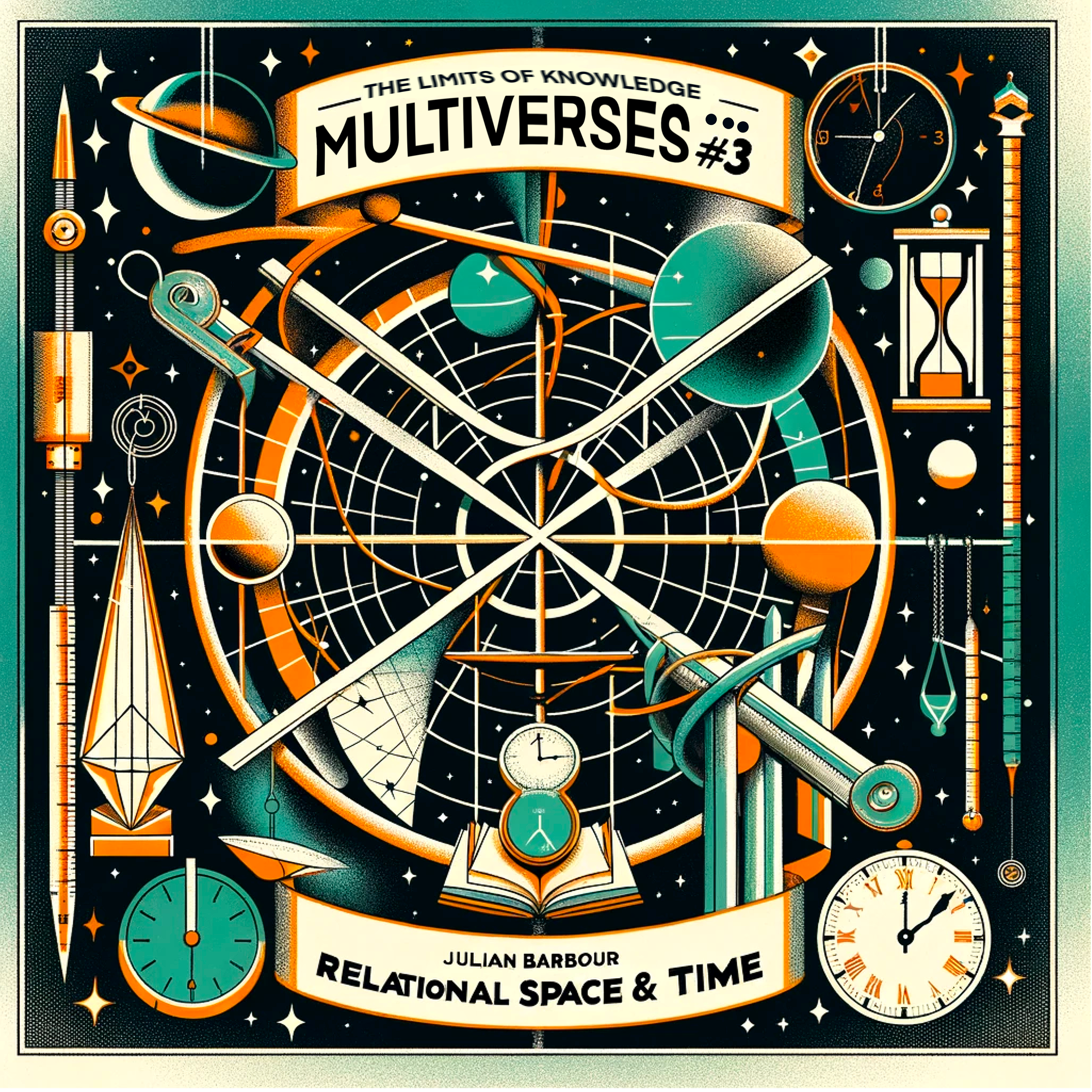
About this episode
Space and time appear in charts as axes oblivious to the points they demarcate. Similarly, we may feel that we, and all the objects of our worlds, are like such points — and spacetime is a container in which we sit.
Julian Barbour is a physicist who has spent six decades arguing against this. He takes the relationist approach of Leibniz and Mach: there is no space without objects and no time without change. Rather space is just the geometric relationships between things.
Julian has pioneered theories that recover the predictions of Newtonian mechanics and General Relativity that drop their invocation of imperceptible space, time, and spacetime. Recently he has taken an iconoclastic approach to the arrow of time — looking to a new measure of structure, complexity, and the expansion of the universe instead of the traditional accounts in terms of entropy.
Find more at:
- The podcast home: multiverses.xyz
- Julian's website: platonia.com
- Julian's books: The Discovery of Dynamics, The End of Time, The Janus Point
Get every episode summarized
Each time MULTIVERSES publishes, we email you a written briefing from the transcript — the topics, who appeared, and any specific claims, with the ad reads skipped.
Email me new episodesFree for 3 shows. No card needed.
Hosts & guests
No transcript yet
This episode has not been transcribed. Request it and it moves to the front of the queue.
More episodes
More from MULTIVERSES

A Story For Humanity — Minhyong Kim on Why Maths Will Never End
MULTIVERSES

Molecules & Mirrors —Vanessa Seifert on the Philosophy of Chemistry
MULTIVERSES

Consciousness is not Computation — Christof Koch
MULTIVERSES

Where Does It End? — Adrian Moore on The Infinite
MULTIVERSES