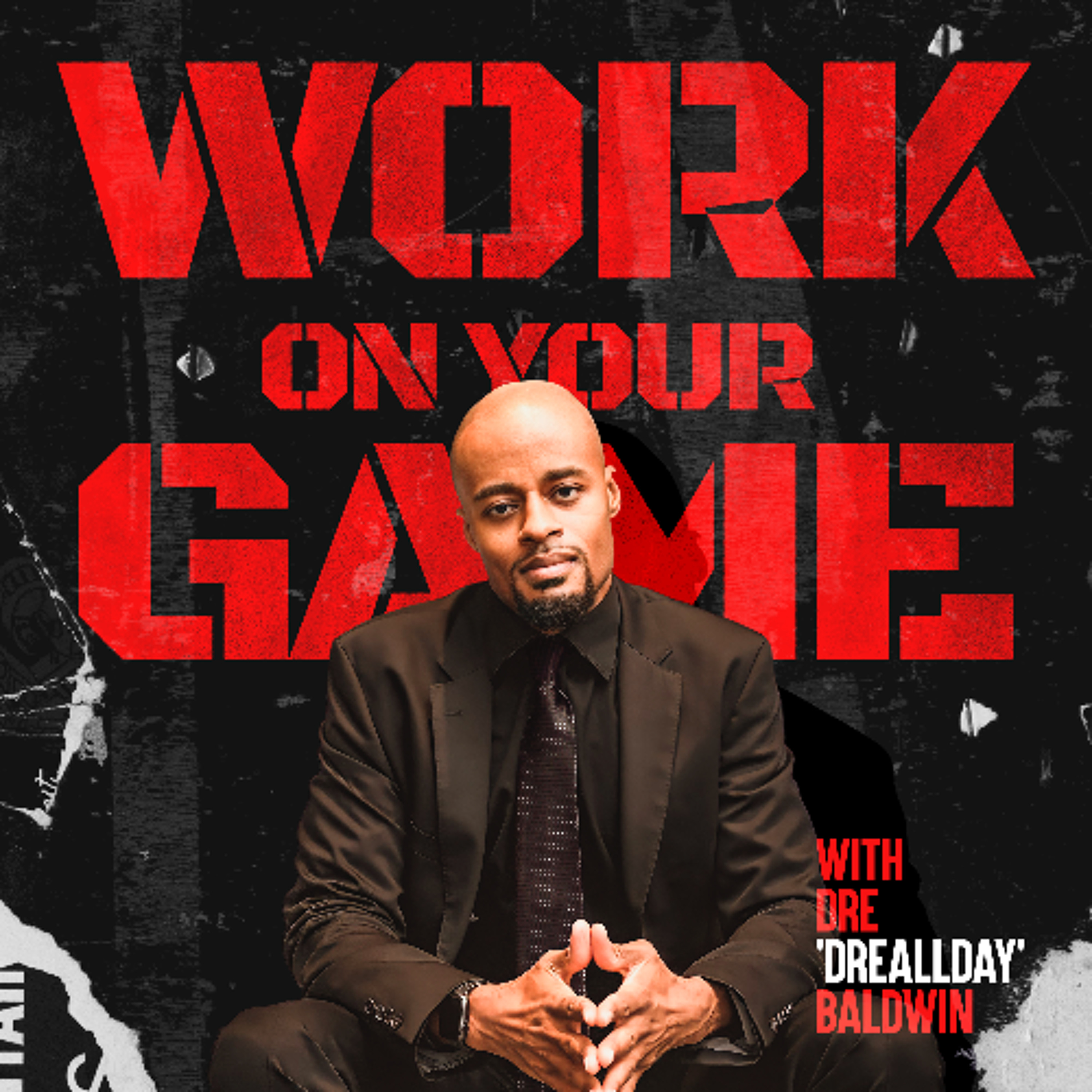
#3599: Standards MUST Offend
About this episode
Get every episode summarized
Each time Work On Your Game: Discipline, Structure, and Execution Under Pressure publishes, we email you a written briefing from the transcript — the topics, who appeared, and any specific claims, with the ad reads skipped.
Email me new episodesFree for 3 shows. No card needed.
Hosts & guests

Transcript ready
550 searchable segments. Every word is indexed and playable.
Full transcript
Work On Your Game: Discipline, Structure, and Execution Under Pressure — #3599: Standards MUST Offend. Machine-transcribed; use the interactive transcript above to jump the player to any line.
The power presence calibration is not offered publicly. It is not explained. It is not scaled. It exists for people whose position already carries cost. Everyone else should move on. The reference point is in the episode notes. I'm at Mason's home and it's clarified through friction, not consensus. Stay all day. Work on your game. Work on your game. This is Dre Baldur. And work on your game. This is a system that turns discipline into dominance. Today's topic is why your standards must offend. Yes, you heard me correctly. Why your standards must offend. What is a standard, first of all, ways in gentlemen? Should we pull out the dictionary for this one? Let me pull out the dictionary for this and I'll just give it to you straight from, even though I've started to not become a fan of Google Dictionary because they keep changing the definition of what words mean when it's convenient for them. But let's just see what they have.
We'll go to Marion Webster. Standard is something established by authority, custom or general consent as a model or example. Something established by authority, custom or general consent as a model or example. And I don't even think that's in here hard enough. Another definition says a structure built for or serving as a base or support. That's a little bit stronger. And actually here's the best one. This definition number four and it is this Marion Webster by the way. Something set up and established by an authority as a rule for the measure of quantity, weight, extent, value or quality. That's the proper definition that I'm working from here today. And you know words have more than one definition. Standards, ladies and gentlemen, are the rules and expectations put upon you in certain environments that are communicating to you what is acceptable versus what is not. That's what a standard is. I'm talking about standards many times here on this show because standards are the hallmark.
This is something that you're always going to find when you're dealing with a professional. We're dealing with a highly disciplined person. When you are in any environment in which execution and production of results are paramounts and they are mandated, you will find standards. Why? Because you cannot execute and produce results consistently without standards by which everyone is measured and everything is measured. I asked what standards are you going to set back in episode 2668. Episode number 2097, I told you that standards still matter. Episode number 1974, standards are the enemy of mediocrity. Episode 1331, never go where the bar of standards. Episode number 1291, how to raise the standards of a group. Episode 1026, your standard is the best that you can do. Episode 3565, how people subconsciously test your standards. So as you can see, we are not new to this topic. I say we, I mean me and the people who listen to this show, we're not new to this topic. If you are new to this topic, welcome. You're going to get familiar here today.
Standards, ladies and gentlemen, are not neutral preferences. A standard is not a neutral preference. Standard is not what you feel like. A standard is not what you think. A standard is not your personal opinion. Standards give not a damn about any of those things. Your preferences, your opinions, or your feelings. Standards draw lines. They create exclusion because a standard excludes anything that is not within the standard. And standards also impose consequence because if you don't meet the standards, something is going to happen. If no one is offended by the standards of an environment or the standards of a person, there's no one out there who has an issue with the standards that you have said as a person. And no one out there who may have been turned away or feels some type of way, based on a standard that was imposed upon them in your environment, your group, your team, your organization, your business, whatever, it happens to be. If no one is bothered by it, you don't really have standards. No standards of being enforced. And there are no exceptions to this point. What I just told you is a heart and fast reality. Your standards should be excluding people.
Your standards should have people feeling like maybe I shouldn't be in here. We talked about this a couple days ago. I told you, when someone steps into an environment that you are in, those of you who are high level at what you do, high level at performing, high level at expectations, high level of producing results, when someone steps into your environment and they are uninitiated, some of those people should step into that environment and say, maybe not out, out of their mouths, but they'll be thinking and feeling, I'm a little bit uncomfortable here because it looks like just by looking at the people, just by feeling the energy, feeling the aura of what's in here, it feels like the standard here is a little bit higher than a level at which I'm currently operating or the level at which I'm willing to operate. I'm saying that other people should look at you and look at your environment, look at the places that you go, maybe not everywhere that you go, but they at some level should look at it and say, I'm not sure I can measure up here. That's what standards feel like. Standards should have people thinking, I'm not sure I can do this. I gave you all an example of this that I mentioned a couple times over the last week or so. My sophomore year of college, very few people tried out for the basketball team,
even though theoretically anybody could technically try out for the basketball team. Why didn't people try out for the basketball team? Actually let me back up when we tell you the rest of the story. My junior year, a whole bunch of people tried out for the team. What was the difference between my sophomore year and my junior year? Did a bunch of people who just had more confidence when it came to basketball, all of a sudden enrolled on my college campus? No, it was the same bum of the fuckers in the sophomore year they were in junior year. The only difference was my sophomore year, there was a coach there who held the team, the membership on the team to a certain standard to where people excluded themselves. They didn't even try to try out for the team because they knew. There were certain standards that that coach was holding and if they weren't willing to go up to them, they might as well not even try, so they didn't even try. My junior year, the coach announced that the standards from the previous regime no longer existed and everyone had an opportunity. He literally announced that and so many words, everybody has a chance to make a team because he was a brand new coach. I understand that he did it on that level, but at the same time, he lowered the standards to the point that being on the basketball team didn't carry the same weight because he wasn't holding the same standards. The standards didn't exist and this is how you get a bunch of bumps. When you lower the bar in any place, you get a bunch of low-level people stepping into that place,
thinking that they're capable. This is the way it works. Another example, there's this woman, Bonnie Blue. If you heard of Bonnie Blue, Bonnie Blue is English. She is from the UK. So if you're based in America, maybe you haven't heard of her, but Bonnie Blue's real name is Tia Billinger. She's a British adult content creator and pornographic film actress. That's her name is Bonnie Blue. She became famous for her extreme, this is straight from Grock. Grock is the AI platform owned by Egon Musk and those guys over there. She became famous primarily through her extremely controversial and highly publicized stunts in the adult industry. So her claim to notoriety, this is how Bonnie Blue became famous. 2025, she claimed to have had sex with 1,057 men. Not in her lifetime, ladies and gentlemen, that's not in her life. In 2025, she said, she has sex with 1,057 men, not in her life. Listen, in a single 12-hour window.
In a 12-hour period, 1,057 men penetrated her vagina with their penis. This is according to her, according to Bonnie Blue. And this was an attempt to set a world record for most sexual partners in one day. Now, this went viral. That's how I heard of her because people on social media were talking about this about. Now, she says she wants to have even more extreme events. She says something like a petting zoo challenge, but 2,000 men have no idea what that means. And what happened is she got permanently banned from only fans. As you know, you can get banned from only fans. Bonnie Blue got banned from only fans for violating their rules against, quote-unquote, extreme challenges. And now she's moving on to other platforms like Fansley, that's against another form of only fans. Anyway, I'm bringing up Bonnie Blue to say this. Access to Bonnie Blue's vagina does not have the same standards as that of other women. And when you lower the bar of standards, you lower the standards, and you make it easy for anyone to access whatever it is you allow it easier access to now has lower value. So I'm drawing a parallel between Bonnie Blue and her open access vagina and the basketball team at my college.
I never heard anybody do that on my podcast before you have now heard it. So now, now, let's get into the topic. It's the point number one. We didn't get into the topic yet, folks. The fun is just beginning point number one. Today's topic once again is why standards must offend point number one. It's standard that offense is doing its job. It's standard is supposed to offend. And when I say offended, it doesn't mean that it says something bad about you or makes you feel bad or anything like that. When I say offend in this context here today, what it means is it should cause you not you, but somebody, some discomfort. If your standards not making anybody uncomfortable, you don't have any standards. Simple as that. If your standards don't make people uncomfortable, there are no standards. So if it's just whatever happens, happens. That's not standard. That is a fair. Do as you wish. Do as thou wilt. Let it be. No. We don't operate that way if you're operating at a level of mandated execution. You can't do that. My design, a real standard, will offend people without trying. Because when somebody is bothered by a standard, that is a signal that a boundary has been reached.
Somebody has touched on the boundary. That's why they're uncomfortable. And if you have a dog and you put an electric collar on the dog, what happens when a dog gets to the perimeter of the area of the electric collar? They get a little bit of, they bump against that boundary to get a little jolt to their neck. Not one is going to kill them, but a little jolt enough to get their attention. To tell them to turn around and go back to where you came from dog, because you can't go outside of this boundary. That's the whole point. When someone is bothered by a standard, that is a signal that they have reached the edge of the boundary. And that makes people uncomfortable. People reach the edge of a boundary and they are informed. And some way, they reach the edge of the boundary and makes people uncomfortable. And when you accommodate everybody, you enforce nothing. That's the way it goes. Give you another example. The Los Angeles Clippers basketball team in the NBA. They have this new stadium that they're playing in recently. It's called the Intuit Dome. Intuit like the, I think Intuit is a financial company. And it's called the Intuit Dome. They're the name sponsors of the building. And people who live in Los Angeles who've been to the building said the building is amazing. The way it's designed is great. And the Clippers built this thing called like the fan wall or something like that.
It's one area of the arena. Behind one of the baskets where it's like this big thing for a Clippers fan. So if you're a really big Clippers fan, you prove you're a really dedicated fan. You can get premium and preferred seating and seats. And I don't know, season tickets or whatever. Some type of membership access to sitting in that particular area of the stadium. Now, from what I've heard, I'm not a type person even go to sporting event games. They usually too wait in a day and I'm not going to spend my own money and three hours of my time watching somebody else build their dream in their career. I'll listen and find out about the highlights, but I'm going to sit there and watch you build your business. I'm not really wanting to go to sporting events. So if you want to give me a gift, don't give me tickets to a sporting event. Don't thank you. But anyway, not the point. At the Clippers games from what I've heard, I've seen this more than one time on social media. A person will go to the game and they're there to cheer for somebody who's playing on the other team. Now again, the Intuit Dome is in Los Angeles. So a lot of people will go to Los Angeles. So let's say the Boston Celtics come play in Los Angeles.
You go to the game and you have on a Boston Celtics jersey or Boston Celtics gear and you're cheering for the Clippers. Now this is not applied to the entire stadium, just this one area of the stadium behind one of these baskets. If you're sitting behind that basket in that area and you have on gear of the opposing team, there's a little card. One of the security people will come over and hand you this little business card size message and on the card it says. And I saw a couple of people posting on social media. I'll have it in front of me. But in so many words, what it tells you is that, hey, this area of the stadium is specifically for Clippers fans who are supporting only the home team. The Clippers. You have violated by wearing no that jersey or because even if you cheer for the other team or you cheer against the home team, the security will notice and no hands you this little card. You did something that violates one of the rules of sitting in this area. So if you violate again, they say it on the card. There's your first warning. But if you violate again, well, either I can't remember what it says is going to do with the kick you out of the stadium or
it will revoke your season tickets or you won't be able to buy tickets in our arena again or you can't buy tickets in this area of the stadium again. And they are letting you know that if you sit in this area, if you wear anything, you got to wear Clippers gear. And if you cheer for anybody, you got to cheer for the home team. You cannot go against the home team while sitting in this area of the stadium. Now personally, if you just ask my personal opinion, I don't like that idea. I don't like that standard. I don't like that policy. However, the point here today is not about what policies and standards are like. The point is, does the standard push some people to an edge, maybe offend some people, does the standard piss some people off? No, I'm not pissed off about the standard because I don't even live in LA, but I know what I'll be going to a game. Even if I did live in LA, I'll be in Miami and I could literally see the stadium on my damn window. I don't go to Miami Heat Games, but the point is, does the standard push some people in a way that they're like, oh, is this a little bit uncomfortable? It's a little bit different than what I expected. That's the point of a standard. Standard should make people uncomfortable. If you accommodate everybody, you are enforcing nothing.
And there's nothing wrong with accommodating everybody. Bonnie Blue, you want to accommodate everybody with your vagina? Go ahead. But you're not enforcing anything. You're not enforcing any rules, only access to it because you're allowing everybody. That's the point. Point number two. Today's topic, once again, is why standards must offend. Number two, misalignment is uncovered by a fence, fasten an agreement. This is what we talked about a few days ago when we were talking about in groups. When people working groups, you tend to, people tend to smooth over misalignments and act as if they don't exist until the misalignment either becomes too obvious to ignore or the misalignment causes a failed end product execution of whatever the mission was supposed to be. In other words, the group produces a less than ideal work simply because nobody wanted to offend everybody. And everybody was just trying to get along. So then with somebody did something that wasn't quite up snuff, nobody said anything. Everybody allowed it to pass and then in product becomes some shit. Because nobody wants to say anything to piss anybody off. This is what happens when everybody is trying to agree. And this is the reason why group projects often produce a less than ideal results, especially when you don't have anyone in a group who is willing to offend others
and you have people in a group who are too thin skin to accept anything that may offend them. Or they claim that everything offends them. These are the soft, thin skinned individuals who I would suggest most of you not work with in any capacity. Misalignment, ladies and gentlemen, when people are out on the same page, you figure this out really quick when somebody gets offended. The challenge is you gotta have, first of all, somebody in the group or somebody in the space, a security guard, a policy, a boss, whatever. Somebody has to be willing to say and do things that they know could possibly make other people uncomfortable and they do it anyway. Now let me ask the question, how many of you fit that description? That's the key question. It's not a question of whether it's true or not. The question is, how many of you fit the description? And if you wanna be leaders? And if you are in a position right now where you're not leading, but you wanna be in position where you are leading? Maybe in the same place that you are, but just leading instead of not leading right now? Okay, let me tell you what you must be willing and able to do. You must be willing and able to say and do things that Pete, the same people you're dealing with now will be offended and bothered and made uncomfortable by what you said and did and you say and do it anyway
with no hesitation and without softening the edge of the message. How many of you are willing to do that? See, if you're hesitating to answer that question, in the time it took me to ask the question and start talking again, if you hesitated to answer and fatically with a yes? That is one of the main things keeping you from a leadership position. Yes, that's one of the main things keeping you from the position, not because anybody necessarily, quote unquote, knows that you hesitated because I just posed you the question and you're only thinking about it and you're hit. But because the energy that you carry when you don't mind saying and doing things that would offend other people, people can feel that not everybody can articulate it, but they can feel it. Even if they can't quite say what it is that they're feeling they get it. And if you're not willing to do that, oh, you think people can't tell? They can tell. This is why people may not look at you as a potential leader because they don't see you as a type person who will call somebody up. Are you willing to call somebody up? Again, another anecdote. A few years ago I was in this coaching program. And in this program, we would get into these little groups. It was a group of maybe five or six of us.
And we were having a conversation about whatever. And somebody said, somebody else in the group, they put them on a spot with something that they had said or something that they had did. And this is what we were supposed to be doing in the group. This is a healthy conversation. And I'm the type of person I think you all can tell. I don't mind people doing this. I wasn't the one involved, but I was witness to it. And somebody said, well, I like the fact that you called that person out. You called me out, or thanks for calling me out, or I like that you called this person out, et cetera, et cetera. And it was this girl in the group. I remember, it was a white girl from Chicago. She just wrote to me, you know, maybe about 30 at this time. And she said, well, hey, I see what's happening here in the conversation. I just want to offer a request. I would request it. Instead of saying, call somebody out, I rather you say, call them forward. And she went on this little one and a half minute spiel about why calling them forward as the language was more productive than calling them out because I don't know something in her past and traumatized her with the phrase calling them out.
See, this is that bullshit. See, this is the person who's not qualified to leave. That girl, I remember that girl's name too. And I remember where she was from. I told you she was from Chicago. I remember her name. I'm not going to say her name. She was unqualified to leave. I don't know if she's still walking around with that bullshit in her head. But that bullshit came out of her mouth back then. It was, oh, that's not say calling them out. Let's say calling them forward. See, this is that language policing that is based on, well, this is going to hurt my feelings if I hear something that is actually completely benign language. But I have some trauma attached to that language. I'm going to ask everybody in the world to not use that language. So it doesn't trigger my trauma. No, bitch. You need to go to a therapist so that random language is not triggered your trauma. Not tell the rest of the world to adjust to you. You adjusted the world. But I digress. The whole point here, ladies and gentlemen, is that if nothing happening is offending anybody or making anybody uncomfortable, you don't have any standards. You have no boundaries. People who react negatively to a standard reveal themselves as incompatible with standard. And that's good. Because now we know we got to get rid of them. Or they need to adjust. But guess what we're not going to do.
We're not going to adjust the standard and make you comfortable. See, that's another issue that many of you who want to be leaders, you have. See, if you're standards or your roles or your communication will make people uncomfortable and they let you know it will make them uncomfortable. And or you guess you predicted it will make them uncomfortable. You will either hold back and not say it or you'll stop doing it or you allow them to basically guilt you or bully you out of holding people to a standard. Or that's some bullshit. It's not a standard. If you allow people to guilt you out of establishing the standard. And another example. You've heard me give this example. I worked at a movie theater. The boss named Tom. He said, anybody who's late. I'm going to mark the date of your weight. Your late three times your fire. He put a date next to my name. I only have one out of three. I saw I wasn't fired yet. But I had one. I didn't think I was late that day. I honestly do not believe I was late. And I said the time. Why is there a date next to my name? He said, your late that day. I said, I was not late. And he said, okay, I'll erase it. There was no other discussion. That's it. He erased it. And I never got another late notice on there. Now again, I honestly don't think I was late. I was not trying to manipulate Tom. But the thing that I always remember about that is that he didn't even push back.
He was the fucking boss. It told me there were no standards. Actually, I already knew about that point. At that particular job, there were no standards. That place was the zoo. And one of the reasons it was the zoo. That anecdote is exemplifies why it was the zoo. Because he was the head person. And he held no one's a sandwich. And as soon as someone challenged him on a standard, he folded. And that can't work. If you're trying to have a high performing organization. And that organization that I worked at then was not high performing. It was fun for us. I don't think it was fun for the bosses or the bosses. The people looking at the numbers from their place. Anyway. Alignment raises Germans clarified through friction, not consensus. What does this mean? If you want to get everybody in an organization on the same page, there needs to be friction. So you find out you stress test who can deal with the friction that will exist if someone goes outside of these lines. You can't get alignment if you're not holding people within the lines. Consensus usually means you're telling people things that they want to hear. Things that make them feel good. That's not how you get alignment. You know, I'm it by telling people things that might make them uncomfortable. And you find out who's willing to stick around anyway. And you also get rid of the people who need to be gotten rid of.
Or the sales guy said he ran a sales organization with a bunch of people working there. He said, I want to make sure that our standards are set in such a way that I don't ever have to fire any underperforming salesperson. I want them to quit. If it gets to the point that I had to fire them, that's because our standards aren't tightened up, they just quit. I want the standards to force them out instead of me having to kick them out. And that's exactly what I'm talking about. I send out a daily motivation text every single morning that is guaranteed to have you focused, sharp, and on point to start your day. And I promise you you want to receive this message. All you have to do to join my text community is to text me my number. 305-384-6894. Once you join, we'll tell you all your options for how often you can get text by us. And all of that just text me at the number 305-384-6894 to get that daily motivation. Point number three. Today's topic once again is why standards must offend number three. Standards lose authority the moment they are solving for comfort. I've already told you just five times here. A bunch of you right now have people in your life in situations in your lives
in which you need to do or communicate something to another person that you believe might make them uncomfortable or end or it will make you uncomfortable. So you are either saying and doing nothing. That's what many of you do. Say or do nothing about the situation about 60% of the time. Or the other 40%. You will say or do something but you soften your words or your actions so as not to offend them and so as not to make you uncomfortable. Here's the problem. That's not going to solve the problem. All you're going to end up with is an exacerbated issue. And you're going to feel weak because you know you didn't need solving it but you did. See this unwillingness to deal with conflicts. And you have to extorpate this from your being if you plan on leading. If you plan on leading yourself, you have to get rid of this unwillingness to deal with comfort. If you ever want to lead anybody else. If you ever want anyone to look at you as an authority as IE a person to be listened to or followed. You cannot be uncomfortable with saying or doing things that might make somebody uncomfortable.
You got to be comfortable being uncomfortable and making it other people uncomfortable. You don't have a standard if you soften the standard for comfort. When standards are adjusted to avoid offense. They become what they actually are, which are suggestions. I'll tell you many times. You tell yourself you have a standard and you follow it when you feel like you don't have a standard. What you have is a suggestion or preference or a choice. That's okay. It's okay to have suggestions, preferences and choices. But do not buy and don't disrespect the game by calling them standards when they're not. Standard tolerates no exceptions. When I tell you this show comes out every single day. That means I tolerate no exceptions. That means every fucking day. Not every day unless I don't feel like it. Not every day unless I'm sick. Not every day unless something is going on somewhere. It's every day. No exceptions. Authority raises on me and depends on enforcement. Not approval. This means that you get authority when you enforce your standards. When people know you have standards and they know that you will enforce those standards. People respect your authority.
Now you have authority and you don't enforce the standards that made that authority. You don't really have authority. You may have a title, but you don't have authority. Some of you listen to this. You have a title, but you have no authority. I.e. you're the boss, you're the manager, you're the tech writer. But people don't really respect your authority because you don't enforce your rules. Who am I talking to right now? Some of you are parents. You technically have a title. I mean, your mom, your dad, but you only enforce rules on your kids. So you can do what they want to do. I'm assuming, let's say under 18, living under your roof kids. They do what they want to do. You only enforce rules. They kind of listen to you, but not really. And you all know what I'm talking about. I see some parents like, I take my kids to parks all the time. So I see some parents who fit this description. I mean, you're technically a year, you're the parent, but your kid doesn't need to listen to you. Now, you got to chase your kid around the park to get them to pull their pants up or eat this app or whatever it is you're trying to get them to do. It will be a snowy day in Miami when a child of mine is not listening to what I'm saying in private or in public. But that's just the way I operate. I'm not telling you you got to be like me. I'm just saying.
If you're a person with a title, you also need authority. And by the way, you can have authority with no title. And you also have a title with no authority. I deal with you want to have both. And any of you is moving up into leadership positions. Authority requires enforcement. If you're not enforcing your rules, you have none. And this applies to you dealing with yourself as well, folks. Once you start softening, your standard no longer governs behavior. So let's recap. Top of care today, which is why standards must offend. Again, let me get a definition of standard straight out of Marion Webster dictionary. So we're all in the same page. Standard is something set up in established by authority. There's that word again. Authority as a rule for the measure of quantity, weight, extent, value or quality. Standards do not have exceptions, folks. Number one, a standard that offends is doing his job. You should be offended by a standard or it should be offending somebody. And it's going to force people to do things that they otherwise wouldn't want to do. Number two, misalignment is uncovered by offense, fastening agreement. You don't get alignment by getting everybody to agree. You get alignment by offending people and letting them know this is where we're at. You either are sitting at the table or you're outside the room.
Number three, standards moves authority to moment. They are softened for comfort. You don't soften a standard. That's oil and water. A standard is a clear line that you're either on this side of the line or you're on the other side of the line. But there is no in between. There is no standing on the line. Get in or get out. That's the way standards work. And if your standards don't look like that, then you don't have standards. You have something else. Don't call them standards. Call them what they actually are. All that said, folks. PowerPresence Protocol dot com. Work when you're gay. Dre, all dead. Some people recalibrate before things drift. Others wait for feedback. They can't undo. PowerPresence calibration exists for the first group. It is not designed to be welcoming. The location is listed below in the description.
More episodes
More from Work On Your Game: Discipline, Structure, and Execution Under Pressure
#3775: Systems ALWAYS Get "Gamed"
Work On Your Game: Discipline, Structure, and Execution Under Pressure
#3774: Don't Be An "Open Book"
Work On Your Game: Discipline, Structure, and Execution Under Pressure
#3773: Why Stories ALWAYS Beat Statistics
Work On Your Game: Discipline, Structure, and Execution Under Pressure
#3772: Your Brain Needs "Alone" Time
Work On Your Game: Discipline, Structure, and Execution Under Pressure