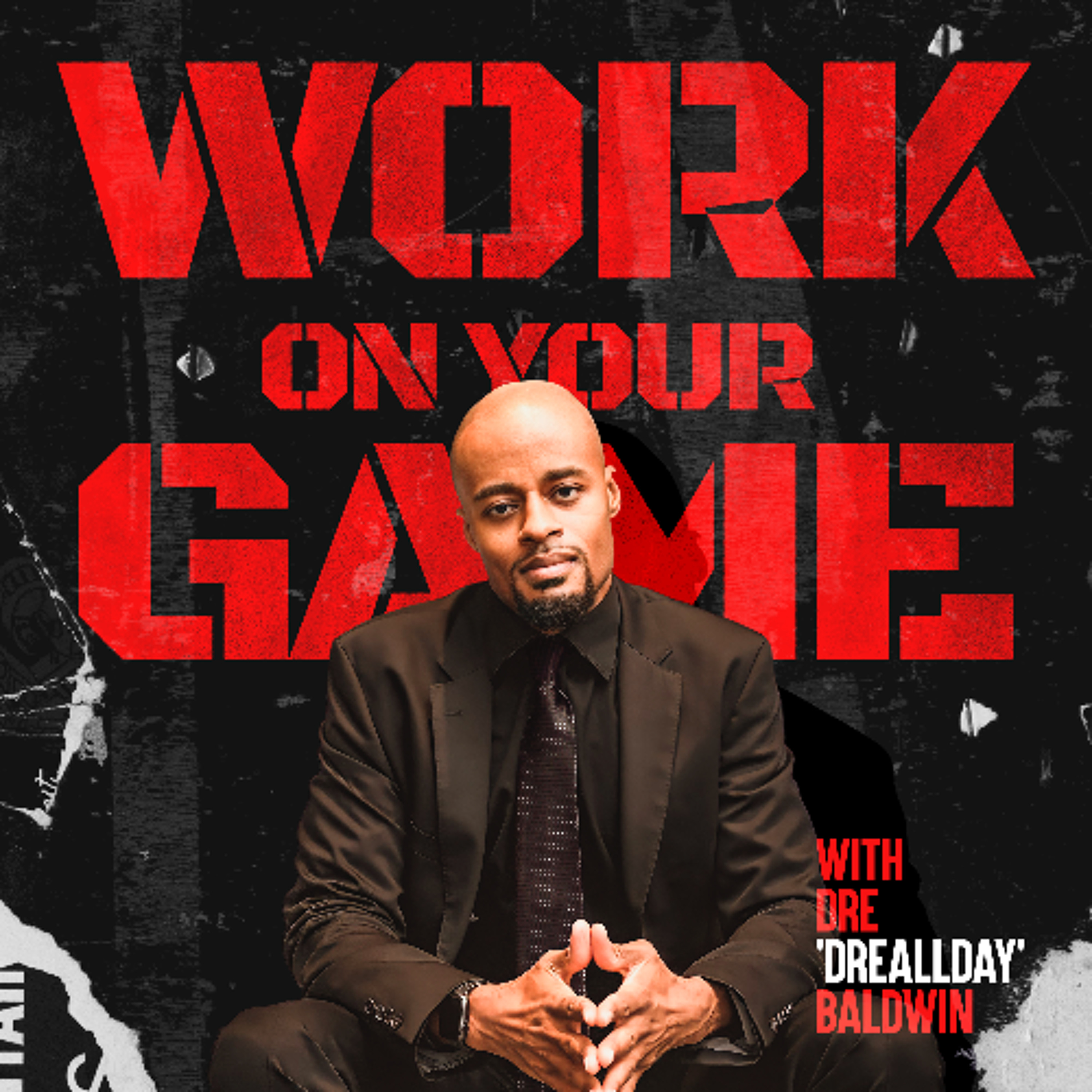
#3604: Distance Creates Clarity
About this episode
Get every episode summarized
Each time Work On Your Game: Discipline, Structure, and Execution Under Pressure publishes, we email you a written briefing from the transcript — the topics, who appeared, and any specific claims, with the ad reads skipped.
Email me new episodesFree for 3 shows. No card needed.
Hosts & guests

Transcript ready
381 searchable segments. Every word is indexed and playable.
Full transcript
Work On Your Game: Discipline, Structure, and Execution Under Pressure — #3604: Distance Creates Clarity. Machine-transcribed; use the interactive transcript above to jump the player to any line.
The power presence calibration is not offered publicly. It is not explained. It is not scaled. It exists for people whose position already carries cost. Everyone else should move on. The reference point is in the episode notes. Keeping a distance between you and your subjects is not you being above them or better than them. It's you preserving authority. Presence is preserved through space. Stay all day, don't come. Work on your game. Work on your game. This is Dre Balder and working on your game is the system that turns discipline into dominance. Today's topic is distance creates clarity. One of the biggest challenges that I noticed in working with professionals, whether I'm talking to an athlete, an entrepreneur, a sales leader, a person running a business, a person leading a large team is one of the biggest challenges most people have is not in that they can't solve their problem or problems or whatever they believe them to be.
Many people are unclear on what their problems actually are. Yes, you do have an issue of solving your problem, but the issue of actually solving the problem is downstream from the issue of clearly identifying what the problem actually is in the first place. Whether I'm talking to an entrepreneur working in the software world, in the clothing business, in the food business, in the training world, in info products, in coaching, in finance. I work with a lot of different professionals in a lot of different areas, often consistently the biggest challenge is people lack clarity on what exactly is the issue that needs to be addressed here. Most of the time smart people are able to diagnose an issue, but not the core issue. So today what we're talking about is how distance creates clarity in more ways than one. I gave you one example right there, or one hint towards an example there, and I'll dive into this in more specificity as we get into this episode. Distance, everybody, and I'm going to talk about this from a couple different angles. Distance is often misread as ego or detachment if you see it in a person, a person who you would describe as distance.
People will look at them as well as persons ego-tisable. They don't want to be around other people. They are too good to talk to anybody else. They carry themselves like they're above everyone, or they're better than everyone. People look at you as being some form of ego-tisable in a negative way. So they see you as detached, so this person is just not available. They don't talk to anyone. They are not sociable. They're not friendly. They are not part of the group. They don't really communicate that much. If you are a person who enjoys your distance from other people, I guarantee this has been said about you, maybe it's been said to you, and I guarantee you a lot of people think it about you even if they don't say it to your face. In reality, distance is what allows judgment to remain clean and standards to stay intact. Distance allows judgment to remain clean, or for many of you, as I gave my opening example, distance allows judgment to become clean. Some of your judgments have not been clean for a long time because you don't have any distance. This is also all allows your standards to remain intact. I'll explain what I mean when we get into the episode here today.
Proximity, verse, perception. I mean proximity in a tangible sense, and by the letter of that point, being too close to something makes you hard to understand what's actually happening. This is the proverbial, see the forest from the trees. Many people are so close to the trees, they don't notice that they're in a forest. That's proximity. And also, on the other hand, distance restores accuracy because all of you, at some point in your life, have been able to see things accurately. Maybe you were six years old, but there wasn't a time when you could see things accurately. Many of you don't remember that time whenever it was for you might have been at 26, 36, or 16. But that accuracy can be restored when you're able to create and retain distance. Let's talk about what exactly this means because I mean it's both literally and metaphorically here today, so keep up. Point number one. Today's topic once again is distance creates clarity. Number one. Distance removes emotional contamination from decision making. This is a very important one, especially for those of you in leadership positions.
When you're in a leadership position, this is a way of describing leadership many times. The leader has to possess the ability to disappoint the people, disappoint your subjects at a rate at which they can tolerate. That's what leadership is. That's not all with leadership, but that's a big piece of it. This is a requirement of leadership. As you must be willing and able to disappoint some of your subjects at a rate at which they can accept it and keep following you despite the fact you just disappointed them. And when I say disappointed them, I don't mean that you failed as a leader. I mean, you made a decision that this is what you decided and not everybody's going to be happy with that decision. Because if all leader had to do is make decisions that everybody was happy with, we wouldn't have a need for leaders. We could just let everybody make group decisions and everything be done. Problem is, those are the things that group decisions. Group decisions are oxymoron. Those are the things that group decisions. One person makes a decision and a group follows. Distance, however, I'm back to my original point here. Distance removes emotional contamination from decision making. In other words, you cannot be so close to the people you're making a decision about while making a clear decision.
You can make a decision while being close to the people about having high proximity, but you won't make a clear-minded decision in that situation. If you make a clear-minded decision, you need distance from the situation, whatever you're making a decision about. This is the reason why when people have civil disputes, they go to court. They go to court because the judge has distance from the people. The judge usually doesn't know the people. When the judge does know the people, they usually excuse themselves from the case. The judge doesn't know the people. The judge is ostensibly judging based on the facts of the situation. And what is being told to them and what the lawyers or the plaintiff and the defendant can argue the court. The judge makes a decision objectively, ostensibly, objectively, based on what's been presented to him or her. The judge having distance from both individuals in the case is what allegedly provides the judge enough objectivity to make a clear-headed decision. This makes sense when I'm saying it. This is what distance does. It removes emotional contamination from a decision to the judge. If the judge is a judge-wotner or a judge-JUDE for those who are old, the judge-wotner or judge-jewdy for those who are younger, they can make decisions about the people who come to their courtroom because they don't have any emotional connection to the people who are coming to their courtroom.
Now, they may have opinions about what they hear. They are out there, humans all have opinions. But they don't have any emotional connection to the decisions. Again, ostensibly, the decisions to be based on an objective observation of what's been presented to them. presented to them. That's the way it's supposed to go at least. But, as I've already told you, I'll stay out of court. When you are too close to a situation, feelings influence your judgment without even being acknowledged that your judgment is being influenced by feelings. Many human beings make way too many decisions based on how you feel, not based on what logically makes sense or what is objectively provable, accurate, or observable. You make decisions based on how you feel, especially when you're making decisions that involve other people. If it comes down to feelings, well, things get messy, and they get messy very quickly. I was working at this gym called Philadelphia Sports Club, about 2006, 2007, and I sold a membership to this guy who lived literally half a block away from the gym. I remember I was walking with him outside after he signed up and I literally walked him to his front door. He
went into the gym literally like 50 feet away from the gym. And it's a nice area of Philadelphia called Society Hill. And two days later, on my day off, that guy, because we talked about the asking for referrals when I made my sale. And he said, yeah, I'm bringing my wife in, Brian joined too. He wrote his wife down as a referral. I called his wife. She didn't answer. I got some messages, etc. So the two days later, on my day off, his wife comes into the gym. She joins the gym. One of my co-workers is white girl named Melissa. She signs up the guy's wife. Now, let me pause right there and ask any of you who has been in sales. A question. To whom does that commission belong? To whom does the commission for the sale to the wife? Who's that money goes to? Is that my money? Or does that go to my co-worker who made, quote unquote, made the sale of that day? You tell me where that money goes. And then you tell me what you think I did when I found out what happened. So I get back to work. I find out the wife signed up. Who's your son up? I was just signed up with Melissa. That's my co-worker. I go to our boss, Gary. Gary's a white guy.
Gary's also gay. And that matters for the context of the story. I'll tell you why in a minute. I tell Gary the situation. Gary immediately understands the situation. Gary kind of gets uncomfortable. Gary turns a little bit red in the face. White people get red in the face. White people will get red in the face because they're pigments too dark. Gary is red in the face because Gary is already reading the TV as to how this is going to go because he has a pretty good understanding of my personality. And it wasn't quite as measured back then as it is now. But it was pretty much the same. And Melissa doesn't have my personality. I just put it that way. She was not a shark saleswoman. She really didn't belong on the sales job. She wasn't a shark. But she had the job. Now she has the sales. She has this commission on her books. And I'm like, that's my fucking money. And this is a pretty much most of your money came from commission. And if you work in these type of sales job, you know, most of your money comes from commission. So this is not just some stat on a whiteboard that I didn't give a fuck about. This is my actual money. I need this money. And that's my money. I made that original sale to the original customer. That's his wife. That's a
a walk in lay down. We call that a lay down sale and retail sales call a lay down. That's the person who walks in and just lays the money on the table. You don't have to do anything closing. She knew she was buying. That was easy. So it becomes this back and forth. I am how I am saying what I'm saying. Y'all listen to the show. You got a pretty good feel for me. Melissa, as we're going back and forth, she's trying to argue that this is her sale on what grounds. There's no grounds upon which she can make this argument zero. But again, Gary's a gay guy. He's a little bit feminine. He's buying into the feminine damsel and distress argument that Melissa is making eventually. She comes up with this argument that I am not going to just let people walk all over me. This bitch really said this in the meeting. I'm not going to let people walk all over me and take the sales from me and I'm thinking to myself, bitch, what? Walk all over you. That's my sale. You're trying to walk over me. But of course, with me being me and talking how I'm talking and her being her and talking how she's talking. How does that sound to Gary? You guys see how this becomes a little bit tricky of a situation? So we're going back and forth. Gary does not make a
judgment. This is what Gary does. This is a failure in Gary's leadership. Gary's a good guy. If he's a good guy, but this is a failure in his leadership because he refused to make a ruling on this situation in the meeting that we're having in his office. He says, I'll figure it out. You two just go and do your job. He says, maybe worst case scenario, I'll split the sale. I'm not happy with the split of the sale. I'm like, this is my fucking sale. Why am I splitting money with this bitch? You didn't do anything. Anyway, but again, listen to how I talk and I basically said that to him then. So again, imagine what position I put myself in. So anyway, the day goes on. Something else happens in the sales day and I'm talking to Gary about something and Gary got crossways with me over something else that happened. It didn't have anything to do with that with me just again, being myself. He says, you know what? That sale that happened with that thing between you and her. I'm giving that sale to her because I guess he was mad about something else that happened and I guess he wanted to let me some punishment to me over the whole situation. The whole point here is Gary was a guy who was easily swayed by feelings and leaders who are
easily swayed by feelings and emotional arguments. Doesn't necessarily make them bad people. Doesn't necessarily make them weak. Doesn't mean that they cannot be affected leaders, but you need to know your own personality. And if you're going to get behind someone as a leader who operates in that way, you need to know if that makes sense for you or if it doesn't. That makes sense for me. And I didn't stay afield of his sports club more than, hmm, I don't know what to do. And about seven months, then I got out of here. That's my last job in Philadelphia as a matter of fact before I moved to the southward. The whole point here is when you get too close to a situation, too close emotionally, too close physically, your feelings will start to influence your judgment without acknowledgment. Now see, had I been to boss, I would have said, Melissa, what exactly did you do here? All right, what's the rule here? How do things work here? I would have said to Melissa, listen, I would have said everybody. Oh my god, I've all the sales people. There wasn't that many of us, maybe four or five. I would have said, listen, everybody, if a person comes in and makes a purchase of a membership and you made the sale, then their husband or wife comes in, we all recognize unofficially that that's a lay down sale. We know that that's a guarantee sale. It's not like the husband is going to join the gym and the woman is going to be like,
hmm, I don't know. She's going to join her, she's not, but she's going to join that gym, but she's not joining any gym at all. She comes in and she's joining the gym. All right, that sale goes to the person who made the original sale. We're not going to play these games, so that person was out, so you get the sale. We're not doing that. Let's not be snakes here. Everybody be respectful of the game. Let's operate by some principles here. Melissa, no, you're not getting that sale. You did not sell anything. Cut it out. All right, wipe it here. It's going to get some Kleenex, but cut the bullshit. We're not doing it here. Everybody get the fuck out of my office. All right, that's what I would have done had I been the sales manager, but I wasn't the sales manager. I was just a sales person. Distance, everybody allows decisions to be made on consequence rather than reaction. You see, Gary was reacting with his emotions because and Melissa tried to use her emotions because she ran out of logic. She didn't have any logic, so she went straight to emotions. This is what happens sometimes with certain people. And this is not just when men do it as well. And you've heard me share my opinion on that. I'm sure I'll bring it up again and sometime in the future I will be compelled to do so. When you are emotionally distant from a situation and even physically distant from a situation or and or physically
distant from the people involved in a situation as much easier to make a clear headed decision. Based on consequence, I hear the principles of rules and the things we operate by rather than by reaction. Oh, somebody try to pull my heart strings with emotions. So now I'm going to make a decision really quickly because I feel emotional about the situation. All right, that's bullshit. That's not a leadership position as far as I'm concerned. But any of you who see it different, you can let me know. Point number two, today's topic once again is distance creates clarity. Number two, distance preserves hierarchy and role clarity. Distance preserves hierarchy and role clarity. Meaning when you are distant enough from the people around you, they don't ever feel or get close enough to you that they ever forget that there is a role that they have and a role that you have that there's a chain of command and there's a hierarchy and they are in a certain spot and you're in another spot. And people don't ever get close enough to you emotionally or maybe even physically, then they will never be confused about that.
Our first president, man, my name is George Washington. I'm talking about president of the United States. He codified a lot of the processes that are in place now when it comes to the president. None of you can just go knock on the door of the president and have a conversation. It doesn't matter who the president is. You can't call the president and have a, you can't call the president and get his time on the phone. It doesn't matter who the president is or what time you call. You cannot walk into the White House and get in. You cannot get time on the president's schedule. No matter how hard you try, probably for four straight years of a presidential turn. Why is this? George Washington codified these processes that you cannot go straight to the president. If you want to talk to me, the president George Washington, you got to go through this person and you got to go through that person's assistant and there are two assistants and these people over here. You got to go through this chain of command if you want to get to me and if none of them can handle the issue, then I might give you five minutes to tell me your issue. But I might not. The whole point here is George Washington codified the process of there is distance between the president and everybody else. That's the reason why in the United States of America, we've only had, as of this recording, 47 people have taken the role of 47 times,
someone has taken the role of president. Some presidents have won, they weren't the president, they came back and were president again. For example, our current president Donald Trump is number 45 and number 47. But we only have 47 times as somebody taking that spot. And I'm bringing that up not because he created the scarcity of the number of spots. That's just based on years. But the prestige of the position is what it is because of what George Washington did and what George Washington did was he created hierarchy and he created a tangible and emotional distance between him and everybody else in that position as president. And every other president who followed just followed in the president that George Washington said, that distance preserved hierarchy. It made sure you understood. If you have a conversation with the president, understood, and you had to jump through Hoops to get this conversation. So don't waste my time. And if you want to have a conversation with me, you probably won't. So whatever it is, you have to say, you better get it solved with the person three levels now for me because that's about as far as you going to get. Distance preserves hierarchy and it preserves role clarity. When everyone knows their
role and everyone knows their position, they know how close they can get and how close they will never get to people and other roles. Michael Jordan, I had a documentary come out about 60 years ago called The Last Dance. Many of you saw it. If you have not saw it, I suggest you watch it even if you're not a sports person because a lot of what's in that documentary is not really about sports. It's about mindset. It's about leadership. It's about achievement. It's about role clarity. It's about leadership. It's what that documentary is really about and success with the group. And Michael Jordan was the guy under Chicago Bulls. There was a hierarchy on that basketball team. And everyone on that team do their role relative to Michael Jordan. He was the guy. He was the gravitational force. Everything orbited around him and he preserved the hierarchy. Yes, he was on the team bus every day. He was in an aquarium every day. He was at every game. He was in every practice. He was on a court with a uniform on, but his own teammates wants to document his own teammates up to and including the next best player on the team. God, my name is Scottie Pippen. Hall of Famer and his own right. The damn coach Phil Jackson. Hall of Famer. Dennis Riman. Hall of Famer.
All of these guys made it clear. There was a distance between Michael Jordan and everybody else. And I don't mean a physical distance because he was right there with them. There was a emotional distance between Michael Jordan and everybody else. Nobody really knew Michael Jordan. Nobody on the team of the Chicago Bulls was friends with Michael Jordan. None of them talked about Michael Jordan as a friend. Michael Jordan was a teammate, a co-worker, and we worked together and we won a bunch of championships, but nobody calls Michael Jordan their friend. Not a single one of them. Not even a coach. Nobody. Michael Jordan made it that way. Not because he was trying to be a jerk because Michael Jordan understood in his bones. I don't know if he could write a book about it, but he understood in his bones that if I'm going to be this guy and I'm going to have this kind of say within the team to where I can about a teammate know, hey, you better step it up or you won't be fucking playing or you won't be on a fucking team. If I'm going to hold that position and have that power, I can't let any of these guys feel like we're friends. And again, I don't think Michael Jordan did this intentionally. Now, there was another guy who came along several years later who I believe was doing it intentionally. He tried
and you could see the effort in his actions. His name was Kobe Bryant. We talked about this juxtaposition between these two guys a few episodes ago that was episode number 3532 effort versus inevitable Kobe Bryant versus Michael Jordan. If you like him, you break that down. I believe Michael Jordan just understood it in his bones in a way that he couldn't even language it. He just lifted. He was it where his Kobe understood it in a way that he could explain it and then he went out and tried to do it himself. Authority collapses when access becomes casual and constant. Again, George Washington. One reason why the Office of President is and was as preceded as it was and is still to this day because George Washington codified that you don't get casual and constant access to me. I talk to you when I want to and if I don't want to talk to you, you won't hear from me. But I'm still running things. Even though you don't see me, you don't hear me, you can't shake my hand. I'm still running things. That maintained it established and it maintained the authority of the Office of President of the United States. Still existed as that. It exists with certain CEOs
and certain companies. Some of you work at companies where you have never met the CEO. You know his or her name. You have seen their name and email. You've heard people talk about them. You heard that they might be in town or in a building or such and such but you have never met them and if they were in a building, you probably couldn't get into the meeting that they're attending. But you work there. And if you can relate to this, that's authority. Authority is preserved through limiting casual constant access. Now what's this mean for all of you? I was actually just having a conversation today. On of the air, I was on this TV show called Fearless. Well, it's on the internet podcast, TV, YouTube, whatever. Show called Fearless. Hosted by his guy named Jason Whitlock. Some of you may know about Jason. And one of the things we were discussing today, the conversation veered in this direction because he was, the question was about something else, but my answer led to us talking about this a little bit. This very thing right here. How is hierarchy and status preserved in Jason was saying that, Hey, Jerry, I like to respond to people on social media and engage with
people on social media, even if they're not a known entity, even if they don't have a ton of followers or anything like that. Because, and this was his explanation, I don't ever want to feel like or have people think that I feel like I'm better than them or above them. And we went on, I had a conversation about it. And I would say back to anyone thinking that way. And Jason, if he happens to hear this, I don't know if he's listening to my show that keeping a distance between you and your subjects is not you being above them or better than them. It's you preserving authority. Presence is preserved through space. You need space. You need to be isolated at times and you have to be able to recharge that battery of authority. Authority collapses with access. The more accessible you are, the less authority you have in the eyes of the people who have access to you. That's just the way it works. The more accessible you are to certain people, the less authority you have in their eyes, simply because they can access you all the time. You become casual to them. If you want authority with a lot of people, you have to create distance between yourself and all of those
people you want to authority with. If you're around all the time and you're with them and you're one of the guys or one of the girls, you can't have authority with those same people. Doesn't work that way. This is just what it is, folks. Distance maintains structure without explanation. You can see when you're away and you're not accessible, there's nothing to explain because nobody can ask you a question. I spend a lot of time around people that are going to start getting curious. They're going to try to locate you. They're going to try to figure out who you are, where you are, where you operate mentally and eventually the authority collapses because the distance collapses and the mystery goes away. People need to have some things that they don't know in order for you to have authority in their eyes. That's the way it works. When I play sports and if you play to sport in high school and college, when you're riding on the bus, the coaches are on the bus, but they usually sit in the front of the bus. The players usually sit in the back of the bus and we're in the back of the bus and I have thing in joking and talking shit. Do the coaches come back here and hang with us and joke with us? No. Why? Because they have to maintain the distance between them and us so that we understand
when they do say something, we need to shut up and listen. But if they're back there joking with us and eventually they become a casual acquaintance and when it comes time for them to try to enforce some authority and some disappoint, we don't listen to strongly. Why? Because you're one of our friends. You were just joking with us yesterday. Now you want to tell us what to do? Doesn't work that way. So which one do you want to be? That's the real question. I send out a daily motivation text every single morning that is guaranteed to have you focused, sharp and all point to start your day and I promise you you want to receive this message. All you have to do to join my text community is to text me my number three oh five three eight four six eight nine four once you join we'll tell you all your options for how often you can get text by us and all of that just text me at the number three oh five three eight four six eight nine four to get that daily motivation. Point number three the topic once again here today distance creates clarity number three distance prevents negotiation from replacing enforcement was what I just touched on when you are too close to people and you're around all the time and you are accessible in their eyes when you try to enforce
something it becomes a negotiation why because now you're a friend now you're one of the people you're cool we're cool why are you telling it forced things on me you get out of force rules on your friends this is one of the reasons why I often said it's difficult to do business with friends now if someone was not a friend and y'all started doing business you become friends in a process of doing business that's different but you also got to be careful there but if someone was a friend already and then you started doing business together that one is difficult because at some point one friend is going to need to impose or enforce something on the other friend and that other friend in my experience usually doesn't take it too well when their friend is trying to enforce something on them wait wait with friends who were you trying to tell me what to do now don't say I didn't warn you folks also happens with family again they're a family who do business very well together there's a clear line everybody knows who's who everybody knows their role and they respect it when a family member a sells family member b hey I got to enforce a rule hey do what you gotta do do your job this can work with friends but it also can fail that's the point distance prevents negotiation from replacing
enforcement so if you try to stay too close to people who you're supposed to be enforcing standards upon and you're too close as soon as you're trying to enforce those standards they're not quite listening as much why because you're too close the distance is there you are casual now you don't want to become a casual acquaintance with people upon whom you have to enforce standards you got to pick one either get away from them or be their friend but you can't enforce anything of your different my parents I remember I was talking to my mom many a couple of years ago we were just talking about child rendering and things like that my mom said that she always wants to make it clear and raising her kids I have one sister that I and your father that's my mom talking me and your father we want to make it clear we are not your friend we're your parents and there's a difference and I 100% agree with that and yes parents can be friends to their kids but more importantly than being a friend to your kid as a parent is that you establish a position of authority meaning when you say to your kid this is what we're doing that you really need it
when you say two minutes we're going to put the games away and we're going to take a bath that your kid understands that that two minutes really means two minutes and that when you say something needs to be done it gets done it's not a negotiation it's this is happening but you can't do that your friends with somebody again the surprise of the adult level as well proximity advice discussion exceptions and emotional appeals when you are too close to people they start trying to connect with you emotionally and when you connect with another person emotionally emotion collapses operation of standards the standards don't have emotions standards do not tolerate emotional exceptions so you get exceptions when you're too close to people oh you're my friends so you don't have to don't enforce the rules on me we're friends proximity advice discussion speaking to the team bus again another story my sophomore year in college that small team wasn't very good but the coach was a big stickler on punctuality be on time for practice be on time for the games don't be wait for the team bus going to the game don't be wait for the team bus leaving the game things like that we played in this tournament maybe we played in this tournament it was after Christmas
maybe like the 27th 28th of December right after Christmas playing this tournament and we lost two games in a tournament it was only two games we lost two games after the last game we're sitting on the team bus to go back to our campus because the game is at somebody else in school and the coach is always big one make sure everybody be on the bus before I get on the bus coach is like we the coaches were the last ones getting on the bus you're not on the bus when we get on the bus then we're leaving without you I do not be waiting for the bus now was he asking me to leave somebody at some other college no but there would have been a severe penalty for being late so I remember we're sitting on the bus all the players on the bus the coaches get on the bus but there are four players not on the bus because they're four players who kind of hung out together they're not on the bus and the coaches are on the bus all the players are on the bus these four players are not on the bus now this is the exact rule I just told you the coach said don't buy it but the bus just sit there no I say anything bus is just sitting the bus said there for about 10 minutes then these four guys I'm sitting at a window seat and that's looking out towards the and I can see the building that we just came out of these four guys come sontering out of the building
and walking towards the bus but they weren't rushing they weren't running they weren't like hey wait don't leave us they just walked on to the bus very cool we walked on to the bus walk right past the coach coach didn't say a damn thing and they all just got on the bus and then the bus took off and no I said anything I didn't say anything but I'm sitting there thinking okay so the coach is treating these guys like there's friends and it was at that moment that I knew that team was in for room I knew that team wasn't going to turn the season around because the coach had just collapsed his authority in that moment I don't know if he noticed it I doubt he even thought about it he collapses authority that day because I saw it I noticed it and I think other players on the team noticed it again nobody said anything because the coach the coach what do you want to do I'm just not back in the NIL days where you got another school offering you a bunch of money to leave it wasn't like that and long story short that team didn't end up getting any better that season and that coach got fired I predicted it anyway distance keeps standards final and non-conversational when there's distance but you'll allow that distance to collapse things happen it's recap today's
class says distance creates clarity point number one distance removes emotional contamination from decision making you know what emotions involved in your decisions when you're making decisions based on standards structure and the operating rules you put in place number two distance preserves hierarchy and role clarity when there is distance you make sure that everybody understands that here's your position here's my position let's not get these confused ever number three distance prevents negotiation from replacing enforcement what happens is people start negotiating whether they feel close to you and they feel they're friendly with you when they feel too familiar with you this is why the trade off of being a leader is that there must be distance between you and the people that you're leading so that they never confuse your leadership with friendship because they're not the same thing you often cannot be a friend with the same people that you're leading you must choose which one you want to be final thought here distance everybody is not arrogance it is not someone having an overblown ego even though many people will mistake your distance for this very thing distance is the condition that allows clarity to exist in the first place so if you want clarity one thing you need is distance guarantee work on your game drain all day some people
recalibrate before things drift others wait for feedback they can't undo power presence calibration exists for the first group it is not designed to be welcoming the location is listed below in the description
More episodes
More from Work On Your Game: Discipline, Structure, and Execution Under Pressure
#3775: Systems ALWAYS Get "Gamed"
Work On Your Game: Discipline, Structure, and Execution Under Pressure
#3774: Don't Be An "Open Book"
Work On Your Game: Discipline, Structure, and Execution Under Pressure
#3773: Why Stories ALWAYS Beat Statistics
Work On Your Game: Discipline, Structure, and Execution Under Pressure
#3772: Your Brain Needs "Alone" Time
Work On Your Game: Discipline, Structure, and Execution Under Pressure