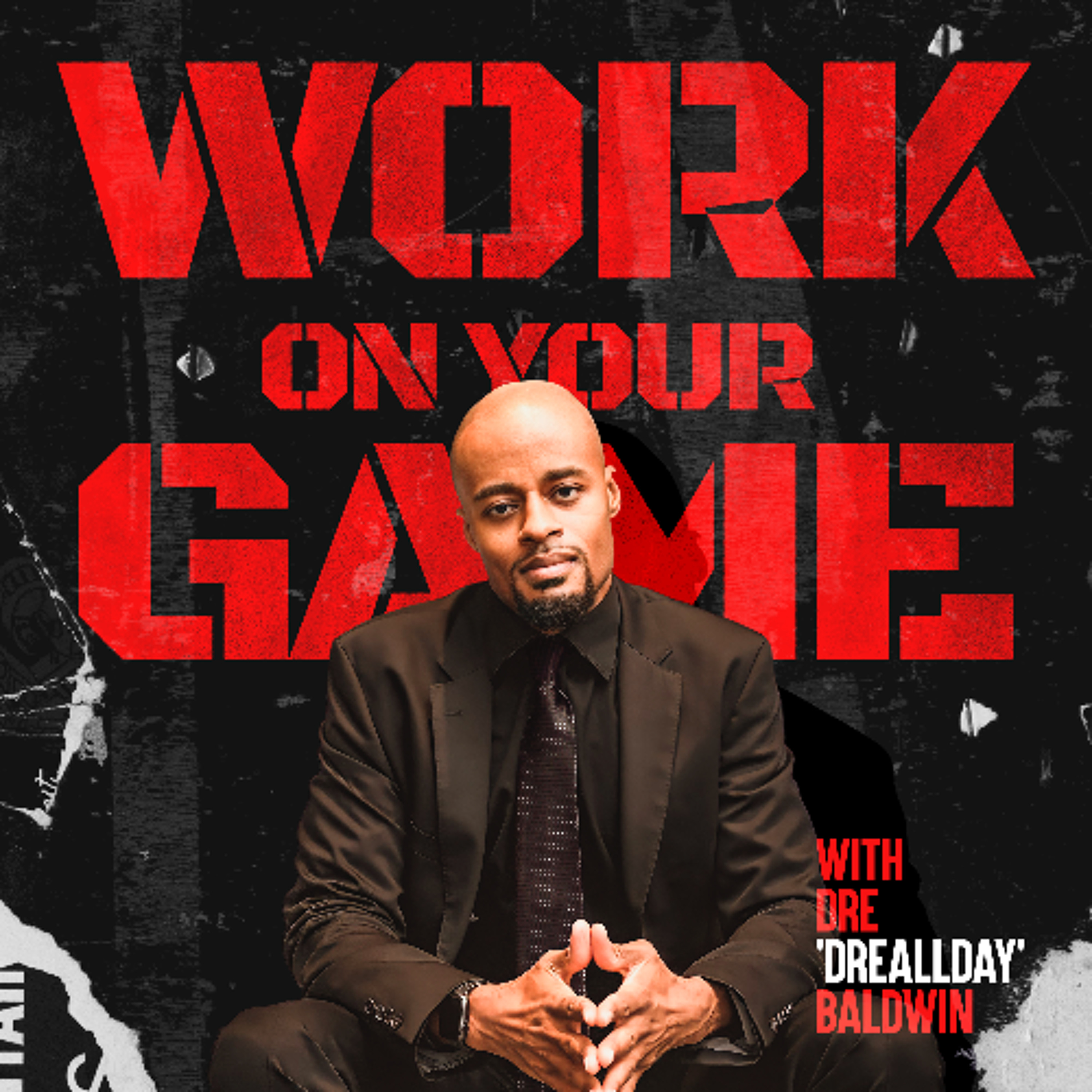
#3605: "Potential" = You Haven't Done Sh*t
About this episode
Get every episode summarized
Each time Work On Your Game: Discipline, Structure, and Execution Under Pressure publishes, we email you a written briefing from the transcript — the topics, who appeared, and any specific claims, with the ad reads skipped.
Email me new episodesFree for 3 shows. No card needed.
Hosts & guests
Transcript ready
543 searchable segments. Every word is indexed and playable.
Full transcript
Work On Your Game: Discipline, Structure, and Execution Under Pressure — #3605: "Potential" = You Haven't Done Sh*t. Machine-transcribed; use the interactive transcript above to jump the player to any line.
Power presence calibration exists. It is not training. It is not coaching. It is for people already operating under consequence. And that's not you, ignore this. Information is in the episode description. Pass a certain age, the book turns from what I could do to what I could have done. Because the potential becomes regret. Stay all day, don't come. Work on your game. Work on your game. Work on your game. This is Dre Balder. And work on your game is the system that turns discipline into dominance. Today's topic is potential is an empty compliment. Now this is something that we touched on a couple of days ago in the episode on how skill without risk is irrelevant. Today I want to talk a little bit more about potential itself. Because we all know what potential is. Our potential is stored energy.
Potential energy scientifically is stored energy. Energy that could be used but hasn't been used yet as opposed to kinetic energy with this energy in motion. And if someone compliments you by telling you that you have potential, they are giving you an empty compliment. Maybe they minted positively but they are not really saying anything because what this potential means. Potential means that you could do something. Potential means that they see success in your future. But it also could mean, depending on how shrewdly the person may be using this quote-unquote compliment, they could be giving you a backhanded kickin' knee pants and letting you know, okay, your still at potential is about time you turn this shit into something real. That could be what they are trying to say even if they are not actually saying it. Again, it depends on how shrewdly they are using what they are using and that everybody is that shrewd. But potential still doesn't mean anything regardless of who said it, why they said it, or how they said it, or how you decide to receive it. Potential is an empty compliment because it means you ain't done shit yet. I already told you this two days ago. Somebody tells you you have potential and you have a done shit. That's what it means. Potential is often offered as praise but it carries no obligation and it carries no consequence.
Someone tells you you have potential and that doesn't mean you had to do anything. Someone tells you have potential and it doesn't mean that you are doing anything that matters and things that matter have consequence always. That's what makes the matter that there's consequence. Potential is used to acknowledge ability without requiring any proof. You can see once you have proof of ability now you are in kinetic mode, i.e. in motion. You have results. So nobody tells you you have potential when you have results. They say, congratulations on your success. I see what you've been doing. I see the way that you're moving. I see the things that you've got done. That was nice what you did over there. Now they're talking about things that are completed, finished and on the record. Someone's talking about potential. That means things that are completed, finished and on the record. Under your name, there's nothing there. So they got to defer to the only thing left, potential. i.e. you might become somebody. This is acknowledging you have ability but you have not produced any proof. This show here, just to be clear. This show is targeted towards people who are operating under consequence. Those of you who are or you want to operate under consequence.
i.e. you have skill. You're out there proving it. And if you don't go out there and prove it and you don't get shit done. You don't execute. You don't get things completed. There will be problems. And your professional life and your business. And for your family, for your community, for your industry, whoever you work with or is working for you. There will be problems if you don't execute. That's the person to whom this show is targeted. Just to be clear. So with that in mind, if someone's telling you that you have potential. This is a red flag. Most of you listening to this should be way past the potential stage. You're in the telling other people they have potential stage. That's where you should be now. People with potential should be coming to you and learning how they can turn this potential into something real. That's what I assume that I'm talking to. I'm going to put this out anyway. Because you can go give this to your understudy. You're mentee. You're juniors. You're junior associates. People who are learning up under you to help them understand without you saying it. You can say it about me saying it. Because they don't know me and there's distance.
Like we talked about yesterday. There's distance between me and them. So I can tell them the truth right to their face and not give a fuck how they feel about it. You would have to give a fuck how they feel about it. Because you got to work with them. I don't. So let me tell them. So you let them listen to this episode. Okay. Potential is an empty compliment. It's used to acknowledge you have ability but you have improved shit. And no longer your potential is referenced. You can do anything. Eventually you find yourself out of a job, out of an industry and out of opportunity. That's the way it works. In sports world, a player gets drafted because they have potential. And let's say some player gets drafted high in the draft in any sport. And they don't really do anything their first couple of years in a week. They may keep getting opportunity after opportunity after opportunity for four or five or seven or eight years. Why? Because the potential is still there that they could become something. Eventually, however, that player gets kicked to the curb by the league itself. Not the league actually saying you can't play. But all of the league collectively decides. Okay, this player is not ever going to turn his potential into something real. Nobody wants you anymore.
And now you're completely out of the league. Because you never turn that potential into anything tangible. In every industry it works this way, by the way. I'm using sports because all of you can understand it. And sports is very, it's public. You can see this happening publicly in sports. And other industries that happens quietly. And sports that happens about we. But it happens everywhere. The longer your potential is referenced. People keep talking about you with the word potential next to it. That means you ain't done shit yet. You should not be happy when someone says you have potential. In case you're not reading between the lines here. Point number one. Today's topic once again is potential is an empty compliment. Number one. Potential is recognition without commitment. I.e. recognizing that something could happen, but you haven't committed to actually making something happen. Because when you commit to making something happen, what do you do? You start doing things. And things start happening. So potential flatters you without the manning that you do anything. Which is why I just told you at the end of the introduction. If someone tells you you have potential, that's not something to be happy about. Don't get excited when someone tells you you have potential. I'm translating for you what it means.
If I tell you that you have potential when I'm telling you is, I see the possibility that you could do something that matters. And also see the reality that you have not done anything that matters. That's what I'm telling you. Now me. I don't really tell people they have potential. I would tell them what I just said. I would actually tell you that. There's a possibility you could do something, but at this point you ain't done anything. So what do we need to put in place? Tell me what is in your way of actually doing shit that matters. Because that's why we're having this conversation. That's what I would say if you and I were sitting down having a conversation. I would not tell you that you have potential. I don't talk that way. I would say I see as possible that something could happen over here, but nothing has happened yet. So I want you to let me know what do you feel like is in your way or slowing you down or that you don't know or that you can't do that it's stopping you from actually doing things so that we could stop talking about hypotheticals to start talking about what's real. Then I'll shut up and let you talk. The conversation goes from there. Our potential, that word flatters you without demanding action. Being labeled full of potential delays the moment where results are required,
but as I've already told you a couple of days ago and I'm telling you again here today, that delay of no results being required can only be tolerated but for so long at the professional level and this is usually what we're talking about, the professional level where money is involved and when money is involved, there's consequence. Everybody get it? So that's why this show is targeted towards professionals who are operating under consequence because professional means you are doing something as your main paid occupation. This is how you make money and we use money to pay for food clothing shelter. Not only for ourselves, maybe for others. And the money that gets generated through your business helps other people pay for their food clothing shelter. So that's what I mean when I say consequence. At the amateur level, there's no consequence, there's no money. That's why you're an amateur. At the pro level, something hasn't happened. And results eventually become required. So if you are a person of potential for too long but you haven't produced any results, well, you're not doing anything to make the money move, but who's going to keep paying? Answer is nobody. So then you become a free agent. I.E. you are the word free emphasized here, free meaning no money involved.
I.E. you ain't a pro right now. You're kind of a pro but you're kind of not. You're technically a pro in name, but you're not a pro informed because you're not doing anything to make money move. Therefore, no money is moving to you. How long can you live under those circumstances? Everybody following me here? If not, rewind this and listen to it again. Point number two. Today's topic once again. Potential is an empty compliment. Number two. Potential excuses non-performance while preserving your ego. Now this point, I shouldn't even need to say to you all who are operating under consequence. But again, I told you, play this for your junior people. You're up and coming people. Your understudies, your mentees, your apprentices who are just learning the ropes. Because again, I'm saying to them what you want to say to them, but you can't say it because you're too close to them. But I'm not close to them. So let me say it. It's almost saying you have potential there, excusing your non-performance while preserving your ego. But understand the person. So now I'm talking to your juniors here who are listening to this. The person who let you listen to this episode and told you to listen to this one.
Understand, they're only going to tolerate your potential but for so long. If you're a kid who's over the age of 18 and you're living in your parent's house, your parents are only going to tolerate the potential of you becoming something but for so long before they say, you're going to have to get about it here. For some parents, that rope is a little bit longer than for others. Now, don't take it personally. I'm not dissing you. I moved out of my parent's house permanently at the age of 24. Played in college or went to college, graduated college in 22. At 22, came home at 22. Worked a year at still living at home. Went overseas to play ball at 23. Came back from playing ball where overseas was still living at home. Then went back out again when I was 23. I was turned 24 while I was out playing still again. Second and third jobs playing I was 24. Came home I was 24 and that following summer I moved out. I turned my birthdays in February. So in the summer fall of the year that I turned 24, that's when I moved out. Halfway through age 24 before 25. That's when I moved out of my parent's house.
I'm telling you that not that you need to move out of age 24. Point being that your parents will tolerate you because they see some potential in you. But eventually if that potential ain't turned anything, they're going to tell you, you've got to go sleep on a bus bench and do something with that potential. I'm not saying your parents are going to do that, but you get my point, hopefully. Potential excuses your non-performance while preserving your ego. It allows you to feel capable without being accountable. I could do this and this and this, but there's no accountability for you actually doing it. See, it sounds good when you're just talking about it. Hold everything when you actually do it. Speaking of sports. Coming out of college sports, one thing that many of you may have heard, you follow sports, you know that 97% of high school athletes do not play their sport at the collegiate level. And let's just use basketball because this is where I know the actual stats. 97% of high school boys basketball players do not play college basketball. So only top 3% go on playing college. Other players who play in college 1%, the less than 1% ever played professional. I.e. ever get one paycheck for playing basketball one time ever.
The less than 1% of players who are playing in college basketball right now today will ever receive one paycheck playing professional basketball. Not one. What's the point? When you're in college playing a sport and I'm going to speak on a sports that I know best. Basketball and football. In basketball and football, every fucking player in college, if you ask them, what are you going to do after a college, especially during their senior year, damn they're all with them say they're going to go play pro. I'm going to try or I'm going to try or I might. Now I'm going to see if I can make it. If I can go basketball players say NBA or overseas football players say NFL or whatever other football we can get into. I would say out of 100% of players playing football and basketball right now in college, what percentage of them are saying that they might do that or they're going to try to do it or they believe they're going to make it. I would say college coaches who are listening to this, y'all should throw me in your numbers, but I would say at least 40% and I might be being generous because I'm not actively talking to these people on a daily basis.
Those of you who are coaches, y'all talk to these kids every day. You tell me you're an accurate number. I'm saying 40% and that's conservative. I think it might be closer to 70%. Every athlete in college in football and basketball believes if you let them tell it that they're going to go play at the pro league, some pro league of their sport, when 99% of them will never play a second in the pro league. What's the point here? What they're all talking about is their potential. I could go play pro. I could go play overseas. I could go play in NFL. I might go make it in NFL. This allows people to feel capable without being accountable because I could just tell you I'm going to go play. When I was a senior in college and everybody's asked me what you're going to do after I graduate, what was I telling? I'm going to go play overseas. Now, was there a guarantee way I was going to make it? Absolutely not. Did it take me some time to get there? Yes, it did. But did it make me feel good to tell people I was going to do it? Yes, you know why? Because there was no accountability to the talk. I could just say I'm going to go play overseas and people say, oh, that's cool. I got to go ahead and dope me for them saying, that's cool. There was like a light going in social media before social media existed.
I graduated college in 2004. There was no social media. So telling people you're going to do something and not having to actually prove it was our social media at that time. This is what I'm going to do. Oh, that's great. Thank you. I haven't done shit. There I can graduate you. That's what potential does. It lets you feel good without any accountability to actually prove shit. Over time, though, that potential becomes a shield against measurement. But again, that shield only lasts for so long before people start saying, okay, when you want to actually do something here, all right? It was cool when you was 21. Now you're 31. Now you got to actually do something. Eventually, people run out of patience for your potential. I send out a daily motivation text every single morning that is guaranteed to have you focused, sharp, and on point to start your day. And I promise you, you want to receive this message. All you have to do to join my text community is to text me my number 305-384-6894. Once you join, we'll tell you all your options for how often you can get text by us and all of that. Just text me at the number 305-384-6894. To get that daily motivation.
Point number 3. Today's topic, once again, is potential is an empty compliment. Number 3. Results end the conversation that potential keeps alive. This is the real game, folks. You see, that potential that I was happy about having, believing that I was good enough to play basketball at the professional level felt good when I was in college walking around campus, not graduated yet, still living under very little consequence as a college student. It felt good talking about it then, but then graduation hit, then everybody goes home. Now you're not in that environment with college students anymore. You're hanging around a bunch of adults, i.e. living at home. You're saying your parents go to work every day. What are you doing? I wouldn't do shit. I have anything going on. So that potential didn't feel as good in a different environment. So now, there was some pressure on me. My parents said, hey, what are you going to do now to graduate from college? I'm going to go play professional basketball and I didn't really have a way that I was going to do it. My parents asked questions that shot holes in my completely illogical pipe dream. I was going to become a professional athlete.
At that point, it was a pipe dream. That created accountability. It was accountability. Like, hey, you're in our house. You're a grown adult. You eat food. You use the electricity. You're using the bathroom. This is causing us extra money. You're not bringing in any money. Now, there was some urgency. Do you understand? There was some accountability. You need to actually go do something and make something out of the situation. Yes, it sounds good. You want to play basketball. But you don't have any prospects to go play basketball. Maybe you need to go do something else to bring some money in because you are an adult. And you are a government in our house that, hey, if the basketball thing ain't making any money, you got to do something to make some money. Now, this creates a conflict between my dream. What I wanted to do. And at that point, it was a dream. What I wanted to do. And the reality of the situation, that created conflict. That conflict was necessary. I was the conflict necessary because the conflict created urgency. It made a fire under my ass that I had to go figure out how do I make this basketball thing work because it sounded good when I was just talking. Now that I'm being held accountable to make it happen, now I got to actually do it. And if I don't actually do it, it ain't happening.
See, you can talk about things all day. It feels good. There's a whole other thing when now you got to do it. And there's a real consequence if you don't. I was facing real consequence. So now I have to go do something. And this is in the summer of 2004. So I graduated college in May of 2004. I hung around my college campus till about August of that year. So in August, I came back home and filled up. It was around the time this conversation happened with my parents. It took an entire year. I went and got a couple regular jobs as suggested slash demanded by my parents. There's a belly total fitness and foot locker where places that I worked. And then I went to that exposure camp that I mentioned a couple days ago. And that exposure camp is what got me my first job. So it took me an entire year. From the time I came home from college to the time I actually was able to make that dream wake up and become reality. The whole point here is folks, the reality, the results, ended the conversation about potential. I was no longer a basketball player with potential. Now I have some proof. Oh, now I've been overseas. All right, now it's time to concentrate. Now I've been sober.
Now I've actually done something. Now I've got a resume. Now I've done something. Now we don't have to talk about potential ever again. Because now I've done something real. See, once outcomes exist, potential is not part of the conversation anymore. And at a certain point, and what you do, whatever it is that you're doing, you need to be urgent, mentees, apprentices, need to be urgent about eliminating the word potential from your resume. You don't want potential when you're scouting reporting. Potential to get better. Because again, potential has a shelf life. Because imagine you and somebody else are at the same level and you both come in with potential. Now two years in, this person is cashing in on their potential and turning into results and you still haven't done anything. Well, everybody's looking at you like, okay, why are we keeping this bum around? Everybody else is turning their potential into something. What are you doing? That's what they're thinking. Now, thanks to many people who say that to your face, but they're thinking it. And even if they don't say it to your face, when they kick you out of there, you'll understand. They don't have to say it to your face. The results will talk. Reality replaces speculation.
And when real things happen, that's your responsibility. Produce the outcome so that we don't have to keep talking about what you could do. And you don't have to keep talking about what you could do. That matters as well. Because again, pass a certain age. We only hear about what you could do. Pass a certain age, what happens is, and since we're talking about basketball, I'll give you another example. Growing up in my neighborhood in Philadelphia, I remember when I went to play in college. When I went to play in college, and I would come back home, knowing the summers and things like that, and then right after college, and then when I went overseas, and came back home, and a little bit would be in the same neighborhood I'd grown up playing in. And I would see guys who I'd grown up looking up to on a basketball court. These are older guys. But they'd be out at the park playing basketball. This is where I'm learning to play basketball. When they would hear me say, I'm going to college. Hey, I'm in college. I just graduated from college. I'm trying to play overseas. So I went overseas. It came back from overseas. I can't tell you how many times one of them would say to me, I was supposed to go play in college. I was going to play in college.
I had this offered a scholarship, or I had this one year I was playing, or this coach was recruiting me, or I was supposed to go overseas. But this happened. And that happened. All of these things. How many times I heard the stories of what I could have did, but I didn't do. I heard that from the, if you've heard the episode where I talked about the old heads, where I'm from in Philadelphia, that's what we call the older guys. We call them old heads. And how many times I heard this episode, this is episode 3384 and 3385. I heard that so many times from older guys, when I started to actually produce the results that they thought in their youth, they would have produced, but they never got around doing it. The point is, past a certain age, the book turns from what I could do to what I could have done. Because the potential becomes regret. It becomes didn't happen. It becomes okay. What did you do? Because people don't want to hear about what you could have done. They want to hear what you did do. And it's only so much people want to hear what you did do. They just want to hear about what's happening now. And it happens quick.
Let's recap today's class, which is, the potential is an empty compliment. Number one, potential is recognition without commitment. So people are recognizing that you could, but you haven't made any commitments yet, but again, it's a nice way of telling you you haven't done anything. Number two, potential excuses non-performance while preserving your ego. So it makes you feel good. When people say you have potential, and you talk about the things you could potentially do, but again, that has a shelf life eventually where you got to prove it. And number three, results in the conversation that potential keeps alive. Once you start producing outcomes, you don't have to talk about what you could do anymore. And if you never produce outcomes, you can't talk about what you could do either. You start talking about what you could have done, and you don't want to be that person. That's who you don't want to be. Final thought here, ladies and gentlemen. Potential carries zero weight, is weightless. Only outcomes goes the gap between promise and position. Outcomes, results, tangible, things on the table, proof in the pudding. Work on your game. Drey, all dead. There is a private calibration process connected to this work. Most people should not look at it.
It assumes responsibility, not curiosity. It assumes pressure, not interest. Details are in the description. Do whatever you want with that.
More episodes
More from Work On Your Game: Discipline, Structure, and Execution Under Pressure
#3775: Systems ALWAYS Get "Gamed"
Work On Your Game: Discipline, Structure, and Execution Under Pressure
#3774: Don't Be An "Open Book"
Work On Your Game: Discipline, Structure, and Execution Under Pressure
#3773: Why Stories ALWAYS Beat Statistics
Work On Your Game: Discipline, Structure, and Execution Under Pressure
#3772: Your Brain Needs "Alone" Time
Work On Your Game: Discipline, Structure, and Execution Under Pressure