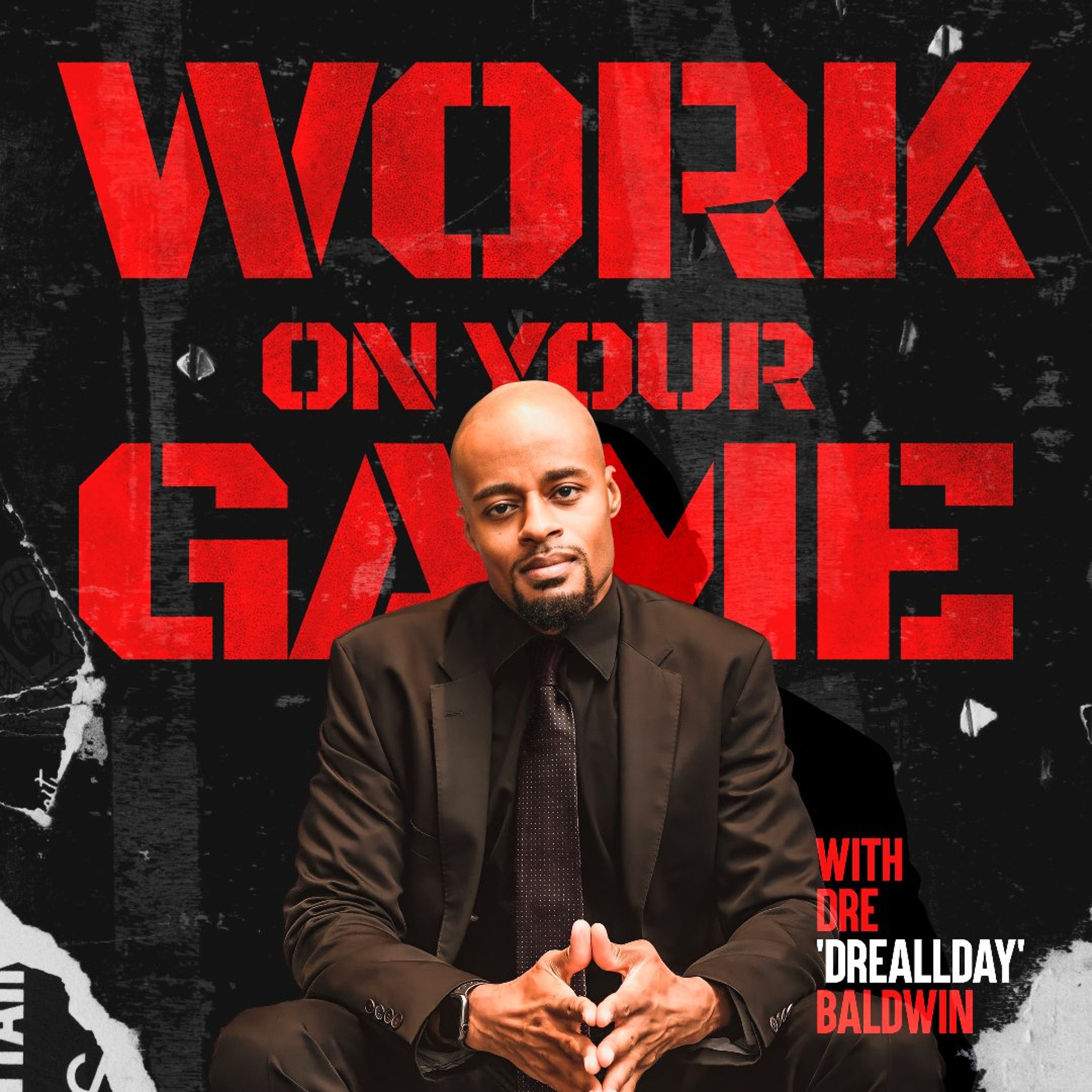
#3765: Communication Without Consequence Is Noise
About this episode
Get every episode summarized
Each time Work On Your Game: Discipline, Structure, and Execution Under Pressure publishes, we email you a written briefing from the transcript — the topics, who appeared, and any specific claims, with the ad reads skipped.
Email me new episodesFree for 3 shows. No card needed.
Hosts & guests
Transcript ready
514 searchable segments. Every word is indexed and playable.
Full transcript
Work On Your Game: Discipline, Structure, and Execution Under Pressure — #3765: Communication Without Consequence Is Noise. Machine-transcribed; use the interactive transcript above to jump the player to any line.
Power presence calibration exists. It is not training. It is not coaching. It is for people already operating under consequence. And that's not you. Ignore this. Information is in the episode description. If you're serious about improving your leadership, your discipline, and your ability to execute, I send one email every single day with one practical lesson you can use immediately. No motivational fluff, no life story, just straight to the point game on mindset, structure, leadership, and high performance. It's free. Get it every day to your inbox at workonmygame.com. That's workonmygame.com. Standards become real only when there is a predictable response to following short of a standard. Workon your game. Workon your game. This is Dre Baldard.
And workon your game is the system that turns discipline into dominance. Today's topic is communication without consequence is noise. This statement here, this title is a good description of what social media is. Pretty much for all intents and purposes. This communication without consequence. Now I say this as a person who engages on social media. On X, that's the one social media app where I will engage. If you engage with me there, you may get a response from me. I will respond to every single thing to get said. But I do engage. I will go to other people's content. I will scroll through the fees, see other people's content, and I'll say something. They'll say something back. Random people will jump in conversation. These kinds of things happen on X. I'll look on my X account right now and tell you. Now the time you hear this, the dates have changed. But just in the last seven days on X, I have gotten 2.5 million impressions on X. 28,000 engagements, 2000 replies, 900 reposts, 150 shares, 850 bookmarks, 18,000 likes, 7,000
profile visits, and whatever, whatever. These are the empty vanity metrics on X that I've gotten over the last seven days. I'm bringing those up because I actually engage on that app. That's the reason why those numbers are what they are. Probably not nearly as high on other apps like TikTok, Instagram, LinkedIn, Facebook, etc. Because I don't engage back. So it doesn't drive engagement. The whole point is that app, just like all those apps that I just mentioned, every single one of them is communication with our consequence. They're all noise. Now the question should be, well, Jerry, what the hell are you engaging in noise? I mean, you talk down on noise, why are you engaging? I engage in noise on X in particular, just X. I don't do any others because X is the internet town square. I get my news from X. I know it's happening in the world from X. I do not watch CNN. I do not watch Fox. I do listen to some podcasts and talk about current events. But mostly I find out what's happening in real time through X. Player gets traded in the NBA. I find I don't X who won the game last night. If I didn't stay up to watch it, I find I don't X. What's happening politically?
What's the next negative thing to say about Donald Trump? I find I don't X. Trump Democrat is in the lead to be the candidate for 2028. I find all those things out on X. That's where I find out what's going on. That's one reason why I use X is because the town square is basically my news source. Second reason is because it provides source material for what becomes episodes of the show. I don't get every episode topic from X. I have over 3,500 episodes of this show. There's no social media that offers enough material for me to come up with 3,500 unique topics. I got it at I give myself credit for it. On X, I will see things and hear people saying things. Especially when I hear the same thing coming over and over again and I disagree with it. It tells me a lot of people think the same thing is not right and they think it either for the wrong reasons or they just have the wrong conclusion or the wrong framework or the wrong thought process. I can make content out of this. I can use this for material. The things that I see other people saying and what it appears they are thinking provides source material for me. That's another reason why I engage in this noise.
Another reason is I can test out my own material and see how people engage with my material based on the things that I said. I will post things on social media. I told you a couple days ago that I had a couple post-go viral over the last week. The main reason these are those posts went viral is because I offered an opinion, a logically framed opinion that people disagree with. Not everybody disagreed. Of course, a bunch of people who agreed with me but there are a lot of people who vocally disagree with me. That's what makes things go viral. Things don't usually go viral because everybody agrees with them. They go viral because there's a bunch of people agreeing and a bunch of people disagreeing. When you find that sweet spot in the middle, that's when things usually go viral because you need enough attention from both sides and you need enough rocket fuel in the comments that people will go back and forth to see who else said something back, etc. But if we all agree, then you're not going to have that rocket fuel. Rocket fuel usually is provided by the contrast between positive responses and negative responses to the exact same material. If you want one little piece of strategy, if you want to call that strategy to go viral,
there it is. Anyway, all of those things happen on social media is still noise. It's still noise. Despite everything I just told you, it is noise. Why? Because there's no consequence. Consequence means there is a tangible difference in the universe. Something began, something ended, there is something tangible and measurable that has moved, chains, begun, or ended. That didn't happen what you just engaged with is noise. Social media is noise. Unless you're the owner of the platform is not noise for you. That's actually a consequence of your Mark Zuckerberg. Everything happening on Facebook is consequence. Why? Because that's your business. You're making money off everything happening there. You are on the platform. If you're Dre Baldwin on Facebook, everything you're doing is noise other than running ads. If you run ads, that's actually a consequence because you're spending money and you're leading people to where you can make money. But if you're just on there responding or posting and other people are engaging, that's noise. It's not saying that it's necessarily a bad thing because that can draw attention. The attention from the right people, we talked about this a couple days ago, attention from the right people can build trust, that can build relationship, that can lead to business.
If you're doing it strategically, which I do, I just told you some of my strategy for using apps. But a lot of people just do a whole lot of communication with no consequence, intended, and no consequence achieved. And consequence usually doesn't happen by accident. It needs to be intended to be achieved for the most part. And if you're doing it without intention and achievement of consequence, then what you're doing is noise. And it feels good in a moment because you're engaged, but in the end, nothing actually happens. You wake up, you're still on the same spot you were in before. Most leaders communicate expectations, but fail to connect those expectations to outcomes. In other words, you tell people what you want them to do, but you don't tell them, well, I want you to do this because it leads to this. Now, you may think you don't need to tell them that I just do what I tell you to do without even knowing where it's leading. For the most part, you should let people know where it's leading because number one, they might have a better idea than you. Number two, it will give them more reason to get it done. Number three, it lets them know how their efforts are connecting to a bigger picture and to something bigger than they are. And that's usually the lack of that is usually many reason people leave jobs. When they fill out, they're just a cog in a wheel to act a machine and they're not really
contributing in any meaningful way. They go find somewhere where they fill out, they are contributing. Communication becomes effective, everybody. When people understand what happens when they do what is being communicated, then what happens if they don't do what's being communicated. And yeah, sometimes it is understood. Sometimes it is assumed. It's even better though if you can communicate it and let them know in a positive way. I'm not talking about, hey, if you don't do your job, I'm going to fire you. Most people understand that inherently. If this doesn't get done, then that slows down. This part, that slows down. This part, and if you have good people within your organization, they probably don't want to be the cause of a hindrance to the bigger picture was happening in an environment in which they are involved. They're engaged, they're part of it. So it's not like they're doing this as some type of a charity work. They're doing this because they're trying to contribute. Then this is the reason why you need to make this kind of communication. I tell readers this all the time. If you want people to follow you in your organization, you want to be a leader, not just a boss, then you need to find out why they're there, what they actually want to get out of it and make sure that when you're dealing with them, you're showing them how doing what you need them
to do or what the company needs them to do helps them achieve what they want to achieve. And that's a communication job for you as a leader. Point them one. Today's topic, once again, communication without consequences is number one. Expectations without consequences are suggestions. I told you before that rules without consequences are suggestions. As our expectations without consequence, expectation is this is what I want you to do, but you don't tell them, hey, here's what happens when you do it. Here's what happens if you don't do it. People use this given them a suggestion, which means they might do it, they might not. People do what you inspect, not what you expect. When you inspect something, that means you're checking on their work to make sure they did it presumably because if they did it right, that's a good thing. And the next step occurs and if they did it wrong, that's a bad thing and correction occurs. Those are consequences. You get to take the next step as a consequence. You will be corrected as a consequence. If you don't share either of those, there is no consequence. Therefore what you offered is as an expectation is actually a suggestion because an expectation
usually means this happens and this happens and this happens. Expectation means if I do this, I get this. That's what the word expectation means in the mind of a human being. Reasonable person doctrine. When there is no cause for ignoring a standard, compliance is optional. This is why I told you, standards not only do they matter, but standards must be enforced. It's not a standard. It is not enforced. If you say this is the rule, but nobody follows the rule and then nobody does anything when the rule is not being followed, then you don't really have a rule. Every building I've lived in the last 10 plus years has rules for how things are supposed to be done when it comes to where you're either got your dog, relieve themselves, what you can and cannot do with the pole deck, how to dispose of your trash, how loud you can play music, how to invite guests, how guests are supposed to come to the building. They have to check in at the front desk, they have to show ID and do a call you from downstairs and all this stuff. They all have all these different rules.
Most of the time in my experience a lot of the rules are not enforced. Therefore they're not standards, they're suggestions, meaning sometimes people follow them and sometimes they know. And it's not because people are bad or the workers are bad, it's simply because there's no enforcement. There must be a cause for ignoring a standard if you're going to call it a standard. There must be a correction to violating a rule if you're going to call it a rule. If you ever rule and somebody clearly violates it but you don't do anything, you don't have a rule. You got a suggestion. It was just shown to you that it was a suggestion because it got treated by one. Rules are enforced. Someone violates a rule, it is immediately enforced always. That's how you make sure people are more likely, not guaranteed, but more likely to follow rules when they know there will be enforcement. Just yesterday as a matter of fact from the day number coordinates I got a driving citation and a moving violation as they call it. I was driving my car and what was essentially a bike lane, I was trying to get to a left turn but there's a lot of cars in the main lane is essentially one lane street. But there's a big bike lane on the left hand side and I basically circumvented the long
traffic line by riding in the bike lane to get to the left hand turn to get around all the traffic. I do this all the time. I've done this probably a hundred times and never had an issue on this particular day though. There was a cop sitting there. He saw me, he hit the lights immediately, pulled me over and I got to take it. There's a point being that enforcement gives me pause the next time that I run on that road which might be today. If I'm going to circumvent traffic by riding that bike lane again because now I got to be wary is that cop going to be sitting there and give me another ticket. Now I got to think twice about it today. I might just follow the rules today. It's because it's a freshman my mind that cop might be sitting there. But I'm looking where that cop was at yesterday. If I don't see him then that tells me next time I can just violate the rules again. The whole point is the enforcement is designed to make sure that people follow the rules even when the enforcement may not be around. So the enforcement kind of woke me up to the fact that I might get caught doing this illegal thing and I'm not supposed to be doing it. When there's no cost for ignoring a standard compliance is optional. People quickly learn what's expectations matter and what's expectations do not matter. And they learn to gauge sometimes as it comes to making the legal turns and riding the
legal roads on streets. What they can get away with, what they cannot get away with, win how and how often. Point number two today's topic. Once again, it's communication without consequences is noise. Number two, incentives direct attention and effort. Human beings respond to an incentive. So 100% of the time and without fail. 100% of the time and without fail. If you want people to do something, everybody listen to this. If you want people to do something, give them a good reason to do it. Simple as that. If you want more leads in your business, then one thing you can do is offer a lead magnet. A lead magnet in the online marketing world is something free that you offer to people. It doesn't actually have to be free, but generally free or very go cost. You offer it to people in exchange for their contact information. You give me your email address. I'll give you this free guide with 10 hidden recipes for making cookies in your house using bananas and strawberries.
I give this guide to you for free. It's PDF for free with all the recipes and all the ingredients. All you got to do is put your email address in this little box, click the button, we'll send it to your email immediately. That is a lead magnet. Now you have to email address with lots of people who love bananas and strawberries. Now you can send them emails and tell them everything you love about bananas and strawberries. Eventually you can offer them to join your banana and strawberry membership program for 50 bucks a month or whatever it is that you're offering. They are leads. Leads are people who are interested in something that you could possibly be sharing. That's a lead. So you offer a lead magnet. That's the thing that draws people in who are interested in that thing and usually again it's free or low cost to get them to incentivize them to move. The whole point is you offer them an incentive to get into your space. Now they were already interested in bananas and strawberries, but until you offered them the incentive they would not raise their hand so to speak and let you know that they were one of those people. So you had to offer them something to entice them and incentivize them to show that they
were one of your people. Until you offered that enticement they existed but they didn't let you know that they were one of your people and they didn't know that you wanted to know that they were one of your people because you didn't get them a reason to tell you. So you got to offer them a reason. That's also known as an incentive. Also an incentive is going to work in a negative way. Again, you want to direct effort. I just gave you an example. I got a citation yesterday for riding in a bike lane. So today if I run in that same street I may avoid riding in a bike lane just because I got the citation yesterday and the citation is fresh on my mind. So I don't want to get another citation. So I may just follow the rules today. Why? Because the incentive, the negative incentive of getting that ticket has me thinking twice about doing that. That is how incentives work. So if you want people to pay attention to something or you want people to do something offer them an incentive positive or negative to move them. Just communicating to people that they could do something or they should do something or there is something available to be done is often not enough to move people to action.
Why? Because human beings are lazy. Number one. Number two, because human beings already have their own agenda that they not include doing whatever you just introduced to them. So they may not want to interrupt their own agenda to do what you're suggesting because you haven't given them a good enough reason. They get them a good enough reason. People will change their entire schedule around to go do the thing that they weren't even thinking about doing. I'll give you another example. A few years ago, I don't know what years was. This is probably 2000, maybe 19, 20. That was a Friday. I'm recording this today is a Friday. This is a Friday several years ago. And on Saturdays, Saturday mornings usually I go for a run. And I was looking at running events. This is at a time when I used to do all these running events like 10K races. I've done enough of them. I got a wall full of medals from running 10Ks. I don't really know many more because it wasn't really exciting to win medals. Beatin' people I knew I was going to beat. But anyway, this is when I hadn't accumulated so many medals. I was looking at running events, looking for some races to get in it. And I saw that there was going to be a 10K race on Miami Beach the very next morning.
Now usually when I run a 10K race, I plan ahead. I know like months ahead that I'm going to be running the race. And I taper off my training to go at my body rest for race day. So usually I may take a couple running days off before the day of the race. Now in this particular instance, I didn't know about the race so the day before. So I hadn't taken any rest time. But I might now really want to run in this race. So I signed up for the race anyway. And came in first place. Point is the incentive of the possibility of winning that medal for coming in first place is the reason why I signed up for the race even though it was interrupting my normal agenda. And it didn't even allow me to exercise my normal process for getting ready for a race by doing anyway because I was incentivized by the prospect of collecting another trophy which I did do. Even if I hadn't, I still would have been glad that I did it because I gave myself a chance. So a strong enough incentive will cause people to interrupt their own schedules and their own agendas to follow whatever you're offering. Just gotta give them good enough reason. That's how it works.
Get people good enough reason to do something and they'll do it. Even if they weren't planning on doing it. People naturally move towards rewards and recognition. I just gave you an example. I signed up for a 10k today before the race not because I need to prove that I can run 10,000 kilometers. I run 10,000 kilometers all the time with no fanfare and no audience. I know I can run it. It was the prospect of doing it. And a crowd of a whole bunch of other people and doing it faster than them and then getting a visual recognition token that showed that I did it better than a whole bunch of other people. And there are certain people out there also known as athletes. We like doing that. We collect trophies for that. Metals and trophies for doing that. That's why we do it. People move towards rewards and recognition. So you offer people reward and recognition for doing something they'll be more incentivized, more likely to actually do it. Now just doing it for the sake of doing it because that's who they are. Those people are fewer far between. You may hope that you have a bunch of people on your team who are like that. Probably not. They're probably not that. They might seem like that the first month or two but they're not really. All human beings are driven by rewards and recognition.
Okay. You saw what he wanted to trophy. He didn't put on the ground. He held it up in the air so you can see it. Okay. So this applies to everybody. There are some renaulions when it's trophies. He holds it up so you can see it. Antigua was when it's trophy. He held it up so you can see the trophy. All right. So all human beings no matter how driven, no matter how strong, no matter how good, time Brady, who else? Messy, Cristiano Ronaldo and they win. They hold that trophy up. They're not ashamed of that trophy. They want you to know they got it. Okay. So incentives drive people to action. All right. People will do things for incentives that they would not do just for the sake of doing it for the love of the game. So to speak, strong leaders online in census with the behaviors they want repeated. Simple. Simple, but also challenging for a lot of people. What behavior do you want repeated? Answer that question. Then ask yourself, what can I give people or what can I incentivize people so that they do this thing over and over again? Simple two questions. There is a point where self-awareness stops being enough. More presence calibration exists past that point.
It assumes consequence, not curiosity. The reference is listed below. Point number three. Today's topic, once again, is communication without consequence is noise. Number three, consequence creates accountability. More consequences you put in place, the more accountability you put in place. Why? Because the consequences themselves become the accountability. The consequences become real only when there is a predictable response to falling short of a standard. If people know something is going to happen when you come up short of a standard, people make sure they don't come up short of that standard if they really want to avoid that thing that's going to happen. The coach says everybody on time for practice, if one person is late, the whole team is going to run. The whole team makes sure that everybody else on the team is on time. And nobody wants to be the one person who shows up late and causes the whole team to face a penalty because of their negligence. You don't want to be the jerk that everybody's mad at and you made everybody else face a punishment because of your behavior. So everybody isn't incentivized by not wanting to let down everybody else.
That's how standards become real. There must be a predictable response to any failure of standard. One of the reasons why drivers like me can get away with riding in the bike lane so often is because there is no predictable response because there are not enough police officers to catch everybody doing something illegal in a car. There are a lot of words that be too many cars on the street and that would just cause more traffic that you need a million cop cars on the street to catch everybody doing illegal shit. Running stop signs, running red lights, making illegal turns, riding in wrong lanes, switching lanes without signaling. People do this stuff all the time. I do this stuff all the time. Driving without a seat belt. People do this stuff all the time. They don't have enough cops to catch everybody but people know that there's a chance you could randomly get caught or one random day and that's enough to keep people in line enough for society to function. Keep people like me from driving in the bike lane. Somebody on a bike and running in the bike lane. But when there's nobody in there, I will sneak through the bike lane and then we'll be riding into a void traffic. I will do that. Anyway, standards become real when there is a predictable response to failing the standard. So we need to know there's going to be a predictable response.
What's going to happen if I violate? Nothing okay and I'm violated. If I know something is going to happen then I think twice about violating or I don't violate it all. If I think there's a chance something might happen I think twice. If I know something is going to happen then I probably don't violate it all. So this is a matter of how consistently are you able to uphold your own standards. That's really what this comes down to. And over here I work on your game. Incorporate that we have something and mix this going to help you with that a lot to where your standards will be uphill consistently because there will be a predictable response to coming up short of your own standard. While your end of process will come up short before you even finish coming up short, it will get caught and it will be noted to you. That's all I'm going to say for now. I'm going to say to you for that. Consistent consequences establish credibility and a reinforce authority. Monaric consistent consequences people think twice, three times or just don't at all do something that they're not supposed to do because they know that there will be a consequence. If it's consistent they know. If it's random they guess. Again as I told you today.
I'm going to think twice about riding the bike lane today simply because I just got pulled over yesterday. We have a recap of today's class which is communication without consequences is noise recap. Number one standards requiring enforcement. If you have standards you got to enforce a standard you cannot just tell people they're just standard you got to uphold it. Number two behavior files and sensives people do what they are incentivized to do positively and or negatively at number three. Accountability depends on consequences. You cannot hold people accountable without consequences. Part of accountability is there is a consequence for coming up short. Final thought everybody leadership communication is incomplete without incentives and consequences. You cannot lead people by just hyping them up and motivating them to go do stuff. You got to give them a reason to go do stuff whether it be a positive reason or a negative reason but people do things when they have a reason. No human being will behave consistently over any extent appear to time without a reason. You got to give them a reason or hope you have enough people who have their own reasons. My suggestion is most of your people do not have their own reasons. You must provide those reasons that is the burden of leadership. People take standards seriously only when outcomes are attested.
Work on your game. Dre, all dead. You call yourself a high performer. The ERI execution reliability index will verify this. It measures how often you do what you said you would do on time and under pressure. No opinions, just data. Get your score at workonyourgame.com slash ERI. That's workonyourgame.com slash ERI. That's workonyourgame.com slash ERI.
More episodes
More from Work On Your Game: Discipline, Structure, and Execution Under Pressure
#3772: Your Brain Needs "Alone" Time
Work On Your Game: Discipline, Structure, and Execution Under Pressure
#3771: The Death Of Nuance (And Why It's A Problem)
Work On Your Game: Discipline, Structure, and Execution Under Pressure
#3770: How "Red Pill" Men Are Just Like Feminists
Work On Your Game: Discipline, Structure, and Execution Under Pressure
#3769: The 4 Quarters Of Life (And What Each One Is For)
Work On Your Game: Discipline, Structure, and Execution Under Pressure