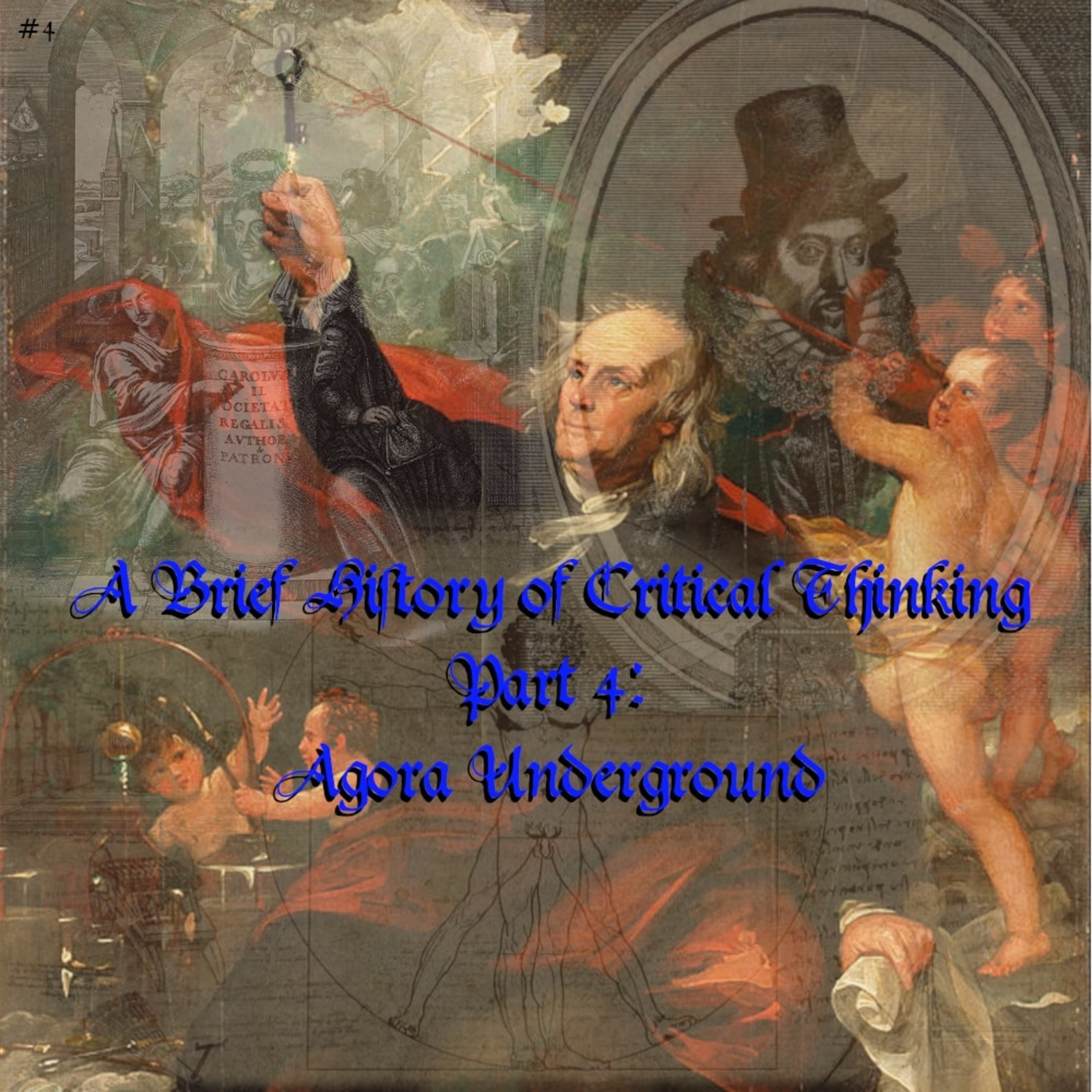
4. A Brief History of Critical Thinking, Pt. 4: Agora Underground
About this episode
Though it is typically associated with its spectacular art, the Renaissance which followed the Middle Ages also gave rise to a new philosophy. Many at the time thought that underlying all of the world's religious traditions was a thread of universal - "divine" - truth. Perhaps more importantly, there arose an idea that the physical world was bound together by some sort of rational "force" - a force which could be understood, if only man paid close attention to the subtle behavior of nature. Of course, such a concept is easy to take for granted now, as it is the bedrock of our modern, materialistic, scientific worldview.
Critical thought was revolutionized in the 17th and 18th centuries, as daring thinkers experimented with old materials to create new technologies, and even went so far as to create new types of political organization. This is the story of science and its early social implications. This is the story of the Renaissance and the Enlightenment.
For comprehensive Show Notes, please visit https://storyofnowhere.com/historyofthinking4
Get every episode summarized
Each time The Story of Nowhere publishes, we email you a written briefing from the transcript — the topics, who appeared, and any specific claims, with the ad reads skipped.
Email me new episodesFree for 3 shows. No card needed.
Hosts & guests
No transcript yet
This episode has not been transcribed. Request it and it moves to the front of the queue.
More episodes
More from The Story of Nowhere

40. A Window in Dallas, Pt. 1A - The Official Story: Evidence of Our Eyes
The Story of Nowhere

39. Crowd Work
The Story of Nowhere

38. Man, Tool, and Telos, Pt. 2: End of Man, End of Machine
The Story of Nowhere

37. Man, Tool, and Telos, Pt. 1: The Technological Society
The Story of Nowhere