Loading...
leisureaviationnews
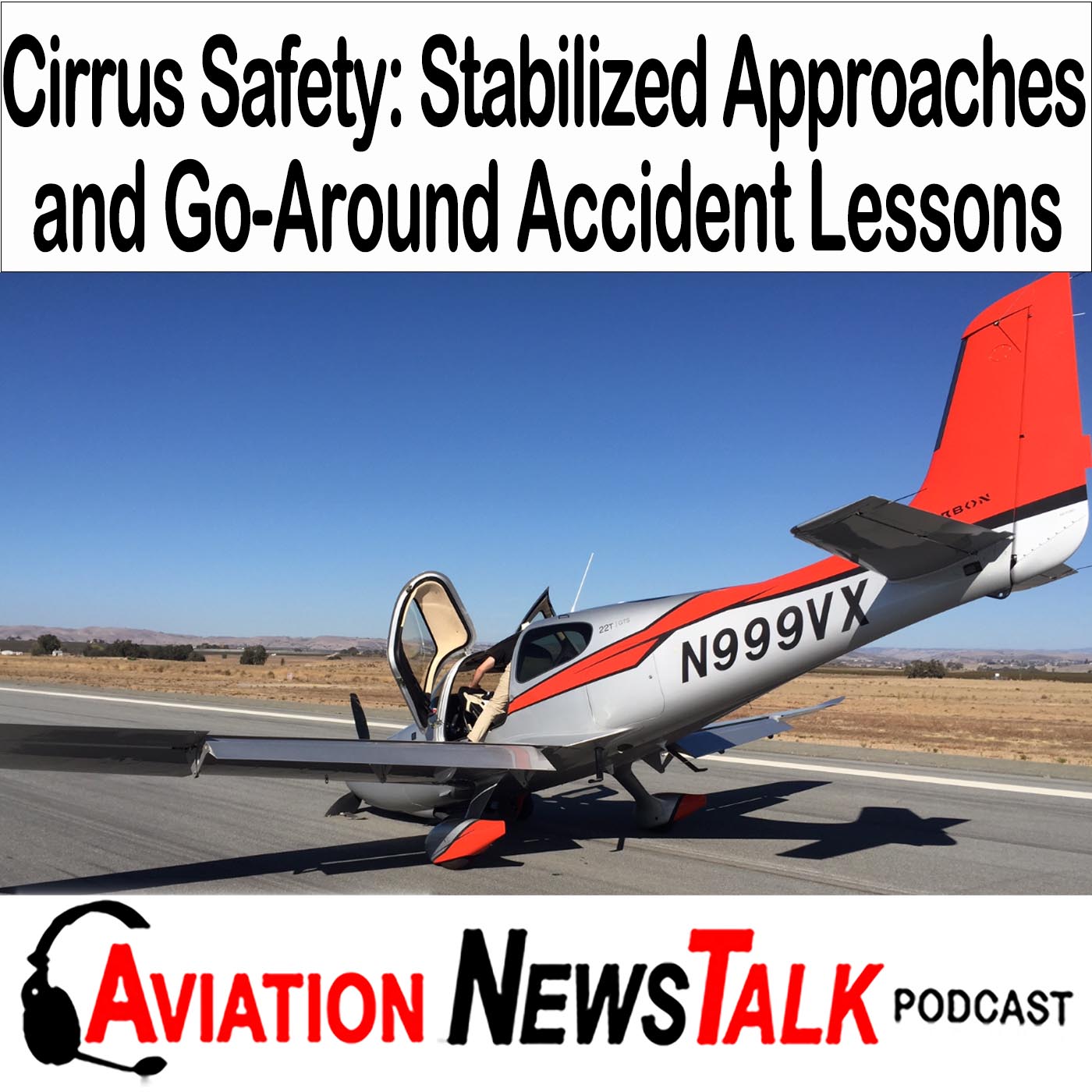
410 Cirrus SR22 Safety: Stabilized Approaches and Go-Around Accident Lessons
About this Episode
Max talks with Mark Waddell of the Cirrus Owner and Pilots Association (COPA) about how Cirrus pilots can reduce accidents by focusing on the places where the accident chain most often begins: unstable approaches, indecisive go-arounds, and delayed choices during power-loss events. They discuss what pilots are doing in the cockpit that turns routine flights into incidents, and what specific habits and training standards reduce that risk.

Mark explains that 2025 included eight fatal Cirrus accidents and twelve CAPS saves. Mark argues that the big safety wins come from addressing repeatable patterns: how pilots manage energy on final, how quickly they reject a bad approach, and how early they commit to the safest outcome when the engine isn't reliable.
A major theme is decisiveness in abnormal situations, especially anything involving power. Mark walks through how power-loss or engine-roughness events can seduce pilots into flying a normal pattern and hoping things stabilize. That often burns altitude and distance in exchange for false comfort. The operational hazard is simple: the moment a pilot realizes the runway is no longer assured, they're already low, already out of options, and now forced into rushed decisions. Mark emphasizes that when the engine is uncertain, "normal" is the enemy. The airplane doesn't care that the pattern looked tidy; it only cares whether you end up with a survivable outcome.
This ties directly into CAPS decision-making. Mark's message is not "CAPS solves everything," but rather that pilots need an explicit decision framework that prevents them from negotiating with themselves while altitude evaporates. He discusses the idea of a CAPS hard deck—an altitude by which, if a pilot is not certain of a safe landing outcome, they commit to pulling the handle. The point of a hard deck isn't to remove judgment; it's to remove hesitation. If you wait until you're low, you've converted a controlled, survivable deployment into a desperate last-second attempt. In that sense, the hard deck is less about the parachute and more about training the pilot's brain to act early enough for any option to work.
From emergency decisions, the discussion moves to the most universal risk zone: landing and go-around. Mark notes that a large share of reportable events occur during landing or during an attempted go-around. That makes this phase-of-flight a high-leverage target for training, standards, and self-discipline. The trap is that approaches feel "fixable" until they suddenly aren't. Pilots often rationalize small deviations—slightly fast, slightly high, slightly untrimmed—because they believe they can correct it in the last few hundred feet. But each late correction is an energy trade, and those trades frequently end with excessive speed over the threshold, a flat touchdown, a bounce, or a rushed go-around.
They get specific about the "flat landing" pattern. Mark challenges a common cultural habit: equating "smooth" with "good." In many airplanes—and especially in a fast, slick airplane—chasing smoothness can encourage a flatter attitude and higher speed, which increases the chances of touching down on the nose gear or loading it too early. That can lead to nose-gear abuse, shimmy events, prop strikes, and expensive engine tear-downs.
Max reinforces the technique side: trimming matters. If pilots are muscling the airplane through configuration changes and final approach, they're behind the airplane before the flare even begins. A well-trimmed airplane is easier to slow, easier to pitch correctly, and easier to land in the right attitude without forcing it onto the runway.
Go-arounds get treated as a primary skill, not a backup plan. Mark describes why late go-arounds are especially dangerous: if a pilot waits until a bounce or a deep, unstable touchdown attempt, the airplane is close to the ground, slow, and in a configuration that can punish abrupt changes. The go-around itself is not complicated, but it requires coordinated execution: power comes in, right rudder counters yaw, pitch is managed to prevent an excessive nose-up attitude, and configuration changes are timed rather than rushed. A common failure mode is trying to do everything at once—adding power, retracting flaps too aggressively, and pitching up—creating a stall-prone situation at the worst possible altitude.
Mark's guidance pushes pilots toward objective gates: if the approach isn't stable by a defined point, you go around—period. The pilots who get into trouble tend to have elastic standards. They keep moving the goalposts because they want the landing to work. Mark argues that consistency is the cure: standardized stabilized-approach criteria, practiced go-arounds that feel routine, and an acceptance that a go-around is not a failure, it's good judgment.
They also address proficiency and recency, emphasizing that safe performance is less about total hours and more about how frequently a pilot is flying and practicing the right skills. Mark points out that annual hours correlate strongly with landing outcomes; low annual utilization can create a false sense of competence because the pilot has experience, but not recent repetition. The solution isn't heroic flying—it's structured practice: recurring instruction, intentional go-around reps, and consistent standards that prevent "drift" back into sloppy technique.
To make those standards stick, Mark advocates data-driven debriefing. Instead of relying on subjective feel—"that was fine"—pilots can use post-flight tools, such as FlySto and ForeFlight's Cloud Ahoy, to evaluate approach stability, speed control, glidepath consistency, and touchdown energy. The goal isn't chasing a score; it's finding patterns that predict future mistakes. If your data repeatedly shows fast thresholds, unstable vertical paths, or late corrections, you now have something specific to train. Mark's point is blunt: most pilots don't need more aviation wisdom; they need feedback that's objective enough to change behavior.
The episode's bottom line is that Cirrus safety is not about secret techniques. It's about earlier decisions, tighter standards, and repeated practice in the phases of flight where accidents are born. Nail stabilized approaches, normalize early go-arounds, commit sooner in power-loss scenarios, and use honest debriefing to identify risk trends before they turn into an NTSB report.
If you're getting value from this show, please support the show via PayPal, Venmo, Zelle or Patreon.
Support the Show by buying a Lightspeed ANR Headsets
Max has been using only Lightspeed headsets for nearly 25 years! I love their tradeup program that let's you trade in an older Lightspeed headset for a newer model. Start with one of the links below, and Lightspeed will pay a referral fee to support Aviation News Talk.
Lightspeed Delta Zulu Headset $1199 HOLIDAY SPECIAL
NEW – Lightspeed Zulu 4 Headset $1099
Lightspeed Zulu 3 Headset $849 HOLIDAY SPECIAL
Lightspeed Sierra Headset $749
My Review on the Lightspeed Delta Zulu
Send us your feedback or comments via email
If you have a question you'd like answered on the show, let listeners hear you ask the question, by recording your listener question using your phone.
Mentioned on the Show
Cirrus Owner Pilots Association (COPA)
COPA YouTube Channel
Video: Garmin Green Donut Explained
Buy Max Trescott's G3000 Book Call 800-247-6553
a
Aviation News Talk Network podcasts
NTSB News Talk podcast
UAV News Talk podcast
Rotary Wing Show podcast
Free Index to the first 282 episodes of Aviation New Talk
So You Want To Learn to Fly or Buy a Cirrus seminars
Online Version of the Seminar Coming Soon – Register for Notification
Check out our recommended ADS-B receivers, and order one for yourself. Yes, we'll make a couple of dollars if you do.
Get the Free Aviation News Talk app for iOS or Android.
Check out Max's Online Courses: G1000 VFR, G1000 IFR, and Flying WAAS & GPS Approaches. Find them all at: https://www.pilotlearning.com/
Social Media
Like Aviation News Talk podcast on Facebook
Follow Max on Instagram
Follow Max on Twitter
Listen to all Aviation News Talk podcasts on YouTube or YouTube Premium
"Go Around" song used by permission of Ken Dravis; you can buy his music at kendravis.com
If you purchase a product through a link on our site, we may receive compensation.
Hosts & Guests
Transcript
Landing accidents aren't just a serious problem, they're an aviation problem.
No matter what you fly, most close calls and vent metal happens in those last few minutes,
unstable approaches, rushed flares, bounces, and goar rounds that come too late.
Today we're talking with Mark Waddell about what serious accident data from 2025 reveals
and why those lessons apply to every pilot.
To break down the predictable traps behind, I should have gone around, and how data-driven
debriefing tools can expose risky patterns in your flying before they become an accident.
Even if you've never flown as serious, you're going to walk away today with practical techniques
that you can use on your next flight.
And just a quick reminder, there are just a few days left to grab that light speed holiday
deal.
The sale ends January 12th and that's coming up fast.
You'll get $100 off when you buy a light speed Delta Zulu or Zulu 3, bringing the Delta
Zulu down to $11.99 and the Zulu 3 to $8.49.
And yes, that just cannot apply to either model or one of each.
And I mentioned it because dozens of you took advantage of this offer last year.
And if you've been thinking about upgrading your headset, now is the moment.
Don't wait until the last minute and miss it.
One more thing if you buy through our special link, light speed will send a check that
helps support aviation news talk that no extra cost to you, but only if you start at our
link.
You get $100 off the Delta Zulu or Zulu 3 before January 12th.
Go now to aviationnewstalk.com slash light speed.
Hello again and welcome to aviation news talk where we talk in general aviation.
By the name of his back stress got I've been flying for 50 years on the author of several
books in the 2008 National Flight Instructor of the Year.
And my mission is to help you become the safest possible pilot.
Last week in episode 409, we talked about the altitude reporting errors in the citation
crash that killed NASCAR driver Greg Biffle.
And about an illusion that occurs in heavy rain that can cause any pilot to fly a low approach
and crash short of a runway.
So if you didn't hear that episode, please check it out at aviationnewstalk.com slash
409.
And if you were new to the show, welcome glad you found this.
And if you would, now take a moment and touch either the subscribe key or if you're using
a Spotify or the Apple podcast app, the follow key, so the next week's episode is downloaded
for free.
And my thanks to one new supporter from the past week.
Thanks to mods, Peter Lubeck, he's from Denmark, I believe, he writes, thanks for a great
podcast that I learned a lot from.
He says he has his private and instrument rating.
He says he's the owner of SSNA 210L with a Garmin stack, including the Garmin 500 TXI,
750, 650 and a GFC $500 pilot.
So nice setup there.
Mods, thanks so much for supporting the show.
And if you'd like to support the show, if you've been listening for a while and you feel
that you're getting value from it, I would really appreciate it if you would sign up now
because it's the beginning of the month.
And we always lose a few supporters, which we did in the last few days, because people's
credit cards expire and often they don't update those expiration dates.
And so we are constantly looking for new supporters just to replace the ones we lose each
month.
And we've got four different options you can use.
You can make a one-time donation via Venmo, Zell, or PayPal, or you can make monthly
donations through Patreon as well as PayPal.
So sign up now to support the show by going to aviationnewstalk.com slash support.
And what do you do?
I'll read your name on a future show.
And just a couple of quick updates, if I sound a little different today, it's because
I'm recording this in my hotel room in Las Vegas.
I think I mentioned last month that a new vision jet arrived in the San Francisco Bay area
last month that has become available for dry leases.
And I'm suddenly finding myself doing a lot more flying and teaching in the vision jet,
which not a problem.
It's my favorite airplane.
Anyway, I'm on a two-day trip with the owner.
And I'll be getting home on Wednesday night and promptly leaving again on Thursday morning
with another owner.
So lots of flying, but also lots of fun.
Now we've had a lot of rain in the San Francisco Bay area for the past five days.
And when we departed, it was raining heavily.
Actually when I fly, I have the tower and departure frequencies on com one and ground
aides and guard frequencies on com two.
But I anticipated that we might have some peacetatic during the climb, so I did something
a little different.
A couple of years ago, I was recording audio and video for a flight departing from
then eyes on a vision jet in heavy rain.
And as we climbed, we started getting very heavy static on the frequency, which was so
loud that I couldn't hear ATC.
Now that static is called peacetatic, which is short for precipitation static.
And it's not uncommon that you'll get it when you fly into heavy rain, and occasionally
you can get it just when you're flying close to storm clouds.
So I told ATC at the time that we were unable to hear anything and would call them back
when the static went away, which was probably 90 seconds later I would guess.
Now I posted that video and got contacted by the FAA, and they're using it as part of
a training video for air traffic controllers to help them understand what it's like
on our side of the conversation when we get peacetatic.
I also posted about the experience, and I heard from a couple of vision jet owners who
suggested two things that might minimize the static, and you can try these things in
other airplanes as well, they're probably not just limited to the vision jet.
One was to turn on the windshield TKS, which coats the nose and the windshield with TKS
fluid and prevents ice from forming.
And the other was to switch to comp 2 to talk to ATC.
So during this climb this week, anticipating that we might have a problem, I loaded the
departure frequency into both COM1 and the standby position of COM2, and of course we're
all required to listen to the guard frequency 121.5 on COM2 when we fly, and I hope you
do that.
Sure enough during the climb, we started picking up heavy static while talking to departure.
So I switched the COM2 frequency from guard to the departure frequency, and voila, no
static.
Now I also had turned the TKS on before we actually needed it.
So those two things actually helped, which was kind of nice.
So like most things in flying, the devil is in the details.
Which is why I always recommend that flight instructors fly in relatively few aircraft
types, so that you can become expert in the nuances in those aircraft that you fly.
Speaking of which, if you were thinking of buying any kind of a Sirus and or if you'd
like to get some time flying in a vision jet, please contact me by going to aviation
newsmark.com and clicking on contact at the top of the page.
Now last week in episode 409, we talked about the altitude reporting errors in the citation
crash that killed NASCAR driver Greg Biffle.
And it turns out that I wasn't the only one to spot this issue.
I received the following message via X from Scott Manley, who has quite a large following
there.
He wrote to me, replying to at Max Trustcott, Max, you're correct about the pressure
altitude readings being stuck.
We know this because ADSB data transmits both barometric and GPS altitudes.
You can look at the data from this and compare them to show the GPS altitude rising while
barometric value was stuck.
I posted this comparison days after the crash.
And he shows a plot of the GPS derived altitude versus the barometric altitude.
And you can clearly see that initially they were the same.
But then while the GPS derived altitude continues to climb, the barometric altitude flattens
out and remains unchanged until suddenly it spikes up and becomes nearly identical
again to the GPS altitude.
So this confirms what I said, which was the aircraft was certainly having problems with
their altitude reporting capabilities over ADSB.
And they may have seen this reflected in the cockpit on one or perhaps more of their
altimeters.
But in my opinion, this was unlikely the actual cause of the crash because this pilots
we can certainly land safely even with inaccurate altimeters.
In fact, once I'm on final, I rarely, if ever look at the altimeter, instead I'm looking
at the ADSB indicator in the runway.
And if all this proves to be true, this will become yet another example where some type
of anomaly caused a pilot to return to the airport.
But then they crashed for some other reason.
So please keep that in mind.
Anytime you experience a system failure or an emergency, it's so easy to get distracted
by these issues, you still need to focus on flying the airplane and landing and not
getting distracted while trying to land.
Then again, our condolences to the family and loved ones who were lost in this terrible
tragedy.
And now speaking of safety related issues, let's get to our main topic.
Let me tell you a little about Mark Wadal.
Mark is the University Dean of Aviation Safety for Copa, the Serious Owner and Pilot
Association.
And he's an advanced ground instructor at Copa's C-Triple P weekend training events.
In 2024, Serious Aircraft Company presented Mark with the Serious Air Safety Medal for
his efforts in promoting safety.
He currently flies an SR-22G6 based at Essex County Airport in Caldwell, New Jersey.
And now here's our conversation with Mark Wadal.
Mark, welcome to the show.
Great to have you here today.
Thank you, Max.
It's great to be here.
Thank you for inviting me.
Well, you've got so much important data here that I really wanted to help share that
with folks.
How do we start with 2025 and talk about fatal accidents in Serious Aircraft?
I give this kind of a rundown and also talk about how many caps pulls we had as well.
Yeah, and I can give you the raw numbers.
And if we have time to go into it, I actually covered this in a safety stand down at our
events and I've got slides that I prepared for that.
But last year, we had eight fatal accidents up from six the previous year.
So it's not trending in the right direction.
Virtually all of them, Max, I'm sad to say, are loss of control.
And that's pretty typical of GA as well.
The NTSB GA stats show that loss of control in flight is number one followed by power
plan failure.
We track closely to that in our service fleet.
We're no different.
Cap saves.
We had 12 in 2025.
So that's both good and bad.
Ten of them involve power loss.
So that's something that we emphasize in our training program.
We want to teach pilots not to fear it so much, but to be prepared.
And we want them to know how to pull caps.
Believe it or not, we've had some incidents where pilots did not use effective capsule technique
and ended up pulling too low.
Two of them last year.
So that was 10, the other two to round out the 12 were both flight control malfunctions,
which are pretty rare.
I mean, you don't hear about that very often in the series, but it happened twice last
year.
Unfortunately, in both instances, the pilots were ready to pull caps and had it not been
for caps, they wanted to survive this.
Well, that's really surprises me and that's incredibly rare to have flight control malfunctions.
Tell us about one or more of those in detail.
Well, the one I know more about happened in Santa Barbara, California.
There were two pilots, both professional pilots, by the way.
They were practicing pattern work in Santa Barbara.
As they came around base the final, they heard a loud bang from the left wing, which was
followed by uncontrollable roll to the right.
They thought maybe it was a roll trim issue.
So they tried hitting the autopilot disconnect to no effect.
So now they're rolling uncontrollably the nose is, you know, heading towards the ground.
And they pulled caps.
It was pretty low pull.
I estimated between three and four hundred AGL.
So it didn't have time to get the caps out fully deployed.
They went in nose first, but with pilots, maybe don't realize as soon as they pull the
caps handle, caps is attracted by the rocket.
The aircraft does start decelerating.
I've looked at data from finished investigations.
And the deceleration is almost twenty knots per second.
So they did still end up going into the ground, nose first, you know, pretty rapid stop.
But they were able to get out of the aircraft, both separate serious injuries.
We don't know the full details on that, but most likely, some broken bones in the process.
But the point as they survived, what would have otherwise been, it was unrecoverable and
probably unsurrivable in an aircraft without caps.
It's kind of ironic when you think about it, my recollection is the very first pull of
caps was someone who was bringing their plane back from a mechanic.
And the L-RON had not been properly reconnected.
And as they were climbing through, I don't know, a thousand feet or something like that.
Notice the L-RON flopping in the breeze.
So these are really very rare kinds of accidents.
But if you think about it, if you have those kinds of issues in another aircraft, you might
not have a good solution.
Right.
And look, in that kind of a scenario, Max, you're close to the ground, things are happening
pretty fast.
You don't have time to pull out a checklist, you know, look down and try and diagnose it.
You really need to be trained for this in advance.
So that's something that we also try to emphasize in our programs, particularly using simulators
is putting pilots in situations where caps is ultimately going to be the best solution.
But we want them to get to that decision point without a lot of delay.
Yeah, and certainly you're not going to have a very good checklist for what to do if the
L-RON is loose and flying in the breeze.
Right.
Yeah, caps is a good solution.
Talk a little bit about what you've learned from the training sessions, the C-TRIPLE-P
events about caps, poles, and what people might not be doing correctly with that.
Yeah, well, this is a topic that I do spend quite a bit of time on.
I go through scenarios and let me use a scenario to set this up.
It happened in Becker's Field, California.
This is a 2024 event.
Pilot was within sight of the airport, a pretty long runway in Becker's Field.
You probably know it well.
He's at 10,000 feet.
He's got a rough engine.
He doesn't declare an emergency, but he tells the tower he wants to come in and land.
He ends up, instead of coming straight to the runway, and we'll come back to this and
talk about emergency procedure training, but instead of going straight for the runway,
he just flies it like he's flying a standard downwind.
He ends up on such a wide downwind that by the time he's turning base, he's miles from
the airport.
His engine's failing.
And now he finally realizes that he's not going to make the airport.
So he's down at the 600AGL, and he reaches up and he pulls the cap sandal out of the
receptacle and nothing happens, because all he did was pull the slack out of the cable.
He then had to reach up again and pull with full force.
He got the caps to fire at about 200AGL.
Fortunately, it decelerated him enough, even though we went in nose first.
The aircraft took a beating as did the pilot, but he was able to survive it.
That one was particularly interesting to me, because when the preliminary report first
came out, none of that cap's pull detail was in it.
And I'm pretty close with the Sierra safety team, and we talk about the need to get more
information out in preliminary reports so we can use it for training.
And they actually went back to the NTSB and asked the NTSB to amend the preliminary report
and reissue it so we could have all those details in it.
That's excellent.
Yeah, I remember that looking at the track data for that, and it was a very high downwind
decreasing in altitude, obviously.
And I think there's an illusion there that most pilots are not aware of.
And people are trying to figure out how far to space themselves out from the runway for
their downwind.
They have an idea of what that view looks like when they are a traffic pattern altitude.
What they don't realize is if they are much higher or much lower than traffic pattern
altitude, if they then position themselves to make that view look correct, they are
no longer at the right distance from the runway.
So for example, this gentleman started out at 10,000 feet, about 10 times the traffic
pattern altitude.
Well, if he looked out the window, and as I recall, he was on the left downwind and
places the runway at the normal spot, well, he's going to be 10 times further away from
the airport on his downwind than he normally would be.
And by contrast, when people are flying, circling approach, circling land, if the circling
altitude is half the traffic pattern altitude, typically, they're going to look out the
window and place themselves in a position where the runway looks correct.
But now their downwind is only half the distance that it normally is, which then results
in overshooting the base-to-final turn.
So one thing I like to do is I will use the moving map, and I'll use the arc, and I'll
go ahead and change the selector to get a map range of roughly one mile, and that way
I can position myself about a mile from the runway on downwind, and that works at any
altitude that I might be at.
Yeah, it's perfect.
I think one of the problems in training pilots is that they need to do these engine out
emergency procedures often enough that when it's happening for real and they're dealing
with all the stress of that, they're going to perform correctly.
And I talked to our other C-Triple P instructors, and I asked them, when you put pilots in
this scenario, how often do they make the runway on the first try?
And the statistics on that are very, very low.
These are pilots who know it's coming, and still have a good engine that they can go around
if they have to.
So when I taught this class at the Copa migration back in September, a pilot asked me,
well, how do you know if you have the runway made?
And I said, if you have to ask, you don't have it made, you should just be pulling caps.
And we deal with this issue, we can train pilots to a higher level.
They should be capable of having an engine out at 10,000 feet with the runway insight and
making it.
But in reality, they don't all perform up to that level, necessary to pull that off with
a hundred percent survival.
So what we teach them instead is they really need to use a hard deck for caps full of
10,000 AGL.
And if they're entering a traffic pattern, let's say they're flying it downwind to final.
When I practice these myself, I don't descend to a thousand foot AGL, but beam the numbers
to pull the engine.
I'm doing this for miles away, and I still want to be 2000 AGL as I'm entering downwind.
I can always slip to lose altitude, but I can't get it back.
Yeah, I think another key thing when people lose power in their traffic pattern is they
don't realize that if they use a steeper bank and say 30 degrees versus 20 degrees, then
they're going to shorten their turn radius by 59%, which is huge and can make all the
difference.
I see a lot of people who make what I will call Wimpy 20 degree bank turns in the traffic
pattern.
And that just gives them huge traffic patterns, which is fine when you've got an engine.
When you don't have an engine, it's just not going to get the job done.
And the other thing is you can always cut the corner.
I don't know why people continue to fly, get a square turns when they're practicing engine
outs.
Any time you want, you can just head straight for the numbers on a diagonal, and that can
also make the difference between making it to the runway and not making it.
Yeah, and another issue that I've seen in our accident data is we have a lot of copum
members, serious pilots who are trying to work on their commercial using their serious.
And while you can do that, I think they really need to understand that a serious, particularly
the turbos with the fat props are not the best colliders in the world.
And we had a fatal accident last year.
It was an instructional flight where the flight instructor was not a CSIP, not really a
serious specialist.
And they were practicing commercial power off 180s in a turbo normalized series, which
has that big fat prop on it.
And high wind day, the first two or three attempts as I recall, they went around because
they weren't going to make the runway.
And the last attempt is the one they crashed.
We don't know who was flying that one.
We don't know if that was one where the instructor took the controls and said, here, let me
show you how to do it.
We had another fellow, this was a nonfatal accident in Fullerton, California.
Pilot was by himself doing power off 180s on a 3,000 foot runway.
Which is a little bit of a challenge.
He ended up crossing the numbers, still over 100 knots, touching down more than halfway
down the runway.
And they found that he hit the brakes so hard that he actually bent the torque tube that
the brakes are attached to, causing him to lock up.
And he ended up skidding off the runway, hitting the fence at the end.
Fortunately, he and his passenger walked away, but it must have been a pretty exciting
landing.
Yeah.
That's more excitement than I'd like to have during my landing.
Yeah.
Well, let's talk a little bit about the phases of flight.
Where do most accidents typically occur in the Sirus?
And is that typical of GA as a whole?
Yeah.
Well, I'll start with the Sirus.
I've been tracking all of the accidents, both in the NTSB reports, farm reports, but
also FAA reports, and I'll come back to talk to that in a little bit.
Over half of Sirus incidents or accidents are in the landing phase or go around phase.
I just lump them together, it's landing a go around.
We have, I'd say, the same demarcation in NTSB stats, just in GA as a whole, most are
in the landing phase, and those are mostly loss of control, either in flight or on the
ground.
So very similar in the Sirus.
Our number two behind landing a go around is arm root cruise phase.
You might not think that would be it, but that's because we have so many power loss
accidents that we're tracking.
Hmm.
Let's talk a little bit about go around landings.
What are the big issues?
Were our pilots finding themselves getting trapped?
Well, we start with the concept that you need the fly standardized and stabilized.
Now, in the Sirus fleet, we have a flight operations manual that's been created by the
manufacturer that instructors can use to guide our training.
That's at certain standards, if you will.
So if you look at the most current, it's called the IFOM.
The most current flight operations manual or IFOM has a traffic pattern mapped out with
specific speeds for downwind, for base, but then when you get the final, it doesn't have
a specific airspeed range anymore, like the old IFOM.
They've replaced that with V-Ret.
Now, most pilots you talk to, I mean commercial or ATPs would understand what that is, but
most GA pilots don't really have a concept of what V-Ret means.
When you look in the Sirus POH, beginning of section four, I think it is, has airspeeds
for normal operation, and it gives you an airspeed range for a normal approach.
What would it be in a 22 or 22, 80 to 85?
We find most pilots are just comfortable coming in at 80 to 85, but if they want to come
into a short field, they need to use a V-Ret.
That's published only for max gross weight.
There's a little note in the POH that says, the airspeeds here are for max gross weight.
You need to adjust the speeds for lighter landing weights if you want to achieve the landing
performance, let's say, that's in the POH tables.
So here's the dilemma.
If your pilots are used to always coming in at 80 to 85, and they get a little bit of
extra wind or a little bit of extra turbulence, they start adding gust factor on top of that,
I would just tell you, I fly in SR22G6, my normal V-Ret in that is between 75 or 76 knots,
typically.
If I'm coming in at 85 and I'm adding a little extra for gust factor, I've got so
much extra speed and extra energy, crossing the numbers, I'm set up for what are typical
landing accidents.
So we find that pilots are, first of all, having trouble with airspeed control.
If you ask a pilot, you're training pilots, you ask them, what speed do you plan to fly
on final?
Would they have a specific number in mind?
And below 500 AGL, they've turned base to final, they're on final.
When you look over at the airspeed indicator, where is it?
And more often than not, it's going to be substantially faster, they're probably going
to be high, so they're steepening their approaches, picking up more speed.
And then we see this in the ADSB data for every landing accident we look at, we've yet
to find one that flew a stable approach, where they came in at a stable pitch attitude,
and they got the aircraft trimmed to a stable approach speed.
You can fix those, right, and you know how to fix them.
But we really want to get away from training pilots to fix poor approaches, unstable approaches.
We want them to instead recognize that they're unstable and go around early, rather than
waiting until they've bounced off the runway and trying to do it then.
So you're talking about stable approaches, I agree, that really is the cornerstone of
good landings.
Yeah.
Talk a little bit about the criteria for a stable approach.
How do we know if our approach is stable or unstable?
Well, there are about six criteria in the IFOM, but it starts with airspeed control.
That's number one.
The aircraft should be trimmed on final to a V-ref airspeed and glide path.
It should be on a stable glide path.
So in most runways, you're going to have a PAPI available, set it three degrees.
I know there's some airports in Phoenix that have four degree glide paths.
So that's important to know.
But you should just always be on a stable glide path, trimmed to a particular airspeed.
You should only need small corrections in power to stay on that glide path.
So I'm sure you've seen this with students, I've seen it in accident data where pilots
start out high, meaning they're higher than the desired glide path.
They pull power out and drop the nose.
And rather than getting established on the glide path, they actually dip below it.
Now they're adding tons of power to try and get the aircraft back up on a glide path,
pulling the nose up.
I've had accident data where I've seen the pilots actually trigger the stall warning
on short final and still not go around.
So let's talk a little bit about small changes in throttle and also about speed control.
I see some people who, if they're trying to adjust the speed in the service, will use
the throttle.
And yeah, that kind of works, but in my mind, it doesn't work nearly as well as making
small changes in pitch.
I usually generally adjust the throttle only if I've got altitude issues.
If I'm high, if I'm low, but I think one of the big things that people don't realize is
that if you are, for example, on airspeed and you're high, if you pull power, then you
probably are going to need to lower the nose a little bit in order to stay on airspeed.
And so basically, if one of our criteria is correct, either we're on the glide slope
or our airspeed is correct, and we're making a power change to, or even the pitch change,
if you want to stay on airspeed or stay on glide slope, you got to make another change
as well.
And I don't think people realize there's this interaction between pitch and power.
And if you're changing one of them, yeah, you kind of need to change the other one to
either stay on glide slope or to stay on the speed that you have at that moment.
Yeah, absolutely.
Yeah, I mean, you're talking about these compound errors, right, both input or power
controls and pitch.
I do agree with you.
Some people will just pitch to the spot they want on the runway, and they'll just be
adjusting the throttle to control their airspeed.
But what speed is the aircraft trimmed for?
And what we focus on in the C-Triple P training is the instructors will actually tell you
when you're on final.
Take your hands off the controls.
And it's a magical thing when the aircraft is trimmed for correct speed, you've got the
power just right, so you're on glide path.
It's as though the plane would land itself.
But instead, what we see pilots having trouble is they're just jockeying the power.
They're jockeying the nose.
They're never really getting it stable.
I think it's been described like trying to push a shopping cart with one stuck wheel.
It's just very, very difficult.
Yeah, just the other day I did that while I was landing.
I was by myself in the airplane that I was thinking of just that.
I let go.
And it was just, it was really nice to see, yeah, nothing changed.
The plane was perfectly trimmed.
It stayed on airspeed.
So I knew that I was in good shape there.
Well, I think trim is actually one of the things that I don't see people doing properly.
So for example, I'm going around the pattern in the serious, each time I add flaps, I add
some trim.
Usually it's about two seconds for each notch of flaps.
But then I see as people are on final, they have not trimmed sufficiently, and they're
in general, especially as they get in the flare.
They're not able to pull back enough because they haven't trimmed, you know, prior to getting
that point in time.
Talk a little bit about flat landings and how that contributes to the accident rate.
Well, we have an awful lot of nose gear collapses in our fleet, which lead to prop strikes,
engine tear downs, et cetera.
Most of them are not in the NTSB reports because nobody gets hurt.
And the NTSB just stopped devoting resources to investigating every time a serious pilot,
things of prop.
We know why they happen, so pilots who aren't really paying attention to their data in
debriefs or flying off and enough with an instructor who would be telling them this.
Think that that nice smooth landing they're happening where they're touching down at minimum
sink rate is the ideal.
When in reality, a lot of them we found are touching down on the nose gear first.
If you sit in my plane, I fly a 22 G6.
If I just sit in that plane on level ground, my pitch attitude is about two and a half degrees
nose up.
So we try to show that to people and say next time you're in your plane, look at your
pitch attitude just sitting level.
So if you're touching down at three degrees nose up, that means the nose gears barely
off the runway.
And a little bit of error touching down means you're going to actually touch down on the
nose gear first.
What it leads to Max is we've seen nose gear shimmy with these high speed touchdowns which
can cause a loss of control.
And also the repeated abuse of these higher speed touchdowns start to create small cracks
in the nose gear.
Strusts.
Now hopefully you can catch those with frequent inspections.
Cracks don't get smaller over time.
And if you can continuing to abuse the nose gear like that, eventually it's going to drop.
We do see it more in the training pleats than in the ones that are just used by private
owners.
And that's just the repeated abuse of students just touching down hard.
I was watching an interesting video.
This had nothing to do with serious, but it was training Navy pilots to fly the C2 gray
out.
And they make them do about 16 passes a day on a simulated aircraft carrier runway in
Wallops Island, Virginia.
And they don't let them touch down.
And one of the instructors was interviewed, he asked, why don't you let them touch down?
He said, if we let them start touching down before they get the approach stable and we
know they're right, et cetera, et cetera, said, these are old planes.
They're old landing gear.
They would just be breaking the landing gear on us.
So it's kind of getting back to my point about not saving bad approaches and bad landings.
It really starts with the instructors, I think, during transition training.
If you're not stable on speed, et cetera, you just not set up for a correct landing to
begin with.
And then the flattened fast touchdowns that I was mentioning, we see about 10% of landings
in the fleet were pilots in more than 10 knots above stall speed, it touched down.
And three degrees pitch or below, it's just not acceptable.
Yeah, and I've brought into a lot of people that enjoy flying the aircraft fast and seem
to think that that's going to keep them more safe.
Not the case, you need to be on airspeed for all kinds of reasons.
You know, one of the things that's unique to the Sirus is the springs that are attached
to the side stick.
It's yokes and most aircraft are free moving, we've got the springs.
One of the things I've noticed is that if you pull the stick out part way, usually
to about the point where most people pull it out, which is about three quarters inches
short of the full amount, that the pressure required to get there is probably about 10 pounds
of pull.
And yet to get to that last three quarters of an inch is about 20 pounds of pull.
It seems to me that pilots just don't understand in order to get the nose all the way up.
They have to pull a lot harder than they're typically pulling.
Yeah, I agree with you.
And I think it starts with not being trimmed on final approach.
So they're fighting not being in proper trim to begin with.
You know, the other thing that we notice is you may see this with your students because
we can see it in the data that we analyze, it's called yoke pumping, right?
Instead of a gradual steady pitch up to get the airplane ready for touchdown, the nose
is bobbing up and down, right?
And what's going on there?
What do you think is going on there with students where they're just not doing that gradual
pitch up, but instead doing this up and down bobbing?
Yeah, pumping of the controls.
Certainly they're over controlling.
I years ago read something that an extremely well-known flight instructor had written about
that.
And he wrote that he thought that by pumping the controls, you were pretty much finding
the edge of control or finding the edge of something.
So he was advocating that as a method for landing an aircraft, which at the time I thought,
okay, that sounds interesting.
And yet over the years, I think he's done a disservice by suggesting that because my
experience has been that when people are just pumping the controls, they do a much poorer
job of landing and that, yeah, in general, as you're coming into the flare, it's basically
a motion in one direction, pulling back and waiting and pulling back some more and waiting
and pulling back some more pumping.
Now, I don't see the value in it, quite the opposite.
I think it leads to bad landings.
Yeah, and I think once you have the serious and ground effect, the landings can be pretty
smooth if you just gradually pulling back to let the speed bleed off on its own.
I like to wait until I hear the stall warning before touchdown.
Now, I get asked by pilots at our events, well, what should my ideal pitch be at touchdown?
And what we go for is, let's say, 75% of the time, if you can be at least five degrees
nose up, at least we know you're protecting the nose gear.
If people really want to hold it off longer, and I do these, one of the collaborators I
have Chuck is Chuck Cali, I don't know if you know Chuck, but he favors holding it off
very long in the flare and touching down about eight degrees nose up.
And I can do those for demonstration purposes.
But what I find in pilots who are trying to do that is as they try to pull up and increase
their angle of attack and get slowed down, it actually increases the left yaw.
And they're not on the right rudder.
So you'll see it in the data.
The ones that are touching down at higher pitch are also generally yawed a little bit
left.
So they're not touched down with the aircraft axis aligned with the center line of the
runway.
That's funny.
You mentioned that years ago, when I was teaching in Cessna's, I noticed that anyone
who did a good, full stall landing with the nose up fairly high would end up yawing to
the left.
And it makes sense because it's the left turning tendency of the airplane.
And we know that the left turning tendency is strongest when you're at higher power settings
and slower speeds.
Well, in the flare, the power is completely off.
But as you get really, really slow, you're at slower speeds.
And that left turning tendency occurs.
And so I don't recall having ever read about this anywhere that if you do a great
nose high landing, anticipate that you've got to push some right rudder at the very end
just before touchdown.
Be sure to.
Now, the funny thing is in Ceres, as I almost never see that happen because people are just
not doing a great job of getting the nose up all the way, getting to a stall.
And so I really actually see it happen in our fleet.
And I feel like maybe pilots just stop flying the airplane at that point.
Yeah.
I think they're probably just happy to have it on the ground, even if they're drifting
to the left a little bit.
Yeah.
And I can tell you, you know, at this question, you asked me about flat and fast touchdowns.
There was a pretty serious accident that happened in Australia.
I was a pilot of a G5, as I recall, who's coming in to try and land on an 1800 foot runway.
Now you know it's possible to do it.
But you've got to touchdown on the numbers at the correct V-Ray, right, and everything
has to go right.
This pilot was adding a little bit of extra speed.
You know, it was a little gusty.
I think it was coming in at 85.
So he touched down flat and fast, got the nose wheel, Shemi.
And he pulled back on the yolk because Ceres has an SB on this or an essay on this that
if you feel that nose wheel, Shemi pulled back pressure to try and relieve the weight
on the nose wheel to make it start.
Stop.
But remember, it's an 1800 foot runway.
So by the time he got it slowed up enough to get the nose wheel down and start getting
on the brakes, there was just no room left to stop.
They ended up running off the end, and it was up on a kind of mesa.
They ended up inverted and, you know, getting some injuries out of it.
And so this brings to mind this whole question of having standards that you train pilots
to recognize deviations from those standards and to go around sooner rather than later.
And if somebody pushes it past the unstable approach to try and touch down on a short
runway like that, I'm sure you probably tell your students this as well.
They don't have a lot of time to make a decision to abort the landing, to reject the landing
and go around.
And so it becomes even more critical that they be taught these skills of, I call them
low energy aborts because unfortunately, that's where our fatal accidents are occurring
when pilots are just getting in so deep, they're bouncing, they bounce two or three times
off the runway.
Maybe they've had a prop strike and they try and go around at that point, and they just,
within seconds, they're off the left side and rolling and burning.
Yeah, not a good way to go.
Any other thoughts about landing accidents and causes things that people should avoid?
Well, we talked about stable approaches.
What we should talk about is go around training, okay?
So I mentioned how we've had fatal accidents.
One of the worst fatal, so I read it was a pilot in the UK in 2024 who had just bought
a 22T.
He had 10 hours of transition training and then he had it flown for 54 days.
Yeah, I can see you cringing.
He went out and every one of his approaches was unstable.
The one that ended up killing him, he bats it off the runway and when he went to go around
what happens?
The nose came up, the aircraft rolled and it was uncontrollable at that point.
So what I demonstrate in my standout class, I took a plane up and configured it for landing
max.
I just slowed it down to 80 knots, just to keep it simple, full flaps, and then I gradually
added full power while letting go of the controls and not being on the rudder.
And what do you think would have happened?
Yeah, not pretty.
It's going to definitely yaw left.
It yaws left, the nose comes up and it starts to, it's eventually going to end up an
spiral dive out of control, but it doesn't stall.
It never stalls in that situation.
So what we're concluding is that the pilots are actually adding back pressure because as
to that progresses with the roll and the yaw, eventually the nose is going to drop and
they're going to pull and they're going to pull back.
And at that point, they're gone.
There's no way to recover from that at that point if that's happening and to go around.
So for go around training, the other thing that I do in my class, I demonstrated a lake
go around where I flew the plane into ground effect, high, so simulating somebody that
misjudged the flare, it's in ground effect, and then I induced the stall so that it sets
up a sink rate.
Now, I don't want students to go do this, but it was for demonstration purposes.
The go around was a very undramatic event.
It was just slow addition of power, simultaneously adding the right rudder, simultaneously in
my aircraft.
Again, it's a 22TG sixth.
I had to push the nose down to keep it from coming up.
And so three things had to happen simultaneously as we teach them.
The right foot, your right hand on the power, and your left hand on the yoke.
All had to move forward about the same distance at the same time.
And we accelerate with all flaps.
And believe it or not, this is something else pilots don't realize, even in SR-20.
The maligned under power at SR-20, if you look in its POH, it's got a bucked landing
climb rate table with 100% flaps.
So they will all climb out with full flaps.
So the message there is pilots who haven't been trained enough and go around, often make
three mistakes.
One is, as soon as they have power, the nose comes up.
So they're not controlling the increase in angle of attack.
One thing is, they're in a big rush to reach for the flaps handle and raise flaps to 50.
And those two things combined immediately put the aircraft in a stall situation, nose
high, low air speed.
You raise the flaps, now you've stalled the wing and it becomes uncontrollable.
So we're trying to teach them the corrects, go around recovery technique.
You can't teach them how to do it after a bounce because it's just unsafe to bounce
an aircraft.
But the nearest we come is the one I describe where we just kind of get it in ground effect
and slow it down and go around from there.
Yeah, when you talk about the nose pitching up when you add power, that's certainly to
be the expected aircraft when their trim for particular speed, try and maintain that
speed.
And so if you add a lot of power, the only way for the aircraft to maintain that trim
speed of maybe 80 as you're coming in is for the nose to pitch up.
And yeah, it'll go back to 80, but it's going to be a little dramatic having the nose
come up.
So yeah, absolutely.
Go around, you've got to push to keep that nose from going up.
Yeah.
And if I could just put in a plug for flight instructors because God bless you all.
I mean, you're doing your best to keep us safe.
But so many of these accidents are happening with instructors on board.
A student can react a lot quicker than you can.
And you just have to be so careful in these situations where you might let them continue
with an unstable approach so they can see what happens.
But this was actually the very first G7 accident.
It happened up in New York State with a CSIP on board.
It was continuing the factory transition training at all.
And they had briefed the go around technique.
Now G7, supposed to have a flaps inhibit.
They were one not above the airspeed for the flaps inhibit.
So even flaps inhibit could not stop the state from reaching for the flaps bit and switch
too quickly.
Once he did that, it created an uncontrollable sync situation.
They bounced.
Unfortunately, they weren't injured.
But it tore, but brand new, brand new G7 in the process with an instructor in the right
seat.
So I just put that out there.
I know you had John Fiskus on your show.
He briefs his instructors on all these accidents that we post up on COPA.
I know he does kind of a weekly email about it.
And that's why we work so hard to put this information together because we want to be a
resource for all you flight instructors.
Yeah.
And along those lines, one thing I think that's incredibly important is to communicate to
people about adding that right foot in the go around situation.
For years, I've always told people that the entire right side of your body needs to be connected,
needs to be moving together.
And so I'm telling folks, hey, if that throttle is going forward, that right foot needs to
go forward.
And I think it's actually useful to sit in the airplane, even with the engine turned
off on the ground and just practice that.
If you do that repetition a lot of times, I think it kind of forms that connection you're
brain, which is, yeah, when that throttle goes forward, then that right foot is going forward.
Yeah.
You're going to be doing a certain amount of that during takeoff anyway.
For sure, you're going to have to do it during go around.
So yeah, I think that really forges that connection in your mind to just kind of practice.
If the right hand is going forward in the throttle, the right foot needs to be moving forward
simultaneously.
Absolutely.
Well, you came across an interesting piece of data that talked about pilots experience,
of a sweet spot for having landing events to also about that.
Well, we find the reports on the landing accidents, not only in the NTSB, but also the FAA.
So as I mentioned, the NTSB stopped investigating most of our landing accidents involving prop
strikes, et cetera.
And I picked up a lot more looking at FAA reports.
And the FAA doesn't do a detailed final report in the same manner as the NTSB, but they
still try to collect basic information such as pilot total hours, time and type, et cetera.
What I was finding is that more often than not, the landing accidents, you know, lost control
on the ground, running off the left side of the runway kind of thing.
We're tending to happen to pilots regardless of their total experience level, but who had
low time in type, right?
We're seeing it in pilots who maybe they're coming out of a sezno or a piper, and they
buy a serious, they buy a used serious.
If they take the embark transition training that's serious offers, so what's that about?
10 hours that they're going to get?
And then they think they've learned what there is, I guess, about the serious.
And they'll go out and they're not flying stabilized, they're not flying standardized.
Like I said, we've got a lot of information from ADSB data that I can then correlate
with the FAA reports and look, and one of the things that I notice in these pilots is
that their low time in the sear is, I think, working against them because they were used
to saving all these unstable approaches in whatever they were flying before, maybe
a more forgiving aircraft than, you know, the searous.
And when they move up to the searous, they've got to fly it a little bit more carefully,
right?
And if they're used to saving all these bad approaches, and they had the skill in their
sazno or their piper or whatever to save those, those skills don't carry forward to the
searous and keep them out of trouble.
So I think that's the main issue that I'm seeing.
That's not to say, Max, I don't want to tell people if you've got over 120 hours, you've
got it made because I do find landing accidents in pilots with a lot more time in the searous.
What I think happens as we gain hours, and I don't know if you see this in recurrent
training, but I think as we gain hours, we can also get a little complacent.
And so you're maybe cutting corners on those stable approaches because you can, and eventually
it's going to bite you.
Yeah, I agree.
I think that's the biggest challenge that high-time pilots have is sticking to the standard
operating procedures and doing them the same way they were taught, the same way they teach,
doing them that way every single time.
I would imagine that this is probably just a human failing in general, and it probably
applies to other disciplines as well.
And certainly, I know I have felt it personally where it's like, oh gosh, you know, I've
12, 13,000 hours, you know, I can cut this corner here, and wow, I have to constantly
be telling myself, no, don't do that because there have been one or two times where I have,
and fortunately it hasn't resulted in a problem, but it was enough for me to realize, okay,
Max, let's pay attention here.
Let's stay on the game just because you have lots of time doesn't mean you're immune to
this stuff.
I'm going to do it the same way, the right way every time.
And can I tell you, I read the narratives that the pilots supply.
And fortunately, most landing accidents don't result in injuries, you know, their insurance
claims, they're broken rough headlights, and as I mentioned, prop strikes and engine
tear downs and the like, the most common thing that pilots write in their kind of after-action
narrative is, I should have gone around.
I think they recognized that they were pushing something a little bit further than they
showed up after the fact.
So, gosh, if we could just do more to teach them when they should go around, because they
know they should have, let's teach them to go around before they actually bounce it
off the runway.
But can I also share with you the one thing I never read, none of them ever writes, I should
have used more right rudder, or I should have been faster when I landed it.
Yeah, indeed.
I saw some data a while back, I don't know if you've updated it or you've seen it, that
showed that the accident rate in older serious aircraft was significantly higher than it was
in newer aircraft.
Can you speak to that in any way?
Yeah, I started doing that research back in 2019 and I wrote a lot about this a couple
of years ago on our COPA forums, so I had four years of data.
And it definitely did show that there were more fatal accidents in the legacy aircraft,
which are pre-G3 with the Abidine or the earlier avionics.
Now, that kind of analysis is fraught with difficulty because is it the avionics or is it the
pilot?
And I've really come to conclusion, Max, that it has more to do with the fact that the
older airplanes were less expensive to acquire.
And so we were getting pilots who were buying those, who, typical pilot like I was talking
about, who might take minimal transition training because they've been flying a while.
And they don't really keep up with the level of recurrent training that I think you need
to stay sharp.
And so I think it was more of that going on.
However, I will say that as I look back on the fatal accidents last year, we have fatal
accidents happening even in the latest and greatest G6 and G7 serious with all of the
bells and whistles and electronic stability protection to go with it.
That's not protecting pilots from fatal accidents.
So it just comes back to me, it comes back to training.
So I think while there's a correlation there that the older airframes tend to be in the
fatal accidents more, particularly if you look at them as a percentage of fleet size,
it's higher.
But my conclusion, after looking at this for years and years is it's really just related
to the level of pilot training and their commitment to recurrent training.
And I think that's the difference.
Yeah, Mark, you and I have reached the same conclusion independently.
And I think that I drew the conclusion that the differences in the aviomics are not
significant enough to explain the kinds of accidents that occur.
And I think about the older Abidine electronics, they have 80, 85% of all the bells and whistles
in the newer aircraft.
You've got everything you really need to fly in those airplanes.
But the one difference and you kind of hit on this is that those airplanes were less expensive
and probably most of those people bought those aircraft because they couldn't see their
way to buy a more expensive one.
You can't buy a million dollar airplane, hey, buy a $300,000 airplane.
And my guess is that likewise when they do training, they're spending less money on training
because hey, if you're having to buy a less expensive airplane because of their money,
you're probably trying to spend less money on training as well.
So I agree.
I think training is the big difference and I think it's probably driven by folks who just
haven't had the resources to go spend more money on training and that's unfortunately catching
up with them in the accident rate.
Yeah, and it's a problem that we face even with our own training program, we have our
live events that we put on across the US, in Europe, and this year we'll be on Australia.
But there are a commitment both financial and time wise.
But everybody has the time to devote three days to a full weekend training event.
So that's why we started the branch out to try and do more online education.
And I think programs like yours are a major contributor to promoting pilot safety.
I think if you can reach pilots who don't otherwise come to training events like a C-Triple
P, but at least motivate them to maybe call up third instructor and go get some recurrent
training.
That's what it's going to take to really move the accident needle, I think.
We got to get them in the cockpit with good instructors and have them retrain often.
Not just, you know, the buy annual every two year thing.
Well, there's one other thing that might help move the needle a little bit and that's
some of the data driven debriefing tools.
I saw you write recently about how you've compared both fly stove, a serious IQ in the
cloud of high capabilities and for flight.
Talk about those different debriefing tools and how do you like to use these tools?
How would you recommend that people use them?
Yeah, well, I'll start with fly stove first.
Their tool right now is free.
We'll see if they're going to move to a subscription model at some point.
They have a very detailed information on your approach stability.
If you're flying behind Garmin A, Bionics where you've got one second data being recorded,
the fly stove app can actually look at your touchdown speed, your touchdown pitch.
So there's a lot of information there that we can use to get pilot's feedback.
Now, I just want to say something about this.
When pilots are coming into land, I really want them to be looking outside and concentrating
on the site picture and landing the plane.
We can look at the data later, right?
They shouldn't be thinking about their fly stove landing score or what the data is going
to look like when they're flying the plane.
It's really for post flight debriefing.
I like using the 4th flight cloud-o-hoi, particularly for pilots who don't have the Garmin A, Bionics.
Pilots who are flying the older Abidon panels where they have six second data.
Fly stove is not going to be able to do as much with that, but with cloud-o-hoi and
with 4th flight and cloud-o-hoi are kind of the same now.
You can do a debrief there and it will still show you the stability of your approach.
It'll look at your airspeed from 500AGL, look at your airspeed range.
How well did you trim the aircraft?
It'll look at your pitch attitude.
They're doing that either from a 4th flight track log or they can do it with ADSB data,
if that's all you have.
I'll give you an example of how I used it.
I don't want to talk about the individual, but gentlemen had bought an Abidon equipped
legacy seris and he was having a lot of trouble finding an available seris instructor in
his region to give him training.
He ended up having a pilot-induced oscillation, porpoise event, prop strike, his new to him
airplane, where he was going to need to put a new prop and a new engine on it, unfortunately.
He called me up to ask me, is there any way I could help him?
He told me his avionics.
I asked him if he knew how to get the data off the avidon.
He didn't.
He said, do you use 4th flight?
He says, yes.
Do you have a 4th flight track log?
He said, yes.
I was able to use the 4th flight track log and at that time, I used fly stuff for this,
but I couldn't also use claddle boy for it.
They'll both use it the same way.
And Max, what we were able to show him from reviewing that data is as he was coming in
on approach.
He was very fast and he was high.
He pulled the power out and let the nose drop.
He fell below the glide path and as he pulled the nose up to get back on glide path, he
stalled, heard the stall warning, and you could see it in the airspeed bleeding off.
And then he just added full power to try and arrest the stall.
And rather than go around, he's wrestling with all these energy management issues as
he was crossing the threshold.
He ended up coming across pretty fast and touching down at 80 knots.
And remember, the 80-85 range is given in the POH.
That's an approach speed that is not a landing speed.
And pilots don't understand that sometimes.
Landing speed is whatever it takes to be slightly above stall, whatever that's going to be.
But anyway, we could show him with the data just from his track log, where his approach
had become unstable and what contributed to him being set up for a very difficult landing
save.
Then in his case, with his inexperience in the series, he wasn't able to pull along.
So I think it's particularly useful for post-axon and analysis for pilots who were interested
in seeing where they went wrong.
So we take it a step further and just in our training events, when people go fly with
our instructors at the C-Triple P events, as soon as we land, we load their data up either
into fly-stow if they've got the Garmin avionics or we'll put it in four flight debris for
them so they can look at it and just teach them how to use that for post-flight debris.
Yeah, they're really excellent tools.
We had an episode probably a year or two ago in which I talked through with someone who
had a landing accident in a Sessna exactly what went on and we were able to pretty much
identify, okay, these were the issues.
So yeah, looking at that kind of data is great.
Don't just look at it after you've had an accident.
You would suggest looking at it before, right?
So I can share with you one thing.
I mentioned John Fiskus before and he and I had talked about this.
I customized fly-stow for the Garmin avionics airplane we've got cellularometer data.
I customized my fly-stow so that it will show any G load that's being put on the plane
above 1G in the pattern and it'll give a yellow caution above 1.2G, it'll give a red alert
above 1.4G and I analyzed a base-to-final stall accident.
This was a Zinnia Ohio fatal accident where an ATP-rated pilot crashed the series trying
to just pull off a really tight pattern.
He ended up about 60 degrees of roll, pulling about 2G's in the final turn and you could
see where the stall warning went off and this had an angle of attack indicators so you
could see as the angle of attack was coming up, it was in the red zone, let's say, with
stall warning for about 5 seconds before it lost control.
That one pulled on us 2G's.
I set my alarm limit at 1.4G's because obviously the goal is not to see how close you can
get crashing the plane but it's something that a flight school could use and I think John
might use it this way where he can look at the data from all his flights, all his training
flights and if he sees any of their plane exceed whatever limits he's chose to set in
those pattern turns, that'll be flagged, he might actually want to have a conversation
with the instructor but what they were doing and what happened and just to reinforce this
concept that when we're in the pattern we really don't want to be loading up the wing
in those turns.
Now the crash in the Zinnia was that an overshoot of the final that led to that really steep
bank?
Yes and he started on a very tight downwind, about a half mile downwind as I recall, coming
in pretty fast, he had 50% flaps in because he had flown through some icing on the
way in so that further increased the stall speed of course and made it even more difficult
to pull off.
Yeah, so the half mile downwind basically is what I've seen as the setup for many stall
spin accidents on the base to final turn.
I find that I need probably a minimum of 0.7 miles in the series to be offset for my
downwind if I'm at half a mile that's going to be an incredibly tight turn and if I'm
at all fast that I'm going to overshoot the final.
Unless you had a crosswind that was being very kind to you, it's going to be tough to
pull that off.
Well I think that's the other thing that's worth mentioning.
It took me many years before I started to look at what was my headwind or tailwind on
base and that makes a huge difference in turns of being able to turn on to final.
If you happen to have a big tailwind on base that greatly increases the turn radius and
increases the odds that you're going to overshoot the base to final turn.
Yeah, you mentioned turn radius before and I wonder if that's something pilots understand
the relationship between back angle airspeed and turn radius.
Well hopefully they understand that if you're steeper the turn radius gets a little smaller
but what we're looting to here is if you've got a tailwind that turn radius as you measure
along the ground gets larger with that tailwind on base.
Of course.
Yep.
All kinds of things to look out for.
Mark, where do people go to find out more information about you and your work and how
they can help themselves stay safe when they're flying?
So if they're COPA members they can just go to the COPA website, serispilates.org.
And they can learn about our safety events there.
They can also register for a sea triple piece there.
We're also on YouTube.
The COPA has a YouTube channel if you just search for COPA on YouTube or seris owners
and pilot association on YouTube.
We're putting a lot of our safety videos up there.
So Chuck Callie who I mentioned and we've started doing fatal accident analyses where we
look for factors from whatever data we can find that suggest training priorities.
And the message here, we're not trying to train pilots on YouTube but we're trying
to expose the issues that we think may have contributed to the accident.
And we're trying to reach pilots who are interested in flying a seris to recognize they need
to go get training.
Need to come back in for recurrent training and some things to focus on.
The other thing, I made a training video actually for COPA.
If you fly any of the newer plans with the flight into known icing that has an angle
of attack indicator.
Starting with the G6 and now in the G7, seris has started to put an approach speed queue
on the airspeed tape.
It's a little green doughnut that's generated by the angle of attack stall warning system.
There's actually no training information on how to use it.
So Chuck asked me to put together a little training video.
I think we've had about 2000 views on that one now where I just had some rather amateurish
video that I took by hand while I was flying just to show how this green doughnut works.
And it's getting back to this concept of flying correct VREF on a stable final approach.
So they can look for me on YouTube.
That's an easy place to find me.
If they're COPA members, they'll find me on the COPA forums.
I'm pretty prolific posted there.
And I'll include links to all of the things you've mentioned in the show notes.
Mark, thanks so much for joining us here today.
Thank you.
I enjoyed it, Max.
Safe fly.
Hello.
In my thanks to Mark Woodell for joining us here today.
You can find more about his work at SirusPilots.org.
And just a reminder that I love hearing from you and I read many of your emails on the
show.
If you'd like to send me a message, just go out to aviationnewstalk.com, click on contact
at the top of the page.
That's absolutely the best way to send me a message.
And of course, I also want to thank everyone who sports the show in one of the following
ways.
We love it when you join the club and sign up at aviationnewstalk.com slash support
to support the show financially.
You can also do that at aviationnewstalk.com slash PayPal.
We also love it when you leave a five star review on what our app that you're listening
to us on now.
And of course, if you're in the market for a headset, please consider buying a light
speed headset and using one of the links in our show notes because if you use those
links, they will donate to help support the show.
So until next time, fly safely, have fun and keep the blue side up.
And remember that you can always go around.
More from Aviation News Talk – Pilot Stories, Safety Tips & General Aviation News
View all episodes →
418 New Zealand Flying: Aero Clubs, Milford Sound, and Glowworm Caves + GA News
Aviation News Talk – Pilot Stories, Safety Tips & General Aviation News
Apr 7, 2026·1:12:30·failed

417 Cirrus SR22, Vision Jet and SR20 Design with Mike VanStaagen
Aviation News Talk – Pilot Stories, Safety Tips & General Aviation News
Mar 11, 2026·1:05:46·failed

