Loading...
leisureaviationnews
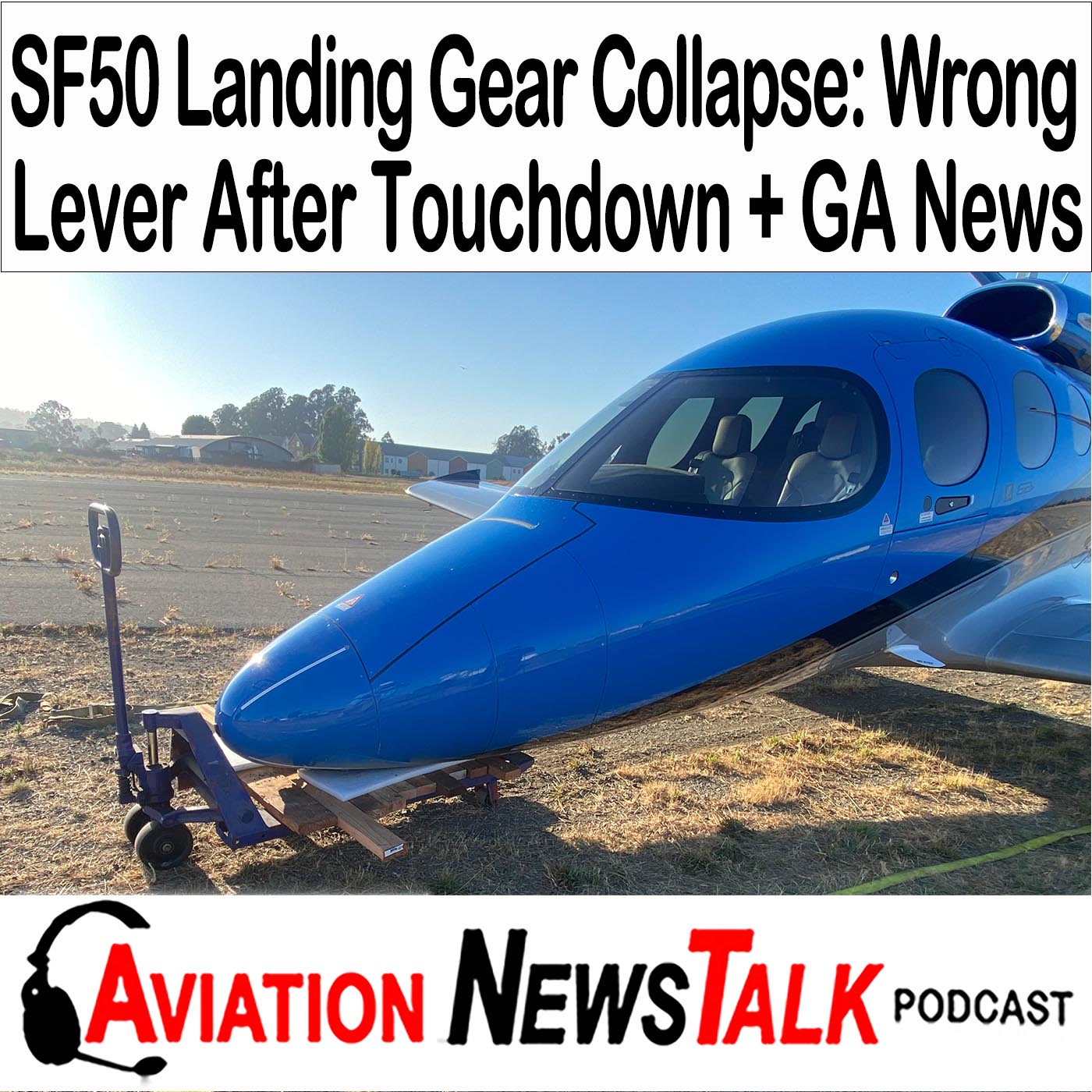
411 Vision Jet SF50 Landing Gear Collapse: Wrong Lever After Touchdown +GA News
About this Episode
Max talks with Rob Mark about a classic "simple mistake with big consequences" scenario: a pilot who possibly raised the landing gear handle instead of selecting flaps up during the landing roll in a Cirrus Vision Jet. The event looks minor on the surface—no injuries and the airplane stayed on the runway—but it exposes a human-factors trap that can bite any retractable-gear pilot, especially when you're trying to be quick and efficient right after touchdown.

The discussion centers on the NTSB's final report for a Cirrus SF50 Vision Jet that landed at Watsonville Municipal Airport (Watsonville, California) on August 9, 2024. The pilot reported a normal approach and landing. Before touchdown, he had the flaps set to 100% and saw three green landing gear indications. Touchdown itself was uneventful. But during the landing roll—right about when braking began—the nose landing gear collapsed.
Max and Rob walk through what the data showed. On short final, the airplane was properly configured: flaps at 100% and the landing gear down and locked. During rollout, both weight-on-wheels switches were briefly "unloaded," and the landing gear handle was raised and then lowered. That sequence unlocked the nose gear and allowed it to collapse. The main gear also unlocked, but it re-locked before collapsing. The probable cause boiled down to an inadvertent control selection: the pilot likely moved the gear handle instead of selecting the flap switch to 0%.
From there, they unpack why this kind of error is so believable. The flap selector switch sits below the landing gear handle, and many pilots develop a post-touchdown habit of "cleaning up" quickly. Some of that comes from short-field technique: retracting flaps can put more weight on the wheels, increase braking effectiveness, and reduce stopping distance. But the exact moment you're tempted to do it is also the moment you have the least spare attention. You're still fast, directional control still matters, braking is being modulated, and you're managing the transition from flight to rollout. Add fatigue, distraction, or a slightly different cockpit flow than usual, and a wrong-control grab becomes completely plausible.
A big takeaway is that landing isn't over at touchdown. Many pilots subconsciously relax as soon as the mains touch, as if the hard part is done. In reality, the landing roll is when you still have a lot of kinetic energy and limited margin for distraction. Looking down, changing configuration, or reaching for cockpit controls before you're stabilized is how small errors turn into big repair bills. Max and Rob emphasize that "post-landing tasks" are optional until the airplane is clearly under control and slowing.
So what should pilots do differently? Their answer is intentionally boring: slow the flow down. On most runways there is no operational need to rush flap retraction during rollout. Keep your eyes outside, keep the airplane tracking straight, and let speed decay. If you choose to retract flaps on rollout, treat it like a checklist item, not a reflex. Touch the correct control deliberately, verify what you're touching, and use a short verbal callout ("flaps zero") before you move it. Better yet, tie configuration changes to safer triggers—below taxi speed, after exiting the runway, or after stopping and running the after-landing checklist—so you're not doing "extra tasks" while still managing high speed and directional control.
They also discuss building habits that are resistant to error. If your technique is "as soon as I touch down, I do X," you're training your hands to move before your brain has finished verifying the right target. Replace that with a pause that forces confirmation, or a flow that keeps critical controls physically and mentally separated in time. The goal isn't to be fast; it's to be consistent and correct.
If you're getting value from this show, please support the show via PayPal, Venmo, Zelle or Patreon.
Support the Show by buying a Lightspeed ANR Headsets
Max has been using only Lightspeed headsets for nearly 25 years! I love their tradeup program that let's you trade in an older Lightspeed headset for a newer model. Start with one of the links below, and Lightspeed will pay a referral fee to support Aviation News Talk.
Lightspeed Delta Zulu Headset $1299
NEW – Lightspeed Zulu 4 Headset $1099
Lightspeed Zulu 3 Headset $949
Lightspeed Sierra Headset $749
My Review on the Lightspeed Delta Zulu
Send us your feedback or comments via email
If you have a question you'd like answered on the show, let listeners hear you ask the question, by recording your listener question using your phone.
News Stories
- ForeFlight and Jeppesen announce Layoffs
- AOPA asks pilots to contact Congress to Support PAPA
- FAA makes permanent restrictions for helicopters near DCA
- House passes bill that would block ATC privatization
- Report Shows Rise in DPE Supply
- Super Bowl LX: What General Aviation Pilots Need to Know
- New glider distance record - Instagram video
- Stolen Plane Crashes Into Hangar
- FBI investigates stolen planes, one found at Auburn airport
- Authorities looking for couple in connection with thefts
- Pilot in crash near Boise charged with operating under the influence
Mentioned on the Show
Buy Max Trescott's G3000 Book Call 800-247-6553
Video of the Week: Max's video showing ADS-B data for NASCAR driver crash
Free Index to the first 282 episodes of Aviation New Talk
So You Want To Learn to Fly or Buy a Cirrus seminars
Online Version of the Seminar Coming Soon – Register for Notification
Check out our recommended ADS-B receivers, and order one for yourself. Yes, we'll make a couple of dollars if you do.
Get the Free Aviation News Talk app for iOS or Android.
Check out Max's Online Courses: G1000 VFR, G1000 IFR, and Flying WAAS & GPS Approaches. Find them all at: https://www.pilotlearning.com/
Social Media
Like Aviation News Talk podcast on Facebook
Follow Max on Instagram
Follow Max on Twitter
Listen to all Aviation News Talk podcasts on YouTube or YouTube Premium
"Go Around" song used by permission of Ken Dravis; you can buy his music at kendravis.com
If you purchase a product through a link on our site, we may receive compensation.
Hosts & Guests
Transcript
Today, Rob Mark and I break down a vision jet, nose-gear collapse incident that, in my
opinion, started with one simple habit, and that's raising the flaps immediately after
every landing.
And I'll tell you about my involvement in the recovery of that aircraft and how I happened
to be there a few minutes after it happened.
And by the way, raising the flaps immediately after touchdown, it's something that professional
pilots do not do and will tell you why.
And today, I'll be talking about the stormy weather crossing the US and how it related
to my analysis for an upcoming vision jet flight, and also I'll be reading a couple
of your emails about flying into a mountain airport that we talked about on the show.
Hello again and welcome to Aviation News Talk, where we talk in general aviation.
My name is Max Truscott.
I've been flying for 50 years on the author of several books in the 2008 National Flight
Instructor of the Year, and my mission is to help you become the safest possible pilot.
Last week in episode 410, we talked with Mark Waddell of the Sirus Honor Pile Association
about recent Sirus landing and go around accidents, and the need for stabilized approaches.
So if you didn't hear that episode, you may want to check it out at aviationnewstalk.com
slash 410.
And if you are new to this show, welcome, so glad you found us.
And now if you would, touch either the subscribe key or if you're using Spotify or Apple
Podcast app, the follow key so that next week's episode is downloaded for free.
And my thanks to these people who signed up in the past week to support aviationnewstalk.
We have a new Patreon supporter, that's Josh Hamati.
And we had two one-time donations via Venmo, my thanks to Monty Slatton, who says he's
from Amarillo, Texas, which is one of my favorite places to stop as I'm moving airplanes
across the country.
And also thanks to Graham Figg.
And if you're the kind of person who tips your waiter, your barista, your Uber driver,
who why not tip your podcast host as well.
Shout out to aviationnewstalk.com slash support, and I'll read your name next week.
Coming up in the news for the week of January 19th, 2026, four-flight in-jeppison announced
layoffs.
AOPA is asking pilots to contact Congress.
And from our bad boys' file, we have three stories of pilots in trouble.
All this and more, and the news starts now.
From multiple sources, four-flight in-jeppison announced layoffs.
These are a footed four-flight in-jeppison, as many of us had anticipated, after they
were sold from Boeing to Tomo Bravo.
That deal closed on November 3rd.
Tomo Bravo was a private equity firm, known for software and technology-focused buyouts.
In December, a month after they were purchased, four-flight announced that the discounts
that they offered to flight instructors was being cut in half.
And now two months after the deal closed, there have been layoffs.
I first learned of this last week from an employee who emailed me, saying essentially
that over 200 people were laid off.
Many of them were software coders, and many of them were pilots, which is what made them
both passionate and really good at their work.
And it appears that some of the work is starting to be outsourced to developers in another country
with lower wages.
It's been reported in some places that 50% of the workforce has been cut, but apparently
that's not quite accurate.
I'm told that some teams have had cuts of more than 50%, including the group that develops
the logbook portion of four-flight.
So stay tuned for future news about four-flight in Jeppison.
From AOPA.org, AOPA asks pilots to contact Congress to support the Pilot and Aircraft
Privacy Act or PAPA.
The PAPA bill would address growing concerns over the use of ADSB data, including its use
by some airports to charge fees to pilots.
AOPA issued a call to action asking pilots to contact their senators and representatives
in Congress and urge them to co-sponsor the Pilot and Aircraft Privacy Act.
AOPA President Darren Pleasant said, quote, when the ADSB mandate went into effect in
2020, the FAA said this important technology would only be used for safety and airspace
efficiency.
Instead, we're now saying it used in ways that discourage its adoption.
If passed, PAPA would prohibit the use of ADSB data to assist in the collection of fees
from pilots or aircraft owners, clarify that ADSB data may only be used for its intended
purpose of air safety, traffic and efficiency, expand a provision in the FAA Reauthorization
Act of 2024 that would effectively ban any government official from initiating a non-criminal
investigation based solely on ADSB data, ensure airports are transparent about proposed
fees on their intended purpose, and give the Secretary of Transportation the discretion
to authorize other uses of ADSB data.
AOPA also said, quote, to be clear, the bill would not prevent airports from imposing
fees on pilots, nor would it impede the use of flight-aware, flight-radar 24 and other
popular flight tracking apps.
When this bill becomes law, airports will be able to impose fees as long as they are
fair and reasonable.
Airports could also continue to use ADSB to monitor traffic counts, understand traffic
patterns and flows to help them manage and create operational efficiencies.
From FAA.gov, FAA makes permanent restrictions for helicopters and powered lift aircraft
in certain areas near Reagan National Airport.
According to Transportation Secretary Sean Duffy, these restrictions apply unless those
aircraft are conducting essential operations.
The restrictions were put in place immediately following the DCA Midair Collusion and are
supported by NTSB's preliminary recommendations.
The rule prohibits certain helicopter operations when runways 1533 are in use at DCA.
In addition, helicopter route 4 between Haynes Point and the Wilson Bridge is closed.
There is a revised agreement with the military to require ADSB out broadcasting, and they've
eliminated the use of visual separation by air traffic controllers within 5 nautical
miles of DCA.
And separately, but somewhat related, in December 2025, the U.S. Senate passed by unanimous
consent.
The Rotor Act, which stands for Rotorcraft Operation Transparency and Oversight Reform, that
bill will eliminate a loophole that allows military aircraft to operate without ADSB out.
From AOPA.org, House passes bill that would block ATC privatization.
House and Senate appropriators reached an agreement on a package of four spending bills
that include DOT and the FAA.
The Senate is expected to pass the bill before government funding runs out on January 30th.
A report from the Senate Appropriations Committee in July stated, quote, the committee does not
support any efforts to transfer the FAA's ATC functions to a not-for-profit independent
private corporation.
The committee is aware that if the nation's air traffic control system had been privatized
during the COVID-19 pandemic, similar to other navigation service providers in Canada and
the European Union, the U.S. would have faced severe funding shortfalls.
Those shortfalls would have likely led to control our layoffs and greater risk to flight
safety in a slower recovery after the end of the pandemic, thus leading to more flight
delays and price increases for consumers.
AOPA Vice President Jim Koon said, quote, other countries that have gone down the privatization
path continue to face delays, funding shortfalls, and staffing shortages.
In addition to blocking ATC privatization, the House bill would provide funding to hire
2,500 new air traffic controllers and 54 additional aviation safety inspectors.
From avweb.com, report shows rise in DPE supply.
The flight school Association of North America or Fassana released new figures last month
related to the U.S. supply of designated pilot examiners or DPEs.
According to the report, in the fiscal year 2024-25, there were increases in both practical
tests conducted for applicants and the total number of examiners.
Fassana reported DPEs conducted nearly 154,000 practical test events last year, up from
129,000 the year before, and 140,000 the year before that.
The organization further reported that the total examiner pool reached 1122 active DPEs.
The data show a broad range of activity levels among examiners.
Fassana reported that 536 DPEs completed between 100 and 400 tests, while 319 DPEs conducted
fewer than 50 tests during the fiscal year.
A smaller group of 48 examiners performed more than 400 tests, including 22 who recorded
more than 500 evaluations during the year.
The Association noted the 264 DPEs accounted for 52.9% of all tests by completing 200 or
more evaluations.
From FAA.gov, Super Bowl 60, what GA pilots need to know.
GA pilots flying in the San Francisco Bay Area from February 4 to 10, 2026 must be aware
of TFR's following special flight procedures, and comply with additional operational requirements
that will be in effect for Super Bowl 60.
The FAA will issue a notem later in January about the procedures for the games and specific
arrival into departure route requirements.
Information about the San Francisco Area Airports and Airspace is available on the FAA's
Super Bowl webpage.
Special air traffic procedures are in effect for the following airports, with every airport
from Monterey, North to Napa, and Concord, and East to Stockton.
They say a reservation program to facilitate aircraft parking will be in effect from February
4 through February 9, and that pilots should contact FBOs at their airport to obtain reservations
and additional information.
The FAA will publish a TFR for the Super Bowl centered on Levi Stadium in Santa Clara,
California.
They expect the TFR will be active from 2.30 to 8.30 pm local time on Sunday, February
8.
The TFR will have a 30 nautical mile outer ring and a more restrictive 10 nautical mile
inner core, and that by the way will almost certainly close the Reed Hillview Airport,
and likely the Palo Alto Airport as well.
And from Facebook.com, a new glider distance record, Gary Osoba posted on his page that
on December 19, two glider pilots said a new US distance record flying from the California
Nevada border to Dodge City, Kansas, using a lift from periodic and high altitude mountain
waves.
They covered 1112 miles and about half a day without an engine.
There's a link to an Instagram video that shows their best climb of the day with a
cent rates of more than 2,000 feet per minute over Colorado's Sangra de Christo mountain
range, and a note to be sure to turn on the sound, and I'll include a link to that
in the show notes.
Gary continues, it was a spectacular flight, requiring a lot of preparation, stamina and
skill, as they flew an altitude band of about 20,000 to 28,000 feet.
Life support systems and backups are essential for oxygen, and heat as the temperatures at
that altitude were minus 20 to minus 40 Fahrenheit.
They're final glide from about 28,000 feet with good tailwinds covered 240 miles.
So congratulations to Gordon, better year and Bruce Campbell.
And now here are three stories from our bad boys' files, what are you going to do when
they come for you?
First, we have three stolen planes, which is highly unusual.
We just don't seem to have as many planes stolen in recent years as we've had in the
past.
From avweb.com, stolen plane crashes into hangar, assessment of 172, that's believed
to have been stolen from an LA area flight school, crashed into a hangar at Venice early
one morning in late December, prompting at an investigation.
Officials said the allegedly stolen plane was taken before dawn, from a flight training
facility at the airport.
The FBI confirmed it's assisting the LA airport police in response to the incident.
The stolen plane impacted the exterior of a hangar at about 5 a.m. shortly after it was
taken.
Authorities told NBC4 that the aircraft never left the ground.
Law enforcement said one person was taken into custody on suspicion of burglary in aircraft
theft.
And from kiro7.com, which is a Seattle-based TV station, FBI investigates stolen planes,
one found at Auburn Airport.
Federal investigators are trying to solve the mystery of who stole two planes.
The first one was taken from California and later recovered at Auburn Municipal Airport
in Washington State.
The second one, taken from the same airport, Auburn Airport, and later found in California.
According to King County Sheriff's Office, assessment of TR 182 was stolen from Chino, California
on December 12th.
It later landed at Crest Airport in Covington, Washington, that it was stolen again
at Christmas Eve, taken from Covington to Auburn.
Two days later, the plane was taken once again, flown from Auburn to Cougar Mountain Airport
in Yale.
That same day, it was flown back to Auburn where authorities recovered the plane.
Now picking up on that story from avbrief.com, there was later another theft that may be
related.
Authorities in Washington are looking for a younger couple with a couple of fuzzy white
dogs in connection with a string of airplane thefts in Auburn near Seattle that involved
an RV-12IS built by local high school students.
According to King V News, the first incident involved an aircraft that was stolen in California
and recovered as a private field and then stolen again.
Then on January 3rd, Teen Flight Pialops newly built RV-12IS, which now belongs to an
Auburn couple, was flown away at 4.27am.
After the transponder was turned off two minutes later, it wasn't seen for three days.
The two-place experimental was found at Coronamusable Airport in California almost 900 miles away.
It's not clear if the plane was damaged at all, although authorities have not yet linked
with thefts, the new owner says it seems likely the incidents are related.
The couple is now trying to figure out how to get the plane back from California, meanwhile
gatecoats have been changed at the Auburn Airport.
And finally from IdahoPress.com, pilot and crash near Boise charged with operating
aircraft under the influence.
The pilot who struck a light pole in crash near the Boise airport in November 2025 has
been arrested on a warrant alleging he was operating an airplane under the influence.
The male pilot, age 61 of Twin Falls, was arrested on a misdemeanor charge of aircraft
operating under the influence.
Police said he was flying a small aircraft with a passenger on November 8th, traveling
from Twin Falls.
He was scheduled to arrive in Boise around 6.40pm.
And I witnessed with the Idaho National Guard so that he saw the airplane hit the light
pole and crash land on the right side of the street.
Police said that the responding officers believed the pilot was showing signs of being
under the influence.
Being as passengers were taken to a nearby hospital for their injuries.
After further investigation, it was determined that the pilot was under the influence while
operating the aircraft.
And last week, more than two months after the accident, he was taken into custody and
booked.
While that's news for this week, coming up next a few of your emails, and then our conversation
with Rob Mark about how professional pilots fly.
But first…
And now here's a headset minute by light speed with Derek Schmidt.
Derek, I'm always connecting my light speed to my phone, either to make phone calls
or to provide sound from the headset for the videos I shoot.
Talk about the other different ways pilots can use Bluetooth with their headsets.
Yeah, aviation headsets certainly have come a long way.
While headsets used to consist of simple speakers on an ad band, most premium aviation headsets
now come standard with Bluetooth modules that allow them to pair with a pilot's phone
and tablet.
The Bluetooth bearing can seamlessly integrate the use of those personal electronic devices
through the headset, making available exciting applications designed to keep pilots safe
and improve cell phone communications on the ground.
At many airports around the United States, pilots must make a cell phone call to a tower
or operator to get clearance before takeoff.
Having the cell phone go through your headset can save pilots' time repeating what they
or the operator has said, because the sound goes through their headset, and is in muffled
or distorted by the background sound of the engines.
Any pilots also are using applications like for-flight or Garmin pilot to get audible alerts
in their headset of real-time weather, traffic, and GPS data during flights.
These real-time alerts are being sent directly to the pilot's headset, giving them up-to-date
safety information throughout their flight, allowing them optimal time to react to any
unforeseen weather or traffic events.
Some aviation headsets like the light speed Zulu 4 headset can even pair over Bluetooth
to two devices at the same time.
For pilots who use both the cell phone and a tablet at the same time, they can make a
phone call to get clearance and can automatically switch to their tablet without having to
un-pair and repair their headset between the devices.
This really simplifies the use of multiple Bluetooth devices in their aircraft.
Derek, thanks so much for sharing with us how we can stay connected with Bluetooth.
You're welcome, Max.
And now let's get to the good news.
First congratulations to Sam Dawson.
He's a longtime patron supporter.
He writes, smacks.
I just earned by commercial multi-engine C-plane rating at Seabring Aviation in Florida,
with a checkride at the world-renowned Jack Brown C-plane base.
The instructors at Seabring were great.
This is the same place where Aircam kits are built.
Well, congratulations to you, Sam.
Sounds like you did that flying in an aircam.
I've got some time in an aircam on floats and it is so much fun.
And if you have good news to share or anything else you'd like to tell me, do what Sam did
to contact me and go to aviationnewstart.com and click on contact at the top of the page.
That is so much better than trying to reach me through the various social media and emails
and whatever.
I have so much trouble going back and finding stuff.
But if you go there, click on contact.
I always will have access to that information.
Now let's talk about our video of the week we have anyone.
It's a follow-up to our discussion in episode 409 in which we talked about the crash of
November 257 Bravo Whiskey, a citation 550 that killed retired NASCAR driver Greg Biffle
and six others.
And as I said in that episode, the ADSB altitude data appeared to briefly freeze for 34 seconds
and then it jumped back up 1,300 feet in under 2 seconds, which of course would be physically
impossible for the plane to have done.
And I'd mentioned there that I think that's the reason the aircraft turned back to the
runway though I don't think it's ultimately why the aircraft crashed.
Now ADSB out has two different outputs and I just looked at one of them, which was the
barometric altitude.
But it also has a GPS derived geometric altitude.
So I went back and I looked at that altitude data and then I plotted the two sets of data
against each other.
And that provides proof positive of what I said in 409, which was that I thought the aircraft
was climbing normally during the time when the altitude data appeared to freeze.
So I created a video that compares the two sets of data and you can see how the GPS derived
data shows a normal climb while the barometric data freezes and then quickly jumps back
in place to closely mirror the GPS data once again.
Now Patreon supporters have already received an email with a link to that video.
But if you're not already a supporter, please sign up now to support the show and get
early access to information like that.
And the links for this video and all of our videos of the week is on the same page with
the links where you can become a supporter.
So when you go out to view the videos, look down at the bottom of the page for the video
links and at the top of the page, you'll see four options for supporting the show.
So to see all of these videos of the week, go online to aviationnews.com slash video.
And just a quick note that next week, the NTSB will hold a public board meeting on Tuesday,
January 27th to determine the probable cause of the mid-air collision between a PSA Airlines
CRJ 700 jetliner and the US Army Sikorski UH-60L Black Hawk helicopter over the Potomac
River near the Reagan National Airport last year.
During the meeting, the NTSB board members will discuss safety issues related to the crash
and vote on the probable cause.
I'll be watching the webcast of that meeting, taking notes and recording audio clips from
it.
And I'll bring that to you in a future episode, either on this show or possibly on NTSB
NewsTalk.
If you listen to NTSB NewsTalk, then you know that back in episode 7, 8, and 9, I did
some reason of three days of hearings that were held less summer about this crash.
So if you're not already following that show in whatever podcast app you use, search for
NTSB NewsTalk and touch either the follow or the subscribe key.
And I'll include a link in today's show notes with a website that you can go to view
with Tuesday's public board meeting if you have time to do that.
Now let's talk about the weather across the US at a vision jet trip of mine that just
got canceled.
Lately, I've been doing a lot of vision jet flying, which I really enjoy.
Speaking of which, if you're buying a newer user vision jet this year and you'd like
to do the 25 hours of SOE or supervised operating experience that you'll need to do in the
jet, after you finish your type rating, please contact me.
We have lots of fun doing these.
I've not got about a thousand hours of experience in the airplane and I'm happy to share that
with you.
I was supposed to leave on this Sunday for a 4-day trip to Chicago.
It was to be just the two of us, so we would have needed just a single fuel stop.
In the past, I've used the web-based for-flight trip assistant tool to plan fuel stops, but
my client told me that it's being discontinued in February.
So if you know of any similar tools, please let me know.
We were planning to refuel in Cheyenne, Wyoming, and then land at Chicago Executive, previously
known as Palwaki, sometime after dark on Sunday.
And originally, it looked like the big storm hitting the country was going to be passing
just south of Chicago.
But as I looked at the weather on Thursday, I could see the forecast was showing a couple
of inches of snow for Sunday in Chicago.
So in the worst case, we would have been landing with ice contaminated wings on a wet
runway.
So that's two factors that increase the landing distance.
Individuals yet, and actually this is also true in the SR20 and SR22, when you have ice
contaminated wings, you cannot land with full flaps, and landing with 50% flaps requires
a higher landing speed and hence takes more runway.
So when I calculated both factors for our landing weight, I found that the total landing
distance was very close to the 5,000 foot runway length at Chicago Executive.
So as I started to think about other options, the first one that came to mind was to land
further north out of the storm path.
So I was going to recommend to my client that we consider landing at Milwaukee and drive
to Chicago.
Now my wife, who's heard me talk a lot about risk management, suggested a perhaps better
solution, which was that we leave a day earlier and arrive before the storm.
So I was about to contact the client and offer these two alternatives, what I got a message
from him saying that he was canceling the trip.
Apparently he was planning to have company team members fly into Chicago for a meeting,
but some of them were having difficulty getting there as the airlines started canceling
flights ahead of the storm.
And on Friday, Pete Muntine posted on X that quote, US Airlines have already canceled
2,500 plus flights for Saturday, making it the worst day for air travel in the past year,
nearly 4,500 cancellations are now posted from Friday through Sunday.
So sounds like the airlines are getting smarter about dealing with weather and canceling
flights before the weather hits.
So if you're in the storm path, which we'll be tracking from Texas through the south
and the Midwest up to New England, please be careful when you drive and please evaluate
any GA flying plans that you may have.
Consider all of the options available to you, including canceling your plan flight, because
as we say, it's always better to be on the ground wishing you were in the air than in
the air wishing you were on the ground.
So hey, let's be careful out there.
And I want to share a couple of listener emails.
These came in response to my discussion in episode 401 about the crash of an SR-22 that
killed a country singer when he was attempting to land it, making County Airport in Franklin
in North Carolina in September.
You may recall that I talked about how the airport is in a valley surrounded by 5,000 foot
mountains in nearly all directions.
And that the pilot did a 360 degree turn to final to get down, was still too high and
did a go around.
He then flew the traffic pattern high, which led to an unstable approach to the runway.
And I mentioned that by looking at a sectional chart, it was apparent that by altering his
course slightly, he could have descended along a river valley that would have let him join
the 45 leg to the traffic pattern at the traffic pattern altitude.
I also mentioned that when flying into unfamiliar airports, especially those in mountains or
in metropolitan areas, that it's helpful to contact a local pilot for information about
that airport before you fly there.
Now, a couple of you wrote to me about your experiences flying into a Macon County airport,
which is 1-alpha-5, Laura Simmons sent me a photo and she labeled it, about to enter
left-and-wind for runway 7 at 1-A-5 in August 2025.
And she wrote, and by the way, in that photo you can see, lots of mountains.
She wrote, I called and spoke with the worker at the airport before going.
She is a GA pilot and has years of experience flying here.
He talked me through approaching the airport by following the river, starting at a VFR
reporting point, southeast of the Tyson Airport in Knoxville.
It was a beautiful flight.
I went with another pilot who had flown to the airport once before.
The mountains in the distance are what the Sirus pilot would have dropped in over, looking
at those hills near the approach to runway 7 sort of explains why one might creep toward
the runway and stay close on base.
If you ever have a chance to fly to 1-A-5 following the river, I recommend it.
It is beautiful.
Other than my one-time landing in Harlan, Kentucky, this was my only experience at any type
of mountain flying.
I just finished listening to your most recent podcast and thought you might want to see
1-A-5 wishing you all the best, Laura Simmons.
Well Laura, thanks so much for your email.
And listener Drew Stoken wrote, he said, Max, I'm a big fan of your show and I've learned
a lot from it.
Let me tell you about my recent experiences while landing at 1-A-5 and how listening
to this show may have saved my life.
A little background on me, he writes, I'm a 68-year-old pilot that's been flying for
three years and I've had an instrument running for a year before this flight.
I bought, as my first plane, a new SR22 G7 in September of 2024.
I had 500 hours total and 300 hours in my G7 at the time of this flight.
As you can see, I've been flying a lot since I had delivery of this airplane.
In spite of this, I consider myself a low-time pilot with much to learn.
On July 30th, just six weeks before the fatal crash you discussed, I flew from York
PA on an instrument flight to 1-A-5.
It was a marginal VFR day and I was in and out of IMC on the three-hour flight.
Descending into 1-A-5 on the Arnavd GPS Alpha, the only approach and its steep.
The circling approach has you crossing the runway on a perpendicular, then requiring
you to choose either left traffic to runway 7 or right traffic to 2-5.
He says, note that it's right traffic on 2-5 due to terrain.
I chose left traffic to runway 7 as the wind's favorite that runway at the time.
As I was on the downwind, eyeing up my base turn, I noticed a very intimidating ridge crossing
up to meet my base leg.
I still needed to lose altitude and turn on the base and cross the ridge, seemingly very
close to the trees.
This is where the magic happened.
I knew that I wouldn't have a glide slope since it was a circling approach, so I entered
this would be into the avionics.
The visual approach to runway 7, just after seeing the airport.
As I approached my turn to final, I'm a gentle diamond appeared on the altitude tape showing
I was still high.
Then the highway in the sky box from the side appeared, giving me a target to point my
green pumpkin, which would be the flight path marker, it's kind of a gun sight, looking
device.
Point that on to intercept the glide slope.
In spite of my efforts at losing altitude, I was still above the three-year glide slope
when I turned on to final, but I had enough time to flip the plane to lose altitude before
finally intercepting the glide slope and landing nicely.
Had I not had those few more seconds on base to see how high I was and correct, I would
have been even higher as I turned on to final.
Oh, did you notice the papi is out of service?
Indefinitely, it has been for two years.
Certainly the approach to this runway is a setup for disaster, without this trick of landing
in the visual approach and this trick I picked up right here in aviation news talk.
During my transition training when I picked up my SR-22-10 months prior, there was a damaged
and sad-looking Sirus SF-50 vision jet sitting on the ramp in front of the FBO, the victim
of a hard landing.
And as I was being fueled up for my return flight on this recent flight, I mentioned that
to the linemen and he informed me that they now had a bent-up king air that was sitting
on a hanger, another victim of a rough landing.
At the time, I felt pretty proud of myself for being able to land there without much
undue effort or incident.
But after hearing the news of the fatal crash and lining up their ADSB data with my fly
stove data, I felt an absolute chill go out my spine knowing exactly what happened to
him and what might have saved him and his family.
Max, thanks so much for everything you do for us.
Laura and Drew, thank you so much for sharing your stories and I'll be writing more about
this accident and share Laura's and Drew's stories in an upcoming issue of flying magazines,
so if you don't already subscribe to that magazine, you might want to do that.
And I just want to mention that mountain airports in general have much higher accident rates
than airports in the flatlands.
We talked about that in relation to the Trekkie Tahoe Airport in which they said that
they compare themselves with other mountain airports and they compare favorably with those,
but it's just natural that when you've got lots of terrain, accident rates are going
to be higher.
So do all the work you can in advance to prepare and get additional training before you fly
into mountain airports.
Coming up next our conversation with Rob Mark about a vision jet landing gear collapse
in my involvement with the recovery of that aircraft.
All right here on the aviation news talk podcast.
And let me tell you a little about Rob Mark.
He's worked as an air traffic controller and as an airline pilot, corporate pilot and
CFI.
He publishes the JetWine blog at JetWine.com and he's an award-winning journalist.
He's also my co-host on NTSB News Talk podcast.
And now here's our conversation with Rob Mark.
Rob welcome to the show.
Great to have you back.
Hey it's nice to be here Max.
Well the funny thing is we have not had you on aviation news talk for a number of months,
but you and I get to talk all the time on the NTSB News Talk show where I'm having a great
time or I think sharing a lot of good information.
And this particular story we're going to talk about today is the kind of thing we would
do on that show.
So I think this gives our audience here an idea of just what it is you and I have been
up to for the last 19 episodes on that other show.
That's true and I'm glad they're here.
Well in some ways this is exactly what we do in that particular show.
But we're looking for a larger audience because some of the lessons from this are broadly
applicable.
So that's why we wanted to share it today.
This involves November 727 Victor Bravo as vision jet SF50 in accident that occurred
in Watsonville, California, August the 9th, 2024.
There were two people on board, fortunately there were no injuries.
And the final NTSB report is out.
And so much of what we're going to talk about comes directly from that report.
Now interestingly, I have a connection with this accident or incident, whichever you
want to call it, because moments after it occurred, a friend of mine who works for the FAA
and knows that I do a lot of work with vision jets, phone me to say, Hey Max, there's a vision
jet that's stuck on the runway at Watsonville and the airport is now closed.
That Watsonville is about an hour from my home, but totally coincidentally, I was about
10 minutes away.
And my wife and I jumped in the car to drive over to Watsonville to see how we could assist.
And I'll tell you about that in a few minutes.
But here is what the final NTSB report says.
It says the pilot reporting that during the landing role, because they were just landing,
about the time that he was applying the brakes, the nose landing gear collapsed.
Having no training on what to do in this scenario, he said that he cycled the landing gear
by raising, then lowering the landing gear control handle.
Post flight inspection revealed substantial damage to the undercarriage near the nose
landing gear bay.
Stored on board central maintenance computer or CMC data showed that before touchdown,
the airplane was properly configured for landing with a flaps at 100%.
The nose and both main landing gear were down and locked.
After touchdown and during the landing role, while both weight on wheels, switches, also
known as WOW, WOW switches, were temporarily unloaded, the landing gear handle was raised
and then lowered, which unlocked the nose gear and allowed it to collapse.
Additionally, both main landing gear became unlocked, but re-locked before they could collapse.
After the nose gear collapsed, the gear handle indicated an unexplained four-second anomaly
by indicating either up or down, then indicating down.
Post accident examination in a landing gear swing test revealed no pre-accident mechanical
malfunctions or failures with the airplane that would have precluded normal operation.
A missing nose landing gear locking spring from the nose gear assembly was not causal to
the accident.
The flaps selector switch was located below the landing gear control handle.
For the review of CMC data, it showed that the operators of the airplane often raised
the flaps within seconds after touchdown, which was about the time that the nose landing
gear collapsed.
Although the pilot was familiar with the airplane and had accrued about 102 flight hours
within the past 90 days, it is likely that the pilot inadvertently raised the landing
gear control handle during the landing role instead of selecting the flaps selector switch
to 0%.
Probably because the pilot's inadvertent use of the landing gear control handle instead
of the flaps selector switch during the landing rollout, which resulted in the collapse
of the nose landing gear.
And then further down in the report, it says a review of ADSB and downloaded CMC data
from the airplane revealed that at 1250, while the airplane was about 1,250 feet from the
approach threshold of the runway, the flaps were at 100%, the landing gear handle indicated
down, and the nose gear and the left and right main landing gear were down and locked.
15 seconds later, the airplane touchdown as indicated by the left and right wheel speed
increasing from 0 to about 1,501 RPM and 1488 RPM respectively.
One second later, the wow data indicated a load on the left and right main landing gear.
Two seconds later, the wow data indicated no load on either landing gear, the gear handle
indicated in the down position, and the landing gear indicated down and locked.
A few seconds later, the gear handle indicated in the up position and the wow switches indicated
in no load.
By the way, people might wonder why would there be no load?
And I think everybody's had the experience that when you touchdown, sometimes the airplane
floats up just a little bit.
Not a whole lot, but that would be just enough to unload those particular switches.
So I think this is something that could happen in any landing.
When you're on it says the left and right main landing gear indicated down, but not locked,
and the nose gear indicated down and locked.
At the same time, the hydraulic pack was enabled, and the landing gear was directed up.
One second later, the nose gear also indicated down, but not locked.
At the same time, the left wow switch indicated no load, and the right wow switch indicated
a load.
So it was a little heavier on the right wheel, it was still light on the left wheel.
The hydraulic pack remained enabled, and the landing gear continued to be directed
up.
A few seconds later, the gear handle indicated down, the nose gear indicated not down and
not locked.
And the left and right main landing gear indicated down, but not locked.
Hydraulic pump was enabled, and the gear was not directed up.
The airplane indicated a 12.5 degree nose down attitude.
So obviously the nose dropped down at that particular point, and that indicates for
four second period, the gear handle indicated neither up nor down.
One second later, the gear handle indicated down.
And this, by the way, to me, is very interesting.
It says, a review of the CMC data for the prior 12 flights revealed that flap retraction
from 100% to 0% occurred any time from two seconds after touchdown to 70 seconds after
touchdown, with eight out of 10 times being within two to five seconds after touchdown.
The accident flight recorded no flap retraction.
So here's what I remember from that day last summer.
When we arrived, I drove over to a specialized aviation, which I knew that there was a place
there to park, and there was a gate close to the airport, and from there I could actually
see the airplane straight out across from their facility.
And I walked out to the field, and that's where I found the head of specialized aviation,
who I've known for a number of years, and I just want to mention there, the helicopter
school, where I got my certificate two years ago.
So I was quite familiar with him and their operation.
He had a fork lift, and they were kind of figure out how to raise the nose of the aircraft.
It was just off the left end of the runway, probably, oh, I would say halfway down the
runway.
So maybe 2,500, maybe 3,000 feet from the far end of the runway, where it would have touched
down.
And I was the one who said, hey, let's call Sierra's support.
I've got them in my contacts, so I called the SF-50 as support number to get some advice
from them.
And I actually handed the phone over to Chris, the head of specialized, and he talked
with them, and ultimately they figured out how to go about securing the aircraft, raising
it, and then being able to pull the nose gear out so that they could then tow it off the
runway.
So interestingly, I was at a meeting last year with a lot of SF-50 pilots, and Sarah's
and a data at that time, that there had been prior to this five different incidents where
vision jets had the nose gear collapsed because the pilot raised the landing gear during
the rollout.
So this then would be the sixth one of those.
They have about 600 aircraft that have been delivered.
So amazingly, that tells you that this problem has occurred to 1% of the fleet.
So let's talk about this, Rob.
I mean, you've worked as a professional pilot.
What are professional pilots know and do when they're landing?
What we know is that there are checklists for everything.
And as having flown to the left and the right seat on a number of turbine airplanes, once
we touch down, we slow the airplane, turn off, and we may stop or we may continue taxing,
but then the PIC says, after landing checklist.
And that is the point at which the person in the other seat runs through the items.
And one of them is usually raised the flaps.
And of course, even in my experience in turbines, someone will do the afters, and I'll watch
them.
It's not meant to be disrespectful or that I don't trust them or whatever.
I just, you know, I'm in charge of the airplane.
I just want to make sure that as they grab for things and some people run through the
afters pretty quick.
And that is the time when people can make mistakes.
I just like to watch that.
But anyway, when you're single pilot, you have nobody to back you up.
And again, the reason that people did like to pull the flaps up after touchdown was because
they were taught at some point in their training that it puts more weight on the wheels and
contributes to better braking and shortening the landing roll.
However, you pull the gear up by mistake.
If that's indeed what happened, that's certainly shortens your landing roll.
But it also adds a huge bill for things to be fixed.
So again, you know, there's a reason that we have a checklist in a professionally flown
airplane.
And there are reasons that we don't do anything quickly.
And I can't remember a time in a jet, any of the citations, the hawkers, the falcons,
that we said, as soon as we touchdown, we have got to get all the weight on the wheels
so the airplane can be stopped.
We just don't do that because if you're cutting it that close, you probably shouldn't
be landing there in those conditions.
So mistakes happen and they usually happen when people try to rush.
Now, I don't know that's what happened here, but I'm just saying that that is why we
pull the flaps up after we have turned off the runway when there's no nothing really
to distract us and everybody can make sure that we're doing what we should be doing.
I talked about this concept once before on the show and the concept being that after you
touchdown, professional pilots don't touch anything until after they've slowed, they've
gotten off the runway, and then they run the checklist as you just described.
And I actually, after that episode, had an airline captain contact me and he said,
that's absolutely true.
We are taught the only two things we are allowed to touch after touchdown is going to be the
thrust reversors and the tiller, which of course would be for steering the aircraft.
So as pilots, smaller aircraft, we're using our feet to steer after we've touched down.
But since, you know, we don't have thrust reversors in most aircraft, we should not be touching
anything while we are on the runway.
The problem, I think, as you allude to is that there is a lot of primary training that
is done for short-filled landings where pilots are taught, hey, after you touchdown, raise
those flaps because that's going to shorten your ground roll distance.
I did some research on this and I could not find any hard data on what percentage of ground
roll you're going to save by doing that.
The best estimates I could come up with were that perhaps it would reduce the ground roll
by maybe 5%, which for most J-aircraft is going to be on the order of maybe 100 feet.
As you said, if you've got so little runway that it's important that you raise the flaps
to shorten your ground roll, you have no business landing on that particular runway, which
is to say, there is no good reason to raise the flaps after you touchdown unless you find
yourself in the unusual situation of landing on the wrong runway and it was shorter than
you expected it to be.
The other thing you mentioned is when running these checklists is raising the flaps.
One thing I like to encourage people to do is when they reach down for that flap lever
after they've gotten off the runway, they've come to a full stop, that they should look
at the label next to the handle and say the words flaps identified because, just because
you've come to a stop if you're rushing at all, you could grab the wrong handle.
So I think the habit of saying flaps identified because you've looked at the word flaps, that
I think also reduces the odds of grabbing the wrong handle.
I think, too, that sometimes when you have more than one pilot in the aircraft, it can
lead to issues.
I remember years ago I was flying a mixed master, I call it a mixed master, but it was a
Skymaster which was one of Cessna's earlier twins that had one engine in the front, one
in the back between two tailbooms, two vertical stabilizers.
But anyway, I was in the left seat flying the airplane, I had the owner in the right seat
and we landed some place at night.
I can't remember where, but I do dearly recall that we were, I barely had the nose gear
down and I saw his hand going for something at the bottom of the instrument panel and I
said, no, you know, when he raised the flaps on me.
And so I was so angry, I said, no, this is not the time.
Get the airplane stopped, get it off the runway, get to where you're going to park, get
it all shut down and then have a conversation with this person.
And I actually worked for this person and I said in a nice way, please, don't ever do
that again.
He said, but I'm trying to help.
I said, you're not helping.
I explained to him what he could have caused and he said, I don't know, he said, just
making such a big deal out of it.
And I said, well, I'm sorry that you see it that way, but please, I'm asking you nicely,
don't ever do that again because if you do it to me, you're going to be looking for
another pilot because I have a pretty good record of not breaking any airplanes over
the years of flying and I don't want an accident on my record, but I sure as heck don't want
an accident that wasn't even at my instigation and that that would be the worst kind.
Yeah, totally agree.
Yeah, it's interesting that people think that, oh, I'll never make that particular mistake.
And I bet there are people listening right now who are thinking, ah, no big deal.
I would never make that mistake.
I would never grab the landing nearby accident.
If I grab the flaps, I know it's going to be the flaps handle.
I was talking with John Fiscus who we just had on the show here a couple of episodes
ago.
He is the co-founder of the flight academy, which is a serious flight school up in Washington
state.
He does a lot of simulator training for serious back in Knoxville and the vision jet simulator.
We were talking about this problem of people, you know, raising the other nose gear instead
of the flaps.
And he said that there was a time that he had a gentleman in the simulator.
And after he did his first landing, he raised the flaps and John said, do not do that.
That's an incredibly bad habit.
It could lead to accidentally raising the landing gear.
The guy turned home and said, that's ridiculous.
I will never make that particular mistake, John kind of, you know, didn't say anything.
They continued on, wouldn't you know, the very next landing, this guy lands, he raises
the landing gear.
Even after he had just insisted, he would never make that particular mistake.
And he just turned and looked at John, you know, his face kind of in horror and disbelief.
And I think that lesson landed really strongly and hard with him.
That just because you think he will never make that mistake, even if you insist to your
instructor that you will never make that mistake, people make mistakes all the time.
And so to prevent that mistake, just don't touch the flaps.
Wait till you're off to the runway and then run through your checklist.
A wise instructor years ago, a former World War II guy that I flew with had flown P-51s
in the war said, Rob, one piece of advice I'll give you.
Be very careful when you use the word never or always, it's going to, it'll get you in
trouble.
Yeah.
Indeed.
So I actually had a conversation with one of the training managers at Cirrus about a
year ago about this particular issue.
And I said, you know, there is a real problem.
In some of the Cirrus checklist for the SR-20, the SR-22, as part of the landing checklist,
it actually said after touchdown, raise the flaps.
And so we have a generation of people who have been trained in piston airplanes, that that
is the correct proper thing to do because that's what the checklist said to do.
He told me, Max, we know this is a problem.
We have been in the process of trying to change all of those checklists, trying to remove
that from those checklists, that it's been about a three year process to make that a
curve doesn't surprise me because it probably requires some kind of FAA approval.
So I think what people don't realize is primacy is incredibly powerful.
And primacy is what you learned first is what you remember best.
A lot of people have been trained in these airplanes, oh, after touchdown, raise the flaps.
We have a whole generation of instructors, sadly, who are still telling people after
you touchdown, raise the flaps.
If you only fly a fixed gear airplane forever, this is not going to be a problem.
And yet, we don't want to train people for the airplane they're flying today.
We want to train people for the airplane they may be flying tomorrow.
And this is a huge problem once you move up into retractable gear aircraft.
And then there are those people who say, I'm never going to own or fly a retractable gear
airplane, so it doesn't matter until they do.
Yeah, no, I think that's a really good point.
I think a lot of people don't realize that there may come a time where they step up to
an aircraft where that bad habit that they developed in fixed gear aircraft that they
thought would never bother them because they would never be in any other kind of aircraft
turns around to bite them.
So anyway, I guess the moral of story is pilots make mistakes.
You got to train to fly like a professional pilot, even if you're not going to be hired
as a professional pilot, professional pilots don't touch anything after they land until
after they're off the runway on the taxiway.
Train as you will fly and fly as you were trained.
That's what we like to say.
Yep, so this is a huge problem.
I sure hope that we've helped save somebody from the expense and the embarrassment of raising
the lane that year at some point in the future.
Rob, thanks so much for joining us here today.
Talk about this problem.
Hey, you betcha.
We'll see you next time, Max.
Thanks for inviting me.
And my thanks to Rob Barkford joining us here today.
You can see more of his work at JetWine.com and of course, you can hear him on the NTSB
News Talk podcast and just a reminder that I love hearing from you and I read many of
your emails on the show.
If you'd like to send me a message, just go out to aviationnewstalk.com, click on contact
at the top of the page.
That's absolutely the best way to send me a message.
And of course, I also want to thank everyone who supports the show in one of the following
ways.
We love it when you join the club and sign up at aviationnewstalk.com slash support to
support the show financially.
You can also do that at aviationnewstalk.com slash PayPal.
We also love it when you leave a five star review on what our app that you're listening
to us on now.
And of course, if you're in the market for a headset, please consider buying a light
speed headset and using one of the links in our show notes because if you use those
links, they will donate to help support the show.
So until next time, fly safely, have fun and keep the blue side up.
And remember that you can always go around.
More from Aviation News Talk – Pilot Stories, Safety Tips & General Aviation News
View all episodes →
418 New Zealand Flying: Aero Clubs, Milford Sound, and Glowworm Caves + GA News
Aviation News Talk – Pilot Stories, Safety Tips & General Aviation News
Apr 7, 2026·1:12:30·failed

417 Cirrus SR22, Vision Jet and SR20 Design with Mike VanStaagen
Aviation News Talk – Pilot Stories, Safety Tips & General Aviation News
Mar 11, 2026·1:05:46·failed

