Loading...
leisureaviationnews
412 Cirrus SR22T N17DT Stall Crash: Flaps Retracted on Low-Power Approach + GA News
About this Episode
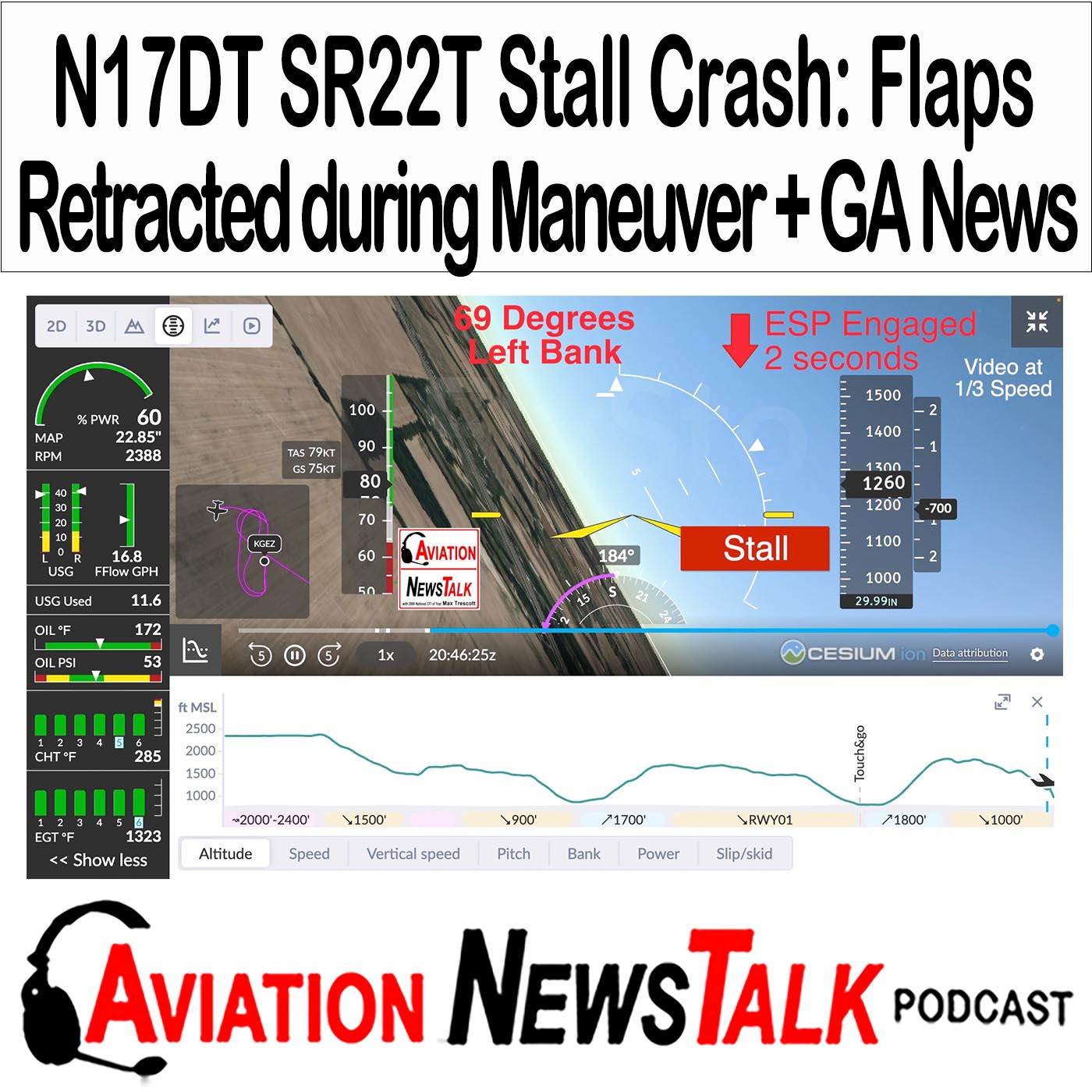
Max talks with Rob Mark about the fatal crash of Cirrus SR22T N17DT near Shelbyville, Indiana, and why this accident is so instructive for any pilot who flies approaches at low altitude with high workload. The NTSB's probable cause centers on inadequate airspeed and an aerodynamic stall, but the real value is in the flight data that shows how the airplane got there: low power held for an extended period, repeated stall warnings, multiple ESP interventions, and flaps that ultimately remained retracted until impact.

This episode matters because it's rare to have this level of detail. The NTSB recovered onboard data that captures dozens of parameters multiple times per second—far more than you usually get from ADS-B alone. Max describes how the NTSB published extensive graphs and also released a spreadsheet of recorded parameters. The spreadsheet didn't include position data, so Max combined it with ADS-B track points and interpolated the missing locations to create a second-by-second reconstruction. The result is a cockpit-style view that shows airspeed, pitch attitude, power, flap position, stall warning activations, and ESP engagement together—so you can see the chain of events, not just the endpoint.
The key factual finding: the engine was operating normally. The "partial engine failure" theories that circulated right after the crash don't hold up against the final report and recorded parameters. Instead, power was pulled back to a very low setting—about 15%, roughly 10–11 inches of manifold pressure—and held there. That's close to a landing-power setting, which means airspeed and energy must be managed carefully to avoid drifting toward stall, especially if configuration changes.
The second key finding is configuration. The flap record shows the flaps briefly at about 50% and then transitioning to 0%. Later, the data shows the flaps again toggling, but ultimately the airplane ends up with flaps retracted and stays that way until the crash. That detail is not cosmetic—stall speed is strongly affected by flap setting. In a low-power approach, retracting flaps increases stall speed and requires a different pitch picture and energy plan. If the airplane is flown as if it has more lift available than it actually does, airspeed can silently bleed away.
As the airplane slowed, the recorded data shows repeated stall warning activations in the final minute, and ESP (Envelope Stability Protection) engaging multiple times. ESP is designed to help discourage pilots from exceeding the envelope by nudging pitch and roll back toward safer values, but it can't create airspeed or altitude. It's a guardrail, not an autopilot that can save a low-altitude slow-speed situation once the margin is gone. In the reconstruction, stall warnings and ESP engagement cluster around the periods when the airplane is slow, pitched up, and operating near the edge of the envelope.
Witness observations align with a low-altitude stall sequence. A driver on a nearby interstate described the airplane as very low, appearing to "hang," then making a sharp turn. The witness observed a wing drop and rapid rocking from one wing vertical to the other before the aircraft disappeared behind trees and a fireball was seen seconds later. The NTSB's recorded data similarly shows the airplane slowing near stall speed followed by a loss of control consistent with a stall at low altitude.
The practical lessons are direct and transferable to any airplane, not just a Cirrus. First, treat any stall warning on approach as a command—not a suggestion. You don't troubleshoot while the airplane is approaching the critical angle of attack. Your first move is to reduce angle of attack (unload) and regain airspeed. Second, make configuration errors harder to commit and easier to catch. Flap position is not a "set it and forget it" item when workload is high. Use callouts, verify indications, and confirm the pitch picture matches the configuration you think you have. Third, recognize that "low-power" plus "slow" plus "turning" is the classic trap. Bank increases stall speed, and when you're low, you don't have the altitude budget to recover from a stall break and wing drop.
Finally, this episode reinforces a mindset: the accident wasn't one bad second; it was a sequence of small choices and small drifts that added up to zero margin. The data shows multiple warning opportunities—stall horn and ESP events—before the final loss of control. The goal for listeners is not to judge the pilots. It's to build habits that make this chain harder to start, easier to detect, and easy to abandon early. When the airplane is telling you it's running out of margin, believe it—then reset the approach while you still have altitude to spare.
If you're getting value from this show, please support the show via PayPal, Venmo, Zelle or Patreon.
Support the Show by buying a Lightspeed ANR Headsets
Max has been using only Lightspeed headsets for nearly 25 years! I love their tradeup program that let's you trade in an older Lightspeed headset for a newer model. Start with one of the links below, and Lightspeed will pay a referral fee to support Aviation News Talk.
Lightspeed Delta Zulu Headset $1299
NEW – Lightspeed Zulu 4 Headset $1099
Lightspeed Zulu 3 Headset $949
Lightspeed Sierra Headset $749
My Review on the Lightspeed Delta Zulu
Send us your feedback or comments via email
If you have a question you'd like answered on the show, let listeners hear you ask the question, by recording your listener question using your phone.
News Stories
- NTSB: Greg Biffle Crash Followed Instrument Failure
- Reagan National Midair Collision Probable Cause
- AOPA Air Safety Institute suggests icing as factor in Challenger crash
- Burbank Airport at risk of a midair collision, according to NTSB
- Pomona Man Arrested in Connection with Aircraft Thefts
Mentioned on the Show
Buy Max Trescott's G3000 Book Call 800-247-6553
Video of the Week:
Max's FLYING Magazine article: Pattern Problems
Free Index to the first 282 episodes of Aviation New Talk
So You Want To Learn to Fly or Buy a Cirrus seminars
Online Version of the Seminar Coming Soon – Register for Notification
Check out our recommended ADS-B receivers, and order one for yourself. Yes, we'll make a couple of dollars if you do.
Get the Free Aviation News Talk app for iOS or Android.
Check out Max's Online Courses: G1000 VFR, G1000 IFR, and Flying WAAS & GPS Approaches. Find them all at: https://www.pilotlearning.com/
Social Media
Like Aviation News Talk podcast on Facebook
Follow Max on Instagram
Follow Max on Twitter
Listen to all Aviation News Talk podcasts on YouTube or YouTube Premium
"Go Around" song used by permission of Ken Dravis; you can buy his music at kendravis.com
If you purchase a product through a link on our site, we may receive compensation.
Hosts & Guests
Transcript
Well, today we're talking about the crash of November 1-7 Delta Tango, the SR-22 that
crash near Shelbyville, Indiana, killing the newly minted private pilot, and is CFI.
The NTSB probable cause was, quote, both pilots, failure to maintain adequate airspeed during
departure from the airport, which led to the airplane exceeding its critical angle of
attack, entering an aerodynamic stall, and impacting terrain.
While this tells us what happened, it doesn't tell us how and why they get into that situation.
But in a rare move, the NTSB published the data that the aircraft captured itself, and
by merging that data with ADSB data, I was able to create a video that shows exactly
what happened.
And in my opinion, the pilots were doing a training maneuver that emerged the approach
and landing to a cornfield that went horribly wrong, and Rob Mark and I will tell you why.
Also, today I'll be playing an audio clip of something I heard over the radio, and I'll
be reading a couple of your emails.
Hello again and welcome to Aviation News Talk, where we talk in general aviation.
My name is Max Prescott, I've been flying for 50 years on the author of several books
in the 2008 National Flight Instructor of the Year, and my mission is to help you become
the safest possible pilot.
Last week in episode 411, we talked with Rob Mark about a vision jet nose gear collapse
incident that the NTSB says was likely caused by the pilot raising the landing gear.
So if you didn't hear that episode, you may want to check it out at aviationnewstalk.com
slash 411.
So if you're new to this show, welcome, glad you found us, and if you would, take a moment
to touch either the subscribe key or if you're using Spotify or the Apple Podcast app, the
follow key, so that next week's episode is downloaded for free.
And just a quick reminder that whenever you buy a new light speed headset, light speed
will send a check to support aviation news talk, but only if you first go to this special
link we've set up for you to get to their website.
And that link is aviationnewstalk.com slash a light speed.
And if you've been listening to the show for a while and feel that you're getting value
from it, why not make a donation?
Think perhaps about what you might pay an instructor for an hour or two of good instruction.
And then support the show by going to aviationnewstalk.com slash support.
Coming up on the news for the week of January 26th, 2026, and TSP releases preliminary report
on the Greg Biffle Citation Crash in North Carolina.
The Reagan National Mitter Collision Publical CAUSE was announced, and we have a follow-up
to our bad boys file, all of this and more than the news starts now.
From avweb.com, Greg Biffle crash followed instrument failure and cockpit confusion.
Greg Biffle Citation 550 encountered multiple instrument failures and communication issues
before crashing near the runway at State's Field Regional Airport in North Carolina in
December, according to the NTSB preliminary report.
Biffle's aircraft departed State's field shortly after 10 a.m. on a personal flight to
Sarasota, Florida.
The pilot, a retired airline captain with multiple type ratings, took off VFR with the intention
of activating an IFR clearance once airborne.
The AWAS reported calm winds with 10 mile visibility, 3900 foot broken, and 4800 foot overcast
ceilings on a temperature of 7 degrees C. On board were seven people, including two additional
people with pilot certificates, one of whom was seated in the right seat.
That person, an instrument rated single engine, private pilot, was not qualified to serve
as second in command.
Even so, the left seat pilot controlled the fully fuel jet, while the right seat passed
your handled radio calls and checklists.
Back-but-voice recordings, along with reports from nearby ground personnel, confirm that
the left engine did not start up on the first attempt.
Both engines were nonetheless running before the aircraft began taxing.
The pilot and passengers discussed a malfunctioning thrust-reverser indicator, though the reversers
themselves appeared functional.
After departing from runway 1-0, the airplane climbed in left turn, at approximately 2,200
feet at began to descend.
The right seat passenger attempted to contact ATC to activate the flight's IFR clearance,
but those transmissions were unanswered due to the controllers workload at the time.
Around the same time, one of the pilot passengers noted a difference between the left and right
ITT temperature indications, although no further discussions regarding engine instruments
came up for the remainder of the recording.
At 4,500 feet, the pilot reported an altitude indicator issue, something we talked about
in a prior episode, along with the possibility of other left-side instrument problems.
The aircraft's Garmin GTN 750 stopped recording air-speeded about that time, along with heading
data about a minute later.
The pilot also disengaged around the same time, though it is not clear whether this was
intentional or not.
The right seat passenger, who did not verbally report instrumentation issues on the right
side of the flight deck, took the controls for a moment.
The aircraft descended to about 1,800 feet by 1013 am.
Audio recording suggests the pilot took control of the aircraft back at about that time
and turned right back to where the airport.
The pilot called out flapping gear extension, but the landing gear indicator lights were
not eliminated.
A few moments later, the right seat passenger transmitted on the seat staff, saying we're
having some issues here.
Although there is no alternator on the aircraft, one of the passengers asked the pilot about
power to the alternator, and about 4 seconds afterward, audio recording quality improved,
and the pilot responded that that was the problem.
He did not elaborate further on what was meant by that, though there were no further references
to instrumentation troubles for the remainder of the flight.
Garmin GTN 750 airspeed data resumed seconds afterwards.
Data indicates the aircraft rolled out on runway heading at about 1,240 feet and 114 knots.
Airspeed declined steadily over the next 30 seconds during the final descent.
The aircraft crashed short of the runway.
The pilot held a CE500 type rating with a second-in-command limitation, meaning he was required
to have another pilot who met the requirements for a second-in-command pilot.
The right seat occupant, a private pilot with a single engine land and instrument rating,
was not qualified to serve in the role of second-in-command.
The aircraft was not equipped with a flight data recorder and was not required to carry
one.
Investigators recovered a cockpit voice recorder and extracted roughly 31 minutes of audio,
so poor audio quality hampered parts of the review.
Limited flight data was recovered from the GTN 750.
And the Reagan National Midair Collision Final report is out.
The NTSB held a public board meeting this past Tuesday, January 27th.
On the midair collision that occurred over the Potomac River near Ronald Reagan National
Airport, the board discussed their findings and voted on a probable cause findings and
safety recommendations designed to prevent similar crashes.
I watched the entire 10-hour hearing and will play some of those excerpts on an upcoming
episode of NTSB News Talk podcast.
Now, here's a recording of the probable cause the board voted on as read by member Graham,
who we had on as a guest back in episode 13 of NTSB News Talk.
Thank you, Chair, and I appreciate staff and the individual members of working individually
with me on this.
I moved to amend the probable cause to read, and I'm not even going to write, well, I guess
you got a red line in there.
That's pretty good.
I'm just going to read the whole thing because I can't read through those red lines right
now.
The NTSB, my motion is to amend the probable cause to read.
The NTSB determines that the probable cause of this accident was the FAA's placement of
a helicopter route in close proximity to a runway approach path.
They're failure to regularly review and evaluate helicopter routes and available data, and
they're failure to act on recommendations to mitigate the risk of a mid-air collision
near Ronald Reagan, Washington National Airport, as well as the air traffic systems over
reliance on visual separation in order to promote efficient traffic flow without consideration
for the limitations of the sea and avoid concept.
Additional causal was the lack of effective pilot-applied visual separation by the helicopter
crew which resulted in a mid-air collision.
Additional causal factors were the tower teams' loss of situational awareness and degraded
performance due to a high workload of the combined helicopter and local control positions
in the absence of a risk assessment process to identify and mitigate real-time operational
risk factors which resulted in misprioritization of duties, inadequate traffic advisories, and
the lack of safety alerts to both flight crews.
Also causal was the Army's failure to ensure pilots were aware of the effects of air tolerances
on barometric altimeters in their helicopters, which resulted in the crew flying above the
maximum published helicopter route altitude.
Contributing factors include the limitations of the traffic awareness and collision alerting
systems on both aircraft, which precluded effective alerting of the impending collision
to the flight crews.
An unsustainable airport arrival rate, increasing traffic volume with a changing fleet mix, and
airline scheduling practices at DCA, which regularly strain the DCA, ATCT, workforce,
and degraded safety over time.
The Army's lack of a fully implemented safety management system, which should have identified
and addressed hazards associated with altitude exceedances on the Washington, DC helicopter
routes.
The FAA's failure across multiple organizations to implement previous NTSB recommendations,
including ADSBN, and to follow and fully integrate its established safety management system,
which should have led to several organizational and operational changes based on previously
identified risk that were known to management and the absent of effective data sharing
and analysis among the FAA, aircraft operators, and other relevant organizations.
From GlobalAir.com, AOPA Air Safety Institutes suggest icing as a factor in the Challenger
650 crash.
The Air Safety Institute stated on Tuesday that icing was a likely factor in the crash of
November 1-0 kilo Juliet, a bombardier Challenger 650 that crashed in Maine on Sunday.
The aircraft was departing Bangor International when it crashed near the runway, also because
people on board died.
The Institute states that around the time of the takeoff there was a light snow with three
quarters of a mile visibility and overcast ceiling of 1,200 feet in a temperature of
three degrees Fahrenheit.
The Challenger crew configured the aircraft for takeoff before deicing and had only a few
minutes to get off the ground before the protective ice fluid was expected to fail.
The crew requested the deicing starting at 7.17 pm.
The Challenger took off in the Legion flight on the same runway, requested time to perform
a tactile check on the aircraft and reported that they needed to return to the ramp due to
failed deicing fluid in poor visibility.
The Legion pilot confirmed on the ground control frequency that the batteries snowed and falling
had begun to stick to the aircraft.
The Challenger reported ready to taxi at 7.35 pm, cleared for takeoff at 7.42 and crashed
at 7.45 pm.
The time interval between the application of the fluid and takeoff is expected to be longer
than the anti-ice fluid can effectively prevent wing contamination.
The acceptable interval between the application of deicing and anti-ice fluids and flight is
no more than 10 minutes of hull over because of the weather conditions according to the
FAA hull over time guidelines.
The audio recording and ADSB data show the Challenger crew did not take as much time conducting.
Every takeoff checks as the Legion crew had.
The Legion's crew inspection took 7 minutes at the whole short line and the Challenger
took 30 seconds.
It's unclear if the Challenger crew had time to conduct a visual inspection for wing contamination
from the cabin.
And also from globalair.com, Hollywood Burbank Airport at risk of midair collision.
NTSB Chair and Jennifer Hamedi warned that the Burbank Airport could be at risk for a midair
collision during Tuesday's NTSB hearing.
The hearing was part of the NTSB investigation into the 2025 Potomac Midair Collusion.
Hamedi warned that commercial airline operators at Burbank have repeatedly raised concerns
about the risk of aircraft colliding.
Burbank is a medium-sized airport with short runways, a tight airspace, and a high volume
of mixed helicopter and airplane traffic.
Hamedi said, quote, I keep hearing about other areas in the airspace where they're concerned.
Burbank is one where commercial airlines have called me to say the next midair is going
to be at Burbank and nobody at the FAA is paying attention to us.
So whether it is involving helicopters or not, people are raising red flags and why aren't
people listening?
The FAA has to ensure safety.
That is their job.
There have been six reported near midair collusions at Burbank since January 1, 2021 according
to AveWeb.com.
A statement issued the following day by the Burbank Airport said, quote, the safety of our guest,
staff, tenants, and all stakeholders, while they are at Hollywood Burbank Airport, is
our top priority.
The FAA responded in statement, the airport is a safety hotspot, and that it has been
working to help alleviate the risk since the collision.
The FAA lowered the VNI's traffic pattern by 200 feet to see if that would reduce conflicts
with aircraft landing at Burbank and claim that data showed a reduction of T-CAS alerts
for arrivals to the airport.
And finally from our bad boys' file, this comes from FBI.gov, yes, that FBI, promote
a man arrested and charged with operating an unregistered aircraft at municipal airports.
A man was arrested on Tuesday for suspicion of operating an unregistered aircraft, 38-year
old man from Pomona was charged in a federal criminal complaint, while in U.S. District
Court in Los Angeles on Wednesday.
According to the complaint, a single-engine aircraft was reported stolen by the owner on
January 3 at Auburn Municipal Airport in Washington.
The aircraft was recovered on January 6 at the Corona Municipal Airport in Corona, California.
Corona police determined that the transponder had been manipulated during the flight in order
to conceal where the plane had been over a three-day period.
However, the airplane was physically seen at another airport in Kelso, Washington on
January 4.
Where a couple, driving a rented vehicle, was suspected of having flown in the aircraft.
The couple was then linked to a second suspected aircraft theft on January 27 at the Corona
Airport of a plane that had not been registered since 2017.
At that time, FBI agents conducting surveillance witnessed the man enter that aircraft and start
the airplane's engine.
They concluded he was in the process of stealing the plane and took him into custody.
The man is not a registered pilot, and he admitted to being under the influence of
Methanphetamine when operating the plane.
He had an initial appearance before a federal magistrate on Thursday and was released
on Bonn.
So beware as this seems like a catch-and-release program for airplane thieves.
Well, that's the news for this week, coming up next a few of my updates.
And then our conversation with Rob Mark about the crash of a Syrus during an emergency
approach to landing.
All right here on the Aviation News Talk podcast.
And now let's get to the good news.
Congratulations to Wayne White, who passed his commercial.
He says, I'm a 70-year-old instrument-rated pilot.
I just passed my commercial check-ride.
I don't plan to use my commercial privileges, but it was a great review and did count as
a flight review.
I want to thank you for your advice on check-ride anxiety a few years ago.
It was fun hearing my name mentioned during that podcast.
Keep up the good work.
Wayne, congratulations to you.
And I want to mention that another one of my columns from Fly magazine is now available
online for free for anybody who wants to check it out.
It was called Pattern Problems Why Sloppy Entries Can Lead The Close Calls.
And I said in part, pilots tend to focus on take-offs and landings which make sense since
their critical phases of flight.
By comparison, the approach to a landing or even the entry into a traffic pattern garners
less attention probably because it seems trivial compared to landing an airplane.
And I talk about a couple of instances, including one of mine where that having thought out
had to enter a traffic pattern resulted in a problem.
And oddly, in one recent incident, a low-time pilot I was flying with was confused as to
which runway he was on the downwind for.
And if that had not been the case, he would have turned less than a half mile in front
of a Pilates during a straight-in approach.
Could I later found out that Pilates was being flown by Rob Lover of Ertao, who we've
had on the show.
Rob was prepared to go around when I announced that we were departing the pattern.
In the article, I'll show you how you can place a pen over the HSI or DG and turn the pen
into the runway number, which helps you with your orientation when looking out the
window to identify the runways.
So check that out.
I'll have a link for you in the show notes.
And if you don't subscribe to Flying Magazine, you might consider doing that at flymag.com.
And here's an email from listener Tom Quinn.
He says, good day, Max.
In reference to your technique of selecting the one nautical mile rangering on the moving
map for assistance in identifying how far your downwind leg is offset from the runway.
This episode 410, and I talked in that case about a pilot in Bakersfield who's lost
his engine at over 10,000 feet, but then he started his downwind at 6,000 feet.
But he didn't understand how different the view is from a high altitude when trying
to determine how far offset your downwind is from the runway.
In the fluop pattern, that was too wide, which created a baselog that was so long that
he didn't make it back to the runway.
Anyway, Tom continues.
Let's see episode 410, including during a high-altitude return to the field.
It's brilliant.
On a recent cross-country trip while at 6,000 feet AGL, I selected the one nautical mile ring,
then compared where landmarks passed under my wing.
I was shocked.
These landmarks passed under the plane much closer to the fuselage than expected.
I will continue to check this reference off and during straight and level flight, especially
down the long legs to imprint in my memory, where to place potential landing spots under
my wing during partial power situations with caps at the ready.
I would encourage all to practice this often, thanks for the idea.
Fly often and safely, sign Tom, 18,500 hours, and still learning.
Well, Tom, thanks for your email.
And I want to tell you about a recent email exchange I had with my friend John Fiskus of
the Flight Academy, who we've had on the show.
John copied me on an email he'd sent to the CFI's in his flight school, in which
you talked about a recent landing accident in Watertown, Wisconsin, that involved November
814, a Cirrus SR-20.
And coincidentally, Rob Mark and I talked about that accident in the current episode of
NTSB News Talk, which is episode 22.
In that accident, the flight instructor had just nine hours of experience in that aircraft
type.
And the student pilot had 10 hours total time, six of which were in the Cirrus.
I commented to John that it was odd that the aircraft was so fast on final this time,
when they had had an approach speed of 83 knots, which is just three knots fast, on their
prior two landings at another airport.
A rote, we just have to do it right every time, we get no credit for past performance.
John replied, that's a concept I've tried to relate to people when they say after an
accident, but they were such an experienced pilot.
Doesn't matter, aviation has no memory, we have to do it diligently every time.
Because of our experience, not in spite of it.
Well, well said, John.
And please keep in mind that as you get more and more experiences of pilot, it doesn't
matter if you've been accident for over the past 10,000 hours.
It's only the next hour that counts.
You have to continue to do things right for your current flight, because we don't get
any credit at all for our past performance.
And now here's a short conversation I overheard a pilot have with NorCal approach a couple
weeks ago when I was working with a pilot on an IPC in a vision jet, and we were flying
into this Salinas airport.
Now, the conversation was innocuous enough, but see if you pick up what I noticed.
And this recording comes from liveatc.net.
In NorCal sailing side, do we laugh at the new one-fix pads?
Well, how do you want me to do the look like we're perfect?
If I have no alpha, whatever you do for her, I can give you vectors, you can do the
procedure channel and several words set her for it.
A vector is very fabulous.
A five-villain alpha fly heading 180 vector is final maintain via part.
One in zero, DFI, five to the alpha.
So did you hear that?
It's that a big deal, but it gets at the heart of something that pilots sometimes don't
understand.
And that is the role of pilot and command, who's in charge of that airplane?
Is it you or is it the controller?
As a pilot, you should know what you want and communicate that to ATC.
ATC will then do their best to accommodate your request.
Fundamentally, ATC wouldn't exist if there were no pilots.
They are there to serve you and to help keep you safe.
Now, I'll give you an extreme example of this, and I wish I had thought at the time to
capture the audio so I could share it with you.
I was flying in the Stockton, California area when a pilot called NorCal approach and
intimated that he might like to fly in this to an approach.
The lady controller's response was brilliant.
She said, would you like me to choose the approach for you?
She got it.
She was suddenly telling the pilot what I'm trying to say to you right now.
The interaction between pilots and controllers is a dance.
And pilots are supposed to lead.
So decide ahead of time what it is you want to do, and only after you've figured that
out, then call ATC and tell them what you want.
To do often, pilots just push the push to talk button, and their mouth gets ahead of
their brain.
They haven't thought about what it is they want to do, and they leave controllers wondering.
That controller then have to play 20 questions to figure out what the pilot wants.
And that takes up valuable time on what might be a congested frequency.
And here's the most common form of that situation that I see way too often.
Off-winter pilot calls ATC for the first time, they need to give our position.
Which is not hard to do, but here's what I see.
Pilot pushes the mic button, starts to talk, needs to get their position, pauses for
a second, and then makes something up.
Most commonly they give the wrong direction from which they're located from the airport.
All because they didn't think to figure out ahead of time where they were.
Instead they pushed the mic button and started talking before they thought about what they
wanted or needed to say.
So please, before calling ATC, think first about what it is that you want, and if you
need to report your position, take that few seconds to figure it out before you mash
the push to talk switch.
Otherwise, your brain may become mush and you won't be clear about your intentions or
your position when you talk with ATC.
And I wanted to follow up on the discussion we had in episode 406 with Safety Expert,
Todd Conklin.
That episode drew more emails than most, and if you haven't heard it, I'd encourage
you to check it out.
I was walking in my favorite park a couple of weeks ago and listening to a recent episode
of Todd's Preaccident Investigation Podcast, and he said something that struck me that
I wanted to share with you.
First I should mention that Todd works mostly with companies, not with individuals.
Some of these companies are in the aviation industry, but most are not.
What he speaks of events, he's talking about accidents or incidents.
Todd said and I quote, and that's the unique challenge with events is that for the most
part, every event that happens in your organization has never happened before and will never
happen again.
So Todd was saying that most accidents that occur are new to an organization.
By contrast, what you and I often hear pilots say is that there are no new accidents being
invented, which is to say that every accident we read about is something that has happened
to someone before.
But what is likely true for most of these accidents is that the accident type was new
to the pilot.
It wasn't new to aviation.
It may have been well known to many other pilots, but it was not known to the pilot who had
the accident.
In other words, the pilot was either unfamiliar with the particular circumstances that led
them to that accident or much less likely they proceeded with full knowledge of their
acts and knew that it could lead to an accident.
So in the first case, a lot of accidents happen to low-time pilots.
For example, those flying in the mountains without an instrument rating at night because
they're unaware of the dangers involved.
And an example in the latter case might be pilots who go buzzing low to the ground, knowing
that there's some risk of hitting a wire or other object, but who just figured, eh,
it won't happen to me.
So to me, the really excellent pilots are those who don't rest on their laurels, but who
continue to be curious and try to learn as much as they can about their airplane, about
risk management, and about aviation in general.
Because you never know what small detail could trip you up.
For example, I saw something new a week or two ago that I hadn't encountered before,
but it wasn't new to the industry, and I'm sure some of you may have encountered it
before.
Then I'll talk about that next week.
Coming up next our conversation with Rob Mark about the fatal crash of a Sirus that
in my opinion was doing a training maneuver that appears to have gone wrong, all right
here on the aviation news talk podcast.
And just a quick note, the video that Rob and I are about to talk about is one that was
fairly complicated to create as I had to merge two data sets with the different time
codes.
That video has been available to Patreon supporters for almost a week, and that's one
of the benefits of signing up to support the show as you get access to these videos.
Eventually I make some of them available public, and I'll let you know when this one becomes
available.
In the meantime, please consider signing up to support the show via Patreon by going
at the aviation news talk.com slash support.
And now let me tell you a little about Rob Mark.
He's worked as an air traffic controller, and as an airline pilot, corporate pilot,
NCFI.
Rob publishes the JetWine blog at JetWine.com, and he's an award-winning journalist.
He's also my co-host on the NTSB News Talk podcast.
And now here's our conversation with Rob Mark.
Rob, welcome to the show.
Good to see you again, sir.
Hey, thank you so much for inviting me, Max.
Well, I wish it weren't under these kinds of circumstances, but I think we've got some
important information for pilots, and some really valuable follow-up to the story we did
back in episode 303.
We know how the final NTSB report, which tells us what happened, but not why it happened.
And when you and I speculate about the how and the why, that's our opinion.
Because the data can't tell us what the pilots were thinking or trying to do.
But we do it for the purposes of safety education.
So if you would, go ahead and give us the background for this accident.
And then later on, I've created a simulation with data that actually came from the airplane.
So we can see second by second exactly what happened in that aircraft in terms of flap
settings and the exact pitch and roll and all of that kind of stuff.
And I think that really tells the story.
In fact, it probably tells the story in better detail than the NTSB report does.
I can't imagine how you did that.
And I'm really looking forward to seeing it.
But the facts as we know them from the NTSB came out in the recent final report into the
crash of November 1, 7 Delta Tango.
That was an SR-22 turbo.
It came out last week after the airplane had crashed on November 22nd of 2023 near the
Shelbyville, Indiana airport in Fairland, Indiana.
The airplane went down at 1646 local time and claimed the lives of a new private pilot
and his flight instructor.
Now, full disclosure, I knew the flight instructor in this accident.
And we knew each other through friends at Chicago Executive Airport.
And I also know that the instructor owned an SR-22T of his own that had been damaged
in a shoot pole years before.
And he'd rebuilt it with a help of other mechanics, obviously, into a really solid flying machine.
I also know that this instructor taught aerobatics in an extra 300.
So the just licensed private pilot had purchased this SR-22 in Greenville, South Carolina and
hired the flight instructor to move the airplane with him from Greenville to Monroe County
airport in Bloomington, Indiana.
In November the 19th, 2023, and then also fly with him for a few days in order to meet
the insurance requirements and most of all to make the pilot feel comfortable with his
new airplane.
They flew to the Shelbyville airport where the accident occurred and conducted several
take-offs in the landings.
Whether that day was clear with west winds at just nine knots.
During a departure climb from the airport after one of these landings, the airplane slowed
and stalled and impacted a nearby cornfield.
Post-accident examination of the airplane along with recorded data revealed there was
no evidence of mechanical anomalies that would have precluded normal airplane operation.
The recorded data showed that the airplane was near stall speed and that the stall warning
had eight activations over a one-minute period just before the airplane descended into
the terrain.
It was unknown whether the pilot, the flight instructor, or both pilots were manipulating
the aircraft's flight controls up to the point of the accident.
They also did not know the reason for the duration of the stall warnings over that one-minute
period.
There was no deployment of the air frims parachute.
Toxicology results indicated that the pilot had potentially used one or more cannabis
products.
However, the precise timing of his last cannabis use and whether it had any impact on this
accident could not be determined.
The National Transportation Safety Board determined the probable cause of this accident
to be both pilots failure to maintain adequate air speed during departure from the airport,
which led to the airplane exceeding its critical angle of attack, entering an aerodynamic
stall and impacting terrain.
The flight track data showed the airplane departed to the Monroe County Airport at 1605
and flew to the Shelbyville Municipal Airport.
There were no reports received by witnesses who saw the airplane during its take-offs and
landings or heard any of the transmissions from the airplane while it was at Shelbyville.
A witness who actually found their way to the NTSB through UMAX was traveling southeast
bound on I-74 near the airport and saw a small airplane to her left flying southbound
over the field.
The witness said the airplane was very low and looks stalled or as if it were hovering
or hanging.
The witness estimated the airplane to be at about 200 feet above the ground.
Now as the airplane approached the witness's position, it took a sharp turn to the left
or east and the witness said that immediately the airplane seemed to lose all control.
The left wing dipped, the airplane was fully sideways with the wing's vertical before
the airplane rotated to the right with the wing's vertical.
The witness thought the airplane rotated to the left one more time and then leveled
out extremely low to the ground.
The aircraft disappeared behind some trees and an estimated height of 50 to 100 feet
above the ground.
The second or two after disappearing behind the trees, the witness saw a fireball and
thick black smoke.
Post-accident examination of the flight control system confirmed continuity.
The wing flap jackscrew extension equated to fully retracted wing flaps while the
aileron trim was neutral.
Post-accident examination of the engine also showed there were no anomalies that would
have precluded operation.
Now as to the two pilots, the FAA Airmen records show that the pilot was issued a notice
of disapproval of application for his private pilot certificate with a single engine rating
after he failed the practical portion of the examination on October 31st of 2023.
And just a few days later on November 2nd, during his second attempt, the student pilot
passed the examination using an SR-20.
At that time, the pilot reported flight times that included a total flight time of 81.4
hours, 72 hours of dual, and 9.4 hours of solo.
Now the 9.4 hours of solo is much less than what's required for a private.
It wasn't clear in the report.
I'm thinking that maybe that was the amount of time that he had logged in the cirrus.
No pilot logbooks were received from the pilots of state to clarify any of this.
Now the instructor passed an exam for his initial flight instructor certificate in a single
engine land airplane in a single engine land airplane on November 3rd, 2020, approximately
three years before the accident.
The instructor had just renewed his flight instructor certificate in December of 2022.
At that time, the instructor reported flight times, including total airplane flight time
of 2267 hours, 652 hours of dual, 250 hours in single engine land, and 137 of total
rotor craft time.
The accident airplane was equipped with a recoverable data module that records the flight
data and the crash and saves it in a fire-resistant housing.
It was logged up to five times per second and stored internally.
This data module sustained severe fire damage from the accident that indicated the circuit
board had been exposed to temperatures over 138 degrees C. However, the last two hours
of raw data were downloaded normally.
The data module showed no elevator mistrim and that the stall warning was operational.
Now again, the accident occurred at 1646 and 30 seconds local and prior to 1645-33, engine
power decreased to about 15%, engine speed decreased to about 1750 RPM, and the airplane
airspeed decayed through 79 knots while the airplane was at approximately 850 feet AGL.
Beginning at 1645-33 until the end of the recorded data, the initial onset of the stall
warning for the flight became active.
The stall warning activated eight times and remained active for the last six seconds of
the recording.
After the beginning of the stall warning, there was an increase, although the NTSB doesn't
say exactly to what, I'm kind of assuming it was the power lever being pushed forward,
had a positive correlation in engine speed, power, fuel flow rate, and manifold pressure.
During this period, the wing flaps were at zero degree extension.
Now, a private forensic pathologist performed the student pilot's autopsy and according to
the autopsy report, his cause of death was multiple injuries and his matter of death was accident.
The autopsy reported traces of cannabis derivative in the pilot's blood, although they
could not confirm whether or not it might have affected the pilot's judgment.
There were no drugs found in the instructor's blood.
So, that's what I have on the known data, Max, and I'd love to see how you translated that into
some sort of video component.
Yeah, so first of all, let me just mention by what extent my condolences to the family and
the loved ones of the two pilots that died in the crash. It was certainly a terrible accident.
And I think the way that we can honor their memory really is to find
one or two nuggets that we as pilots can take away from this and learn from that.
And I think there is. And so we'll get into that as we get into the video.
We do sometimes hear both from witnesses as well as from family members.
The witness who was referenced in the NTSB report heard what I had to say about this accident back
in episode 303, which I put out about the time of the crash. We knew a lot less about the crash
then. And I encouraged her to contact the NTSB. And I heard back from the investigator who said
he was really thrilled to hear from her because you said at that point they had nothing.
They had no witnesses. They really didn't have much to go on in that particular point in time.
So I want to encourage anybody who ever sees an accident send an email to witness at ntsb.gov and
share what you've seen. And by the way, the data that we're going to see in the video very much
lines up with what the witness saw. Her observations were very accurate. She was not a pilot,
but she had some experience with aviation. And she made an excellent to witness.
I did also hear from a family member. And this just came a week or two ago on the day that the final
NTSB report came out. This family member wrote in part in your podcast. You assume an engine failure,
which is true. I did assume that, which turns out not to be true. And that my family member
wasn't a proponent of the cap's pull. Now I didn't assume that. I said that they didn't pull it.
He continued. What you didn't know is that my family member owned an airplane that had been in a
cap's pull and he took a ton of pride in it. If he ever got the chance to pull the parachute,
he would have done it just so he could tell the story. By the way, I agree. I would do exactly
the same thing. I'm a strong proponent and I would never hesitate to use it because I think it's
a real life-saving system. Indeed, I would want to tell that story. He continues,
no, he wasn't a CSIP instructor, which is the factory designation for people who've gone and
spent a week at the factory as flight instructors learning more about the airplane. He says,
he wasn't a CSIP because he wasn't going to pay for the politics of it. I don't really know what
they meant by that. Continuing on, but that doesn't mean he wasn't a proponent of the parachute.
We have countless GoPro videos of him announcing caps available at 600 feet,
which by the way is the standard callout that Sirius pilots are taught to make. If you're an SR-22,
when you hit 600 feet, you say caps available. You now know that if you've got a problem,
that you're at a safe altitude to pull the parachute. He said, today the NTSB released their final
report. It's impossible to know exactly what transpired in the cockpit that afternoon.
However, the student pilot's toxicology report came back positive from Rwana, a drug known to slow
decision-making. I suggest that you talk about that on your podcast instead of making assumptions
about what an instructor didn't do. So we have just talked about that. And just to go back,
here's what I said in part in episode 303. I said, here's how I concluded these pilots had a
partial engine failure for the last 69 seconds of the flight. The aircraft descended a total of
600 feet. That translates to a descent rate of about 520 feet per minute. If the aircraft had run
out of fuel, or if it had a complete engine failure, it would have been descending it more than a
thousand feet per minute. For this particular Sirius, most Sirius C-substructors trained that the
aircraft should be above 600 feet AGL in order to successfully use the cap's parachute system.
That means it was above the cap's altitude for nearly a minute and 40 seconds from the time
the aircraft started to slow. So in my opinion, this pilot and flight instructor had plenty of time
to pull the cap's parachute, but they apparently decided instead to glide the airplane down to a
cornfield where the aircraft crashed and burned. Throughout the descent, the aircraft was clearly
under control, which the video also shows. It glided with partial power for about two minutes.
There were no crazy turns, such as those you typically see when an aircraft is out of control.
And the last data point showed the airplane at 87 knots, which is fairly close to the best glide speed
of 92 knots. So that's what I had to say about that. Of course, we knew far less about that accident
than we could only look at the ADSB data. We now know from the NTSB final report and from the
additional data that they released that came from the airplane's RDM module that the engine was
working perfectly fine. And that what I thought was a partial engine failure was actually a
reduction in engine power by the pilots. They pulled the power back to about 15% and left it there.
That's around 10, 11 inches of manifold pressure. So the main question is, why did they do that?
And I've seen a lot of speculation online where people said, oh, I think they were conducting
slow flight or oh, they were practicing stalls. Neither of which makes any sense and Rob, you're
shaking your head, you agree? Because they were at 800 feet AGL, that's well below the 1500 feet
minimum altitude that the FAA recommends for these maneuvers. So I don't think any CFI,
any pilot would practice those maneuvers that close to the ground. And as I look through the data,
it didn't look like that's what they were doing. But the data does fit extremely well with a simulated
emergency approach to landing in a field, which some instructors do. In fact, this is very common
in airplanes that don't have parachutes because that's the only option you have if an engine fails
as you glide down to a field. And in my opinion, that's what they were doing. They were simulating
an engine failure, though they didn't have the engine completely off. But for some reason,
they were simulating with about the power level that you would normally use to land.
Now, the NTSB reports tell us what happened. And usually we're now left to try and figure out the
how and the why. Usually we just have the ADSB data, which is what I looked at after the accident
occurred. But in this case, we really have far more data than I have ever seen in an accident
before because that RDM data was published by the NTSB in the docket, which goes along with the
the final report. And they published pages and pages and pages of graphs showing all those
parameters. And I would guess they're at least 50 parameters recorded by the RDM several times
a second. But when they published the printouts, what they did was they used different time scales
on different pages, which made it almost impossible to line up the data so that you could really
get a good picture of what was going on. I spent an hour and a half pouring through that data,
and I could pick up a little nuggets, but I could never quite figure out the correlation between
the different things that occurred in the airplane. But what they did, and I've never seen them do
this before, they included a spreadsheet, a .CBS file that had most of the data from the RDM, or
well, at least 30, 40 parameters, probably not all of it. But that spreadsheet lacked the position
data. So they didn't include the lat-long coordinates for each of the data points. So those
would have been extremely helpful to plot the aircraft track and kind of put the whole picture
together. But what we did have was the ADSB data that had that information, the position data.
The problem is that the RDM provided several data points a minute, whereas the ADSB data provided
position and altitude data once every couple of seconds. So mashing the data up between those two
sets of data was just a massive challenge. Also, the RDM spreadsheet had over 16,000 lines of
data in it. So I spent about eight hours yesterday, and I finally figured out a way to mesh the data
together and to interpolate the GPS points for the missing points. And so what we got now is a really
accurate file of aircraft position, as well as all kinds of cockpit information. So we've got
engine data, we've got flap data, we've got information about when the stall warning occurs,
we've got all kinds of information about air speed. First time I've ever seen a simulation where
we had three different kinds of air speed. Normally, we just have ground speed. In this case, we have
the actual indicated air speed that was shown on the PFD and the cockpit. We also have true air speed,
we also have ground speed. We also have the exact pitch and data recorded in the aircraft. So we
know exactly what the attitude of the aircraft was at every moment. And so what I was able to do in
flystone.net was create a cockpit view that showed all of this instrument data, all of the engine
data simultaneously. And then when I put a video together, I added to it information on the
flap position, the stall warnings, and when ESP was engaged. Now ESP is the envelope stability
protection. And what that does is anytime you're pitched up too high, the aircraft kind of grabs the
controls and pulls the stick forward to help prevent to help keeping you from going into a stall.
It also does the same thing if you're banked more than 45 degrees. It rolls you back to 30 degrees.
Now ESP activated eight times. We've included that in the video. It was correlated roughly with when
the stall warning went off. Now one other thing that's really important to remember is we go through
the data. And that's the published stall speed for the aircraft. So when you've got 100% full flaps
down, the published stall speed for this is 64 knots indicated or 61 knots calibrated airspeed.
So that full flaps 64 knots is your indicated airspeed for stalling. If you're at zero flaps,
that goes up to 74 knots indicated. But if you're in a 30 degree bank, that stall speed goes up
to 80 knots. So remember that number, 80 knots, 30 degrees of bank, that's when you're in stall.
So as the video starts here, you can see we're at about 2,300 feet. So about 1,500 feet above
the airport were crossing overhead. So they have just arrived and they're going to be entering the
pattern. There appear to be one or two other aircraft in the traffic pattern we just saw an
aircraft fly beneath us. Now as the aircraft crosses the field, they're not quite perpendicular to
the runway. They're kind of crossing the field at a bit of an angle. Now when I cross a field, I try and
straighten the aircraft up so it's perpendicular. It makes it a little bit easier to enter on the
45. They've cut the power back now to about 25% to 11 inches. They're in a right turn. They're
descending through 1,900 feet and they're going to end up a little too close to the airport because
they didn't cross perpendicular. Also, traffic pattern altitude looks like they're a little low
at this point. They're down about 1,600 feet and we're down at about 1,500 feet now rolling out.
Power is coming back up. It's about 68% to 23 inches. We're around 120 knots and they're
established on the downwind and they're climbing back up a little bit. You can see they're pitched
up about five degrees, picking up another 100 feet or so. Now they are established on the downwind.
Pretty shortly here, they'll be reducing power and putting in flaps.
We're doing 120. There we go. Flaps 50%. Right now, this is running at double speed just so that we
can get through it a little bit more quickly. We'll slow this up later on. They've now started
their base turn. They're about 105 knots. They've just added 100% flaps midway through that turn.
They're getting a little bit slow. They're just about to roll out here and it's 83 knots.
Let's see, they're on base. I had it almost do East 83 knots. Typically, we'd be 90 knots.
They are level. Okay, now they've just started to come back down a little bit and this speed has
picked up. The power came up a little bit. They accelerated to 100 to three knots. They're fast
for final. Typically, in the final, we'd want to be around about 80 knots. The rated descent,
there's almost 1,200 feet a minute. Yep, exactly. The center rate was a little bit high.
Now, it appears that they've lined up a little bit to the right of the center line and that they
are going around. We can see the power has come up to about 80%. We're flying mostly level.
The flaps just went up to 50%. Now, the power went all the way up to 112%. 36.9 inches,
which is slightly in the yellow. They are now climbing up straight ahead at a thousand feet per minute.
Airspeed's increasing, about 135 knots. Power's coming back a little bit as they start to
level out. It looks like we've got our turn now to the crosswind,
doing 130 knots. Power still at 62%. It's just a little bit fast as you level out. I think
we're going to see the aircraft increase speed, which is not uncommon when I fly with relatively
low-time, serious pilots. They just don't pull the power back enough when they level out. Sure
enough, we're at 140 knots indicated on downwind. I would say more typically you'd want to be
between say 110, 110, 115, something like that. Power's still up at 70%. We're level at 1,700
feet. Now, the power's coming back and we're spaced out nicely from the runway. This whole
approach is going to be much better than the one before. We've got a left turn starting here with
the flaps 50% to where it looks like we're possibly over the interstate. We're now on base at about
104 knots, so just a little bit fast. We're now starting our turn to final and flaps are still at
100%. And let's see, here we go. So now is the final turn on to final 89 knots, which is about
what we want to be on base. So that's good. Now we're lined up with the runway 93 knots coming
down 1100 feet per minute. So a little high on the descent rate. They've got that back and check
a little bit 900 feet per minute 92 knots. So still a little fast, still coming down a little fast.
Power's at 10 inches or 18%. We're lined up pretty nicely with the runway and this turns out
to ultimately be a fairly good landing. And I'll tell you about that. I'll tell you why in just
a moment here. So we're at 84, pretty close to the target airspeed of 80, we're at 900 feet,
so just about 100 feet above the runway. We're back to 450 feet per minute on the descent. So
everything looks really nice and stable. We've got a few bumps in the video here, but that's
because of how I had to interpolate the data. Now aircraft's pitched up about six and a half
degrees of touchdown. That is excellent. That is fantastic. As we've talked in the past,
Sir's pilots often land a little flat. This was really, frankly, better than most landings that
we see in terms of the touchdown attitude. Okay. So we're back at one X speed video now. So this
is going in real time. The flaps are up at zero. We're climbing out at 100 knots, climbing at
about 800 feet per minute. And this will be the segment that ultimately results in the accident
about two minutes from now. So we're climbing up at 1200 feet a minute, 110 knots, powers up at 108
percent. We're pitched up at about seven degrees. And of course, that pitch data comes directly
from the airplane. So we know that's exactly what they were pitched at. In a moment, they're going
to turn crosswind. Here's that turn coming right now. And they're banked about 18 degrees. So a nice
shallow bank, which you'd expect. Now they're getting a little bit slow. So they're 92 still climbing
a thousand feet per minute. Power went back up briefly. It's coming down a little bit. It's about
48 percent. Now we're leveling off here about 1,850 feet. And we're slow. We're at 88 knots.
And in a moment, I think we're going to see the power come up. They're perfectly level. Yep,
power is coming up. They want a little bit more airspeed. 90 feels a little slow on the crosswind.
Power is up at 108, 109 percent. They're speeding up. And they're staying level just around 1,820 feet,
which would be about 1,000 feet above the field elevation. Now we've slowed the video to 1,3rd speed.
So everything is going to be progressing at 1,3rd the speed that actually happened. They're on the
crosswind. And they're about a minute and a half from the accident. Okay, we're level at about
1,800 feet, 113 knots. And they're flying a crosswind that's longer than a typical crosswind. So
they're flying out of the pattern, which was certainly one of the things that people didn't
understand. And now the flaps have come in. They're coming down to 50 percent. And I have made a
note that they were at 50 percent flaps for 13 seconds. So if you were simulating an approach to
a field, then you would want flaps 50 initially. And then of course, you would ultimately go to
flaps 100. We're still leveled about 1,800 feet, getting a little slow 90. That's okay. We'd
typically be descending it somewhere around 80 knots or maybe best glide around 92 knots.
Getting just a little slower power set at about 18 percent, about 10 inches. That's about the power
we would normally use to land. Now, here's the first surprise here. Take a look. The flaps just
went to 0 percent. So my expectation would have been that they would go to flaps 100. They went from
flaps 50 to flaps 0. Now, ESP just engaged. The aircraft is pitched up at about six degrees.
They're at 87 knots. And I think that neither pilot knows at the moment that the flaps were raised
to 0 instead of lowered to 100 percent. Now, this is an error that I have seen over the last 20
years, probably at least half a dozen times. People instead of continuing to put the flaps down,
raise them. Now, I think what happened is the flight instructor eventually recognized that,
because we'll see the flaps go to 50. We've got a stall warning. ESP just engaged for two seconds
or pitched up almost eight to nine degrees. Install came out again. ESP engaged for five seconds,
where it's 76 knots were pitched very high. Still at 0 percent flaps. 75 knots is just what?
Not above the stall speed for 0 percent flaps. ESP has engaged again. We've got the stall horn
again. We're speeding up just a little bit because we're starting to descend. And now flaps have
gone back to 50 percent. And they'll be there for 12 seconds. So we had initially flaps 0,
that flaps 50, then flaps of 0. Now we're back to flaps 50. But they've left the traffic
pattern. Oh yeah, we're continuing to fly away from the airport on the crosswind. We're pitched
up nine almost 10 degrees, 77 knots. And we're actually climbing slightly with a flaps still at 50 percent.
Pitched up. Okay, 73 knots, 72 knots. Now the flaps were just raised to 0 one more time. They're
going to remain at 0 until the crash, which occurred about 30 seconds after this.
We're at 74 knots were pitched up at about five degrees. ESP has just come on again. We're
descending at about 500 feet per minute. The stall warning has just come on again.
Airspeed is increasing slightly 80 knots. Now often when people are doing a simulated landing
to a field, they'll make turns. So we were on the crosswind. Now it looks like we're turning
left to join what would be perhaps the downwind. We're banked left about 15 degrees. So that turn
is starting. We're at 86 knots. And we're banking a little bit more. We're at 20 degrees. And we're
at 84 knots. And I'm going to have you stop it in just a moment Rob. So we're at 20 degrees left
bank. The aircraft is turning to that downwind. ESP has just come on. It's going to stay on for seven
seconds. We're at 78 knots. We're in that turn to the left. We're about 15 degrees of bank.
20 degrees of bank. And now stop. All right. So what you can see is the aircraft was at 30 degrees
of bank. And what do you see for airspeed there? 78 knots. Yeah. So what I said before was that when
you're in a 30 degree bank, the stall speed is 80 knots. And what I saw is the moment that they
reached 30 degrees of bank, the aircraft then started to go even further to the left. So let's
just go ahead and restart it. And what's happened is the aircraft immediately stall the left wing
dropped. And it went down to 69 degrees left bank. Okay. I'm restarting here. ESP is engaged for
two seconds. The stall horns on. The aircraft is now rolling to the right. It's banked 68 degrees
to the right. ESP has engaged again. It's now rolling to the left. It rolled 102 degrees. The left
bank, it's pitched down nearly 20 degrees. It then rolls to the right. And it reaches 50 degrees
of bank to the right. The stall horn is on. And we have now reached essentially at the ground level.
So what we saw was the wings rock back and forth exactly as the witness described.
And I think as I look at this, I think some people kind of focus on ESP and think that somehow
that was contributory to this. I don't think that's the case at all. If anything, I think ESP
kept them from stalling sooner than they might have. I feel ESP were not active and not trying to
push the nose down. The stall probably would have occurred earlier. What I think is critical here
was a mistake that I said I've seen it probably half a dozen times. And here's the problem.
People put the flaps down. They'll put one notch down. They'll leave it there for 12, 13 seconds.
And then they kind of forget, oh yeah, I need to keep pushing down and then they'll raise the flaps
instead. And in my opinion, I think it's likely the flight instructor probably recognized that
mistake and said, oh, hey, something's wrong here. We need to put those flaps back down again.
So the flaps went back down to 50. And if I'm right, and again, this is just my opinion,
it appears that the pilot made the same mistake again and raised those flaps again rather than
putting them down to 100. And I got to tell you, as a flight instructor, I wouldn't expect a pilot
to make the same mistake twice. So I think it's pretty understandable that it would get missed
the second time. What really stands out for me about the whole video is that the aircraft is
pitched up most of the time between five and 10 degrees throughout the entire time. In my opinion,
the pilots probably thought that they had 100% flaps in. But that's not the pitch attitude you'd
expect. If you're set at about 10 inches of manifold pressure as if you were landing and you had
full flaps exactly, you're lowering your hand, you're going to be pitched down more like four,
five degrees down below the horizon. The only time I do a landing when I pitched up five degrees
above the horizon is when I'm doing a no-flaps landing. And that's part of the challenge of doing
a no-flaps landing is most people don't do a great job of getting the nose up high enough so that
they can maintain the target air speed of 90 knots when they're doing a no-flaps landing.
So I think some of the takeaways here are all pilots make mistakes, all flight instructors make
mistakes. And we need to try and correct those as quickly as we can. But another is pitch attitude.
I think it's important for pilots to know what the proper view out the windshield should be
depending upon your configuration. And if you're set for landing power and you've got full flaps,
the nose is going to be below the horizon, not above the horizon.
This video was eye-opening doesn't even cut it. I think that I found myself watching it in those
last few seconds. I could feel my heart starting to beat much faster. And I was doing this with my
hand. People can't see it, but I'm pushing the stick forward because it's instinctive to me.
I don't know what was going on, but I just kept thinking, get the nose down because the airplane
wants to fly and it's not flying right now. You know one thing I didn't see when the wing started
to roll, what was the power set at? It was still relatively low. Yeah, no, it was nowhere close
to full power. It remained relatively low. But here's something that I think is important to understand.
From the time the aircraft stalled when it reached 30 degrees of the bank to the time it crashed
four seconds. So they were about 450 feet above the ground at the point where it stalled.
They had only four seconds. The descent rate reached about 3,000 feet per minute.
The whole thing was over very quickly. When you figure it banked left and right,
twice on each side, that means it did a complete reversal from left to right within a second.
So this would be a very violent movement of the aircraft that would be very disorienting.
And of course, recovering it from that altitude is going to be virtually impossible.
In fact, I would say that at that altitude 450 feet with that kind of violent movement,
it would take any pilot at least a couple seconds to think, oh, I got to pull the caps parachute.
And by then, of course, you're too low. So that's one of the dangers of low altitude pulls.
You got to use it before you lose it, which is if you get too low, it's not going to help.
Well, now this explains quite a bit. There were so many things moving at one time in the airplane
that when I first looked at the data of the other day that I downloaded from the dock at the NTSB
I couldn't for the life of me figure out how I was going to get my arms around it because there
were so many parameters in a format that I simply could not understand. And I guess thanks to you
being able to put some of that knowledge to work here and put some parameters around this. But
I'm just trying to figure out the when they departed the traffic pattern out to the west.
What do you think they were after there? Well, I think they were just looking to get away from
the traffic patterns so that they could do a simulated approach to landing in a field that was
got far enough away from the airport that they wouldn't be interfering with the traffic pattern.
It sounds like they were turning to parallel the interstate. There were corn fields there.
And it seems like it would be a reasonably good place to practice that.
Nothing wrong with practicing, you know, what they were doing. But in my opinion, the key was
that they didn't recognize how close they were to stalling. It's kind of interesting that each time
the flaps were raised from 50 to zero, that's when the stall horn and that's when the ESP would kick in.
And that makes kind of sense because when you raise those flaps suddenly your stall speed goes up,
you're a lot closer to stall speed. And that's why we saw all those warnings.
When I'm doing this kind of maneuver, I never hear the stall warning throughout the entire
maneuver. And I think that's also something that could have let them know, hey, something doesn't
seem quite right about this. We're hearing the stall horn a lot. Normally I don't hear the stall horn.
Hey, we seem to be pitched up kind of high. Something doesn't feel quite right. And I think we've
all been in that situation, whether it's aviation or not, where something doesn't feel quite right.
We don't quite know what it is. And I would say any time you're in those kinds of situations,
just follow your instincts, get out of there, figure out later what it is that didn't
perhaps feel right. But it doesn't make sense to just kind of continue in a situation having doubts
about where that uneasy feeling is coming from. Well, that's probably what I was thinking. I mean,
not quite as eloquently as you put it. But as I was watching the wing start to rock, I looked
at the power. I guess I did see it back. And I thought, get the power in there. I don't know,
I don't know that it would have helped or that it would have saved anything. But I just can't
imagine my hand not going for the throttle and jamming the thing in. Yeah. And I've always read that
the stall spin accidents and traffic pattern are almost always fatal and that you're too low to
recover. I don't think I've ever seen such a dramatic indication of exactly what that view
looks like from the cockpit. How disorienting that is, how rapidly the wings are moving and how
totally confusing it would be. So yeah, I mean, it's dramatic. I'm not sure I would even encourage
people to look at it because, you know, when I finished producing the video and looked at it,
it made me feel very, very, very queasy, sad, unhappy. It's, yeah, it's not pretty. But if
nothing else, I think people should take away that if you get any kind of stall warning, the
traffic pattern, you got a lower the nose. Yeah. And the dangers of stalling the airplane when
you're close to the ground. I mean, that was, that was very dramatic. I mean, if they'd been
practicing stalls at 3500 feet, you, this wouldn't have seemed like, oh, you got to get the nose
down. I mean, it would have been much more nonchalant. But I could just watch things happening and
knowing that something was going to occur very soon and feeling like I wanted to do something
to help. But I couldn't do anything. Well, hopefully this helps folks in the future if they're
in any kind of situation where they hear the stall horn where they're feeling some level of uncertainty.
You've got to honor your instincts because your instincts will often steer you in the right
direction. And if something doesn't seem like it's right, then maybe it's not time to, time to
get out of that situation and, you know, improve your safety margins, climb, increase airspeed,
do whatever it takes and figure all that out later. Wow. So, you know, one question I had, Max,
you mentioned the amount of data that was in the docket on this airplane. I have not looked at other
dockets as much as you do. But I'm curious. So this is unusual for the NTSB to release so much data.
I guess they just happened to have it, right? But there have been other services that have,
that have crashed. Yeah, maybe I've missed it, but I've never seen them upload a spreadsheet
before with this kind of data. So it's new in my experience. Maybe they've done it in the past.
I hope they do it in the future because I think it really goes a long way to helping people figure
out exactly what happened in a meaningful way that goes beyond the what of the report itself.
You know, the what says two pilots stalled. And it's easy to walk away from that and go, well,
I would never do that. Well, guess what? If you look at the details of what happened,
somebody could end up finding themselves in that situation. And it's not as obvious
as it might seem, you know, the pilots stalled. Well, gosh, if you look at all the circumstances
that led up to that, you can kind of understand how a mistake here, a minor oversight there can add
up to them, not realizing that they were about to have a stall spin accident.
I remember when I got the phone call from a friend of mine at the airport to tell me about this
accident. And I mean, I've known about other people that have lost their lives and airplanes.
And it gave me pause. And I just said, you're, oh, no, not please. I guess I was lost for words
because it's not like some distant person that I knew nothing of. I had just seen this man
maybe a week before. And we had chatted about some various things. And now he's gone.
It's so hard to understand that. Yeah, totally. And I actually kept a list of the pilots that I've
known personally face to face. And that's over a dozen names now. And frankly, I don't want to
forget any of them. So all I can say is hold your, your loved ones closely and do everything
you can to fly safely. Thank you for putting this together, Max. I don't know how any of us
would have made anything out of that data if you hadn't taken the time to produce this video.
So again, thanks very much. Thank you, Robin. We'll see you soon on NTSB News Talk. Take care.
You bet you. And my thanks to Rob Barkford joining us here today. You can see more of his work
at JetWine.com. And of course, you can hear him on the NTSB News Talk podcast. And just a reminder
that I love hearing from you. And I read many of your emails on the show. If you'd like to send me
a message, just go out to aviationnewstalk.com. Click on contact at the top of the page. That's
absolutely the best way to send me a message. And of course, I also want to thank everyone who
sports the show in one of the following ways. We love it when you join the club and sign up
at aviationnewstalk.com slash support to support the show financially. You can also do that at
aviationnewstalk.com slash PayPal. We also love it when you leave a five star review on what
our app that you're listening to us on now. And of course, if you're in the market for a headset,
please consider buying a light speed headset and using one of the links in our show notes.
Because if you use those links, they will donate to help support the show. So until next time,
fly safely. Have fun and keep the blue side up. And remember that you can always go around.
More from Aviation News Talk – Pilot Stories, Safety Tips & General Aviation News
View all episodes →
418 New Zealand Flying: Aero Clubs, Milford Sound, and Glowworm Caves + GA News
Aviation News Talk – Pilot Stories, Safety Tips & General Aviation News
Apr 7, 2026·1:12:30·failed

417 Cirrus SR22, Vision Jet and SR20 Design with Mike VanStaagen
Aviation News Talk – Pilot Stories, Safety Tips & General Aviation News
Mar 11, 2026·1:05:46·failed

