Loading...
leisureaviationnews
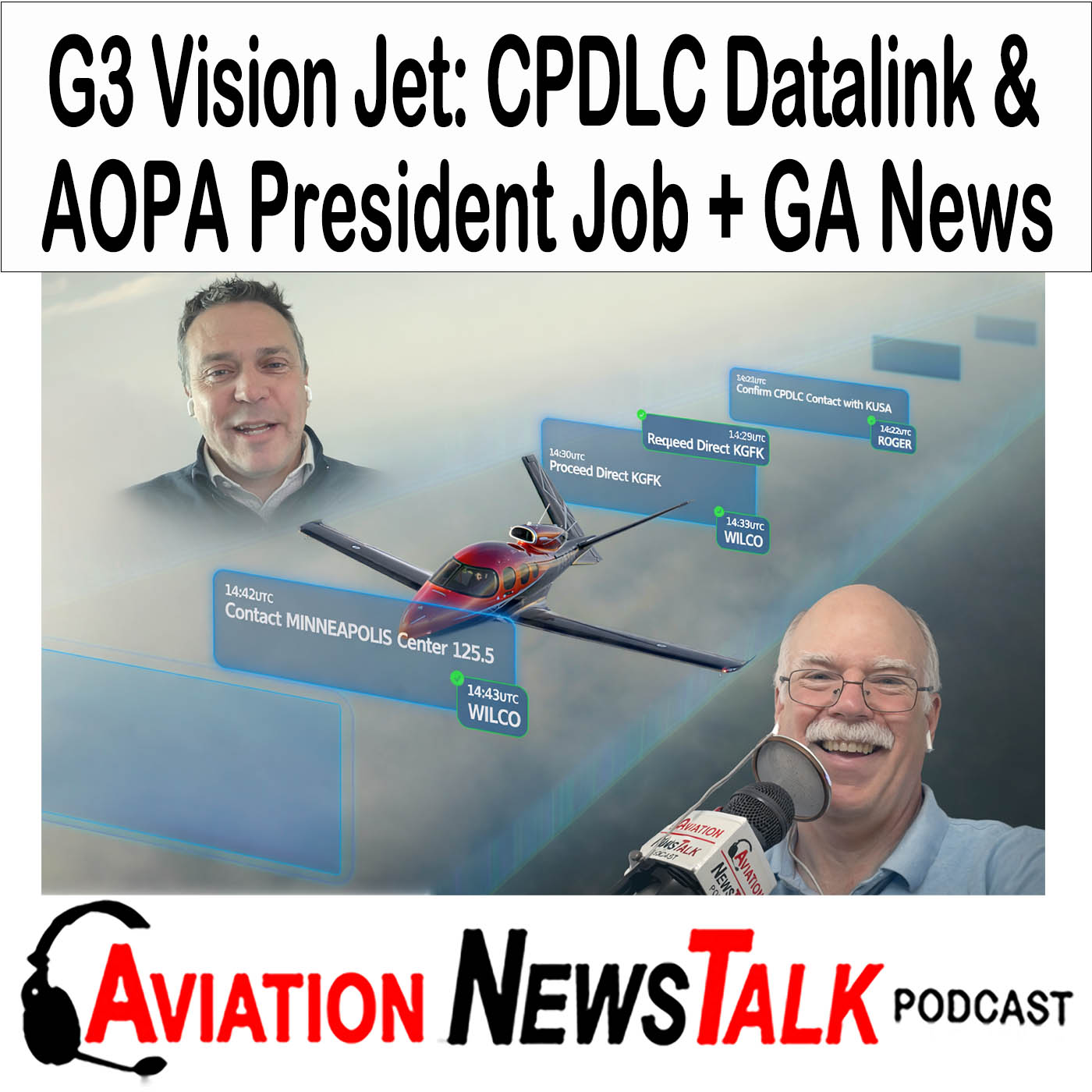
413 Cirrus G3 Vision Jet: CPDLC Datalink + 6-Adult Cabin (Matt Bergwall) — AOPA President Job + GA News
About this Episode
Max talks with Matt Bergwall, Executive Director of the Vision Jet Product Line at Cirrus, about the just-announced Cirrus SF50 G3 Vision Jet—and before that, he offers an unusually personal look at what the AOPA President's job actually requires.

Max opens by explaining that he interviewed for the AOPA President role twice and uses that experience to outline what makes the position difficult and consequential. In his view, the job is not simply "being the public face of GA." It demands relentless travel to connect with members, lawmakers, regulators, and stakeholders—while still maintaining a strong day-to-day presence at headquarters to lead a sizable staff. He also emphasizes the fundraising reality: membership dues matter, but major donors increasingly drive what's possible, especially as traditional advertising revenue has eroded across media. Max argues that regardless of opinions about leadership changes, AOPA's advocacy work and member services—like the hotline—can be meaningful to pilots, and he encourages continued support for the organization. He also describes the way top roles like this are typically filled: boards often rely on executive search firms and closed candidate pipelines rather than a standard "job posting" process.
Then the focus shifts to the Vision Jet. Matt explains the G3 Vision Jet changes through a pilot-centric lens: what's different in capability, how it affects workload, and what it feels like in real use. One headline upgrade is cabin practicality. Cirrus designed the G3 so six adults can fit comfortably, while still maintaining seven seat belts. That might sound like a simple seating tweak, but Matt describes it as a serious engineering effort that required deep iteration with mockups, real-world body sizes, and attention to the small geometry problems that make the third row either tolerable or miserable. The end goal was not only more capacity, but a better experience for passengers in the back—especially when the airplane is used as family transportation rather than a four-person luxury machine.
On the performance side, Matt notes that Cirrus increased the airplane's MMO by 0.01 Mach, which equates to roughly 7 knots of additional true airspeed in certain cruise conditions and can also help during descents and arrivals. He frames the gain as less about bragging rights and more about flow: small speed margins can matter when mixing with faster traffic in busy terminal environments. He also explains the "why" behind the change: rather than a dramatic redesign, the team "sharpened their pencils," did additional flight testing, and validated that the aircraft had enough performance and safety margin to raise the limit. Max asks whether that might also yield a slight range improvement, and Matt says it can—though it's hard to quantify cleanly—while still being a meaningful, felt benefit on colder days when the throttle might otherwise need to pull back.
A major avionics headline is CPDLC / ATC Datalink. Matt describes it as a system long familiar to airlines, increasingly available in U.S. centers and at many larger airports for text-based clearances. The practical advantage is removing the most error-prone part of IFR communication: copying down complex clearances and route changes while juggling frequency congestion. With datalink, pilots can receive clearances as text, review them at their own pace, and—in many cases—push the routing or frequency changes directly into the avionics instead of re-typing and re-verifying everything manually. In flight, the system can reduce "did ATC call me?" uncertainty: messages arrive with a clear alert and are hard to miss. Max and Matt also touch on D-ATIS and planning advantages, including how having information in text can reduce repeated listening and make it easier to configure the airplane early.
They also cover a string of real operational refinements that make the G3 feel more modern day-to-day: improved taxi situational awareness features, taxiway routing guidance, and more capable visual-approach tools that help pilots set up patterns beyond the common "straight-in" workflow. Inside the cabin, Matt describes seat mechanism improvements that make entry and adjustment easier and more intuitive, plus passenger comfort refinements aimed at making the airplane more usable across a wider range of missions.
The result is a G3 that's less about one giant breakthrough and more about a stack of changes that compound: a truer six-adult cabin, modest but useful speed flexibility, and datalink and avionics upgrades that reduce friction during the highest workload moments of an IFR trip. Max closes with the practical ownership layer—what this means for buyers thinking about price and programs—so listeners can translate "new features" into real-world value.
If you're getting value from this show, please support the show via PayPal, Venmo, Zelle or Patreon.
Support the Show by buying a Lightspeed ANR Headsets
Max has been using only Lightspeed headsets for nearly 25 years! I love their tradeup program that let's you trade in an older Lightspeed headset for a newer model. Start with one of the links below, and Lightspeed will pay a referral fee to support Aviation News Talk.
Lightspeed Delta Zulu Headset $1299
NEW – Lightspeed Zulu 4 Headset $1099
Lightspeed Zulu 3 Headset $949
Lightspeed Sierra Headset $749
My Review on the Lightspeed Delta Zulu
Send us your feedback or comments via email
If you have a question you'd like answered on the show, let listeners hear you ask the question, by recording your listener question using your phone.
News Stories
- AOPA Seeks New President
- OIG To Audit Controller Training
- FAA Recommends More Spatial Disorientation Training For Pilots
- FAA Sets 25-hour Cockpit Voice Recorder Standard for New Aircraft
- Texas pilot sentenced for falsifying aircraft maintenance records
Mentioned on the Show
Buy Max Trescott's G3000 Book Call 800-247-6553
Video of the Week:
Free Index to the first 282 episodes of Aviation New Talk
So You Want To Learn to Fly or Buy a Cirrus seminars
Online Version of the Seminar Coming Soon – Register for Notification
Check out our recommended ADS-B receivers, and order one for yourself. Yes, we'll make a couple of dollars if you do.
Get the Free Aviation News Talk app for iOS or Android.
Check out Max's Online Courses: G1000 VFR, G1000 IFR, and Flying WAAS & GPS Approaches. Find them all at: https://www.pilotlearning.com/
Social Media
Like Aviation News Talk podcast on Facebook
Follow Max on Instagram
Follow Max on Twitter
Listen to all Aviation News Talk podcasts on YouTube or YouTube Premium
"Go Around" song used by permission of Ken Dravis; you can buy his music at kendravis.com
If you purchase a product through a link on our site, we may receive compensation.
Hosts & Guests
Transcript
Today, we're covering two stories that matter a lot to pilots, but in totally different
ways.
First, Sarah's just announced the Visionjet G3, and I'm going to go deep with Matt Bergwall,
executive director of the Visionjet product line.
We'll talk about what's actually changed, including this is my favorite CPDLC or ATC data
link that can deliver reroutes, text that you can load into the aviomix.
They've also redesigned the cabin, so it's now a six adult airplane, and they've got
a small speed bump.
But before we get to Sarah's, I'm going to pull the curtains back on something you probably
haven't heard elsewhere, and that's what the president of AOPA really does every day.
I interviewed for the job twice, so I'll walk you through what the board is looking for,
why the role is equal parts, CEO, fundraiser, and constant traveler, and why it's a tougher
job than you might think.
Plus I'll have more of your emails.
Hello again, and welcome to Aviation News Talk, where we talk in general aviation.
My name is Max Truss.
I've been flying for 50 years on the author of several books in the 2008 National Flight
Instructor of the Year, and my mission is to help you become the safest possible pilot.
Last week in episode 412, we talked with Rob Mark about the crash of November 1-7 Delta
Tango, a Sarah's SR-22T that appeared to be training for an emergency approach to a landing
in a field, but got slow installed.
So if you didn't hear that episode, you may want to check it out at aviationnewstalk.com
slash 412.
And if you were new to the show, welcome to Laji Foundis.
And so that you find us every week, take a moment in whatever app you're using to listen
to us right now and touch either the subscribe key or in Spotify or the Apple Podcast app,
the follow key so that next week's episode is downloaded for free.
And my thanks to these two people who just signed up to support aviation news talk in
the past week.
Thanks to Ron Fox who signed up via Patreon, and I'll read his email right after the news.
And also thanks to Kyle Decker who made a one-time donation via PayPal and also sent
a nice email.
And again, I'll read those right after the news.
And if you've been listening for a while and feel like you're getting value from the
show, well, I'd greatly appreciate your support.
We lose supporters every month when people's credit cards expire and they don't go in and
update the expiration dates or constantly looking for new supporters just to make up for
the ones that we're losing.
There are four different ways you can donate either monthly via Patreon or one-time donations
via Venmo, Zell, and PayPal.
And to do that, just head out to aviationnewstark.com slash support.
Coming up in the news for the past week of January 26, 2026, AOPA is looking for a new
president.
FAA controller training is under scrutiny and we've got more from our bad boys file.
All this and more in the news starts now.
Some multiple sources, AOPA announced on February 4 that president and CEO Darren Pleusence
has stepped out of the day-to-day top job and into an advisory role while the board of trustees
searches for AOPA's next leader.
AOPA said it has become, quote, increasingly clear, the CEO role should be based full-time
in Frederick, Maryland, inside of Pleusence, commuting from Ben Oregon.
He was appointed president in January of 2025.
AOPA said day-to-day operations will be jointly led by CFO Jill Baker and senior VP of membership
strategy and growth, Katie Pribble, serving as acting co-presidents during the transition.
The organization said its advocacy work and member services will continue uninterrupted.
The move to backlash among some pilots and members, have reef.com described Pleusence
as exit as a surprise dismissal and reported sharp criticism of the board across pilot
forums and social media.
In an interview with Avbrief, Pleusence said he could not discuss details of the board
deliberations, but said he intends to support AOPA from the outside and urge members not
to take their frustration out on AOPA staff.
Avbrief also reported Pleusence told them he has a house in Frederick and spends two weekends
a month that his family home in Ben.
Rumors about what drove the decision have added fuel, AOPA noted that Sirius Aircraft co-founder
and former CEO Dale Clatmire joined the board of trustees earlier that week, and Avbrief
reported Pleusence called it unfounded to suggest Clatmire drove the outcome.
Avbrief also cited anonymous sources saying it had direct knowledge that AOPA retained
a crisis management firm on a $250,000 retainer while noting it has not been able to confirm
that directly with the association.
On February 7th, the board published an open letter to members acknowledging the volume
of calls and emails in emphasizing fiduciary oversight, organizational stability, and continuity
of AOPA's mission as the search proceeds.
And from Avbrief.com, OIG to audit controller training.
The Department of Transportation's Office of Inspector General wants to get to the bottom
of ATC controller shortages and is launching a major audit of systems used to recruit
trained and deployed new controllers.
Neltus Smith, principal assistant inspector general for auditing and evaluations, said
she will concentrate on the FAA's latest efforts to swell the ranks of controllers, which
are down 3,500 from the full complement recommended for running the system.
Quote, acknowledging this challenge in February 2025, the Secretary of Transportation announced
a campaign to supercharge controller hiring the memo says.
The campaign closed in March 2025 and attracted more than 10,000 applications of these
more than 8,300 applicants were referred to the FAA Academy for testing, resulting in
approximately 600 trainees, the highest number of academy students in history.
Smith said she wants to find ways to help the agency achieve its goal of hiring 8,900
controllers in the next three years.
Quote, our objectives are to assess one FAA's efforts to address the Academy instructor
shortages, training capacity limitations, and trainee failure rates, and two, the Academy's
progress with updating the air traffic controller training program curriculum.
The audit will begin within the next month.
From avweb.com, FAA recommends more spatial disorientation training for pilots.
The FAA is encouraging part 91, 91K and 135 operators to expand spatial disorientation
or SD training for pilots, according to a recent information for operators or info guidance.
The info sites the NTSB, which continues to identify spatial disorientation as a serious
safety concern, high-profile accidents, including the 2020 helicopter crash that killed
Kobe Bryant and eight others, showed how SD can have fatal consequences.
Following the crash, the NTSB directed the FAA to evaluate training methods and convene
the panel to assess simulation technologies for effectively preparing pilots to recognize
and manage SD.
FAA's guidance suggests operators include a mix of scenario-based and maneuver-based training,
combining ground school, simulator sessions, and in-flight practice to help pilots recognize
avoid and recover from disorientation.
It also notes conditions where SD commonly occurs, such as low light, lack of visual
references and changing weather, and stresses reliance and instruments over sensory cues.
While not mandatory, the FAA says enhanced SD training can address human factors issues,
which contribute to 70% of aviation accidents.
And also from avweb.com, FAA sets 25-hour cockpit voice recorder standard for new aircraft.
The FAA published a final rule that extends required cockpit voice recorder or CVR retention
from two hours to 25 hours.
This new requirement will apply to newly manufactured aircraft already subject to CVR-equipment requirements.
The rule, first proposed in 2023, is intended to preserve additional flight deck audio for
incident and accident standards and aligns US requirements more closely with existing
international standards.
The FAA said it's final rule that the change, quote, provides accident investigators, aircraft
operators, and civil aviation authorities with substantially more CVR data to help determine
the probable cause of incidents and accidents and prevent future incidents and accidents.
Regulators cited investigative deeds raised by the NTSB, which has recommended longer duration
CVRs after multiple events were relevant recordings were overwritten under a two-hour loop.
The rule notes that 25 hours is within current recorder capability and references prior
adoption of similar standards by IKO and ESSA.
Aircraft built on or after May 16, 2025 operating under part 121, or that are configured as
transport category aircraft types are situated with 30 or more passenger seats are required
to have a 25-hour CVR meeting these standards.
New aircraft with 29 or fewer passenger seats and a maximum takeoff weight of 59,525 pounds
or more will need to comply with getting February 2nd, 2027 while aircraft at 59,524 pounds
are less will need to comply by February 2nd, 2029.
And finally from our bad boys' file, this comes from globalera.net, a Texas man who had
been falsifying aircraft maintenance records and flying an unairworthy aircraft for years
was sentenced to probation this month in federal court.
The man was sentenced January 7th in U.S. District Court for the Southern District of Texas
to one year of probation.
In addition to his one year probation, he was also fined $1,000 and a $100 special assessment.
He was turned back in September 25 and pleaded guilty for making and using a false statement
in aircraft maintenance records.
According to investigators, he repeatedly operated the aircraft over several years despite
not holding a valid medical certificate and without completing the required annual inspection.
Authorities said after the aircraft was involved in an accident, he attempted to conceal
the lack of a proper inspection by submitting fraudulent maintenance documentation.
Investigators determined he forged another mechanic's certificate number and signature
on an annual inspection record and then presented the falsified paperwork to the FAA.
Prosecutors did not release details about the nature of the accident or whether anyone
was injured.
And here's the irony in case you missed it.
A $1,000 fine is actually cheaper than getting an annual.
Coming up next a few of my updates, including my insights into what it takes to be president
of AOPA plus some of your emails, all right here on the Aviation News Talk podcast.
Now, let's get to the good news.
First, this comes from Beck Hydmas.
He says, Hey, Max, I wanted to send you a message reporting I have acquired my commercial
pilot certificate out of K E I K. That's eerie municipal in Colorado.
I wanted to send you a thank you as a lot of your ADM topics have enhanced my ability
to perform risk management.
Additionally, your accident analysis has aided me in enhancing my safety in each flight.
Keep the blue side up.
Well, congratulations to you, Beck.
And here's the email from David Weeks.
He writes, Hi, Max.
I enjoy the discussion of flap retraction after landing in my former life as an American
pilot ex-US air ex-America West doing anything in all capital letters other than actuating
speed breaks and thrust reversers before clearing the runaway with something that would
get you immediately busted on a sim-ride or a line check, yeah, makes total sense to
me.
While you mentioned the AFM for the SR20s and 22s, it didn't mention that the service still
has the retract flaps for maximum brake effectiveness wording in the most recent revision to the
AFM.
It has been removed from the short field landing section, but both the rejected takeoff
and engine emergency on takeoff below VR still have this verbiage caution for maximum
brake effectiveness, retract flaps, hold side-stick control full-back, and bring the
airplane to a stop by smooth even application of the brakes.
The pilot information manual says it takes 10 seconds to go from flaps 100% to 50%, and
another 10 seconds to go from there to the up position.
If you are already braking hard, you'll be slow long before the flaps have come up much.
It's a really good point.
In my opinion, it's still a big mistake for stairs to allow raising flaps, even in those
two abnormal checklists, best regards, David Weeks.
David, you make great points, so yeah, let's everybody continue to stay on the bandwagon
to get people to stop raising the flaps after every landing, just observe that people are
doing that.
Now, last week I mentioned that I saw something a week or so ago that I hadn't encountered
before, and that it wasn't new to the industry, and I was sure that some of you hadn't encountered
it before.
And since I was familiar with it, I wasn't surprised when it happened and was able to deal
with it.
I'm not going to talk about it in detail this week since we've got some other important
topics to cover, but I will tell you what occurred, which was that I was flying an ARNAV approach
into Hayward and the Vision Jet.
At some point, the LPV and then Theater in the HSI turned from magenta to yellow, and
then a yellow L-slash V-navon theater appeared in the HSI, and then later it turned magenta,
which was not quite the sequence I was expecting, and I'll talk more about that in the future
show.
And let me read a couple of your emails, these both come from new supporters from the
past week.
First one comes from Ron Fox.
He writes, Hi Max, thanks for your analysis of the Cirrus SR-22T November 1-7 Delta Tango
accident, and that's the accident I discussed in the last week's show episode 412.
He says, the CFI was my aviation mentor and good friend.
I'd gotten back into GA after a 25-year hiatus and purchased an SR-20 G6, although I was
signed off.
I wasn't extremely comfortable in the aircraft having all my previous experience with steam
gauges.
A mutual friend introduced me to him while he was still working on his CFI.
He spent countless hours with me, including two trips back and forth to South Florida,
helping me hone my skills.
After he received his CFI certificate, I trained with him for my commercial rating.
I had more than 60 hours in the cockpit with him.
He was an excellent pilot, and I've been baffled for the past several years, trying
to understand how he let that aircraft stall in this accident.
It all makes sense now, and it's a big relief to me to understand the circumstances.
I sincerely thank you for figuring this out.
I'm not alone.
He helped and mentored many in the Chicago land area.
Thanks again, Ron Fox.
And I did produce a video of that, which shows in detail exactly what happened.
At the moment, that's available for Patreon supporters.
You can get that to I going to aviation news.com slash support and signing up to support
the show.
I will get that published publicly, but I've just been so short of time.
I have not gotten to it, but I promise I'll get that posted publicly at some point here.
And also thanks to Kyle Decker, who made a generous donation.
He writes, thank you for all your wonderful aviation content and education you provide.
Big AGA pilot fly as a hobby has been a dream of mine for many years, and your podcast
has been a regular listen for me for several years.
I earned my private in 2019 in my IFR this past October at KVYS Illinois Valley Regional
Airport.
By 13-year-old son and I listened to your podcast every Monday evening on the way to our
civil air patrol squadron meeting, your in-depth discussion of various GA topics are contributing
to the betterment of the GA community and making all of us safer and more effective pilots.
Thanks again for all you do, Kyle.
Kyle, thanks so much for that.
Now I'd like to share a few thoughts about AOPA and the President's job as that's been
in the news this past week.
Now this is something that I've never talked about publicly, but I did interview for the AOPA
President's job twice.
And one of those times I did get fairly far along in the process, but ultimately wasn't
selected.
But let me take you back even further and tell you about my first visit to AOPA headquarters,
which was sometime in the early 1990s.
And before that, in the 1960s when I was just a kid, my mother would drive my sister
and me to visit her parents in Virginia, and that trip always started from Northern Pennsylvania,
headed down US-15, which eventually goes right through Frederick, Maryland.
So I'd seen this picturesque town many times before, and I also quickly learned the difference
between Frederick, Maryland and Frederick'sburg, Virginia, two cities that are often confused.
Now in the mid-1990s, I was driving through Frederick, and on a large decided to stop
into AOPA headquarters for a visit, I was greeted warmly and given a tour throughout
their facility, which is right next to the Frederick airport.
It's a two-story building, which was relatively new at the time.
And most of their employees work there, though as I recall, there's also a separate smaller
office in Washington, D.C., where many of their advocacy staff members work.
That group, by the way, performs one of the organization's most important functions,
which is working with regulators such as the FAA and lobbying Congress.
They also have a number of people spread around the country that work with state legislatures.
Now, that headquarters building is two stories high in the president's office is on the upper
floor.
There's a staircase in an open atrium that leads from the first to the second floor,
and it's in this atrium that AOPA presidents in the past have occasionally addressed
the headquarters staff when there have been important announcements.
My strongest memory of the visit is stopping by president Phil Boyer's office.
I was disappointed that he wasn't in, but I talked with his secretary, and I saw his
unoccupied desk.
And then I don't recall how this happened, but I did find myself sitting in his chair
behind his desk, and for a few minutes imagining what it must be like to run one of the most
important organizations in general aviation.
Now, that left a lasting impression.
And I remember thinking at the time that I would love to do that job.
I'll talk about Phil Boyer in a minute, but first let me explain the historically AOPA
presidents have stayed in office for a long time.
The first president was C. Townsend Luttington, who served for 13 years from the organization's
founding in 1939 to 1952.
Then Doc Hartentraft, Jr. was president for 25 years from 1952 to 1977.
Next was John Baker, who either role for 13 years from 1977 to 1990.
Then came Phil Boyer, who served for 18 years from 1991 to 2009.
Now, Phil always seemed like the model AOPA president to me.
His previous job had been as the senior vice president with ABC television in New York.
And before that, he was a VP and general manager of the ABC TV affiliate in Chicago.
Before that, he worked at the TV station in Sacramento.
Each year, he would go on the road and hold a number of town hall meetings in major cities
across the country to which members were invited.
I attended several of these, and they were really quite memorable.
They were typically held in a rented hotel ballroom, and there would be perhaps 300 plus members
in the room.
He always brought a professionally produced multi-projector slideshow, as I was the state
of the art of the time, for high level presentations given by corporations.
And his background of television always came through.
He was very engaging in his presentation style, and he had great vivid images to illustrate
his talks.
He would give all kinds of statistics for GA and AOPA, and he talked about the legislative
challenges we faced and what the organization was focused on doing to affect change on behalf
of GA.
Later, he would take questions from the audience.
The town halls were held in the evening, probably around 7pm, maybe 6pm, or recall exactly.
But during the daytime, Phil was always busy holding meetings with airport managers,
legislators, and regional staff.
In a typical swing, he'd hit four cities in a week, and then head back to the headquarters
for four to six weeks before making another swing through another part of the country.
So from the outside, he appeared to be doing a great job of splitting his time between
traveling the country, connecting with members and stakeholders, and being back in the
headquarters managing staff.
Now, the town hall meetings reached many thousands of pilots each year, and they appeared
to be a very effective way to connect with members.
Unfortunately, those town hall meetings were discontinued after Phil left the job in
2009.
In early 2008, it was announced that Phil Boyer would be leaving the job.
The Board of Trustees hired an executive search firm and they were responsible for locating
potential candidates and interviewing them for the job.
So like many top jobs, the AOPA President's job is not a job that's posted that you
can apply for.
Typically, they find you.
Now oddly by 2008, I had totally forgotten about my visit to AOPA, and the thoughts I'd
had sitting behind Phil Boyer's desk, and that I would like to have this job.
And when it was first announced that Phil would be leaving, I didn't give it any further
thought.
But months later, I realized that it was something that I wanted to do and that I should pursue.
Now from the get go, I knew it was a long shot, but I've always believed a person should
have stretch goals and include ones that may seem like a bit of a long shot, because
if you shoot high, well generally, you end up achieving more.
So I found a way to become part of the candidate pool and ended up being interviewed by one
of the principals from the executive search firm.
He was a recently retired Air Force general and we had a good meeting.
Prior to the meeting, I had assembled two two-inch binders with all of my research about
AOPA, as well as plans for what I would do in the first 90 days if I were selected, and
the names of a few people that I wanted to bring into the organization.
I did make it to the shirtless, but ultimately Craig Fuller was hired and he was president
for five years.
Had I been selected, I was prepared to move to Frederick for five or ten years, though.
Definitely would have rented out my house in California as I would have wanted to return
here afterwards.
Having that decision that I would move to Frederick was an easy one, as my mother who lived
in Northern Pennsylvania, was getting up in years and it would have been a short flight
from Frederick and a GA plane to get up there and visit her.
What I learned after the new president was hired was that the Board of Trustees really
wanted to hire someone with prior experience in government.
The Board was great in many regards, but in my opinion, the Board at the time felt that
there were critical legislative issues coming up and that would be helpful to have a president
with experience working in government.
I Craig Fuller served for about four and a half years, so at the time that was by far the
shortest tenure of any AOPA president, and what it was announced that he would be leaving
I thought, well, what the heck, why not try one more time?
So I got ahead multiple interviews, but didn't make the short list.
This time it appeared the Board was looking for something different.
They made it clear that they were looking for someone who previously managed the staff
or company of 200 people or more.
I'd certainly manage people when I was at Hewlett-Packard, but never had a staff that large.
I did run two different nonprofit member organizations.
One was Los Medicos Volodarius, which I could never pronounce correctly, but it's Spanish
for flying doctors.
I was president of that organization for three years and helped grow to over 300 members,
but members is not the same as staff and they were looking for someone who'd managed
a large staff.
Why the change in what they were looking for?
Well, in my opinion, while Craig Fuller had the experience in government that they were
looking for at the time, I don't believe that he had managed a staff the size of AOPA,
but Mark Baker, who they did select in 2013, had previously been president of a company
that had approximately 200 employees, and he was selected.
He served for 11 years, so presumably the Board of Trustees were happy with his work as
at the time.
The job typically came to the five-year contract, so he must have been renewed at least once.
As I disappointed to not get the job, yeah, a little, but not hugely so.
To me, the most important thing was to have someone in the job who was effective, and
while I think I would have done a great job, I also felt that the Board of Trustees had
selected good people, so I really couldn't quibble with that.
When the job opened up again in 2024, I didn't pursue it as I'm really enjoying the life
I've built here, which, by the way, includes talking to you.
As president, I probably would have had to give up the podcast and also wouldn't have
the time to teach in serious aircraft, including the Vision Jet, which I absolutely love.
So I have no idea what the Board was looking for when they hired Darren Pleusence, but I'm
guessing they'll be looking for something a little different this time around when
they hire his successor.
I'm sure they'll find a number of good candidates, and we'll soon have one hired.
What does it take to do the job well?
Well, if I'd gotten the job, I would have followed the Fill Boyer model and brought back
the town hall meetings.
I think that connection with members through local events is important.
Job clearly requires a significant amount of travel to connect, not just with members,
but also with legislative bodies and regulatory agencies, but it also requires a strong presence
in Frederick to leave the staff.
Another major component is meeting with donors.
While members pay a lot in dues, AOP also relies heavily upon donations, and those donations
have never been more important.
One of the big challenges when I first saw the job was that AOP was rather quickly losing
one of its major sources of funding.
In the 1990s and the early odds, a lot of that funding came from advertising pages in
AOP a pilot magazine.
The advertising revenue more than covered the cost produced the magazine, and it was
a major source of revenue for the organization.
But as you've probably noticed over the last 20 years, magazines of all types have gotten
thinner.
And that's because of Google and Facebook and other digital ad platforms.
Advertisers have shifted billions of their dollars out of traditional media, including
magazines, radio and television, into digital advertising via the internet.
They like it because they can directly correlate dollar spent on advertising to the sales
they get, something that's much harder to do with magazine advertising.
So AOP A relies heavily upon large donors, and they're always looking for new sources
of revenue.
But here's the most important thing you should know about AOP A.
While you may not agree with everything they do, I implore you to support them by becoming
a member or if you are a member, maintaining your membership.
The advocacy work that they do for us with state and federal government is incredibly
important.
Congress and state legislatures are constantly coming up with new proposals that would
be costly to GA pilots, and AOP A is one of just a handful of organizations that are
fighting for us.
If you think flying is expensive here in the US now, you only have to look overseas to
see how bad it could be if we eventually get more of the kind of restrictions that are
found overseas.
AOP A's member hotline is also a valuable service.
Over the years, I've called them about legal issues and about medical issues, and they've
always come through for me, and I'm constantly recommending the hotline to pilots who are
looking for help with these kinds of issues.
So regardless of how you feel about Darren Pleusen's exit from AOP A, I personally hope you'll
continue to support the organization that I look forward to seeing them continue to support
General Aviation.
Coming up next, our conversation with Matt Bergwall about the Series Vision Jet G3, all right
here in the Aviation News Talk podcast.
And now let me tell you a little about Matt Bergwall.
Matt's a graduate of the University of North Dakota, which has one of the largest university
aviation programs in the US.
For the past 19 years, he's worked for Sirius Aircraft in a variety of marketing positions.
And for the past three years, he's been the executive director of my favorite airplane,
the Series Vision Jet.
And now here's our conversation with Matt Bergwall.
Matt, welcome to the show.
Great to see you again.
Yes, great to be here, Max, thanks.
Well, it's been a minute.
I looked it up.
We had you here last in 2019, that was seven years ago, talking about the SF50 G2.
So here we are now again, talking about the G3.
Well, let's talk about performance first.
What can it do better than the G2?
So the biggest change is in the G3 airplane, and just in terms of performance or capabilities.
The big thing is, it now can hold six adults in the airplane.
You still have seven seatbelts.
But with that, six adults can now comfortably fit into the airplane.
We'll talk about that a little bit more a little later.
The second thing is, we actually increased the MMO of the airplane by a .01 Mach.
You're asking, well, what does that mean?
It's about seven knots of two airspeed or so.
And when you get at kind of cruise altitudes, and it's usually when the temperatures are
a little bit on the colder side, also you get that in that distance as well.
So you get a little bit of extra airspeed when you're coming in on arrivals, which
can kind of help out with even traffic flows.
The way we got that extra Mach, you know, people have been kind of asking about this quite
a bit, is really, we just kind of sharpened our pencils.
And we were able to do some extra flight tests.
Then we were able to see, oh, yeah, we do have the necessary criteria and performance kind
of buffers that we could actually increase that Mach number just to be a little bit more.
If you picked up a little speed in VMO, then I guess that probably increases the range
ever so slightly.
It does a little bit and it's a little hard to actually quantify that totally, but with
that being said, it's those times when you're flying those cold weather and you actually
see that throttle kind of pull back a little bit, it's just nice to have that little bit
of extra airspeed.
And then again, on the arrivals too, it is nice because you just kind of get into the
flow of traffic a little bit better.
Well, one thing that you've added, which I'm excited about, is CP DLC, which I have
not used in the past, actually wrote about it in my G3,000 book because it was available
with some of the other OEMs that had the G3,000.
So delighted to see that it's now available in the SF50 as well.
Go ahead and talk from A to Z about the CP DLC, just kind of explain what it is and kind
of walk us through how a pilot would use it at every step throughout a flight.
Yeah.
So CP DLC, or we call ATC data link, is something that has actually been in the airlines
know for quite some time, especially kind of for oceanic routes.
And then, you know, the United States, we're starting to get that capability more and more
kind of within our center, all of our centers now have it.
We're also seeing that about 60 or so airports, the bigger airports in the United States can
also have a pre-demparture kind of clearances, you know, available kind of through all the
same network.
What we found is probably the biggest benefit of a kind of CP DLC is you can take some
pretty complex clearances, whether you're on the ground, you're able to actually get that
textually.
And with that, you can see exactly what that clearance is, the arrival, the routing,
and if anything has changed, you can actually even push that right to your avionics.
So it's a pretty seamless thing, instead of having right down kind of everything that,
you know, the ATC is saying and making sure you actually, you know, read it back, you
know, right, it's now just right there, it's kind of front of you, you can kind of take
your time and make sure it's right in the avionics, and then you're on your way.
When you are in route, boy, it's nice for a few different reasons, you know, one is sometimes
you might be busy, you might be talking to somebody and don't quite hear, you know,
when ATC called your tail number, but right now it's hard to miss them because it's just
a little light that kind of comes on with a little chime and says you have an ATC message.
So then you go on your avionics and you see what that message is, it can be a frequency
change, which simple enough, you just put the, you acknowledge it and then you just push
that frequency and it goes right into your avionics and you check in with the next controller.
Or I mean, what I love it for the best is, hey, it's, you can get a reroute, that's all
just right done there.
So instead of the dreaded, oh, are you ready to copy a reroute?
It's now just right there on your avionics and it's no, and it just pushes right to your
flight plan and then just have to acknowledge and go direct to wherever the next way point
is.
It's great.
Yeah, I'm really excited about the ability to have reroute's handled that way.
I flew to Southern California on Monday at NSF 50 and I always tell folks, you know,
it seems like whenever I go to Southern California, we can always count on a reroute.
And shortly after I said that, we got the first of what turned out to be two reroute's
on the way down there.
The irony is they ended up giving me what I had filed anyway, which they, you know, didn't
give me.
So I still can't figure out why ATC doesn't understand that, yes, I figured out what you want
and I filed it, but you won't accept it.
You'll just give it to me later.
So kind of inefficient, well, that's pretty slick.
And you mentioned centers.
Is it also available, for example, in some terminal areas, nor can also so count things
like that?
So approach facilities do not have it yet in the terminal facilities.
It's about six years.
So the busier airports, you can get the air clearances on the ground.
And then all that the centers in the United States has this capability.
Okay.
And then to use it, you end up logging in, I think, talk about that.
How does that work?
Yeah.
So you do have to have a kind of a subscription.
Garmin actually makes this pretty easy where you just register with them and you get
on a subscription list.
But then it's just logging on to, if you're in the United States, it's like, I think
it's KUSA takes care of the whole United States and there's a message at, when you've logged
on and say, hey, just acknowledge here, you know, we established this link, you say Roger.
And now you and ATCR, yeah, this connection and they can start text messaging you essentially
to the instructions.
And I guess the thing we want to make clear is that using this is not going to actually
change the flight control itself in other words, when you get a reroute, it's not going
to automatically start the airplane flying.
You're going to have to accept that and then that's going to make the change.
Yep.
Exactly.
So you do have to accept it with ATC.
You have to actually then also push it to your avionics and also activate it to your
avionics.
So there's a few different steps that do happen before, you know, anything does change with
your flight profile.
So it's similar to, I guess, uploading a flight plan from your iPad.
Exactly.
Great.
Tell us about any other avionics changes that you may have done as you've updated the plane.
Oh, there's a lot of them.
With this last update, as I kind of mentioned, the clearances on these busier airports,
these same busier airports also have something called deatus.
So when you go to your weather display at your Garmin avionics, you can actually get the
atus right there, which gives you the textual description of, you know, whatever, hey, this
is Delta at Memphis, let's just say, usually you're reading, especially those busier airports
you're probably listening to atus, you know, five or six times to actually get everything
because there's other radio chatter happening.
But now it's just, it's just textual as well.
So you can read it all, make sure you understand kind of all the different elements there and
get your airplane kind of set up and to figure it as needed.
And you can also get atus kind of well in advance too.
So if you're thinking going to a busier airport and like, what runway are they using, I'm
not sure the winds are variable or whatever.
You can very easily start planning your flight hours even before you actually, you know, reach
that destination.
So it's helpful, especially in those busier airports.
So let me just to clarify that.
So for a deatus, we can get it at some airports when we're on the ground.
Are you saying we can also get it in the air for those airports as well?
Yep, exactly.
That's fabulous.
What a wonderful benefit.
Exactly.
Some other benefits too with the avionics, it's the little things, right?
When you're flying through the flight level, you're going, you know, from, you know, 18,000
or if you're in a different country too, whatever, you know, that flight level changes, you
can program it into your avionics.
It does automatically switches to standard or as you're going down, it will switch to whatever
you're pre, you know, frequency is, there's no longer kind of any interaction.
Again, it's a little things though.
It wasn't much work in the first place, but it's just one more thing you don't have to worry
about.
We now have something called 3D Safe Taxi, which is on our PFD, which kind of gives you
almost like a, you know, 3D representation, essentially a synthetic vision, but while
you're on the ground, this has been in RSRs for, you know, quite some time now, but it's
nice.
We had a, you know, a capability down on the vision jet, just some extra situational awareness.
And we also have something called Taxiway Routing, where it will essentially just kind of put
in whatever the tax route is and you just follow like a, you would a GPS in a car.
Very helpful.
And again, kind of giving you some extra situational awareness.
And boy, there's a lot of little things too, like visual approaches.
Oh, this is a great one.
For our visual approaches, we can now put in a base and download legs.
So in, it's one thing, when you start flying the, like the vision jet quite a bit, majority
of your patterns end up becoming straight ends.
But, you know, there's always that occasion is like, oh, enter, you know, a right downwind
from, you know, runway 22 and you're like, oh, boy, I haven't done this in a while.
Well, you can actually program that where you can have a right downwind.
It has, it sets you up, like, at a beam point for that right downwind.
And it just gives you all the guide and says that the altitude just will be at the glyphosilver
which is supposed to be at and you'll be able to just kind of have, again, another aid
to kind of help you transition you from that in-round environment to the landing environment.
That is really big.
I got to tell you when I'm doing SOE training with new vision jet pilots, there are two
areas that I've said consistently.
I've seen them, you know, a week in the past one is doing arrivals because a lot of them
are coming up from pistons and I don't do many arrivals.
But the other one is absolutely that.
They do so many long straight ends that when they get a baseline entry, boy, they just don't
know exactly where to aim for that baseline and they either show up most of the time high
on the final, sometimes low.
So having that altitude guidance really takes out a lot of variability and really I think
increases the odds that you're going to get a stable approach in landing.
Absolutely.
It is one of my favorite features that guess work is just gone.
Yeah, that's good.
I'll tell us about some of the changes inside, some of the cabin changes that have occurred.
Oh, this is something that I think a lot of you, especially our previous vision jet owners
will really appreciate is just the amount of refinement that has gone on in the interior
of the airplane.
Kind of mentioned at the very beginning that we now have seating for six adults.
The way we accomplished that is in the very back row, we went from one kind of captain seat
to two smaller seats to actually replace that with a bench that now can fit three people
in the has three seat belts, which could be two adults would fit comfortably back there
or two or three kids or whatever that combination might be.
So it offers even just a little bit more flexibility for who can be flying with you and that
has actually been something that you've heard quite a bit from our customers that, hey,
there's this times where I just need to have six adults in here, whether it's family members
or three couples or kind of anything along those lines is like, I know I'm not going
to be flying that far.
Like, I'm not worried about that.
I just need to be able to fit the six adults.
So we're pretty happy to be able to bring this into our airplanes.
This actually took a lot of effort to be able to put this bench seat in there.
It's not just kind of putting in and we actually wanted to make sure that we made that experience
the best it possibly can be.
And we spent a lot of time even just kind of with the team in Duluth and the edge of your
team where we had like a mock up where we're always were taking the seat.
We had our sitting people of all sizes in this back seat and figuring out, hey, what
does the ankle have to be like?
Do I have enough leg room?
Okay.
If I don't have enough leg room, what can we do?
And so we ended up actually moving the second row about two inches just by redesign of
the seats.
We didn't change like the hard points at all on the floor, but just by changing the
redesign of the seat, we're actually able to get about two extra inches of overall
room.
And then it's kind of even the simple things where we're actually having a little cutaway
where you can easily put your feet.
So if you kind of think about it, it just those little things make it actually a good
experience to be even in that third row of the airplane.
And you still have the great views that you kind of expect from a vision jet.
And it was very well thought out and our engineers did a fantastic job and it was great
collaboration with all the various teams just to make sure we got that right.
Let me see if I understand the bench just a little bit more.
So it sounds like this is a single unit.
It's not separate pieces, right?
So you pull the whole thing in or out, right?
Okay.
And does it fit into the existing hard points and would someone, for example, with a G2 be
able to buy that and retrofit that new bench?
So this is one of those features that really kind of shows the difference of what a G2
aircraft is in a G3.
The main reason why we had to change a lot in the structural aspect of the airplane in
order to get this bench seat to work.
For example, like the backrest is actually now kind of permanently in airplane.
And the bottom bench is what kind of comes out to get that floor space.
So when you take all the seats out, if you're hauling kind of a lot of it, some of our
customers haul a bunch of dogs or whatever, you can just kind of take all of them all out.
You still have the floor that's open.
But with that though, we did have to kind of change some structure in that very back row,
which kind of makes it special for for the G3 airplane.
Okay.
Understood.
I think they can't be retrofitted to somebody who's got a G2 and says, oh, I want that
new seat.
So when people are sitting in that seat, it sounds like two adults would be kind of on
the outside of the bench and they've got a lot of shoulder room.
Or if there's a third small child that could sit between those adults and or you could
have three kids in the back, am I correct on that?
Exactly.
And if you want to look at it, if you're familiar with the SR series, we have the three
seat belts back there as well.
And it is as similar as just whatever you can physically kind of put in where people
are not overlap in shoulders.
Okay.
So I mean, honestly, if you have three small adults, three small adults can fit back there
too.
If you can physically sit side by side and not overlap shoulders.
Understood.
Okay, great.
Any other changes on the inside for the cabin you want to mention before we get to the
outside?
Yeah.
So we also took the opportunity to redesign all of our seats in the airplane.
And if you know the only thing about aviation, when you touch the seat, it's actually a lot
of work.
A lot of testing that kind of goes in just to ensure that it can take the proper loads
and various kind of flight situations.
So it does take a lot of time.
It does take a lot of effort, but it was also a great opportunity to again kind of create
some refinements in our overall product and the seats being one of them.
We changed our mechanisms.
There are a lot more smoother whether it's reclining the seat.
If you're bringing the seat back as you're kind of coming into the airplane, before it
was a two-handed operation and so you kind of were outside and tried.
Now it's just a one-hand, you take it and the whole sleet kind of slides back.
Oh, that's great.
I think our customers are going to appreciate this that ease and just be able to have things
in one hand, be able to grab the handle, move the seat back in the other hand, hop in
your pilot seat and get into the flight position.
Got it.
So that would be the pilot seat and the co-pilot seat, both of those now instead of using
two hands, you can just use one hand to slide them back and forth.
Yep.
So when you're kind of coming into the airplane, when you're coming out of the airplane,
it's still a two-hand operation, which is very deliberate because when you're in the
flight position, you never want that seat to slide back on you.
And that's what you have to kind of do is have the two hands, so you kind of unlock that
stop and then bring it back.
It's like, okay, it's still a little bit.
I see.
Okay.
There's a few other things.
We also change how our customers consume when you kind of an entertainment.
So we decentralized it.
So we now have various places where we actually change up the trade tables.
They actually come out of the side now versus the center console where you also have like
a little flap that you can put electronic device that you can consume also.
Each one of the seats, you have a little cover that you can take off that exposes something
that's called a cold shoe mount.
I know it's pretty popular in the camera world, but that allows you to have a wide amount
of adapters that you can use to essentially mount in whatever your personal electronic
devices, whether it's an iPad and iPhone, it can be magnets, it can be clamps, whatever
so you can actually have that to kind of right there, you know, bio, again, whatever
what customer wants or the passengers want, they can customize it.
Excellent.
All right.
Good.
A lot of changes on the inside.
Let's talk about the outside.
What's different on the outside?
So when you start looking around the airplane, you know, one of the first things you'll probably
will notice is we now introduce the Spectra Wing Tip lights on the Vision Jet.
We have them on the SR.
We've had them for years.
The thing that actually kind of helps identify a serious now, that's, you know, especially
at night on the ramp, is there is a signature halo light that kind of goes on the wing tip
that when you're on the ramp and that airplane lights up, it's like, man, that's a serious.
We also increase the overall brightness of the landing light by about almost three times.
So it's something that's pretty noticeable during those dark nights and you can, it's
bright as day.
As you kind of continue around the airplane, you'll notice that we now have a kind of
an option that actually goes with all of our color schemes of having a black deice boot.
We've kind of transitioned kind of from what we have as a silver deice boot to the black
deice boots.
And there's some advantages there.
First of all, it looks great with most of our color schemes because most of our customers
have been choosing more darker colors.
The second thing is that actually a lot easier to maintain if you think about it, every
single line guy with a hose is what black.
So if you ever get any kind of little scuffing right there, it's, you know, A, it's hard
to notice and then B, it's, if you do have anything, it's pretty easy to just kind of wipe
it down.
And then the third thing is actually, I kind of found myself, I wasn't really anticipating
this, but it's a lot easier to also see any kind of airframe ice that's accumulated on
the airplane with the black boots again and just a little extra level of awareness.
Yeah.
That makes a lot of sense, especially being able to detect the ice.
Do I understand the black boots are an option or the old G3's now ship with black boots?
Generally speaking, it is an option.
What kind of depend on the color way, pretty much what your color of your wings are.
So if you have a lighter color wing, silver is still available.
But then if you have a darker wing, it would be the black boot.
Generally speaking, though, it seems like almost all of our customers are going towards
more kind of a darker pain scheme.
One other thing, too, that's probably worth noting is right by the passenger side of
the airplane, you'll notice we no longer have this mechanical air-conditioning door.
And it's now just kind of a grill or a event, but we notice in the past, it's kind of funny
because we went from G1 to G2, one of the things that we're kind of taking care of is some
of the noise on the inside of the airplane.
And the thing that was creating the most noise was the engine at that point.
And then, so we put some extra insulation in and then we were able to quiet down that
cabin.
Now, like, it's like a game of whack-a-mo when you think about sound.
It just seems like whatever the next loudest thing is is now, you know, that's the thing
is like, oh, we have to fix that.
Well, it's when the AC door opened up.
So when the AC, when the compressor kind of kicks in, the door opened up and just kind
of disturbed the airflow.
And you just kind of had this change that could be a little startling if you weren't
used to it.
So now just having this vent just or this grill, you just don't have that disruption anymore
and you just never have this change of sound in the airplane.
So it took care of, you know, that now I'm just waiting for the next thing now, it's the
next noiseiest thing in the airplane.
I'm sure we'll find out soon enough as, you know, more of these G3s get up flying.
We're pretty excited about that and being able to bring that onto the airplane.
Yeah, it's funny you mentioned that.
I observed that usually it's somewhere around 14,000 feet where I get that change and
get the noise.
I'm always telling new pilots, oh, yeah, don't worry about that.
So yes, it's definitely noticeable in every airplane.
So let me just ask you because I ever once in a while we'll see this.
Sometimes in an SF-50, when we land, that air conditioning door will still be open.
Big deal, not a big deal or...
It's not a big deal.
And in fact, it's, I'm not really sure what the reason is, but I know you can also just
kind of put a little pressure on it and it'll kind of come right back into place.
Ah, good to know.
All right, super.
I don't see that often, but I figured I've got the expert here a good time to test that
question.
Well, let's see.
For people who are thinking about, boy, I'd love to get an SF-50 G3.
What do you tell them in terms of general ballpark price to be thinking about?
Now, I'll just go right to the top.
So our top-level trim and, you know, foil-loaded airplane is about $3.68 million.
And then talk about the jet stream and how that works and what people might want to think
about when ordering that as well.
We have a jet stream program, which is an all-comprehensive ownership program, which takes care of your
maintenance, when you schedule maintenance, any un-scheduled maintenance, takes care of
all your subscriptions.
So you're not managing, you know, six or seven different subscriptions.
It's all taken care of kind of within the program and kind of within the service team.
Also, any kind of recurrent training on an yearly basis.
So it's just this is all comprehensive program, which quite honestly, especially if you're transitioning
from a piston airplane to a turbine airplane and you're just kind of even worried about
and, hey, what this cost might be, this program will very much help you understand what those
costs are and, you know, feel comfortable with that transition into turbine ownership.
Yeah.
So it really makes the cost more predictable, right?
So you actually can kind of figure out in advance, oh, this is pretty much what this
is going to cost me.
What kind of things are not covered by jet stream?
So the things that are not covered by jet stream are gas, fuel, oil, kind of those
those type of consumables, software, kind of wear and tear.
So you know, see that, you know, as five years old, if it starts showing somewhere, that's
one thing that's not covered.
But generally speaking, you know, most of the things that in terms of ownership is part
of jet stream.
Right.
And how many say 50s have you shipped today, then roughly how many to build a year now?
Oh, boy.
Wow.
We have about 730 digit jets flying throughout the world.
It hasn't even been quite 10 years yet.
So it's quite a bit.
And you know, we are looking at, you know, over 100 airplanes now, kind of being delivered
on a yearly basis.
Yeah.
That's fantastic.
Well, it's certainly been fun for both of us to be there near the beginning.
I think I started flying serial number 27 or 28.
So I was happy to be one of the early vision jet pilots as I've said many times on this
show.
It is my favorite airplane by far in your smiling.
So yeah, I'm guessing it's probably your favorite airplane, too.
Oh, absolutely.
Absolutely.
Yeah.
And I think what impresses me most is just the overall design.
I've always admired good design.
And as an engineer, I know how hard it is to get good design.
So anyway, all I can say is congratulations on just a fantastic product and your wonderful
success that you're having in the market.
Thanks.
I appreciate that.
We're joining us here today, Matt.
I'd look forward to seeing you again soon.
Thanks, Max.
How?
Then, my thanks to Matt Bergwald for joining us here today.
You can find out more about the vision jet at serousaircraft.com.
And if you're thinking of buying a new serous, especially an SR20 or an SR22, please contact
me before you place your order.
I'd love to provide you some hints and tips.
You can reach me by going to aviationnewstalk.com slash contact.
And just a reminder that I love hearing from you and I read many of your emails on the show.
If you'd like to send me a message, just go out to aviationnewstalk.com, click on contact
at the top of the page.
That's absolutely the best way to send me a message.
And of course, I also want to thank everyone who supports the show.
And one of the following ways, we love it when you join the club and sign up at aviationnewstalk.com
slash support to support the show financially.
You can also do that at aviationnewstalk.com slash PayPal.
We also love it when you leave a five-star review on what our app that you're listening
to us on now.
And of course, if you're in the market for a headset, please consider buying a light
speed headset and using one of the links on our show notes.
Because if you use those links, they will donate to help support the show.
So until next time, fly safely, have fun and keep the blue side up.
And remember that you can always go around.
If it don't look right, coming down, don't wait until your silence, baby, sliding
upside down, you can always go around.
More from Aviation News Talk – Pilot Stories, Safety Tips & General Aviation News
View all episodes →
418 New Zealand Flying: Aero Clubs, Milford Sound, and Glowworm Caves + GA News
Aviation News Talk – Pilot Stories, Safety Tips & General Aviation News
Apr 7, 2026·1:12:30·failed

417 Cirrus SR22, Vision Jet and SR20 Design with Mike VanStaagen
Aviation News Talk – Pilot Stories, Safety Tips & General Aviation News
Mar 11, 2026·1:05:46·failed

