Loading...
comedy
474. Waterstone’s Book Club with Max Olesker and Jess Robinson
About this Episode
The Guilty Feminist 474. Waterstone’s Book Club
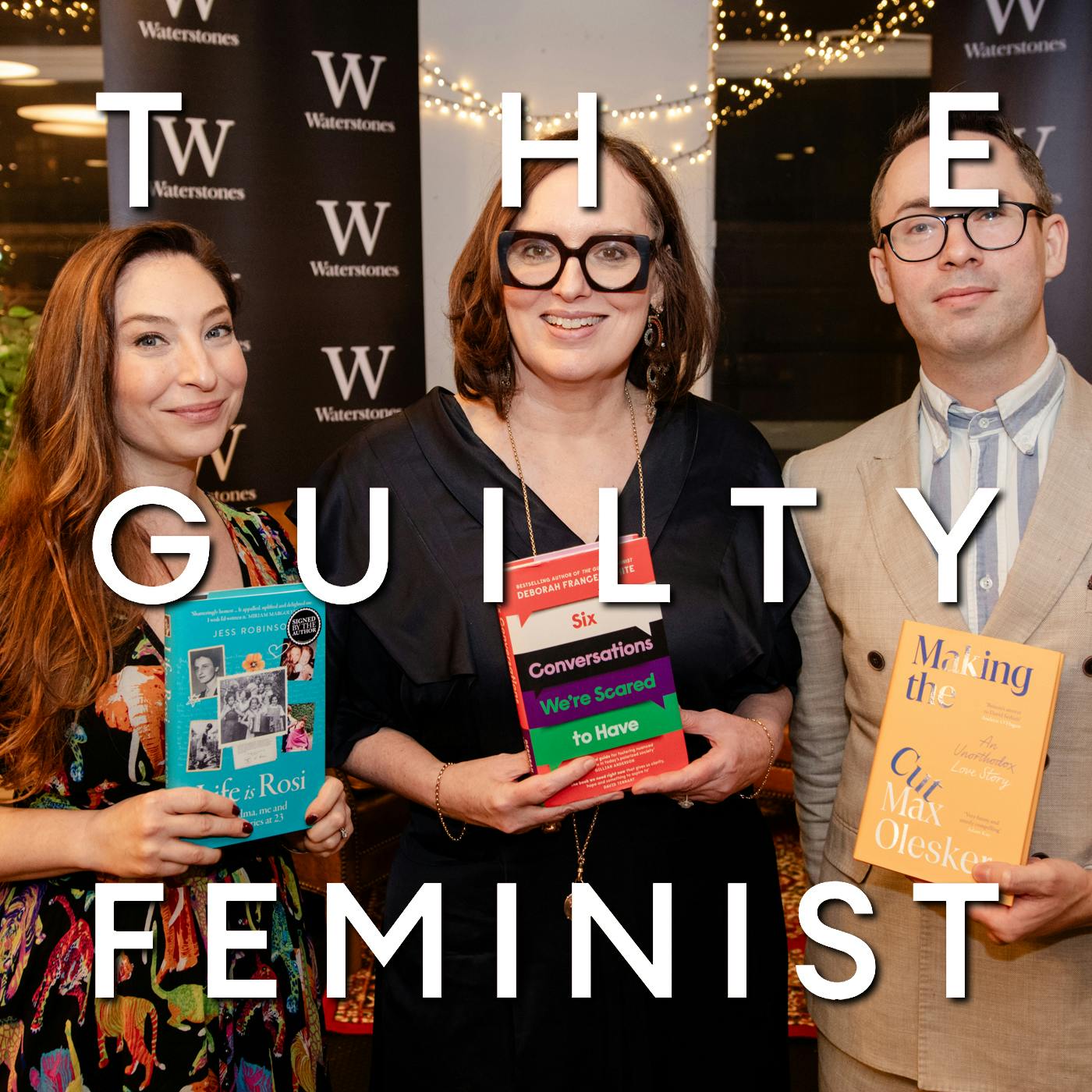
Presented by Deborah Frances-White with special guests Max Olesker and Jess Robinson
Recorded 23 February 2026 at Waterstone’s Piccadilly. Released 16 March.
The Guilty Feminist theme composed by Mark Hodge.
Get Deborah’s new book with 30% off using the code SIXCONVERSATIONSPOD https://store.virago.co.uk/products/six-conversations-were-scared-to-have
More about Deborah Frances-White
https://deborahfrances-white.com
https://www.instagram.com/dfdubz
https://www.virago.co.uk/titles/deborah-frances-white/six-conversations-were-scared-to-have/9780349015811
https://www.virago.co.uk/titles/deborah-frances-white/the-guilty-feminist/9780349010120
More about Max Olesker
https://www.instagram.com/maxolesker
https://lnk.to/MakingTheCut
https://maxolesker.com
More about Jess Robinson
https://www.instagram.com/jessrobinsonofficial
https://jessrobinson.lnk.to/lifeisrosibook
https://www.jessrobinson.co.uk
For more information about this and other episodes…
visit https://www.guiltyfeminist.com
tweet us https://www.twitter.com/guiltfempod
like our Facebook page https://www.facebook.com/guiltyfeminist
check out our Instagram https://www.instagram.com/theguiltyfeminist
or join our mailing list http://www.eepurl.com/bRfSPT
More Big Speeches workshops now available https://guiltyfeminist.com/big-speeches/
Come to a live show
Endometriosis Special. 31 March Bloomsbury Theatre. https://www.bloomsburytheatre.com/event/2026/03/guilty-feminist-live
Road to Gilead at the Museum of Comedy. https://www.museumofcomedy.com/the-guilty-feminist/
Guilty Feminist x The Nerve. https://www.leicestersquaretheatre.com/show/guilty-feminist-x-the-nerve-road-to-gilead/
Thank you to our amazing Patreon supporters.
To support the podcast yourself, go to https://www.patreon.com/guiltyfeminist
You can also get an ad-free version of the podcast via Apple Podcasts.
The Guilty Feminist is part of the AudioPlus Network. If you’d like to work with us, please get in touch at [email protected].
Learn more about your ad choices. Visit megaphone.fm/adchoices
Hosts & Guests

Transcript
Score more with the college branded Venmo debit card and earn up to 5% cash back with Venmo
stash.
Got paid back?
With the Venmo debit card, you can instantly access your balance and spend on what you want,
like game day snacks, gear, tickets, and more.
The more you do, the more cash back you can earn.
Plus, there's no monthly fear minimum balance.
Sign up now at Venmo.com slash college card.
The Venmo master card is issued by the Bankport Bank NA, select schools available.
Venmo stash terms and exclusions apply at Venmo.me slash stash terms.
Max $100 cash back per month.
Sierra has all the best active and outdoor brands you need.
From athletic stuff, like a full-court pickup game, swish to athletic-ish stuff like a half-mile
stroll.
Get those steps in!
And for morning hikes up the mountain trail, good pace!
It's a nighttime ghost stories from the camping chair.
What a twist!
Whatever level of active, Sierra loves it all.
Head to Sierra or Sierra.com for the brands you want at the prices that let you do it all.
From athletic to athletic-ish, Sierra's got it.
The spontaneity shop presents the guilty feminist warstens football club with me, Debra
Francis White, and my very special guest, Jess Robinson and Max Aleska.
Our first guest today is a multi-award winning comedian, a contributing editor at Esquire
and was once Britain's youngest professional wrestler.
He is one half of globally acclaimed comedy double-act Maxine Van and his first book, Making
the Cart, is out now.
Please welcome to the stage, Max Aleska!
Which ever takes your fancy, clearly there's no plasmum, because it's very rough and
ready tonight.
But that kind of sometimes feels very live and Londony, doesn't it?
It feels quite underground, although we're four floors up.
But psychologically underground.
We are also joined by a multiple-award winning actor, impressionist singer, comedian and voice
artist who has many times toured with the guilty feminist doing absolutely brilliant and
delightful songs, sometimes parodies, sometimes impersonations, sometimes very poignant and
touching things, including a brilliant song that she did about her grandmother before she
wrote this book on the same theme.
It's called Life is Rosie, Grand Bar Me and our Diaries at 23.
Please welcome to the stage, the incredible Jess Robinson!
This way, this way, this way, well done and welcome.
So let me say, that's a nice way to start well done and welcome.
Well, it's a death trap coming up on this in high heels, Jess and you've really smashed
it so far.
And we've peaked.
That's it now.
Let me say it is truly wonderful to be interviewing two of my dear friends, who I hold much affection
for, and you have written books on similar themes, interweaving themes, two very different
books on a similar theme, and I am delighted to say that they are both absolutely sensational.
They are moving, they made me laugh, they made me cry, and I haven't had to lie to either
of you about how great your books are, which is not always the case.
Thank you so much.
I genuinely do think that I can hardly recommend these books to everyone, they give them
as prisons, because I don't think anybody could not like these books.
Well, I actually ran the quote, I didn't have to lie about liking it, Debra Francis White,
it's on the back.
You say that to all the writers, I absolutely don't.
I say things like, extraordinary, you know, that's a great quote for a book, but it could
be extraordinarily bad, we don't know.
But both of your books I found so beautifully written and so heartfelt.
I feel like you're both real artists, because you really share, you're not managing your
image, it's not cosmetic, it feels very raw, and I think it's very, very brave, that the
way that you have shared at this level, could you give us a little praise each of your
books, Max, can you tell everyone what your book is about?
Yeah, absolutely, yeah, it is, and I suppose kind of when I start talking about my little
somewhat give away the theme of Jess's given that you've implied there is a connection.
So yeah, it's a Jewish memoir, as is Jess's, but I'll speak only about mine, it's called
Making the Cut, an unorthodox love story, and the headlines are that I met a woman in
a bar in Edinburgh three in the morning, we fell in love, and then after about six months
of us seeing one another, I came to realise that it would be impossible for us to be together
if I were, unless I were to undergo the orthodox Jewish conversion process, which is known
to be one of the most challenging religious conversions in the world, and it was a double
blow, not just because that was incredibly difficult, but also because up until that moment
I'd felt that I was Jewish, I'd been raised with a Jewish identity, I'd had a bit of an
all sorts of things, but it turned out that my flavour of Judaism didn't quite mesh with
Elianas, and that's the name of my partner, and the book is the story of our three-year
attempt to navigate this orthodox Jewish conversion process in order to be with one another.
And an absolutely extraordinary journey and a brilliant book, Jess, tell us about your
book.
So my book is about my grandma Rosie, who she was German and Jewish, and in 1938 she
was living and working in an orphanage, in Esslingin in Germany, where she was looking
after the children and playing her guitar to them, and she was sort of like a German
Jewish Maria von Trapp, but because she had a Polish passport, even though she was born
and lived in Germany and didn't even speak Polish, because her parents were Polish, there
is a bit of the Holocaust that nobody ever talks about called the Pollan Action, and that's
when sort of Hitler's dress rehearsal for the Holocaust, when he got all of the Polish
Jews out of Germany, and my grandma at the age of 23 was one of them.
And so I've got all of her diaries from this time when she was 23 years old, and what
I've done is I have run them in parallel with my diaries from when I was 23, and it all
started because I wanted to get a German passport after Brexit, and I had to go back through
all of her papers and documents to prove the ancestry.
And that's when I discovered her diaries and delved into my heritage.
And it is really, really, it's poignant to read her diaries.
You originally pitched it to me as a cross between Anne Frank's diary and Bridget Jones diary.
That's what I said to HarperCollins Anne Frank meets Bridget Jones.
Yeah.
And it does work at the time I thought, oh, Jess, why are you not in?
Are you sure?
I genuinely thought, are you sure?
And I found it so compelling, like actually, in some ways, how similar that you are because
you're both moaning over boys and wondering if you'll ever meet anybody and all of those
sorts of things.
And someone very close to me in my chosen family, he's lived in refugee camps as a refugee
and he said, you'd be amazed how much of refugee camp angst is, why didn't they text
me back?
And getting a new crush and then thinking, well, they said that they were going to be volunteering
today and they're not here and haven't texted me and they've kind of left me on red.
And this is really weird.
And how much that angst continues that life goes on.
And so how much of her diaries are about pride in her work, at the times when she's able
to work, even though she's not being paid, and about pride in herself, her determination,
and about boys she likes.
Honestly, I was very surprised and heartened as well to read that while her world was crumbling
and she was in this refugee camp, she didn't know whether her family was alive or anything.
She was still worrying about boys, but I think that was because she needed to keep some thread
of normality, normality, when everything else was so shaky around her and of course, humans
want to feel safe and safe is, yeah, feeling love, isn't it?
And you can't every moment of every day go, oh my god, this is terrible things happening
to me.
Your day is made up of lots of small moments and if you find a connection with someone
in a hopeless place, then you do hold on to that.
Absolutely.
And also, she's 23.
This is terrible.
My world's, oh, he's hot.
Exactly.
Your book also really has a big romantic heart to it because you are doing something for
somebody you love so that the two of you can be together, it's, I think that and sort
of marrying for a green card is, but marrying because you want to be with somebody because
you can't be in the same country, you know, I don't mean for a green card, but I mean
marrying somebody because otherwise you will lose them to the, because of state borders,
but possibly the last two big romantic reasons to marry, because most people now like just
shack up for ages and then by the time they think, oh, well, we want to have kids, maybe
we should have the party, yeah, obviously, it'd be nice to have the white dress and have
our friends and, oh, we've already got a toaster, don't worry, just pop something in for
the honeymoon.
Like, we're in that sort of place and I think your story is so romantic and it had some
of the romantic reflections of moments from your grandmother as well, it's really, really
interesting.
Absolutely.
Firstly, Rosie, like the grandma that she writes was such like chic, elegant kind of prose
in the diary.
And me?
Popped only by Jess Robinson's deathless sentence making.
No, it's just gorgeous, it's just different tones, hers is very kind of is, yeah, I'd say
yours is wonderfully excitable and full of heart and you wear your emotions on your sleeve
and she's so kind of sort of elegant and plastid, but then she'll be like, well, I'm
seeing six boys simultaneously at the wedding and that's quite all right and I shall choose
one of them at a certain time.
She says, I'm carrying on, I mean, these have been translated into English, but, you
know, she'll say, I'm all, but I'm also, she'll talk about a boy for ages then she
said, but I'm also carrying on with Stefan, yes, she'll say and there's that guy as well.
They hate each other and that's actually lucky because they don't speak and they don't
know.
And I think at one point you say, grum, I was a player, but she was an absolute player,
she was a fabulous, she really was.
I'd actually, before I dive into quoting things from your books, it would be great for
the audience if they could hear a little bit of each to get some context who would like
to go first.
You go first.
Certainly.
Going to read the entire book.
Not going to read the opening, the opening chapter, which is also the shortest chapter.
Beginnings and endings, the Edinburgh fringe to AM.
She has red lepstick and clear blue almond eyes, which dance with mischief and a sheer confidence
that I've never encountered before.
Uniquely, it doesn't seem fueled by either insecurity or entitlement by trying to achieve
anything or to prove anything.
She just seems to exist more vividly than other people.
Your show was really funny.
Thank you so much.
Would you like a drink?
Ivan and I have just bought a bottle of wine.
Would you like a glass?
Somewhere across the bar, Ivan González, my comedy partner, turns and gives a cheerful vague
wave in the direction of whoever said his name.
Nah, she says, I'm going out.
Shots.
She orders us both yaga bombs, undrinkable, saccharine poisonous things.
Much later, we all realize that neither of us actually liked them in the first place.
Though our friends who were with us at the bar assure us that that evening, we both drank
them slowly, savoring each syrupy monstrosity as though it were a delicately aged, old-fashioned.
Cheers.
It's nice to meet you.
Nestle between a group of loud French-Canadian circus performers and some extremely earnest
student puppeteers, we are pushed together in the crush of the bar as she explains that
technically we've met before.
A previous summer, when working at the fringe, she was assigned to run the front of house
at a chaotic show in which comedians become professional wrestlers, a show I produced
and a product of my misspent youth as a teenage grappler.
And so, the first time we met, she was taking tickets and I was summa-sulting off a ladder
onto some comedians.
Taylor's old as time.
Our double act show has quite a different energy to the wrestling, I hope that was okay.
I mean, I demanded a full refund because you weren't wearing your lightning bolt shorts,
but otherwise very few complaints.
She is sharp and whimsical and surprising and effervescent and self-possessed and spectacular.
Her name is Eliana and I like the Jewish jokes, she says, oh, it's okay, I say, I'm allowed
to make them.
Her eyes light up and so it all begins because I'm Jewish.
One year later, London, 3pm, we have fallen deep into the ravine of togetherness, we have
moved in together, organized surprise birthday parties for one another, given one another
handmade cards, become part of one another's friendship groups, nursed one another through
illnesses, argued furiously and reconciled passionately.
We've fallen inescapably in love.
My suitcase is packed and waiting where the front door.
There are more of my possessions piled on top and unruly and wheeled the overspill of
things, clothes, books, stationery, crammed hastily into spare rocksacks, canvas totes,
and eventually over stuff, plastic shopping bags, yet more things on the floor, my coffee
machine, my stupid folding bike that I love, my half of our life together.
We cook each other a sad, beige dinner of steak in mushrooms and we sit in silence and
eat.
My face is grey, tears streak Eliana's cheeks.
Maybe a cab arrives, an XL to account for, you know, all of the stuff.
I'm so sorry, it's Eliana.
So am I, I respond.
We have broken up because I'm not Jewish.
I do think that's a really beautiful piece of writing and it really creates a great promise
that opens up for the rest of the book.
Jess, can you read a little bit of yours?
No, by can now.
I was beautiful and mine's got a really silly word in it.
Okay.
Diary of Rosie Shul, age 23, Wednesday 30th of November 1938.
In the internment camp, my day really starts when I arrive at the stadium.
The children always greet me with enthusiasm.
They run to me shouting, Rosie is here, Rosie is here.
It spurs me on to give them lots of love, both the 11 and 12 year olds and the little
ones too.
At midday, the children queue up for their second breakfast and as there are no chairs,
they have to eat standing in a row.
Then I visit those children who are ill and I try to make them laugh and feel relaxed.
The highlight of my day is always story time.
In fact, as soon as I arrive, there are shouts of, we want a story today.
So I climb up one of the wall letters and hold onto the rungs while they sit below me
on their beds.
Because I have no books here, I make up funny and interesting stories.
At the beginning of them, I don't even know how they will end myself.
But oh, how I love the sight of the children's eager little faces, their wide eyes so expectant
for more twists and turns in the tail.
Sometimes I get ideas from them by asking, well, what do you think happens next?
And when I leave, there are always more shouts of, another story tomorrow, please.
I have always felt different from mum and grandma, they're so strong.
I'm a model of sensitivities, always worrying about what people will think.
It's only now at 38, though I maintain when acting I can play 18 and I must play 18.
That I no longer choose to hang out with the people I don't actually like, just to avoid
being alone.
I'm only beginning to discover the sort of funny, emotionally intelligent women who understand
me, who don't mind if I'm too much or laugh too loudly, or the fact that whenever I compliment
a stranger, for some reason I get a lump in my throat and want to cry.
Why is that?
Getting a choked up when you say to someone, oh, your hat looks beautiful, why does that
make me emotional answer me?
I keep reading about women stepping into their power.
I don't think I can do that until I find my voice and have the confidence to use it
unapologetically.
Will I ever have the courage to simply say, no, I'm not coming to your party because I'd
rather stay in and watch real housewives of Beverly Hills instead of making up a far-fetched
excuse.
And if you know me and I flaked on your party, those excuses weren't for your event.
I really was tied up, tied up by a burglar in my own house.
The only place where I'm totally honest, where I have always been totally honest, is my diary.
In fact, I'm now starting to wonder what I might learn if I look back at my own diaries.
How will a young Jess measure up to Rosie at the same age on the sameish date?
This is probably a suicide mission which will result in more self-loathing.
But what if I find glimpses of that same strength and where it might have disappeared to?
Maybe I can pinpoint a moment and put it right?
What if, as I uncover grandma's experiences and look back at my own, I can learn to live
on my own terms, just as grandma did?
Okay, here we go, I'm going to do it.
Oh, God, I feel like a little bit like I'm showing you my bumhole and asking for approval.
Diary of Jess Robinson, age 23, Friday 30th of November 2006.
Rachel and I have just been drinking wine and we think it would be a really good idea
to run a sex phone line.
You can just sit there in your PJs and your phone's re-rooted and the calls come in
and you just talk to pervs while you're watching something on telly or having a cuppa.
We saw it on a documentary.
There was an old lady saying, mmm, oh yeah!
While she was putting her laundry in the washing machine and easing biscuits in her slippers.
P.S., I've got an audition for Cinderella tomorrow at 5pm.
I have to sing an uptempo and a ballad.
So I'm going to sing Moment Like This by Leona Lewis.
Unbelievable.
And is this the way to Amarillo by Peter K?
I'll just stand and look into the middle distance for Leona.
Oh, I'm such a wanker.
But I think I could sing Amarillo sort of posh like a princess
and I'll imagine I'm in the woods and I'm asking the animals the way to Amarillo.
I hate myself.
APPLAUSE
So, can I ask you, I mean, sorry, I fluffed a bit there.
No, you did it. No, you did it. It was wonderful.
So can I ask you both to sing a ballad in an uptempo?
Yes, I do.
I'm going to do somewhere from West Side Story.
Oh, that's a nice one.
It's a bit classy, right?
Yeah, absolutely.
Beautiful.
Leona Lewis will be very upset.
Can I ask, how did you come to write these books?
What was the moment where you thought this should be a book?
And I need to write this because these books are so personal.
And I'm sure you'll both go on to write other books.
But I feel like you're never going to give birth to anything as personal
and 360 out of the soul as these books, in a way,
because they're about such huge things.
Up, huge pieces of your own identities.
Just after 2016, you wanted a German passport,
and you thought also you should be able to have one.
Yes.
Because your grandmother was forced to leave Germany.
Yeah, yeah.
And that was when you started showing interest in your grandmother's
old letters and diaries.
Or did you not know they were there before?
I always knew my grandma's story.
And I always knew that she had written diaries
because my auntie Stephanie had sat with her
and translated a few pages for posterity
and a few of these A4 pages were given to close friends and family.
But it was actually, when my lovely agent Sophie,
who's more like a big sister to me, met my grandma
when we were filming Britain's Got Talent.
And the producers wanted to film grandma
and get her to say to the camera,
I'm very proud of Jessie.
Although, actually, whenever they said action,
she'd go, I'm proud of all my grandchildren.
She was amazing.
Every time, can you just say you're really proud of just,
yes, of course, action.
Can I just say your grandma and my mum would have been best friend?
Really?
Oh, I love how many similarities there are in our books.
Yeah, but my agent Sophie fell in love with grandma
and her story and just the remarkable sort of formidable
woman she was.
And from that moment, she said, we've got to try
and tell your grandma's story.
So I put like a little excerpt in the show
and I did a little bit about her on the guilty feminist
and I pitched it as a sitcom and a documentary
and nobody was biting.
And then during lockdown, that's when I decided to get
a passport for all the family, which was harder than it,
it sounds.
But Sophie said, do you want to just write a book proposal as well?
So I went, you're all right.
I didn't know what I was doing, but I did my best GCSE English
and Harper Collins got back to us within about a month,
which was bonkers and I couldn't,
I still can't really believe it, to be honest.
Wow.
So you were thinking, because it would make a great documentary,
you going back.
And I hope you do get a documentary off the back of it.
But it was just sort of, you needed to get it out
in some way, shape or form, whether it be a drama or a doc
or something.
Yeah.
And this is the format came out in, basically.
The publishers were the people to buy it.
And you thought, right, so it can be a book.
Yes.
When did you first know there were diaries?
And when did you first read the diaries?
I think I first knew there were diaries
when I was about 25 or 26 after I'd written
the actual diaries that are in the book.
My diaries, I mean.
Then I went back and looked at all of the other diaries
once I'd got the book deal, actually.
So if they had been rubbish, that would have been really bad,
wouldn't it?
But they were all written in German
and all in this tricky handwriting
called Sutterlin-Schrift, which was only used in German schools
for a really like something like a 10-year period of time.
So there aren't that many people that can read it.
But luckily, my mum has a great mate who translated the diaries
and mum wrote them all out in pencil on A4 pages.
And they sent me the pages through the post.
It was all very analog and very lovely.
That's so lovely.
Yeah.
And were you, I mean, it's an absolute gold mine of things
in the absolutely glorious staff.
Was it like, because you knew your grandmother very, very well?
But was it a strange experience connecting with her
as a 23-year-old?
Yeah.
You were a 38-year-old.
Yes.
She, I knew her as a very cuddly to me and kind grandma.
And I knew that she also had a very strict side
and that she could be a bit spiky to my mum.
But I just knew her as an old lady to remete her
when she's a 23-year-old and so vulnerable and so stoic
and so carries herself with such grace, actually.
It was like meeting a new person and trying
to sort of marry them together was, it was both completely easy
and totally jarring as well.
It was very interesting.
Did it awaken in you?
I mean, some of this is in the book,
but did it awaken in you a fire for your own heritage?
Or a few parts of you that were,
you were just cracking on with your life and trying to make
it in show business and you hadn't really
considered the heritage of someone
who'd escaped the Holocaust?
Yeah, absolutely.
I feel more connected and more moved by my heritage
and more tender about it now and also more scared
to have Jewish heritage than ever,
because it's a very weird and shaky time
to come out and do a book about being Jewish
when there's just so much horror going on in the world
and echoes of awful, awful, awful things.
So that felt quite exposing and also to look
and realize that while I was writing,
a lot of my opinions and the way that I thought about myself
had sort of frozen at that age
and I hadn't moved on or moved forward
or hadn't learned to speak up for myself and use my voice
and was still being the good girl and grateful girl
that I thought that you have to be to get along.
And I'm not her anymore.
I think it's writing has changed me
and it's a muscle I'm still learning to flex
to speak up for myself and say,
hey, no, and that's wrong, but yeah.
But it's allowed you to distance yourself
from those ways of thinking and ways of being in actions
and say, hold on a minute,
if I'm not lacking what I'm reading as a 23-year-old
in my condemning of myself or my feelings
about myself and my body or any of those things,
if I feel protective for that 23-year-old,
when I replicate these things now,
should I not be protective of myself now?
And that's a really interesting thing.
As a writer, you have then become a bold, more mature person.
I think it's important now that I become the woman
that I should have been for her.
Interesting.
What about you, Max?
How did this writing of this book
have interplay with your younger self and your heritage?
Well, the entire book is a sort of
absolutely enormous identity crisis
playing out over the course of the entire thing.
And it ended up in book form
because that felt like the only plausible way
of kind of communicating everything that happened
in a way that felt, in any way,
representative of what happened.
As I've sort of, like the shows that I've made
and the things that I've done have become increasingly
kind of autobiographical as I've, as the years have gone by.
And it's no spoiler alert.
It doesn't give too much weight to say
that the conversion process did not go as planned.
There were about seven or eight moments
where the entire thing very nearly imploded.
And it was such an extraordinary experience
or series of experiences that I knew that by the end,
I would need that some, it was sort of sat
on the top of my kind of psyche.
And I knew that I would need to respond to it
or reflect on it in some kind of way.
And having lots of very considerate and compassionate
and kind friends who would sit there
over long lunches or interminable nights
with, you know, one to 12 bottles of wine,
it's just such a densely kind of packed, strange thing.
And also, it's a kind of, it's a story that,
if you have a Jewish background, you can explain lots of it,
slightly quicker because there's, you know,
there's, there's shared shorthand and terminology.
But if you don't come from that world,
then it's, then lots of it's totally mind-boggling.
There's, there's all sorts of concepts
that you need to introduce.
And I wanted to be able to tell a story that was accessible
to the world, not an unbelievably niche handbook
from how to convert from one type of Judaism
to another in order to marry somebody you love,
even though you're not allowed to convert for that reason.
And suddenly we're getting into the specifics of all of it.
So yes, I found myself re-examining and re-engaging
with my Jewish identity and my kind of preconceptions
and also my insecurities about it in ways
which I found very reflective of Jess's book as well.
We both kind of grew up outside of London,
both grubbers like, you know, the most,
I grew up in Portsworth.
I was like the most Jewish kid in my school.
And I was in a little village in Hertfordshire called Aldbury
where my mum played the organ in the village church.
So.
And then, and then you, you know,
and then you securely find yourself in London
where, you know, by some distance,
one of the, you know, least Jewish people
in the Northwest London neighborhood.
But I didn't, in my, in my particular case,
I didn't realise until I met Aliana
and then even then I lived for a few months
in willful deniability.
That, you know, that, although I knew I was never particularly
good at being Jewish,
I didn't know that I was considered non-Jewish
by a whole quadrant of the Jewish community.
And even though that hadn't been at the forefront
of my identity, it was still part of who I was
or who I perceived myself to be.
So it was the...
And that, that was because your mum is...
Yes.
Well, not Jewish through heritage, right?
So my mum, my mum converted, my, my father was,
was, well, he was never religious,
he was, he was,
helically Jewish would be the term.
He was, you know, two orthodox Jewish parents.
My mum converted to Judaism
when I was about to do my Bermittsfer.
Something she'd always knew that she would do at some point.
She wanted to be part of our family's Jewish journey
and support that.
But she converted by the reform movement.
And that's partly because it sort of naturally align
with her values as a progressive,
like feminist artist, Bohemian.
It kind of seemed to mesh with her sensibilities.
But it was actually also ironically
because she wanted her three sons to have
as engaged and active a relationship with Judaism
as she could.
And in Portemouth, the orthodox shul,
which ironically was about a three-minute walk from my house.
But the median age of the attendees is 206.
And she just felt that if you're taking three boys there
to see the slightly faded, sclerotic minion,
the quorum of men trying to muster up a, you know,
a gathering for a weekend service.
There's little to connect to.
So she took what was actually a kind of, you know,
a more labor intensive route because it involved
schlepping out to various places around Hampshire,
this reform community, which was itinerant
and roving around and was never in the same place.
But it meant that we had kids our age.
There were other Jews.
It gave us a semblance of a very patchwork kind of
diaspora or of a diaspora.
But we kind of, you know, I got to go to Josh's
but Mitzfer and Layla's bat Mitzfer and we got to kind of,
you know, go to a Hader School, which I sort of
resented, but kind of enjoyed.
And you know, it meant that there was some sort of
a framework.
And although it led to a catastrophic series
of theological bureaucratic kind of rabbit holes,
it did mean that there was this sense of identity
and it was never imposed upon us.
We, oh, I was never even told I had to have a Bimitzfer,
but I think my parents just wanted to show us, you know,
these are the festivals.
This is what the candles that your grandfather gave us.
I mean, this is what, this is your heritage.
This is part of who you are.
You can embrace it, you can choose to participate or not
as you kind of, as you choose.
That part of it where your, you know, your father was very,
I was a great student of like Hebrew stories
and Jewish songs.
Yiddish folklore, plasma music.
So you had a relationship with a father
who really embraced all of the culture around it.
Oh, he was the most Jewish man ever.
And like, looked exactly like a rabbi.
Completely, completely irreligious,
but gorgeous, long, beard and a strong Jewish schnauz
and like an endless array of plasma songs
in stick and ridiculous stories.
So you of course, and your father is not Jewish, is that right?
No, so my dad wasn't Jewish.
So you're kind of as Jewish as each other
because you're both Jewish.
Well, it depends on your spirit.
Oh, it's nothing.
Yeah, that's the thing.
It's a mach louque as you want to know.
Yeah.
In some, in some circles, I would have been
considered more Jewish than Max
because my mom is Jewish, even though my dad isn't Jewish.
And even though he had this amazing Jewish upbringing
with I didn't have any of that.
And your mother played the organ at the church.
The church.
Do you have the only pianist in the village?
Did you have a pap mitzvah?
No.
So you didn't have any of that.
I didn't have any of that.
And your 50% genetically, if we can say that,
is that correct for you?
Yes.
And genetically Jewish.
Jewish blood.
Yeah, yeah, yeah.
And both of you have family who were in the Holocaust.
Yeah.
And yet, I actually wonder whether our,
my great grandparents were from a town near New York.
Near Olesco in Galicia.
Yeah, maybe.
We need to look.
We'll check that out.
And your wife, Eliana, her family
is from nearby villages yet.
Yes.
But we're proud to say that we're not related by blood.
But we might be.
We might be.
That would be a delight.
Yeah.
Wouldn't that be lovely?
Yeah, yeah.
So you are as Jewish as each other.
But as you say, not really because it has to come down
through the mother's line.
Oddly, or interestingly or maybe not.
But one of the few orthodox, any orthodox community
would judge that you were de facto, you know,
had I not converted, done the orthodox conversion
that you were more Jewish than I.
Weirdly, one of the only instances
where that might be flipped is reform,
which is now known as progressive Judaism,
who are in general, you know.
Have they changed the name because of the political party?
Well, I don't think that's a problem.
I think they waved it through quite quickly.
Yeah.
I was like, where are we going?
Yeah.
They changed the name to, you keep Judaism.
Yes.
Yeah, yeah.
You keep our Judaism.
Yeah, yeah, yeah, yeah.
Come on.
Yeah, yeah, yeah, yeah, yeah.
Come on.
I can't believe I missed that.
I'm so annoyed.
I'll never get over it.
But there is a tradition in the progressive side,
whereas which is basically if you are not raised
with a Jewish tradition, then they don't kind of say
you are de facto Jewish.
You would need to kind of choose to embrace it.
It is the hardest religion to be embraced by, isn't it?
Tell me about it, mate.
Tell me about it.
There's actually a very poignant part in your book
where you talk about anti-Semitism
and you talk about how you would definitely be Jewish enough
to have been killed in the Holocaust.
I say that too.
But you say that in fact you realize
and the way other people relate to you
and so on and so on and when you start practising Orthodoxy
but you say if I've got this wrong, please correct me.
But I think you say the only people in the world
who don't see me as Jewish is a small collection of Jewish people.
Yeah.
I was quite surprised at how painful I found it
to be considered not Jewish.
And I think part of that is because I'd probably,
I always thought it was a sort of a sliding scale in a spectrum.
I've got an orthodox uncle with in Jerusalem with like 30 kids
and a big black bit.
And I kind of knew that was in one side and I knew that we were
driving to synagogue on a Saturday.
And our rabbi was a lesbian.
And I didn't know there was this kind of this halachic goal
for this kind of definitional definition.
And I'm sure part of the reason that it was so painful
was because I happened to discover it via falling in love
with a woman who was then suddenly, you know,
on the other side of a canyon or behind an invisible pain of glass
or whatever imagery you want to use.
It's a very, I mean, if you were writing a movie,
it's a great story because you come together,
she thinks you're Jewish, you think you're Jewish
and then when it comes to looking at a more serious future,
this issue comes up.
And I think it's particularly poignant because when you're born,
you say that the nurse in Portsmouth asks
what your name's going to be and your mother says,
Max.
Max Jacob Henry Oleska.
And the nurse says, oh, it sounds a bit Jewish.
And she says what he is Jewish and she gives you back
to your mother and goes like that.
And your mother says at that point, she thinks,
oh, this is going to be your whole life.
This is going to be around you.
So I need to be with you on that journey.
To be, I can't let you have that alone.
So I'm going to be Jewish with you.
And that's such a beautiful poignant thing.
Yeah, I didn't realize that until I was writing them.
I thought she'd possibly just decided to,
she was very welcome in the progressive community
that we're a part of.
I'm not sure there was any element of that she couldn't really
participate in.
She was definitely the most organized one.
So she was kind of running it all anyway.
But I thought she just kind of,
I thought she did her conversion because I was doing my
Bometopher and it felt like the time.
But she said that she'd always,
that might have been what prompted us to finally get round her.
But she said, yeah, from the start,
this was something that she knew she'd do.
And she would, and yeah, from this moment when I was,
you know, handed back with a look of disgust,
she knew that even if I hadn't had the slightest interest
in any element of Jewish identity,
it's not something you can completely sort of absolve yourself of
or, you know, remove yourself from.
And not, which is not to say that you should let
the fascists choose, you know,
what your identity is or isn't.
And they shouldn't be the ones who get, you know,
to do the sorting.
But it certainly was oddly painful that I'd, you know,
growing up, my, I thought I was Jewish.
My parents thought I was Jewish.
My rabbi at my Bometopher seemed to think I was Jewish.
The kid who had butted me in the playground,
thought I was Jewish.
It just happens to be the Jewish girl who I've fallen for.
And she doesn't not think I'm Jewish, but it's, you know,
but she can't Jewish enough.
Do you feel more Jewish now that you've converted to orthodoxy?
No, it's a good question.
I mean, without a shadow, like, without a shadow,
as indignant as I felt at various times about my like,
identity or the fact that I wanted to be accepted,
I certainly didn't think I knew, you know, what I was doing.
I, in terms of actually being a practicing Jew,
I'd learn to read Hebrew when I was a teenager,
when I did my, my father taught me how to read Hebrew
for my Bometopher.
But I mean, I'm really keeping it up.
So it was, it was...
You were doing your Jewelingo.
No!
Nice.
I was not, no.
But yeah, it was there.
I mean, I must have just mispronounced it,
I've only just got the joke.
I thought you were just being really cool about it.
No.
I meant Jewelingo, but I think I just said it in a way,
and I went way, way, way, way, way.
And it took me a while.
I was like, what's the joke?
I said, oh, I get it.
I thought you've been storing it now that I can make that joke.
So I'm really glad I've clarified it.
That's the whole joke for you.
I think you keep it.
Actually, I could have made
and I really feel a missed opportunity.
But anything with the Jewel, and I'm like, no, I'll leave that.
Um...
At the moment, reproductive rights
are under attack all over the world.
Laws are being rolled back.
Clinics are being forced to close,
and the right to choose is being treated like it's optional.
That's why I want to tell you about MSI reproductive choices.
MSI is a world leading reproductive health care charity,
working across 36 countries to provide an advocate
for contraception and abortion,
to keep services open wherever they can.
In the face of attacks on reproductive rights,
MSI is holding the line.
They're there for women and girls
who would otherwise be denied care, choice,
and control over their own futures.
This isn't abstract.
When access is restricted,
people are pushed into dangerous situations
and the consequences are devastating.
MSI is calling on the world to choose choice.
And you can be part of that.
If you're able to, please support reproductive freedom
with a donation to MSI reproductive choices.
Just go to MSIchoices.org.
That's MSIchoices.org.
And thank you for helping hold the line.
Join their movement for social impact,
like I have, at MSIchoices.org.
You have some really extraordinary,
there's an extraordinary moment of anti-Semitism
that you don't, you react to because it's 2006
and you're very young by thinking,
oh, maybe I need to change in show business.
Yes.
So tell us about that.
That audition that I read about in my book,
I went for it for Cinderella
and at the end of this audition,
the director said,
have you got any questions?
I said, when would I expect to hear?
And he said, well, I can tell you now,
you've got a lovely voice, Jessica,
but I'm afraid you're just a bit too,
look a bit too Jewish.
It's just not long ago.
It's just 2006.
And I said, because this is what you were taught
and I didn't realise it.
Okay, thank you so much for having me.
And then I went out.
And then I had to go back in to get my music.
And then I went out again.
And that was it.
And then I also, I was so not getting on very well
with my love life and the regular actors
that I was sort of trying to go out with.
I decided to see if I could join a Jewish dating agency.
But they said the fact that my dad wasn't Jewish
and I couldn't speak Hebrew and didn't have about myths
or anything, I wasn't Jewish enough for that.
And again, it's this...
Both of you have this tension in your books
and in your lives of two Jewish, not Jewish enough.
But they still want to kill us with that.
Exactly.
And it's...
This is what you publish at the same time.
This is the barbenheimer of Jewish identity crisis
familial memoirs with love at their heart.
That's what people are saying.
Yeah.
But interestingly, it's your agent at the time
says, when you tell her,
they said, I look to Jewish, your agent at the time said,
maybe die your hair blonde.
Yeah.
And then you...
That's the kind of support you need.
And you're...
Shit.
I have the meaning to say, babe, you do look a bit too Jewish.
Well, she'd actually spoke like that.
Her name was Anna McCorkadel.
Oh, dear, dear, dear.
She was assistant to a lady and waiting.
She was on the phone to the casting directors
and she'd have to say,
pickles get down all the time.
The dog.
Because it's horrible.
Pickle the dog.
It's not her assistant.
I don't think so.
But anyway.
Yeah.
So she said, why don't...
Maybe die your hair blonde.
But you were saying in your diary,
in your sort of Bridget Jones style diary,
that you were writing at the time,
you were saying, I think I need to look into plastic surgery
and get a nose job.
Yes, I wonder where the grandma would lend me the money.
Yeah.
Maybe grandma would lend me the money,
so I look less Jewish and poor grandma.
And at one point, grandma herself, Rosie,
in her diary, when she's writing about Kristallnacht
and she's writing about all the terrible things
that happen as she hasn't heard from her parents for so long.
And she just says, I'm sick of being Jewish.
Yeah.
And it's so...
Because it's this constant weight in this constant,
where can I go that's safe in this constant fear?
And why do I...
In that moment,
and most of the time, of course,
she is railing at the Gestapo
and the Nazis and the horror show
that is being inflicted upon her people.
But occasionally, it's like, this is a burden.
Yeah.
I don't want this burden, and I totally understand it.
And it's a moment of going, this is such an imposition.
And of course, it isn't.
It's only an imposition because of the brutality of the power structures,
but it does feel very heartbreaking to read that.
To read both her saying that and you saying,
I should get a nose job, you know,
but heartbreaking diaries of 23-year-olds.
Yeah.
It was amazing to see some of those parallels
in amongst her writing so eloquently,
and me going,
oh, that girl's such a cowback!
So, yeah, it was a nice...
She really was such a cowback, by the way.
She was awful.
Wasn't she?
Yeah.
There's an incredibly funny bit where your juxtaposition
between your diary and your grand diary,
when she writes this really long heartfelt piece
about being forcibly repatriated to Poland,
and, you know, she's locked in a cell,
and she's desperately missing the children that she teaches
at the orphanage,
because she's got this gorgeous relationship with children.
She loves singing to them and doing stories,
and it's just so beautiful.
And she writes this long heartfelt piece about how she's determined
to keep her hold of her dignity and her power,
and she will not be cowed by this.
Now, I'm not going to crumble,
and this is the rest of my life, so it be it.
It's just something of it.
And then you can't immediately to use saying,
I feel sick.
I hate myself.
I've eaten three quarters of it.
I just eat half a jar of Nutella.
I just eat half a jar of Nutella.
I just eat half a jar of Nutella.
I just eat half a jar of Nutella.
And I'm like, who's depressed to live?
I've done it my cosfit.
I'm too depressed to live.
And then you just put these two together,
and you go, oh, we don't know we're born to be born to be born to be born.
Oh, no.
We do not know we're born.
And it's just...
But what's beautiful about the book,
what's so charming about it,
is of course, had your grandmother not had this hellscape,
she would also have been saying, oh, you know,
I'm infurious about this that happened at work today,
or she does, as we said, talk a lot about...
There's a...
Oh, there's a...
I can find it.
There's just an amazing bit where she talks about this young man,
while I'm looking for it.
Max, can you talk a little bit about...
Pat, like the sort of...
Not that I won't listen, I'll listen while I live.
No, no, no, it's fine.
Read amongst yourself.
You know, when you...
I'll just vamp for a bit.
This is fine.
No, I've folded down too many pages now.
I don't know which folded down page is...
A bit of Sosu shuffle. Mr. Bojangles are just going...
Just keep things going.
I'd like a little Leona Lewis still.
Okay.
I'm changing from...
There are all sorts of power dynamics in the book,
things in your family, power dynamics in your family,
power dynamics within your own struggle,
political power dynamics, showers and power dynamics,
and in...
And as well as sort of, you know, broad or political ones,
Max, can you talk a little bit about the power dynamics
that you discovered within orthodoxy with the Beth Din
and how that unfolded and made you feel?
Absolutely.
And the Beth Din, for those...
That word has just been introduced to the group.
It is the court.
The court of Jewish judges.
They are judges. They are rabbis.
And they work within Jewish communities.
They oversee marriages, divorces,
and various issues including conversion.
And unsurprisingly,
the orthodox Beth Din are some of the most serious rabbis
on the face of the planet.
Unsurprisingly, temperamentally,
they were at best maybe bemused
by the narrative sketch comedian
the slash professional wrestler slash
a Squire magazine contributing editor
who sashayed into their throne room.
Yes.
Yes, there's a large throne there.
They don't always meet you in the throne room,
but sometimes they do.
And it does have a throne in it.
And yeah, I would sit there with Eliana,
you know, a solid distance between us
because you're not allowed to make any physical contact
throughout the entirety of this process.
And it's unbelievably daunting
because the orthodox conversion process
goes on for question mark amount of time.
There is no set amount.
You meet them at kind of periodic moments,
five to six month intervals.
And throughout this process,
your fate is very much in the palm of their hands.
It is almost...
There's a lot of reading you could do about it,
but the headlines are,
it's almost the nature of your soul.
You know, are you to have a Jewish soul in their eyes
or are they going to permit you to go through
this transformative experience?
And strangely, my uncle,
my sort of extremely from orthodox uncle,
actually, he converted.
He was my father's half brother
and my grandfather, who I never met,
was an RAF pilot in the war
and then after the war, he went off.
And I'm not quite sure on the timelines,
but there was another family occurred
in the north of England
with a woman who wasn't Jewish.
So whilst my father was,
hallackly Jewish, my uncle was not.
So he'd gone through this whole process
for reasons of his own many, many years ago.
And his advice was,
it's not like anything that you'll experience.
You've lived your entire life with Western consumer rights.
And that does not happen within this process.
Within this process, you are a supplicant
and you apply and you are from the very second
you write your first letter.
You are de facto on their terms.
They are the authority within this community.
And they can at any point say,
no, we don't take this any further.
But it's not like snakes and ladders,
we go to the bottom of the board and you can try again.
They could just say no forever.
They could, I mean, they may be a board,
but they never let me see it.
But they would always, you know,
I never got to read the notes they were writing,
but they did keep a detailed file.
But yes, I mean, in a sense, there maybe is
because each of the meetings is very intense
and it's a bit like a kind of spoken exam,
like a Viva or a Viva,
that is pronounced.
And you might be asked to, you know,
read some Hebrew from a book
or you might be asked which is the blessing
that one utters before or after a specific piece of food
or kind of anything.
And there are worlds in which, you know,
that kind of, you pass with fine colors
and they go, okay, great,
we see that your progress has been steady
and you go on or it could be,
I'm afraid, you know, down the ladder you go,
down the snake, I forget, it's been a while since I...
I think it's up the ladder down the snake.
Up the ladder down the snake.
Absolutely.
You've made that sound like an innuendo.
I've actually kept it very high.
I haven't even mentioned the circumcision yet.
No, that's absolutely true.
But if they decide, well actually,
let's pivot to that then in that case.
Sure.
Can we see it?
Yeah, we see it.
Okay.
Since you've mentioned the same.
Right, Potter for a podcast.
Let's go down the snake, guys.
Come on.
We won't need a ladder.
Tell us a little bit about how that came to be
because you were a Jewish child
but you weren't circumcised.
Yeah.
Which does happen.
Especially in liberal communities around the world,
there are people who choose not to do it.
It's still very much in the minority.
It is a fundamental core component of Judaism for many, many Jews.
But there are communities who do all turn it.
Ceremonies that are representative of the same kind of covenant.
But my parents were free-wheeling kind of Bohemians
and I was their first kid and they hadn't worked out
to what extent Jews would be at the forefront of our identities.
And B, there was this slightly negative presence,
this woman in the hospital who sort of handed me back in
in sort of disdain.
And C, as it turned out, there was one other, a rare other Jewish baby
who had been born down the corridor,
had had a breast, a circumcision.
And it got, there had been some, I think,
I think what had happened, the baby was jaundiced.
And you're not supposed to, strictly under Orthodox law,
if the baby, if there's any, you know,
if there is any health complications, you are obliged to wait.
But for reasons unknown, they didn't.
So anyway, so this woman was like,
oh, there you go, having back.
And then she was like,
you're not going to want to do that horrible thing to am I here?
And my mom was like, well, not like here,
not with you, maniacs, and not now that you're judging me.
So it was all just kind of, she really just,
at the time she was like, I just wanted to get out of,
you know, she hadn't really taken a strong view on it either way.
She probably would have done it.
But anyway, it kind of, it didn't happen for me.
The point is you hadn't had it.
Correct.
And then but to be holocically Jewish
and marry the love of your life,
it became necessary later in life.
Yes, yeah, yeah, yeah, absolutely.
When I was, even within much, most progressive,
you know, Judaism, they're still, they're still real keen on it.
So when I went to have my permits for,
I technically converted by the reform movement then,
as did my brothers, as did my, as did my mom.
And at that point, they were like, this is great.
We're like, happy to welcome you in.
Like, do you fancy getting the snip like now?
And I was, my response was, can I not?
And eventually they were, well, I think they were like,
we'd prefer it if you did.
To which my response was, yeah, but,
but crucially, can I not?
And they were like, yeah, I guess so.
It's a technicality.
Yeah.
And so, I mean, I was 13 years old.
This was absolute, my, I mean,
I couldn't think of anything more terrifying.
It was an inopportune time in a, in a growing boy's life.
Anyway, and obviously at the time I was like,
well, that's a bullet dodge now.
I'll never have to think about that again.
That bullet frowned to you, my friend.
Bullets.
It found me good.
You wrote that, you wrote it so brilliantly.
It's so funny.
And I mean, that is a content one.
There is a full chapter on the circumcision day.
Oh.
Well, it's called making a card.
And that is a sort of double meaning of making the card
with the Beth Dinn, but also, obviously,
literally, quite literally making that card.
It's brilliant.
And honestly, I was really hoping at that point of the book
that Eliana didn't change her mind.
Yeah.
Actually, should we, I don't know.
So, when, it's not much of a spoiler alert.
I'm talking about Eliana as my partner.
And I'm here wearing a wedding ring.
So, happily, despite the innumerable complications
and disasters and illnesses, one way or another,
with a few strange things that happened,
we did, we made it to the end.
And we were married.
And we're happily married this day.
But on the day that I proposed to Eliana,
I messaged my family.
And what was one of the least surprised messages of all time,
saying, I proposed to Eliana.
And she said, yes.
And my brother said, Mausleto, but admit it would have been funny
if she'd said no at this moment.
And I was like, as a professional comedian,
I would have had to have handed to her.
It was the funniest, long-game practical joke.
You could possibly play on someone.
I don't love to, if she just said, can I think about it?
And then I left you hanging for a week,
going, fucking kidding me.
Speaking of love and romance,
I found a little piece here that I'd love to read.
So, this is Rosie's diary.
I mean, should you read it because you do it so beautifully
in the accent, or do you want me to do it?
Go for it.
You do it.
She says, on the 25th of October 1938,
this heartbreak is so painful.
Samuel is in love with Jenna.
She is a classroom assistant here,
and only 18 years old.
It is impossible not to admire her.
She is very beautiful.
Her legs and hips are unbelievable.
Again and again, I catch myself looking at her.
For example, on Friday, in the bath,
I waited to see her beautiful figure.
She has a fantastic image.
She has a perfect body.
If Samuel saw that body, wow.
She's excellent in her clothing,
but so beautiful when she's naked.
On top of that, her face is indescribable.
How she must catch men's eyes.
I cannot compete.
I am an ancient 23-year-old cow.
I must get Samuel out of my head.
It will never be.
And then, not long later,
oh, it must be the next day.
The next day, she says,
I have really gained self-respect,
and then she says how she's talked to Samuel
and decided to become friends with him.
And now they've got great camaraderie.
And then she says,
it's all okay now.
Thank God.
I have just read him my diaries.
He was speechless.
Absolutely unhinged behaviour.
We love it.
At the moment, I went,
oh, there we go.
I am related to her.
I then just goes,
just goes, grandma, no!
Don't reach your diaries to your crush!
No!
I think when I read that book the other day,
on my own sat there silently,
I got a bit and just audibly went,
wow!
I mean, it's just so charming.
But also, the body comparison.
I mean, it's never been any different.
It has it like women are trained
to be comparing our bodies
to being, well, she'll be more attractive.
And he'll like her more,
and he'll never like me.
And it's just such similar stories
where you're like you like a boy at a nightclub,
but then you take ecstasy
and have to go home,
because she'll first of all thrown out of the club,
because they think you're a dealer and second.
Yeah, they thought I was what?
No, I didn't call it a dealer tonight,
so I called it a drug pusher.
They thought I was a drug pusher.
And so she gets thrown out of the club,
then she hasn't got her bag,
so she has to talk her way back in
to get a balancer to help her get her bag,
and then she ends up throwing up in the loo.
And then you go home, and then you're just so annoyed
that one of your friends,
you don't really think it's a very good friend,
as you think has gone home with the boy that you like.
Yeah.
Which she did it.
That's the biggest one.
Now we're on the real stuff.
Oh, and now we're talking about.
I think these young women in the front row
are the age that you were when you wrote this,
and were then the same age as Rosie as well.
Right. Oh, wow.
They are going through this right now,
and they've had a bigger response to that
than when I talked about crystal-narked.
I like that.
And I'm here for the whole very well being repatriated
against your will in handcuffs to Poland,
but fuck me if that girl friend goes home with the boy that you like.
Which she did go home with the boy as well.
I did. So you were right to, you know,
really respect that. I fully respect that.
It's scary actually how much we are,
just even grandma after she had escaped and survived,
hated her thighs,
and you would think anyone that survived an escape
would just be too happy to be alive to worry about anything else.
She was worried about her thighs.
She was really judgmental about her weight,
my mum's weight,
my trousers down in front of her friend once and went,
look at those thighs. She just didn't get those from me.
Look, they go forward.
They're my quads.
I learned that afterwards.
But that is so damaging.
It's just come down, come down the line.
I mean, imagine escaping the Holocaust
and then worrying about your weight.
It's incredible.
But we are human beings have such a capacity
to be anxious about small things,
to be self-judgmental,
and to avoid the big scary stuff.
To control my thighs.
And actually, as a woman of thigh,
I know you can't.
You absolutely can't.
You can't control your thighs.
You can't control your thighs.
It's not.
I'm getting less and less control over my,
all of my body as I age.
Well, I think that we all,
it just does.
But I think one reason we try and control our bodies
is we think I can control that.
Or we should be able to control that.
100%.
And you, you know, again,
a choking family member of mine who says,
he said to me once,
he was getting really annoyed about a bank,
he was getting a bank account,
and then they were sort of making him fill out more red tape
or say, you have to actually come back in
because there's been an error on the system or something.
And he said, I was just like,
oh, fucking hell, like I've got to go back down there.
And he just went, oh, I must be getting better.
Because I'm annoyed about a small thing.
I'm annoyed about Admin.
And he said, when you're in a refugee camp,
the idea that you could get a bank account
would be so fantastical.
You would spend days waiting in a bank
to be able to get a bank account
and, you know, to have those rights
that normally think nothing of,
you know, of being able to call up
and say, can I have a doctor's point?
We think, oh, wait, two weeks, come on.
Where you have no right to a doctor.
You know, that which happens, you know,
grandmother is in, says that there's someone calling for a doctor
and says, I'm not well.
And the Gestapo Guard says, yeah, well, neither am I.
And laughs and walks off.
Yeah, yeah, yeah.
And there's no right to a doctor.
And as you say, western consumer,
we are in an age of rights.
And we get annoyed at a tiny inconvenience.
You know, we can stand waiting for a tube
and go seven minutes far, come on.
You know, we are, we are such a,
and we don't wait for anything, you know,
it's all, you know, one night stands
and vegan tacos to the door now.
And we, but we are coming.
Sounds like a hell of a night.
But we are coming.
We are coming into...
Was that a delivery guy that you had the one night stand where?
Let's talk to him on that.
We're not talking about my diary.
That's, that's...
You must remember to tip if you have a one night stand.
That was the guy.
Listen, that's unpublishable.
HarperCollins said so.
When I said that my proposal, they were like,
unfortunately, at this time...
It was an indecent proposal.
Hey!
Yeah, so, put a whole new spin on Uber Eats.
That's just...
Absolute filth now, at this point.
Absolute filth. This is meant to be...
This is meant to be a literary event in a bookshop.
Come on now. Come on.
Waterstones have invited us here.
What was that?
Oh, was it.
So, yes, what were we talking about?
Thies.
Yes, absolutely.
The small, the small things that we can get upset about when we are in...
Privilege position.
...in a privileged position.
And how quickly it can wear off that we sort of start to, you know, want these things.
But we are coming into an age now where we are losing rights all the time.
We've lost a lot of rights in this country to protest in the last 10 years.
We've lost all sorts of rights.
What we're seeing in America now.
When we see ice come into the street and drag people away, you know, when reading
from your grandmother's diaries, I thought we're seeing this now.
Like, very similar experiences that people are having.
And being taken off to internment camps.
And I know they're not death camps, but that's...
It didn't start with death camps.
So, you know, that's the...
That's what we're seeing now.
I think, you know, you have a beautiful chapter about lion your...
Your wife's grandmother.
She's my...
Eliana's unbelievably fabulous grandmother, who was a...
She went to a Swiss finishing school, then became a sort of a house model for
mature houses.
Then pivoted to being a, like, major collector of modern art over the 20th century.
And...
Art De Laure.
Art Persia.
Art Persia.
And general patron of opera and theatre.
And, yeah.
And exquisitely, catty and judgmental gossip.
And just, yeah.
My grandma would have liked her.
Oh, absolutely.
I met her at your wedding and had an incredible conversation with her
in which she said, because she was raised in Britain.
And she said, she was telling me about the Second World War.
And she said, she was a kid.
And she said, oh, my mother was so paranoid.
She kept moving us around.
She was so neurotic.
And I was like, well, it was probably quite...
Probably reason in the Second World War for a Jewish person to be protecting her.
And she was like, no, we were fine.
We were in Britain.
Oh, my God, she was absolutely paranoid.
And it was sort of like, as her teenage self...
Lion, that was the actual blitz.
Like, it was...
It seems absolutely hilarious.
It was kind of unpacked.
Have a real beauty, but sometimes also a real reminder of the past
and what we have gained and what we can lose.
And I think so, as well as being very personal books,
they're sort of, I suppose, gently political at a time
where we need to be connected with our past
and our future.
These books, I think, both look to your past and to your future.
And can you just briefly tell us
how your grandmother ended up escaping and coming to the UK?
Yes, so grandma...
She was taken to this internment camp
in a border town of Poland called Sponshin.
And she was with about 3,000 Jews there, Jewish refugees.
And she took it upon herself instead of sort of wallowing
to go and look after the children.
And she started washing them
and telling them stories and finding them clothes.
And she was then asked to sort of join this
makeshift school where she would look after the kids.
And she made herself just so invaluable
that when it was the time for the Kindertransport boats going from Poland,
my grandma was asked to shaperone the children over and then return.
So she was 23 years old.
She had 70 children in her care.
They came over, she saw tower bridge lifting up
and the boat came, came through.
And then she couldn't return because war broke out.
Did you thank goodness?
In a way.
I mean, not thank goodness but for her thank goodness
because she would have had to go back to Poland
and that would have meant certain death for her.
So she was able to stay?
So she was able to stay.
And did she claim asylum?
The UK gave her a little card
and it said, you are a friendly alien.
Please don't shout in the streets
or make noise after dark.
Be polite and look after people's furniture
or something really random like that.
There's a little card in there.
I'm not sure.
I got that card as well.
Don't trash people's houses.
No, I've disregarded that whole card.
I lost it.
She was doing.
But she was sort of embraced by England
and a few years later she managed to get into the royal
college of music to do a course in classical piano.
And she got a job pretty easily working in shed references
but she worked in some different nurseries looking after children
and that's what she did all her life.
She continued looking after kids until she retired.
She was doing when she gets into the royal college of music.
And again, it speaks to the refugee crisis at the moment
and the way that she was accepted
and then she gets into the royal college of music
and she contributes so much to our society
and the raising of our children.
Although she loves all of the children,
all of the German children of Polyshers,
she's like, they might children or I love them so much.
And then the entry about England,
she says, there's one sweet little girl when she starts nannying
and she says there's one sweet little girl and two demon boys.
And then she says, I hate English children,
English children are awful or something.
She just badly brought up, badly brought up.
She says English children are awful compared to, you know,
it's just so funny.
But she made a home here, made a life here
and had she not, we wouldn't have the wonderful Jess Robinson.
To worry about her thighs.
Not now though, they're fine, they're strong.
They went to the gym today and they lifted 60k.
There you go.
I read recently that women with larger thighs tend to live longer.
Well, grandma lived to 103.
There you go.
If there was an advertisement for the woman of thigh,
listen, a long, a long life.
We will thunder through life.
Is there anything either of you came to say that you didn't get to say
or you would like to tell the audience about your book?
Please, can you buy it?
Please can you buy it?
I hope you enjoy it.
You are on TikTok, by the way,
which I have only just sort of really joined.
I've been reading grandma's diaries on TikTok.
Well, the youth really like her.
Apparently she's got lots more grandkids now.
They just, they love her.
It's crazy. It's very touching and quite surprising
at how many TikTokers, I don't know, with drug pushes,
like grandma.
Yeah, absolutely.
Absolutely.
And I saw that she was at a reception with the King Charles,
who was then Prince Charles.
Yes.
And you say in the book, here is a picture of Prince Charles
trying not to look intimidated by my grandma.
Yes.
The main thing that she took away from that day
was that he had sausage fingers.
Famously does.
So, yeah.
Matt, anything to say?
Please, if you fancy reading the book,
that would be a wonderful thing.
I would be thrilled to share it with you.
It's not just the story of Aliana and I in this strange conversion.
It's also a story of my father, who was part of it.
He was very ill, and that was kind of part of the quest.
You've met Lion a little in this conversation,
but Lion was in her 90s, and my dad was a real.
So part of the quest to get to the chuppa was,
was they were part of it as well.
So I just wanted to mention him.
Yes.
Well, and you...
And his slippers.
Yeah.
Yeah, absolutely.
And you told us about his love for all things.
Of course.
Yes.
But it's true.
Yes, you're both against the clock in the book,
because Lion, as I said, I met her at your wedding,
and she said to me,
I just wanted to make it to, she was very elderly,
but seemed, I mean, full of life.
She was raised as sharp.
But she said, I just wanted to make it to Aliana's wedding.
Totally.
And so...
Well, she lent over when I was at Aliana's sister's wedding
the year before she lent over to me and said,
if I'm not at your wedding, I will be furious.
Lion, I am going as hard as I can, but I'll try.
I'll try.
Message received.
But she made it.
She made it.
She absolutely did.
Both there with us.
I recommend both these books,
and I recommend you read them back to back,
because I think you'll get a lot out of it thematically.
They also make wonderful...
They genuinely do make wonderful presents.
Especially for a racist uncle who doesn't like refugees.
Truly recommend.
And the nice thing is often when I come to a book signing,
I buy like three or four for birthdays coming up,
or I buy a little stack and I get them all signed,
and then I add in a little, you know,
deer, so and so, and they go,
I got the author to sign a book for you.
So they do make really beautiful presents.
There will be a book signing there if anyone would like to buy a book
and or get a book signed.
That would be absolutely wonderful.
We have some more shows coming up.
We have, I think there's only 20 tickets left now
for Zack Polanski at the Union Chapel.
It was also Jewish, which is a 900-seater.
I think it's going to feel very much like a festival slash rally.
There's also musicians playing that night.
It's going to be a real party.
If you would like one of those tickets,
I would get it now,
because I think they will all be gone tomorrow.
We also have other shows coming up,
which you can see on the website,
guiltyfeminist.com live shows.
But we're doing this big road to Gilead project at the moment,
which is about the rise of the far right,
and how we can resist it.
If you'd like to know about any of the shows that we're doing for that,
the days that we're doing to get together,
to come up with grassroots projects,
if you'd like to march with us at the together alliance,
just go to guiltyfeminist.com,
join the mailing list, and whenever anything is happening,
we'll let you know.
You'll also get told about other book shop,
Waterston's Bookshop book club events.
There is a special Waterston's guiltyfeminist book club mailing list.
If you'd like to sign up for that,
just tell somebody here tonight,
and we'll add you to the book club one.
Have you enjoyed tonight?
Well, then, thank you so much, and please come again.
I also wrote a book called Six Conversations We're Scared to Have,
which is partly about the rise of the far right,
and the fracturing of the left.
If you would like me to sign a copy of that,
I can also do that right over here.
Other than that, there seems to be drinks and snacks.
Is that for everybody?
So hang around, have a drink, chat about what you learnt,
say hi to Jess and Max.
Thank you so much.
You've been a really lovely audience.
We really appreciate it.
Oh, I didn't do Q&A with the audience.
Shit.
Oh.
So sorry, I've totally forgot Q&A.
I'm totally forgot.
Oh, sorry.
Could you just say it again so I can say it for the podcast?
Did you think about?
Have a live, and basically say an e-door you had done,
do you have to actually physically show them to let them know you had it?
Oh, do they have to see whether you've been circumcised?
A very good question.
And the headline, which is not quite as salacious as it might sound,
is yes.
The final stage of any conversion process
is entering a body of water called the Mickva.
You are fully nude when you're immersed in the Mickva.
And a conversion is ratified by that taking place in the presence of the Beth din.
Now, they are not staring at you.
However, it would be quite the audacious move to bank on them, not clocking.
Which would be a high risk maneuver at the very end of a process.
And at that point, I'm afraid you really have fallen down the ladder
and they're not going to let you climb back up the snake.
Because if you've been disingenuous about that particular element of it,
I think the theory would be kind of unmatched.
So, strangely enough, that it would be pretty easy for them to tell.
And in fact, even before you get to that point,
had I been one of the many prospective converts who have already had a circumcision
for whatever reason, early on in their life,
there is an equivalent ceremony which takes place called the Hatafat Dam Brit,
which is a sort of ceremonial version of the Brit Miller,
which basically involves a small pinprick on the tip of the affected area.
So, one way or another, somebody within the community would have had a glance.
Well, and you had to be witnessed as well, didn't you,
when you actually had it done and by an approved doctor, right?
Oh, yes, all the ceremony itself, the Brit itself took place.
Yes, via someone who was both a doctor, but also a loyal,
which is the name for the surgeon.
So, they wanted someone who was kind of, who was both.
But, yeah, no, I could, and believe me, every thought in the world about,
could you play any more?
It was one of the biggest fears I had.
You know, it was that thing of like, it was a huge fear at the start.
And then I was like, I'll grow up like, you know,
there's far bigger challenges along the way.
And then once I got all those challenges done with,
I was like, well, back to that fear, which is actually still here and totally terrifying.
And I ended up writing one of the more unhinged emails I've ever sent to the doctor,
to the loyal. Yes, there were diagrams.
And it was asking for a specific style of surgery, which believe it or not,
there are different styles.
I've been on, I've been on some subreddits in my time.
I've seen some things I didn't want to see, but it was important that I did,
because it gave me the fractional degree of agency that I could possibly have,
which is like, I know that something's about to change for the rest of my life.
Could it be a bit more like this than this?
And he phoned me up ten minutes later to say, no, thank you so much.
You're cool, yes.
Yeah, no, that's fine.
I could do it like that.
And that was how I was able to commit to the process.
And that's how I got married.
Thank you so much for that question.
If you have any other questions, they'll be at the table.
You've been a terrific audience.
We've been the guilty feminist.
I've been Debra Francis White.
Big round of applause for Max and Eska.
Yes, Robinson.
Are you on tour at the moment?
Are you on tour at the moment?
I am on tour, yes.
Quickly say where you're on tour.
Please come and see Elton Reimagined.
It's all of Elton's songs sung in the voices of my favourite icons,
like Britney Spears doing Benny and the Jets, Barbara Streisand doing.
I'm still standing.
It's joyful.
If you check out my website, jessrobinson.co.uk,
you can see all of the tour dates.
You do not want to miss that.
Thank you so much, everybody.
Thank you to everyone at Waterton's.
Go ahead, have a drink.
You have been listening to the guilty feminist with me, Debra Francis White
and my very special guest, Jess Robinson and Max and Eska.
The guilty feminist theme tune was composed by Mark Hodg.
The producers for the spot on either shot were Ned Sedgwick and Tom Solitsky,
the recording engineer was Grundi Lazimbra.
Thanks to Gina D.C. O. Zaynabahamed and all of you for listening.
More information about this and other episodes, visit guiltyfeminist.com.
None of this can be on the podcast.
Well, this is worth interrupting for.
Now I've just given them such a good wrap-up and none of it will be on the podcast.
I could do it again.
This is really amateur tonight, isn't it?
Don't know when we're coming on stage.
Haven't got a mic.
Completely forgotten how to do it.
I've literally been doing this show for 10 years.
I've never once forgotten to pick up the mic.
It just feels like a bit of a dinner party tonight.
It feels like very intimate and very cosy.
Well, this is the thing, it's just the people at home can't.
People at home have to have the mic.
All right, I'll say these things again when I bring them on stage.
Okay, so I, I mean, okay.
Monster Energy.
Everybody knows white monster, zero ultra.
That's the OG.
It kicked off this whole zero sugar energy drink thing.
But ultra is a whole lineup now.
You've got strawberry dreams, blue Hawaiian, sunrise, and vice guava.
And they all bring the monster energy punch.
So if you've been living in the white can, branch out.
Ultra's got a flavor for every vibe.
And every single one is zero sugar.
Tap the banner to learn more.
Send Easter Jewel on time at the UPS store.
Visit the UPS store.com slash air guarantee for full details.
Trends and conditions apply.


