Loading...

sciencelifehealth
529 Advocating for Yourself Without Burning Out
About this Episode
Advocacy can feel exhausting — especially in a profession that already demands so much emotionally and physically. In this powerful episode, we sit down with Bethany Montoya, MBA, BAS, RDH to talk about how to stand up for yourself, your patients, and your profession without sacrificing your well-being.
Bethany shares her personal journey through challenge, change, and growth — and how embracing the storm can actually make you stronger. From navigating the pressures of clinical life to stepping into new leadership roles, she reminds us that authenticity and community are essential tools in sustainable advocacy.
This conversation is honest, energizing, and filled with practical encouragement for hygienists who want to make a difference without burning out.
Connect with Bethany:
🔗 LinkedIn: https://www.linkedin.com/in/bethanymontoya/
🔗 Resources & Projects: https://linktr.ee/humanrdh
Transcript
a special thank you to our sponsors for supporting the show.
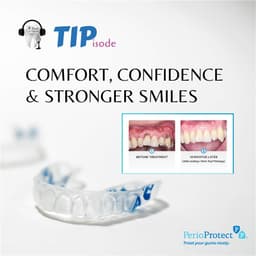
Let's talk about remin gel from perioprotect.
Remin gel is a hydroxyapatite rich gel
that features precursor compounds that bind quickly to tooth surfaces,
delivering bioavailable calcium and phosphate ions
to support enamel repair.
It's fluoride-free and contains no xylitol.
For patients seeking relief from sensitivity
and providers looking for a better way
for their patients to remineralize enamel, this is it.
Remin gel with perioprotect trays
worn just 15 minutes a day
has patients reporting sensitivity drops
of more than 50% in seven days.
And 80, yes, 80% in just 21 days.
Learn more at perioprotect.com-rdh.
That's perioprotect.com-rdh.
With cost rising everywhere, every dollar counts.
Especially when it comes to the office supply budget.
Net32 helps practices find better pricing
on the same products we already use.
And those savings can add up quickly.
That extra room in the budget can go right back into the hygiene department,
making sure we have the tools and supplies we need to do our jobs well.
It can also open the door to investing in new technology
or even adding extra support when the schedule is packed.
It's not about spending less.
It's about spending smarter.
If you want your office to save time, save money,
and purchase smarter, have them check out Net32.
And with a 30-day money-back guarantee, there is no risk.
Visit net32.com-rdh.
That's net32.com-rdh.
I think that community is very important.
It's very important to connect with not just people in your profession,
but people who inspire you, people who encourage you,
and challenge you to grow and develop,
and to be a better version of yourself for a long time.
I used to talk to myself out of doing a lot of things
because I would just my immediate response to any creative idea
I had was, what if it doesn't work out?
What if it's not received well?
What if I accept people?
What if people come after me?
Or they speak negatively about me online?
Like, what if what if what if?
I was rarely ever thinking about what if it goes well?
What if it works?
What if it really resonates with somebody?
And really help?
It's Net32.com-rdh.
Welcome back listeners to a Tale 2 Hygienic Podcast Episode 529.
My name is David Torres, and I am here with
the clinician in the catalyst, the floss boss,
the periocuin in the gingerval guru,
and the best co-host ever, Ms. Jessica Arkison.
Ooh, gingerval guru.
That's a good one, Dave. That's a good one.
And today, Dave and I are joined by one of my favorite people.
This is true, Bethany Montoya, and Bethany,
we chose to have you on because this month,
we're talking about advocacy, legislation, things that are happening.
And at the end of the day,
all of this starts at ground zero, our office,
what we're doing day in and day out,
and you just fit into that category.
I watch you on social media, and I just think,
wow, Bethany, yes, yeah, I find myself saying yes, yes, yes.
So Bethany, tell us a little bit about yourself,
and why advocacy is so important to you,
and how you did it without burning out.
Yeah. Well, thanks for having me, guys.
I will be completely honest and say that although my heart for advocacy
is strong now, it wasn't for many years of my career,
and so I graduated from hygiene school
in Southern Colorado in 2012.
And I tell people that when I was a hygiene student
in Colorado, my ultimate goal was to finish school,
get a couple of years of experience working for a private practice somewhere,
and eventually I wanted to have my own practice.
But after graduating, our family situation had kind of changed.
My parents had relocated to North Texas,
and they were getting very close to retirement,
and just started kind of gently hinting that if my husband and I would consider moving to Texas,
that they would be available 24-7 to help with our kids,
and we didn't have that where we were in Colorado.
So we decided to move just months after I finished hygiene school.
And so I will say, from a professional aspect,
I experienced pretty severe culture shock coming to Texas.
I, from Colorado to Texas.
I came from a state where hygienists are empowered to do a lot of things
to a state where hygienists are very restricted from doing a lot of things.
And even just the general mentality toward hygienists,
I felt was very, very different.
I experienced a lot of kind of criticism
during some of the working interviews that I did early on.
Just a lot of practice owners really scrutinizing my education,
and the mindset that I was coming into the practice with,
they really weren't used to a hygienist coming in with an ownership mentality.
They're used to a hygienist to choose one of the girls,
or auxiliary staff, and that's just not the way I was trained.
And so it took me some time acclimating and just adjusting.
But I did, and I worked for about the first five years of my career in a corporate setting.
It was very demanding, very high volume.
And so crushing.
Yes, there were good parts about it.
There were bad parts, I would say, you know, looking at the bright side,
I learned a lot about the business of dentistry.
I learned how to read reports.
I learned how to monitor my metrics.
I learned how to really cultivate my communication style with my patients,
so that I wasn't just trying to get them to go along with my treatment recommendations.
I was really coming from an educator's perspective,
really wanting to teach them about their health and teach them about themselves.
I found pretty early on that coming from that place,
yielded me a lot of success with my treatment acceptance.
And so I did really well in that environment,
but at the same time, I experienced burnout pretty quickly.
I just didn't know there was a name for it.
I was just working so hard all the time.
It felt very much like a grind and not really like health care,
like what I had signed up for.
And so I ultimately decided to look for a new job.
And I got hired on at a private practice.
And I didn't know it at the time, but the practice was fee for service.
And I remember them asking me during the interview,
do you know, are you familiar with the fee for service practice?
Do you know what that means?
And I said, no.
But I did notice, even though I didn't understand what that term meant,
I noticed that things seemed to be a much slower pace at the office.
And I noticed that the doctor was giving me a lot more autonomy in the practice
to treat patients the way I felt they needed to be treated.
There was a lot less pressure to meet certain goals and benchmarks.
And it was the first time in my career where I really felt like
I had leadership who was interested in developing me as a leader.
And so I had a really great experience in that practice.
And I worked there for several years.
And then since then, I've kind of experienced a lot of different things.
I've worked in dental sleep medicine.
That was a cool experience.
But when it comes to clinical practice,
I've mainly stayed in fee for service or out of network environments.
And that's where I feel like I've been the happiest
because I feel like I'm really valued for the care that I provide
and not for the production that I bring into the practice.
And I think that when the care is prioritized,
the production follows like it all works out really well that way.
So that's just a little bit about me.
And then maybe during the COVID pandemic,
I was let go from the practice that I was working at.
And it absolutely crushed me.
I wasn't expecting it.
And I really wrestled with that for several months.
But picked myself up.
And I decided that I wanted to claim a little more ownership over my career
and have a little more control over my income.
And so I started developing myself as a writer.
And that led to speaking.
And it led to me starting a social media brand.
And and that's really where my heart for professional advocacy was born
is the more that I started speaking to and connecting with my peers and my colleagues.
I really started to really appreciate the value of the dental hygienist.
And so I know now, you know, years into this.
Sometimes I'll post on my social media, I'll post content.
And I get really touched because once in a while,
someone will say in the comments, thank you for being our voice.
And I'm just so grateful to be in a position where I can be a voice.
And and I want to use that that opportunity for good.
And I want to see dental hygiene expand and progress.
And I also just want to lift up my colleagues with me.
I want to I want to see good things happen for everybody.
So that's just a little bit about me.
So you mentioned you graduating in 2012.
I graduated in 2012 myself too.
Oh, cool.
And I think, yeah, I know we're graduated buddies.
Yeah, twins.
I think that we go through the shift or this,
there I say, infancy at the beginning where you graduate where you're kind of finding your
footing, like, do I work in private practice?
Do I work in DSOs?
Do I volunteer?
Do I go back to school?
But you and I have that similarity where we've done this long enough.
That life just happens to us.
I can relate.
My wife is a hygienist as well.
And when COVID happened, it was both of us right in the wave of uncertainty
where we may not have an income.
So what do we do?
And I think you developed this, I want to say,
you learn from your lessons, right?
Like life happens to you and you level up.
You were like, I'm not going to take this for face value.
I'm going to make a change, be a change, create a change.
And if I don't have a solution, I'm going to come up with one.
So how do you speak to that listener that's probably in that stage that
God forbid, they don't have another pandemic.
We don't have another pandemic.
Guys, everybody knock on.
Which, right?
That we don't have another another pandemic, right?
But, you know, they're experiencing, you know, moving.
Maybe their spouse is in the military where they're going to a different state
and their face would uncertainty or short-term disability.
How do you advocate for that listener where there's a storm coming?
And I don't know how to navigate this.
But I know, deep down inside that I'm going to overcome it.
And I'm going to weather this storm.
What are some of those feelings and emotions that you probably felt
where you were resilient as opposed to
giving up or saying this is not going to happen to me?
Yeah.
Well, my story to finding kind of myself outside of clinical hygiene is kind of interesting.
I, after I had been let go from my practice, I went for
maybe a four-week period where I was unemployed.
And then I kind of jumped back into things with a new practice.
And I just, I was very discouraged at the time because I was still
reeling from everything that I had gone through and getting fired from my last job.
But I also was dealing with a very toxic environment
that I had recently joined in this new practice.
The leadership just wasn't strong.
And in fact, one of the doctors at the practice really encouraged a lot of division and discourse
between the team members, which just made coming to work every day kind of a nightmare.
And so I just continued to kind of spiral into this very dark place.
I was deeply depressed and like many hygienists that I talked to you know,
I felt very stuck because at the time, I had an associate degree in dental hygiene.
And that's all I could see is that I, I had this entry level degree in a very specific
trade that I felt like I couldn't use it for anything.
So I didn't know what to do.
And and so when I was on Facebook one day, I connected with this girl
that she also was a hygienist.
And she also had been let go from her practice during the pandemic.
But she ended up making a transition out of clinical practice completely.
And she started working with a kind of a practice management like a consultant group.
And I was just kind of watching her career development from my Facebook feed.
And I was really inspired by it.
So one day when I just really had hit like one of my lowest points,
I went out on a limb and I decided to send her a private message.
And I had no relationship with her.
But I sent her kind of a lengthy message just explaining my situation and
how I was feeling at the time and and feeling really lost and confused and stuck in my career.
And I asked her if she had any advice for me because I had seen her transition.
And it was really inspiring to me.
And so she was kind enough to respond and ask me if I wanted to have a phone call with her.
And so we talked on the phone and she was just a great listener.
But I just I remember toward the end of the conversation.
She said Bethany.
I couldn't help but notice that the message that you sent to me was kind of long.
But as I was reading it, I came to the realization that you're a good writer.
Have you ever written anything before?
Like, have you ever pursued that at all?
And I said, no, she said, have you even thought about it?
And I said, yeah, I've thought about it.
And she asked why I never pursued it.
And I said, well, I just I wouldn't even know where to start.
Like, I don't feel like I have anything to say that people would want to read about.
And she said, that's not true.
Because what you just shared with me and your message is very relevant.
And so many people can relate to your experience and your feelings.
And so anyways, she directed me to RDH Magazine and she connected me with Jackie Sanders.
And so as soon as we got off the phone, I nearly ran to a notebook and I just started brainstorming
like different topics that I would want to write about because her suggestion to me
was to pick out a topic that I felt like I could hold maybe a five or 10 minute conversation with
with somebody without even having to do any research where it's something that I just
already knew it was in my wheelhouse.
And so I just started brainstorming about all these different topics.
But ultimately what spoke to me the most was my experience getting fired.
And so that was the first article that I wrote and I sent it to Jackie Sanders.
And she got back to me pretty quickly and she also said, hey, let's have a phone call.
And so I had a really great conversation with her.
She kind of educated me in what's involved with being a regular writer.
She gave me some advice and some coaching and things just kind of took off from there.
I just I started writing a whole bunch.
I think I was probably submitting at one point.
I was probably submitting four or five articles to her a month.
I'm going to go, I think.
Thanks. Yeah, the more the more that I started to do it,
companies started reaching out to me and saying, you know, we're familiar with your work.
We wondered if you ever do any product reviews.
Maybe we could send you some products.
You could try it out and just give us, you know, your honest feedback in article form
for the magazine.
And then after I started doing that for a while,
then they started reaching out again and asking, what else do you do?
Do you speak?
And I said, no, but I'm willing to try.
Like I do now. Yeah.
I just kept saying yes to opportunities.
So really that's that's kind of my origin story is.
I hit a really desperate kind of dark place,
personally, and I reached out to somebody for help.
And thankfully for me, that person that I happen to reach out to
listened and they were willing to just give me just a few pointers, just some direction.
And I kind of ran with things from there.
And the cool thing now is I kind of get to pay it forward in a sense because I get a lot
of hygienists that reach out to me now either through email or private message on social
media, kind of with the same story like help.
What do I do?
And I love that I get to be that person to give them a little bit of guidance.
And I can't say that every person that I talk to, you know, does what I suggest.
But I have had quite a few stories come back from people saying like I did what you suggested.
I tried this and it's working really well.
Like now I'm starting to I decided that I wanted to start a side business and I'm working on that.
Thank you so much for your insight.
So it just took a compassionate person in my profession.
And and that's what I try to be now to my peers.
I just want to be a place of compassion for them too because it's it's hard.
Our profession's really tough.
And I know I know that every profession has its pain points.
I don't want to make it sound like ours is the worst ever.
But I think that community is very important.
It's it's very important to connect with not just people in your profession,
but people who inspire you.
People who encourage you and challenge you to grow and develop.
And to be a better version of yourself.
And so I just I feel extremely grateful that I was able to make those connections years ago with
people who inspired me to be better.
I love that.
I think the bedrock of advocacy is connecting with others.
The bedrock of change is connection.
And to connect with someone.
His listen, I have had rough days.
I don't always have the sunshineiest best outlook on what our future looks like.
Great.
Bethany, I appreciate your candor and talking about how you've gone through these
experiences of deep depression.
And for anyone looking at your career right now,
that's not something that somebody would say would be part of your story.
But I think because it is part of your story that opposites those that comparison for you
makes you even more so profoundly impactful in in the space in which you're in now.
And gives hope to those who maybe are going to be like,
well, I'm not really loving where I'm at right now.
This message is for everyone that's it's working out great.
The message of advocacy is in the office where the dentist is giving them the instruments
that they need.
And they're really having all the things they need to be the hygienist that they want to be.
And in reality, this advice, this platform is for where you're at right now.
And to connect to someone who is a little bit more down the road
or doing something that you admire is the bedrock of advocacy.
Yeah, thanks.
It reminds me of like a lotus flower.
For those of you that don't know, right?
A lotus flower blooms on murky water, right?
And so being resilient and being able to feel that I got kicked in the and I got punched in the
gut and I feel really bad right now and I feel bad.
You can feel bad and go through your stages because it's going through stages of grief too,
right? It's like a bad breakup like you're told you got to let go, right?
Being in that environment in the stage and still coming ahead and looking at what
everything that you've been able to manage to do out of that has been really inspiring.
And there's probably somebody listening right now.
Maybe they're in bed, they're having a gloomy day or they're in the gym and they're
taking it out on a punching bag.
Please take it out on a punching bag now and somebody else had a fork, right?
But taking it out of the gym or even driving and they're in that reflection state and listening
to your story and knowing that you can come ahead out of it and be a better person,
level up yourself.
But it mostly happens because you believe in yourself and because you believe in yourself,
you ask somebody a question and it comes across as I'm like,
oh, I understand you're struggling, which we all go through these stages.
But somebody's somewhere out there is believes in you and what you could be,
you could be a great writer or motivational speaker.
And hearing that tone and understanding that,
yeah, there's going to be sunshine at the end of the day, right?
When it rains it pours, but the clouds will clear.
And that reminds me of, you know, I too, once upon a time, they'd get fire too
and it was very relatable.
The difference is I didn't become a social media influences like you did, right?
But it was very difficult to feel lonely.
But when you kind of share your story and just connect with people that have that empathy
and understanding, it's like a fresh breath of air, right?
Like, okay, I'm not going through this by myself.
So yeah, you're like a load, guys, be the loaded flower.
Kind of so nice.
Thank you for saying that.
I didn't know that about lot of flowers, but I didn't know that about Bethany.
Well, thank you so much.
Yeah, it's just, I don't know, like when I started my social media brand,
I was really trying to think of what my handle was going to be, you know,
like what I wanted to call myself.
And at the time, like, and I think still, like what was kind of trending at the time
is a lot of the hygiene accounts that were coming out were something RDH.
Maybe it was their first name, RDH, or their area, their realm of expertise, RDH.
And so I kept thinking to myself, like, gosh, what would I want to call myself?
Like, I don't know if I want to be Bethany, RDH online.
But I also don't know if I have like an area of specialty that I could use in my name.
And the word human just kept coming to me because I just really wanted my social media
account to be a place where I could be authentically me at all times.
And because you're an expert of being a human being.
Yeah, yes.
And I will say if there's a realm of expertise I have, it's just being true to myself.
And that has taken me years to get to that point.
It's taking me a lot of the inner work to be able to get past the desire to people please
all the time and the desire to present the persona that I feel like most people would
appreciate and respect to be able to overcome all of that, to just want to be me at all times.
That's really what I wanted.
And so I'll be honest in the very beginning, I kind of felt like I was faking the humanity part
because I was still kind of finding myself and finding that inner strength.
Or is that the definition of the humanity part?
Yeah, yes, it is.
I mean, it was my journey and my journey is, you know, it's still in progress.
Like it's just, it's going to keep going the rest of my life.
So I don't know, like I just, the longer that my account has been around,
I've just really come to appreciate that human part to it because I can just see
when I share things about my thoughts or my experiences, I can really see how a lot of times
are pretty universal and a lot of my audience will reach out saying, oh my gosh, I'm so glad
that you shared that because I went through that too recently and I didn't know how to handle it
and your post really encouraged me or whatever that might be.
Like I just, I love the connection and the community that my account has brought and
but also like to your point Dave, like you were kind of talking about, you know,
the maybe the fear of branching out or trying new things, trying to create change or feeling
the fear of maybe an uncontrollable in your life that's about to alter things like
one thing that I've really had to overcome in my own life is just the negative self-talk, right?
Like for a long time, I used to talk myself out of doing a lot of things because I would just,
my immediate response to any creative idea I had was what if it doesn't work out?
What if it's not received well? What if I upset people? What if people come after me?
Are they speak negatively about me like online? Like what if what if what if?
I was rarely ever thinking about what if it goes well? What if it works? What if it really resonates
with somebody and really helps? So I had to change my frame of mind quite a bit in that way
and over time, you know, the more that I just kept clinging to my authenticity, I really
have come to find it as a great strength and now I just, I don't know who else to be at this point,
like I love being me and I love being around other people who are authentically themselves too
and they're so strong in it and and very comfortable in in their own skin and so I don't know like
it's it's a good place to be. Life is not perfect for me. I would never want anyone to think that
and actually I just recently went through like some turmoil in in my work life and everything
but it's always it's only for a season. It'll only last for a little bit and and better days are
ahead so positivity always. I love that the story isn't that things won't be difficult
or things won't challenge you. The story is when you're having a hard time believing in yourself
surround yourself with people who believe in you. When you're going through a hard time, make sure
you are sure to buy a community and I think yeah at the end of the day when you're advocating for
yourself to not burn out it's because we cannot do it alone. To avoid burnout means stop trying to
do it alone. Sometimes I feel like am I the only one who cares about this and and at the end of
the day I'm not the only person who cares about the things that are important to me. So if you're
listening out there and you're like you know I do care about the future of dental hygiene. I do
care about advocating for myself. I am feeling a little doldrum about it. What do I do? Listen to people
who are looking for the positivity. Listen to people who will give you options and not restrictions
and remember that you're not alone nor can you do it alone. So thank you for listening and thank
you for being here Bethany. Yeah absolutely thanks for having me. And guys get get inspired by the
fact that sometimes we have the self-defense mechanism or protecting ourselves with the what is
but embrace the painful parts. Embrace those hard moments those storms coming because I can't
think of a person that weathered that storm and weren't better off for it. Just like a muscle you
challenged it you you tested and you work it you get stronger by those difficult moments. So Bethany
thank you for being that strong muscle that lotus flower that advocate for all of us and
you're making an impact out there and for those of you that are listening that hey I need
I need to be able to pull on some of that positivity. Bethany is your person. Thank you for being
here. Thank you so much. I appreciate you guys. That's a wrap on today's episode of A Tale of
Two Hygienous Podcast. If this conversation made you feel seen inspired or even just a little
fired up share it with a fellow hygienist or fellow dental professional. Share it with your
neighbors your friends share it with everyone. That is how this community grows. Make sure you
subscribe even to review and connect with us on social media so that we can keep on going
with this conversation. Remember you career your voice and your story matter here. We're David
and Jessica and until next time keep learning keep laughing and keep showing up for yourself
and for each other. This has been a production of Endeavor Business Media, a division of Endeavor B2B.
More from A Tale of Two Hygienists Podcast
View all episodes →
531 When Advocacy Doesn't Win: How to Respond When Legislation Goes the Other Wa...
A Tale of Two Hygienists Podcast
Mar 25, 2026·30:24·pending
530 Legislation 101 for Hygienists: What Actually Moves the Needle
A Tale of Two Hygienists Podcast
Mar 18, 2026·37:13·pending