About this episode
Big thanks to Cisco for sponsoring this video and sponsoring my trip to Cisco Live Amsterdam 2026.
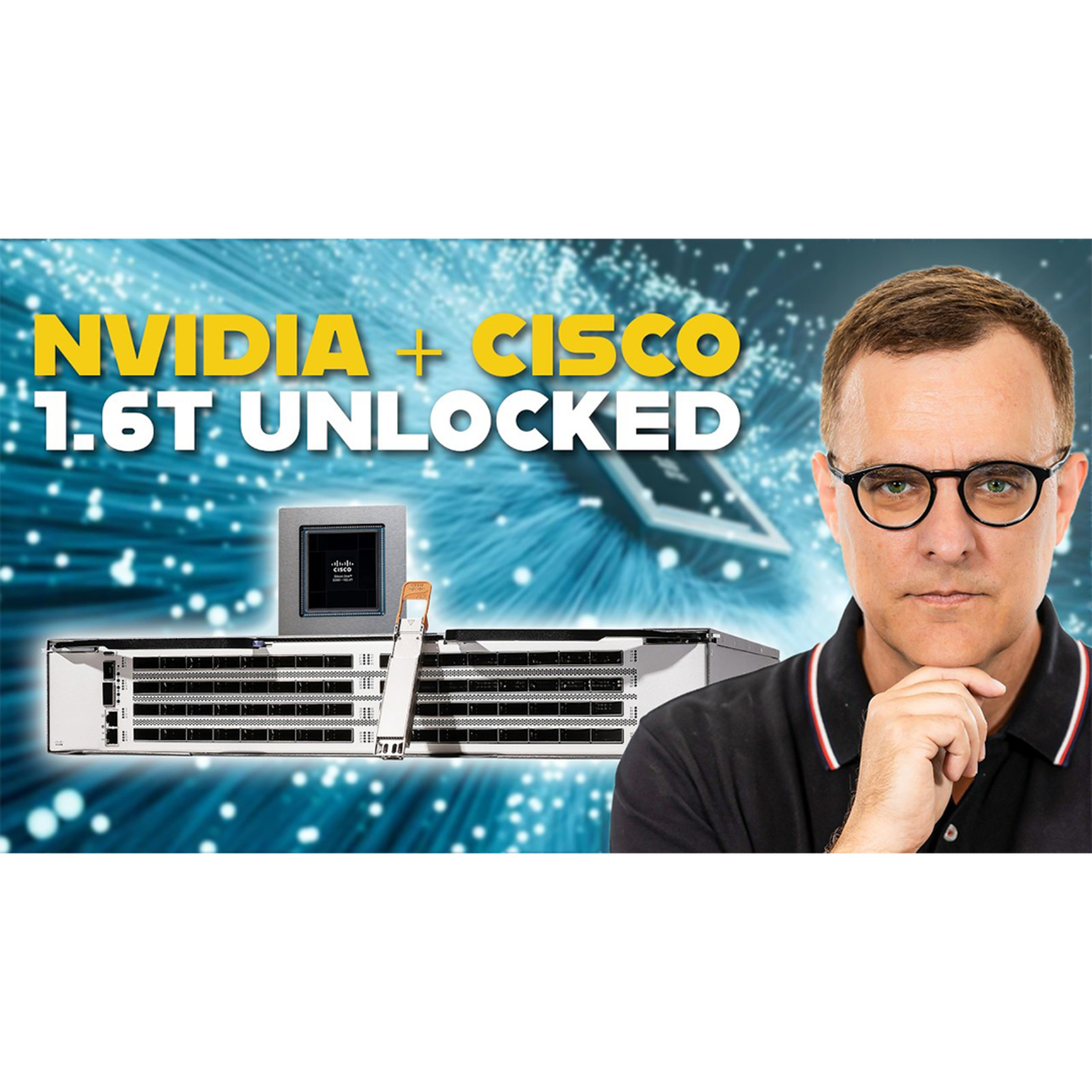
In this deep dive, Cisco’s Head of Corporate Strategy, Nathan Jokel, joins David Bombal to unpack the future of AI data centers and the groundbreaking Cisco and NVIDIA partnership. Discover how 1.6T networking speeds and the new 100T G300 silicon are solving massive infrastructure bottlenecks to keep GPUs running at full capacity. We explore the critical role of network security in the AI era, detailing the Splunk acquisition, HyperShield, and eBPF technology. Plus, get an insider's look at the looming power constraints facing data centers in 2025, and how Cisco is preparing for the future with post-quantum cryptography and distributed quantum networking.
// Nathan Jokel’s SOCIAL //
LinkedIn: / nathanjokel
// David's SOCIAL //
Discord: discord.com/invite/usKSyzb
Twitter: www.twitter.com/davidbombal
Instagram: www.instagram.com/davidbombal
LinkedIn: www.linkedin.com/in/davidbombal
Facebook: www.facebook.com/davidbombal.co
TikTok: tiktok.com/@davidbombal
YouTube: / @davidbombal
Spotify: open.spotify.com/show/3f6k6gE...
SoundCloud: / davidbombal
Apple Podcast: podcasts.apple.com/us/podcast...
// MY STUFF //
https://www.amazon.com/shop/davidbombal
// SPONSORS //
Interested in sponsoring my videos? Reach out to my team here: [email protected]
// MENU //
0:00 - Coming Up
01:29 - Intro
02:20 - Demo Overview
03:57 - Demo Begins
09:35 - Adding Guardrails
11:45 - Secure Workloads
14:30 - Segmentation Workflow
18:33 - Overviewing Finance App
21:02 - Encrypted Visibility Engine
24:34 - Firewall Observability and Control
25:44 - Ant's Advice For The Youth
26:40 - How to Learn Hybrid Mesh Firewall
28:16 - Conclusion
Please note that links listed may be affiliate links and provide me with a small percentage/kickback should you use them to purchase any of the items listed or recommended. Thank you for supporting me and this channel!
Disclaimer: This video is for educational purposes only.
Get every episode summarized
Each time David Bombal publishes, we email you a written briefing from the transcript — the topics, who appeared, and any specific claims, with the ad reads skipped.
Email me new episodesFree for 3 shows. No card needed.
Hosts & guests
Transcript ready
452 searchable segments. Every word is indexed and playable.
Full transcript
David Bombal — #567: Why Power Is Becoming a Major Problem for AI in 2026. Machine-transcribed; use the interactive transcript above to jump the player to any line.
Each switch interface is 1.6T speed, so yeah, it's really fast. We've gone from going 10 meg to 100 meg to gig and now 1.6T. So we've announced the silicon, the systems that go along with that, and then some really fast optics actually that go in and help connect from the electrical to the optical interface. Okay, so that solves the networking issue. Yes. And then what about security? I'm assuming that as we mentioned earlier, the little splunk acquisition is part of that run. It's absolutely part of it. So, and we've invested in over 180 companies I want to say. How many was that? 180 or more. Yeah, we've been pretty prolific over the past several years. And last year we actually announced a billion dollar fund to invest in early stage AI companies. And again, we love to build these technologies in house, but our engineers can't possibly build everything. And so... Everyone dared bumble back with a very special guest. Nathan, welcome to the show. Oh, glad to be here, David. Thanks for having me. So, Nathan, we're going to talk about some really cool stuff,
because you've been involved in, I believe, the acquisitions with Splunk, and we want to talk about Nvidia. But before we get there, can you give us a quick background, or like a quick introduction about yourself? Absolutely, David. So, Nathan, Jokel, I lead the corporate strategy team at Cisco. So, really looking out for long-term direction, growth, innovation, supporting our executive leadership team, and all the general managers across the organization with long-term strategy. I also manage some of our most strategic partnerships across Cisco, so thank you, Nvidia, that you mentioned, our relationship with public cloud providers, like Amazon, Microsoft, Google. You're involved in the Splunk acquisition, right? I was, right. So, I have a peer that leads our corporate development organization, who drove the acquisition. My team from a strategy perspective really worked at the beginning of that, to think about, you know, from a build-by partner perspective, where should Cisco be, and Splunk really came to the forefront. So, we can certainly get into some of that in more detail. I love that. So, let's start with Nvidia, because I know Cisco had the AI summit recently, and I watch Chuck and Jensen having a great conversation.
So, for everyone who's interested, I'll link that below. Really good conversation, and there's like a cool surprise there, because they got better and better as it went along, I think, in my opinion. It was a great conversation, but perhaps you can give us some more information. So, what's the partnership like, where you guys going? Where do you see the future? Absolutely. Well, the partnership with Nvidia actually goes back almost two years now, when we first started talking about AI, we had this Chatchee BT moment. So, really, if you think about Cisco's position in the ecosystem, we're providing really a full stack to our customers, to help them realize the benefits of AI, and infrastructures at the foundation of that. We provide our servers, our silicon, our systems, and optics, but we're not a GPU vendor, and Nvidia is the leader out there. And so, we linked up to make sure that we're delivering fleet solutions that our customers need to deploy AI, whether that's for training, for inference, where Cisco brings its unique spin, because Nvidia has a number of partnerships in the ecosystem. It's really our expertise in security.
So, when you think about AI, it brings all these new opportunities, but also new security threats and risks that people need to think about. How do you protect the AI stack itself? And then, how do you really protect the world from AI that we're deploying? And so, what we've done with Nvidia together, we've developed what we call the Cisco Secure AI Factory. So, it brings not just our hardware, but AI defense, Splunk, integrated into the system, so that our customers can realize the benefits of AI securely. It's the other thing that really is important about the Nvidia partnership. So, we've brought our expertise and networking. Now, Nvidia has been hard at work with their spectrum system, both Ethernet and as well as Infiniband, really providing the high-speed interconnects that GPUs need. Do you think about the backend network, scale up, scale out across racks? Well, Cisco, currently we're the only networking partner that's fully certified as part of Nvidia's reference architectures. We've actually taken some of their technology,
built it into our silicon, our switching, so that it's fully compatible with Nvidia, we're actually also building switches with Nvidia spectrum silicon, and what that gets for our customers, things like advanced congestion control that standard Ethernet doesn't really give you. And if you think about an AI workload, if you're dealing with any packet loss, any latency, it can actually set back an entire training workload, which would be extremely expensive. And so, being able to have that kind of handshake between Cisco networking, the Nvidia SuperNix, that really gets the most enhanced performance. So, we're really excited about the partnership. We're bringing our technology together and bringing it to the markets, really help our customers. If you talk more about the AI effect tree? Yeah. So, if you think about it, it's a complete solution. So, compute storage from our partners, Cisco networking, Cisco security, into an all-in-one system, and there's different footprints, depending on the size and scale of what the use case customer needs to deploy.
But the idea is you're really getting out of the box, seamless capabilities, for the full AI stack. And one thing that we find is particularly helpful. We talked earlier about the security capabilities, but also the management aspect of it. So, if you are an IT professional, you're not necessarily as familiar with maybe the native operating system that Nvidia runs on their switches, or, for example, Sonic. But we can provide a familiar kind of IT focus, whether that Cisco's Nexus operating system, or HyperFabric, to be able to really give a seamless management experience with our secure AI factory. And we find that really helps ease adoption. Because, look, there's all this promise and value of AI out there, but actually getting into the data center, putting into practice, it's a little easier said than done. So, anything we can do to reduce that friction and help our customers is a big focus for us. So, you're just getting video working on hardware together, as well as software together.
That's right. So, there's a whole NVIE, which is like Nvidia software for the enterprise, because GPUs are great, hardware is great, but you ultimately need to run a model on that, you need to run an application. And so, basically, having all that full software stack that you need, that's ready out of the box for whatever AI use case you may deploy. And then, our teams actually go in and work very closely with customers. For example, I was just sitting with one of our manufacturing customers the other week, who's trying to optimize their production line, they're deploying one of our AI factories. And so, we're working with them, not just on the hardware layer, but actually the application, how that integrates into their manufacturing systems, holes in their data. They wanted to deploy it on-prem, because, again, think about this manufacturing company. Their secret sauce, they have parameters and tuning in. I want to put that in the chat GBD. Exactly. They do not want that getting out there. So, really having control of their own data, and they were able to do that with Cisco Security Eye Factory. Powered by Nvidia's technology. Can Rick me if I'm wrong?
But I think Jensen said on stage with Chuck that it's security and networking that are holding AI back. Yeah. So, if we think about all the constraints, and there are some very obvious ones, which is like power, which we can get into a little bit later. That would be great. But customers, especially from an enterprise perspective, they really need to feel safe. They need to feel secure in order to apply this technology. And so, being able to build security directly into the AI systems, really helps give them the confidence to deploy this. And know that they're mitigating against risk. They're complying with all the regulations and policies that are out there. And then networking absolutely. If you think about GPUs and compute being the necessary ingredient to Power AI models, well, you need to get the most utilization out of those GPUs possible. And that's where the network really becomes key. And so, you're absolutely right. That was a key call out from Jensen. And you just have just announced a really amazingly insane, fast switch, I believe. 100T switching silicon. So our G300, right? So if you think again about AI networking,
we're talking about the backend now that interconnects GPUs to each other. You've got scale up within a rack, scale out the connects racks together, and then scale across between data centers. What we announced yesterday was our G300 silicon one chip. And that's really for the scale out connecting different racks to each other. So it's 100T chip. Each switch interface is 1.6T speed. It's crazy. So yeah, it's really fast. We've gone from going 10 meg to 100 meg to gig and now 1.6T. So we've announced the silicon, the systems that go along with that, and then some really fast optics, actually, that go in and help connect from the electrical to the optical interface. Okay, so that solves the networking issue. Yes. And then what about security? And I'm assuming that, as we mentioned earlier, the little splunk acquisition is part of that, right? It's absolutely part of it. So when you apply that to AI, security angle is really important in terms of making sure that workloads that are running in an AI system, just like any other workload, you want to be able to monitor from a security operations perspective
what's running. Some of our largest customers that are in the NeoCloud space that are actually really building up at the forefront of some of the largest AI data centers in the world, it's actually a splunk that was one of the most interesting security technologies, and they'll be building out a massive sock to oversee multiple of these AI data centers running at scale, and a splunk is a key technology at the heart of that. The observability piece of splunk is actually pretty important, too, when you think about these AI workloads that we were talking about before that are so compute intensive performance, you want to make sure you're getting every ounce of performance out of it, as well as if there is any kind of issue you're able to quickly triage that and get it back up and running. So, in I live in the UK, and there's been in the news, BBC have reported, and I believe it's the same California, these reports about AI data centers are having a problem with power. There's a constraint on power, and in some cases, even water. So, you know, what are we doing to address that problem? So, it's certainly a problem in terms of what are the things that are going to hold AI back
from scaling, right? When you think about supply chain constraints, and is there enough memory, and can we produce enough silicon, that's one, but power is foundational. In fact, in Europe here, in 2025, about 2.7% of all electricity generated in Europe is powering data centers, that's going to be up to 5% by 2030. And so, it's a really big demand. I think a lot of different countries are taking different approaches to how we address that demand. You can look even, for example, at China, where they've really taken all of the above strategy, right? It's renewables, it's nuclear, it's fossil fuels. And so, I think Europe and the US can really think about what's the national approach to bring more power online, but leaving aside the big picture, like, what can we do as technology vendors, right? And technology leaders making these decisions, in addition to the usual things around performance and cost, really thinking carefully about power draw, and power efficiency of the technology that we're building and deploying,
because it's not just for sustainability, right? This is actually a business advantage as you're thinking about being able to deploy AI and other workloads. So, G300 that I mentioned we announced just yesterday, along with a new generation of optics. We actually have a technology called linear pluggable optics, which are, these are 800 gig, really high speed optics. They actually offload that DSP, that digital signal processing capability, from the optic itself to our silicon one, which is very cool. And that gives you a 50% power advantage relative to standard optics. So, we're really, really investing hard in making sure that we have the most power efficient technology in addressing this power gap. So, I'm really old. So, I remember years ago when Cisco acquired Celsius, and the whole VoIP revolution took place. So, I remember working on the old Celsius phones, and then Cisco had their call manager for, for being so old, but that changed the whole world. And I remember guys who didn't change their skills, got into trouble from traditional telephony, because VoIP just changed everything.
And I mean, that's the thing about technology. You just have these waves. So, I mean, it's really cool to see some of the acquisitions and perhaps you can talk about that. We've mentioned Splunker. I don't know if you want to talk more about that, or other acquisitions. Sure. Because, obviously, you guys are seeing things, and then acquiring these companies and writing the new technologies and AI being sort of the latest one. And perhaps Quantum is happening. Perhaps you can talk about some of the acquisitions that you've been involved in. Sure, and I'd love to come back to Quantum, because that's another favorite topic of mine. But if you think about acquisitions, I'll answer it from my lens, which is from a strategic one. Yeah. You know, obviously partnering very closely with my peers in corporate development that leads some of these. If you think about it, we have a build by partner and best strategy. So, you talked about technology moving very rapidly. Obviously, we're innovating from an organic perspective, right? Cisco deploys over $6 billion of R&D every year, and a lot of that for cloud AI security things. But sometimes there might be innovations in the market that other companies have developed, and we want to bring that in and leapfrog. And so, that's where our investments
in acquisition strategy really helps here. When you think about investments, we've invested in over 180 companies, I want to say 180 or more. Yeah, we've been pretty prolific over the past several years. And last year, we actually announced a billion-dollar fund to invest in early-stage AI companies. And again, we love to build these technologies in-house, but our engineers can't possibly build everything. And so, we take observer positions and really monitor what's going on with these early-stage companies. We also form commercial partnerships with some of these companies, so think about what we've done with some of the AI models, like Mistral AI, right here in Europe, or some of the larger ones. And so, we've kind of used Cisco's enterprise reach and go to market to help these early-stage companies scale, and also then, you know, integrated their technology. And in some cases, these investments actually then turn into acquisition. So, if you look at, for example,
we've a kind of company called Armor Blocks in the security space. I'll think about EVBF. Oh, yeah, exactly. That's another great one where, if you think about that technology, and Isovailin, these were really the backers of EVBF extended Berkeley packet filter, right, which is a really, really innovative thing. You're able to basically do things in user space and inspect packets in a very deep way. We brought that in, and it was a very unique to Cisco that actually we've now been able to build that EVBF technology across all of our switches, all of our neural systems, which is actually exactly right, the foundation of our hypershield technology, so really fusing security into the fabric of the network. And that started with acquisition and investment. So, basically, our inorganic strategy is really a good compliment to the organic strategy. And then the last piece I mentioned build by Partner Invest. So, Partner, right, we talked a little bit about Nvidia, but Cisco has a number of other strategic partnerships. We're very closely with all the large cloud providers,
for example, Amazon, Microsoft, Google, and it's about building our technology together to integrate, make sure that users of these clouds have access to Cisco's security and networking technology as first party, as well as making our technology available through the cloud marketplaces and other aspects. And it's an ecosystem, right? Yeah. No one's, you can't stand alone. That's what it really comes down to at the end of the day, David, right? We want to work with the technology ecosystem that's out there to deliver solutions to our customers, as well as also participating and shaping the standards that really help define our industry. So, I think, you know, Wi-Fi 7, now Wi-Fi 8, like, really making sure that the way that those, actually, technology standards come together, it's in the interest of our enterprise customers. Yeah, I mean, people forget, right? I, again, showing my age. I remember Cisco created Ether Channel, and I mean, we had the industry standard off to that. I mean, Cisco's doing a lot of that, where you create something and then you work with partners and the ecosystem
to create an open standard for everyone. That's exactly right. And there's, there's standards development organizations like the IETF or Etsy here in Europe. And Cisco is absolutely representing, representing ourselves in those standards bodies, as well as working with our peers in the industry, because we want to make sure that our technologies are interoperable and that, if, and we know our customers have heterologists' environments, they're, they're consuming products and solutions for other vendors. They need to work together seamlessly, and that's where the standards help. And I've, I love that, because I've seen, like, even G2 from stage is talking about, like, open source stuff. And I mean, like, putting stuff on hugging face. It's fantastic to see that. No, absolutely. If you think about, again, back on the AI topic, we've taken some of our data, some, we see all this networking telemetry, security events. We've actually trained some foundation models in AI, so our foundation security, 8 billion perimeter model, for example, and we made that available as open weights, because really the goal is to protect everyone from the bad guys out there,
so making that, that model freely available on hugging face so that our customers can, can make use of it. Wait, do you see things going just before we wrap up? Yeah, absolutely. Well, look, we'll, we'll continue to, to look out into the market for opportunities, as I mentioned, build by partner invests. We'll keep our, our engineering teams under G2, you know, hard at work, developing technologies organically. But, you know, as, as we think about merging technologies, we keep an eye on things like quantum, for example, again, not suggesting that we're going to do anything there from a acquisition perspective, but just really making sure that we're, we're really focused on what's going out on the market, and keeping our finger on the pulse so that we're ready and able to bring those technologies to our customers as fast as possible. Sure, I'm just going to keep you for one minute longer, hopefully I would don't get into trouble. Can you mention quantum, right? Yeah, absolutely. So that's very hot. So that's something that you guys are looking at, at the moment. Absolutely. So if you think about it, Cisco's approaching quantum from a networking and a security perspective, right? There's a number of players that are focused on quantum computing.
We're seeing advances in the number of qubits that are able to come together, and we're excited to see that happen. Quantum also brings with it some risks, right? Yeah. If you think about post quantum cryptography, for example, we're actually not that far out from having a quantum computer that's powerful enough to basically break all the encryption that makes the internet work. Okay, so we're seeing, for example, in the US, the NIST, the National Standards Body, made it by next year, networking from the plane has to be quantum resilient. And so we've built those technologies into Cisco's networking capabilities in terms of quantum resilient algorithms, so our customers can be ready. But we're also pushing thinking on a quantum networking side. So if what's really holding back, quantum is being able to assemble a quantum computer that has sufficient qubits to do interesting things. What if you could actually build a distributed quantum system and so being able to network together multiple quantum computers? That's where our teams are outshifts by Cisco, which are incubation-armed.
They actually built a quantum entanglement source for quantum networking, which I still think this is like magic, right? You can take all two photons, it goes over a traditional telco network, and you actually have a quantum teleportation where it just exchanges information instantaneously. But I'm really continuing to push the envelope there, and I'm excited to see what that has to bring next. I wish I could keep you for longer, but unfortunately, out of time, Nathan, thanks so much for sharing. Thanks for having me, David. Yeah, great to be here.
More episodes
More from David Bombal

#600: This Free Tool Decodes Game Boy ROM From a Photograph
David Bombal

#599: This Pocket Tool Diagnoses Wi-Fi in 45 Seconds
David Bombal

#598: AI Can’t Understand Intent. That’s a Security Problem
David Bombal

#597: The Hacking Gadgets You Need to Know
David Bombal