About this episode
Radiolab is made possible by:
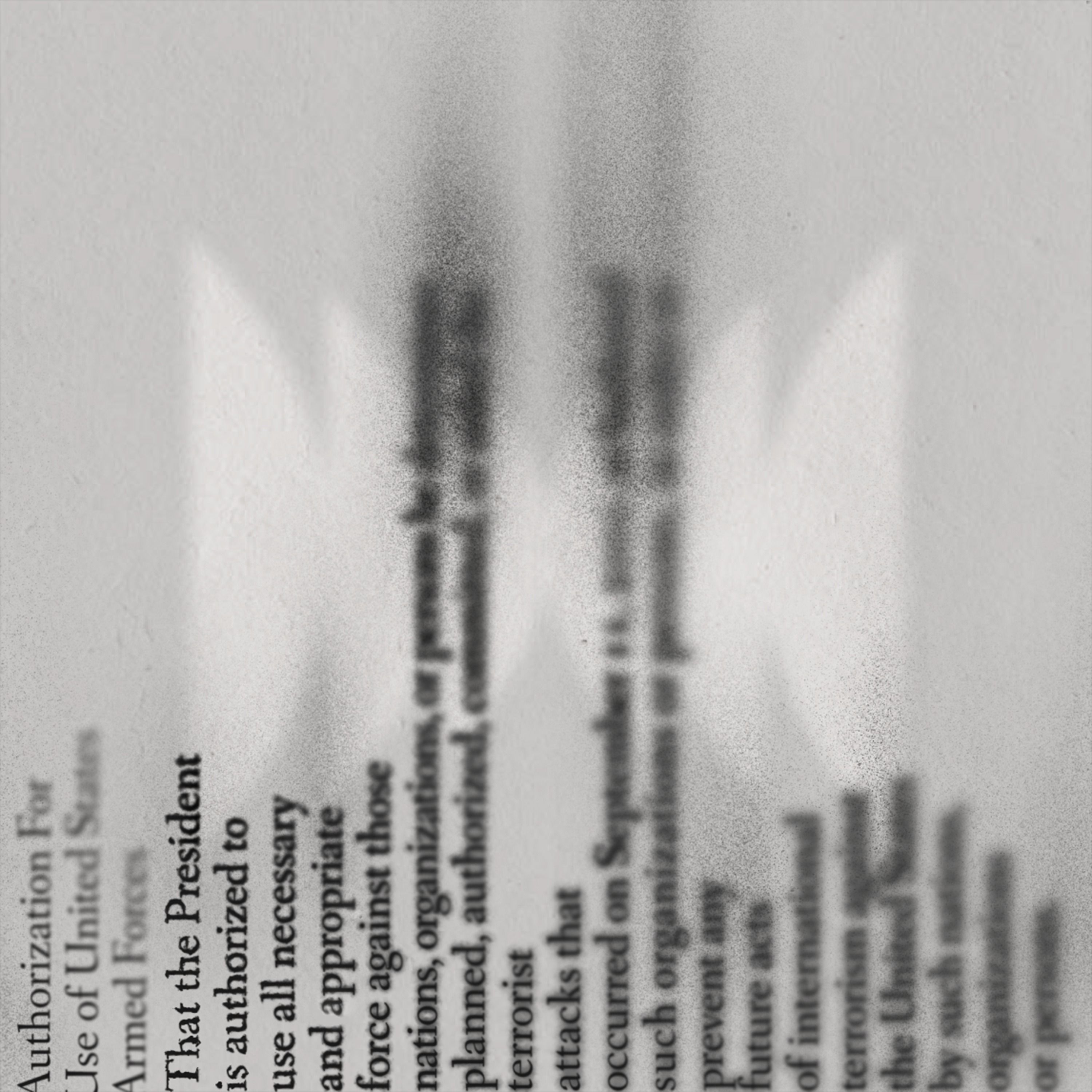
We’re coming up on the 25th anniversary of the 9/11 attacks, and it had us thinking about an episode we produced in 2014. It’s the story of one sentence, written in the hours after September 11th, 2001, that has led to the longest war in U.S. history. We examine how just 60 words of legal language have blurred the line between war and peace.
In the hours after the attacks of Sept. 11, 2001, a lawyer sat down in front of a computer and started writing a legal justification for taking action against those responsible. The language that he drafted and that President George W. Bush signed into law—called the Authorization for Use of Military Force (AUMF)—has at its heart one single sentence, 60 words long. Over the last decade, those 60 words have become the legal foundation for the "war on terror." In this collaboration with BuzzFeed, reporter Gregory Johnsen tells us the story of how this has come to be one of the most important, confusing, troubling sentences of the last two decades. We go into the meetings that took place in the chaotic days just after 9/11, speak with Congresswoman Barbara Lee and former Congressman Ron Dellums about the vote on the AUMF. We hear from former White House and State Department lawyers John Bellinger & Harold Koh. We learn how this legal language unleashed Guantanamo, Navy Seal raids and drone strikes. And we speak with journalist Daniel Klaidman, legal expert Benjamin Wittes and Virginia Senator Tim Kaine about how these words came to be interpreted, and what they mean for the future of war and peace.
LATERAL CUTS -
Really anything from our sister show, More Perfect
EPISODE CREDITS:
Reported by - Kelsey Padgett
with help from - Matt Kielty
Produced by - Matt Kielty
with help from - Kelsey Padgett
Sign up for our newsletter!! It includes short essays, recommendations, and details about other ways to interact with the show. Signup (https://radiolab.org/newsletter)!
Radiolab is supported by listeners like you. Support Radiolab by becoming a member of The Lab (https://members.radiolab.org/) today.
Follow our show on Instagram, Twitter and Facebook @radiolab, and share your thoughts with us by emailing [email protected].
Leadership support for Radiolab’s science programming is provided by the Simons Foundation and the John Templeton Foundation. Foundational support for Radiolab was provided by the Alfred P. Sloan Foundation.
Hosted by Simplecast, an AdsWizz company. See pcm.adswizz.com for information about our collection and use of personal data for advertising.
Get every episode summarized
Each time Radiolab publishes, we email you a written briefing from the transcript — the topics, who appeared, and any specific claims, with the ad reads skipped.
Email me new episodesFree for 3 shows. No card needed.
Transcript ready
878 searchable segments. Every word is indexed and playable.
Full transcript
Radiolab — 60 Words. Machine-transcribed; use the interactive transcript above to jump the player to any line.
Hey, this is Ray D'Lab. I'm Matt Kilti. So we are coming up on the 25th anniversary of the September 11 attacks. Actually, a week from today, it'll be the 25th anniversary. And while back, I co-produced a story that was about the legacy of 9-11. Only it wasn't about any aspect of 9-11 that I had ever heard before. It's about one single sentence, 60 words long written in the Panic grief-stricken days right after 9-11 that ended up defining America for decades. In the story, it's a sort of like strange side door into this legal world behind the longest war in our country's history. We have a couple of updates for you at the end, so stick around for that. But for now, we're just going to jump in. So here we go. Yeah, wait, wait, wait, wait. Okay. All right. Okay. All right. Here you go. You're listening to Radio Lab. Radio from WNYC.
Three, why. Okay, ready? Hey, I'm Chad Ibuomron. I'm Robert Kroelich. And this is Radio Lab. Today, we've got a story about the crazy power of words. In particular, 60 words. Single sentence. That is, well, you could say defined America for the last 12 years. And uh. Yeah. And the place to start is a difficult one. This just in you were looking at obviously a very disturbing life shot there. September 11th, 2001, 846 AM. A plane has crashed into the World Trade Center. We don't know anything more than that. We don't know. This is a day that anyone who is old enough to remember does remember. We can remember where we were, who we were with. So you have no idea where to write down. Not even another one. Another plane just hit. Oh, oh, my God. Another plane has just hit. And of course, we can remember how we felt. Tell me what you just saw. Oh, me.
You fell down. I'm supposed to. Oh, my God. What happened? It is the worst attack ever on American soil. But if you really want to understand the world we live in now, you've got to jump ahead one day to September 12th to a corner office in the White House where there's a lawyer sitting at a computer trying to figure out how are we going to declare war? And one of the things that everybody realizes after sort of an initial discussion is yes, we'd like to declare war, but we have no idea upon whom we should declare war. That is Gregory Johnson. The Michael Hastings National Security Reporting Fellow at Buzzfeed. Now the reason this lawyer, man by the name of Timothy Flanagan, the reason Flanagan is sitting at a computer in an office is because then President George Bush had to do something. He had to act and he didn't want to act alone. He wanted congressional approval. Right. I mean, technically in an emergency.
The president can defend the country. He is the commander-in-chief after all. He doesn't have to go to Congress and say, hey, do I have authorization to use force? Not an emergency. That's been witnessed by the way. Senior Fellow in government studies at the Brookings Institution. The president Bush needed Congress on his side. He felt, you know, it was important that we project unity. That we were all standing together as one. And second, if this was an act of war... The power to declare war in the Constitution is given to Congress, not to the executive. When Congress declares war, suddenly the president has a very clear and powerful mandate. Now... The Declaration of War is kind of a dead instrument of international law. I mean, nobody's declared war since World War II. But the modern incarnation of the Declaration of War is the authorization to use force. The authorization to use force. What's called the authorization for the use of military force? Or as it's commonly referred to, the AUMF.
Right. So our lawyer in the White House, Flanagan, he's given a task, go write an AUMF that Congress can send to the president. He really has no idea. So he goes back to the last time that the US did this. Last time Congress passed one of these things. He does a quick sort of search on his computer. Boom, finds it. 1991, Iraq, the Gulf War. Flanagan grabs the text. And then he copies that into a word document. And that becomes his template. He makes some cuts, he makes some changes, he deletes some words. And then... He hits send. Our war on terror, a just war. And he sets in motion this bewildering series of events. The US drone strike in linked to Al Qaeda in the war, bringing the troops hold now. This madness that is basically the world we live in. That's how the life is. Fifteen members of a wedding procession were killed by a US. And if you're like me. Bizarre even sadistic treatment. You're like me and you find yourself flippin' through the channels, see the news, basically
ignoring it, but then every so often thinking, wait a second. Terrorism targets in Africa. From Libya now, the US Air Force. Our drone strike in southern Somalia. Wait, wait, how are we doing this in all these different places? 100 presenters are on a hunger strike. And like that. And protest of their indefinite detention. How are we detaining people for so long? I mean, is it okay to do that? We're just who signed off on this, you know? And it turns out we all did because it was in that document. This is the legal foundation for everything that the US has done. Everything from Guantanamo Bay to drone strikes, to secret renditions, to seal rates. It's all been hung off these 60 words. And that's the crazy part. The body of this document, the part that really matters. And the reason that when I was reading Gregory's reporting on this, I was like, what? Is it it all goes back to one single sentence? 60 words, one sentence. Can you read it? Absolutely. But the president is authorized to use all necessary and appropriate force against those
nations, organizations, or persons. He determines planned, authorized, committed, or aided the terrorist attacks that occurred on September 11, 2001, or harbored such organizations or persons in order to prevent any future acts of international terrorism against the United States by such nations, organizations, or persons. 60 words. Today, a collaboration with Buzzfeed, and with reporter Gregory Johnson, we're going to try to decode those words. And ask, where do those words come from and how did they come to mean what they mean? Which is not what you think they mean. And how did they end up leading us into what is arguably the longest war in American history? Nobody saw it coming, absolutely nobody. That's the weirdest part. Well, nobody minus one.
Let's start there. Maybe you should introduce us to Barbara Lee. Right. Barbara Lee is a congresswoman from right around Berkeley, California. Hello. Hello, hello. Hi, it's Barbara. And she is someone who has been in many ways a lifelong activist going all the way back to when she was 15 in high school in San Fernando Valley. Because I wanted to be a cheerleader. But you know, since this was the early 60s, you had to have certain criteria like at least whether it was stated or not, blonde and blue eyes. That would have been hard for you, I would figure. Yeah, that was really hard. So I went to the NAACP. She got them to pressure the school to change the rules. And I won. And she became the first black cheerleader at her high school. Yeah, yeah. That's just by way of introduction, fast forward many years, she becomes a congresswoman, she gets elected to a second term, and on that day. There is smoke pouring out of the Pentagon. She was at the Capitol. No one knew where to go, so the police officer just said, run, run, run, go, go, go.
This was an apparent terrorist attack in our country. So I ran out of the Capitol down Pennsylvania Avenue. I remember looking back and saw a lot of smoke, which was, you know, the Pentagon. You know, clearly the country's under attack, clearly people have died. Clearly, we've got to deal with whoever did this, whatever it takes. Fast forward two days, September 13th, Barberlees back at the Capitol to meet with her democratic colleagues to review that document that Flanagan had sent over. The mood in the room was very somber and very angry. The thing we have to keep in mind when we're talking about this is all of this was done within 72 hours after the worst terrorist attack in United States history. And very confused. What would be the appropriate response? So as she and her colleagues read those 60 words, there was a lot of debate going on back and forth. Oh yes, oh yes, from everyone. Because this actually wasn't the first draft, Flanagan had sent one over the night before.
September 12th, 2001. And that one was something that almost no one agreed to. Corrigan agree that early draft had a few extra lines in it. One gave the president the power to preempt any future acts of aggression against the United States. And Barberlees and her colleagues knew that look, so many things can be packed into this word aggression that if we sign on to this, that if we give the president this power, the president may never have to come back to Congress ever again and request authorization for military force because he can say that anything is aggression and we're also giving him the power to preempt. So they kicked it back to the White House, Flanagan took out those words. And now they have this new draft that the president is authorized to use all necessary and appropriate force, which is what you heard. It's still when Barberle read that in soft phrases like all necessary and appropriate force, you thought, what does that even mean? I said, this is too broad. It's not definitive. It's open ended. And as she was speaking, this is taking place in the basement of the Capitol building.
She sees some of her democratic colleagues start to nod. Yeah. People were nodding. People were nodding. Because everybody there knew the danger of ill-defined words. You just had to go back 50 years to the Gulf of Tonkin. Yep. Gulf of Tonkin. Tonkin. Tonkin. Tonkin with an N. Yes. To explain. My fellow American, as President and Commander-in-Chief. 1964, LBJ announces that two American ships, two US destroyers, parked in the Gulf of Tonkin off the coast of Vietnam, were torpedoed by North Vietnamese boats. By a number of hostile vessels, many people now argue that one of these attacks never even happened. Nonetheless, President Johnson wanted to strike back, so he asked Congress to pass a resolution, which they did, giving them the power to, quote, take all necessary measures to repel any armed attack against the forces of the United States and to prevent further aggression. Making it clear that our government is united in its determination to take all necessary
measures and support a freedom and in defense of peace and Southeast Asia. Now it is the broad language of that document, most people believe, that opened the door to the worst part of the Vietnam War. The rangers and Marines took casualties, mostly from hidden snipers. The thousands and thousands of casualties, and horrific atrocities, and in a television interview in 1969 when President Johnson was asked to justify it all, he said, you can't just blame him. So the lessons of Gulf of Tonkin and Vietnam, that was very much in the air, in that meeting on September 13th, 2001. So it was understandable that when Barbara Lee stood up and said to her colleagues, she
was worried about some of this language. There was a lot of uncertainty about what to do, but in the end those concerns were ultimately outweighed by another desire. We've got to be unified with the President, we can't show political divisions. Let's have the nation, let's have Congress speaking with one voice. It was a time for unity and for action, and so walking out of that Democratic caucus meeting. On the evening of September 13th, Congressional leadership decided that these 60 words, this is the version, there's no going back to the drawing board. And so at 10.16 a.m., September 14th, 2001, the Senate is gabbled into session, National calls a vote. There are 98 senators on the floor. All 98 of them vote, yay. No senator voted in the negative. So it was a sweep. Yeah. Later in the day of the resolution would go to the House where Barbara Lee was a representative.
National had actually rushed the vote through the Senate because the White House is called for a national prayer meeting at the National Cathedral for the victims of 9-11. That's supposed to start right at noon. And so right after the vote, all the senators pour out of the Capitol and get onto the buses I'm trying to get through the drizzle. It was actually raining that day. Now at that moment, Barbara Lee, she hadn't decided how it is that she was going to vote. I struggled with it. For the previous two nights, September 12th and 13th, she stayed up late. Calling back to advisors to friends in California. We talked every day. Including this guy, this is Ron Delams. I served for over 27 years in the U.S. House of Representatives. Barbara used to be his chief of staff and when he resigned, she won his congressional seat. You know, she would say, well, what about this and what do you think about that? And we kind of talked through the emotional state of the country that we are feeling pain, anger, we're shocked. Both Barbara and Ron were trained as psychiatric social workers. So they both knew that when a person is feeling all of those things, it's generally better
to do nothing. Yes, I called you 101. You don't make decisions when you're mourning, afraid. On the other hand, I believe you know in unity too. I want to be unified with the president when the country is under attack. I understood. He didn't tell me. He didn't say which way I should vote. But I did say to her, Barbara, however you vote, I will always respect you. You will always be friend. You will always be family. So at that moment, with the memorial service about to start in a few hours till the house vote, Barbara Lee was at the Capitol. I was in the cloakroom. And since she wasn't sure how she was going to vote, she planned to skip the memorial service. She wanted to stay. She wanted to think. And then I don't know what it was. It may have been the spirit moving me. I don't know, but it's a very last minute. She was drinking actually can of ginger ale at the time. I said, I think I'm going to go and I just ran out. I probably was the last one on the bus. I had the can of ginger ale in my hand and ran down the steps and got on the bus. She got to the cathedral.
The house bus has arrived about 30 minutes or so before the opening. And so for 30 minutes, she's in the cathedral about halfway back listening to the organ. Thinking about the families and those who were killed. There are people around her who are sort of whispering the pain and anguish, a few people who are crying. I said, I got a prayer over this. And she's just wrestling with her vote. Her heart is saying one thing, this is too broad. And her head is saying unity. How is it that you can be against the president at this point? Speaking of the president, eventually, President Bush takes the podium. We are here in the middle hour of our grief. Just three days removed from these events, Americans do not yet have the distance of history.
But our responsibility to history is already clear. To answer these attacks and rid the world of evil. And then as soon as President Bush steps down, everyone in the congregation stands up. And they sing the battle hymn of the Republic. Which is a very powerful, a very moving piece of music. But it's not the sort of thing that is typically sung at a memorial service. It's a very forward and almost aggressive sounding. That's the phrase terrible swift sword. Yeah. Oh my God.
It was not quite what I expected in a memorial service. But the second speaker. A reverend by the name of Nathan Baxter. He got up and he gave a reading from Jeremiah 31. When an ancient Israel suffered the excruciating pain and tragedy of militant aggression and destruction. Hearing that all over again takes me right back there and I remember. A voice is heard in Rema. When I'm in bed, I'm in bed, I'm in bed. Rachel weeping for her children. When he spoke, that's when to me it was a memorial. And then he started to pray for the healing of our grief-stricken hearts, for the souls and sacred memory of those who have been lost. And he said something that really struck Barberlead. Let us also pray for divine wisdom.
He said as we act, we not become the evil we deplore. That evil that we deplore. When he said that, I became very, it was the sense of peace and calm came over me. And Barberlead says it was right then that she knew what she'd do. The clerk for report the title. House Joint Resolution 64, Joint Resolution to authorize the use of United States armed. Later that evening, the house opens up its debate on the AUMF. In Congressperson after Congressperson. It stands up. I rise in support of this resolution. One after another. It's about to speak. I rise in support of the authorization. I rise today in support of this resolution.
We will roundly behind our president. 16 in a row. Until. California is recognized for a minute and a half. We get to Barberlead. Mr. Speaker, members, I rise today really with a very heavy heart. One that is filled with sorrow for the families and the loved ones who were killed and injured this week. Only the most foolish and the most cows would not understand the grief that has really gripped our people and millions across the world. Now I have agonized over this vote. And I came to grips with it today and I came to grips with opposing this resolution. During the very painful yet very beautiful memorial service. As a member of the clergy so eloquently said, as we act, let us not become the evil that we deplore.
Just after the vote, Barberlead says she was in the cloakroom again and she starts getting accosted by colleagues. All of these friends are coming up to her and saying, you've got to go back. You cannot vote this way. That's not changing my vote. One of them actually said to her, look, you've done so much on HIV, you've done so much on AIDS, this vote is going to take you out. Think of the bigger picture. They're saying you're dead. Yeah, but that's the right vote. I'm not going to give any president the authority to go to war and we don't know what we're doing. The only Congress can declare a war. Help me on this, guys. Has the House just now finished that vote? And we see one no vote during the final vote for the House was 420 to 1. We know it's a Democrat. We don't yet know who. We'll figure that out. You know, moment or so, but that vote is now. Barbara Lee was the only person in the Senate or the House to cast a no vote.
That must have been a very lonely moment. To be perfectly honest with you, I said some prayers for my friend. This was the right thing to do. And you know, votes like this, you have to be ready to pay the consequences. Over the next few weeks and months. Our office was inundated with letters. Barbara Lee, you are a traitor and a disgrace to the office that you hold. You can find all these letters archived at Mills College. You are a blade on American society, the terrorist yourself. So much hatred. I don't know why you decided to place yourself into the camp of terrorists. Those attacks came and they came and they came. Subject headline. What's your ****? Death threats. Now off to hell with you. You've been addicted Arnold wannabeans. So I had to have security day and night. Up yours. Thanks for supporting the Taliban. Hey, Hennoy Barbara Lee. Are you? What do you believe in? If you go to Mills College in Oakland and we sent a reporter there, you will find 60,000 letters. They're not all negatives, but most are. But Congressman Lee says she never faltered because right after the vote, she was in her
office. My dad called me Lieutenant Colonel retired in the army. He said I'm really proud of you. You know, my dad had been in Korea and World War II. And he, he sees it the way I see it because I really wasn't sure what he was saying because you know, I really wasn't sure. She thought, all right, daddy's proud of me. Now we should note that Barbara Lee is still a congresswoman. She did not pay the price for that no vote. And whatever you think of her vote, whether you think it was the right thing to do or the wrong thing to do, what is interesting to me is that as we're sitting here looking back on 12 years of war, she was sitting there 12 years ago looking forward. And maybe she saw something about how this would play out about how these, these words these 60 words would start to grow and expand. That's next. This episode is sponsored by BetterHelp.
You know something I would like to wake up tomorrow and be better at? Speaking another language, one of the things that holds me back is, you know, feeling vulnerable that I'm going to mess up my pronunciation or how I look in front of other people or getting something wrong. And so in the process, I get self conscious and I cut myself off and I don't end up speaking the language at all. So I actually get worse, not better. Getting better at something is a feeling defined by you. And for BetterHelp, it's a BetterHelp therapist who really gets you. To focus on global emotional well-being, with thousands of therapists and millions of members in over 100 countries, it's progress. Sign up and get 10% off at BetterHelp.com slash radio lab. That's betterhelp.com slash radio lab. The Pentagon is battling the media on many fronts, even within its own ranks. The Pentagon fired the editor-in-chief, publisher, and a reporter for the military news outlet,
stars and stripes on Friday. The three employees claimed they were let go for insubordination after they defended their outlets independence in an interview with CBS Sunday morning last month. That and much more on the next on the media from WNYC. Find on the media wherever you get your podcasts. Hey, I'm Chad Abumrod. I'm Robert Crowich. This is Radio Lab and today 60 words. This is a collaboration with Buzzfeed and reporter Gregory Johnson. The story is based on an article that Gregory wrote about the 60 simple words that have really defined American counterterrorism for more than a decade. It's called the authorization for use of military force that's shortened to AUMF and it was passed by Congress three days after September 11th. And here it is again read by Senator John McCain. Which says the president is authorized to use all necessary and appropriate force against those nations, organizations or persons he determines planned, authorized, committed, or
aided the terrorist attacks that occurred on September 11th, 2001 or harbored such organizations or persons in order to prevent any future acts of international terrorism against the United States by such nations organizations. All right. So why would we be looking at that boring ass sentence? He seems even was almost bored of saying it. Yeah, he does. Can I just be honest with you for a second? I generally move through the world with the assumption which has been proven over and over again to be true that I don't know how the world works. Like somehow I miss that day in school or something. Are you referring to something in specific? No, I'm referring to a general sense that somehow like Oz is out there behind the curtain pulling the levers and I'm just always going to be stuck on this side, you know? Yeah. I think it's what motivates the show for me is that like I just I feel kind of stupid most of the time and these shows are a way to engage the world and really examine the world. Right. Exactly. And when it comes to these matters of national security, I really feel clueless.
And so when I read Gregory's article, I felt like I understood something crucial for the first time, but the way words actually operate in the world. Because like again, this sentence, this totally boring sentence, this is the legal foundation for everything that the US has done, everything from guantanamo Bay to drone strikes, to secret renditions, to seal rates. It's all been hung off these 60 words. One lawyer who was in the Bush administration said, look, this sentence is like a Christmas treat. All sorts of things have been hung off of this. But how? How? Like, because you read the thing and you don't see any mention of guantanamo Bay in those 60 words. It doesn't mention detention. It doesn't mention drone strikes. It doesn't mention drone strikes against American citizens. Okay. So that guy, this is one of the first folks we called to help us decode this. That's John Belinger. I served as the legal advisor for the National Security Council from 2001 to 2005.
And as the legal advisor for the Department of State from 2005 to 2009. You can't do any speed dating with a credential like that because the date will be over. That's my congressional testimony voice. Okay. And we asked him like, okay, so detention isn't anywhere in this document. So how do you read detention from these 60 words? The argument with which I am comfortable as a legal matter is this. He says, if you go eight words into those 60 words and you get to the phrase, all necessary and appropriate force, all necessary appropriate force. Yeah. You got to ask yourself, what is force? What does that mean? What do you know what force is? Is that I punch you in the face? That's amusing force. That's one kind of force. It's a force to kill people. But a lesser use of force is to detain them. Detention is simply lesser included in the use of force that comes naturally in a military operation. It's like a subset of force, basically. So if you're authorized to use force to kill people, you are also by default authorized to use force to detain them, essentially, to knock them out of the battle in other ways.
And that force is both necessary and it's appropriate. But the courts have upheld that. So that one word, force? That is how you justify Guantanamo Bay. A la Contraversy surrounding Guantanamo Bay continues. The authorization to use military force act has... What happens at military commissions? I've been the legal basis for the detention of thousands of individuals. Now many of them have been detained for more than 10 years. None have been changed. And the words detention are never mentioned. Okay, so that's detention. It gets even trickier if you go just a few words past all necessary and appropriate force. To what? You get to the mention of the enemy who the force is supposed to be used against, right? And it seems to be very limited language. You mean we can't shoot everybody or anybody? No, only the people who planned, authorized, committed or aided the terrorist attacks that occurred on September 11th, 2001, are hard to check. Sounds much more. Sounds very much tethered to 9-11, right? Which is why a lot of congressmen and women voted for it.
Joe Biden on the day of the vote, September 14th, 2001, he says, look people, don't freak out about this language. It's relates to the incident and there's broad authority relating the incident. It does not relate to all terrorism every place. Because we're just talking about al-Qaeda who did this and the Taliban who have harbored them, right? No. Not necessarily. Gregory Johnson again. Over time, what's happened is there's been this other sort of catch-all category that has been read into these 60 words, even though it appears nowhere in these 60 words. And that catch-all category is associated forces. Associated forces. Yeah. What we've been calling these 61st and 62nd words. Is what's long time and is what's long time. We wait. And if you define the enemy as al-Qaeda, the Taliban and associated forces, it's a whole different ballgame. Yeah. So when you read all those words, it did not include the phrase. Associated forces is nowhere in the text.
So where does it come from? So then why could people cite something that isn't in the text? This is one of the enduring mysteries of this. So the earliest example that we could find of those two words is in a 2004 memo from Deputy Secretary of Defense Paul Wolfowitz. He defines the enemy as al-Qaeda, the Taliban, and associated forces. But the truth is it may have just been there from the beginning. What do you mean? Because according to Ben Wittis from the Brookings Institution, there is a concept in the laws of war called co-belligerency. It's the idea that if you're at war with Person A and Person B is on Person A is side in the war. You're also legally at war with Person B. Makes perfect sense if you think of it in traditional war terms, because like we're at war with Germany, Italy joins their side so by default we're at war with Italy too. Right. So just transpose that here. If we're at war with this group called al-Qaeda and a certain set of groups that aren't them, join the war on al-Qaeda's side, then you are legally at war with them.
If you don't think about that too hard, it is crystal clear. But then the question that it has arisen over time is how broad do you make that that circle? Because the problem obviously is that we're not talking about nation-states anymore. We're talking about groups. So, okay. How close does the link to al-Qaeda and the people who carried out September 11th have to be? So if you have someone who's connected to someone who's connected to someone who's connected to someone who is connected to September 11th, is that enough? Or is it only three links? Or can you be an associate and an associate? Now we can't exactly know how broadly the Obama and Bush administrations have defined those words. We'll talk about why in a second. But you just have to look at the news. You could see that we started with a war that was in Afghanistan and then it spread to a lot of different places. Pakistan, Libya, Somalia, Yemen. Yeah, and in Yemen, there's a lot of debate and a lot of discussion. But is this legal? Does this have anything to do with September 11th anymore?
Because now the group in Yemen, al-Qaeda and the Arabian Peninsula, which is a group that was first formed in 2009, they have their own hierarchy and their own structure and it's not clear how in what fashion they take orders from either Osama bin Laden, why he was still alive or now I'm in al-Qaeda. So does this make them an associated force or does it make them part of al-Qaeda? The answer, at least on. Good morning everyone. It is Friday. It's September 30th, 2011, Marked on your calendar. September 30th, 2011, seemed to be yes when the US assassinated two members of the group. This is not confirmed yet, but it could very well have been a US predator drone strike that is a US government attack. And to put all this in context between 2002 and 2014, according to some estimates, there have been about 65 drone strikes in Yemen killing about 400 people. And so much hinges on how you define those words. So much is in the definition. I asked the Pentagon, I said,
who, what are the list of associated forces? So al-Qaeda, yes, the US is a war that's clear. What about the other groups? El Shabab, al-Qaeda in Iraq, al-Qaeda in the Islamic Mugrab, armed Islamic group Abu Sayyaf, Jameel Azamiyyah, brotherhood of this, brotherhood of that. Who, who are these groups? Who is the US at war with? And the Pentagon emailed me back and they said that the list is classified and not for public release. Wait, so we, who we are at war with is- We don't know. I- Wait, so you're saying when you approach the Pentagon- They say that they, they will not tell you the names of the people we're at war against. Well, maybe they should have. Maybe that's the value. Well, they don't you want to know as a citizen of America who were fighting? On the other hand, do I want to know as the, as if the United States has determined that I am dangerous to it. If it announces, then that would give me a certain amount of notice, which I may perhaps would be disadvantageous to the United States. It could also though act as a disincentive for you to take action.
Maybe, but maybe not. Maybe they will just get quieter, more dangerous. I mean, it's true there might be reasons for this. They have not wanted to provide a public list because they- This is John Belingerian. One, the groups move all the time and so if you say, well, these are associated groups. Well, then certain people just move from group A to group B. And they also want to leave these different groups guessing. But it still raises democratic concerns if the American people don't really know who the executive branch believes is covered by the AUMF. In a democracy and in a representative democracy that has to be weighed out, should the citizens of the United States know who it is that the United States is targeting for death around the world? Who it is that the United States is technically at war with? Should war be a decision that the citizens of a democracy, of a representative democracy, have a say in it? Well, we're a representative democracy as you just said. So I'm assuming that the chairman of the House Intelligence Committee knows every item on that list.
I'm not so sure. Good morning, everybody. The committee meets today to receive testimony on the law of armed conflict. One of the more interesting Senate hearings took place in early 2013, including the status of the 2001 authorization for the use of military force, the AUMF. It was the Senate Armed Services Committee. Senator Carl Levin of Michigan's chairman of the committee, Senator McCain is on the committee. I'd like to welcome our witnesses. And Gregory says the Senators call the couple of defense department officials to answer questions. Members committee, thank you for the opportunity to testify about the legal framework for the U.S. military operations to defend our nation. Because they want to know like now that we're 12 years into this war, how are you using this document? Does it need to be changed? So the department of defense officials and there were four of them. The necessary and appropriate. Came and said, look, I believe that existing authorities are adequate for this armed conflict. Don't revisit this sentence. Don't repeal it. This sentence is sufficient. It gives us all the
power that we need against Al Qaeda and associated forces. In as they're laying out their case, they say those two words associated forces, associated forces, and associated forces, over and associated forces, and associated forces, and associated forces, and associated forces, and their associated forces, associated forces, and associated forces. Instead of just nodding along, a lot of the Senators were like, what? Gentlemen, I've only been here five months, but this is the most astounding and most astoundingly disturbing hearing that I've been to since I've been here. You guys have essentially rewritten the Constitution here today. That's Angus King, independent senator from Maine. And you keep using the term associated forces. You use it 13 times in your state, but that is not in the AUMF. And you said at one point, it suits us very well. I assume it does suit you very well because you're reading it to cover everything and anything. But one of the most striking moments of this hearing is when the head of the committee, Senator Carl Levin, turns to one of the DOD officials and asks him, is there a list? Now, does there an existing list
of groups that are affiliated with Al Qaeda? Senator, I'm not sure there's a list per say. I'm very familiar with the organizations that we do consider right now are affiliated with Al Qaeda, and I could provide you that list. Would you give us that list? Yes, sir. We can do that. And when you add it or subtract names from that list, would you let us know? We can do that as well, Mr. Chairman. Thank you. Let me just see if I understand what you just said. At a committee hearing, yeah. Say, you as senator asks specifically, so who's on the list of people who were allowed to kill? Right. That suggested that the Senate Armed Services Committee, who had oversight, really had no idea. Which means one are like, all right, if we don't have any idea who we're at war with, and the Senate Armed Services Committee doesn't seem to have any idea. Then who does? Well, one of the things that became clear to me as I was reporting on this story was that many of the people who were making these decisions had never been elected by anyone to any position, and they were the
ones who were making the decision not the elected represented. And so who are they? Is that the one I see? Not the one right thing? I guess so, yeah. Yeah. So we were rooting around for a while looking for an answer to that question. Until we found this guy, this is Daniel Clydeman, he's a journalist, and I've covered national security and counterterrorism for many years. And based on hundreds of confidential interviews that became his book killer capture, he was able to paint a picture for us of who makes these decisions and how. He told us about these meetings. You say it's the STVS meetings. What are they? Who's in the room? How do the events unfold? Well, these are, they, they call them civets meetings in the vernacular of the bureaucracy. It stands for secure video teleconference meetings. He described them as a sort of a massive top secret Google hangout chat, where literally hundreds of people from throughout the national security bureaucracy log in to decide who's on the list and who isn't and who should live and who should die. You said literally hundreds? Literally hundreds of people. Now many of them are
backbentures. They're not participating in the call, but they're taking notes before they get together in this meeting. Many of the folks at this meeting, he says, are given little packets of information on each target. They call them baseball cards because they sort of look like it. You got a picture and some stats like Yogi Berra on one side and then you got his batting average and his hometown on the back. Well, the terrorist equivalent of all of that. So who is this person? Where does he ranked and what kinds of operations has he been involved in in the past? Eventually a general will come on the screen and say here's our target. Objective Akron. For some reason, he says they always refer to the targets by the name of American cities. Objective Toledo. General might say target is in Yemen. We have a drone overhead. There's an opportunity to kill this person. Can we legally do it? And the fascinating thing, although maybe it won't come as much for surprise, is that the people he's making this pitch to are not generals, but lawyers. There are lawyers everywhere. That is just a basic fact of modern warfare, says John Belinger. You now have lawyers on the ground with
artillery units, tank commanders, lawyers in Kevlar, lawyers in helicopters. There are lawyers really almost behind every bomb. Just lawyers everywhere. Yeah, and that's a very good thing. That's Harold Koe. He was the top lawyer at the State Department from 2009 to 2013. Because it means that we're not just shooting away at people willy-nilly or because we're angry at them or anything. It's a considered careful decision. Now Harold Koe, according to Dan Cliveman's reporting, was in those civet speedings and he would often be the one to answer the general's questions. Can we legally kill this person? So we asked him like if lawyers are now the ones deciding who we are at war with and who we aren't. How do you do it? And unfortunately for us, I don't think I'm getting into that on this call. There are multiple methods, but I'm not going to go into that. He said he couldn't comment on any of it because it's classified. But Harold Koe is a creative lawyer. According to Dan Cliveman, who spoke with a lot of people familiar with the process, Koe in particular had a fascinating way of determining who is and
is not an associated force. In other words, we are or aren't at war with and it seems to be less about the groups as a whole and more about individuals within the group. For example, a seniority. That was an important issue. For Koe, if you're going to target a guy, he has to be a senior member of group like Al Qaeda. He has to be able to give orders and he has to be unique within the organization. You couldn't simply under Harold Koe's theory go after say a driver or a cook who was in Al Qaeda or even foot soldiers because they were fungible. Meaning they could be easily replaced. Another criteria was whether they were externally oriented. For Koe, if they were just participants in a civil war, you couldn't target them. But if they were targeting Westerners or Western interests, then yes. So if you take Dan Cliveman's account of Harold Koe's criteria as a representative and we personally have no way of verifying it, but if you take that as the norm, then maybe there is a strong vetting process in place. But I interviewed numerous people who
participated in these meetings. And one of the things that I heard over and over again was that there was this kind of an extrable momentum toward killing and that the military people in these meetings could speak with a kind of a tone of do or die urgency. In fact, two of the people who I quote in my book used exactly the same metaphor to describe that sense of momentum that was very difficult to resist. It was like standing on a train track with a train hurtling toward them at a hundred miles an hour. Then I guess like the important question for me is like how often do they say no? Well, the answer has been 99 times yes and one time no or 50 times yes and 50 times no. How many nose are there? Well, look, I'd say I did not come across many, many examples. But he did tell us about this one instance. This was a meeting between the top lawyer at the defense department and a man named Jay Johnson and the top lawyer at the state department who was then Harold Koe.
Harold Koe. And according to Dan's sources, Harold Koe and Jay Johnson were faced with determining the fate of a 40 year old man, roughly 40, named Sheikh Muhtar Robo. I think that's the way I'd say his name. I'm not sure. He was a member of the Smalley Group El Shabbab. And for context, the news world cup celebrations have turned to tragedy in the Central African nation of Uganda. A few months before this conversation, this is in 2010, El Shabbab bombed a rugby club and a restaurant at the same time in Uganda, killing 74 people. Broken chairs smashed tables and the sounds of pain as rescues search for the living and the dead. So that had just happened. And according to Dan Clydeman at this moment in intelligent circles, there was a debate raging as to whether El Shabbab should or should not be considered an associated force. At the time, their leader had sworn allegiance to Osama bin Laden, but their agenda was primarily a local agenda. They had never struck out against the United States or against American interests in the region.
So you've got the top lawyer at the State Department and the top lawyer at the Pentagon facing off as to whether this fellow Robo from El Shabbab should live or die. And how does this work? Does somebody just like, does someone pound the table? Yes, this was a very heated meeting. Jay Johnson argued vehemently that Robo was covered under the AUMF. He was, after all, a founding member of El Shabbab. Harold Koe vehemently disagreed. Harold Koe's conclusion, based on the evidence and the intelligence that he saw, was that Robo was not externally focused. In fact, he belonged to a faction of El Shabbab that was arguing against attacking the United States and other Western interests. So according to Clydeman, these two men went back and forth and back and forth until eventually, Harold Koe just drew a hard line and essentially said, look, if you do this, you need to know that you will be doing it over the unambiguous objections of the State Department's legal advisor. The unambiguous move. And that's very strong language coming from a lawyer. And the signal that it sent to the
White House was, you will be taking military action even though the top lawyer at the State Department said that this would be an illegal action. Okay, so what happened? Did they decide not to? They did not do it. This is not academic. It's, it's lives depend on which way the decision goes. We'll continue in a moment. This week on the New Yorker Radio Hour, Sarah Longwell has a word of advice for Democrats who want control of Congress. People should be all over corruption and you do it with the contrast of saying, you are getting poorer. Trump is in a war getting rich off of oil. Like
sees that. Be outraged by it. Tell people how it's harming them. Sarah Longwell, on our new book, How to Eat an Elephant. That's the New Yorker Radio Hour from WNYC. Listen wherever you get your podcasts. Okay, I'm Chad Ibu Mraad. I'm Robert Krolywood. This is Radio Lab. Today we've devoted the intro of, we're continuing to devote the entire show to a single sentence, one sentence. 60 words. That's all. It's the 2001 authorization to use military force was signed into law on September 18th, 2001. Together with Buzzfeed and reporter Gregory Johnson, we have manhandled these words. Yeah, we have dissected. We have bisected. Trisected. And whatever other kind of sected you could be. Quadrasected. To the AUMF as it's called. Yes. We've looked at how the sentence has defined our last 12 years of counterterrorism. And now? How will it define our future? Gentlemen, thank you for being here today. This is a very important thing. So when we were thinking about that Senate Armed Services Committee hearing, we ended up calling someone who sat on the committee.
Tim Cain, Senator from Virginia. And who was there that day? Yeah, that was a, that was a very, kind of hair raising day. And Senator Cain told us that one of the most hair raising moments for him was when one of his fellow senators, Lindsey Graham, asked one of the department defense officials. Do you agree with made the war against radical Islam or terror, whatever description like to provide, will go on after the second term of President Obama? In other words, how long do you think this particular war has declared in the section is going to go on? Senator, my judgment, this is going to go on for quite a while. And yes, beyond the second term of the President and beyond this term of Congress. Yes, sir, I think it's at least 10 to 20 years. It was chilling. Because like this is already the longest war in the history of the United States. Longing the Vietnam. And now a DOD official is saying add on 10 or 20 years? So, I said, is it the administration's position that you tell me if somebody is
born after 9-11? Let's imagine in 2030. They join a group that has just become associated with Al Qaeda. In 2030? Is it the administration's position that the AUMF would would cover them and those organizations? And without hesitation, the administration witnesses said yes. As long as they become an associated force under the legal standard that was set out. It's not limited in time, not limited in geography, really troubling. But you know, I'm also troubled by another thing. I mean, you know, the iconic, it's a New York picture of the VJ Day kiss and Times Square. You see the fog? To see that here we have a combination of every type of situation. August 14th, 1945. There ought to be a day where those who have served in war that you declare that the war is over and then you celebrate them. Are these people happy? That's the only way to express it. Are you happy?
You could ask sometimes by service families like when is this going to end? Do you ever come up? Yes. Yes. Yes. You told us it's something like one in three people in his state of Virginia are connected to the military. So he does get that question a lot. And the truth is we all want a VJ Day. We need it. And so seven days after that Senate Armed Services Committee hearing, President Obama? It is a great honor. Give a speech. To return to the National Defense University? Where he seems to say basically, it's time. This war, like all wars, must end. That's what history advises. That is why I intend to engage Congress about the existing authorization to use military force or AUMF. Basically it announces that he would like to get rid of those 60 words and in this war. Yeah. But common sense tells you that these are different kind of enemy,
not a state or a government. They make war in a different way. Senator McCain has a great line to go. Look, we're in an age of warfare where the war isn't going to end with the signing of a peace treaty on the deck of the destroyer. That's not how it happens these days. There's no clear start and ending. And yet the president, he wants to end the war, says Ben Wittis. And every war has come to an end. He sees himself as a person who came in to a country fighting two wars. And he brought them all to an end. And I think he wants to have done that. But how do you, how do you do that? How do you end a war when the vast amount of people that you're calling the enemy haven't stopped fighting? So what he does in the May speech, and it's extremely clever. And by the way, it's really well-loyored. Is he announces a set of rules going forward for drone strikes? America does not take strikes to punish individuals. We act against terrorists who pose a continuing and imminent threat to the American people. That he's only
going to use drone strikes when there's an imminent threat. And it's well understood by people who understand this kind of stuff. That in the Constitution and also an international law, the president is allowed to act unilaterally in self-defense when there is an imminent threat, meaning it's urgent, and you can't feasibly capture that person. Ben fears that what President Obama was doing there by stressing that word. And imminent threat to the American people. Is it he was laying a new foundation? He was saying, when the AUMF ends and I wanted to end, I do have another way of justifying all these things. Maybe they wouldn't change. So the drone strikes and the raids would would continue. As long as you have a capacious enough understanding of what the word imminent means, you might be able to continue a whole lot of this stuff and then you don't have to go to Congress at all. And you can say you've ended the war.
And the human rights groups will cheer for you. And we're going to mysteriously find that there are a whole lot of imminent threats for freedom. Thank you very much everybody. God bless you. And in the context of what happened to those 60 words, you do have to wonder what's going to happen to a word like imminent. And all the while, according to Ben Wittis, and pretty much everyone we spoke with, we haven't really answered the big questions. When do we want to attack the enemy? Who is the enemy? And if we're going to be fighting them, even when we're not technically at war with them, then what's the difference between war and peace? And that's why this whole subject is so unsettling. If you don't know, the common sense definition
anymore of when you're at war and when you're at peace, then how do you write rules? Yeah. This was an attempt to begin a war. And so it had the usual beginning questions, okay, you who are you? You out there, where? You for how long till you surrender? No, you're not going to surrender. All the usual business of warfare is this doesn't apply in this case. So then you have to think of now, what do we do? Yeah. It's just like one long improvisation. Hey, it's Madigan here in the present. There are a lot of updates here and also depressingly
a lot that has stayed the same. So Obama never did get rid of the AUMF. In fact, he sort of stretched it out even further about a year after he made that speech calling to end the AUMF. His administration started using it to justify fighting ISIS. Arguing ISIS was a successor to Al Qaeda, even though Al Qaeda publicly rejected ISIS. Obviously, the US withdrew from Afghanistan in 2021 under President Biden. You probably remember that didn't go too well. It was basically a disaster. And on top of that, it still left us in this bizarre place with this AUMF hanging open despite the fact that so many people claimed the war was now over. It definitely wasn't the VJ day that Tim Cain was hoping for. And Barbara Lee, our one lonely congresswoman who voted against the AUMF has continued fighting against it. Our producer Sarkari actually talked to Barbara a few years back. Hello, hello. It's connecting to audio. I hold on a minute. Hi, right as Barbara was sponsoring a bill to repeal actually a different AUMF.
So we just told you this whole story of the AMF after 9-11. This one came in 2002. Not for the Iraq military action, the invasion and war in Iraq. And just last year in December 2025, Congress finally passed it, clawing back that second authorization. But as for our big AUMF, like the original one, there are multiple efforts still to repeal or replace it. Barbara Lee herself introduced a repeal bill. She's actually no longer even a congresswoman now. She became the first black woman elected mayor of Oakland in 2025. But her bill is still out there. There are several other attempts. And as of now, they're all still pending. So the 2001 AUMF remains fully intact today. It is still there on the books exactly as broad as it was in 2001. So those are the updates. I'm Mack Hilti. Thanks for listening. Huge thanks to Saur to Buzzfeed and to their reporter Gregory Johnson. Check out Gregory's piece.
Where are we started? We will link to it from RadioLab.org. It's on Buzzfeed as well. It's called 60 Words, Any War Without End, The Untold Story of the Most Dangerous Sentence in the US History. That is a title right there. Also thanks to the great Dylan Kea for original music and Glenn Coachie for music from his album Adventure Land. This hour was produced by Kelsey Paget and Matthew Kilti and myself. I'm Chad Abubrat. I'm Robert Roewich. Thank you for listening. Hi, I'm John Colt and I'm from Brooklyn and here are the staff credits. RadioLab is hosted by Lulumila and Latifnasa. Saur and Wheeler is our executive editor. Sarah Sandak is our executive director. Our managing editor is Pat Walters. Dylan Keath is our director of sound design. Our staff includes Jeremy Blue, W. Harry Fortuna, David Gable, Maria Paz Gutierrez, Sindu Nyanem San Bandan, Matt Kilti, Mona Madgalka, Annie McEwen, Alex Niesen, Sarah Cari,
Natalia Ramirez, Joanna Strogatz, Anise Vietzer, Ariant Wack, Molly Webster and Jessica Young, with help from Gabi Santos and Maya Apobimalamid. Our fact checkers are Nora Belglidia, Hilary Elkins, Rachel Gross, Diane Kelly, Emily Krieger, Natalie Middleton and Sophie Samae. Hi, I'm Aubrey, calling from Salt Lake City, Utah. Leadership support for RadioLab's science programming is provided by the Simon Foundation and the John Templeton Foundation. Foundational support for RadioLab was provided by the Alfred P. Sloan Foundation.
More episodes


