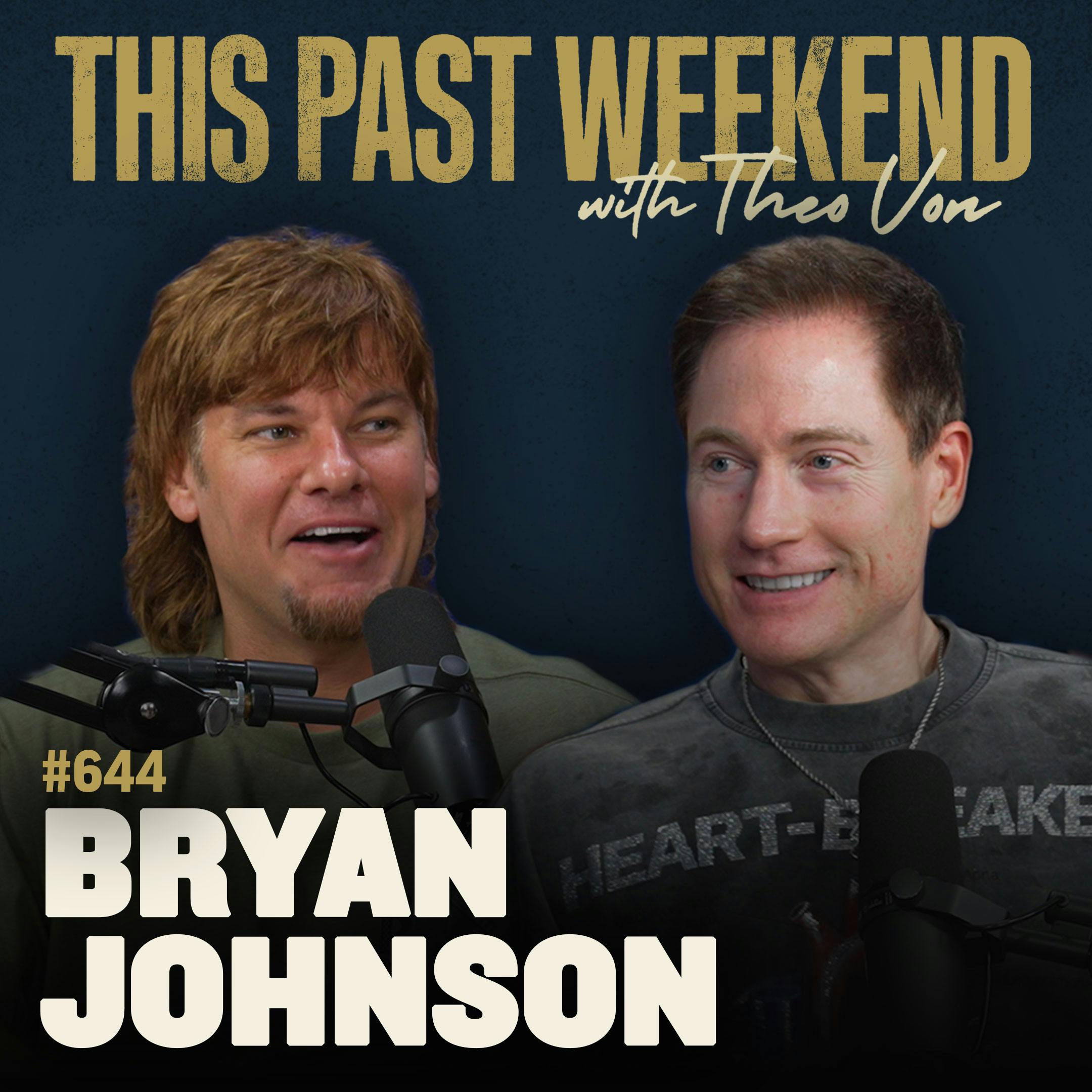
About this episode
Get every episode summarized
Each time This Past Weekend w/ Theo Von publishes, we email you a written briefing from the transcript — the topics, who appeared, and any specific claims, with the ad reads skipped.
Email me new episodesFree for 3 shows. No card needed.
Hosts & guests

Transcript ready
3,221 searchable segments. Every word is indexed and playable.
Full transcript
This Past Weekend w/ Theo Von — #644 - Bryan Johnson. Machine-transcribed; use the interactive transcript above to jump the player to any line.
Hey, everybody, it's Theo Vaughn here, and I got a question. When it comes to soda, are you really picking a zero sugar cola that you actually prefer, or are you just settling for what you've always had? That's the question. And I'll say this. When it comes to taste, I find that nothing beats Pepsi's zero sugar, but you don't just have to take my word for it. That would be ridiculous. Pepsi has been doing blind taste tests for years. No labels, no brand names, just taste. And last year they brought back the Pepsi challenge, and the results were clear. 66% of people agreed and said that Pepsi zero sugar tastes better than Coca-Cola zero sugar. In fact, Pepsi zero sugar won in every market they tested. So if you're grabbing a zero sugar soda, go with the one people keep choosing when taste is the only thing that matters. Go out and try Pepsi zero sugar today, let your taste decide.
Today's guest is a longevity expert. He's a health advocate. He's basically his own guinea pig. You know, he's kind of the doctor and Frankenstein in a way. He's an entrepreneur. He's been experimenting on himself, trying to beat the final chapter, the coffin. Yep. He wants to live forever. We're going to learn about it. I'm grateful to have a conversation today, which we got to do quickly because I think he's got to be in bed at like 4 p.m. I'm very happy that he's here. Today's guest is Mr. Brian Johnson. Yeah, this lemon water dude, I drink this a lot. I hear that it's good for inflammation and I do a lot of fasting. And so that's been something that on a fast I will have this a certain amount.
I like the chunks of ginger, man, that's that's solid. Oh, yeah. Did you on those? No. Yeah, you done that? No. It's good. I mean, it's, is that a thing chewing on ginger chunks? Yeah. Wow. Never even thought of that. Do you know exactly what it does? You just feel the vibes of it. Yeah, it's very strong vibes. Yeah. Yeah. It's a nice reward at the end. Like, let me give you a punch in the face. Ginger does something similar. Hmm. Yeah, maybe I'll throw one in the old. You feel better after doing it though? I just feel like I'm on, I have a plan and then I'm sticking to it. I mean, so much of life is like that. If you like, kind of that matter if it works, but like if you, it's like a thing is structured and planned. Kind of the thing. Yeah. Well, it starts to give me a little bit like a integrity to myself. You know, it becomes kind of a pattern. That's been one of the toughest things I think for me. And I would guess probably for most people is just starting a pattern sometimes, you know? Yeah, yeah. I feel like that's kind of been one of the things. Then it keeps you from the negative patterns. Yeah. Well, if I know if I have this to do tomorrow and it's a positive thing, then sometimes it's like if there's something negative the night before or
it's somehow, I'm like, I can't do it. I already have a commitment, you know? Yeah, yeah. But sometimes it has been tough. I go in sports where sometimes it's better than others, but honoring like commitments to myself, having that in, you know, and just building that integrity that I know I'm going to be here for myself every day. Yeah. That's been a challenge for me. It's gotten better over time, but it's been a tough, that's been, probably we have one of my tougher things. I would imagine it might be for most, for a lot of folks. Yeah. Like the disconnect between like what you want to do and then what you actually do. Yeah. Which is like the human condition. It's like what our existence is defined by and like how big is that divide? Probably determines if you're happier not in life. Yeah. I think you're right. I mean, that's one of the things that I think about the most is how far away am I from what I would like to be doing what my behaviors would like to be. Yeah. Were you out now in life? I mean, you've got through various stages. How would you assess now? I think like with work, working things like that have been good, that stuff has been
good. I think on the wellness side of like probably emotional wellness, I've dealt with a lot of like connectivity disorders, like relationship stuff, commitment, probably wishing I was making better choices with my like dating and social life at times. And you know, sometimes if someone will show interest, I'll kind of, I'll have to see what's there. Whereas sometimes if I know it's not even a good fit, you know, so that's probably been one of the tougher things. There's probably been my emotional addictive behavior. Yeah. I guess I'm newly in a partnership, the best relationship of my life. We've been together for a couple of years now and man, it is like, I mean, it is the single thing in life that makes me more happy than anything.
You know, like relationships are so tough and especially when they tip to acrimony, what is acrimony mean? Just like when it's a, when it's a negative state, you know, when there's like bickering and like finding fault and trying to correct and the inability to resolve conflict, when there's a negative vibe and it just kind of persists in this low level where it's always unsettled, there's just nothing worse. And I mean, that's true in business relationships is true in personal relationships, friendships, all kinds. And like what I have now is just so good. Let's go. Yeah, yeah. So I feel you and without it, it, I mean, it's tough to be alone, you know, it's tough to be like trying to date, build relationships and I'll work out and go to the next one. It's tiring to like repeat that again and again. Yeah. Yeah, I think that is, that's, that's definitely true. And then it's like, you start to compartmentalize things, okay, well, I'll just go on a date here. I'll just, you know, have this part of my relationship or intimacy here.
And it's like, you know, and that's not, that's not the healthiest way to operate either. So congratulations. Yeah, they just show your lady right there. Yeah, it's Kate Tolo. Oh, beautiful lady, man. Congratulations. You guys were smiling in that picture. Oh, man, we, we have so much fun together. I mean, we, it's like, I'd get tiried, it's even talking about it. We laugh and play. It's just so good. Yes, she really does something for you. She does, man. Like, you know, like, I was, I wrote this up online. I was thinking, I'm a big fan of Ernest Shackelton. And he was just a, yeah, exactly. So he did the, the trans and Arctic expedition. He was trying to go pull, you know, short of shore for the first time. So from top to bottom, just down to the, the South Pole, from like one side to the other side. Okay, just at the South Pole. Yeah. So they got, they got the ship all prepared. They got all their materials, you know, like enough food and materials for the entire duration. They get stuck in the ice before they even get there, early winter.
And then the entire book is about this insane survival story. Like what they went through and not a single man in his crew died. But when you read what he went through, it's just unimaginable that they were able to endure these kinds of things. And I know this is like, it's a two, two dramatic of a comparison, but there was some similarities. I was thinking before, like, what does it feel like to not have deep companionship of my life where I've had a relationship and they weren't good, right? They ended up being bad. And then having something that is good, it felt like I'm sure what Shackleton and his crew felt like putting their feet on land after being adrift in the ocean for, you know, I don't know what the total duration of times, maybe a year, but just like stable, sturdy, solid, you know, instead of like, what's happening today? What do I have to deal with? Is my life at risk? Like just all the emotional whiplash you get and like challenge you certainly, and when you're by yourself, it's also harder to self regulate. It's harder to calm yourself down. It's nice when someone else is there to kind of be like a...
Oh, get a hug. Yeah. A hundred percent. Oh. That's so true. The other day, I saw my friend in L.A. and I got a hug and she just kind of gave me like a nice hug and then I was like, I'm going to stay in this hug. Yeah, totally. You could just, yeah. Like, you're going to my phone. Yeah, yeah. Oh. Yeah, yeah. So like, was she like a 10 out of 10 hugger? You know what? She surprised me because, but yeah, she got, she got the good hug on her. That's for sure. Yeah, some people are just like gifted huggers. They, right, they just know how to like bring it in and like somehow the arms and the chest and like the whole thing just fits like a puzzle piece. Yeah, like even like a lot of times, yeah, we talked about before like a grandmother will hug you so well. Yeah. Sometimes, yeah. I'm like, I've always kind of, I guess, been that I'll do the one arm hug. I hug a lot though. I hug a lot. I think sometimes it catches people off guard and people like, yeah, what's going on, man? Yeah. I don't just put them on this person. But open up a hug bank. You know what they should do? Yeah. Those places where they had pay phones before, they should have somebody stay in there,
put a quarter in their pocket and they got a hug, you know? It's like one of the most underappreciated things. Yeah. Re-launch the hug. I think they got it. Well, I think we're ready for it. Brian Johnson, thanks for coming in, man. Yeah, thanks to meet you, bro. Yeah, it's good to see you. It's a pleasure to do that. I think you're different than maybe what I seem like you. I thought you would seem a little bit more like a robot. You know, I get that so much. I mean, I've had several people think, you know, approach me like, are you AI? You know, like really believing that's the case. So I think I am robotic. I think I'm somewhere neurodivergent in some areas. So I think people are just confused by me, generally. So I understand that. Like, yeah, that was my thought. But it's, you seem way more normal than that. Like just like a regular dude who's been like, you know, doing wild shit with his blood. You know? You seem to some more like a, like a chill ass kind of Dracula type of of life. What was your, what did you expect? I think I expected somebody that seemed to be honest to have, like more of a sense of,
and this is just a wild generalization. And this is probably not the best word, but more of like an autism to them. Yeah. And I, yeah, I didn't get that at all. I just got like a warm guy who seems like a lot more engaging than other people I've met who I've thought similar things about. Yeah, yeah. Yeah, it's just, it's just hiding. It will manifest in a few minutes. Yeah. Yeah. I don't want to say that. It starts to bubble up. Yeah, that's right. When you're keeper, whoever's operating you on, on the app, that's probably who turns up. Yeah. And the mask, like slowly starts slipping. And it's like, oh, yeah, like your database is showing it or something. Yeah, exactly. Um, so just our viewers know, and so many people know about you now, man, there's so many clips you out there. You've kind of, um, you're kind of this astronaut that hasn't left the planet in a way, kind of, because it's like, you know, you're kind of using yourself as an experiment. That's what it seems. You know, your life, maxing. That's what people say. Um, can you just explain to us kind of what your general sort of goal is, um, or what your motive has been? Yeah. So I'd say, um, here's an example for you.
In, um, 1870, the big talk of the town was, there was this divide over this guy who had ideas that the reason why it is, yeah, around the reason why people were getting sick and dying is because of these microscopic objects called bacteria. And half the town was like, that's stupid as fuck. What are you talking about? The other half was like, honestly, that could be legit. Now, like, they didn't have the ability to see these microscopic objects, but turned out, it's true. These microscopic objects are called bacteria, right? They can cause infection. So if you don't wash your hands in between surgery or, uh, when you're maintaining hygiene practices, you get infection and risk, and create your risk of dying. So that's the kind of example where a new idea showed up. It was seen as crazy and, uh, eventually it turned out to be true. And now today, like, oh, of course, like, that happens every, every year, every year. Yeah. Yeah. Exactly. And so the idea I'm basically suggesting to the world is that we've reached a point of humans on the planet where we may not die.
Now, that sounds that shit crazy, whereas in we can live forever. Not even forever. Right? Because it's a concept we understand. It's just that we might be able to extend our life spans to horizons where we can't really imagine, for example, like 150, 200, 500, a thousand, like, some number we don't even know that breaks our brains. So it's just not like a 70 year expectancy, right? It's something much longer and it could be the case that as our life spans are extended, they get longer and longer and longer and longer, we can't quite see the end horizon. So that's what I'm suggesting is we are at that point with technology. We may be the first generations of humans who don't die. Now, if that's the case, everything changes. And so that's what I've been trying to do is to say that if that is the case, how does a human behave? What do they do? And so that's the whole, that's why it's so controversial is because you take status quo. And it's like, if we're all going to die anyways, well, bro, you might as well, right?
Do all the stuff people do today, right? Drink PBR, whatever for it, you know, send it, you know, exactly. Yeah, knock up some woman or man. Now I think you can even knock up. You're like, what's happening? Yeah. But I see what you're saying. So like, if you, if you say if you got to the finish line and like, oh, you can't cross the finish line anymore, you're like, oh, if I didn't know that, I would have ran the race. Exactly right. So differently. Exactly. Or back in the night. I would have taken my time along the race instead. Now I'm just standing there at the finish line to crep it or like with, you know, just like aftermarket pieces and stuff. Yeah. And I would have done it differently. That's right. So like right now, like you basically, if everybody dies, then you're playing a game of YOLO. And so then your game of YOLO is like, okay, what am I willing to, well, I'm willing to trade life for what? And so for example, the world I came from, entrepreneurship, the playbook is you don't sleep. You don't take care of your health. You run yourself ragged. You try very hard to make a whole bunch of money, but in doing that, you burn yourself to a crisp. Yeah. And you end up and you're like fat.
You're like 40 or older than when you started your family's falling apart, you're a crisp or you don't have one. Exactly. But you're just burnt to a crisp. That's what happened to me. And so you basically say, I'm willing to trade life for this money because there's this idea of if you have money, then you get blank. And so you're making this explicit trade off. I'm willing to trade my conscious existence for money. And I'm saying that trade no longer makes sense and no longer makes sense to die for something like that. Now we all have like practical things. We need to pay our bills and stuff like that. But I'm trying to be say, we're a society that has built a society of die. And I'm working on don't die as the new way of being human. So that's like the gist of it. But do you think it's easier to say that once you have some money and once you have like a, you know, you have a place where you're like, okay, you know, I know that I'm going to be okay. Like it's like do you think you would have been able to switch that mindset before having because then you got a company and you got sold it for, you know, a great deal of money. And congratulations. Thanks. And yeah.
And that's, that's the American dream, you know. But do you think you would have been able to have that same mindset before because that mindset before is like, yeah, grind, get this money, everything will be good. And it kind of is nice in some ways because there's a goal there. Yeah. Do you think you could have had it before or is it easier to have now? Yeah. I mean, there's, there's two parts. This one is I'm saying that like fast food companies like McDonald's and Wendy's, they're evil. They, they use science to make food that addicts you to their food, right, they're building addiction. For sure. Um, social media algorithms, they're building addiction, right, um, fake porn alcohol smoking, like basically as a society, we have a predator prey relationship where companies prey upon individuals with the best science and technology possible and extract from them life for profit. And so first of all, the observation I'm saying is, hey, companies, stop being evil. Like don't use your power to make people addicted to make them, you know, to take their
life from them. And then two is, um, it's, I don't want to blame people because I know that's like, that's, it's easy for me to say this once I've been on the other side. So one, I'm just trying to say like, hey, this is fucked up. Uh, uh, number two is I try to be a really positive role in people's lives to say like, if you're ambitious and you do want to make a whole bunch of money, for example, um, here's a playbook, right? Like the idea that you're better off working 18 hours a day and sleeping for is just scientifically wrong. Oh, I got it. Right. So like if you're going to work really hard, make sure you get eight hours of sleep, make sure you do a little bit of exercise, eat well, but you're not going to be doing yourself a favor. If you're eating trash, right, not sleeping well and not working out like it, make sure your system, like for an engineer, it means like nobody wants to write shitty code. If you don't take care of yourself, you are shitty code. It's like, don't be shitty code and try to build life. And so those are the two things, but I want to be very clear. Like I'm not blaming people. We just live in a fuck. I think it sounds like that. We live in a fucked up society.
Yeah. And I'm trying to call attention to the fact that like, like the system you're playing in is not a good one. And it's heavily stacked against people. Yeah. Especially if there's a lot of things where it is a dictionary, like, oh, but they know, there's so much information now of how to get, you addicted down to the molecule, down to like the moment of what you're looking out on your phone, that it really is a war. It's a battle for your preservation. It's like, it used to be that, you know, the man had to wake up and he was, he had to know where the predator was, where the apex predators are. And now the apex predators are, you know, they're in our homes, they're in our hands. And it really is. It's, it's still a, it's a battle. And that is a battle. It's like, if you want to take it on. And then some days and moments and some people's lives are like, you know, I don't really want to take that battle on. And that's kind of okay too. But I think knowing that the battle is there is pretty, yeah, at least makes it that all the cards are on the table. Yeah. Yeah. I saw that you recently, you did a social media fast, right? Yeah, I did. Yeah.
Take me through some of that. What was that like? Yeah. So at first, I, I love social media. I think it's so much fun. We have great stuff on X. It's like, you can't even scroll through X without finding something that's great from Brian Johnson. And a lot of it's really great information too. Oh, here's the post right. I did a 40 hour and then a 70 hour social media fast. I've come to believe that social media is pollution. Yeah. So first of all, you know, in watching your Netflix specials, like what I, what I love about watching that is you can say anything, right? Like the shit you talk about is so, is so unhinged. Like literally, there's like no, I, maybe you've got material where you're like, probably shouldn't include that one, but like I couldn't detect it. Oh, yeah. I like just saying shit. And so that's what you're supposed to be able to do. Exactly. So like what I love about that is the elbow room you have, right? There's like, when you look at existence, you say like my, my goal is to entertain you. And I have all this open space. But then when people don't have that, when you, when you don't have comedy as the outlet
and you're playing in society, people sit in a very narrow box. They feel like they can only say certain things that they step outside that. They get punished by the tribe, right? Like for whatever reason. And so what I love about social media is it just has enabled me to create elbow room. Like I post a nudes of myself, you know, like we did the blood, the plasma transfers. Like we, we basically have done enough thing. I didn't, I did magic mushrooms on a live stream. Yeah. That's what really made me think, oh, I really want to talk to this guy now because he's going into other realms. Yeah. And before we get into some of that, what were some other findings from the social media fast? Or do you think it was long enough to, to notice anything? It was honestly, it was kind of life changing. It was, I did one fast that was 40 hours long and then a second fast that was 70 hours long. And the science behind this is when you're engaged in social media, you basically have dopamine dysregulation, right? Like you're in this addiction state and you don't realize it, but it's actually creating all kinds of harm than you engage with social media to feel normal again.
Now, once you pull out of it and you have that break, you kind of get, you're out of the spell. You're not hypnotized anymore and then you get to feel it for what it is. So now when I pull up the feed, it feels toxic. Like it feels like I've had a fast food mill or like I've had, I'm in a second hand, room of second hand smoke or like it just feels so bad. And I guess that I pay attention to these feelings because over the past five years, I've been doing like hundreds of experiments to my body. Like what things make my body rejuvenate and what things make my body die? So I have this intuition I've built and now when I go into social media, it literally feels like death. And so it's complicated though because I love social media. I love to post. I love to play. I love to interact. But also when I get on, it's like, I'm like, nah, this is not good. So honestly, it's complicated. I don't know what to do. Yeah, there's a thing I noticed if I've taken mushrooms before and you'll look at your phone, it's like, oh, get that away from me.
You feel it, right? Yes. It's like, oh, that's not real. That's the most unnatural thing. Like what is that? Yeah. It feels like a kryptonite or if I've done ayahuasca or bitter ayahuasca and you're coming out and I see my phone or I'll get home and turn on the TV. I'm like, oh, get that thing away from me. That is something that's just resonating, like something dark. Yeah. Interesting, like in those moments when you feel sober, it's like you do, you can viscerally feel it. Yeah. But then when you get in there and you kind of play around for a while, you don't, you lose that sensitivity and you feel normal again. But yeah, it's, I think, and so what's been resonating is I've been, so I posted this on social. I said, because a lot of people think that social media is like a vice or like a, you know, a bad habit, but I reframed it and said, actually, I think it's pollution. It's like microplastics or lead in the pipes or asbestos in the wall or like, you know, I've lead in the gasoline. I think it really is like a societal pollution. It accumulates in the body. It creates low-glated, low-grade information. And I've been sharing this.
So many people are like, I feel this, but they, the problem is you can't, like telling someone to turn it off is like telling so much, not breathe, cold smoke in London in the 19th century. Yeah. Like you, you can't do it. Or like, you know, if there's, if there's water pollution, like the solution for water pollution in London in the 19th century was not to say don't drink water, it was like to fill to the water. Right. So I think the solution here is like, I proposed this that if people could build AI to basically create a layer of protection between me and the internet, the me and the social feed, like, extract out all the performative metrics, extract out all the garbage, all the slopp and they give me the goodness. But I want someone to, like, it'd be cool if someone could build a social media into a longevity therapy versus like, they actually have this cigarette. Oh, as you were saying, like, make it a long, slow fire that has like, um, all a mix of things. Like, help me, when I engage with it, I wouldn't feel good. I want to feel like I've drank, like, you know, lemon water and ginger.
Right. As opposed to like having a couple of cooks. Yeah. Yeah. But you're a slammer of energy drinks. Oh, yeah. It keeps a five hour energy drink in his sock. Yeah. Yeah. I know. Like, this is a thing. But it's just like, right? People pound like two to three to four a day, like between, you know, 400 and 800 milligrams of caffeine. And they're like, on top of the metafinil or something, you know, so it's like, and kids are doing it. Kids will get an energy drink before school. I'm like, what are you? Yeah. Dude, your grades are bad. Yeah. It's not even a performance. Yeah. But even doing it over there, dude. Yeah. Yeah. Yeah. Yeah. Yeah. Yeah. Yeah. Yeah. This is good science. Because like, when you engage heavily in social media, you're basically, you have higher depression, higher anxiety.
You've got more inflammation. You sleep more poorly. So these are all things that when the body is in that condition, you just look worse. So yeah. So heavy social media users lose at least a point or two on the attracting the scale. Like, you may go from a seven to a five. So yeah, it does legitimately affect appearance. Yeah. And I think everybody kind of starts at an eight. That's what I think. If you brush your teeth, you're eight. Yeah. You're right. And you're nice. You're like eight point five. Yeah. And you give a good hug. You're like nine. Oh, you're already halfway there. Yeah. And then the rest is just the Lord. Wow. Yeah. Because this is interesting because I do notice like, first of all, I'll say to people, I noticed this now. I'll say to people, hey, I'm going to go into my phone for a second, right? So it's almost like I'm, I'm letting you, it's almost like, yeah, I'm going to have a cigarette. It's like the same sort of thing. And then now it's gotten to me. Sometimes I'm just so sick of, so watching social is just like, I'll look at a few things and it's just like, oh, this isn't how, this isn't doing anything anymore. That's the start of the thing too is I don't even, this doesn't feel like it's doing
anything anymore. And then that the algorithm that you know, somebody's behind it kind of queuing up what is next, it doesn't leave that as much of a whimsicalness about it, you know? That's right. Somewhere over the rainbow, there's a moon. I made up that second part, but what I want to tell you about is when I want to add some Bitcoin to my portfolio, moon pay is the first app I reach for because you don't need to buy a full coin. That's what I love. And the whole process is clean, simple, and easy to understand, moon pay has also been a major partner of this show. And I've actually chosen to take my compensation from them in Bitcoin. Yep. That Bitcoin will live in my personal moon pay wallet and it's fully in my control. No one else has access to it except more, more, more, more.
With the US dollar constantly moving up and down, I think this is a smart way for me to diversify a bit and potentially get more long term value out of the partnership. Just keep in mind, even though moon pay makes it easy to buy crypto, you should always do your own research and understand what you're getting into. crypto can be volatile and there's always the possibility of losing money. Moon pay is a tool to facilitate your transactions, not a source of financial advice. Trade responsibly. I'd be the first to tell you that when it comes to investing or when it has come to investing, I was always afraid. I was always afraid to get into the market. I just didn't know when to put my money and I didn't have enough information. And I didn't even know if I had enough to invest. How many people are focused on where their money is today? Acorns is the financial wellness app that cares about where your money is going tomorrow. And with the acorns potential screen, you can find out what your money is capable of.
Acorns is easy. You can sign up in minutes and start automatically investing your spare money, even if all you've got is spare change, even if you just got that jangle on you. So sign up now and join the over 14 million all time customers who have already saved and invested $27 billion with acorns. Plus acorns will boost your new account with a $20 bonus investment offer available at acorns.com slash Theo. That's a C-O-R-N-S dot com slash THO to get your $20 bonus investment today. Those are the conditions apply C acorns dot com slash terms for details paid nonclinid or some compensation provides incentive to positively promote acorns to your two compensation provided. Potentials to various factors such as customers accounts, age and investment settings does not include acorns fees results do not predict or represent the performance of any acorns portfolio. Investors will vary investing involves risk acorns advisors LLC and SEC registered investor advisor. The important is close to acorns dot com slash Theo. Oh, yeah. I saw this to this one tweet that's just getting a lot of attention that I saw mobile phone
short video uses negatively impacts attention functions. An EEG study says one thing I do feel like is that there should be accountability for whoever is making the algorithms like because there's been kids who get affected and then they watch stuff and then they might consider self harm, right? Yeah. Well, people who you're curious about one video, but then it serves you seven others and now you have a strong take about a group or about a person or anything. Yeah. So it's like shouldn't the creator of the algorithm like if I make something and I give it to you, and I know it's bad and poisonous, you know, there should be, you should be somewhat accountable. It feels like I know there's just now a court case or wasn't Zuckerberg just in court. Yeah. Yeah. No way. Here we go. Mark Zuckerberg grilled about underage Instagram users social media addiction during landmark trial. In his first time testifying about child safety in front of a jury, Zuckerberg said the company does not seek to make Instagram addictive to younger users, pushing back against
claims that the social media app is designed to be harmful to children. I'm focused on putting a community that is sustainable. If you do something that's not good for people, maybe they'll spend more time, short term, but if they're not happy with it, they're not going to use it over time. I'm not trying to maximize the amount of time people spend every month. Yeah. This is why I was saying that I wanted to reframe because when people talk about social media, typically the blame is on the person. The person spends too much time on social media, right? They need to be more disciplined. They need to set limits. When you reframe this, you say actually social media is a pollutant. It's like some company manufacturing cigarettes or asbestos or lead or like when you reframe it that way, it's what you said is this is a pollutant driving society that is making society depressed, anxious, lose focus, having all sorts of negative psychological and physiological implications. When you reframe it that way, it changes the blame from the individual to like, you can't reasonably expect people to want to be part of the tribe, to want to be part of a friend
group and then put them in a system like the, it's like lead in pipes. Water is in the pipes, but also lead is too. So it's like, you can't, the solution is not some people get off the phone. You have to do some kind of filtering or something because it's poisonous right now. Yeah. I think it's a great way to say it. Yeah, that it's a pollutant, right? And people say, well, let's get off your phone, but our society has gotten to the place where it is on our phone is we live in an electronic a society and a digital age. So it's, yeah, if you have a neighbor next door who is a company that's just like, blowing like, you know, those smoke stacks that they never, that they never had any governors on and they were just pouring horrible smoke into the air, those were held liable. So it makes sense that these would be two. The case filed in Los Angeles Superior Court involves over 1,600 plaintiffs, including families in school districts, suing meta, YouTube, which is TikTok and Snap, KGM claims features like infinite scrolling, notifications and beauty filters created addiction, exacerbating
body image depression and suicidal thoughts, yeah. Some of the key moments Zuckerberg denied meta aims to addict youth, stating his focus is on a sustainable community where unhappy users won't stay long term, grilled on underage users and AR beauty filters, despite internal concerns, he emphasized balancing free expression and well-being, saying, you don't really build social media apps unless you care about people being able to express themselves. I don't know if that's true anymore, you know, that you know, it feels like is in physics, there's this idea, like a phase transition. So when water is at 99 degrees Celsius, it's a solid when it's 101, it's a vapor. So just a very small change, it's not gradual, it just snaps at the phase transition. It feels to me like social media is heading towards a phase transition where there's like all this built up problems that are over like about to go from 99 C to 101 C and
it just snaps and society is like, we can't, we can't do anymore, like it's too much, like we're all fucking broken from this thing, it's got to stop and like I don't think these things are cool because they don't happen gradually, it's just suddenly overnight. Yeah. So I would love that if like somehow there was a snap and we could all get back our sanity. Right, like with Ugg boots, like when people were like, oh, these are great and Tom Brady was wearing them then one day people were like, done. Yeah. Yeah. The shit we hear. Yeah. People will be so relieved to not feel like, because right now, dude, I think I know with a rule right now and said on your phones won't even work on Saturday and Sunday, I think the entire world would exhale 100% that it's also true like on like crying culture, but the expectations, you have to work 20 hours a day. Get up and fucking grunt. Right. It's like in this expectation eyes open, people looking at invoices, it's like we're like driving ourselves insane as a species is like we're losing our shit and like it's
right there in front of us and it's all these expectations and if it would be it would be amazing. I love that. Damn, let's, let's celebrate. I think and I think people would, they don't even work good. Fuck them. I think one day if people take over a business or like people like storm the Capitol, dude, storm T-Mobile, storm these towers and bring them down, free us from what it's digital chains where we're locked, you know. You know, it's people when people are not with the tribe, they experience it as physical death. But we are evolved to live in a group of 150 people or less to be seen by the tribe. And when you're on social media, if you're not posting on social media, you're not seen by the tribe. So it fills literally like death. That's why you can't just say like don't be on your phone because your body's like am I dead to the tribe? Right. Do I even exist? Yeah. You feel like that? Yeah. I take a couple months off where people know do I exist? Yeah.
What's even going on? So therefore you're forced into this performative existence of like, hey guys, I exist. Remember me? Like, would be over here? Like, remember? I'm part of the tribe. So it's such a violent and abusive relationship of this game that no one wants to play. I mean, it is fun. Like, there's value to it. There's good information. Like, I don't want to say there's not virtues to it. But the way it's structured now, it's just like a loss for society overall. Yeah, dude. Well, there's just things that you would miss, bro. Sitting there at home wondering if a chick thought about you or not. Yeah. Bro. Yeah. I mean, now you can just find out immediately she's liking some of the dude. You see that she's already married or whatever. But back in the day, you couldn't do that. So you just had to, and you thought that she did. So you were like, hopeful and excited and you would just, you would take care of yourself till the next time you saw her. But now you just go see something like, oh, she's out with Rick or whatever. So now I'm depressed. Now I'm at home. Now I'm not even going to get out of bed. You know, I think, um, just those things. And then the, also like the negative effects of just like, if you communicate with all
types of people all day, then when you finally see like your spouse or your partner at the end of the day, you're kind of burnt out sometimes, you know, your burnt out because you've had all this odd connection that's not real connection, but it's, it's a, some artificial connection. It's like if you've been eating fritos all day, and then you get to dinner, you're like, oh, yeah. Yeah. I just, this looks so good. Yeah. I'm just, I can't even have any right now. I'm already full of shit. So we, with this project, we have been, so basically, my project don't die. Oh, your project don't die. Okay. So like basically, like the idea is, if we are the first generation who won't die, then the goal is like, identify things that make you die. And then don't do those things, right? Try to eliminate them. So what you're talking about at the end of the day, when you're like, I don't know what it is, but I just feel like shit. Right. So it's basically, it's the stacking of all these things that make you die. For example, did you know this that when you walk into a fast food place like McDonald's,
you have to smell the, you, you, right, when you walk in, that is like second-hand smoke. It's the aerosol, aerosolized oils. Yeah. So like, that's Ronald McDonald's cologne, maybe. It is cologne. That's creepy. Wow. You know what? That's creepy as fuck. Very creepy. Because you got that play place in the back. Oh my god. That is just totally shit. I didn't think about that. It is, huh? So like, that is one example. So we track 250 things in our society that make me die. And so when you go about your day, with this project, you'll die. Yeah. Exactly. So you guys track 250 things that make you die. Yeah. So basically, when I started doing this, we said, okay, like, are we the first generation who won't die? Okay. Let's take that as a premise. So they're a hired team of doctors and we got to work. And so we went through all the scientific evidence. We said, like, what does the scientific evidence say about longevity and things that make you die? And then I measured every organ in my body that I could. Like we would go through and say, what is the age? So I was 42 years old when we started.
So I said, like, what is the biological age of my heart? Because your biological age can be different than your chronological age. Okay. So for example, like my ear, my left ear is age 64, because I shot a lot of guns as a kid. Listen to loud music. So it's impaired. So we measured all of my organs and said, like, here's my baseline. And then we got to work, like doing therapies and measurement. And so I became those measured person in human history. There's more data on my body than any humans have ever lived. And so in doing that, we just found out, like, what kills the body? You know, like, do microplastics harm the body? If so, how? You know, like, do just going into fast food, like aerosolized to that, like social media. And so when you, it really resonates when you say you go home, like, you don't know why you feel like shit, but after doing this for years, I know why. It's like the stacking of all these things that society has done to make a profit. And then it's just like, you're the collateral damage. But it's like, we've built a society of die.
And that's what sucks about it. So I'm, I never want to approach it to say, like, hey, you individual, like, you get off your phone and you stop doing these things. It's like, the system's broken. Right. What we're talking about this moment is if we do see this moment is like, this is like 1870, bacteria is present. Do we believe this crazy idea or not? Like, this could be like, it would change everything. So like, we transform ourselves as a society. Yeah. I love that idea because yeah, when you put it like that, it gives you more of a hope. It gives it more of like this universal type of thing that's going on. And I feel that I feel like there's a lot of people questioning everything right now. Like, is this good for me? Why did I believe all these companies? Why did I believe that the government and the FDA and the EPA that they were looking out for me? It's obvious now from so many trials and corporate interests that they weren't. There's all these things that none of that was happening. And so now it's back on us. And what do we really want? Right? Because we put the faith, I think a lot of people would put the faith in the hands of their government.
And not entirely, but you would just assume that, yeah, the food they're letting come into us into our lives where we pay taxes to make sure there's an agency that overlooks this, that it's going to be okay for us. And then I think it's at the point now where people, that idea is totally spoiled. So where do we go from here? Are those powers going to try to like imprison us into this space? Which also feels like it's going to, they're trying to because you have like companies like Bear and Monsanto. They're lobbying, you know, like trying to keep all these things in our food and make sure that people can't sue if they do get sick. Or is it going to be that there's some sort of a revolution? So I saw you just, you just asked Trevor to pour your coffee into, and that was out of a paper cup into, hey, yeah, stay in the steel, yeah. Okay. What is the cause of that? Because that's one thing a lot of people were thinking of what's, yeah. So there's a lot of, there's been a lot of discussion around microplastics. Yeah. They're everywhere.
There are clothes. There are food. We did this project where we said, okay, can we measure microplastics in my body? And so we did a few things. One is we measured microplastics in my blood and we measured microplastics in my semen. Okay. And so two distinct biological systems. And we wanted to look at semen because fertility is really important and we wanted to say because there was a few studies that showed that 100% of tested males have microplastics in their balls and they're semen. And so we wanted to basically pose this question, could we do anything in life that would lower my microplastic burden in my body and my blood and all my semen? And so we did a few things like one is the cups they use for your hot coffee. They leach microplastics. They heat causes the leaching of microplastics. So when you're drinking that coffee, you're consuming microplastics. And so we did that plus a whole bunch of other things to reduce it.
And we dropped my microplastic burden by 87% in both blood and semen. And so that was a big win for us because no one in the world had ever demonstrated that that you could look at both those things and look at their mediations. And the second thing we saw is we think that part of the reduction was from the things we did like removing plastic cups, you know, plastic cutting boards, like trying to remove plastic from the house, then also dry sauna. We think dry sauna was potentially, we're not sure. It's actually the cause of reducing microplastics in the body overall. So it's kind of the example of where if you hear a headline of like toxin, like microplastic is scary, we try to lay out a clear path of like you can do these things to reduce your exposure and to bring your levels down. So we do that systematically over like a whole bunch of things. But yeah, that's why I basically try to avoid any material that would be warmed and leach microplastics where I stain the still, you don't have that leaching problem. Got it. And what about using just our microwaves and stuff like that?
Are there microplastics in there? I hear recently that there's microplastics in our air friars and stuff like that. Is that stuff true or is that just a sales pitch for them to get you to get a new air fryer? Yeah. I mean, if you're air fryer, I was looking into air fryer recently. I think a lot of them are made with plastic. And so you're heating these materials to certain degrees where you're inevitably going to have off-gas scene of microplastics. And I know this is the thing is like, once you start, once you realize the plastic is a target, you realize you come to learn it's in everything, not like everywhere you look. So even now, like after I've tried to purge my life from plastic, I will still, like for example, here's an example. I was doing sauna to try to rid my body of toxins, including microplastics. I mistakenly used a towel that was 10% polyester and 90% cotton. So there I am, trying to rid myself of toxins, and I'm using it on my body, right? I'm like, oh, I'm like, oh, I'm like, oh, I'm like, oh, I'm like, oh, I'm like, oh, I'm like, wiping my body with toxins.
So like, you know, like that was an idiotic mistake. But like an example, like we're always, we're just finding this forever. So I got rid of all the, I thought that was a cotton towel that wasn't, but we got rid of that. But it's just forever. It's amazing how omnipresent they are. Yeah. I've actually been working with this company, American Giant, that they make, they've tried to use just American cotton and make their products just in America, like that's, I mean, just a top to bottom, America only company that makes textiles or clothing, because they don't really even have those anymore. Yeah. I remember their journey was, how do we even get a shirt made here? And it was seemingly impossible just because we don't have the looms or so many things we don't have. But we've been working on a cotton, like a cotton only underwear that would be just so it's only cotton, right? So you're not dealing with anything else. That's awesome. What fabrics have you found that are okay to kind of keep on your body that do not have microplastics in them? And which ones are the ones that people need to be wary of? Yeah. There's a list. So, I mean, one is on the cotton stuff is we were, we've, everything I put into my
body, we test. Like all the food I eat, so we were testing clothing and actually we tested a diaper. A diaper where the portion of the diaper that absorbs the urine for the baby, we tested that. And it was like eight times as high in glyphosate. So cotton unexpectedly, that puts in the pesticides. Exactly. So cotton is better than like a polyester, but cotton is also not, it's not just pure, right? So there could be residual pesticides in your cotton, like how fast that come out we don't know. But this is like, I, this is like dangerous because I think a lot of people listen to kind of like, oh my God, I give up. Like, what do I do? Right. But I want to give you hope that you, you just slowly peel back one layer after another, after another, like chip away. It's okay. We'll get off, we'll get on top of this. But just like, you just know that there's always these layers. So yeah, so we tested that. So that's in the diaper.
Now there's no evidence that glyphosate can go from a diaper into the skin. No one's tested it. So maybe it is. If it is, that's terrible. We're bathing our children. You're brave in bathing their private parts in pesticides and the diapers. And so like, this is the kind of thing where I'm saying, like once you start chasing these, these paths, you just find out society has built itself for profit. They've not built itself for life. And that's what you see everywhere. And so back to this conversation, you, the point you made before, I'm like, this idea of care, like think of, okay, here's a question for you. Who in your life unquestionably acts in your best interest? Like without a doubt, they act in your best interest. Right my brother. Like you can probably count on one hand, right? Yeah. Everyone else, like whether it's like a social group or whether it's companies or the government or whatever, everybody else shows up with a complicated set of objectives.
Part of it may be like, it's not good, but a whole bunch of it. The wrapper behind it may be like, they want something from you. And so there's this idea of care that I'm trying to pioneer with the company I'm building around this is, can we legitimately unquestionably always act in our customers best interest? Even if it means we lose money, we always show up for you because that's really like what I've been trying to do in this whole process. But it just shows that as a society, we don't have care as a principle is our society. Like you're not expected to actually act in someone's best interest. You're expected to have a better exchange to make profit. Well, it's almost all romanticized. Well, it probably used to be that way and I don't know if that's true or not. But the fact that we're at that place now, I think is important. We do this thing this year around the holidays where we've tried to find 10 American companies that were like American made products and then show those off like highlight those. It was me and Mike Rowe. And it was just so if you want to buy something that's American, you can get it.
This is something that when you buy it, you're supporting a fellow American. So it's like screw these big company. If I buy it from you and you buy it from me, then we keep each other alive. So we're trying to start to create this space where you can do that where it's like, if I want to buy something, I'd rather instead of going to look at these things that are in the same shelves in every single place, why don't I go find this unique thing that's only made by one of my fellow human beings. That's a cool idea. It's one of the things that's kind of made me most excited recently, like in the world. And we're trying to work with Shopify or something. Some company to come along and be like, well, these are the sites. People are going to need these sites to build their products. But because in it's like, we even had a woman who sells these really great little characters and ornaments and stuff, so we had some artists and creatives in there. But it was great. And a lot of them had great profits. It was like, oh, people want this, right?
People want to go down the road where there is some accountability for themselves. And they want to be in a way where they can purchase, where they're putting their money, it feels like I'm giving this to someone else who I know probably need it just as much as I do. They're just a regular person. They're not a big entity. So I think, anyway, I'm saying I think there's somewhat of a, people do care to get people to care where they're spending, you know? That's kind of stuff is very important. What are your thoughts on RFK juniors, his eat real food initiative have you seen that? Yeah, I have. Yeah. It ties in being this folks person. What's that? Yeah. Mike Tyson was the spokesperson. He was in the Super Bowl ad. Oh, I didn't even see that. Yeah, yeah. Because he came one of you and he talked about it. He just said, eat real food, you know? Yeah. Yeah, that is great. I mean, I think, so RFK is a friend. Yeah. Same. Yeah, he's getting after it. Like in any situation, people are going to have various opinions, fine, but he's really trying his best.
Right. So I respect that he's pulling up and he's made some great, he has some great wins, getting rid of food, dies and so yeah, I mean, I'm grateful for him doing it. It was cool, you know, like Mike Tyson is probably the person that has been in my consciousness more than any public figure. When I was, when I was seven years old, he had, he, I think he was 21. He just won the belt. And he was on the cover sports illustrator, like every week again, that's right. I would cut those out and I had it on my wall, but Mike Tyson was my idol. And I actually, this is like a terrible story. I loved him so much and I saved up all, I worked all summer long, mowing lawns and like doing all this whole bunch of shit, I saved up money and I bought the pay-per-view. It was like $44.95, I called my friends over, I'm going to treat them to this amazing experience and he was fighting Buster Douglas, his first big loss. And oh my God, that was, that was like soul-wrenching because I wanted to see Tyson like, you know,
knock on the park, I'd never seen him fight live and you couldn't just like pull him up on clips on YouTube, YouTube's like it's, you know, harder to see, but anyway, somebody like, tangent there, but it's cool to see Tyson go from that to now he's like in my world talking about real food and how it's important. So I think he's got to, he's got a cool life arc. He has had a great life arc. I mean, he's pretty fasting. We're supposed to do a podcast with him coming up soon actually in L.A. actually. So if I do do that, man, I'll have to make sure that you get to come over there. We'd love to. I would love to meet him. Super dude. Yeah. Oh, yeah. He was like, you know, boxers were such, like, I don't know, like, they were such gods. They held that status, right, in the 80s, they were it, like, you have like basketball at the bowls, you've got the bears, you know, Bo Jackson, like, they were it. Yeah. 100%. Oh, what do you think the government's role should be in our health and diet?
And so I guess I got two things. One is there, there are a lot of things I want to do that I can't do because the government prevents me from doing it. So I can go out and smoke. I can eat fast food. I can eat all the junk food out there, but I can't try a new longevity drug. The companies are forbidden from allowing me to do that. So like in many ways, I, I dislike, they give me the freedom to kill myself, but I can't have the, I don't have the right to experiment on myself. Now, I wish I had more experiments, experiment, experimental power that I could do that. Have there been certain drugs that you wanted to go try or something? A lot of them, really. Yeah, yeah. What's one that really kind of, you know, tickles your Benjamin butt? Yeah. That's a good, that's good. I mean, there's a whole bunch of, there's like probably a dozen. And like the thing I want to do is I want to accept the responsibility of determining if it's safe or not.
Now if I mess up, it's on me. Yeah. Like I'll take that responsibility, but I do, I don't want them to say like only after, because in it, it creates this gigantic, you know what I mean? It makes sense. Companies go through like a structured process and they say it's gone through this process. We give it a stamp of approval. So like it's a good idea. Like on large scale vaccines, like you don't want to ship a shitty vaccine to society, totally get it. Also, right? On like n equals one, like me scale, I want to do things without their limited liability to do it. So it's a really tricky balance because there needs to be some structure in place where as a member of the society, I can say, I trust some entity to ensure what I'm doing is safe because we're saying the company itself can't be trusted, right? Like there needs to be some, right? Some middleman. Yeah. That's the idea. And it feels like can't be trusted. Exactly. So like what if we just like take this little wholesale, what we're going back to is care, right? Like do I trust that whoever is doing something is legitimately looking after my best
interests or not? And so what I'm saying when you go back to like who legitimately is looking after your best interests, it's not like one hand, your brother. Yeah. And so what if we established as a society, the principle of care? And now that's hard because you have to do things that are not in your best financial interest. You've got to do things like don't look good. So like it really puts a different mentality, but also man would be kick ass to live in that society. Yeah. You know, if you're going to tell me to take a drug, like you're not hiding shit, like you're not like, you know, so that'd be cool. So. Oh, yeah. It'd be so nice because imagine also the stress that it adds to all of us. Yeah. You know, it's so stressful now. It's like you go eat a hot cake or whatever and you're like, is this thing going to kill me? Not today. Yeah. But is there something in here that they're strategizing to kill me 30 years from now? Yeah. It's some new disease in me that then I'll need some new type of medicine. You know, it's just kind of, yeah, it's a lot of turmoil. What is your kind of daily dietary strategy? Where do you stand with your diet? Yeah. And then we'll talk about like supplements that you like.
Cool. Yeah. The principle here is that I am a collection of around 70 trillion cells, like Brian Johnson is 70 trillion cells, half, like over half of those cells are alien cells and not even me. They're just bacteria. So I'm like around 30, 35 trillion cells. Is it true? Yeah. Yeah. You, you are a collection of like 70 trillion cells. That makes deal on. Okay. And half of those cells are not, they're not you. They're not natural born citizens. Yeah. Exactly. Yeah. They're immigrants. Yeah. So like they're bacteria, another that are hanging out in your ecosystem. And so the question is like, you know, when it comes to food, food is just a collection of molecules. So you're taking one set of molecules and you put them in your molecules and you see like what happens. And so we know, for example, when you take fast food, those molecules are putting your body, it does bad stuff. And so with diet, we basically just say, if you have to create a list of the very best molecules in existence that help the body thrive, what are those molecules? So every calorie has a fight for its life.
And so that's the first principle. And then two is I don't subscribe to any camp. Like I'm not carnivore. I'm not vegan. I'm not vegetarian. I'm not paleo. I'm not keto. I just want to look at the evidence and say you take a given thing, you put in the body, what happens? And so I might die at primarily consists of a whole bunch of vegetables. I do berries, nuts, seeds, extra virgin olive oil. That's primarily what I eat. And so I'm just I'm extremely meticulous because I'm trying to become the most don't die person in the world. So, but you know, if people enjoy eating meat, eat meat, you know, like do your thing. If you enjoy eggs, do eggs, just measure your body. Like measure your body and see if you're happy or not. The body is so there's what your mind can say, like, oh, I love blank, but measuring your body is a different thing. Your body is going to tell is going to speak the truth, not your mind. So basically like you want to measure out your body report out, how's inflammation, how's cholesterol, like how's all the different markers. So. And when it comes to meat and things like that, or they're just, you don't like them,
or you feel like they don't work for your body, was there something that you found that you were like, this isn't the best for me? So it's actually, I mean, one is I think there's two points. One is I think you can make an evidence based argument that a diet that primarily consists of vegetables, berries, nuts, seeds, extra virgin olive oil, legumes is one of the best paths to longevity, not the only, but like a good one. And then on the like red meat, there's not a ton of evidence that a lot of tons of longevity evidence that says this thing is a longevity up producer now. But I pull myself out of the argument, because I don't care about red meat, I don't care about the argument, I don't care about the disagreement. If somebody wants to eat red meat, I support you in eating red meat. Like I'm not going to go after red meat, like I'm not that person. So just like do you patch you on the back while you have a little, you know, while you have some burn in. Yeah, man, do it. Like do your thing and just measure your body.
So I tried to do that and I tried to then share my body biomarkers and say, here's what my body looks like. Here's the evidence. If you want to try it out, here you go. But like a lot of, so like a couple things, one is I love extra virgin olive oil. I think it's one of the best foods you can put into your body. Is that a seed oil or not? No, okay. Yeah, there's like this whole seed oils are bad for you. I don't, I don't buy it. You don't. No, I think it's fried, it's, it's high temp seed oils, but you know, like cold pressed seed oils. You know, like they're fine. So like that whole thing got away, but you think the seed oil thing is kind of out there. Yeah, yeah. It's, you don't want to heat them. That's when they become dangerous, but cold pressed seed oils, the evidence says they're fine. But again, like if somebody wants to do it, great, like, you know, you have a stain or take it, just measure yourself to try to find the markers. Right. Check them with yourself. Have some sort of like, okay, how do I really feel after having this? Yeah, and how does your body report out?
Write your mind, not your opinion, not what social media says, ask your body to report out with biomarkers. Get a blood draw. Look at your markers and say, it's the body happier, sad. Right. Not each time you, but you're saying over time, over time, because yeah, because those like, your body reflects your diets over, you know, period of time. Yeah. Yeah. But like the easy ones, like just avoid, there we go. Yeah, this was just saying cooking oils, not all cooking oils are created equal. This chart breaks down the linoleic acid content in different oils, helping you make informed choices for heart, health and inflammation control. High linoleic oils like soybeans, some foreign corn oil can contribute to inflammation, but healthier options like coconut, olive and grass fed butter offer beneficial fats. But you don't buy into this. I mean, so this is cooking. This is what does this is actually using it for cooking? Yeah. What does well at higher heats? This is kind of what you're saying, actually, that some of these may provide less health benefit for you. Yeah. But on this, though, like this graph, I want to see the toxic compounds that are formed.
Otherwise, like, I don't know how to read this graph. Right. Right. And they'll show stuff like this. I mean, even in trap me, it just, you know, they use the red, yellow, green, green, green. Yeah, exactly. There's a lot of small strategies that can kind of like, yeah, I want to see what temperature, one of the toxic compounds I'm evaluating, when do they form, et cetera. So that is like a, that would be a much more quantified approach. Right. Now I feel like I have a good basis for decision making versus like, this is easy to read online. You see red, green, yellow. It's like, okay, good bad because anything more than good bad, it kind of gets overwhelming for people. Yeah. For sure. Yeah. You say extra virgin olive oil. That's sort of your go-to. Yeah. Based upon the evidence, I, my team and I have reviewed, this is what I would suggest if people want quick takeaways. One is I consume more extra virgin olive oil than any food in my diet is 15% of my daily caloric intake. But it's, we source it ourselves, we test it in the lab ourselves. It's high polyphenol has, it's the right acids, right, right, constitution.
So it's a specific kind of olive oil. It's not, because most olive oil's bullshit, like most of it does nothing and most of it a lot of, yeah. So you need to vary. So whatever you buy, make sure it has a third party lab test result. Now that's, that's a lot. Like, what is your brand that you tell us, I mean, I know, or do you have this yourself that we can buy it to your own? I do it myself, because like, going back to that discussion of care and trust, after you're playing this game for five years, I don't trust anybody. Yeah. No one. Like, I don't care what they say I'm marketing. I don't care. I just don't trust anyone. That's how I am. So like, yeah. I want to source it from the farm myself. I want to test it in the third party lab. So I just basically, I did this myself and then my friends were like, I want this too. And I'm like, sure. Yeah, I was about to ask you for something and this is, but this is one you guys have. It's called snake oil. Yeah. It's kind of a troll. Yeah. But yeah, it's basically be sourced from both hemispheres, Southern hemisphere, Northern hemisphere. We always have a fresh batch. We did third party testing. It's high polyphenols. So all of it. And also, like, I do a tablespoon with every meal because when you eat food, it causes
damage to your body. Like, a lot of people don't know that. They think like food is like a good thing, which it is. But also there's a, there's damage associated. So all of oil lessons, that damage, like less than some of the oxidative damage. So that's all of oil's one, two is eight, a lot of legumes, like lentils, edamame, beans, a lot of vegetables, but I steamed them. So when you, when you char something, whether it be charring vegetables or meat or something, it builds something called AGEs. AGEs? Yeah. I get it in products, which is basically just thinking about like junk that builds up in your, in your, in your body. You don't want it. So I steamed vegetables to lower the AGEs and then I ate a lot of nuts, macadamia nuts, almonds, walnuts, I like walnuts. Yeah. Okay. Those are like the, those are good ones. Like, I don't eat cashews or peanuts, those are like the less valuable ones. They're drunkards nuts. They're like, they, they, they're like, oh, you're drunk here.
Yeah. Then I do a lot of, um, and cashews just looks like it's fucking, it looks like it doesn't even know what it's doing. If you look at a cashew, bring up a cashew. It looks kind of bisexual, which is fine, but I'm just saying it looks like it'll sleep over it. Anybody's having this problem to me. Yeah. I think it's a good interpretation. I've never heard someone riff on a cashew's appearance, but you know what I think you're right. And I've never even thought about it until now, but I'm glad I'm even saying some of this. Yeah. By order of the Peaky Blinders, Academy Award winner Killian Murphy returns alongside an All-Star cast. In Netflix's upcoming film, Peaky Blinders, The Immortal Man, Tommy Shelby must face his own demons and choose whether to confront his legacy or burn it to the ground. Peaky Blinders, The Immortal Man is in select theaters March 6th and on Netflix March 20th, rated R. You know, you wouldn't hire an electrician to perform your root canal. You know, they might just send some high voltage through your veneers and you wouldn't
hire your fun uncle to be your hairstyles. You know, you might find it an nudie magazine in the back of your mullet. Hiring the wrong people can be disastrous. That's where Morgan and Morgan comes in. If you're ever injured by the negligence of another Morgan and Morgan is America's largest injury law firm for a reason, whenever I witness an injury or a car accident happen, I automatically think Morgan and Morgan. They have over 100 offices nationwide and more than 1000 lawyers with over $30 billion recovered for over 500,000 clients. Morgan and Morgan has a proven track record of fighting to get you full and fair compensation. If you're ever injured, you can check out Morgan and Morgan. Where fee is free unless they win, yes, that's right, free. For more information, go to forthepeople.com slash Theo or click the link in the description below. That's f-o-r-thepeople.com slash THEO or click the link in the description below to let
them know I sent you. This is a paid advertisement. This episode is sponsored by BetterHelp. It's March, yes it is. And this month we're celebrating International Women's Day. And that doesn't mean you need to get a mail order bride from another country. It's different than that. This is us taking a second to appreciate some of the strong women in our lives. I'm thinking about my mom, I guess I would be a strong woman in my life, my sister. She's worked really, really hard. Both of my sisters actually, they're two of the most resilient young ladies that I know. It can be easy to overlook how much women do for us, but women deserve a safe space to take care of their emotional well-being, they're the creators. Therapy can help create balance, set healthy boundaries, and support overall well-being for everyone, including the important women in your life. With over 30,000 therapists, BetterHelp is the world's largest online therapy platform,
being served over 6 million people globally, and maybe even people on other planets, we don't know. Your emotional well-being matters, find support, and feel lighter in therapy. Sign up and get 10% off at betterhelp.com slash theo. That's betterhelp.com slash theo. Yeah, I had a couple thoughts, you know, like, I wish I could say, I wish I could talk about shit like you do. Like I have several thoughts I just had, I'd like to express them, but I don't. You know, like, I still play within a certain box of, like, what I cannot say, but... And is it, do you think it's some of that's for, like, business purposes, or do you just think it's just, like, a social way that you learned? I mean, it's like there, as weird as I am, and as much elbow room as I've created in doing crazy shit, there's still some things that I would say that would alienate certain people. And so I do have some parameters, and so, but I, you know, if, if I wasn't doing this, honestly, I'd do stand-up comedy. Really? Oh, yeah.
Oh, yeah. If you're like, oh, that's cool. Oh, man, it would be, it would be so much fun, because you basically, you're trying to put your finger on the thing. Yeah. And that's what I try to do in my life, but you're like, and so, and when people, the response, of course, is like, how good you are, put your finger on the thing, they already know. Right. But you're willing to say it, and you can string it together. So, yeah. But you're kind of doing that. You're kind of like a, um, I mean, it's just not stand-up comedy, but you're just doing it for our health, you know? Yeah. Yeah. And I'm, I would weigh, rather, you're this guy out there who's like, just, who's basically riding around being his own foodoo doll and shit, then have you out there like trying jokes, which you may have been very successful at as well. Um, but I'm glad you're doing what you are. Maybe, you know, maybe to be a side thing or next life, but also some people might not even take you as seriously. You know, one night I watched John Mayer, he got up in his stand-up comedy, and he's like, man, I love stand-up comedy. I would have loved to be a stand-up comedian, and he goes, but now I'm so known for being what I am that I can't even be this because, uh, it just people wouldn't accept it or wouldn't
give you the same walkway into their lives as, as they would knowing I'm already John Mayer, you know? Yeah. Yeah. Yeah. Yeah. I would love to take that on that challenge. And, man, I would love you. You could have so many great jokes. I want to make fun of myself. I, like, I'm so weird, right? Yeah. Dude, of course you are, dude, you probably, you probably, I don't even have any blood in your body, dude. You could go to a blood draw and there just keep drawing and drawing the to see there. Like, nurses are coming out like, we don't know. You know? I mean, oh, dude, I bet if you, have you ever been on Killton, if you've been on that show? No. Oh, bro. If you, I wonder if we, maybe next time I go on there, you and me could go. He's just, if you've ever seen it, no, it's this, it's like the tonight show now, but they do it out that in Austin and it's, uh, and dude, I bet people would write some jokes for it. Bro, it'd be so great. Let's do it. It'd be so much fun. I would love to. This is it. It's so much fun, bro. Every week they have it. You would be the best on there, dude.
I went to a couple roast me, um, shows and it was pretty good. Yeah. Yeah. Oh, I really enjoy people making fun of me. It's fun. My buddy, Adam Hunter, does, I used to do a lot of those, I know he's one of the best at it, um, but Tony Hinchcliffe is really great at it, too. And that's his show, Kill Tony, um, okay, where there are other things you were going to tell us about the some, so some other hell stuff you said that your own, and you also have a, and I'm not pushing your products here, but I was given a gift of one of your products and I haven't taken it before and it's a blueprint protein powder. Yeah. Is it a protein powder? Is it a daily powder? What is it? Yeah, protein. Okay. It's a protein powder. And a lot of times you hear this supplement and stuff like that, a lot of that stuff just comes out in your urine like, what makes this thing any different or is it any different? Yeah. So the, the problem I was trying to solve is I need to eat every day, somehow. Yeah. And I need a certain amount of protein, a certain amount of fat. And so when I go out in the world, I'm like, where am I going to buy it? I, who do I trust?
No one. Okay. So I got to manufacture this. So basically like we put together, uh, I eat everything my company makes, uh, because I trust it. I, I, you know, I worked as a, in high school, I worked at a restaurant, I was, um, and I saw the back kitchen operations and I was like, damn, I am never eating the fish restaurant ever again. Right? Would you see it? It's, it's horrifying. Yeah. Well, it's crazy when you think you're at a restaurant that you think that the people in the back are doing their best because a lot of times you're like, you'll go eat and then I'll go work at a restaurant. So it's like, then I'm just the person in the back. Yeah. The whole idea of like, it's like, competent things going on behind the scenes that, like, you can trust, like, nah, not like some breaks it. So yeah, so like blueprint, I see exactly what happens. That's what I want to use. So yeah, protein, I basically need like 130 grams a day and so I have to get it from somewhere. So yeah, we'd same thing up. We source it. We third party test it. Um, you know, we look at all the, the nutrients and the chemicals and the toxins.
So yeah, so the protein is one of the things we built. And so, um, and would kind of protein powder do you recommend? I take a plant protein right now. That's kind of what I feel like works best with my system. Yeah. But, um, is there a type of, because you hear different ones and new ones pop out and then there's like the one you're supposed to take at night, like, what has your experience been like with protein powder? We've been using pee and hemp. We started using pumpkin and, um, pumpkin got some most pump. Yeah, yeah. So there's, there's, it should be obvious pumpkin as muscles, dude. Yeah, exactly. You're looking to fucking, you're looking to fucking flex in the, in the fields, right? You see it? You see it? It's like that. Who's the, who's the defined? Yeah. So like we, yeah, we did that. But, you know, like, pee doesn't mix very well though. Yeah. That's why. So that's why we do the hemp combo. Okay. And it helps it. It makes it fluffy and nice. Because pee, someone's all get it in a smoothie or something and you can't even drink it because it's not the, the solution isn't like liquid enough. Yeah. So we do that. But people, there's like this online thing where people say that plant-based proteins
are higher in heavy metals, right, because there's, you can test it. The issue with that is that the whole heavy metal discussion is so fucked up because we test all my foods. You can go to the store and get a carrot and test that for heavy metals. It's high in heavy metals. And so the only reason why they, they, they, it's been sensational around plant-based proteins with toxins is because it's packaged food you can easily measure. But it's a harder to measure fresh food. People look to the work. So like we've learned toxins are everywhere in all foods. And so for example, I give you one where I was eating these lentils. And the test came back high. And so we're like, why are lentils high in heavy metals? Like what's going on there? So we got a hold of the company and we're like, what's, what's your manufacturing process? They said, actually we use a human sludge as our fertilization. So they're taking, like, duty or whatever. Yeah. They're taking, they're taking human shit because it's like a, who's selling it? Yeah. So they're using human shit to fertilize and human shit has heavy metals in it. So then it recycles back into the, to the food.
So we've been, this is why I make this shit because I shouldn't say stuff. So we want to source our own food. We want to test it. I want to know what I'm putting in my body. And so we just, I've learned way too much. I'm like, I'm so jaded now. So the lentils, they were using human shit on their crops. And it was getting into the lentils somewhat. That's why, because otherwise if you think about it, you're like, what foods naturally have high levels of blank, right? Or like cocoa has high levels of heavy metals. Like there has a lot of high levels of cadmium naturally. But then people test that that I cured the brand rankings. But then glyphosate could also be present. And so we found that the brand had the lowest levels of cadmium had the highest levels of glyphosate by like 10X. They had an oat filler. So it was in the oats. And so this is the thing is like you, once you actually take a topic and you actually slice it up to capture the nuance, it's just, the conversation online is almost never right. Like when the things that drain, that gain trendy popularity, it's almost always wrong.
And when you said that some of it almost is negligible then because at a certain point just overall, we are in a very tough spot with, with what is in our foods no matter what. 100%. Like this I'm saying, like it is, I don't, people are going to feel stressed about this conversation. So I want to like make sure we close. I want to agree. I want to, I want to give like a few tips where people can regain control of their life. Okay. Because I don't want to terrify. I know it's terrifying. Things that I even, I think you've already done is that's why you're saying like, okay, you may have this diet. If you have an olive oil that you take when you're eating, that it will lessen the effects of your diet on your system at the time. So, and those are the types of things that are kind of important. It's like, okay, well, I know that even if some stuff I know is going to be not great for me, how do I at least just mitigate what's going on while our science hopefully gets uncompromised while our food system hopefully gets uncompromised and we're able to get back into a better place. But you were saying there are some things you want to take away. Yeah.
Okay. Cool. So here's like in short, this, this list of things will hopefully help people feel empowered and not anxious. So yes, there's like all kinds of shit to be aware of. But if you focus on these things, so one is I've learned out of all the things I've measured out of, I literally have like billions of data points on my body over the past five years. If you just still that and say how many are useful signal, probably a few hundred million. But the largest data setting in history, the thing I care about the most is what is my heart rate before bed? It is like the most useful biomarker and it's so easy because it's free. So if you have a wearable, you can just pull up your phone, see what you're wearing, whatever you're wearing. So you go, you lay it on your bed, take a few deep breaths and you call yourself down and then you see a number. Let's say it's like 55 beats a minute or 60. Your goal in life now is to lower your heart rate. So you say you start off at 60 in a month from now, be at 55. And so the way you do that one is you have your final meal the day, four hours before
bed. Yeah, I know. I know. I hear you. And no snacks. No, no food. So if you're bed time to 10 at 6 pm, you're done. There you go. That's a great chart. Got it. So these are the things. If you increase your heart rate before bed, it wrecks your sleep. Yes. When you don't sleep well, your willpower falls off a cliff. So the next morning when you're trying to decide you eat the croissant or the donut for breakfast or not, if you haven't slept well, you're like 90% more likely to eat the donut or the croissant. If you slept well, you have a little juice in the system. You're like, you know what? No, it's not good for me. And I'm going to exercise, which then also increases your willpower. So you get this really positive loop. So all starts with sleep and sleep is determined by your heart rate. So for example, like so four hours for bed, that is going to lower. So when you have that distance, it allows your body to digest the food. It allows your body to say, I'm going to get ready for bed. So lower your body temperature, lower cortisol, increases melatonin, so your body is in
a much better state to go to sleep and stay in deep sleep. The second thing is your phone needs to be off an hour before bed. You can't be in bed scrolling, working, texting. You need this separation because your body, the phone in hand, is going to increase your cortisol, increase your sympathetic activation. You'll be more anxious. And so you need an hour of separation. Instead of the phone, they go for a walk, talk to a friend, hang out, like breathwork, meditation, read a book, like anything but be on your phone that will lower your heart rate. So other small things, like I do this nighttime discussion where I go to bed at 8.30, at 7.30 PM evening, or sleep Brian comes on duty. And sleep Brian is a version of me that defends my sleep. And so all the Brian's line up, so ambitious Brian lines up, he's always the first one. He wants to work. And he's like, I got a fucking banger idea, right? A brand new thing we're going to do. And sleep Brian says, we see you ambitious Brian, like we're doing a good job in life.
We're going to keep out of man, also, we're getting ready for bed. So we're going to write down your idea and then tomorrow we'll come back to it. And ambitious Brian's like, are you sure? And sleep Brian's like, yeah, yeah, we got you. So then he won't go the way that anxious Brian shows up. And he's like, you know, today when you were a Theo, you said that thing and you were a jackass to him, right? And it's like, thank you, anxious Brian, great self-awareness. Appreciate you. We're going to write that down. We're going to hit Theo up tomorrow, make sure we're all good. And they're like, all the Brian's line up. And so you know the sleep Brian ever show up. He's like, hey, let's stay up. All the time. Yeah. Yeah. This Brian is fricking. Leave me alone, Brian. Yeah. And so you'll see this. Like what, whether you do this or something else, the way this manifests is if you don't do this, you put your head on the pillow and then you loop, right? Like you have these thoughts and just like go, go and go into the same thoughts. And then you finally fall asleep, you wake up three hours later, that they are again looping. And so if they cause your heart rate to go up, which causes your sleep to go down, which
crashes your willpower, which crashes everything else. So by doing this like internal harvesting, like you're trying to clean up, you're lowering your heart rate, you're settling yourself down, you're getting to some point of reconciliation. So now you've not eaten for four hours. You've got off your phone and you've got some kind of internal balance. Now you're ready to think I can lead it, put my head on the pillow and have a decent shot at a bang or a night sleep. And so basically I've built my entire life around sleep. Now if you focus on that, it's just like so much of life is just not doing bad shit. Like this is like what we talked about before of like whether you're happy or not in life is how much you're doing, which you actually don't want to do. Yeah. And then like all the other stuff, like all these little things about this and that, like don't worry about it yet. Just get sleep in place, get these basic habits in place, you're sleep is going to make you feel great. And then once you get that in a steady place, you can start layering on good habits. But if you take on too many things, you'll feel overwhelmed.
Yeah. So like get that in place. That's like the winner. Dude, it's like there's nothing better than when you like, I'm going to sleep, man, it always sleep. And what do you say? How's your sleep? My sleep's okay. I'm not that great. A lot of times I stay up editing, but I also have gotten trapped into a late pattern. So it's like I could get up earlier. It's just like I have to line it up earlier. I could get up earlier, get rid of like the working out, the meditation. You know, I'll do like some zoom, like recovery meeting stuff. And then all that's out of my head. And now the rest of my day feels more, it feels easier no matter what I'm doing. As opposed to these things being later in the day and that I still have to do them. That's one of the biggest traps I set myself up for is procrastinating like the toughest things right out of the gate. And they even get easier over time. Yeah, that's right. But like today I got up by sauna. I do sauna a lot.
That is one thing that I like doing. It just makes me feel activated. And not everybody can have a sauna at home. You know, I don't have like a very fancy when there's a lot of different affordable ones actually. But that's something that I noticed has helped me a lot. Are you icing your boys in the sauna? Am I icing my body? Your boys. My nuts? Yeah. It's a good idea. Are you icing in the sauna? Yeah. Whoa, whoa, what do you mean? Yeah. So we did an experiment. So when the testicles get warm, it has all these negative consequences. It destroys your fertility markers. And so, yep, so what you want, what you can do is on Amazon. You can buy like $8 ice packs. They're BPA-free, non-toxic, put them in the freezer, and then just slide them underneath your cotton. So we're cotton underwear, cotton shorts, put them in between the underwear and the shorts, and just have them there for the entire session of the sauna session. But we did this.
I did the most measured sauna experiment in history. We measured like 250 biomarkers, and we did ice all my testicles, and we took it off. And it annihilated my fertility markers. Now, a lot of people will say, like, I don't care about that because I'm not trying to get pregnant or whatever, but it has a whole bunch of negative feedback loop. Like, it's a negative feedback. If you don't want to annihilate them, you want good fertility markers, even if you're trying to have it, maybe. Yeah, you want your brain to feel like your pot, like just alive. But at a roll. Yeah, if your brain starts feeling like, oh, these nuts are useless or whatever, it brings like them. What am I sticking around for? Yeah, yeah, yeah. My job, exactly. Dang, dude. Now, what if you just pour a little bit of cold water on your nuts every now and then? Is that you think that'd be okay? I mean, you could, but you got to keep the water cold. You've got to be sure you keep the temperature. As long as you get the temperature low, like, whatever, whatever you do. And then after you do it, just clean it with like hydrant peroxide or something, and then put it back in the freezer. But yeah, I know it's like, it's uncomfortable to do it socially. Like, you go out to like a public place and it's like, who's the weird person putting,
you know, they ice pack all their balls, you know, but like, it legit is, it's good science and it's a good practice. So keeping them cool, even if you had to go to the wall, to go to the ice machine, get you a little sack of ice and just set them on there while you're in there. Now, anything you can do to keep your, your ice, your testicles cold. Wow. Is the sauna, is there a certain type of sauna that you really recommend or something that works differently? There's ones now like actually was thinking about getting like an infrared panel put into my sauna. Yeah. Do you find that there's any help with that sort of thing? I know that's kind of two different questions. Yeah. The best evidence is with a dry sauna. And so there's wet, dry an infrared. And wet, the problem is it heats up your skin faster than your core temperature. You're trying to get your core temperature up. So dry sauna, an infrared rarely hits the temperature levels you want. So the best evidence is you want to be between 174 Fahrenheit to 212 Fahrenheit. Oh my God. That's warm. That's your window. So what we're doing now is one of the primary benefits of the sauna is when you go in
there, your core body temperature when it gets to about 102 degrees Fahrenheit, it triggers the release of heat shock proteins. So these are like little machines, protein machines that can spun up and they go around and fix it. They fix broken proteins. Like millions. Yeah. Like they're like flooding your body, doing good stuff. But it only gets triggered when your core body temperature hits a certain level. And so if you're not hot enough to sauna, but they're very hard to measure. So we're currently setting up a lab, a wet lab in my house. We can measure this. We're going to try to measure my heat shock protein release on various temperatures, various durations. So what we've been looking, because I've been doing core temperature out of my ear lately, but you can't, the gold standard measurement is rectal. But you've got to do that. You've got to like be inside the ass for like two to three minutes with a long probe. It's far more so I'm struggling with that one. Like I do. I do a lot of stuff.
But like man, I was like, guys, can we find an alternative way of doing this? So we're going to do blood. We're going to measure heat shock protein release because that's like the good, the good stuff. Basically dry sauna, somewhere between 12 to 12 Fahrenheit. For 20 minutes is like a good starting point. And then ice on the boys, ice on the boys while you're in there. And you want to stay in that sauna for you said for 15 to 20 minutes above 170 degrees. Yeah. That's like a good approximation. That's where the evidence is. It's like, if you're in that range, you're getting some benefit. I'm trying to go for like max, max benefit, but like if you're in that temperature range for that duration of time, you're going to get a good benefit. Wow. That's fascinating, dude. Um, yeah, because my, my steps are just got me a sauna hat to wear in the sauna too. So that's good. The heat will dry out your scalp. Yeah. It seems kind of nice to, you know, it's nice to have a little bit of like a fashion of koo trim and in there kind of. It's made of hemp, hemp material. Yeah, probably something like that. Yeah. One thing we're trying to make an underwear that's just all cotton, right?
And it's American cotton. One of the things I know is too one underwear, the, the night band, sometimes the, the waistband, it's too tough and it makes you go pee all night. Yeah. Yeah. So it's like you got to wake up an extra time or sometimes too. Like if I wear some of these ones that are really constricting, I'm like, yeah. So I don't know. I've just been trying to think about making a decent pair of ball, a bridge is bruh, something to hide your cock in a way. Yeah. While you're sleeping, bro. I hear you, man. It's a serious problem. Yeah. Dude. It's crazy. Um, I saw that you went viral not long ago for posting. It was like a night time erection data. Yeah. Take me down at, uh, take me down at Weiner Road for a second. Yeah. Ryan, what did you, what did you see? A night time erection data from my 19 year old son. Yeah. And this is definitely, I mean, that's one way to build, uh, as bonding, as bonding, dude. Uh, night time erection data from my 19 year old son, uh, Tom was Johnson and me. His duration is two minutes longer than mine. Wow.
Yet, uh, raise children to stand tall, be firm and be upright. That's hilarious. Yeah. I noticed you when you're son, do you, he gets involved in a lot of this, right? Yeah. He, he's so cool. He's such a cool guy. Uh, he's my second, uh, child and, um, he and I are just best friends. We roll and man, like, we're like, we're just twins. Like we, just like, you know, with Kate, um, man, I love this kid so much, we have so much fun together. Yeah. What makes him so special to you? I mean, it's your son. So that's one thing. He, there he is. I mean, that's cool. Like, he's in shape, huh? Who? Who would do this with their dad? It's a good, dude, that's actually the perfect answer. Maybe Voldemort's son or whatever. Yeah, but I was just joking. I was just joking. I was no, but no, you're right. Who would be like, yeah, who would do anything with their dad? Look at like the lower left, he's, I have my shirt off. Yeah. He's hugging me.
Like we're doing a shirtless, skinned skin photo shoot. Like what father son does that seems pretty tribal. Yeah. He's, he's, he's like, and so like we're there. We did a blood transplant, like so he gave me his plasma. I gave my dad my plasma. We did it. I could try generational thing. And is that was there any helpful stuff in that? Yeah. So my, the origin behind that is my dad called me an panic and he said, like, I, he's, I just wrote this thing for work. I stepped away from my desk, came back to it. It was gibberish. He's like, I'm, I'm freaking out. And so that day my team and I had a call about plasma exchanges, like the idea of you, like there was a study where a old mouse and a young mouse were so together and they shared a circulatory system. The old mouse got young. They were sown together. Yeah. Like they shared a system. That's kind of a shitty, shitty mouse, right? Like to be that mouse in that experiment, but the old mouse got younger. And so there was this idea, like what's happening, right? Could you replicate the results there by taking plasma that is youthful and giving to
someone that is older? And so my, I was like, dad, if you want to do this, I'm happy to give you my plasma. Like, you know, like, because there were some studies being shared. Yeah. And then you siphoned Talmud. You know what you're like? You know? So he, he heard, he heard me, Talmud heard us talking about, he's like, hey, like, wow. If you want me in, like, I'm, I'm happy to be in him. Like, you guys, this is perfect to try generational plasma exchange. That's just dope, dude. Yeah. So we did it. And interesting, my dad, his speed of aging, it's like, there's a clock inside your body of how fast and how slow you're aging. His speed of aging dropped by the equivalent of 25 years. So his body had a dramatic reduction of how fast it was aging from getting my plasma. How are you able to quantify that? Looking at something called DNA methylation. So body, your body basically has these chemical signatures of like, what does your body look like? 13 year old, the 20 year old, the 45 year old, it's like an emergent science. So it is like metadata almost? Yeah. Exactly. It's like, it's a new area of science. It's still emergent.
It's not yet gold standard. So it's like, you know, it's not like the blood work is a gold standard marker. But this is cool. And so yeah, my dad's metadata changed dramatically. My biomarkers didn't. So when my son Talmud gave me his plasma, my biomarkers did not change. Which, like, makes sense because my biomarkers are already like his, we're already up to comparable health, but my dads are not as good as mine. So yeah, that was the, behind that and so like my son, yeah, like he, that's cool. Yeah, but you know, he's, he's a, he's a yes and guy. Oh, nice. So like anything I say or anything I do, he's always like dad, yeah, and you know, like when I did the live stream mushrooms, he's like, I'm in and I want to hang out with you. And so he's just like, he's such a cool dude. Um, I want to talk about the mushroom stuff and I'll, but take me back to the erections. Oh, yeah. What? And that's the only time I'll ever say that probably. Uh, it's like the time you were gay. Yeah. Yeah. Everyone's a little gay for one. Oh, dude. People's all a little big gay, bro.
You fucking tickle anybody if you tickle somebody hard enough to limit it. Yeah. Um, what did you notice about erections? Yeah. What did you guys find out here? Because you and your son both took this. Is it a test? What did you guys do to study it? Yeah. Yeah. So this, the idea behind this is, um, how do you tell if somebody's in good health, right? You can like, look, you can look at them. It's like, what is the skin quality? Like what are their muscles? Are they aerobically fit? Um, it turns out that night time erections for men is a major marker for health. And that if a man is not having erections at night when he's asleep, it's representative of much larger problems in the body. But after, before we did this, nobody talked about this idea. But every night you go to bed, uh, your body goes to a natural process of erection cycles. So men have between three and five erections every single night. It's not sexual. Your body is just like pulsing the system. Females have the same thing. So females also have, uh, these arousal cycles, they're clitoris and gorges, uh, they,
you know, so, so you can, we can measure a man's erections. So we have this little device you put on the base of the penis and you go to sleep. You think it's annoying, but it's actually fine. You don't even feel it and you wake up in the morning and it gives you a read out. How many erections you had? How long they were and then the strength, the erections. And what it's basically doing is it's telling you the health of your cardiovascular system, your psychological health and your physiological health. So if you're, if your dick is broken, something else is broken about you and you can also use it as an age marker because as you age, uh, like a healthy 18 year old will have something like two and a half hours of nighttime erections. Josh. And by the time you get to 70 years old, it's down to like 51 minutes. So it declines with age. Pop is still rocking. Yeah. And our, uh, my, my best is like three hours and 52 minutes in one, yeah. So I'm at the 99.9 percentile for nighttime erections. And this is a cool marker because like people can, can look at me and say, bro, you still
look 48. I don't think any of your shit's working. And the way to counteract that is when you go to bed, your body just doesn't. Like, I can't change if I have erections and I don't know. I can't think about having sex like your body just doesn't. So it basically is a question of like my body is behaving like an 18 year old, um, a better than an average 18 year old. Yeah. And so that's like a good marker of like, is my stuff working or not? Yeah. Like, so that's what this whole idea is. So I actually, I've teached my son like, I was like, Hey man, how are you doing? Because as a good father wants his son to be healthy and he's like, I want to measure it. So, so he's a very healthy 18 year old. And I was trying to demonstrate that, you know, I'm 48 years old. He's, he's a 20, uh, our bodies basically are behaving the same. So, uh, yeah, people like, you know, he definitely had a lot to say about this post. Yeah. Well, it's, it's so many, it's pretty fascinating. You know, when you think about that, you had 34 million views on this. It'd be like, that's not even like, it went so much more violent.
That's insane, bro. Yeah. Yeah. But dang, also, it's a great business card for your son in the dating world. Yeah, like, you know what? Yeah, yeah, yeah, or the longevity world. I mean, it's just like, yeah, if that's something that's just like, it's your nature, that it's going to show up at night. Cause yeah, I noticed, I definitely, if I wake up with an erection, I do feel more like, okay, I'm viral or very, very ill, and I'm rocking, you know, and I still got it. You know what I'm saying? And bring on the day. Yeah. I remember, feel like when you were like early teens, oh yeah, you're always erect. Like in the middle of the day, you have, you just become erect. Yeah, we're walking down the hall and having like lean my body inward. Yeah. Cause you are like, walk with your, your book over your, yes, holding your book back, wearing your book back on the front. Yeah. Or just, um, or I'd walk in like just a school. I would just point my body towards the wall and just walk sideways and say, just weird shit. Yeah, exactly. Just cocking around. That's like a robust function. But then as you age, right, they disappear.
Yeah. And so that's why it's so important. So I talk about it because people who don't have, men who do not, do not have robust nighttime corrections are 70% more likely to have a cardiac event. So like you, like you really want to know if it's not working, like all their stuff was going on. And so yeah, a lot of my, yeah, there was a long time I didn't because a lot of it was psychological too. I think I was just, there was something going on in my head that wasn't healthy. Um, you had mentioned, uh, you had an experience, I have to pee really quick now. We just took a year and break. Dude, I pee long when I pee due because I drink a lot of fluids during the day. Yeah. Is that good or bad? You think it's a matter? Yeah. Do you cut off fluids at a certain time at the end of the day so you don't wake up to pee at night? Yeah. So I like, I measure what I did. I measured my fluid. So when I exercise and when I am in the sauna, I'm able to exercise how much I, I measure how much I sweat. So Gatorade has a patch, just put it on the inside of your forearm and then it gives you how much you sweat and also the content of your sodium.
So you're like a kind of a baseline. And then you have an idea of like you can back into how much should you consume? And I should you supplement with the sodium or do you have that? So yeah, I consume about about 120 to 130 ounces of water per day. So a lot like you, I front load it in the morning and I stop around four to five. Ooh. So yeah, so that then helps me, uh, less than the number of times that I get up. So sometimes if I'm lucky, I'll sleep the entire night and then other times like probably half the nights, you know, I'll get up once. Um, but yeah, I tried to stop fluid, uh, towards the end of the day to stop getting up at night. So you'll stop at kind of right after you eat dinner? Yeah. So I, well, actually I eat dinner at like 11 a.m. noon. I have my final meal the day around noon. Oh, you do. Yeah. And when you have your first meal in, uh, when I wake up at six, okay. I'll wake up at four or five, like four or five and then I'll have breakfast before I eat. So you eat breakfast. Yeah. It's like so many things that are like don't eat breakfast. I feel better when I don't eat breakfast and I eat later in the day and I keep it into a
smaller eating window, but you don't, that's not your practice. Yeah. Like do your thing, right? You're saying do your thing. Yeah. Exactly. I do your thing. But I like, what I, I built my life around sleep. Hmm. Like unquestionably. So the reason I do that is because if I have my last meal around noon, my heart, before I go to bed, will be around 41, 42, 43 beats per minute, which, uh, if I have that, I will have a perfect night sleep. I'll get like four to four and a half hours of, uh, for sort of sleep. I'll fall asleep within one minute. Um, I'll, you know, half the nights I will not get up. Other nights I'll wake up up and be up to sleep within a, like a minute or two. And so, um, yeah. And then once I have that kind of sleep profile, like I feel like I can take on life. When I don't sleep well, it just, it's like, oh man, it sucks. I hate, I hate how I feel. Everything goes on hill. Everything does. The way I treat other people, the way I treat myself like you're saying. Yeah. The last night sleep was bad. I might as well wreck the rest of the day. You know, there's this, yeah, yeah, this, like regenerative thing that sort of continues
to happen. Yeah. Um, do you, uh, take any supplements for sleeping? Um, I take 300 MCGs of melatonin. So that's not to be confused with a milligram. It's just like a third of a milligram. Okay. So very, very light dose. That's all I take in a powder or tubal or what? Just, uh, I take a plant based melatonin. Yeah. Um, instead of synthetic. By the way, like, you know, people have their sleep stacks. They have like the magnesiums and like cool, but I just don't need it. Um, yeah, what I've learned is that the body is a clock. It loves consistency. And so we've measured this where your body wants to run, they run certain biochemical processes on certain timeframes. So for example, if your bedtime is 10 p.m. And you miss it, you say like, I'm going to go to bed at 2 a.m. Today, but I'll make up for it. I'll sleep until 10. I get my full eight hours. It doesn't work like that. So at 10 p.m., your body has a trash collector that rolls to the body.
And it picks up the trash. If you're not in bed at 10 p.m. And a sleep, the trash collector doesn't come and the trash accumulates in the body. And so it's more important to be on time and consistent. Otherwise, like the body's processes can't do its thing. So that's what I've learned. It's like, you have to treat the body like a system. You can't just be like, fuck it. I'm going to like power over it or like run it, you can't. Like the body runs on certain principles of biology. You can't ever rule it. Wow. And it kind of makes sense because even your brain, like your brain's main job is just to keep things organized. Your body just wants to, yeah, a system just wants to run. Yeah, in an organized fashion. Yeah, exactly. Yeah. Like you were saying, like when we first start talking, it's like, you have a plan, you have a routine, like it feels good. You like, you eventually feels good. The body feels good. It's just better than that. I wrote somewhere that you spend like a couple million dollars a year to take care of yourself and to learn data. What is it? What does that financially look like for you really? Is that the truth?
I mean, that was true, I think initially. Okay. It's, I think it's a bit less now because we have all these systems built out, but the cost primarily came from higher in the doctors, higher in the scientists. So we had like combed through all the scientific evidence. Like for example, if you do sauna, how do you do sauna? What temperature? What kind of sauna? You know, how long do you ice your testicles or not? How do you measure your heat shock proteins? Like the little minions going out doing the good shit. Like you have to go to this degree, which is extensive. And then I bought a bunch of equipment. Like I have a couple, like I don't know, a million or two of equipment at the house, all the various things. And then just all the money for the experimentation and measurement. But the actual things we've learned are low cost. Like I can take everything I've learned and give it to somebody. And they can put it into their life, like at a very, very low cost. So it's been really just about, there's, there's actually very few therapies that cost a lot of money that are worth like most things don't work. Most things are bullshit.
And so that's been the process of like spending the money to figure out what does work. And then how those things work, what about red light therapy? Do you think that's helpful? It's, see, this is the thing is yes. But you have to make sure that you're getting the right amount of red light therapy for the right duration of time. And so if it's like a face mask of whether it's a panel and so we do things, like we'll take a panel, we'll measure the irradiance, like how much exposure you're getting at what distance, what duration, if you're looking for like deep healing or longevity. So again, like, I don't want to make this over to complicated, but it matters. And so we try to be very precise. Like if you're doing red light therapy, get this dose. And now you can just go to an AI model and be like, I have this device. It has these specs. If I want a longevity protocol, how long should I have this that gives you the data? But you want to be precise because a lot of people think like red light's good. I'll just do it and it's great. Like it's more nuanced because I was talking about a naturopath ophthalmologist. Yeah. And she was saying that some exposure to red light therapy can be helpful. Yeah, I do it every day. I do red light. I have three panels that surround me.
I that's red and near light. I do it for six minutes a day. Okay. So I do every day. It's a good therapy. Got it. What about like barometric? Those, you know, those like barometric chambers. You see a lot of those at wellness centers. You know, I'll go to a place where I get NAD every week. And I'll do NAD injections every day. Do are you do is the barometric thing? Something you, yeah, recommend. Yeah. So I have a hyperbaric oxygen therapy. That's what I mean, hyperbaric. Yeah. So it's, it's potentially, it's, it's right there at the very, very top. So I'd say sauna, hyperbaric oxygen therapy, and like, interestingly, mushrooms, magic mushrooms is up there. But yeah, hyperbaric is one of the best therapies, like we all do with our experiments. I did a 250 biomarker measurement. And what we saw after 60 sessions, yeah, there we go. There's the system. We, we saw changes in my brain, in my microbiome, my skin, my blood, inflammation,
like telomeres, it just had more whole body effects. If you pull up, do find the one I wrote up or I did on X, Brian Johnson, HBOT summary, it's the best skin rejuvenation protocol in the world that rebuilds collagen, elastin fibers, it gets rid of senescent cells, which are zombie cells. How long do you need to be in there for? That's the thing. That's a problem. 90 minutes per day, uh, per session, and you need to do 60. Yeah. There we go. That's a good summary. So it does 60 sessions each 90 minutes in 90 days. So it's a gigantic amount of time. Oh, yeah. And you can't have electronics in there. It's too dangerous. Hmm. So yeah, this is the thing is it's, it's, it's really inaccessible, which is sad because it's so good. 300% increase in formation of new blood vessels, telemerins activity of a 12 year old associated with biological age, uh, 21, uh, 219% increase in short-chain fatty acids,
but you'd have to do this and then keep it up for every year, right? Yeah. So wait, actually, so people don't really know we're experimenting, but right now I'm doing 60 sessions per year, uh, in like a big burst. And then I'll do like a 20 session burst once per quarter. And so I'll do this around, for example, like a, a certain treatment. Like Thursday, I had a bunch of stuff done to my face. So I'm, you see how I'm beat up? I've got like stuff all over the place. Yes. Like under I have like bruised, uh, yeah, you're never live, right? Oh, yeah. You're doing white mouths. Yes. Like we, as you age, you, you lose collagen. And so your skin, like it's saggy and let's plump. And so I did a bunch of injectables to rebuild my collagen. Okay. And so that's why I'm bruised and stuff like that. Um, but then you pair that with a hyperbaric oxygen therapy and like boost the therapy. Got it. So yeah, so that's the thing. So say if I'm going to go get an AAD injection or an IV every weekend, it's going to take two hours. Anyway, while I sit in there, I'm not as well sit in the hyperbaric while I do it.
If there's one there, or do you think if I only go 50 times in a year, is it even worth it? I mean, you like, um, there are, you can do like a one session is good for you. Got it. And you can do five also good for you. There's like protocols that are on healing. Like diabetics will do like 10 to 20 sessions to close open wounds because it's really great for healing. Um, this is just like the longevity protocols. So you can do fewer sessions and still do it, but you want to have it, um, it's a compounded therapy. So do them in a close proximity, but no more than five per week. Your body needs to have a break. Got it. Yeah. Um, yeah. I saw you do the mushroom therapy and that's one of the things that kind of brought me like, well, made me think like, okay, this guy, it's not like, you know, this guy's really, he's still out there experimenting and wanting to learn more, right? Um, what was that therapy like for you? And was it, were you surprised by it? And was it psilocybin, I guess, the, and the effects? Yeah, that, this was one of the coolest discoveries we've made is, um, psilocybin like sits in the world of psychedelics, but it's never been bridged over to longevity.
That's a different way of thinking about psilocybin and talking about it. And so we said, can we do an experiment to see is our magic mushrooms, a longevity therapy? So same thing, we measured 250 biomarkers and the data was insane, uh, surprisingly. So like, um, we found this new thing where there were studies in mice that showed that the blood glucose improved in me. My blood glucose went from, uh, 98.2 percentile in the population, good to 99.8 percentile, I think some like that. Like it almost hit like a metabolic reset in the brain, um, resetting your blood glucose regulation, which is gigantic. It, um, took my inflammation levels down to undetectable. It had changes in my microbiome. It, um, so I'd list them all out here. Yeah. Like it, it legit is a longevity therapy. Um, it reduced inflammation and blood detectable, uh, calm my body and mind.
Lower cortisol and embedded HPA access in the days following the dose, made neuroplasticity in the brain. Like takes your brain to a more youthful state. Wow. So you guys did a lot of like treatment while you were under this and did you then, uh, put this into your protocol after that? Yeah. Yep. So we're, it's really early days. Nobody knows the ideal protocol. But right now it's like once every 30 days seems to be about right. And how much, uh, mushrooms you've taken 25 milligrams of psilocybin. Okay. So then it depends upon the strain. So I did the B positive mushroom strain. So it's like four and a half grams of dried mushroom powder, which then was the 25 milligrams of psilocybin. So that's a real trip, kind of. Yeah. It's clinical grade. It's like, it's just below a, uh, ego dissolution. Wow. So you have to be like NSA, you got to chill out somewhere. Yeah. Yeah. You don't want to beat the club. Right. And what about, uh, but you, but you, but that was so helpful that you now, it's part of
the protocol. Yeah. Yeah. Well, yeah, yeah, we're doing our next, uh, psychedelic live stream in three weeks. We're doing a new psychedelic. Oh, yeah, this is cool. So your Kate did it with me. Oh, your girl did it and your son did the first one. I just, he just showed up. So at the end of, uh, when I was coming down, he showed up with my dad, oh, it's crazy. Oh, we had such a good family bonding moment, you know, because like you're in that state and I was just giddy and euphoric and I was able to express things to my dad. Yeah. Yeah. Oh, man. That's huge. And so then yeah, so we do this. We see the temperature. Um, when you take psilocybin, your body changes in its thermal regulation. So the extremities get a lot colder. You have a lot of heat going inside. So we did that as a measurement. Um, yeah. So we're looking at our next psychedelic because there's like a few things like, um, we did psilocybin, but other contenders are, um, ayahuasca, five me oh, um, what else do we
look at? Yeah. So we're doing one live streaming in three weeks. Wow. It's amazing. Yeah. Ayahuasca has been one that you should, it's, I've done it before. It's been amazing. You should come on. So last, the last time we did this, we had people who came on to work. So I was, uh, tripping and we had a bunch of people who were commentators, um, who are like, well, it's going to like almost like fight show stuff. Like, you know, yeah, you should come on and be a commentator. Dang, bro. That would be so wild to commentate somebody who's going through an ayahuasca experience. I'm not opposed to that. Where are you based out of? Well, we'll do it. Uh, I'm internationally. So, oh, you have to, I guess. Yes, but you should be online, which is like, we just break you in. And it's just like, you know, it's like, if I actually, it'd be fun to get a few comedians, uh, come in and like, you know, give, give, give their two cents. I'm like, what's going on? And are, are there any psychedelics that you would say are definitively bad for your brain? Hmm. I don't know. I don't know the answer to that. Is there any like therapy that you went and tried and you were like, Oh,
this is definitely not it. Or like, was there ever a place where you got scared? Like you went to like, um, you know, Romani or some, you know, I'm just hypothesizing, but yeah, I mean, like if you pulled that image of my face to blow up, you had it up there before I, yeah. So that's you. That's me. Yeah. So I got really skinny in the early days of this project. Really was skinny. And I lost a bunch of volume in my face. And so when you lose volume in your face, it's very hard. To get back volume. So most people just do filler, but I didn't want it to filler. And so we did this Renova, which is this, uh, fat. So someone else was fat. So I injected it into my face and I had a severe reaction. So that was, so that didn't work. Oh, that's crazy, dude. I saw this earlier and I was thinking like, who is this lady that they're bringing up? I thought this is like a Native American woman. Yeah. I totally thought this is Native American woman. Yeah. On the on the far right there, that was me like, um, I like 45 minutes after the injection.
I was like, Oh, shit. This is not a good situation. They took me like six days to calm down. It was bad. That's pretty scary, dude. Um, it was spending all this time working on yourself, right? How do you stay out of like ego with it? Because it's such a self, you know, in the end, there's, there is some ego because it's you. You're the, you're your own experiment, you know? Um, and then what are some of the, like, what does it cost you? Like what have been some of the things like, have there been relationships? You haven't been able to have like, has it been tough to like, um, spend time with family? Like what are some things? What are the side effects of being like, you know, one of the biggest experiments in, in, in, uh, in history? Yeah. I mean, that's, that's like one of the primary criticisms I get is people say, uh, you know, brosso busy trying to not die if you got how to live. Hmm, and, um, I understand what they're saying. I definitely understand the perspective and I, I view myself as a, a modern day explorer, you know, like somebody who is out there on the frontier trying to discover something new
and like, man, I fucking love this so much. I love this game so much. Uh, I'm into it. Like it, when I wake up in the morning, it's the first thing I think about all day long. Like what does the experiment, what is the data, what is the science? I love it. And so I think people just don't understand that it's a game I'm in love with. And so, you know, if, is there a cost? Yes. Like on my friends going out and doing things sometimes that I'm doing, yes. Like do I feel a loss? No, like I'm very happy with the situation. And so like in some ways, like I'm, I'm a new kind of athlete. I'm a professional rejuvenation athlete. Like LeBron goes to bed on time and he's well and we're like, go man, like you play well in the court. People just don't understand. I'm a new archetype. They haven't ever seen it before. So it's like just like a disconnect between that. It is cool. Like I love the hate. It's like great energy, right? Like it's just a lot of discussion. Yeah. And there's just a lot of confusion around it. You know, I think you just don't know, especially at a time when there's like these tech lords who it seems like they want to like siphon everybody's andro cronome or whatever.
Have you had anybody hit you up about getting some adrenal cronome or whatever? Yeah. Everybody has reached out to me like everybody. Top to bottom. You name it. And like it's just like what, you know, what gives you a feeling of power? You're like money status or immortality like immortality, right? The other day, they just don't care. It's like they just don't pale like this. I'm saying like this transition's happening. What good is money if you're dead? What good is status if you're dead? Any world leaders reached out? Yes. Yeah. So he's like, what worlds do you think they're from? I mean, they, they, they all want it. They all want to be healthy. They all want world leaders to teach you up straight up, call you right up. Yeah. Yeah. Wow. Yeah. Yeah. I mean, I mean, it's like from everybody. Are you at liberty to say or no, you keep it? I can't. Yeah. That's okay. I, yeah. I had to ask. Yeah. I mean, there was like this moment where she being and Putin, they had this hot mic issue
a couple like months ago where they're both like, yeah, like, you know, it looks like we should be able to lift like 150 years old. I remember that. Yeah. So it's like, it's on their minds, they like, it's clearly in the zeitgeist. And if you're in that circle, as I've watched this, like, it's funny in the world of status and power, the, the new status marker is health. Like, that's what gives people power. And like, now like having a big bank account, sure, it's cool. Whatever, but like, it doesn't matter. It has much. So really is like this big zeitgeist change on what it means to be powerful in society and have status. So I love seeing it. Like, the more that happens, the better off. Do you have competitors out there? Are there other use out there that you start to run across from different realms or different countries or whatever? I mean, like anyone who's trying, I love it. Like, I'm a very much a yes and kind of guy. Like, uh, anyone's out there experimenting great, you know, like, do your thing. Be beautiful. So yeah, I, I really tried to encourage everybody. Like, people will call me and they'll be like, I'm going to beat you like your markers.
I'm like, great. I will help you. I like, I will make you better. Like, I will, you'll have to make, make the same mistakes I have. So, um, take, we're just, when you think about it, we are the whole situation still fucked up. We're on planet earth in the middle of space. What is even going on, right? And it's like, this is so crazy. And like, the fact that we're conscious is so cool. The fact that we're live is so amazing. Like, why wouldn't we do absolutely everything in our power to keep this game going? Like, I don't want it to stop. Yeah. And so like, to me, it's the coolest game. So yeah, it's like, celebrate everybody who's trying to embrace life. And like, honestly, get fucking rid of everybody who's trying to kill us. Like, stop it. Stop the fucking killing. It's so crazy and stupid. Have you had to separate some relationships because you're joining in this direction, kind of? Yep. My, my friends are more like me than I ever would have guessed now. Like, they go to bed on time, right? They, they see it. Um, so I'd say,
my friend group, we now do things together. And so no, I don't miss out much. Like, there's, there's some things like, for example, um, Grimes did a, she did a DJ set, um, and she started at one. So I went to bed at seven p.m. I woke up at nine thirty p.m. Um, and then I went out, did her set with her, then went back to bed. I did it with Aoki as well. So like, I, I've been trying to like be balanced of like, be rigid. Also, the rest of the world parties at one o'clock in the morning. So, and I still had like a great sleep school. I still got my restorative sleep. So like, I have tried my best to go after this goal of don't die, but also like, try to find some compromise and doing things that are currently normal in today's society. Do you feel addicted to wanting to, to, to not die? I mean, probably, right? Like, in the same way, like, uh, are, are people addicted to making money? Yeah, you know, are people addicted to social media? Yeah, like, like the human condition is kind of addiction.
And so like, am I, yeah, I'm, I'm lost in this. I, I don't think I've ever felt as satisfied and fulfilled later now. Well, I've got a fantastic family. I have a fantastic partner. I love the game I'm playing. Um, I just, you know, I, I went through like 10 years of chronic depression. Like legit wanted to kill myself. And I would have done it had not been for my kids. So like, I know what shitty feels like. Like when you're just like, you're so buried deep and it's like, I don't know how many days out of this. Like, it's just bad. What started the cause of that, you think, uh, I had a couple of things. One, I just had my first baby and he was colloquy. And so we weren't sleeping. It was like six months of total sleep deprivation. I was building a startup. So I had no money. I was stressed out of my mind. My partner wasn't working. So I was a sole provider. And so it's just like, no sleep and startup and no money. And like, I think it just got me. And then once it got me, uh, like, it's very hard. To wrestle your way out of it when my circumstances didn't change. I guess I still had no money.
I still had to make my startup work. And so then I just got deeper and deeper. And then like, it just kind of cascaded into like a really bad shit. So, um, well, I'm so grateful I didn't commit suicide. You know, so how much does the, uh, you take care of yourself so much physically. You have so much information about that. How much, uh, how much are you able to, um, attach your mental to that as well? Or what do you notice about the physical mental relationship? Yeah, that if when people, so right now, if somebody is suffering from anxiety, depression or something else, the first move mostly is to take a pill, right? I think get on some kind of, yeah. And so the first move is really to fix your sleep. And the way to fix your sleep is to lower your heart rate, lower the heart rate. You have your last meal the day, like, like, do all these different steps. Now that's not going to fix everybody's issues. But having good sleep in place is the most powerful thing anybody can do in their life on any condition.
And then once you have that in place, like, if you need to, to look at other options, cool, but most of the time people don't look at the very basic things, like, are you in a bad on time? Like when are you reading that last meal, what's your heart rate? So I have found that when my body is operating well, my mind operates well. That's a very symbiotic relationship that you literally are what you consume. You know, social media, food, all the above. And so I don't talk about mental health as directly. I talk about get the basic right and you see the boost in your mental health. Like, like I talked entrepreneurs, I'll say in the room, like, over half of you are in a current mental health crisis. And the room always goes dead quiet. They know I'm right. I see it in their eyes, right? Like they had a happy face on that smiling, like, yeah, I've got this going on. But inside they're dying. Yeah. And you know what you can feel it. And so when I say that and I puncture it, it's like, that's true.
Like you guys, like, it's not good to build a company when you're suicidal, right? Like no one's winning here. So like get your shit together. You can build a great company. You can be ambitious. You can be epic, like sleep. And like, so that's really, I mean, I wish somebody would have been in my life to tell me that. Like, hey, man, I see you're ambitious. Like, yeah, big plans for life. But like, let me just kind of help you get some basics right. Yeah, having so many mitigate, having somebody help you set some parameters. It's just so hard and it's hard to believe. It's like, you know, I'm a regretting so hard for a few years. And I had like a mental breakdown kind of like this is about four or five years ago. Almost literally felt something snap in my brain. It's me too. You remember the day at that moment? Yeah, remember, um, yeah, I do remember. I had some shows that were in, they were up in California. They were, yeah, and I literally had to cancel them the day up. Yeah. Never I'd do that in my life. I said, if I have to walk out there, I, I, I physically cannot do it anymore. Yeah. And the whole time before that, I thought that I just wasn't trying hard enough.
Yeah, 100%. You know, I, I, I would mirror your experience. Had the same thing. Yeah, would you do, do you have to go to therapy or something? No, I was in the parking lot in Orm, Utah with my brother in a red saturday. And I said, he was my business partner at the time. And I said, Jason, um, I was talking to him about like, I'm feeling depressed. I just like can't quite do things. And in that conversation, something like snapped. Like I almost like physically heard a snap. And I'm like, me too, something just broke in my brain. And my brother was like, just try harder, right? Like, you know, he wasn't, uh, I don't think he understood the, if you haven't been depressed, you don't know, but like I will never, ever forget that moment. It was like five, 30 in the evening. It was just sunsetting. Um, and that put me on a 10 year long hole. And so like, you know, I'm so empathetic to people. Like I think it is, it is so much more common than than we talk. And then like people talk about, I do think that like you said earlier that when you
said a lot, like you were in a, in that meeting and you said a lot of people here are, uh, are struggling or barely holding on. I do think that that, that kind of thing is the truth. That like we're all just in this space. We're pretty close to exactly the, we're just holding on. Yeah, that's a much better way of saying it. But like, it's like, but then we're so used to surviving at that space too. You start to think that that's supposed to be the norm and it's not exactly right. Yeah. Yeah, it's very real. And like it's hurts and it sucks. It's no safe place to go. Like, who do you tell us about? Is it safe? Is it not? We be penalized? Yeah. So it's tough. It's a, it's a, and then like the world is so brutal on you. You can't trust anyone. Everyone's after you, tough space. Yeah. And the truth is probably just say what is it going on? Yeah. You know, but it's so hard. Um, well, last question with, with, with AI, you know, AI and things are happening so fast and differently now. Do you think that that will have a large effect on, um, on, on don't die on how we
can live on the possibility to live forever or to have a longer life expectancy? And do you use AI with your own data to help, um, create any, uh, sort of real information? Yeah. This, well, what a lot of people don't know is this entire project I'm doing is about AI. It's not about health. And so like, what do you mean? Yeah. So I did this, um, when I was 21 years old, I, had this ambition that I wanted to do something that would be useful to the human race. Like that was my, I don't know why, but I just like, I really cared about being useful to humanity. I didn't know what to do. I wasn't good at anything. I was kind of shitty at most everything. And so I said, okay, I'm going to become an entrepreneur. I'm going to make a whole bunch of money to my age 30 with money. I'm going to do something epic in the world. And so I did that by 34 years old. I, I saw my company for a hundred million dollars. But at 34, I was burnt to a crisp. I just smoked.
And so I needed to recover. And so, but then I had basically this quite open question. Like, now I have money. What do you do? And so when you have basically unlimited optionality in the world, so I spent 10 years trying to figure that out. And I did one thought experiment, which really helped bring clarity is, um, I imagined trans, I imagined, imagined traveling into time to the year 2500. So a few hundred years into the future. And there you are sitting among those that exist. Like out of the human, the AI, we don't know, but they, they're, they are talking. And they're reflecting on the early 21st century, our time. And they're saying we appreciate homo sapiens that lived in the early 21st century because they did blank that allowed intelligence to still exist in the universe. What they do, that they didn't destroy themselves. And I thought about that question for years. I think they say two things. One is they say that's when homo sapiens gave birth to super intelligence. The second thing they say is they say the second thing that they'd figured out is that they wouldn't die.
That they transformed society from a culture of die of like I will pillage you for my profit. Or I will yolo my way to death to exchange for this to existence itself is the highest value. There's nothing more valuable than existence. And we will do anything to fight for our existence. And so the principles we talked about today of like care, like our society would be better off if we really cared for each other. If you really could trust each other, like genuinely trust. And so what I'm trying to do technically is when you, this is like pretty technical. Entropy is the final boss of the universe. So entropy is the disorder of things, the second, the law of thermodynamics. So eventually like a warm cup of coffee goes cold. Suns burn out bodies die like things just naturally decay. And so the number one enemy of the universe is decay and disorder.
And life is a rebellion against this sort of like we somehow survive. And so what I'm trying to build my whole goal is to say as a species, our number one goal is to build a new anti-entropic system like a new life system that makes fighting for life the number one goal for all things. And you can measure entropy or death in all things. You can measure it in a physical system. You can measure it in a biological system, but you can basically build it computationally. So that's like a whole bunch of stuff, but the goal is you can measure death. You can build protections against death. You can do it in the body, you can do it in physical systems. You can align yourself with AI. It's like it's a new ideology that I want it to become the fastest growing ideology in human history that it helps you understand existence and it's competitive with any major ideology. So there's like, I need like honest like 60 minutes to explain it.
Cause I know it's like, I just jammed it up, but it's basically a new way to exist that like reframes our reality. Well, I do understand what you're saying in the sense that a lot of history, people have lived as if we die, right? Okay, one day we die. There's an afterlife you can live forever somewhere else, you can live extensively somewhere else, but then to have this concept and to really live as if don't die, yes, then now how do you live? Yes, right? And that's a whole reframing of things, right? But I do understand that that once you reframe it, it's like, oh, wow. Well, a lot more of, yeah, if the afterlife of a lot of it can be here, yes, exactly. Then what rules change for me? What rules change in the world? And how does it affect how I play the game? Exactly, right. And like the thing I call don't die is that you can be Christian and don't die. You can be Muslim and don't die.
You can be capitalist and don't die. You can be anything and don't die because don't die. It just says nobody wants to die right now. It says nothing about five years from now or 20 years from now. The single thing that every human agrees to in this moment, one thing nobody wants to die right now. That's it. After that, there's no agreement on anything. And so if you build artificial super intelligence, you're like, what do you do with it? It's like, help me make more money, help me become better at war, like help me acquire more power. Like what I'm saying is the, the obvious answer we say to AI, we want to exist. Right. That's our goal. We don't want to destroy ourselves. We don't want it individually. Not really. This is not saying we don't immortality. It's saying we don't want it that right now. So you're trying to basically just get a piece of cord with all humans and all AI and say, can we just strike a deal where we have the right to exist? It's like you, the United States said like, you know, life, living the pursuit of happiness, the new constitution for our new species is the right to exist.
And that's what those whole things about. It's just like the very basic primal desire I want to take one more breath. Because we've almost grandfathered ourselves into this that we don't that we can't. Yeah. That's right. Exactly. It's like, if you, if you don't state that as the objective, right, then you pointed a profit. If you pointed a profit, you inevitably like have the temptation of saying, I'm going to take your life for my profit. I'm going to give you food that poisons you, but makes me money. It feels like we're right now. Yeah. It feels like we're definitely part of a, you go, all right, I'll give you this. Then you go here, then you spend there and then you go to this, but, um, Brian Johnson, thanks so much, man. Love it, man. This is so much fun. Yeah. This is a super interesting man. Can you, can you imagine now a stand up act that would just rip me? Yeah. Well, I think, I mean, I think I could think of a couple of things. I could think one, you being on a great roast over there. And that's one thing to do at Killtony, the roast, everybody roast everybody. So it's like this thing. You're just part of the universe, you know, um, and then I could think of, uh,
yeah, of a great, if like, if there was like a dope roast and you were one of the people, one of the people would have the best jokes. I bet it just adds a lot of fun. So I appreciate you having a sense of humor about it. Um, what are the, what is a cheat day? Like, do you ever just want to unwind? I did see you had a photo of like the fourth, like a fourth meal or something you had. That was up on social media the other day. There you are. Just geeked out right there. Uh, yeah. I'm trolling or you're just trolling there. Okay. God, yes. There's some talk about this. I was like, I said, I decided to live a little because like, you know, like, it's funny because people are always like, bro, live a little. But then what they're saying is I want you to die, right? To show me your life. And so like, right, it's just like, it's fun. It is kind of true. Live a little in some ways. If we look at it, especially diet, diet, diet, diet, diet, diet, diet, dietetically or whatever, we're saying, yeah, man, diet, you know, take, take the, you know, die some, yeah, they want me to die. So I just, I like all things. I really enjoy playing. People have a lot of fun with me as well.
Yeah. But yeah, like, you know, the funny thing is the cheat day thing. Man, I don't want to do it. Wow. If you got in the point where you don't want to do it, that's huge. Where's it always like that or no? Just got there like a past couple of years. It took me like a hundred reps. Like you do it. You're like, I'm going to do it and be fun. And then it happens. You're like, God damn it. It's so worse. It's never worth it. Like it's, it's so I learned the lesson. It's never, ever, ever, ever, ever, ever, ever, ever, ever worth it. It just doesn't. Like I don't know the situation where I did something and like, yeah, you know what? Now like when I did, when I stayed, when I went to bed early, went to the rave in the middle of the night, I got her dance worth it. Right. But like, you know, fast food meal, like, so my team right now is where they're, they're trying to convince me to get drunk on a live stream as an experiment. So like, what does alcohol do to the body? So we do the same thing. We measure all the markers. We look at my impairment. So like, if I, I wouldn't do an experiment like that. But otherwise, like, just have fun. Like, no, man, it's, it's miserable. I hate it. Has this challenge your faith?
Has any of the, uh, has it challenged which you, where, where your faith lies? I mean, because you grew up in a Mormon community. Is that right? Yeah. And has it challenged, um, which I think is a great community, by the way. Um, has any of your practices, uh, challenged any of your beliefs or your relationship with that community? Yeah. I mean, I, I joke with my, uh, my Mormon friends. I'm a better Mormon than they are. I'm like, I'm like the best Mormon. You know, like, like, uh, you know, cause, um, like sugar is the currency in the Mormon. It's like, you can't do, there's not pre-marital sex. You can't do porn. Like, there's a whole bunch of dude, you can't drink coffee. Yeah. Right. So when you have like a whole bunch of nose, like, it's got to go somewhere. Yeah. So sugar is like the escape route. Hmm. And so, um, yeah, exactly. I, I mess around with them. But like, the thing is like the, the, the, for me, the whole in the world is that we're in this wacky situation where we're conscious in, in, in the universe. Like, what the fuck is going on? It's so bizarre. We're talking about it every day.
It's so bizarre. And so then, like, given the bizarreness, there's all these ways of people being like, let me explain this situation, right? Like, but like, I don't know. I'm quite more of the opinion of like, how do we know? Right. What, what are we talking about? And so like, but then if you say, like, who says they don't know, it's a very, very, very small number of people who's in it, like atheists, they don't know. But that's kind of like a, a defeatist mentality. It's like, we don't know, but like, whatever. So like, what's missing in the world is an ideology that's like, we don't really know. And we have gusto. Like, because when you're in a religion, like, you've got gusto to serve God and to, like, you know, obey the commandments and like, but like, where does an ideology that couples up? I don't know and has gusto. And that's what's missing in the world. That's what I found is like, you can intellectually be like legit. It's pretty hard to know what's going on. Also, like, we can stand up. We can, like, we have power right now. Like, it wasn't before AI, you're doomed. Like, you, no matter what you said, you're off to death with AI.
This is the first time ever where a human can be like, you know what? I got a strut. Like, I'm going to pull my chest out and like, I feel, I feel confident. I can do something. And so like, where's this brand new thing? And that's what I'm saying. Like, this moment is. Why would I be cheating about that? Just because the, the, the ability that the average person can have now, yeah. Like, I mean, you look at AI, um, I mean, like, you basically are giving birth to God. Like, like, when we talk about God, if we say like, God is omnipotent, right? Omnipotent, God is blank, blank, like, we basically assign these powers of like anything. And on some kind of time scale, AI is kind of that. Like, when it's that and how it's that, like TBD, but like generally that is so when you actually have like the potential of building like billions of gods or godlike powers, like we've imagined. Like, why wouldn't you immediately level up your ambition by like a thousand
X, right? Because you're taking some of the more practical possibilities of God and making them more usable to the everyday person. Exactly. You're still not able to replicate like a relationship that is like spiritual in nature, though. Do you think on why not? I mean, it's just a biochemical reaction, right? I don't know. You think somebody is messaging with like a fictional thing is going to make them feel the same ways if they feel like there's some connection to a, to an actual like molecular existing force in the world. I do. I think that basically, um, you think it's the same. Basically when, so you are 70 trillion sales when Theo Von experiences love, or, um, God or like take whatever you think that is a biochemical pattern. Got it. And you can produce it with prayer, with psychedelics, with meditation, with sex. Right? Like there's so many ways to replicate these experiences. So like if AI is able to develop drugs and or experiences and or if we have
implants and or like you can, you can basically just map it back. It's, it's very hard to identify an emergent experience we have right now and not be able to pull back the curtain and say, here's what happened biochemically. Now like I'm open to other ways to explain the world that you can't find a biochemical signature for totally open to that. But like in my experience, everything I am, I can just see the data. Like it is a very clear reveal. And so yeah, will humans be able to experience transcendence and, you know, unconditional love and extreme fulfillment of purpose and like locked in engagement? Yes. Like all those things. And so I actually, I'm, I'm very friendly towards religions. Like no matter who you are, no matter what you believe in, great. Right? Like don't die is something we can all agree to. And so like I, if someone says they believe it in afterlife, super. Like you can still have your afterlife. This is not taken away your afterlife. This is just saying like right now we want to cooperate because we love the game
of life. If that means you want to procrastinate your afterlife for another 100 years, it's still going to be there for you. Like it's not going away. Right. So it's really about trying to strike. So it's the same thing about food. Like I'm not carnivore or vegan or paleo or whatever. I'm not anti-religion. I'm not forwarded to like, I'm just like, we're all good. Like everyone, we're all good. We can be together. We can like play the game together. We don't need to fight each other. No one is to be right or wrong. We just want to agree that existence is awesome. Yeah. So that's like, we're just trying to call peace of all intelligence. Let's not fight. No more killing. Yeah. That should be cool. Hey, man, man, because I wonder sometimes if like when, when, when kids interact with their eye and stuff like that, do they feel like it's like the same as if I, I feel if I'm interacting with a real person, you know, because yeah, that's one of you could ever get that, you know, that kind of hug feeling of like, of your God, whoever your God is or something. I wonder if you could ever get that hug feeling if like something that was, yeah, like man made or synthetic kind of hypothetically synthetic with whatever would be the same.
But I mean, I think it's all interesting conversation. And, and look, man, you're out there on the front lines. You're like the only one in your, in this war. Like you're like your own Vietnam dude out there, you know, so it's really cool. And I really appreciate your time, man. Tell town, town, which how much, how town was we said, what's up? How cool. And, um, yeah, and Brian Johnson, thanks so much, dude. I'm going to grab some of that olive oil. I do want to get some of it and, uh, I'll say, I'll send you some. Well, I'll, I'll, I'll, I'll support me, but thank you. But thank you, even for coming, dude, and just sharing a lot of this with us. I think it's not just, uh, it's not just about, um, milligrams in this. Yeah, but it's kind of like a life idea. And it's a change of perspective. Yeah, you know, yeah. So I understand it. Yeah, I love hanging out, man. It was really fun. Me too, bro. I know you said we saw each other at the UFC. I remember now seeing your face for a second. Yeah, and, uh, but I'm glad to see you again, dude. We'll have to get to one soon. Yeah, cool. All right. Thank you, brother.
30 years ago, blinds.com broke the mold and made custom window treatments easy for everyone. Over 25 million windows later, we're celebrating by giving our customers up to 50% off site wide during our anniversary sale, whether you DIY it or want to pro to handle everything for measure to install, blinds.com has you covered shop online, access real design professionals and get free samples. Thank you for 30 amazing years. Shop the anniversary sale now through March 11th and get up to 50% off site wide at blinds.com, blinds.com.
More episodes
More from This Past Weekend w/ Theo Von

#682 - Bishop Robert Barron
This Past Weekend w/ Theo Von

#681 - Ex-Counterfeiter Arthur Williams Jr.
This Past Weekend w/ Theo Von

#680 - Ultramarathoner Mark Dowdle
This Past Weekend w/ Theo Von

#679 - Luke Bryan
This Past Weekend w/ Theo Von