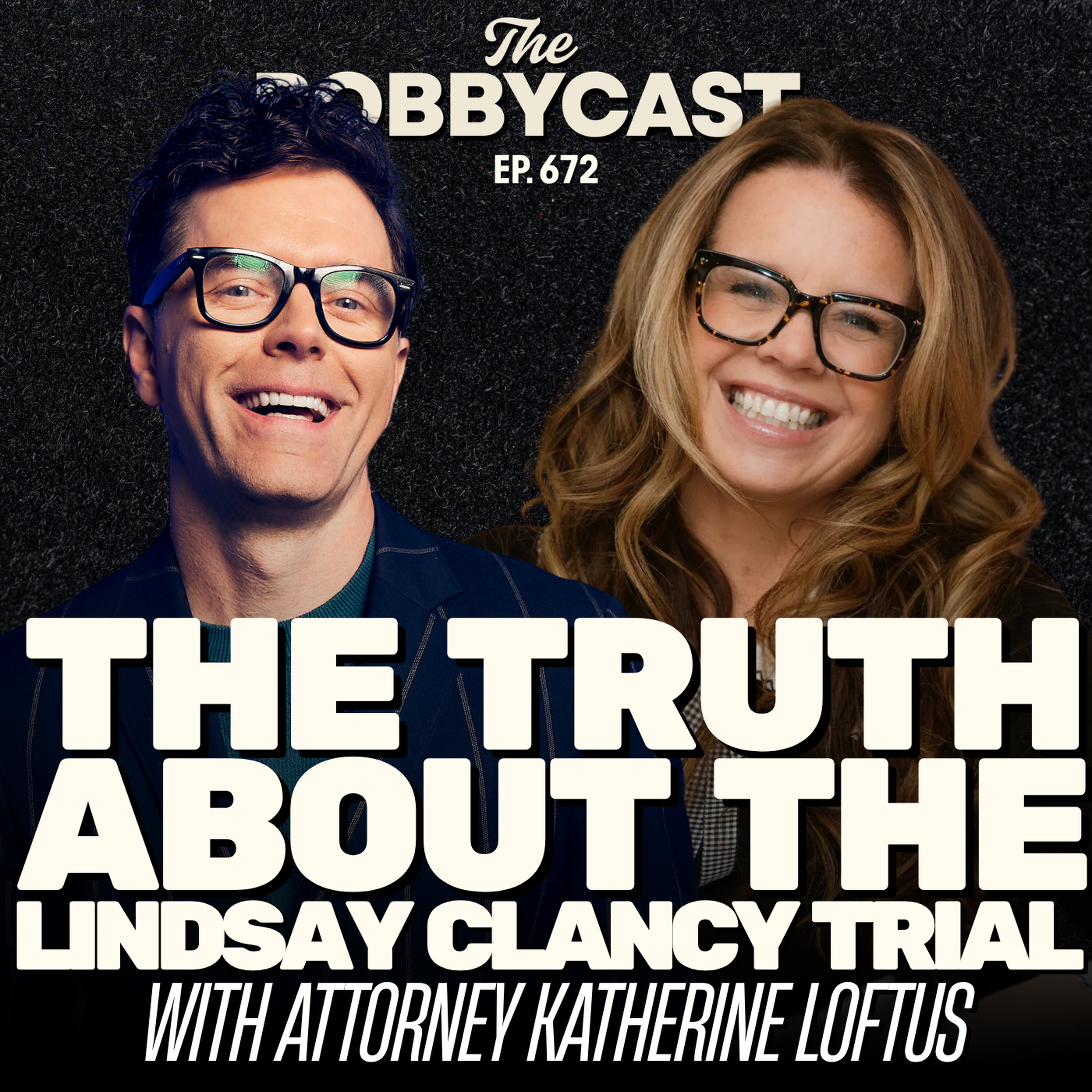
#672 - The Truth About the Lindsay Clancey Trial with Attorney Katherine Loftus
About this episode
Attorney Katherine Loftus joins Bobby to break down the Lindsay Clancey case and the legal questions surrounding her mental state. Katherine explains what the defense has to prove, how reasonable doubt factors are in, and why medical records and medication could play such a major role. They also discuss what could happen with another jury and how emotion can influence a case like this. Plus, Katherine explains why the story playing online can look very different from what actually matters in court.
Check out Katherine's podcast Note My Objection HERE
Watch The BobbyCast on Netflix!
Follow on Instagram: @TheBobbyCast
Follow on TikTok: @TheBobbyCast
See omnystudio.com/listener for privacy information.
Get every episode summarized
Each time Bobby Bones Presents: The BobbyCast publishes, we email you a written briefing from the transcript — the topics, who appeared, and any specific claims, with the ad reads skipped.
Email me new episodesFree for 3 shows. No card needed.
Transcript ready
662 searchable segments. Every word is indexed and playable.
Full transcript
Bobby Bones Presents: The BobbyCast — #672 - The Truth About the Lindsay Clancey Trial with Attorney Katherine Loftus. Machine-transcribed; use the interactive transcript above to jump the player to any line.
This is an I Heart Podcast. Guaranteed Human Welcome to Decoding Women's Health. I'm Dr. Elizabeth Pointer, Chair of Women's Health and Gynecology at the Adriah Health Institute in New York City. I'll be talking to top researchers and clinicians and bringing vital information about midlife women's health directly to you. A hundred percent of women go through menopause, even if it's natural why should we suffer through it? Listen to Decoding Women's Health with Dr. Elizabeth Pointer on the I Heart Radio app, Apple Podcast or wherever you get your podcasts. What up this Jay Valentine co-host of the R&B Money Podcast alongside my brother, R&B Legend, Tank. Together we've built a space for artists, executives and fans of R&B music to reminisce and tell the real stories behind the music. I have no money, I was hood famous. They think you're gonna get everybody out. We lived in a project and real love came out. They hear an im music and we had nothing. From Smokey Robinson to Mary J. Blige, V2K to Geel Scott. If you're a super dedicated R&B fan, this is where you belong.
Listen to R&B money from the Black Effect Podcast Network on the I Heart Radio app, Apple Podcast or wherever you get your podcasts. The World Cup is over, but if you caught the soccer bug and aren't sure what to do now, check out our podcast Big Kick Energy. I'm Cameron Dicker, the kicker from the Los Angeles Chargers and I'm here with Timmy Tillman, current LFC star player. So we know a little something about kicking balls. Each week we'll tackle things like, who's winning the Premier League this year? What do you think is harder? Scoring a penalty kick or scoring a field goal? Join us each week for a quick chat with your soccer-loving bros about the best sport in the world. Soccer, just don't tell my coaches I said that. Listen to Big Kick Energy on the I Heart Radio app, Apple Podcasts or wherever you listen to podcasts. Whether you're a seasoned NFL fan or new to the game, there's one place to keep up with all of it. The league's newest podcast, the NFL report hosted by me. Andrew Siciliano, it is your home for everything football. Breaking news, expert analysis, game picks, and here from your favorite players too. Join me at an all-star cast of experts for everything you need to know from around the league.
Get new episodes of the NFL report Monday through Friday, all season long. Listen to the NFL report podcast on the I Heart Radio app, Apple Podcasts or wherever you get your podcasts. College football will hijack your weekend, ruin your sleep and break your heart. And that's why we make the Solid Verbal College football show. I'm Ty Hildenbrand, he's Dan Rubenstein. Every week we preview the games that matter in the storylines that are gonna ignite your group chat. And you can join us in the aftermath as we react to what happened, why it matters, and how the sport went completely bonkers yet again. Listen to the Solid Verbal College football show on the I Heart Radio app, Apple Podcasts or wherever you get your podcasts. In that very moment was she taking the lives of her children because she knew she had to leave this earth and she couldn't live without them. Or was she commanded to do it and couldn't control herself and conform herself to the law.
So we're gonna talk about the Lindsey Clancy case here and we're talking with Attorney Catherine Loftus. Former prosecutor, legal analyst and the host of a podcast, note my objection where she breaks down law politics and some of the biggest stories in the news. And so we're gonna go deep into this case and from what I've seen she has not actually given an opinion on guilty or not guilty. She just goes in the facts and so I'm gonna have her be the defense and what they could have done better. I'm gonna have to be the prosecution and what they could have done better and we'll talk about the mistrial, what happens next. And so for me, this was super interesting. Here's my conversation with Catherine Loftus. All right, we're talking with Catherine Loftus now who as the Clancy case has been moving along, I've been watching her TikToks really to give me my opinion. And so Catherine, thank you so much for coming and talking to me about this because I have a lot of questions because I've tried to be educated but I am not you.
Would you talk about first of all, you're an attorney, right? I am. So I know what an attorney is but like what are you specialized in? Like what are you good at? So I mostly am good at criminal law. I'm, you know, as you as they like to say, lawyers are good at a lot of things. But most of us specialize. I worked in the district attorney's office while I was going to law school at night. And then I practiced as a prosecutor for about three and a half years after that. So I spent about a total of eight years in the DA's office. And then I went over to the criminal defense side where I've been for about seven or eight years. So I've been in the criminal justice system for probably 15, 16 years total and have had experience on both sides, which I think really enables me to give a unique perspective to my audience. That's coupled with sort of, you know, throwing in my, you know, personal background growing up in the city of Boston. So I have a little bit of the street smite and book smite if you, if you well. And so I try to give through, you know, my platform, note my objection.
Really the most sort of fundamental kind of breakdowns of what the law is, what's happening in the trials that I cover because it's complicated stuff. So before you came on, we were talking about your podcast. And I definitely want to talk about other things other than this case and just a bit. But I need some help with the case. And so I'm probably going to spray around a little bit and just ask random questions because I really don't even know how to talk about this case as an educated person because what I found is when I look something up or I see something on TikTok. And maybe we'll start here like there was the rumor. I remember first of all that the husband could have done it. And I watched one video, but then I started to get fed all videos about him doing it. So all it was doing was taking whatever bias that I had and feeding it to me over and over again. So then I start to feel like that's the reality. Right. So, so if we start with that, like because the rumor has been that possibly the husband would have had something to do with this. That's not a part of this case. Is there any chance it ever becomes part of a case from my perspective? No. And I'm glad that you brought that up.
Because I think, you know, the world that we live in, which is sort of this constantly online conversation that we invite all kinds of people in, right. And what happens that I've noticed over the last couple years of covering cases, criminal cases, particularly is that oftentimes what's happening in the core is very different than what's happening sort of in the online discourse. And as you mentioned, you know, there were all kinds of conspiracy theories and thoughts about, you know, could the husband have done it? Patrick Lancy, you know, sort of going from A to B all the way to Z very quickly. What's happening in the actual courtroom is that this is really a case not about whether Lindsey Clancy committed these crimes. She's charged with three counts of first degree murder for the deaths of her three children, core or Dawson and Cal and Clancy. But really, the trial has always been about what her mental status was at the time that she committed the crimes. And so there's been quite a bit of a divergence between what not only what's actually happening in the courtroom, but all the people who, you know, are sort of on the ground, the defense attorneys, the prosecutors, the judges, the police, the people covering the case, see as what the case is versus what the online sort of conversation has been.
So 11 jurors, have they now said it was 11 saying not guilty and one guilty or did they just let us assume that's what it was? There was a few notes that came back from the jury. The first one being essentially that there was a one holdout juror that they were had some questions about doubt and they were not following the law. I think from that the both the prosecutor and attorney right and 10 assumed that it was 11 to one. We now have seen multiple jury interviews. We've had some local suaconal on NBC 10 here and Christina Rex on WBZ have interviewed in total four of the jurors who essentially have confirmed that it was 11 to one that the 11 voted knock guilty by reason of insanity. And then there was one jury holding out. And you know, I think that really ultimately goes to what, why this case is so difficult because it's not simply just has the calm wealth proven that Lindsey Clancy committed a crime, you know, she's guilty or she's not guilty.
It's really the next step of it, but it seems to be by all accounts that they were 11 to one and they were really trying to convince that final jury, but we're just unable to. Also what I read was that even that juror may have said and you correct me on this that by law that they should say not guilty, but that he just couldn't go along with it. That's right. So we're hearing so you know, there's a little bit of a difference. So obviously we didn't get the benefit of knowing what was happening deliberations when we get the notes from the jury to the judge. The only thing that the judge and any of us in the public watching the case had at the time that the jurors sent the notes to judge Sullivan was that the juror was expressing that there was some doubt, but he was unwilling to follow the reasonable doubt instruction. What we've learned subsequent to that from several sources that maybe there was some more discussion about he had found reasonable doubt, but didn't feel comfortable essentially voting non guilty.
Now in Massachusetts, the way the reasonable doubt instruction is read to the jury is that proof beyond a reasonable doubt is not proof beyond all doubt. So you are entitled as a juror to have some doubt. You just can't you just can't find somebody guilty if you have reasonable doubt. So again, it's this really subjective standard. It's difficult. It's it's even difficult for lawyers really to understand because ultimately it comes down to each individual juror and how they evaluate the evidence that was presented the testimony from all the witnesses. And whether they think that the doubt rises to the level or not. What's the defense as strong as case and just a couple things that come to mind to me is just from again reading things and watching people talk about it. So again, I'm absorbing information like the normal American, which could be wrong a lot of times, right? It could be just the thing that's got the most clicks, which doesn't mean it's right. But what's the thing that the defense has really hung its hat on to me? It seems like she asked for help a lot of times and maybe didn't get it. Is that true?
So I think the biggest benefit that Kevin Renson has to his defense is that this is a woman who sought help repeatedly for months and months and months. And you know, this isn't somebody who, like I said, has been involved in the system has, you know, has had problems before by all accounts. Lindsay and Patrick Lancy and their three children were, you know, a great family. She was a nurse at Mass General Hospital here in Boston, which is one of the best hospitals in the country. She was a labor and delivery nurse. They had a great summer and towards the end of August, early September of 2022, she began having some significant anxiety and depression and started to get it. And she started to seek out help. So she first went to a psychiatrist and from there on out, there was sort of a combination of both, you know, I would say lack of substantive treatment. There was prescribing of medication. So we have a lot of mixing of pharmaceuticals, you know, on one medication taking that off because that's not working, prescribing a new medication.
Most of the meetings with the nurses and nurse practitioners and doctors were all over telehealth. Most of them were not in person. And Lindsay reported we start in her journals. We start from the testimony of the various mental health professionals. So that's really what Kevin Reddington tried to hammer home was what else was Lindsay Clancy supposed to do. She was essentially screaming for help. She called suicide hotlines twice. They basically told her, you don't have a plan so we can't help you. She was admitted to an inpatient program, which really seems to be more of a spin drive than anything else. It wasn't a lot of substantive treatment. But it's really what he hammered home despite the fact that, you know, the mental health system isn't really a typical defense to say to a jury, hey, you know, don't hold me responsible because the system failed me. But I think because the system seems to have failed her, it was an effective argument to the jury. And I think we heard that from the conversations that we've had with the jurors so far.
So there's documentation of her saying, I need help over and over again, please help me. Is there any sort of liability to the people that did not help her? So both Patrick, Clancy and Lindsay Clancy have separate civil lawsuits filed against all of the professionals who treated her and their institutions. So, you know, Patrick's Clancy was filed first and then Lindsay Clancy was filed earlier this year. I believe in January of 2026 against the providers and the health care institutions. And you know, the question really becomes, I think that what was she supposed to do? You know, we have this sort of lack of continuity of care that we see. And I see it not just in this case and the cases that I cover, but you know, every day cases in court that nobody pays attention to that, you know, you hear one doc to talk about, well, I'm at this institution and she had previously been seen in another and we're not the same institutions. So I don't have the records, but we don't have anybody seeking them out. We don't really have anybody, you know, taking the further step.
So it will be interesting to see as sort of a secondary effect, what happens in the civil cases. But I think, you know, I think there's, I think there's some legitimate liability there. Would this have been a trial where character witnesses were actually valuable? I think they were. I think they were because you didn't hear a single person say a bad word about Lindsay Clancy. You had, you know, people from those who only knew her a little bit from drop off at daycare to the individuals working at the health care club, then you had nurses who worked with her at mass general. And all the way up until you know, you had Patrick, her ex now ex husband, her mother in law, Sue Clancy, who also was a labor and delivery nurse and tried, you know, really tried to help her. Not a single person had a bad word to say about Lindsay. And I think that really helped frame for the jury that this truly was somebody who was like any of us, right.
Up until the six months preceding this crime. And so, you know, that sort of leads you to this natural inference that well, something must have happened, right. I think it's a very important thing for her mental health struggles, but for her depression, but for her, you know, medication over medication under medication, sort of the combination of it all in it's hard to pinpoint. You know, we can't just say, Oh, it was this doctor who did it. And that's why it's really the whole sort of cocktail of it all together. I think it's hard to imagine that if those things had not happened that she wouldn't have committed these crimes. So I think the fact that she was well liked, well respected, and well loved by her family and friends really helped the defense case. Her ex husband testified, what was he saying during the trial, but gets if I remember correctly, he was very pro his ex wife. So, you know, and it's my understanding. So when this happened in January of 2023, you know, the community in the entire state, but really the local community in Dexpert in the South Shore, Massachusetts really rallied around all of them.
Patrick came out at the time and said, you know, I forgive her. Please forgive her. Like she loved her children. She was a great mom. She was a great wife. And I think there's sort of a difficult balance because I don't think that anybody in the Clancy family or Patrick wants to see her in prison. I think they want her to get help. So that's sort of a little bit in a little bit of a disagreement, likely with the district attorney's office who is pursuing the case and wants her to serve a prison sentence. But, you know, he only spoke highly and still only speaks highly of of Lindsey to this day. The fact that after the murders happen, she jumped out the window. I'm assuming she was trying to kill herself. Does that lend itself to the she was going through whatever bout of psychosis or insanity? You know, it's interesting. This is really what we had sort of competing into a psychologist sort of the battle of the experts, right? Because we had expert witnesses, psychologists and psychiatrists that testified for the Commonwealth.
And we also had the same on the defense side. And essentially all of them agreed that this was what they call an altruistic filiside. Essentially that she was struggling so deeply that she felt like she couldn't be on this earth anymore. And, you know, the way it's described as the psychiatrist is almost out of love that you feel like, you know, they have to come with me. The question was, and is really the debate between both of the sides was, did she also have psychosis at the time, which would sort of take it to the next level that in that exact moment that this crime occurred that she was in some sort of altered state. There was testimony from both Dr. Zizel and the chaplain who were at Brigham Women's Hospital when Lindsay was first hospitalized reported that she experienced what she said were command hallucinations. And so from the defense perspective, it has been their position that she essentially heard a voice that said, you know, now's the time you this is the last chance you'll have to do it.
You have to kill yourself and you have to kill the children and that that happened when Patrick left that evening to go pick up the takeout food. You know, it's hard to know and that's really the question because again, it's getting into somebody's state of mind and as all of us are watching this as jurors or observers, we're, you know, sort of taking the pieces of evidence and trying to piece together, you know, did she know what she was doing? Did she not know what she was doing? She very clearly was sick. She was not well. The question goes to in that very moment was she taking the lives of her children because she knew she had to leave this earth and she couldn't live without them or was she commanded to do it and couldn't control herself and conform herself to the law. Let's take a quick pause for a message from our sponsor. Everyone, it's the Jonas Brothers with the Hey Jonas podcast. We've been catching up with some great friends Paul Rod Michael Blay, Seth Meyers, Nile Horan, Jake Shane and making some new friends while getting into what's really like to have sisters like Alex National.
She likes to control everyone and tell everyone to control as a harsh word. I would say that's a harsh word. I am more outspoken. Growing up a lot of the times because she was so quiet, I would speak for like the both of us. Now I'm working on like thinking a mom is really not a good thing before I speak. And Joey King. You know if your like mom is yelling at your sibling and even if you're annoyed with your sibling, you just like won't let that slide. It's like you only can yell at your sibling. I'm like, you can't do that here. That is not what I want talk about her like that. I just want to talk about her like that. Plus we've been taking your calls listening to your voice mails and giving advice or at least trying to. So if you've got catching up to do now is the perfect time. Listen to Hey Jonas on the I Heart Radio app Apple podcast or wherever you get your podcasts. When I was 14 years old, I was kidnapped and health captive for nine months. I survived and I've spent my life exploring how other people survive what should have destroyed them.
I'm Elizabeth Smart and these are the survivor files. You just remember this low taunting voice next to my ear saying shut up. Don't say anything. Every week I'm with survivors who live through the unthinkable. I knew if he woke up without a doubt he was going to hurt me. I started feeling that there was someone at the end of my bed and I just started screaming. They are abducted, stalked, controlled and nearly silenced. But these aren't stories about what's taken from them. Their story is about what it takes to make it out alive. Listen to the survivor files with Elizabeth Smart on the I Heart Radio app Apple Podcasts or wherever you get your podcasts. Self-care September is here which means it's time to rethink what self-care actually means. Yes, self-care can be a long walk, it can be an everything shower, it can be putting your phone on do not disturb. But sometimes it's actually about sitting with the uncomfortable stuff. And understanding your patterns, your boundaries, finally figuring out why you keep doing things that you swore you would never do again.
I'm Gemis Begg, the host of the Psychology of Your 20s podcast. And each week we unpack the psychology behind the experiences that shape your 20s. From relationships and friendships to money, anxiety, confidence, attachment, just becoming more comfortable with who you are. Unlike the quarter life crisis which is depicted as the collapse, the quarter life reinvention is the expansion and worth of something. When we develop the ability to be happy by ourselves nobody else can take that from you. So this self-care September, don't just take care of yourself, get to know yourself as well. Listen to the psychology of your 20s on the I Heart Radio app Apple Podcasts or wherever you get your podcasts. If you're bookshelf and you're for you page are equally important to your personality, welcome home. This is Pro's Society, the weekly podcast that's part book club, part group chat for thought daughters, pop culture obsessives and anyone who thinks pride and prejudice and love island deserve the same level of discourse. I'm Eli Rallo and every week we're connecting the dots between books, the internet and the conversations everyone can't stop having.
I'm going to have to look up this story. I'm obsessed. I'm obsessed. From bestselling authors and your favorite book talk creators to the latest pop culture moments, nothing is off the table. So like if you can hide some real messages inside compelling characters and that is the Trojan horse. Whether you're looking for literary deep dives, smart pop culture conversations or a community of readers who love to think a little too much, you're in the right place. Listen to Pro's Society on the I Heart Radio app Apple Podcasts or wherever you get your podcasts. See you between the pages. Hi, this is highly breakman, Angela Jaretana, Jeremy Colhane Cash McDonald, and we're the hosts of the artists on artists on artists on artists podcast. The Improvised Character Comedy Podcast where each week a new panel of artists discuss their craft. Join us for a panel of wellness influencers. What I try to do is foe journal. I don't know, I think I sort of foe journaling. Yeah, it's reading. It's called reading. So you're so we don't like to use that word anymore.
Okay, a panel of New Yorker cartoonists. Have you guys done Terry Gross's Peloton class? No! I've been dying too! I'm so sorry, I'm seeing a reading of Sudako in the Thousand Paper Cranes by Audrement Donald at the Wonderland Bookstore 14. That's crazy, I went to the Wonderland Bookstore yesterday and I heard Nora Jones do a reading of Zero Dark Thirty. No way! You have to come to the last bookstore though. Kim Kertroll is reading the guitar tabs of yesterday! A panel of Eurovision participants. And we do a little Halloween sometimes. Does the Pope dress up? He winks on Halloween. It's right up next to the microphone. I hear you get the elbows here, the eyelashes hate each other. You never seen Italy so quiet as when the Pope gets up to wink on Halloween. Listen to artists on artists on artists on the IHERD radio app Apple podcasts or wherever you get your podcasts.
And we're back on the Bobby cast. This may be a weird legal question, but let's say there's an insane asylum. It might not be a word anymore. A mental health facility. And the door is supposed to stay locked and the people can't get out because they've had thoughts and visions and they've done bad things. But the door was accidentally left unlocked and that person is able to get out and they go out and they kill somebody. But they have been treated, they've been diagnosed, they go out and kill somebody. Would that person that did that be charged with murder or would it be a definition of insanity type? What we're talking about here. Well, they would still be charged with murder. So just like what we have in the Clancy case to be similar. So she's still charged with the first degree murder of all three children, which is the appropriate charges, you know, from my perspective. And then you would have a defense. I think what a lot of people have some difficulty with it as well is that this idea of sort of punishment and justice. And what do we do with the in between, right? Because in Massachusetts, we don't have an option to plead guilty and be sentenced to a mental health facility that's not a legal criminal sentence for a judge to impose.
So the only options we really have are either you're guilty and you go to state prison or you're not guilty by a reason of insanity and go to a mental health facility on a civil commitment, which is re-evaluated. And there is the potential that you could be released. I think it's, you know, it's sort of this moral question that some of us wrestle with, right? We want to make sure that, you know, if you take the lives of somebody else that there is some accountability to it. But how much do we take into account the mitigation of somebody's mental health and that if they were well, would they have committed this crime? And the husband left. Did she ask him to go or did she just do it while he was gone? Like the circumstance presented itself? No, so she asked him to go and this is one of the pieces that the Commonwealth used to try to argue and make their position, you know, which was that she essentially sent him out on purpose. So what happened was the day of January of 24th of 2023. Lindsay was home with their older daughter, Korra, who she had taken to the pediatricians office.
It was essentially a normal day carried on as usual, actually Patrick said, you know, it seemed to be one of our best days yet. She was playing in the backyard with the kids building a snowman. And at some point around 4 30 or so, five o'clock that afternoon, she texted him and said, you know what? You know, I'm kind of tired. I don't feel like making dinner. Can you go pick up some takeout? And so she hadn't go pick up takeout to a location that was they had been to before they had eaten in, but they had an order takeout before it was a little bit longer of a drive than most of the normal places that they usually got takeout from. And she also asked them to stop at CVS to get medication for Korra. She was he was supposed to pick up some pdlx for her. And so that's part of the Commonwealth argument was that listen, she sort of engaged in what would be considered normal behavior throughout the day, right? She went to the pediatricians office, the doctor, they testified said, you know, we didn't see any signs that there was anything wrong or anything out of the norm.
She was able to communicate with people back and forth. She then sent him out to, you know, not only get takeout, but the medication which created the amount of time that she needed to do this. And so that was really the argument from the Commonwealth that this wasn't, you know, a moment in which she had hallucinations and she was hearing these auditory commands, but she in fact, playing it out based on the timeline that, you know, she sort of set up from that's the Commonwealth's perspective. And I'd ask the question about what was the defense hanging their hat on and you may have said it just then, but what was the prosecution? Like what was there? They're strongest weapon to use. I think that, you know, I had a lot of critique of the Commonwealth's case because they, I think there was a legitimate argument for making to a jury that listen, this is somebody who was very unwell, she clearly was struggling with depression, anxiety, she did try to get help from a variety of providers.
But this is into a referendum on the mental health system, right? This is a question about what happened to Lundy Clancy and what happened to her three children. And instead of taking that tact of really kind of acknowledging her mental health and the struggles she was going through, what the Commonwealth did was they essentially tried to paint her as this, you know, this neurotic type A mom in their opening statements, they said, and I might be a little bit off on the quote, but, you know, Lundy Clancy no longer wanted to live the life that she thought she wanted. And I remember from that very moment hearing that saying, well, that doesn't seem consistent with what we're going to hear, right? This isn't just a mom who's, you know, sick of her life, she doesn't want the kids anymore, she's overwhelmed. And so, you know, she strangles her three children, that doesn't seem like a reasonable argument to make. And probably the most effective the Commonwealth was was in the closing argument in which they sort of presented a completely different tact and really outlined the specifics of the timeline, you know, they acknowledged her mental health.
But I think it was a little bit too late for them. I think they had turned off the jurors at some point because they they were, you know, in some ways, unkind to some of the witnesses, including Patrick Clancy talking about, you know, just very dry, questioning when, you know, asking about how he found his children, what they looked like, what, you know, the manner in which he found them. And so I think what will happen is they will take it if it does go to trial again. They will take some of that and sort of retool what what they presented in their closing argument and present that throughout the their case and chief around to it. I think that would be a more persuasive argument for around to if we get there. Are you assuming they will retry this? I think in the zero chance that the case, you know, it's not going to be dropped. It's not just going to go away. The question is going to be what are they going to do with it now in Massachusetts first degree murders can't be tried in front of a judge.
So normally on every other charge you can go jury waived, which basically means that the judge makes the decision. And if that's what happens, the Commonwealth would have to reduce the charges from first degree to second degree. Now the only difference is on a first degree conviction, you get life without parole on a second degree conviction, you get life with the possibility of parole as decided by the judge. It's either 15 years, anyway, between 15 years and 25 years. The question is, you know, what what do both sides want, right? And as we were talking about earlier, there is no middle ground where she could say plead guilty and then go and stay at two very hospital where she is now the mental health facility. There really is the only option between a guilty state prison sentence or not guilty by reason of insanity. So unless the, unless the Commonwealth is willing to reduce the charges, I think they they have to try the case again. So it either goes to a jury trial on a first degree murder or they reduce it to a second degree and maybe see if a judge can decide it because the benefit of a jury waived going bench trial in this case is there's some finality to it.
I think the concern is if they go in front of a jury again, we end up with another hung jury just because it's, you know, it's just so fraught with emotion. It's so difficult to get to that place where, you know, what is in someone's mind. People feel really strongly about it. So I worry that if they go in front of a jury again, we end up with another hung jury. Hi, Paul, just for my limit of knowledge on this, but will they go same teams, same defense, same prosecution with all the attorneys be the same. I think most likely so Kevin Ridington will definitely be her attorney again. He has been with her since I think maybe four or five days into this in 2023. So he will stay with her the two of 80s Jennifer Sprig and Shannon Buckingham. They are prosecutors in the Pumas County District Attorney's office. It is a fairly small office comparatively speaking to some of the, you know, when she gets closer to the city and stuff of county in Boston, obviously there's the little bit more depth to how many people can take on this kind of case.
But I would be surprised at this point if they changed them out. I sometimes it I think that one of the downfalls for the government is that they can get sort of stuck in, you know, there's been a lot of critique of them. There's been a lot of critique of the DA's office as a whole with this case of these two particular prosecutors in the way that they present the case. And I do think that they could benefit from bringing somebody else on that maybe has a little bit of a softer affect. But whether they will do that, I don't know. I would imagine that at the very least these two will stay on possibly somebody else comes on as well. So I have you played both. If you were the prosecution going into the next trial, if there is one, what would you do differently? I'm really leaning into the difference between Lindsey Clinton's mental status as a whole versus what happened that night because, you know, the legal principles are you can be very sick. You can be somebody who has struggled with all kinds of, you know, mental illness.
But do you know what you're doing in the moment? And so I think that there I think that there is a reasonable argument for that. And what you have to really direct the jury to do is to take out this emotion, right? Because obviously this is a sympathetic figure. This is a woman who you're going to hear that everybody loved her. She was a great mom. She was a great friend. She was a great wife daughter-in-law. And she was completely normal up until six months before this. And so that can all be true. And she can also have committed a really heinous crime. And we have to be able to take out the emotion, you know, use a logic common sense. And when you apply the law, you know, I think you, I think you get to the place where you can acknowledge that, yes, she's really sick. And yes, because she felt like she couldn't be in this world anymore. She made that conscious decision to take her all life to try to take her own life and her children with her. And I think that's really the where the Commonwealth needs to go if they want to try to convince the jury. But again, getting 12 people there is difficult, I think.
If you were the defense, what did you learn that you could do better? You know, I think one of the things that we didn't hear from quite as much as I expected to from Kevin Ruddington. I think he did a really good job because, you know, as I said, it's difficult to present a defense of, you know, the entire system failed my client. And therefore you shouldn't hold her responsible. But I think we can dig a little bit deeper into what the specific effects and the combination, you know, effects of the different pharmaceuticals she was prescribed. You know, say Zooloft and Syracul and Adivan and Trazodone and, you know, Varian Milligramson. One was, she's weaning off of one and then being put on the other. But we didn't hear from anybody who testified as to what those interactions could be. You know, what are the black box warnings? Like what are the side effects? What are the possibilities that, you know, sort of taking that next step. Not only was she depressed and anxious and having intrusive thoughts, was she suffering from lack of sleep from the medication.
But, you know, what else could those medications and the combinations have caused? So I would lean even more into the sort of pharmaceutical aspect of it if I was writing to, you know, adding on to what he already did. How in the world do you get another jury? It will be difficult. It will be difficult. We did this once before in Massachusetts. Not that long go with the Karen really case in it. It was more difficult to get a jury the second time around because, you know, not only are these cases. They have national international attention, but everyone's talking about them locally as well, right? And, um, Plymouth County is I will say demographic wise. Plymouth County skews a little bit older, I would say, in the jury, I think was reflective of it for this first time around. So the hope that you have is that you can find a jury pool that reads maybe more, you know, print media and doesn't, you know, is it on social media, is it on TikTok, is it on Instagram, that kind of stuff and that they have at least less access to it.
I don't think it's impossible, but it does make it more difficult and it's also, you know, it's something I talk about and think a lot about sort of where we are in a society now about. How can we separate these two, how can we get fear juries when there's so much information, you know, you think about the idea that, you know, we used to sequester juries or, you know, they all swear and oath that they won't, you know, listen to anything they won't watch anything. But you know, those rules are also from a time when, okay, well, I won't get pick up the paper at the corner store, you know, now it's impossible to avoid because we're all, you know, we're all on our phones, we're all on our iPads, we're all on our computers. And so I think it's much more difficult than in this day and age to find juries that have no knowledge of these cases. I've seen people try to boil it down to, well, postpartum depression shouldn't make you murder. Is it that simple? It's not that simple. And I think anyone who tries to oversimplify these things is just not being honest because one thing I've learned about being in the criminal justice system for a long time is that nothing is black and white, nothing fits in a box, nothing is easy.
And you know, it's, it's human nature, right? So we're talking about what humans do in times of stress or in times of frustration. And, you know, I think that if there's anything good that can come from this is hopefully a conversation about how we treat, you know, women in the postpartum period. And I think that what what we see sort of in this case and why there's so much attention sort of brought to it and why so many people feel connected to it is that, you know, as women, I'm among myself, I have a 10 year old and a seven year old. I think there is a recognition in what happens to a woman in their body after they have children. And unless you experience that, it's often difficult to understand, which makes sense. But the combination of having, you know, depression in anxiety coupled with what's going on in your body, which is that you're, you know, your hormones are all over the place, you're, you know, having a lack of sleep, there's all kinds of stuff that sort of kind of creates this.
Like I said cocktail where it's a different kind of analysis and it doesn't mean that if you're a postpartum woman and you commit a crime that you can blame being a postpartum woman on it. But it's certainly something we have to consider. And I think to just dismiss it outright is disingenuous to be honest. Have you said that if you were on the jury, what you would have said? And you know, I, I, to be honest, I really struggle with it. I really struggle with it because my legal mind feels like she was criminally responsible, but I have a really difficult time sentencing someone who was struggling so significantly to a term of life in prison. And so there were probably a lot of jurors who felt I think like I did is sort of that balance. I don't, I don't know. I don't know. It's really hard. So then can the system be repaired a bit often? It takes a break to even need a repair and there's no nuance here as you've been talking about. It's either go to jail forever guilty or not.
But it shouldn't there be allowed with as you talked about that specific charge there to be something that lands in the middle. I think so. And what I hope from this is that we might see some sort of legislation. I mean, that's where what we have to, you know, lobby your local representatives, your state reps, your state senators to essentially write legislation and enact it in Massachusetts, which deals with this specific issue. And as I mentioned, there are other states and United States that have this sort of middle ground. We've also seen a lot of what happens in Europe, eras some of the laws dating back to I think as early as the 1930s in what makes set of circumstances in which they don't fit into a box, right. They don't fit into a straight guilty or a not guilty by reason of insanity. So one thing in that I hope comes from this, at least specifically to Massachusetts is that we can start to have the conversation about, you know, maybe we need to have some sort of legislation around. A third option for cases that, you know, come like this.
So you're up there where the Karen read case happened and we all followed that too. And it was wild and watched the documentaries and I mean, I was in it's weird to be so compelled by something because that's someone's real life. But to us far away, it just feels like something on television or on social media. And so that had to be pretty wild to live there during that, right. It was, it was wild. I will tell you it. It really took control of Massachusetts, particularly again, this was on the South Shore. Karen read was in North of County, dead on which is about halfway to plumber County where Lindsey Clancy was. But the Karen read case took over Massachusetts for really two years. And then we just, you know, we've about a year out from Karen read. There was a, that ended in June of 2025. And then we've sort of had round two with Lindsey Clancy. So it is interesting to have back to back trials. I don't know what's happening in the waters in Massachusetts. But we seem to be the, the epicenter of it all.
Just watching whatever docu series as I watched or people talk about it. And again, I'm far away. And I probably am not getting all the information because I'm not in the courtroom. That's the only place to get all the information. But it felt like the police officers there were pretty corrupt and that she probably didn't do it. Is that how you felt living there? Well, I have a, I have an unpopular opinion on Karen read. I, so my perspective on the read case was always that she was vastly overcharged originally she was charged with manslaughter and they upgraded it to second degree murder. I think that was mistake number one. And then down from there, we had, you know, it turned into, it turned into it's a life of its own. And we had the federal investigation that came as a result of the underlying investigation in North of County. That's what we learned about, you know, Michael Proctor, who was the lead investigator for the state police. It all kinds of text messages, not only about Karen read, but you know, racist misogynistic type of stuff.
It has always been my position that based on the evidence as I saw presented at both of the trials and all the pretrial litigation that I covered that the evidence supported the idea that Karen read was responsible for John O'Keefe's death. But ultimately the jury found her not guilty. And you know, that's why we have a jury system. So in many ways, you know, there's a lot of through lines, I think, between Karen read and sort of the what was happening in the court, Roomba versus what was the online conversation is similar to the Clancy case. But both certainly took over Massachusetts. On your podcast, note my objection. Well, what do you do every day when there's not a wild case happening that's heard all over the world every second? Well, I do do some real legal work sometimes, so Bobby, but you know, what I try to do is, is you know, it's funny. I started talking on note my objection really during COVID because I had nobody else to talk to.
So I started to talk to people online and I see sort of this whole in the system where we can just get sort of easy breakdown, clear concise, you know, information. And so what I try to do is just talk to about things that I think are important. Sometimes they're local issues, whether they're, you know, local politics in Massachusetts or, you know, criminal cases here. I talk about sort of bigger picture issues, you know, politics in society on a logiscale, but I think that, you know, we're missing. We live in in a world where it's clicks and the algorithm and views and it's really important to me to bring an honest perspective to my audience. And so I like to talk about things that, you know, they often end up being sort of controversial issues or sort of hot topic. And I want to make sure that people know that it's important to dig through where we're living in difficult times, right? It's difficult to figure out not only what's real because, you know, we have the AI age and we can't sometimes we can't tell what's real information, what's not.
We've sort of lost our ability to think critically, source things independently, you know, research. And I try to be someplace that people can at least rely on. So when you're, you know, you're watching a case in Massachusetts that I will tell you what's actually going on, whether, you know, that's, you know, congruent with the position you like or not. Because it's really important to me to be a space where, you know, people can trust. So I try to talk a little bit of this and a little bit of that. Well, I hope everybody checks out, note my objection. And especially your TikTok, I think you're awesome. I even watch you like to do your makeup while you talk about it. And I don't watch anybody to make up. So, yeah, thank you so much for coming on and just presenting facts because I think we can easily be swayed with things that are fact adjacent. And there's a difference in fact, in fact, adjacent for sure. So thank you for the time and everybody check out on TikTok and Instagram at note my objection and then our podcast is note my objection. Catherine, thank you so much. Thank you so much. I appreciate having me. Have a good day.
The Bobby cast will be right back. Hey, everyone. It's the Jonas Brothers with the Hey Jonas podcast. We've been catching up with some great friends Paul Rod Michael Boulay, Seth Meyers, Niall Horan, Jake Shane, and making some new friends while getting into what's really like to have sisters like Alex National. She likes to control everyone and tell everyone to go. Okay, well control is a harsh word. I would say that's a harsh word. I am more outspoken. Growing up a lot of the times because she was so quiet, I would speak for like the both of us. Now I'm working on like thinking a mom is really not a joke before I speak. And Joey King. You know if you're like mom is yelling at your sibling and even if you're annoyed with your sibling, you just like won't let that slide. It's like you only can yell at your sibling. I'm like, you can't do that here. That is not a lot of talk about her like that. I just like about her. Plus we've been taking your calls, listening to your voice mails and giving advice or at least trying to. So if you've got catching up to do now is the perfect time. Listen to Hey Jonas on the I Heart Radio app Apple podcast or wherever you get your podcasts.
When I was 14 years old, I was kidnapped and health captive for nine months. I survived and I've spent my life exploring how other people survive what should have destroyed them. I'm Elizabeth Smart and these are the survivor files. You just remember this low taunting voice next to my ear saying shut up, don't say anything. Every week I'm with survivors who live through the unthinkable. I knew if he woke up without a doubt he was going to hurt me. I started feeling that there was someone at the end of my bed and I just started screaming. They are abducted, stalked, controlled and nearly silenced. But these aren't stories about what's taken from them. Their stories about what it takes to make it out alive. Listen to the survivor files with Elizabeth Smart on the I Heart Radio app Apple Podcast or wherever you get your podcasts.
Self-care September is here which means it's time to rethink what self-care actually means. Yes, self-care can be a long walk, it can be an everything shower, it can be putting your phone on do not disturb. But sometimes it's actually about sitting with the uncomfortable stuff. And understanding your patterns, your boundaries, finally figuring out why you keep doing things that you swore you would never do again. I'm Jonas Begg, the host of the Psychology of your 20s podcast. And each week we unpack this psychology behind the experiences that shape your 20s. From relationships and friendships to money, anxiety, confidence, attachment, just becoming more comfortable with who you are. Unlike the quarter life crisis which is depicted as the collapse, the quarter life reinvention is the expansion and worth of something. When we develop the ability to be happy by ourselves, nobody else can take that from you. So this self-care September, don't just take care of yourself, get to know yourself as well. Listen to the psychology of your 20s on the iHot Radio app, Apple Podcasts or wherever you get your podcasts.
If you're a bookshelf and you're a for-you-page or equally important to your personality, welcome home. This is Pro's Society, the weekly podcast that's part book club, part group chat for thought daughters, pop culture obsessives, and anyone who thinks pride and prejudice and love island deserve the same level of discourse. I'm Eli Rallo and every week we're connecting the dots between books, the internet, and the conversations everyone can't stop having. I'm gonna have to look up this story. I'm obsessed, so obsessed. From bestselling authors and your favorite book talk creators to the latest pop culture moments, nothing is off the table. So like if you can hide some real messages inside compelling characters and that is a Trojan horse, whether you're looking for literary deep dives, smart pop culture conversations, or a community of readers who love to think a little too much, you're in the right place. Listen to Pro's Society on the iHot Radio app, Apple Podcasts or wherever you get your podcasts. See you between the pages.
Hi, this is Highly Breakman, Angel Jaretana. Jeremy Colhane, Cash McDonald. And we're the hosts of the artists on artists on artists on artists podcast. The Improvised Character Comedy Podcast, where each week a new panel of artists discuss their craft. Join us for a panel of wellness influencers. What I try to do is foe journal. I don't know, I think I sort of foe journaling. Yeah, it's reading, it's called reading. So we don't like to use that word anymore. Okay. A panel of New Yorker cartoonists. Have you guys done Terry Gross's Peloton class? No! I've been dying too! I'm so sorry, I'm seeing a reading of Sudako in the Thousand Paper Cranes by Audra McDonald at the Wonderland Bookstore, 14. That's crazy, I went to the Wonderland Bookstore yesterday and I heard Nora Jones do a reading of Zero Dark Thirty. No way! I have to come to the last bookstore though. Kim Kattroll is reading the guitar tabs of yesterday! A panel of Eurovision participants. And we do a little Halloween sometimes. Does the Pope dress up?
He winks on Halloween. It's right up next to the microphone. I hear you get the elbows here, the eyelashes hate each other. You never seen it least so quiet as when the Pope gets up to wink on Halloween. Listen to artists on artists on artists on artists on the IHERD radio app, Apple Podcasts, or wherever you get your podcasts. This is The Bobby Cast. I wanted to share a segment with you from one of the Bobby Bones podcast network shows. And so it's Movie Mike's Movie Podcast. I think every week, especially if you love movies or stories about movies, Mike does best and worst and also fun stories from the history of movies. So if you like this clip, which I hope you do, go check out Movie Mike's Movie Podcast and hit subscribe. That would be awesome. For you, the best movie you saw in August. I'm going to go with one night only. Did you feel like that was going to be more of a rom-com? It was a rom-com.
Did you expect it to be as politically charged as it was? Could you describe the movie? Well, one of my friends texted me before and said, because he saw it early and he was like, the movie was more politically charged than I thought. So it is essentially the purge, but for sex. Single people. Single people can't do it. You can't do it unless you're married. Correct. And there's one night of the year that you can do it. And everyone has this, like, not a chip in them, but the same thing in there. Yeah, and then it disappears. Very hunger games, as far as the markers they have with them. Yes. And then for that one night only, they basically go to town for like, what, six hours? I mean, it was longer than that. Yeah, they were all over the city. That couldn't have been six hours. If I hadn't, I've had that heads up, no, I wouldn't have expected it. But I thought it was really good. I love Callum Turner. He was really good at it. I love him. He and do a leap of together. Beautiful couple, Monica Barbaro, phenomenal. I feel like some people are being robbed of like, still a traditional romcom.
Because I think that those don't really work in theaters as much anymore. It primarily now goes to Netflix. And I feel like people go into a movie like this, or maybe even like the materialist thinking, like, oh, this is being dubbed as a romcom. But I love how the romcom has evolved. Where it's not exactly what you think of a romcom being like one of those 2000s movies with like Matthew McConaughey anymore. I was a little bit more sophisticated. Have you seen that clip going around where he talks about how, how to lose a guy in 10 days, makes him the most money. Mailbox money. Still gets a mailbox. On a residuals. Because of Valentine's Day. Yes. He's like every time around March, boom, big chick. And I feel like it was always on like TBS and like E those sorts of things. I will say I wonder if the shift to romcom on streaming is it's a great like Girls Night Movie. And you know, you get in your comfy clothes, you get a bottle of wine, you have some takeout, you have all your friends over. Feel like some environments, like some movies are meant to be enjoyed more at home.
So yeah, what would you rate that one? For pure entertainment, I'm going to give it, I'm going to give it four Trojans. There you go. I was close on that. I gave it a 3.5 out of five. I would say dating apps. Okay. That's a little bit more appropriate than the mind. Mine's relevant. There's a scene though. Like, and then just. Yeah. I know what you're talking about. I don't know where. For my best of August, would it be weird to pick something I did not see in theaters for maybe the first time ever? No. I think I'm going to go with the Travis Barker documentary. It was so good. I was hooked. It's called louder than fear. It was on Hulu filmed over like nine years. I will say I am a huge Blink-Win-A-D II fan. They are my favorite band. And I knew a lot about the history of the band. And it was cool seeing it all compiled into one story. And it was also fun that I got to experience something that I'm such a huge fan of, but that you enjoyed it too. Yeah, I'm a big Travis Barker fan.
I think he's talented. And of course, I love pop culture crossover, but I remembered when he had his show with Chana Mowgler and now he's married to Courtney Kardashian. I also just think I remember when he got in that plane crash and survived. And so just those huge moments and listening to him talk about it. I don't feel like he's talked a ton about it publicly. He's talked about never flying again. But you get to hear what happened right before and the weird, ominous warning. And just all of this surrounding it and he's gone through so much. And like how extensive the burns were. And that he is back at this level doing what he loves like after something as tragic as that. Yeah, I don't know how he got back to being able to run and like hosting running events across the country. I feel kind of bad for him now because the documentary is out and everybody wants to ask him about the plane crash. Like having to relive that time and time again in all these interviews.
I'm surprised he's not at a point of saying he probably will now of like, I don't want to talk about it again. It's out there. Like don't ask me any questions about it. Like I don't want to be like somebody who's having these kind of like rules on my interviews. But I think at that point people would understand because the documentary is out there. If you want to know about it, watch the documentary. I don't think there's anything else you can possibly ask him that he hasn't talked about already. I feel like people need to stop asking him about it because I just see like this glaze in his eyes when he has to tell the story and talk about it again. That's literally like the worst thing you could ever go through and then you have to relive it and talk about it. And just like put yourself emotionally back there and I'm sure he's done tons of therapy. Like he talked about that but even I mean we saw him in concert and so like to get to see him at that level and then know what it took to get back there because it was the substance issues like he had to overcome a lot. But that's why I put that one as my best of the month. I gave it 4.5 out of 5 drumsticks. What do you give it?
I honestly think I'd give it five. I think it's one of the best music documentaries. I've ever seen but I'm also a huge Blink-Win-N-E-2 fan. Just one of the best documentaries. I mean nine years of footage. Like we were like how they had Taylor Hawkins interviews. So we were like how long ago was this filmed? For your worst of August, what do you have? I'm going to go and again I'm going to say it's my least favorite. It's not the worst. It wasn't a bad movie but I liked other things. I'm going to go to the rivals of Amazigh King. Matthew McConaughey movie. That was close to like my top. I know. You got to see Matthew McConaughey. I know but if you think about all the other movies we saw I really enjoyed the more. Even Netflix don't say good luck with Melanie Lensky and Adam Sandler's daughter. It just was so emotional. Not just like got me. I will say there were a couple graphic injury scenes and rivals that took it down for me. That were at the beginning and I was a little like whoa what are we?
What am I about to watch? So there was a little graphic for my taste. Something I feel like we've experienced recently that is maybe only unique to us. We've seen some of these movies at the Bell Court which is our local theater here in Nashville. Our nonprofit theater. I feel like the crowd kind of influences a little bit as far as how funny movies are made out to be. I will say I think especially because was it the director? Yeah. The director was in the audience and I feel like there were funny parts. But there were some parts where people were laughing out loud and I was a little like I don't know that that was meant to be funny. Yes and it kind of had what I call like the Film Festival effect. Whenever you see a movie debut like maybe overseas or at like the Toronto Film Festival and the actors and directors are in attendance and then you hear it gets a 10 minute standing ovation you're like this must be the best movie ever. It's often times because they are in the room that other people glaze it a little bit. The rock and the smash. Exactly.
You've got a huge standing ovation that we also are and we're like what was that? It was just for the physical transformation. Yeah so I feel like we're starting to experience that a little bit here not even just at a screening with the director and Matthew McConaughey there. The drama. Yes but there's people were rolling on the floor from the drama and I was like this isn't like LOL funny. And I'll talk about another movie I saw there that I kind of felt the exact same thing. So even with all that it did take me a little bit to settle into the movie because I wasn't expecting it to be funny and everybody else was rolling around us that I found it more funny. I thought it was going to be a little bit more of a thriller more focused on the crime. But I ended up really enjoying it because I thought Matthew McConaughey's character was really good at it. And I just I guess I'm kind of re-igniting my love for Matthew McConaughey. I saw him in person and like brushed past him one time at a football game. Not like right next to him but he was with his kid but people were like this is when his kids were so young. I was in college and people like following him with this kid and he was like hey I'm just trying to get my kid a snow cone.
Could you not like follow me? That was before he had an official position and now he's just kind of always on the field. We've seen him at games this was the closest we've probably been to him recently. Yes. And it was cool to see him perform afterwards where I wouldn't say he's a great singer. I feel like he's developed a style that kind of works. Yes. He kind of like Yil sings and he's very passionate. I think because he is so charismatic he can kind of get away with it. Now I'm going to buy and I'm going to buy a Matthew McConaughey album. No, I'm good. But it is kind of interesting to see some more actors kind of dip their toes in music. Like I saw the rock put out a single. He's really trying to sing though. I think he did Mally and he's like I'm a singer now. No. Is this going to bring you back to making me listen to the Vin Diesel song? But Vin Diesel knows his capabilities as a singer. That's a dance driven song. But you make me listen to that song unironically. But I feel like I do. But the rock wrote a song like about his kids and it's like kind of emotional. Oh. Oh, here's the rock singing.
And he's like I remember what he did like rap songs back in like the WF days before they were WWE. He did like a song about Pi. So he maybe just wants to be like this country singer now or something. World Wrestling Federation. Yeah. And then we went to entertainment. Yeah. I think they got sued by the World Wildlife Foundation. So they had to change it to WWE. Attracts. They're paying it was like now you got to drop the up. Speaking of the rock, you made me a bet last week and you were like I bet $20 that you can't name five professional wrestlers. I named nine and what that $20 I bought a new lip gloss is a for us. So thank you so much. Very good. And then I asked you if you could name five books that I read recently. And I could. And you failed so spectacularly. You had like deep cuts too on the wrestlers. You're like Stacy Kebler. I'm like interesting. I did. Thank you. I might have spent more than that. $20 that you spent. So that was your worst for my worst of August. I think I'm going to have to go with super troopers three. They'd be so devastated to hear that which I gave a two out of five.
Yeah, I think that is the lowest of the month. And I think I was excited because I love the original one. I've interviewed the guys from super troopers. I think they are brilliant guys. I think they know comedy. But this movie was not it. I still think that they made the movie they wanted to make. But it's within the super troopers box that only has so much space to expand on. That it felt like maybe if I was 20 years younger, I would have found funny. I don't take pride in not liking that movie. I was actually getting roasted a lot for not liking that movie on TikTok and YouTube. But I just had a little bit higher expectations. And it was just not that good. Not that funny. Thanks for listening to a Bobby Cast production. Welcome to Decoding Women's Health. I'm Dr. Elizabeth Pointer, chair of Women's Health and Gynecology at the Adriah Health Institute in New York City. I'll be talking to top researchers and clinicians and bringing vital information about midlife women's health directly to you.
A hundred percent of women go through menopause, even if it's natural why should we suffer through it? Listen to Decoding Women's Health with Dr. Elizabeth Pointer on the iHeartRadio app Apple Podcast or wherever you get your podcasts. What up this Jay Valentine co-host of the R&B Money Podcast alongside my brother, R&B Legend, tank. Together we've built a space for artists, executives and fans of R&B music to reminisce and tell the real stories behind the music. I have no money, I was hood famous. They think you're gonna get everybody out. We live in a project. The real love came out. They hear them music and we had nothing. From Smokey Robinson to Mary J. Blige, B2K to Jill Scott. If you're a super dedicated R&B fan, this is where you belong. Listen to R&B Money from the Black Effect Podcast Network on the iHeartRadio app Apple Podcast or wherever you get your podcasts. Hey it's Bobby Beones. Join me and former NFL quarterback Matt Castle. Every Wednesday on our podcast, lots to say with me, Bobby Beones and Matt Castle.
You're in training camp and the rookie quarterback has one good throwing session in front of the media. Suddenly everybody online says he should start over you week one. How do you handle this? You just go back out to practice the next day and wait for him to mess up. Listen to lots to say with Bobby Beones and Matt Castle on the iHeartRadio app Apple Podcast or wherever you get your podcasts. College football will hijack your weekend, ruin your sleep and break your heart. And that's why we make the Sullivan Purple College football show. I'm Ty Hildenbrand. He's Dan Rubenstein. Every week we preview the games that matter in the storylines that are going to ignite your group chat. And you can join us in the aftermath as we react to what happened, why it matters and how the sport went completely bonkers yet again. Listen to the Solid Verbal College football show on the iHeartRadio app Apple Podcasts or wherever you get your podcasts. Whether you're a seasoned NFL fan or new to the game, there's one place to keep up with all of it. The League's newest podcast, the NFL report posted by me, Andrew Siciliano.
It is your home for everything football breaking news, expert analysis, game picks and here from your favorite players to join me and at all star cast of experts for everything you need to know from around the league. Get new episodes of the NFL report Monday through Friday all season long. Listen to the NFL report podcast on the iHeartRadio app Apple Podcast or wherever you get your podcasts. This is an iHeart podcast. Guaranteed Human.
More episodes
More from Bobby Bones Presents: The BobbyCast

#671 - Fighting Over the Best Cover Songs of All-Time
Bobby Bones Presents: The BobbyCast

Country Music in the 90’s: The Year is 1995
Bobby Bones Presents: The BobbyCast

#670 - Tim Tebow on Fighting Human Trafficking, Getting Humbled at Florida & Bec...
Bobby Bones Presents: The BobbyCast

In The Weeds: Bobby Talks Going Into The Comments, The Day Dolly Died, & Becomin...
Bobby Bones Presents: The BobbyCast