0:00
Suncast is proudly brought to you by CPS Americas.
0:04
Suncast is also brought to you by Next Power.
0:07
Solar right now employs over 300,000 people.
0:11
The coal industry by last estimates was under 60,000 people.
0:15
We are still on a relative basis, a younger industry to those.
0:21
Some of it is really learning how the game is played a little better,
0:25
getting out of our maybe altruistic ways around politics
0:30
and knowing that the rules of the game are pretty brutal.
0:32
It's a money game and we need to just get better at it.
0:40
If you, like Mini, are curious what is going on
0:45
at the Solar Energy Industries Association.
0:48
The former president and CEO has stepped down.
0:52
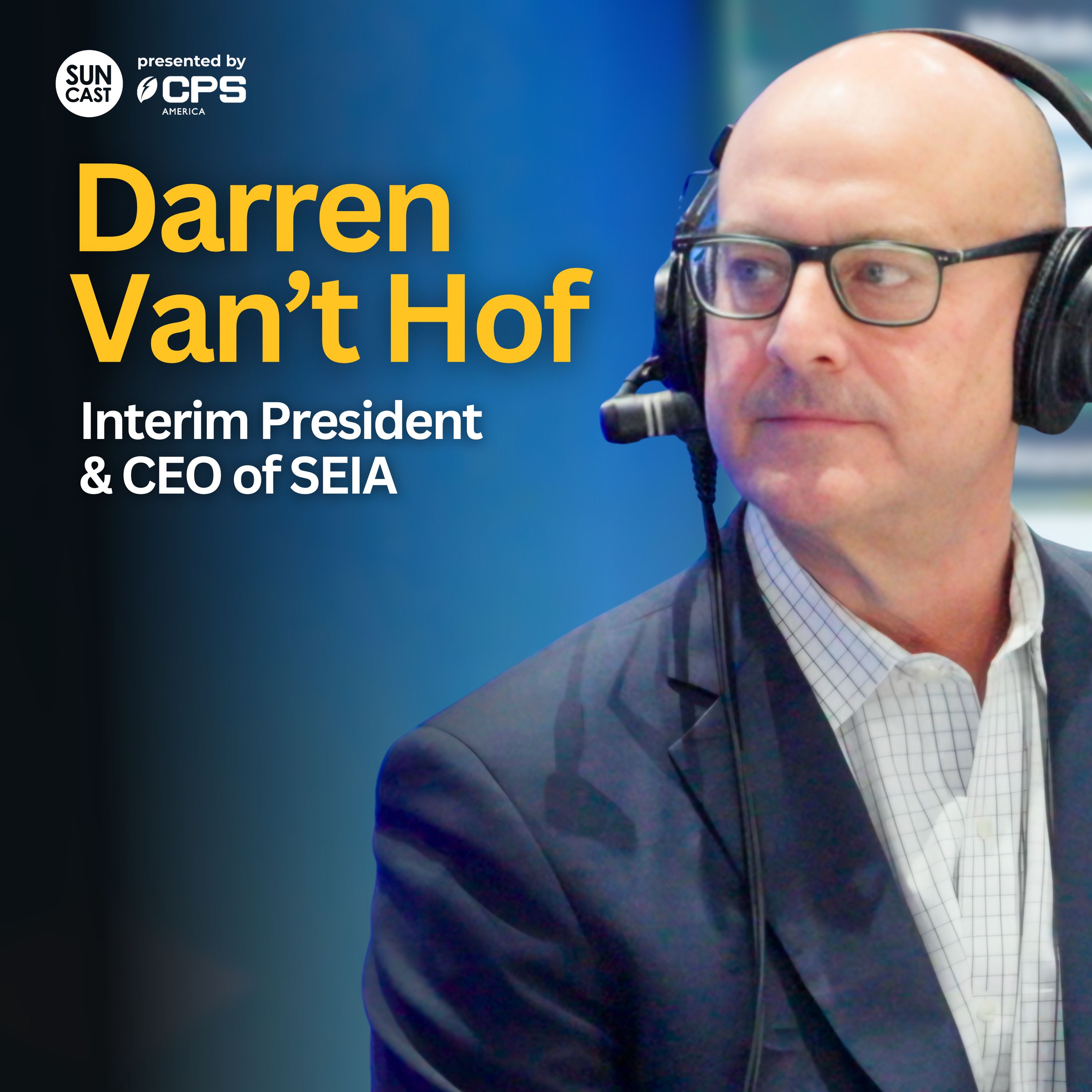
Darren Vanthoff has stepped in as interim
0:55
and long time board member and chair.
0:59
So I reached out and said, Darren,
1:01
do you want to talk about it?
1:02
And he said, sure, why not?
1:04
We're joined here at the Hubstage by Darren Vanthoff,
1:07
the interim CEO at, is it president and CEO?
1:11
President and CEO at Solar Energy Industries Association.
1:15
Better known as, there is so much that we cannot discuss with you
1:20
but we'll discuss what we can.
1:21
So without further ado, Darren, thank you for taking time
1:25
out of what I know is a very busy week.
1:28
You're stepping into this role at a really pivotal moment
1:33
And I'm curious where you see solar and storage
1:36
standing heading into 2026.
1:39
That's a great question, thanks for having me.
1:42
You know, I've been in the industry for about 20 years
1:45
and every year, there's a crisis every year.
1:48
There's something that's going to be the death knell
1:52
And I think we've seen attempts at that
1:54
in the last 12 months, no question.
1:57
The one thing I would say about both storage and solar
2:00
is that the pull through is strong.
2:03
The economics are really good.
2:05
The affordability message is winning.
2:07
And I think it's not a winning message long term
2:10
for folks to try to slow it down
2:13
because it really speaks to affordability.
2:14
So the momentum, we're on the right side of the momentum
2:18
and we're going to get through the blocking and tackling
2:20
that's in front of us every day.
2:22
Are you seeing specific points of friction
2:25
that is slowing projects down?
2:28
Yeah, permitting has been a real choke point.
2:31
And I will say I'm cautiously optimistic.
2:33
There's folks in a very bipartisan way
2:37
are trying to work on that.
2:40
There's a lot of pitfalls in working on anything
2:42
in a bipartisan way these days.
2:43
But it's something that we're seeing some momentum.
2:47
And I think that's good.
2:49
I mean, there's still a lot of state-by-state issues
2:52
with interconnection and things like that.
2:54
But those tend to work themselves out.
2:56
But the long pull in the 10 is really around permitting.
2:58
And then obviously, certainty around FIAC.
3:02
And we have some, not all.
3:04
It's usually used in the long pull in the 10, actually,
3:06
because that's a terminology that has been used to say
3:09
that we're all in this together, right?
3:11
So I'm curious, you know, I've both 20 years in the industry.
3:15
We've seen the ups and downs.
3:16
We've seen the infighting, frankly, in the industry.
3:20
Is there anything about this moment that feels different?
3:23
I think from a cost competitiveness,
3:25
we're probably at the lowest cost we've ever been,
3:29
particularly on a levelized cost of energy across all sectors.
3:34
It really isn't a competitive race on cost anymore.
3:37
We feel like we've won that.
3:39
It's really just now making sure that the message resonates
3:42
that it's the most affordable way
3:45
to bring electrons onto the grid.
3:47
And anything that's slowing that down
3:49
is going to increase cost.
3:52
As the interim, and while presumably there is a search period
3:59
and time for a permanent president and CEO,
4:02
part of your job continues to be,
4:05
because you've been on the board for 15 years,
4:07
to shepherd the vision and position the organization
4:10
to really meet today's challenges.
4:12
How is that taking shape?
4:14
You just had the most recent board meeting here in San Diego
4:19
I'd love to speak on what progress you see.
4:23
Well, one of the things that happened when Abby left
4:25
in the search committee was formed,
4:27
the first thing they said was,
4:28
we don't want a caretaker to come in.
4:30
We want someone to move the board forward.
4:33
And I was on that side of the board at the time.
4:36
So a couple of things that we're going to work on right away.
4:39
One is political engagement.
4:41
We've always been politically engaged.
4:44
We get into the room.
4:46
We're in the rooms with Treasury.
4:47
We're in the rooms with legislators.
4:48
That's always been true.
4:50
Where we haven't done is really on the ground game effort
4:53
on a state-by-state or county-by-county basis.
4:57
And we have a C4 that we've created.
4:59
And that is an apparatus that we can use.
5:01
We can raise money for it.
5:03
And we can start changing some of the outcomes.
5:05
Another area is storage.
5:07
So, SEA is going to lead in that space.
5:10
We announced we're going to announce a partnership tomorrow.
5:13
And that partnership is going to truly identify the size
5:18
of the industry, the scope of the industry, the cost.
5:22
And one of the things I can say is,
5:25
if you look at the forecast just for 2026 alone,
5:29
it's about $25 billion of capital
5:31
that's going to be needed just for storage.
5:33
And storage for what it's worth, it transcends technologies.
5:37
It seems to be a little more apolitical,
5:39
so it has some durability.
5:41
And another point on $25 billion,
5:44
the solar industry alone wasn't $25 billion three, four years ago.
5:49
So it's really, it's outpacing some of the other sectors.
5:52
Would you be okay if I pull a thread on the pack?
5:55
Sure, I don't know what you can and can't talk about.
5:57
And it wasn't part of our talking points.
5:58
But since you mentioned, we have a pack.
6:01
One of the things that we've covered on the show
6:03
is that we have historically,
6:06
well, yeah, historically as an industry,
6:08
we have not been able to convince enough people
6:11
to put our money where our mouth is.
6:12
We are outspent 20 to 1, 30 to 1,
6:15
depending where you look.
6:17
How are we going to encourage folks
6:20
to participate in the pack,
6:21
which has historically been underrepresented
6:24
in terms of where we should be supporting the work that see it does?
6:29
Right, one of the things I always like to compare
6:32
solar right now employs over 300,000 people, conservatively.
6:37
The coal industry by last estimates was under 60,000 people.
6:41
coal continues to raise enormous amounts of money
6:44
on a political level.
6:45
So there is a period of time that we are still
6:49
on a relative basis, a younger industry to those.
6:53
I think some of it is really learning
6:58
how the game has played a little better,
7:00
getting out of our maybe altruistic ways around politics
7:05
and knowing that the rules of the game are pretty brutal.
7:08
It's a money game and we need to just get better at it
7:15
When you're looking at the solar market,
7:17
you have to ask who is the partner you can really trust
7:21
That's why I hope you'll take a closer look at CBS America
7:25
and see how they are shaping the industry's next chapter.
7:30
The evidence is clear.
7:31
Woodback has confirmed them as the number one market leader
7:34
for stringin' voters in the US for eight straight years.
7:37
That's nearly a decade of sustained dominance
7:39
proving their reliability and cost leadership are unmatched.
7:43
But they're not just resting on their inverter success.
7:46
They've extended their leadership into energy storage.
7:49
In fact, they're fully integrated.
7:51
The Gonzo ESS is the best in class platform for C&I,
7:55
built for maximum simplicity and revenue generation.
7:58
But the real game changer is their service.
8:00
Back by one of the top rated support teams in the industry,
8:04
you're equipped with premium hardware
8:05
and the people who make sure your projects stay on track
8:08
season after season.
8:10
Ready to partner with the industry's most trusted provider?
8:13
Visit suncast.media-forward-slash-cps
8:17
or call 855-584-7168.
8:22
Don't settle to your CPS.
8:24
Reliability you can count on.
8:26
You know, extreme weather risk is rising
8:28
all across the utility scale solar sector.
8:30
And next power is responding with innovation.
8:34
Proof comes from Project Developer Desiree,
8:37
which deployed next power's hail pro-system
8:40
across 2.4 gigawatts of their solar portfolio.
8:44
When hail storms threatened Desiree's Midwest sites,
8:48
hail pro went to work.
8:50
It automatically rotated trackers up to 75 degrees,
8:52
mitigating damage from 2-inch hail
8:55
while keeping operators online.
8:57
It's intelligent, repeatable resilience that scales.
9:01
Got weather concerns?
9:02
Discover how next power reduces risk
9:04
for your biggest projects at suncast.media-forward-slash-next-power.
9:10
I'll tell you what I'd like to see.
9:14
And this is Darren, not Darren Toggins,
9:17
I'd like to see, you know, in the oil and gas sector, coal, et cetera,
9:22
you're expected to contribute to the pack.
9:25
It's a part of the bonus stipulation, essentially.
9:29
Oh, you're getting this bonus.
9:30
And we know what the bonus is for.
9:34
Frankly, I just think that we should be a little more
9:36
hard-line as an industry internally in our organizations
9:39
that have the corporate spine to say,
9:41
we are going to stand behind putting dollars into pack.
9:45
And that pack is going to know what to do with it.
9:50
And that last piece, I can't speak to.
9:53
But that's where I hope to see our industry mature.
9:57
Yeah, that's an excellent point.
9:59
I think the industry, they have underspent
10:02
in their political giving.
10:03
And there is some tentativeness to it
10:05
because of the nature that the game has played.
10:08
And it's also an industry of devout rule followers.
10:12
Not that anybody doesn't want to follow the rules.
10:16
I mean, folks do need to step up.
10:17
And I think they need to be shown a vehicle to step into.
10:19
And I think we could do that.
10:21
I look forward to seeing that.
10:23
Regulatory permitting uncertainty keeps coming across
10:26
the industry up across the industry time and time again.
10:30
What does that look like on the ground?
10:31
And what's the ground game for Sia going forward?
10:34
Well, uncertainty, I'll speak to that right away
10:37
because I've been in finance for 20 years.
10:41
And uncertainty is an absolute killer for flow of capital.
10:46
So as these things become uncertain,
10:48
as people are building their projects right now,
10:49
they're busy, they have their financing lockdown.
10:52
If you start looking into 2027 and 2028
10:55
and you start talking to banks and bigger banks,
10:59
they're a little nervous about committing capital
11:01
where a couple of years ago they weren't.
11:03
They could commit a couple of years out.
11:05
And now they're waiting for some of these things.
11:06
So that ripple effect is that while this isn't a today issue,
11:10
it will be a tomorrow issue
11:11
the longer the uncertainty prevails.
11:14
So those things are going to have to get worked out
11:17
I don't know if being an election year is the best time for that,
11:20
but we're going to work on it.
11:21
Yeah, messaging is going to be a key enabler
11:26
or dissabler for lack of a better phrase.
11:31
It seems every conversation that we have here on stage
11:34
is about low growth in particular from AI and data centers
11:39
and how fast it's coming.
11:41
I just had the president of NYSERDA on stage
11:44
talking about I think a rather contrarian view
11:47
on how and why they would want data centers.
11:51
How do you feel A, as industry we are doing,
11:56
at convincing the folks that can make decisions
12:00
that the opportunity is right for us?
12:02
And how do you feel the solar industry
12:04
and the storage industry is stepping into that opportunity
12:06
that has been presented?
12:08
So on data centers, it's interesting.
12:11
If you talk to the procurement folks
12:13
around building a data center,
12:15
they're pretty agnostic about where the energy comes from.
12:18
They will, you've seen some going into the development side
12:21
of the business so that they can control the electrons
12:25
that are being built and that they're being directed to them.
12:28
But the solar and storage industry
12:30
is one of many energy sources that can satisfy that demand.
12:36
But the storage and solar industry
12:39
are absolutely the quickest to supply it without question.
12:43
The other, you know, just to say on data centers,
12:47
there has been a lot of chatter around,
12:50
you know, developing power behind the meter directly on site.
12:54
One of the things I think people don't always acknowledge
12:57
is the amount of energy that they actually consume.
12:59
So developing an on-site power generation
13:02
is a little bit challenging given the amount of energy
13:05
they actually consume.
13:06
So it really does have to be all the above.
13:09
But storage is the quickest to market and the cheapest.
13:12
Another of the questions that I spent some time on with Doreen
13:16
from NYSERDA is the role that storage plays as a standalone asset,
13:22
as infrastructure in what will be the modern grid.
13:26
How is CIP positioning the amazing team
13:31
that you have, by the way, around storage
13:33
to empower the storage side of our business
13:36
to compete in the marketplace,
13:38
even without needing to say the word solar.
13:42
I mean, so a lot of, you know, we just launched,
13:45
again, our whole storage platform
13:47
and we're going to continue to launch it.
13:49
We want it to be a place for the storage industry to come
13:52
because we, as we advocate for solar,
13:54
we are advocating for storage.
13:56
And you see storage having so much success in states
13:59
like particularly in Texas, the amount of storage
14:02
that has actually helped stabilize that grid.
14:05
It's a fact-based analysis that needs to get surface more.
14:11
There's a lot of folks walking the show floor
14:13
asking questions about technology,
14:15
but also asking questions about markets
14:17
and where they should prioritize their time.
14:20
Given both your position now at SEA,
14:22
as well as 20 years of experience,
14:25
what advice would you give
14:26
on where folks should prioritize their effort
14:30
over the next 12 months to win in this next growth cycle?
14:33
It's an excellent question.
14:34
I think the folks that are selling products,
14:37
if they are true to the economics of their products,
14:42
So if you are building behind the meter,
14:45
front of the meter,
14:46
if you're building utility scale or residential,
14:50
if your economic proposition is better
14:54
than what your competitor is offering
14:56
or whatever another subsector is, you'll win.
14:59
You don't have to necessarily be subsector-specific
15:02
because all the sectors are growing.
15:04
The pie keeps getting bigger every year.
15:06
Are there any mistakes that you see folks making
15:09
I mean, you've got to, you have 10-year
15:11
to have seen a number of mistakes, repeat themselves.
15:15
I've, you know, some of them are Econ 101.
15:20
Companies will put a lot of debt on sometimes
15:23
for purposes of growth.
15:25
Oftentimes, the capital markets are looking
15:29
for places to put capital.
15:30
So even on the equity side,
15:32
I think a lot of companies get talked into taking
15:35
outside capital, maybe sooner than they're ready.
15:38
And that can get them into a little bit of trouble.
15:40
Sometimes you can raise the money,
15:42
but it's more important than you can actually deploy
15:44
Is there something that you would encourage folks
15:47
as maybe from the position of mentoring folks
15:50
that are coming in to build these projects
15:53
on an action that would help move projects forward faster?
15:57
Maybe something to, the oft-quoted,
15:59
what to stop doing?
16:04
That's a tricky one.
16:05
I'm not, I don't know that because I don't want to get
16:07
into people's business models.
16:09
Everyone has their own path to success.
16:10
And, you know, I think they're all good.
16:13
Like every company I see out here,
16:14
they're here because they've had a level of success.
16:17
So there really isn't anyone like me who could say,
16:20
oh, you should be doing that better or that better.
16:23
I think sound economics are always a safe place to start.
16:27
So I don't know the quick math, 15 times four,
16:29
but you've been to a lot of board meetings.
16:32
How are you feeling coming out of this board meeting?
16:35
What are you most encouraged by?
16:37
I was encouraged by the enthusiasm.
16:39
I think there's a lot of board members
16:40
who are really excited.
16:43
You know, there's a lot of challenges in the board members
16:46
that have been around for a long time,
16:48
including me have seen them
16:50
and some even worse than what we're facing today.
16:53
So I think part of it is taking the noise out of the room,
16:56
the external noise out of the room
16:57
and just focusing on the core of what got us here
17:00
and how we're gonna continue to win.
17:02
And I think if we focus on that,
17:04
we keep repeating the themes around affordability
17:06
and it is a winning argument.
17:09
It isn't a, we're not trying to shape something
17:13
that it isn't, it wins.
17:15
And people feel really good about that.
17:18
A question that I know folks want to have our wondering about
17:21
is are we watching for white smoke from the chimney
17:25
for the next president and CEO?
17:28
Is this the process that's gonna take a year or two years?
17:35
I hope it goes fairly quickly.
17:37
I'm gauging my level of interest in it.
17:39
I will say the work is a lot more interesting.
17:43
I guess it's a lot more engaging
17:44
than I initially would have thought from the outside.
17:46
It's actually it's fascinating and I'm enjoying it.
17:49
So is the interim position like a trial period?
17:52
Is that something where you're like trying it out
17:54
and might continue in this role?
18:00
Because from the outside looking at it's not obvious,
18:01
it's not obvious I think to the industry.
18:03
Like, huh, is this someone who's been on the board
18:06
for a long time going to stand in the place of
18:08
and help manage while the person is found
18:10
or potentially gonna take the role?
18:12
I think there's certainly folks that would be championing
18:15
and cheering you on because you've got a lot of experience
18:17
to add to this role.
18:20
I don't think I would do it if I didn't think I could be successful.
18:24
So I think that's what I'm gauging right now.
18:25
How much success can we really have?
18:27
Well, we wish you all the success that you can possibly achieve
18:30
and we will be watching for more signals in the market.
18:35
I'm certainly excited for the announcement
18:37
that you guys are gonna make tomorrow
18:38
and for all of the effort that is going into
18:41
elevating the storage side of what Sia is doing.
18:46
Darren Vance-Hoff, our interim president and CEO
18:49
for the Solar Energy Industry Association.
18:51
Thank you very much.
18:54
Yeah, I'm so the warrior.