Loading...
newspoliticscomedy
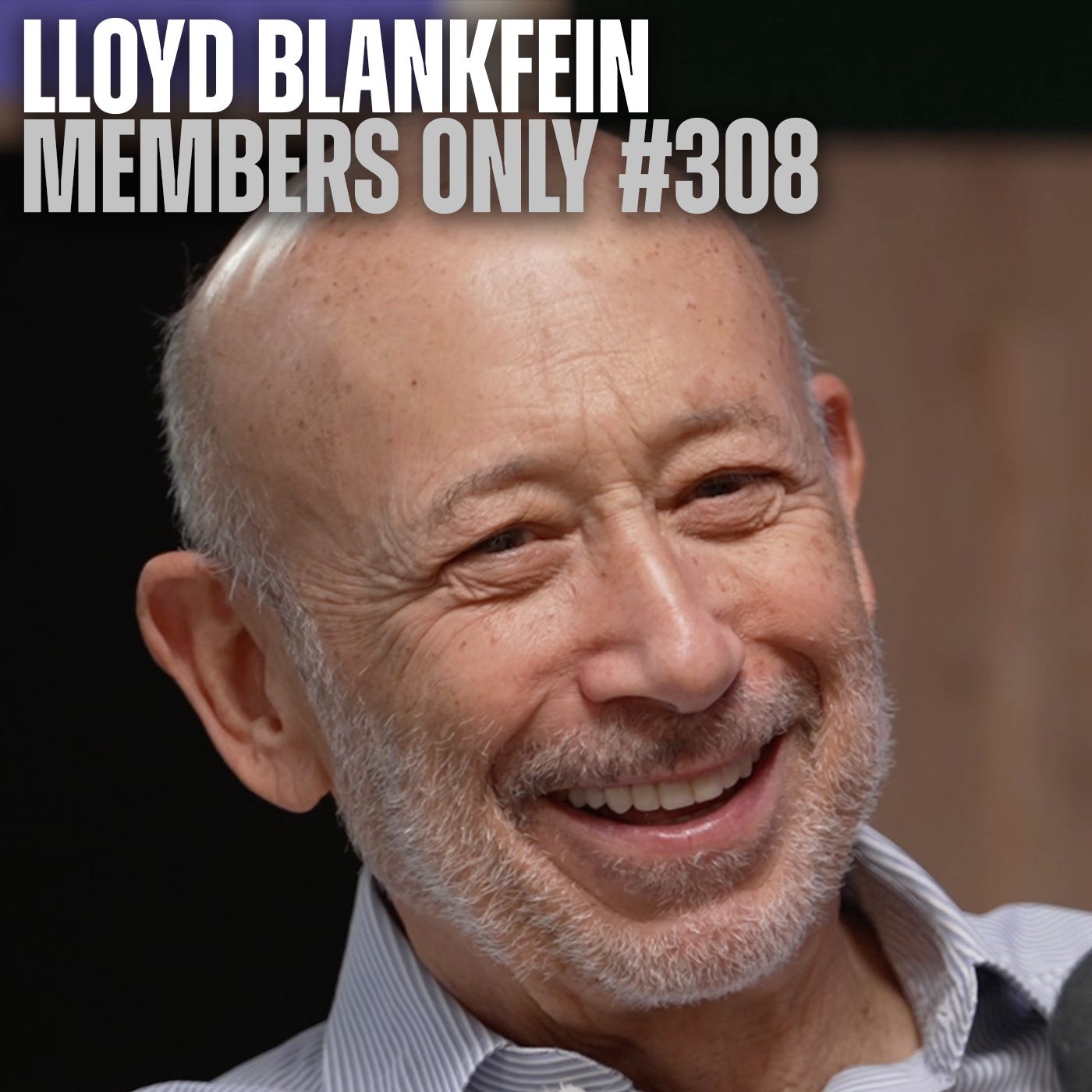
A Brief Defense of the Vampires w/ Lloyd Blankfein (Members Only #308)
About this Episode
This is a free preview of a paid episode. To hear more, visit www.wethefifth.com
He also weighs in on populism, inequality, private credit, and why a country can be prosperous on paper while still feeling bleak to the people living in it.
-“Blankfein hates minorities”
-the economy is strong, unless you don’t own anything
-get a grip, it’s not 1968
-semi-charmed kind of life
-from Russia to China, the cycles come fast
-where are the Hayeki…
Hosts & Guests


Transcript
these are criticisms of you.
This is what you need.
Better listening skills, more inclusive,
less dominant in meetings,
can be overly harsh,
adversarial, and intimidating.
I feel okay right now.
Tendency to micromanage,
inflexible, not open to other opinions.
By the way, we're about a quarter of the way
the rest of it is just more synonyms for the same thing.
This is the fissaurus of your island.
Kind of in a stick is what I'm not gonna.
I think you missed the point.
At Goldman, that's a good review.
That's a good review.
We know of new methods of a pack.
I was in the headlines today.
I just somebody sent me stuff
because it says something,
contract D.I.
Now the rest of the sentence was,
if you just do all the other things right for everybody,
yes, it's gonna be good.
But without the branding of somebody is,
you know, meeting remedial, whatever,
and getting subsidized.
But the headline was always, you know,
was like, unfortunate was blankifying,
you know, Kate's people or something.
Kate's minority is just something like that.
That's fine.
Can we use that as a headline?
Yes, we are real.
So that's a good place to start.
It's a great catch you.
No, it's been done.
It's been done.
Have we started taping?
I got absolutely.
Oh, why would we go?
Oh, cool.
Are we gonna have to go somewhere?
No, no, no, no.
I'm gonna be more careful now.
But we can talk about politics.
The book, which is out last week,
Streetwise getting two and through Goldman Sachs.
Congratulations on the book.
We'll get to the book,
but let's talk about right now.
Let's talk about everything that's happening right now.
Obviously, an oil shot oil goes up.
People start panicking.
We're in a war in the Middle East,
which is a rather more expansive one
than we've been in since 2003, right?
That we know of.
That we know of.
Well, the shadow wars we don't count.
How should we be thinking about everything right now
when it comes to markets, oil, the economy,
Trump waging war on the Fed, et cetera?
That's a lot of stuff.
That's a lot of stuff.
That's a lot of things.
Take one.
Take one out.
Get an oil shot going right now.
I was going to ask you about a compound question,
but that's got everything in it.
Where would you like to start?
This is not our first.
The whole thing.
How does the whole thing make you feel right now?
Well, I would say prior to this current war slash
police action or whatever it's necessary to label it
to avoid.
Connecticut action.
I would say the base case is that things in the things
in the economy are going pretty well.
Mostly with tailwinds.
Now, you can always say I'm a risk manager guy.
So I'm always 50 things I'm always worried about.
But prior to this moment, I'm going to talk about this.
I'll get to this moment.
We were dealing with an economy that
was very strong by any measures.
GDP was good, although we were getting a little bit
nervous, the last reading that unemployment
is weakening a bit.
The inflation is still higher than we'd like it to be.
But not that much higher than we like it to be.
We're kind of the end is visible.
And into a market that was otherwise kind of growing
and where inflation was getting under control,
we're about to have a big fiscal stimulus
with the big bill, big beautiful bill.
And we were also about to have monetary stimulus
with rates coming down.
People are arguing whether it should be next month or the month
after, but where clearly rates are going to trend down.
And more stimulus coming from rise in productivity
and hyperscalers investing money.
And so that's the base economy, by the way,
which is doing a very, very good job.
And I think everybody would agree uniformly
of creating wealth.
And then where the schism in the country
happens, is it doing as good a good job distributing
that wealth according to values?
And so you get a position where people like me talk
about how great the economy is going.
I'm going to get all sorts of hate mail.
And people say, how could you be so tone deaf?
Half the country can't afford a surprise $200 dollar
auto repair bill or something like that.
What am I missing?
And of course, what I'm missing is that a lot
of the incremental wealth creation
is coming from basically a lot of asset prices
are getting elevated.
So if you have assets, you're making money.
And if you don't have assets, you're not.
And so the gap is getting wider.
The polarization is getting wider.
And you could see, you know, we can speculate
on the manifestation, whether the manifestation we're seeing
is, in fact, the extremes of both parties, really.
You're saying the book that polarization is not as bad
or worse than it's ever been in America.
And I mean, you point out that we didn't have assassination.
We did have a civil war.
We did have civil war.
Yeah, civil war.
And do you think people overstate that?
I think there's a notion.
And again, being a risk guy and trying to evaluate things
and not give over to sentiment at time,
there's a kind of anything that's unresolved
always feels worse than anything that's
it's like trying to compare sports figures
from different generations to something.
So it's very hard to be, remember how scared
or to read about and understand how scared people were
is when something else happened.
When it's already resolved and over, the current,
the current crisis always feels worse.
But I point out to people, so even in my,
even in my sentient lifetime, in the late 60s,
when you had Russian Vating Czechoslovakia
and cities were getting burnt down
in political assassination like King and RFK Jr.
And to be clear, we're just talking about 1968.
One year, yeah.
Yeah, and a couple of years early,
the Cuban Missile Crisis, where we actually went to
Defcon II with Defcon I being nuclear war,
I would say that was a little bit more of a dangerous,
more polarized moment of war.
And the president who managed that was assassinated.
And himself was assassinated a few years earlier.
And so yes, is that, but that's all in the history books
and it's like, you know, it's like reading about the civil war
as opposed to living through it
when people getting next to you, getting shut.
So you can't really compare those two,
but I do like to bring that up as a historical basis
because I always say to people who think they're going
through the worst moment ever, I like to point out to,
you know, your predecessors went through blipety blip
that was much worse, get a grip.
If they can do it, can't you do it?
And so, I mean, is that when you realize you're,
you've just become an old man and you're great with them.
Yeah, yeah.
And, you know, and I like to get,
because I'm leaning into that right now.
And frankly, I'd like to get older.
Yeah.
But, you know, a lot of people, you know,
this kind of woe is me.
I mean, everybody gets chow,
look, here's a, you know, you mentioned it in funny way.
So I was, I'm, I'm 71 now.
I know, I know, I don't look it.
But I'm 71.
We're going to add that in post-production.
I'm 71 now.
So I'm just thinking I was going through the math the other.
And so I was born just a smidge too young for Vietnam.
I got a draft car.
They drafted like six people my year,
that the year I turned 18, like I skirted through.
I didn't have, I didn't, I didn't have a war.
There was no, you know, threat of getting, you know,
for me, getting drafted.
I didn't go through an economic upheaval like my,
you know, when my parents were the young adults
in the depression.
I'll tell you, we kind of had things pretty charmed.
And if you go through the period of American history,
you couldn't find another 70 year period like that
in the history of the country
or in the North America since the, you know,
since the pilgrims landed.
And so we're kind of lucky.
And I think that I don't think that the normal set
and expectation should be, everything should be easy
all the time or everything would be.
In the middle of all that, you have 1989,
which is the most like glorious year of liberation
for hundreds of years.
Of course, the end of coming, you know, when I grew up,
I was working, having started out in the commodity business,
I was traveling to Russia in the early 80s and doing people.
And I'd be on planes where people literally break out
into a pause when the plane took off out of Moscow
to go to, you know, their flight.
Yes, you know, they're all not an air flight.
They're only applauded after you landed.
These are, these are like Swiss air,
this is like Swiss air flying, you know, from,
you know, from Moscow to Zurich.
But, you know, different world, by the way,
the cycles come quickly because in my, you know,
in my tenure, you know, Russia was a place
you couldn't do business, then you could do business.
In fact, the old Soviets were very, very good.
They always honored their debts very explicitly and correctly.
And then, and, you know, but it was very limited
what you can do.
Then it was opened up and it was like cowboys
and Indian stuff, all capitalism all the time.
And now it's not again, China.
People have made their, people have invested heavily
in riding the China explosion, good, in a positive way
because they were, if the Dung Xiaoping
and opening up and becoming better capitalists
and the capitalists and all of a sudden,
it's not so easy to do business there.
And, you know, people have to, you know,
take a deep breath, you know, when you go there and,
and so those things have changed multiple times
in just, you know, just a span of, you know,
my commercial life there.
Just think about having a different time,
ways that Ireland has been considered
in that period of time.
Exactly.
I mean, that's, there's a great cover of the economists
and the 80s of a picture of Ireland
and it's like Angela's Assars.
It's like somebody on the street in Dublin
and then you have the tiger that keeps
and then runs away a little bit.
But if you think about that, that was only since Cromwell, though.
Yeah, they're big Cromwell supporters
in certain parts of the North.
Yeah, in Trinity College.
In Trinity College, right?
But if you, look, I mean, you have the kind of capitalism
that takes over China.
You have it happen in Vietnam, too,
their markets open up.
It's a very, very...
Yeah, I don't want to go overboard.
State capital.
State capital.
State managed capitalism.
But let's talk about capitalism for a second.
Considering in this country, we have two parties
that are kind of converging on the idea,
one with the kind of more left wing view of economics
and a kind of populist view.
There's no Hayekians or Friedmanites
on the right these days anymore.
At least they don't say so very publicly.
It's all kind of a Steve Bannon thing.
So, I mean, how do you judge the state of capitalism now
when the two major parties in America
are essentially economic populists?
Well, it's a populist moment
because of where we talked about before
with the haves and the have-nots and the division.
So we're on that moment on both sides,
but I don't know, it certainly gets the more...
It garners the majority of attention.
I don't know if we would vote in socialism
across the country.
Who knows?
Literally, you know we're in New York City right now.
Just leave it there.
Don't think he's a resident.
Yes, he's not going to the dolog.
We are, yeah, the dolog is now in South America
and not in...
But look, I said, we've never had a pure capitalist system.
I mean, I think the best capitalist system
is one where everybody is free-spirited
and can do whatever they want until it gets out of hand,
in which case you've restarted.
You can't let anybody win in capitalism.
You want people to keep...
You want people to keep competing.
So I think that model...
Look, it is the best system for creating wealth.
It is central planning.
At the end of the day, I vote with America
as a better place and everybody worried about
ringing their hands about China.
But central planning, gosh, even this country
would have built this information superhighway
five minutes before we had the internet
and the cloud and all that stuff.
We have millions of decision makers
who are at the coal front.
And I think you get better decisions
and better choices made,
but that's not the real strength.
The real strength of our system
is you deal with your mistakes ruthlessly and quickly.
So if you build houses in the wrong place
and nobody moves in, they don't pay rent,
they don't pay taxes, debt service doesn't get paid,
and they knock down the houses, they plow over,
and they put in a Wal-Mart or an airport
or a garbage dump.
We recycle our poor investments faster.
And if you think in China,
where all these, they decided who could do better than this
when they wanted to stimulate their economy,
they built 82 airports all at once.
How many of them are in the wrong place?
And the ones in the wrong place,
they're gonna stay on their balance sheet
as unused airports for a long time,
like those housing developments in all these cities,
where provincial chiefs wanted to draw attention
to themselves and construct things,
and they constructed and constructed,
and a lot of them are not being used.
There's ghost cities in the world.
There's ghost cities, and you couldn't have that here.
You couldn't have that here.
And so I think we make better choices,
but maybe not that much better, but I think better,
but we certainly rectify our mistakes a lot quicker.
And I think that that's a strength.
Look, the US has been ground zero
for a lot of crises, including probably
the global financial crisis.
But which country recovered faster?
I mean, a lot of the European countries
still haven't really fully covered from the effect of that,
but we did, and we do.
And that's the strength of what we have.
And now it tends to, because of the animal spirits,
it goes to excesses, and once you have kind of winners,
the instinct of any winners to make sure nobody can compete
against them anymore.
And so we have a regulated system.
And we have something where we put on the brakes,
and we say, keep competing, but don't win too much.
Do one follow up on that is your very close friend
and Twitter sparring partner and fellow Brooklyn
ite Bernie Sanders was asked recently by a student.
It was a fantastic interaction, if you saw this,
where the student went up to him and said,
hey, I just want to know, why is the American economy
more dynamic than the European economy?
Why is in, and he just, you know, he does the same.
He's like, oh, the billionaires, and this is,
and they're just into the same routine.
But why do you think that is?
I mean, in the book, I mean, you moved to it.
Why do I think they way more than that?
Why is Europe sclerotic more often than not compared
to America?
I mean, you lived in London, you've been around the world
doing this stuff, looking at modern Europe.
There are economies, I mean, people talking about Spain
the other day, because the Spanish prime minister
was taking shots at Trump.
And it's like, I was impressed to see
that their youth unemployment rate had gone from 48% to 25%.
It, why are these economies like that?
You know, they are, look, I'm no sociologist on this,
but there's a difference, I could see,
even from my own experience,
hiring to these countries and trying to change our business
model from time to time as a situation compelled.
You know, it's a different social contract.
Here, when we have some sort of dislocation,
when we had, even in COVID, companies fire people here.
They fire people and hopefully the good ones give,
you know, compensation to people
and worry about their employees and extend medical care
and you want to, and you should give people credit for that.
But people fire people in a lot of these countries,
you can't fire people.
Before they let you, you know, and maybe I'm over generalizing
here, you're catching me, you know, I don't have a specific,
but I think generally right in my experience,
you want to shut or plant or a factory,
they'll, you know, government will step in,
try to bribe you into keeping those jobs.
Years-long process.
And if they can't bribe you into, you know, doing it,
they'll make it impossible for you to do
and it can take years to fire people.
Here, we do that right away, big dislocation, bad, bad, bad.
But in a year or two years, those guys get rehired
into businesses that have been fixed.
In Europe, they never get a chance to fix those businesses
because it's, again, it's a different social contract.
Now, I'm saying this in a certain kind of spin
where I'm suggesting that there are some people will say,
well, that's the right way of doing it.
You know, we have a social contract with our people.
So, what's up, Twitter World?
If you are not a subscriber to this podcast,
you don't hear how drunk we get.
Well, no, they're not subscribers.
That's why they're hearing this.
That's what I just said.
I said, if you don't subscribe,
you don't get to hear how bad it gets at the end.
That's right.
And you want that because sometimes Michael Moynihan
talks about being in a locker room
with a bunch of naked men.
What kind of men?
Big ones.
What kind of big ones?
Fairly not athletes.
Or maybe they were athletes.
You could be custodian.
I'm just trying to get you to answer of course.
It could be anyone.
According to you, just athletes.
Well, hung men.
That's what she said.
I literally would cancel my subscription.
I don't know how to do that.
That's Florenger.