Loading...
newspoliticssociety
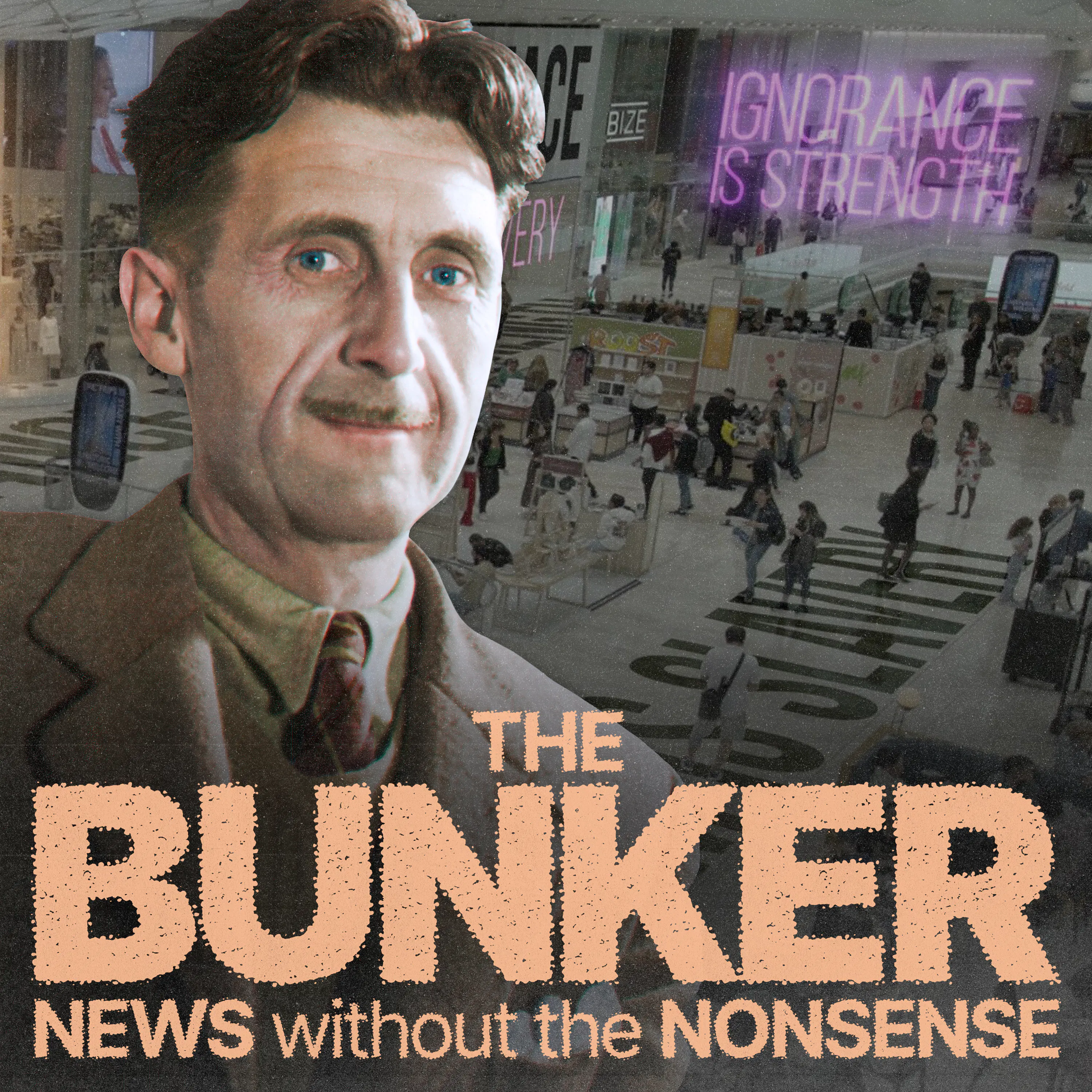
A picture of the future – A new movie captures what George Orwell knew about 2026
About this Episode
George Orwell’s vision of a world of constant surveillance, where authoritarians rule by destroying the very concept of objective truth, is coming true in ways the author never predicted – and many ways he did. A new documentary film, Orwell: 2+2=5 by the acclaimed Haitian director Raoul Peck, connects the dots between 1984, Animal Farm, Big Data and mass manipulation in the digital age.
Our own Orwell correspondent Dorian Lynskey – author of The Ministry of Truth: A Biography of George Orwell’s 1984 – talks to Andrew Harrison about what George Orwell really understood about the human mind, and why the world needs to stop misusing “Orwellian”.
• Orwell: 2+2=5 opens in selected cinemas on Fri 27 March.
• Buy The Ministry of Truth: A Biography of George Orwell’s 1984 through our affiliate bookshop and you’ll help fund the podcast by earning us a small commission for every sale. Bookshop.org’s fees help support independent bookshops too.
www.patreon.com/bunkercast
Written and presented by Andrew Harrison. Audio production by Simon Williams. Music by Kenny Dickinson. Artwork by James Parrett. Managing Editor: Jacob Jarvis. Group Editor: Andrew Harrison. THE BUNKER is a Podmasters Production.
www.podmasters.co.uk
Learn more about your ad choices. Visit podcastchoices.com/adchoices
Hosts & Guests
Transcript
Hello and welcome to another edition of the Bunker, you'll recommend it daily intake
of news without the nonsense every week day morning, I'm Andrew Harrison.
Today, there's probably no more abused word in 2026 than Orwellian.
It's become a catch-all term, applied to everything from state and big texts of aliens.
Right down to matters as diverse as prosecutions for hate speech, the strange PR activities
of FIFA and UEFA, and according to Swanabravenman in the Telegraph, the Equality Act 2010.
And yet, in an age of total information awareness and the war on truth, George Orwell's ideas
have arguably never been more relevant or more misunderstood.
A new documentary movie from the Oscar nominees to film like a Ralph Peck aims to make some
amendments. Orwell, 2 plus 2 equals 5, blends biography, some of the author's writings,
and clips of film and TV adaptations of 1984 and Animal Farm, with contemporary news footage
to show how authoritarianism has spread along the lines that Orwell warned about.
We have peck argues become complacent and we'll pay a price for it.
And here is a taster.
A society becomes totalitarian when its structure becomes flagrantly artificial.
It is, when its ruling class has lost its function, but succeeds in clinging to power
by force or fraud.
But to be corrupted by totalitarianism, one does not have to live in a totalitarian country.
Tonight, I want to take a few minutes to discuss a great threat to peace.
The threat comes from Iraq.
It arises directly from the Iraqi regime's own actions.
Its history of aggression and its drive toward an arsenal of terror.
All well, 2 plus 2 equals 5 goes on general release in the UK on Friday the 27th of March.
How does it expand our ideas about Orwell?
And do we need a national campaign for real Orwellianism?
Here's a talking over with me is our man on the George Orwell desk, Dorian Linsky, of
origin story, whose books include Ministry of Truth, The Biography of George Orwell's
1984, Hello Dorian, how are you?
Hi, Andrea.
It's nice to have you on the other side of the desk for a change.
I'm going to grill you.
I'm going to grill you.
Welcome to the Ministry of Love.
Absolutely.
We're going to release a giant rat on you in a second.
I thought it was just a really remarkable film and you can't exactly say you enjoy it,
but it is an extremely interesting and enveloping experience.
I can't think of a similar instance where the work of a writer of fiction and a work
of a writer of politics would transfer to cinema like this.
What did you think?
Yeah.
I mean, I suppose the nearest comparison would be Ralph X, earlier film, I am not your Negro
where he uses James Baldwin in that way.
And James Baldwin obviously the balance is slightly different there because he's more
famous as an SAS and a speaker than he is for his fiction, but of course he was a writer
of fiction as well.
He's using a similar approach here with Damian Lewis, a fellow Oldertonian reading Orwell's
words.
And then, so it's all sort of, it's led by Orwell's words.
I think Peck said he's like a libretto and then builds all these images around it and
then further structures them with these slogans in 1984 like War is Peace and Ignorance
is Strength.
So it's quite an audacious thing because it's trying to do, it's not like Orwell's
speak, it's also trying to sort of give you some biography.
It's not just about 1984 by any means, it really is about his whole life.
And yet constantly weave that into the present, which means that it doesn't always convince
me the connections, but when it does convince me when it does work, it's brilliant.
Yeah, I mean, the kind of cinematic grammar is really interesting because you do move
from Jura to the inside of Orwell's head to Myanmar to graphical representations of
data in the present day back to goose stepping fascists in a way that, you know, it has
to think about it as a lens of entertainment because it's not entertainment, it's about
the real world, but it is at that level really diverting, really entertaining and really
gripping.
Yeah, it's not the full Adam Curtis where there's a kind of more surreal, playful kind
of dreamlike connections where you're not quite sure necessarily what point is being
made, but it does look and sound lovely.
Here there is a much clearer argument, which I suppose means that when I think the
connective tissue is a bit weak, then it definitely feels like it fails in those moments,
like there's one bit where I just thought, oh, this is like a, I just thought it was
a really bad idea where it cuts from black lives matter protesters with a slogan, I can't
breathe, referring to the murder of George Floyd.
And then that sort of cuts to all well in hospital with tuberculosis, also struggling to breathe,
and of course, the reasons why all and George Floyd were struggling to breathe are completely
different.
And so it's just like, well, okay, well, so what point is being made here apart from this
little kind of coincidence, whereas when it goes some all well serving as imperial policeman
in Burma to Myanmar now, it's like, oh, right, okay, this is fascinating, you know, how
because the country that all well was in in the 20s compared to, well, literally a hundred
years later.
So it's sort of, it's a bit more high stakes.
It doesn't hide in the same way that Curtis tusses sometimes.
There's no vibes.
Yeah.
There's no images of tap dance as well, boards of Canada play and boys always say, but that
was a lie.
The points land or they don't.
Yeah.
The, I can't breathe, but I thought the motif of the growing TB cells, which is the first
thing we see in the film, they decide that this, it is
a suffocatory experience watching the film.
We watch George Orwell get Eric Blair get sicker and sicker and and and and eventually retreat
to to Jordan, which has this kind of strange kind of Christ in the wilderness vibe to it,
where he's kind of retreated to just be with the things that are truly important and
I think he's got a wrestle with.
But in the sense that you can, you know, I found maybe the George Floyd was a bit on the
nose, but I found the notion of society of the world becoming suffocated very around
us.
Actually quite persuasive.
Okay.
Yeah.
That's a real Orwell head who's deep in this stuff.
Did you find the representation of his ideas in the way that they, it playing out in the
modern world persuasive?
Because I thought this was, there's a lot more to this than have you ever thought that
your phone might be a tele screen?
Yeah.
No, no.
I mean, it's very broad in that sense, possibly a bit too broad.
You could argue because a world wrote about so many things that you can almost take anything
that you don't like in the world today and connect it to something that Orwell wrote
because he just wrote such a vast amount of material, you know, he's a very busy, busy
freelancer.
So it does sometimes feel quite overwhelming where it's sort of everything together.
It's not just about truth, disinformation, it's not just about surveillance.
It sort of becomes about everything.
Yeah.
But then I suppose, I mean, the point is, I suppose, somewhat to overwhelm, but then
I feel there is this danger, of course, that you can come out feeling like, oh my God,
I can't even process all the myriad things that are wrong with the world.
Yeah.
Well, one of the things I found really strong about it was that it wasn't just one of
these exercises in, you know, it wasn't like those bottom of the internet things where
it says, you will believe what this guy predicted in 1935, he got it, these are the things
he got right.
It's not about that.
He's not even about the technology of surveillance purely.
It's about the rising atmosphere of the reality is dissolving around us.
One of the key themes is a quote from why I write the very concept of objective truth
is fading out of this world.
And I guess the difference between what all well portrays in 1924, what's happening now?
He said, it's bottom up.
People are actively demolishing their own reality.
They're sharing the truth.
They're creating bullshit AI and what's run yesterday, which was a pub car park fight
between Jeremy Clarkson and Keir Starmer.
Right.
This did not happen, but people are sharing it as if to say, look, this is the real truth.
And that I guess is an aspect that, you know, it wasn't always job to anticipate things,
but something that could not have possibly been on his radar, that we would not just
be subject to this, but we would do it to ourselves.
Yeah.
I mean, when I was writing the old book and Mr. Truth became this title quite late on, because
I realized that in different eras, people were interested in different aspects of it.
Sometimes it seemed more like it was about the Soviet Union, and sometimes it was more
about surveillance, sometimes it was more about technology.
Whereas when I was writing it in the first Trump term, it definitely seemed like the most
astute observations he had were about the idea that you would abolish the concept of
truth altogether, you know, in his distinction between like a classic lie, which is where
you acknowledge that there is a truth, and you are presenting a lie, like an alternative
to that.
Whereas the sort of mindset that took place under Stalin, and you see it under Putin,
and of course under Trump, is the idea that truth doesn't really matter.
And so you don't really know sometimes if Trump is lying or not, if he even knows what
objective truth is, or if it's simply the truth that it is in his head.
And now there are all these technologies which are designed, I mean, AI has, there's no
denying it, that it's sort of, it's obviously a disinformation machine.
It's a lot of other things, but how can it not be if you can literally create fairly
convincing footage of whatever you like?
And I think he was actually alert to that.
I think he was his argument is that people lie to themselves.
It isn't just that dictators lie to you.
Is that people deceive themselves all the time.
So that's where he says it in notes on nationalism.
It's like the part of nationalism by which he means any form of like chauvinism and tribal
prejudice.
Is you're constantly having to construct a narrative that works for you regardless of
the truth.
So it's sort of, I don't like the idea that he's a prophet, but I also don't think that
any of this stuff would surprise him because he did always think that the problem lay within
each individual.
And each individual has to make the effort to commit themselves to truth, commit themselves
to inconvenient truths and not just the narratives that sue them.
Yeah, I mean, I guess that's one of the, one of the kind of some themes of 1984 is it's
not just that Winston is brute forced into genuinely believing a lie that before his
eyes, it's that all the characters are willingly for their own either advancement, convenience
or personal safety have volunteered into it.
They did not have to be tortured into it.
Yeah, and he's, he starts the book, you know, with this war viewpoint, the, the, the
Winston at the beginning of the book is misogynist, racist, antisemitic.
He's very much a product of his environment and then something happens, some sort of switch,
trips in his brain and then he starts writing his diary and starts becoming a rebel.
But yeah, the point is that everybody there in their own different ways has made some
accommodation with the regime, which is largely what people do.
And this is what happens under Nazism or Stalinism or whatever is that people do what they
have to do to get by and some people, they know they're very cynical, like Julia and
they just know that it's bullshit, but they make the right noises.
And other people find it psychologically easier to fully commit to the false narrative
to the ideology.
So it's, it's really, it's really a book about, you know, this site, this process of psychological
warping and people's complicity in that.
It's not as if you've got lots of people constantly trying to speak out and getting whacked
over the head by the, the secret police.
It's, it's people lying to themselves, which he said was what people did all the time
and he saw it in, in, in, in Spain and he, he saw it during the Second World War and
the so on.
You did a start of business just to keep the lights on, you're here to sell more today
than yesterday.
You're here to win.
Lucky for you, Shopify built the best converting checkout on the planet, like the just one tapping,
ridiculously fast acting, sky high sales stacking, championed checkout, that's the good stuff
right there.
So if your business is in it to win it, win with Shopify.
Start your free trial today at Shopify.com slash win.
You know what they say.
Early bird gets the ultimate vacation home.
Book early and save over $120 with Burbo.
Because early gets you closer to the action, whether it's waves lapping at the shore,
or snoozing in a hammock that overlooks, well, whatever you want it to.
So you can all enjoy the payoff come summer with Burbo's early booking deals.
Rise and shine.
Craving the coffee flavor you love.
But without the caffeine, Kachava's got you covered with their newest coffee flavor.
This all in one nutrition shake delivers bold, authentic flavor, crafted from premium
decaffeinated Brazilian beans with 25 grams of protein, 6 grams of fiber, greens and
so much more.
Treat yourself to the flavor and nutrition your body craves.
Go to kachava.com and use code news.
New customers get 15% off their first order.
That's KAC, H-A-V-A dot com code news.
The film uses clips of numerous TV and film adaptations of 1934 and a bit of animal farm
as well as versions from British and American television in the 1950s.
There's the famous John Hart one, the one where we all expect the erudivity on the soundtrack
and in actually isn't.
Did you?
I found myself thinking that these were as much projections of the time onto the book
as they were the book speaking about the time.
Yeah, it's fascinating because he has to use them because the thing about all well is
even though he did actually records quite a lot of broadcasts for the BBC.
None of them have survived as far as we know.
I mean, there might be one buried somewhere, but basically nobody now has heard all
world's voice and we've got no footage of all well.
Apart from this very rare, literally, there was a documentary about Eton and you see him
kind of running across the playground playing the wall game, whatever.
So we cannot see or hear all well.
And so what he has to do is not only use the 1984's, but the Crystal Spirit, which was
a doctor drama about all on juror.
So Peck has to be really ingenious in putting together all this stuff because in the
Baldwin documentary, there's tons of footage and audio of James Baldwin.
There's none of all well.
So it's really interesting the way he cuts between them and yeah, you've got a very
50's BBC version and then you've got a 50's Hollywood version and then you've got
the classic Michael Radford movie from 1984 with John Hurt and there what creates
our understanding of what 1984 looks like.
I think the Radford one really looks like you'd imagine the novel should look, but big brother
keeps changing.
You know, there really are quite different big brothers.
And so that gives you that sense of different eras engaging with the text because you mentioned
at the top of the show, the misuse of the word a wellian, that is happening in the early
1950's.
Like it is already being used about everything from like mouse China to advertising and opinion
polling, right?
It's just that happens almost immediately.
You get this kind of rash of adaptations really just within a few years.
So you've got this long, long life of this novel in the popular imagination and the
new reason why we haven't had another movie is big since 1984 is because of this incredibly
annoying and complicated rights issue because it's sort of crazy that we don't actually
have any subsequent versions or at least film versions.
Who are those the rights now?
I like a lawyer had them and now it's the lawyer's widow and there's been various attempts
Paul Greengrass was trying for ages to make one with a screenplay by James Graham and
I think that just got blocked.
So it's basically it's not owned by the Orwell estate.
You know that is Dorian, that's not wellian.
It's not wellian.
It's all wellian.
We can't have an idea.
So it's kind of fast that you have to kind of look back but I like the texture of that
because of course if you want the modern day, that's where all the news footage comes
in.
And there's lots of very witty, I mean we said it's quite sort of overwhelming and it's
not cheering but you've got these brilliant clips I think of like Ken Loach to Brazil
to Megan.
I really appreciate the Megan one with the scary robot doll.
So there's a lovely kind of time hopping quality to the use of the visuals and then the
adaptations are sort of part of that.
Well one of the other kind of linchpin to the months or modern conception of what 1984
is of course like the Apple ad in which Apple represents itself as the rebellion against
another iteration of Big Brother and that the device that they're selling is going to
be the thing that liberates everybody.
Little did we know within the ensuing decades it becomes part of the structure of the thing
that people are willingly using to both distract and the idea that the telescope is in your pocket
is now a cliche isn't it?
Do you think that because the Apple ad was the one that perhaps reach more eyeballs,
perhaps that's kind of defined what people think Big Brother is?
I don't know because we're thinking about the Apple ad, it was only ever broadcast
twice.
Wow.
It was broadcast once during the Super Bowl and it was broadcast once before that in
one tiny, tiny TV market in America to meet the deadline for awards consideration like
before super virtually no one saw it.
So it's very strange that for a very long time people couldn't see it except on some kind
of like I guess some best ads ever clips show.
And if you actually look at it, it's actually based more on a kind of HD Wells dystopia.
It's not really 1984.
The world bit depicted there really doesn't have much to do with the novel.
So there was a kind of cuteness to do with the fact that the year 1984 was coming up.
I think Steve Jobs came up with the, I mean the very smart idea that IBM was Big Brother
and that was your kind of old fashioned corporate, domineering version of the home computer.
And now there was the sort of spy upstart home computer that would liberate your creativity.
But of course, you know, Apple then was the upstart and now it is a giant corporation.
Although I mean less or well then I think than Google or Amazon or Meta.
It's actually less to be fair to Apple.
It's business model is not based on the harvesting and selling of data.
Yeah, like obviously in the world of big tech, it all reads a little differently.
There's probably a good side hustle out there for you giving an all well score to various
logical operations.
So all well school scholar D. Linsky gives Apple 6.5 on the O'Williams scale.
I mean, I'm not sure they'd want to hear it with there.
And then everybody wants to be compared like that.
But the thing is some of the stuff that you might say in this movie,
we just go sort of that's a bit on the nose.
I think the problem is now is that the world is on the nose.
And even since my book came out in 2019, I feel like certain things are so flagrantly
all well, you know, like Trump's talking about the war in Iran again.
It's a war.
That's what happens in war, war, right?
And then all the Republican Congressmen because they know that they're not men's
states of war because then it's like why haven't you voted on it?
They go, no, it's a it's a security action.
It's a peacekeeping operation.
It's a tactical strike, you know, the kind of euphemisms they're actually quoted in
the movie.
And, you know, the way that Elon Musk or Mark Zuckerberg behave, it's so wildly
excessively all well, you know, it's a bit like the word fascist that there was a
time, you know, when I was growing up there, that O'William and fascists might be
used in really sort of hyperbolic and imprecise ways.
And now it's like, there are literally a lot of things that are happening that
where I would apply both of those words.
Yeah, there are activists in government, certainly the United States,
I'm trying to get in government saying, well, William thinks, saying like
plainly false things, you know, the Trump administration are raising certain
words from government websites and their war on DEI, literally just removing
words like equity and justice and oppression and just going, well, if we don't
use those words, then we don't have to deal with those things, which is just,
you know, very similar to in the novel, new speak, where if you were raised
certain words, then you also raise the concepts they describe.
Yeah, and also purging of history.
So not only do we talk about these things now, but these things never happened.
As has happened with, you know, we've seen the purge in museums, the United
States removal of slavery, ex of its removal of plaques about slavery in locations
where slavery was practiced is an extremely early thing.
Well, of course, it's much more racist now, much more explicitly racist.
There's a really interesting detail that racism in America is actually included
in an early draft in 1984, but he ended up cutting it because he wanted to,
he wanted to make it all about power and ideology.
And so the idea is that within the inksok, if you obey the ideology, as
long as you are a good soldier, then actually it doesn't matter.
You could be black, you could be Jewish or whatever.
And so that's one of the sort of missing pieces of 1984 is actually just
sort of identity based prejudice, which we now see is extraordinarily powerful
and enduring.
Are you stuck staring at your W2?
Our tax refund worry is holding you back.
You probably have FOMO, the fear of messing up the fix.
Using turbo tax on into a credit karma, they find every credit and
deduction to help you get every refund dollar you deserve or your money back.
It's time to overcome your fear of messing up and get your taxes done right.
Start filing today in the credit karma app.
One of the aspects of all, well, I wasn't familiar with was, was how we
saw himself in the class scheme of things.
I mean, we see a lot of him at Eton and we see a lot of him in Burma.
He's shaped by Eton.
He was both a snob and a revolutionary.
And in Burma, that memorable line in order to hate imperialism, you've got to be
part of him and all, well, does actually get a quite a lot of criticism now at
a basic level of claims that he's a racist claim as that he's a homophobic
claims that he's an anti-seemite and a kind of basic box-ticking level.
Because he was a man of his times, writing about his times.
And because he didn't react in the way that people would prefer him to react
now, I would, no, I'd probably unpack that a bit because there are certain
prejudices that he had that he never addressed, right?
So he was homophobic and he never really addressed that.
He didn't really seem to occur to him that this might be a problem even though
he had gay friends like Stephen Spender, the parrot.
And yet there are other things where like he wasn't, you know, he was
somewhat racist when he was serving in Burma, but he writes explicitly against
racism against the way that black GI's were being treated in Britain.
The time and with anti-semitism, he's a sort of unthinking anti-semi in the
30s, not obsessive in any way, not, you know, racially obsessed,
but just kind of casual, anti-semitic slurs.
And then the war kicks that out of him and he writes this incredibly powerful
arguments against anti-semitism.
So what I find really interesting, what I love about Orwell,
when you sort of follow him chronologically, which of course this film doesn't,
and it sort of, it collages his thoughts and therefore it does tend to
concentrate on what he got right, which of course is what you were doing a film like
this. You wouldn't want to point out the things that he got wrong.
But what I really love about him is the way that if he really
noticed a prejudice in himself and questioned it and corrected it,
you could see it's sort of an inspiration of how to improve yourself.
And then there's other things with the homophobia and the misogyny
where he just didn't think about it.
And so he is, he's a very idiosyncratic individual.
There are things that just go quite common prejudices of his time,
but he was totally capable of addressing them and rooting them out and being,
you know, better than his time.
And you always want to remember, of course, that there were plenty of people around
at the time who saw that misogyny and homophobia were, in fact, bad.
Well, all well, two plus two equals five goes on general release in the UK on Friday,
the 27th of March, Dorian.
Thank you for joining me and sitting on the other side of the desk for a change.
Thanks. That's too bad.
Yeah, let's do it again.
I'm not scared.
Actually, well, something to do about that Dorian's The Ministry of Truth,
the biography of George Orwell's in 1924 is essential for every quality bookshelf.
There's a link to buy it in the show notes if you don't have it already.
And while you're there, if you'd like to join the fight against oligarchic
total information control and the erosion of objective truth,
well, you could do a lot worse than supporting the bunker on Patreon pledges
little three-pound a month to get the podcast early and ad free.
Plus our splendid merchandise, but most importantly,
the satisfaction of keeping independent podcasting alive and kicking
and coming to you through your pocket, telly screen.
Follow the link in the show notes to find out a bit more.
Thank you for listening. We'll see you next time.
The bunker was written and presented by Paul Masters,
Greu Pediser, Andrew Harrison.
The producer was Liam Tate with audio production by Simon Williams.
The managing editor was Jacob Jarvis.
Music was by Kenny Dickinson and artwork by James Parrot.
The bunker is a Paul Masters production.


