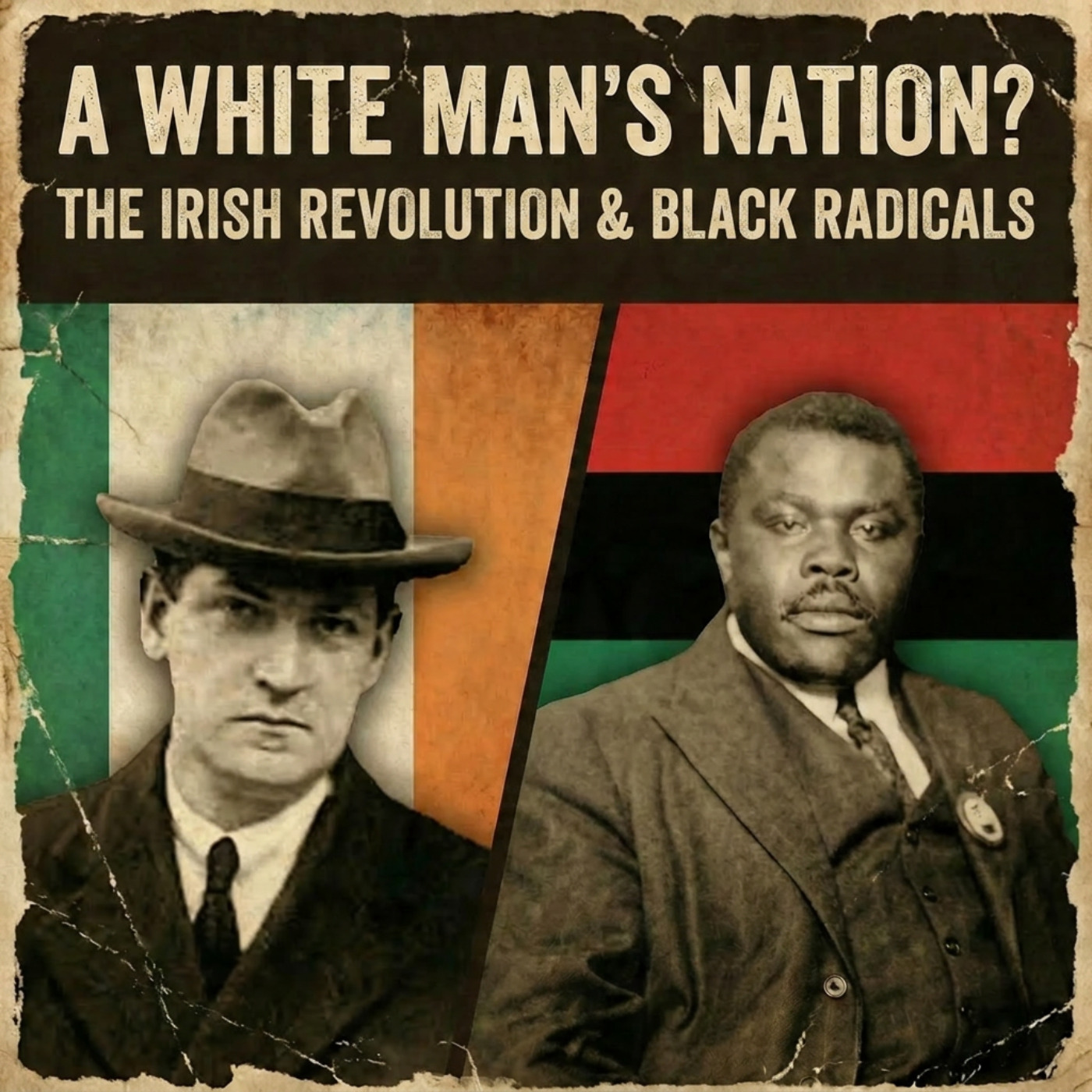
A White Mans Nation? The Irish Revolution & Black Radicals
About this episode
“The Irish fight for liberty is the greatest epic of the modern age… those suffering together under British imperialism must learn to coordinate their effort before they can hope to be free.”
These words from the Black radical Cyril Briggs captured how many people of colour viewed the Irish War of Independence. Today, the Irish Revolution is usually remembered as a struggle shaped by empire, nationalism and religion. But race also haunted this history. As Ireland fought for freedom, racial tensions were erupting across the world. In 1919, the United States was convulsed by the Red Summer, when white mobs launched brutal attacks on African American communities. At the same time, many opponents of Irish independence portrayed the conflict in Ireland as a racial struggle.
Yet the relationship between Irish republicans and Black radicals was never straightforward. While Black activists looked to Ireland with hope, many Irish leaders were slow to support Black struggles and some even argued that Ireland deserved freedom precisely because the Irish were white.
This episode uncovers the forgotten story of solidarity, suspicion and betrayal between Irish and Black radicals and reveals how deeply the politics of race shaped the Irish War of Independence.
This is the fourth episode in Brothers in Pain a groundbreaking Global history of the Irish War of Independence by Dr Brian Hanley
Written, Researched & Narrated by Dr Brian Hanley. Check out Brian's publications here https://www.tcd.ie/history/staff/brian-hanley.php
Producer: Fin Dwyer
Sound: Kate Dunlea
Note from Brian :
In researching these episodes I have been indebted to the work of the following scholars;
Anna Lively, Sam McGrath, Bruce Nelson, John Belchem, Terry Dunne, David Brundage, Niamh Coffey, Gerard Shannon, Maurice Casey, Kelly Anne Reynolds, Chris McNickle, Joe Doyle, Liz Gillis, FM Carroll, Patrick Mannion, Jimmy Yann, Niall Cullen, Pádraig Óg Ó Ruairc, Keith Jeffrey, Arthur Mitchell, John Borgonovo, Kate O’Malley, Michael Doorley, Robin Adams, Kevin Kenny, Fearghal McGarry, Catherine M. Burns, Síobhra Aiken, Patrick J. Mahony, Darragh Gannon, Matthew Pratt Guterl and James R. Barrett.
Hosted on Acast. See acast.com/privacy for more information.
Get every episode summarized
Each time Irish History Podcast publishes, we email you a written briefing from the transcript — the topics, who appeared, and any specific claims, with the ad reads skipped.
Email me new episodesFree for 3 shows. No card needed.
Hosts & guests
Transcript ready
415 searchable segments. Every word is indexed and playable.
Full transcript
Irish History Podcast — A White Mans Nation? The Irish Revolution & Black Radicals. Machine-transcribed; use the interactive transcript above to jump the player to any line.
If you work in university maintenance, Granger considers you an MVP because your playbook ensures your arena is always ready for tip-off. And Granger is your trusted partner, offering the products you need all in one place, from HVAC and plumbing supplies to lighting and more, and all delivered with plenty of time left on the clock. So your team always gets the win. Call 1-800-GRanger, visit Granger.com or just out by Granger for the ones who get it done. Active Campaign is the marketing automation platform built for big swings and big dreams, with intelligent suggestions powered by AI and your data. Generate ideas in seconds, import your brand, and create full campaigns with simple prompts, set personalized messages backed by real-time feedback, smart segmentation, and effortless reporting that tracks every win. Let's redefine what's possible together. Get started for free at ActiveCampaign.com. Have you ever been stuck on a weight loss plateau,
trying everything in anything you can to lose that extra weight and reach peak health? We've all been there, but Nooms unlocked a secret to reaching the mountaintop. Go in micro. The Noom GLP1 Microdose program starts at $99 and is delivered to your door in seven days. Start your microdose GLP1 journey today at Noom.com. That's n-o-o-m.com. Noom. Microchanges big results. Noom GLP1RX program involves healthy diet, exercise, and support. Individual results may vary. Meds in personalization based on clinical need, not reviewed by FDA for safety, efficacy, or quality. No affiliation with Novo Nordisk Inc. The only U.S. source of FDA-approved semi-glutite, not available in all 50 U.S. states. The Irish Revolution and War of Independence is often remembered as a struggle shaped by nationalism and republicanism. However, it also unfolds in a time of soaring racial tension
and violence around the world. While 1919 saw the War of Independence escalate in Ireland, the United States was in the grip of what became known as the Red Summer, as white mobs attacked African-Americans in numerous towns and cities. In this time of rising racial violence and political upheaval, black communities demanded equality, and in Ireland, they saw a struggle that inspired hope. Famous black leaders like Marcus Garvey and Claude McKay sent messages of solidarity and encouraged their supporters to attend rallies, protests, and strikes in support of Ireland's struggle for freedom. However, the relationship between Irish and black radicals was far from straight forward. In the United States, many Irish-Americans had a reputation for racism, while Aiman De Valera, who toured the U.S. during the War of Independence to enlist political and financial support, did not express solidarity with black communities, particularly as he toured the southern states. This episode explores the complicated history of solidarity and betrayal
between Irish and black radicals during the War of Independence and Irish Revolution, and how the racial politics of the age influenced Ireland's revolution more than we might imagine. Hello and welcome to the Irish History Podcast. My name is Finn Duyer. This is the fourth episode in Brothers and Pain, a special series hosted by Dr. Brian Hanley that looks at the global history of Ireland's War of Independence, and this episode is particularly gripping, but it's also at times uncomfortable and challenging. Brian, as you'll know by this stage, is an assistant professor of history in Trinity College Dublin and has several acclaimed publications to his name on the Irish Republican movement and our Revolutionary History, more broadly, I've linked to these below. Now, it goes without saying that this podcast tackles a complicated part of our history, and Brian starts by laying out the situation around the world and how racial tensions were rising as the War of Independence began in Ireland,
and how in this racialized world, many opponents of Irish independence used rhetoric often directed against people of color against the Irish. However, he then goes on to explore the way Irish people responded to this, and this reveals what is a complicated and often contradictory part of our Revolutionary History. Now, just before we dive in, I want to flag that the next episode on the main show is with Dr. Nicholas Wolf. That podcast explores the history of the Irish language and basically the story of how Ireland went from a largely Irish-speaking country to a predominantly English-speaking one. That history is not quite what you might imagine it to be. Sound on this episode is by Kate Dunley. In May 1921, a French journalist, Ludovic Nadu, asked Cana White Race, intellectually equal to the most civilised nations, and which has produced many great men,
be treated in the manner of a savage tribe. Cana White Race, even one of the greatest, hold under its dominion in Europe, and another White Race, physically less strong, but Marley, are equal. And the question that Nadu was posing referred to Ireland and to Britain, and it was a question that troubled many Europeans and many Americans. Because while people were familiar with the idea of a white colonial power ruling over dark skinned people, Britain was ruling Ireland, and most Europeans and Americans quite clearly saw the Irish as a white people. And this was in a period in which the question of race was again becoming central to discourse and to controversy. The post-war period saw a new awareness of race as people of color across the globe saw change, in part inspired by their wartime service, the service of colonial peoples in the French army, for example, or in the British army, and also by the promises of self-determination promoted by President Woodrow Wilson and others.
In fact, many African-Americans assumed that the self-determination that Wilson talked about might apply to them as well. The post-war period also saw a new pride in black literature, art, and music. But this new conference among African-Americans and among people of color in Europe and elsewhere provoked a ferocious racist backlash with lynching's riots and workplace expulsions directed at black people in the United States, Britain, and in Europe. Woodblacks also resisted this backlash. They're moved in the United States, summed up by Claude McKay in his poem, If We Must Die, where he said, let it not be like hogs hunted and penned in an inglorious spot. If we must die, let us nobly die, like men will face the murderous cardly pack, pressed to the wall, dying, but fighting back. And a feature of the race riots in the United States during 1919, and also those that occurred in places like Liverpool, and Cardiff, was that black people fought back. And news of these events was well known in Ireland.
In Ireland, people were well aware of this new discussion about rights for black people, and also about the backlash against it. Indeed, it became a common part of discussion through its featuring in novels like The Great Gatsby. In The Great Gatsby at one point, character Tom Buchanan argues, civilization's going to pieces. I've gotten to be a terrible pessimist about things. The idea is if we don't look out, the white race will be utterly submerged. It's all scientific stuff. It's been proved. It's up to us who are the dominant race to watch out, or these other races will have control of things. And Buchanan courts a book called The Rising Tide of the Colored Empires. Now this was a fictional book, but it was based on a book The Rising Tide of Colour against white world supremacy, written by Lottrop Stottart, an American who was also as it happens an opponent of Irish self-determination. And he had written that the frightful weakening of the white world during the war has opened up revolutionary even cataclysmic possibilities, in other words, the white America and white Europe had been badly weakened by their sacrifice
in the Great War, and now peoples of colour were beginning to take advantage. Someone who worried that Woodrow Wilson's promises about self-determination would cause major problems was his secretary of state Robert Lansing, and this too was relevant to Ireland. During 1919, Lansing argued that Woodrow Wilson had made a huge mistake in talking about self-determination in the way he had. Lansing wrote, it is bound to be the basis of impossible demands on the peace congress and create trouble in many lands. What effect will it have on the Irish, the Indians, the Egyptian, and the Nationalists among the Boris? Will it not breed discontent disorder and rebellion? The phrase is simply loaded with dynamite. It will raise hopes which can never be realised. Obviously there is huge relevance there to the Irish case, but it was also the case that Lansing was clear that self-determination should not apply to certain racist peoples or communities, who in his view were in a state of barbarism or ignorance, and this deprived them of the capacity to choose intelligently their political affiliations. Now what's important, of course, is that these debates
were not just taking place in America or in Britain. People in Ireland were well aware of them, and Ireland, of course, had a great awareness anyway of developments in the United States. In October 1921, the Anglo-Selt which is published in Cavern noted that the Negro people are beginning to realise their powers. They are becoming race conscious, and it said, is it any wonder that they resent the fact that they've been 36 lynchings in America since January last? Is it surprising that they are beginning to manned the abolition of Jim Crow and all the other forms of segregation and discrimination? Is it not natural that they protest against forced labour in Kenya, in Georgia, and trade union discrimination on the land? And if a local newspaper in Ireland could understand this, you can imagine about how it would seep into the popular consciousness everywhere, particularly again when Irish people had so many connections with the United States. But there was also a pervasive racism. This strongly featured in reports of outbreaks of trouble in the United States and Britain and so on. The Irish Times in June 1919, which was at the time very much a unionist newspaper reported on riots in Liverpool.
And it asserted that the Negroes have since the outbreak of the war enjoyed every privilege of equality with white men and have become arrogant and insolent, and in many cases have been guilty of deliberate provocation. The effects of four years of war have not yet begun to disappear, and human life is still held lightly by many of those who themselves have smiled in the face of death. While every effort should be made to discourage the intermingling of the races, occurrences such as those at Liverpool and Cardiff are strongly to be deprecated. The secular feud between white and black will last as long as human nature. But the great difference between the two races is that the white man is capable of self-control by the angry Negro frequently runs amok. And again, I'll stress this was the Irish Times, and this was a view that would have been held across classes and across religions and other groups in Ireland and in elsewhere. So there was, of course, a pervasive racism. While it was true that Ireland at the time was very much a country population by white people, it was not true that people of color were unknown.
Sean O'Neill from Tum, who would ultimately become involved in the Republican movement, first came to Dublin in 1914 from County Galway. And he described it as an awe-inspiring sight, a strange big world of noise, a place where the whole world seemed to congregate. Here too we saw coloured men and men from China and Japan, people crowded together like wasps in a hive. Ireland was an island, but also part of the United Kingdom. Ports like Dublin and Belfast and Colve saw international trade and therefore sailors from across the world visited Ireland and sometimes travelled across it. We also have examples from that period of other experiences of people of color in Ireland. In 1919, a local newspaper and carc reported that a Mrs. Mary Xi had applied to have her 10-year-old daughter admitted to an industrial school. This child was described as an Irish Negro or a milletto would be born in America. We can only wonder what happened to the poor girl. 1921 there's a report in the Limerick leader of Eli Dorgon who's described as a coloured seaman on a steamship called the West Cape, who's being jailed for the murder of a
Negro shipmate James Goodby after a row in Limerick Port. In October 1921, the American soldier and centricopted orchestra were performing at Dublin's La Scala for three weeks. And jazz clubs had opened in Dublin from 1919, opened in fact by veterans of the British Army and the Great War. But these clubs soon drew much criticism for playing what was described as Negro music or actually in which more racist terms. A further complicating factor of course is that the Irish were often viewed in racial terms themselves, particularly by the British or by unionists.
Let's redefine what's possible together. Get started for free at ActiveCampaign.com. Visit betterheelp.com slash random podcast for 10% off your first month of online therapy.
25. After having to relocate following the Irish revolution, wrote a book called Western Togs, our Ireland and the English-speaking world. And he described the Catholic Irish as essentially Negroed, an inferior breed of men and more given to crime and superstition than pure white men. Lord Alfred Douglas, who published the journal plain speech, argued that the Irish were inferior in race to the Negroes. And he said that no peace, and we say it calmly, could become an Ireland, until every weapon of modern warfare is used to burn, slay and exterminate the vermin, who have devoured the south of that country. So again, Douglas sees the Irish problem in very, very racial terms. An important right-wing newspaper at the time was The Morning Post, Daily Paper in Britain. Its Irish car responded with Cyril Brisserton. He eventually wrote a book entitled The Real Ireland, which was published in 1925. And there he argued again that the problem in Ireland was that the Catholic Irish were a matriarchal race. The vigor of the race bought physical and mental and a strength and constitution of its character was carried from one generation
till next by the women, and not as among the Aryan races by the men. This explains, for example, the devotion of the Irish that Roman Catholic Church, which for its own purposes has borrowed largely and intelligently from the matriarchal cults. The hibernian proper has the slave mentality. He is a mixture of childishness and ferocity. He is basically superstitious, callous to suffering, credulous, excitable, triffless, untruthful, dirty, petally dishonest, destructive, conning, chartous, devoid of moral courage, and intensely vain. Most of the Catholic Irish were assembled more of the Iberians in blood than they did the British. Now, Brisserton again is somebody within the British elite who sees the problem in Ireland very much in racial terms. These views were not universal in Britain, many British people would have been shocked by them or certainly wouldn't have held them, but nevertheless it did show that there was a racist element very often to how the Irish were depicted and also to how their rebellion was seen. To counter that, of course, the friends of the Irish in Britain often stressed that the
Irish were indeed a white race, and in fact not that different from the British at all. The Peace with Ireland Council, for example, argued in late 1920 that the worst crime of British government policy in Ireland had been that the British cabinet has deliberately set out to terrorize a whole people, a white people of three and a half millions with a distinct infusion of British blood in their veins. In other words, the Irish should not be oppressed because they were, in fact, like the British and that the Ucoe existed alongside racism in contemporary Britain. Any association between the Irish and peoples of color in America and elsewhere was seized upon by the right-wing press in Britain and indeed in Ireland. In August 1921, a huge Congress took place in New York of Marcus Garvey's United Negro Improvement Association. This was reported in the Belfast newsletter a unionist paper under the headline N of the Black Belt. The racist term for people of color was used to describe those who'd rallied and sent greetings to Ireland
from the streets of New York. That event was significant and was not the only occasion in those years when black American or West Indian radicals had identified explicitly with the Irish cause. Marcus Garvey and the Universal Negro Improvement Association saw the Irish cause as central to the cause that they were fighting for. Garvey said, we believe in the principles of justice and equity. That is why we're in sympathy with Ireland. That is why we're in sympathy with the Zionist movement. That is why we're in sympathy with the nationalist movement of Egypt and of India. We believe all men should be free. Garvey in particular was very interested in the Irish question. Saw that the ability of the Irish to weaken the British Empire would also weaken the British Empire in the West Indies among their other colonies and might lead to freedom for people of color there. He along with other West Indian radicals such as Cyril Briggs, Claude McKay, Hubert Harrison were extremely enthused by the Irish Revolution. In 1919 the US Justice Department
reported that all the colored speakers in Harlem are using the Irish question in their discussions. British intelligence reported in the same year that the general world unrest is not without effect upon the Negroes and the South of the United States has become restless. This agitation goes far beyond the redress of grievances and has taken the color of pan Negroism and a combination with other colored races which are pan at the head. There is a tendency to draw in the Negro a lot with the Irish, the Jews and the East Indies as oppressed peoples. People of color and others were making connections and very interestingly they saw the Irish as part of their struggle. Certainly Garvey saw the Irish question as central. Now Garvey's politics were complicated. He was a black separatist. He believed that black people should leave the United States and return to Africa but he also was an anti-imperialist. In August 1920 his organization held one of their congresses in New York. Significantly they sent greetings to Aiman de Valera as
president of the Irish Republic. Their message read please accept sympathy of Negroes of the world for your cause. We believe Ireland should be free even as Africa shall be free for the Negroes of the world. Keep up the fight for a free Ireland. Now De Valera was actually in the United States at this point and ultimately there was a reply to Garvey's message which was a public message. Their reply however was private. Their reply from De Valera read, My dear sir President De Valera has instructed me to convey to you his thanks for the message of sympathy for our cause sent to him from the Negro mass convention. He believes that every people are entitled to the possession of their own homeland and trust that the time will come when no people will be dominated by another for selfish purposes but that all will be privileged to enjoy the liberty plainly intended for them by the creator. So there's an expression of sympathy there from De Valera but it's a private message of sympathy. Garvey was not the only black radical who looked to Ireland. Cyril Briggs published a journal called The Crusader argued in February 1921 that the Irish fight for liberty is the greatest epic of modern history.
It is a struggle that should have the sympathy and active support of every lover of liberty and every member of an oppressed group. The Negro in particular should be interested in the Irish struggle. For while it is patent that Ireland can never escape from the menace of the overshadowing empire so long as England is able to maintain her grip on the riches and manpower of India and Africa, it is also clear that those suffering together under the heel of British imperialism must learn to coordinate their efforts before they can hope to be free and again Briggs who would be drawn towards communism sees very much the importance of Ireland as a place that can disrupt British colonial control of her other possessions. Claude McKay too also wrote about the Irish question. He lived in England for a period attended Irish rallies in Trafalgar Square. He said I react more to the emotions of the Irish people than those of any other whites. They are so passionately primitive in their loves and hates. They are quite free of the disease of Anglo-Saxon hypocrisy. I suffer with the Irish. I think I understand the Irish. My belonging to a subject race entitles me to some understanding of them. I was born and
rare to peasant. The peasant's passion for the soil possesses me. It is one of the strongest passions of the Irish revolution. But McKay also noticed because he lived in the United States that American Negroes hold some sort of a grudge against the Irish. They have asserted that Irishmen have been their bitterest enemies. And here was a reality that we cannot ignore that there had been almost a century bitter tension and sometimes violence between the Irish in America and African Americans. The greatest single African American intellectual of the era W.E.B. Du Bois wrote about this in March 1921 when he wrote to the Reverend DJ Boston who was part of the Catholic board for mission work among the colored people. They were discussing the Irish. And Du Bois asserted that, I regret to say that there can be no doubt of the hostility of a large proportion of Irish Americans towards Negroes. It has been manifest in so many ways and so continuously and emphatically that there can be absolutely no doubt about it. I have been in personal contact with Irish Americans from my childhood up onto the present.
I have found very few of them who have expressed the slightest sympathy for the Negro. And in our present organization, which was the NAACP, the National Association for the Advancement of Color People, we have lamentable few members of Irish descent. And Du Bois is being realistic here. Then he goes on to say, this fact does not for a moment invalidate the justice of the Irish cause. And I shall at all times defend the right of Ireland to absolute independence. I believe that great Britain is today the greatest enemy of human freedom and independence. Not only for the Irish, but for most of the peoples of the world. When, however, I defend the Irish cause, I shall not fail to point out that Irish men have been hereditary and historical enemies of Black folk with a few fine exceptions. He mentioned Daniel O'Connell, the repeal leader of the 1840s as one of those exceptions. And Du Bois' worries were also echoed by a Philip Randolph, Black American socialist and trade unionist. He too sympathized with the Irish. He opposed British imperialism. He wrote in the messenger how Britain had crushed under
him our imperial heel, the bleeding body of Ireland, the suffering soul of India, and the dusky slaves of Egypt. When a strike took place in New York in August 1920, which involved both Irish and African American workers, Randolph proclaimed, long lived the solidarity of labor. Only labor can free Ireland. He said, maybe later on, Negroes will be having their own Irish brothers strike for Negro freedom. Who knows? When a Philip Randolph also noted that the Irish were the race which Negroes dislike most. And this long history of tension and violence was one that would continue to affect the ability of these people to cooperate during their evolutionary era. Thank you for calling the Bombas Comfort Line. Bombas make socks, slippers, tea's, and underwear made with the highest quality materials. Press one for comfort, two for style, three for donation. You chose style. Bombas are styles for whatever you enjoy. You can run in Bombas, lounge in Bombas, dress them up, dress them down, but always give back in Bombas,
because with every item purchased, another is donated. Bombas Comfort worth calling for. Go to bombas.com slash audio and use code audio for 20% off your first purchase. That's B-O-M-B-A-S.com and use code audio. There are moments that reveal who we are and who were meant to become. For those born to lead, such moments call for a vehicle of equal distinction. Dynamic by design, uncompromising and execution, the Range Rover Sport was engineered for those rare individuals who demand the world and possess the conviction to claim it. When your time to lead arrives, you need a vehicle that rises to meet it. The Range Rover Sport, exclusive offers available now. Explore further at RangeRover.com. Irish Republicans were active in the United States during 1919 and 1919 at saw the worst race riots in the United States since the 1860s. They were most severe in the city of Chicago, a multi-ethnic city in which the Irish played a prominent role. These violent riots, the Red Summer, saw lynchings and attacks on black people
and numerous towns and cities across the United States were particularly intense in Chicago. One historian has written about how the riots in Chicago, seen in a different light, where a tar four, where Irish Americans and Southside neighbors fought against incoming African American populations. The Irish had become well-organized, where numerous, politically connected, with sympathy and even protection from the largely Irish American Chicago police force. More effectively than any other number of ethnic groups, they had established informal territories, with roughs, adolescents and others constantly patrolling. In other words, the Irish had played a central role in the violence against African Americans in the Chicago riots. Now, what's significant, of course, is that these riots occurred in the summer of 1919. Devil era visited Chicago that summer, addressed thousands of Irish people and Irish Americans and was rapturously received. He never mentioned one word in Chicago about the recent violence which had traumatized
the city. Indeed, in no place that he visited in the United States, did he mention the question of African Americans, even as lynching reached new heights and even as the race question was worn which was impossible to avoid. Devil era did speak about other races. In Wisconsin in 1919, he visited a Chippewa reservation and he said to the Native Americans there, I speak to you in Gaelic because I want to show you that though I am white, I am not of the English race. We like you are a people who have suffered and I feel for you with a sympathy that comes only from one who can understand as we Irishmen can. You say you are not free, neither are we free, and I sympathize with you because we are making a similar fight. As a boy I read and understood of your slavery and long to become one of you, I call upon you the truest of all Americans to help us win our struggle for freedom. The Devil era was honored by the Chippewa became chief dressing feather. So he was prepared to speak to Native Americans and empathize and actually express
solidarity with them. But Devil era and other Irish Republican leaders in the United States said nothing at all about the question of discrimination against African Americans. Indeed, when Devil era spoke at rallies in the United States, on several occasions he asserted that the Irish were the one remaining white nation in the slavery of alien rule. Harry Bolum told the Boston audience that the Irish were the only white race condemned to slavery and Mary McSweeney informed Americans that the Irish were the only one of the white races in the world, which is today not free. In Ireland itself George Gavin Duffy, born MacNeil and Erskine Childers, all used the same terminology in their rhetoric. Sinn Fein pamphlets claimed that the Irish were the only white people in the world whose numbers were in decline, so the assertion that the Irish were white. And this whiteness entitled them to self-determination was something that Irish Republicans stressed on various occasions in those years. It was particularly relevant in the United States
because by saying that you were white you were quite clearly differentiating yourself from other Americans who were not. This is also relevant to Devil era's tour of the American South. Irish Republicans wanted to travel to the American South. They were substantial Irish populations living in Georgia, Alabama, Louisiana and elsewhere, but these were also bastions of southern Protestantism and there was a fear that Devil era would meet a hostile reception, indeed he was promised one in some parts of the American South. He was advised to stress the historic Irish connections, not only to the American South but to the American Confederacy when he visited. Liam Melos and others advised Devil era to stress historic figures such as Andrew Jackson, the Rutledge's John C. Calhoun, Pat Claiborne, the southern Pat finders David Crocodne and Samuel Houston, who were all in many ways sons of Irish immigrants. Melos also urged Devil era to note that when the first scone of the Civil War was fired when the Union ships bombarded for Sumter,
the officer in command of the fort was Captain John Mitchell, a native of Ireland, the son of John Mitchell of 48 fame and John Mitchell himself in the days before the war was one of the foremost champions of the South in a newspaper which he published in New Orleans. Now this too is significant because John Mitchell was remembered in the American South as a vigorous defender of not only the Confederacy but a vigorous defender of slavery and white supremacy and here were Irish Republicans stressing to Devil era that he should identify very strongly with Mitchell and with other Irish immigrants who supported the Confederate cause. Indeed while he traveled across the American South, Devil era did leave reeds at Confederate war memorials. There were still of course people alive who'd fought in the American Civil War at this point. Now Devil era did not identify with Confederacy politically that would have been suicidal in terms of American politics but he did go out of his way not to offend the South in terms of its racial politics. But there are contradictions and complicating factors. In August 1920, New York saw it's called the Irish Patriotic Strike.
As Irish workers and Irish Americans workers stopped work on New York stocks in protest at the British arrest of Archbishop Mannix who traveled from New York towards Ireland but was intercepted by the Royal Navy and taken into custody. Irish workers began strike action in protest and were joined by workers of a number of other ethnicities including large numbers of African American Longshoremen. One newspaper reported in fact that another feature of today was the presence of numerous negresses who endeavored to lure the Negro Longshoremen away from work. Order is being maintained on the peers but numerous encounters between blacks and whites over Negroes replacing white Longshoremen have taken place. So during this strike there was both support for the Irish by African American workers but also attempts by the dock companies to bring in black workers as strikebreakers which was a feature again of Dockland labor disputes. Marcus Garvey and others became involved and called on African American workers to support the Irish. Leaflets were distributed arguing brothers if you scab Ireland you scab the Negro race.
A man's a patient of the Irish is the emancipation of all mankind. And this again was a long and complex story but during this strike some Irish Republicans did travel to Ireland to speak to Garvey's supporters. It had a longer term impact. Irish newspapers reported that African Americans were attending Irish protest events particularly during the hunger strike of Terrence McSweeney. One African American J.A. Adams from Albany in upstate New York wrote to the Irish world newspaper to pay tribute to Terrence McSweeney. Under the headline an Afro-American tribute Adams argued as a friend of Irish freedom permit me as a colored man to join in this way in your demonstration of sympathy and appreciation of the heroic soul now at rest after his wonderful triumph over the whole British Empire. Afro-Americans acclaim him among the immortals and pray for the Republic of Ireland. In 1921 a branch of the American Association for the Recognition of the Irish Republic was founded in Harlem and this group had put Irish American and African American members.
There are also reports of African Americans contributing to the dull bond collections and taking part in other protests in support of the Irish cause in this period but unfortunately that again is not entirely the whole story. From 1921 on there was a huge scare in Europe about the occupation of the German rule by French troops, particularly French colonial troops. It was argued that the French government had committed a crime against humanity by allowing African troops to be set amongst white Germans. The Germans made huge propaganda of this reached the United States and Britain where it caused great disquiet and it also reached Ireland and Irish Republican publications seemed to have taken the German word for granted. So New Ireland, a Republican journal asserted during 1921 that taking the African Negro from his home in the Wales and setting him down on check among the city populations of Germany has released an army core of black barbarians
upon the homeless and more civilized countryside in Europe. These conscript drafts from tropical Africa have been torn from their homes and are naturally full of savage resentment against the white race. This was also covered in Irish labour publications and the language was explicitly racist. What was actually German propaganda without any foundation about mass rapes of German women by these African troops was widely believed in Britain, Ireland and the United States. It suggests then that Irish Republicans were not instinctively sympathetic towards people of color and instead were more concerned about whether or not Britain was on one side or the other of these arguments. And that had been notable before, many Irish Republicans had been enthused 20 years earlier by the Bohr struggle for freedom against the British. People like Arthur Griffith, Maud Gone and many others had written, movingly about the Bohr plight. Maud Gone in fact argued in 1900 that one factor in the justice of the Bohr cause was that the Bohr's had battled against what she called the fiendish treachery of the Native tribes.
It wasn't the case that Irish Republicans were unaware that the Bohr's were viciously racist against Native Black South Africans, but as it was actually seen as a positive in their favor. Similarly, Arthur Griffith who lived in South Africa accepted without question that there was a natural racial hierarchy. When he wrote about John Mitchell in 1913 an introduction to Mitchell's famous jail journal, he responded to criticisms of Mitchell's support for slavery by saying that no excuse was needed for an Irish nationalist declining to hold the Negro his peer in right. The right of the Irish to political independence never was, his not, and never can be dependent on the admission of equal right in all other peoples. So some Irish Republicans at least did not believe in the universal right of humanity to self-determination. They too bought into the revering racial views of the time, but of course this was a contradictory situation. The rhetoric around the Anglo-Irish treaty again shows us how racial language could affect how people viewed themselves. Some of those who supported the treaty were very eager for Ireland to
join the ranks of the civilized white nations as they sought. Kevin O'Higgins for example argued that if the Irish rejected the treaty and fought over it, we bid fair to be classed with the racist term and the Mexican as a people unable to govern themselves. Similarly, another pro-treaty out Alexander McCabe said, give us anything that would stamp us as white men and women, but for heaven's sake don't give us a central American republic. But what was important here was that there was a great interest in the Irish cause and the Irish revolution among African-American and West Indian radicals. While the Irish were exceptionally cautious about expressing solidarity with them, particularly in the United States, these radicals were supportive of the Irish nevertheless. The generosity of W.E.B. Du Bois rings out. So too does the radicalism of Marcus Garvey, who felt that no matter what the Irish taught about him and Irish victory against Britain, would be a victory for all people of color. Nevertheless, it is important to remember too how
important the idea of whiteness and of race was even to a revolutionary world. That episode certainly left me with a lot to think about and challenged perceptions I have of Ireland's revolutionary era. I want to thank Brian for his work and research in making the show and bringing out this often overlooked aspect of our history. Now I'll be talking to you and Wednesday with that show with Dr. Nicholas Wolf on the history of the Irish language and Brian we'll be back next Friday with the next installment of Brothers in Pain. Until then, Sloan. You don't usually hear the words good news and cancer together, but there's more progress in cancer research and treatment today than ever before, and more reason for optimism. That's what our podcast, The Good News About Cancer, is all about.
In each episode, we talk with leading experts about the latest breakthroughs in diagnosis and treatment, what's new, why it matters, and how it's changing the future of cancer care. Listen to The Good News About Cancer, wherever you get your podcasts. Security program on spreadsheets, new regulations piling up, and audit dread, it's time for Vanta. Vanta automates security and compliance, brings evidence into one place, and cuts audit prep by 82%, less manual work, clear visibility, faster deals, zero chaos, call it compliance, or call it compliance. Get it? Join the 15,000 companies using Vanta to prove trust. Go to vanta.com, slash
More episodes
More from Irish History Podcast

The Golden Age of Irish Smuggling
Irish History Podcast

Why Did Nazi Germany Bomb an Irish Village in 1940?
Irish History Podcast

The Sinking of the Lusitania
Irish History Podcast

Ireland’s Shipwrecks: History from the Depths
Irish History Podcast