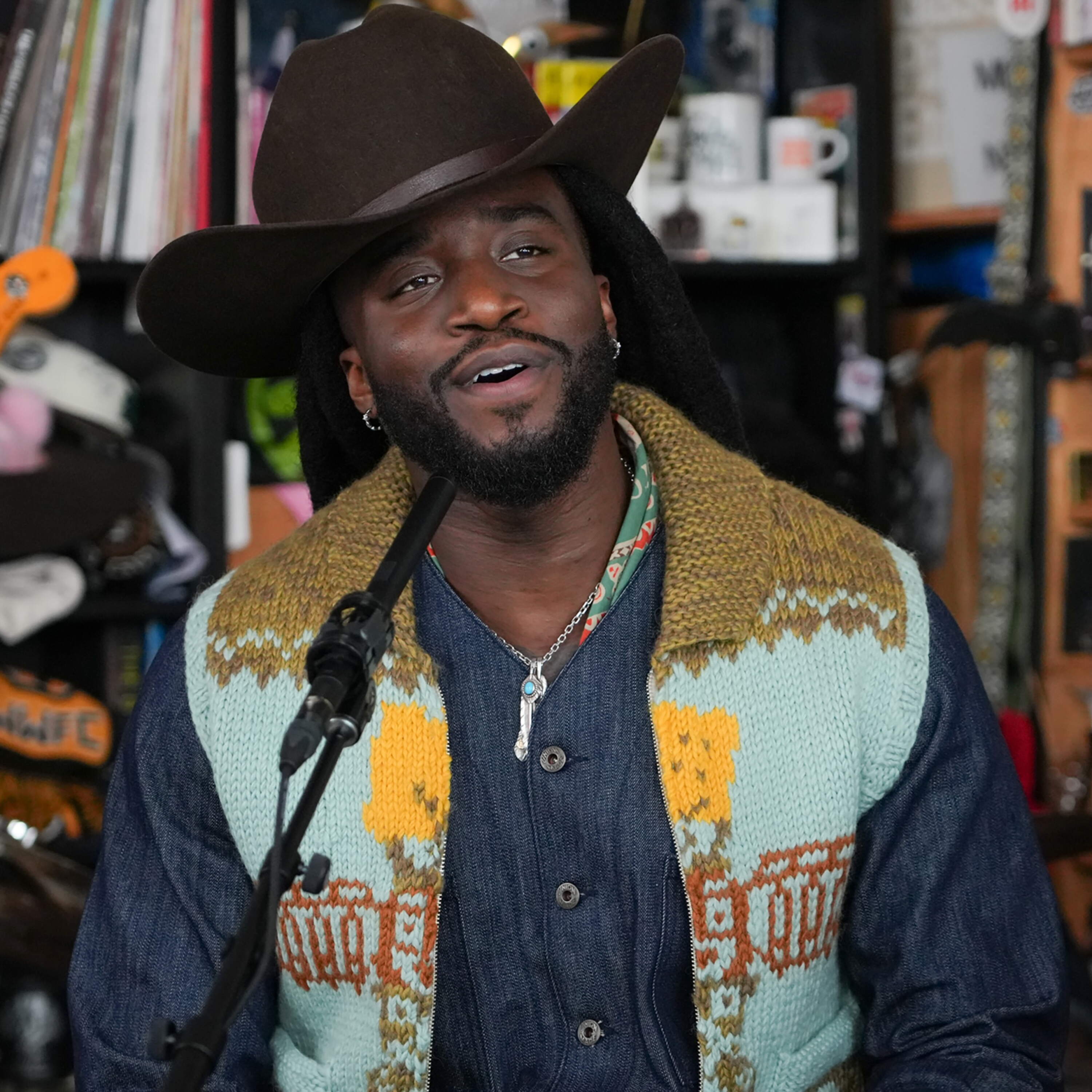
A Wild West revenge tale and the Black roots of cowboy culture
About this episode
It’s a genre-defying concept album that fuses hip hop with country, spoken-word and ballads – and that features Jamie Foxx, Kehlani, Leon Bridges, Gunna and Sam Elliott. On The Sunday Story, Shaboozey joins Ayesha Rascoe to talk about the inspiration – and intentions – behind “The Outlaw Cherie Lee & Other Western Tales.”
Support public media with NPR+ and enjoy perks for over 25 podcasts like this one. This show’s perks include sponsor-free listening. Learn more at plus.npr.org.
See pcm.adswizz.com for information about our collection and use of personal data for sponsorship and to manage your podcast sponsorship preferences.
NPR Privacy Policy
Get every episode summarized
Each time Up First from NPR publishes, we email you a written briefing from the transcript — the topics, who appeared, and any specific claims, with the ad reads skipped.
Email me new episodesFree for 3 shows. No card needed.
Hosts & guests


Transcript ready
258 searchable segments. Every word is indexed and playable.
Full transcript
Up First from NPR — A Wild West revenge tale and the Black roots of cowboy culture. Machine-transcribed; use the interactive transcript above to jump the player to any line.
I'm Ayusharasco and this is a Sunday story from up first. Recently we lost one of country music's greats, Dolly Parton. I love Dolly. My kids received books through her imagination library, her children's literacy program, and I just loved her larger than lifestyle. You know, she embraced her big hair and the rhinestones and the cleavage, which I also enjoy. And I think I saw a little bit of myself in her or really, she gave me permission to be more of myself. I am not subtle. I don't have like a classic style. I can be a little bit over the top. I love a bit of godliness, right? And so I loved that Dolly embraced that and allowed me to embrace being me.
And honor of Dolly, I wanted to bring you a conversation today with a member of the next generation of country musicians. Somebody who also won't compromise his vision and his style, Shibuzi. Now you may know the Grammy Award winning singer-songwriter Shibuzi from his features on Beyonce's cowboy Carter or from his chart topping single, A Bar Song Tipsy. Well, his latest record has a different vibe. That's the song Sweet Revenge from the Outlaw, Sherry Lee, and other Western tales. 19, live hall.
She's her friend again with Won't Go to find every man that did her own. Sweet Revenge is the fifth song on a genre-defying album all about the epic life of the titular Outlaw, Sherry Lee, and about how far she'll go in her quest for vengeance. Shibuzi wasn't sure how this album will go down. It's a high-concept feat of storytelling, fusing hip-hop with country, spoken word, and ballads. It even comes with a comic book that builds out Sherry Lee's world. But also Shibuzi hopes it's a reminder and a celebration of the black roots of Western cowboy culture. I hope that people can understand that like just me, I'm a representation, I am black, I am in country music, I am, there's nothing you can do to take that from me.
Today on the Sunday story, Shibuzi tells me about the inspiration behind his outlaws and how his cinematic album came together. Stay with us. This message comes from Pod Save America. Every week, John Lovett, Tommy Vieter, John Favreau, and Dan Fyfer dive deep into political news with guests from across the political spectrum. Listen wherever you get your podcasts and on YouTube. As the political landscape shifts beneath our feet, we're all vulnerable to a well-funded distraction economy determined to take our eye off the ball. Our weekly politics series, if you can keep it, is here to help where our focus is not the horse race, but the state. We tackle the big political stories of the day and why they matter for our democracy. Join me, Todd Zwillich, and me, Jen White, on the 1A podcast from WAMU and NPR. Hey, you know that nagging voice in your head? The one telling you to put the phone down and stop
doom scrolling? Well, it's time. Look up. Take a daily curiosity break with Sherry Lee, NPR's science podcast. Let your mind wander to the edges of outer space or wonder about what's lurking in the depths of the sea floor all in under 15 minutes. Shortwave, your daily mental reset. Listen on the NPR app or wherever you get your podcasts. We're back with this Sunday story. Shibuzy joins me now. I would say how did, but when I come from, we must say, hey, y'all. So hey, y'all. That's what I say too. What up, y'all? Uh, so Shibuzy, your new album tells the story of an outlaw named Sherry Lee. Please introduce us to her. Um, honestly, the way Sherry Lee kind of birthed in my brain, it was like a character that just hit me out of nowhere that needed to just be brought to life. Um, when I started working on this album six, seven years ago, um, I remember writing the first song just wanting to create this
outlaw group who came into this town and took over and in the chaos of all that they accidentally took the life of this sheriff. But what they didn't know is his sheriff had a daughter and that daughter was coming for vengeance. So, um, really, she just, you know, when I write stories, sometimes these characters just don't just birth out of nowhere and then they take on a life of their own and then I just start following their journey and I just document what I'm seeing. So, um, sometimes when people ask the question, who's Sherry Lee, I'm like, man, you gotta find out for yourself. Well, I mean, she's out for revenge, right? She is out for revenge. And that comes up over and over on the album. Like, why did you want to really delve into this idea of revenge and whether it's sweet and then also looking at how you got to deal with the consequences of your actions? Is any part of her story rooted in your actual life experience? Yeah, I'm think as an artist, everything is always rooted in some sort of life experience, whether you know it or not. I think the beauty of this whole album is how much I'm also learning about myself and helping
process a lot of different things that I've experienced in my life about, you know, everyone has a little outlaw and a little cowboy to them, you know, and I think for her is the same thing. I think a lot of the women that have existed in my life where I've come across in my life have all, like, changed me in some way. So it's definitely rooted in some reality. Maybe there's someone out there that wants to get vengeance against me, you know, and what they're probably in your man's and they're probably, I should probably be. I'm just looking at you. I think somebody's going to get some vengeance on you. And maybe it's my way of just coming to terms with it or playing it out, you know, in my own way, trying to get ahead of it. Making it right. It's probably a little bit of that. Yeah. I mean, so you're and speaking of women, like your last album was like a huge hit, in particular, of course, a bar song, tipsy, it's spent 19 weeks at the top of the Billboard charts,
is Cowgirl, which is on this album. Is that a follow up kind of to to tipsy? I mean, it's telling everybody to get to the dance floor, you know what I'm saying? You want to hear something crazy? Actually, wrote Cowgirl four years before I wrote a bar song. Oh, okay. So it's in a different form. Honestly, more like a, it was actually a little more hip hop before, but it was actually an older song that I had wrote for the first iteration of this album, which initially it was called We Were In The Share if I the Town, and obviously continuing to work on it. I came up with the idea of changing it. I think I have like a notes on my phone with a hundred different titles for the album, and then I remember starring down, lost Sherri Lee and other Western tales. So Cowgirl was definitely a song birth in that generation
of the album, and I just brought it back to this one, you know, having a song just for people to dance to. Yeah. I mean, was that important for you? Because this is a concept album. It's a high concept album, and we're going to get into that, but was it important for you to also have those numbers where people could feel like they could just dance. They don't have to know the whole story. They don't have to be into the whole thing. Yeah, 100%. I remember exactly how it came about, you know, I was, I was in my high concept world where I'm like, you know, this song got to make sense with this song, and this song, and this song, and and my manager, you know, he was like, man, we need a song for the ladies. I'm listening to all this. Yeah. Yeah. Ain't got nothing for the ladies on here. And in that way, you know, Sherri Lee, the whole thing is about that. But, you know, you need a song that people can kind of dance to and have fun. And I remember at first, he said that, and then another friend came to me and said the same thing without even hearing the music. He was just like, yo, man, you know, I hope you got something for something that's a little bit more powerful, you know, easy, that's easy going. Yeah. Yeah. And I remember, we threw a party that night, and I remember we were
playing all the classics, wagon wheel, chicken fried, you know, uh, Miss American pie, all that stuff. And I noticed that people really started dancing to those songs. And I was like, man, let's, I want to do a new version of, of, of those kind of like fiddle tunes. You know, so that's kind of how a cowgirl got a birth. And the next day I made the song in the studio. Well, and the concept album, getting into the deep part about it, like it is a combination of songs with lyrics, instrumental numbers, and like these spoken word pieces by these really big stars, like Hell is Hot, which I think we have a clip of it. Yeah. Hold your fire. Before that fire gets ahold of you. Obviously, that's Jamie Foxx. Remember Hell's Hot, but it's damn cold in the cell. I mean, it obviously, it gives the album this theatrical feel. But like, why did you want to include
spoken words on your album? Because I thought, when I saw Jamie Foxx, I thought he was going to be singing, giving us the groove. I'm like, what is, like, I'm like, oh, this is different. He's giving us the attic. You know, I'm a mad man sometimes. You know, what comes out, you know, I think for me, I have such a, I've always wanted to be a filmmaker, you know, and it's really cool to see. I know my child herself is probably like, dang, he's really doing it. But I've always been trying to make films and movies and write stories like that. So I think my goal with this was to create an album that did feel like a movie and have features that felt more like an ensemble cast than just music. You know, I'm always a guy like any time anyone's dropping an album, I'm always like, who's on the, who's on the album? What's the features? What's the features? And I think what's really cool about this is the fact that, you know, getting Jamie Foxx, K-Lion, and Leon Bridges, Gunna, but also Sam Elliott. Yeah, yeah. Times up out, Laugh, your rope friend, short.
Someone's got to pay for all the blood you took. It's only you and us now the rest of your boot cut boys are dead. I mean, how did you get all of these people? Because I mean, you got like everybody. So I'm like, was everybody hard to get? Was it just like Shabuzie? Everybody was like, yes, we doing it. I think so. And that's why I think it's like, it's really, it's really just just. You say you that guy. That's what you say. That's what you do. Because I said, should you boozey that say? He said, yup, that's exactly what I mean. Hey, look, what's really amazing is how a lot of the people on the feature, like the feature that's are connect, you know, connect with it. Like Sam Elliott was telling me, you know, a lot of his family members loved the song too. And like he loves the song and loves my music. And I think really, man, you know, sometimes you just got to just, you just got to stick to it. You know, I know I had this crazy idea for this outlaw Sherry Lee for a while. And, you know, and I always wanted to do it and do
a concept album. But it was about time and so it's cool that every step of my journey helped create. You know, I made a lot of friends and fans along the way that, you know, just wanted to be a part of it. You know, I just asked really and that's what I love about it. It's, you know, everybody came and brought something unique in Tiana Taylor. She heard it and she was like, she was like, just like sinners. It's like some, it's like some cinnish. I was like, you know, I was like, it's crazy. So, what I mean, you know, speaking of and and Kailani is on it. And she is a beautiful piece. It's blitz and blades. Let's play a little clip of that.
I know your past was a God awful place, but look what it made. That's a lot. That's a bar. You know what I'm saying? That's a bar. Who could wrote that? I always say everybody. All of us collectively as people wrote it, you know, and that's what I love about a song like that. It just feels like it connects with everybody. Like, I remember playing that song with some of the little listening meetings I did and I couldn't help but to cry. You know, it's a heart song. I have to cry too. Because you know, I know all of us, we've all been through a lot of things. But each one of those things that we went through, I wouldn't be who I was if it wasn't for those moments that, you know, I was, I felt, you know, pain and the things we experienced in the trauma, you know, it made us who we are. And it's beautiful. Those imperfections. So, I really wanted to do a girl you're amazing, just the way you are. But you know, Sherri Lee, obviously, she's experienced this loss. She's lost both her parents. I mean, she's lost her father, but
prior to that, she also lost her mother and she's obviously going through all of these different emotions. But it's created this strong, beautiful woman that the character who I play in this boos, which is myself, falls in love with. And all the other characters, all the other outlaws, everyone's kind of, they have a story before those moments. So it's just about celebrating stories in our past, but also, you know, looking to hopefully have a better future always. When we come back, Shabuzie tells us why this was the perfect moment for Sherri Lee. And about his black country heroes, stay with us. This message comes from the Center for US Voters Abroad Foundation. US citizens live, travel, and serve all over the world. But wherever they are, they can stay connected to home through voting. All US citizens abroad may request an absentee ballot to vote in the 2026
election and requesting yours is easy. Keep your connection strong no matter how far away you are. Visit registerabroad.com to get started. This week on Newsmakers, after more than a decade in comedy, I wasn't sure that we would get here. Robbie Hoffman is fearless. I had a small feeling I wasn't sure. And fully herself. My line, Lord. Hello. You can go out and flash. Well, I'm not home now. I'm doing something. We plunge into comedy and success with Robbie Hoffman on NPR's Newsmakers. The NPR app cuts through the noise, bringing you local, national, and global coverage. No paywalls, no profits, no nonsense. Download it in your app store today. We're back with Shabuzie on the Sunday story. You know, what you talked about, like timing. And I have to wonder because, okay, you have, you know, bar song. And it's a huge hit. That puts a lot of pressure on any artist. Like, okay,
when you're going to make the next one, when you're going to make the next bar song, and it could have also put you in a box in a way, right? Like, okay, we want you to make that song that's going to be hot on TikTok, right? Was there any resistance to you doing a concept album and saying, because you like going in a different direction and say, let me do this high concept thing instead of like letting me just give a bunch of, you know, songs, because I mean, as someone else who you worked with famously said, Beyonce, people don't make albums anymore. They don't make albums anymore. Yeah. Man, I think for me, that's a great question. It's come up a number of times and there's definitely been some, you know, a lot of like emotions around that whole idea of, you know, doing what's familiar and just doing what, you know, what maybe some would consider the safer thing. And I think when I brought the idea, you know, everyone was on
the team was really supportive. I was actually very surprised. I mean, this is a, this is an idea. I mean, I brought this up when I, a couple years ago, and I remember at that time, you know, people were like, we need to get to know who you are before you, you know, get into this concept world. But now it just feels like they feel like I, you know, they said, you know, you've earned this. And I'm just really grateful to have the team I have that support the idea. And anytime I have any doubts, they're like, what are you talking about, brother? Like, this is exactly what you need to be doing. I mean, you're from Woodbridge, Virginia, a suburb of the DC metropolitan area and your parents are Nigerian. What led you to fall in love with country music? I think a mix of a lot of different things. I think just being in Virginia and just trying to understand the history of music there. You know, I knew, you know, a lot of times when you think of Virginia music, you think, you know, for real, missy, Timberland, the clips, Teddy Riley, I mean, I keep going on, you know what I mean?
But there's history beyond that as well with Patsy Klein, you know, a Winchester Virginia, Native, Emil Lujares, who went to the high school, Carter family as well, and Bristol Virginia. They did the Bristol recordings, which they recorded with a lot of that with Leslie Riddell, who also penned a lot of those songs or wrote a lot of those songs. It's just a lot of a rich history of country music in general in Virginia. And I just wanted to figure out a way to celebrate it all, combining obviously the hip hop elements of what we, you know, what I grew up listening to as well as the country music that I came to love later and what I was exposed to early on in my life. I think it was really just meditating on where I'm from in Virginia. And I've always been kind of just like talking about nature and just trying to help people like just connect back to nature and connect back to the simple things they have, you know, in life. So it was really me just trying to celebrate those things, you know. What do you feel like, you know, you mentioned obviously Beyoncé
and Cowboy Carter. And obviously there's been all of this attention even way before that on, you know, Black artists and country music. And I know you probably get asked this question all the time. And because of that, I kind of want to ask you, what do you think like in terms of Black Western history, are there specific people or like historical moments that inspired you? Yeah, I think a lot of the, a lot of classic like Western characters like Bill Pickett was definitely one I read about Bass Reeves who was a historical lawman back in the West and you know, George Fletcher as well. There's been so many things ever since I started this project. I feel like my algorithm has been just showing me more and more stories that I wish I was able to read, read before, you know, and I wish more people saw these stories because I think for the longest time, obviously like in the 1950s, 1960s, like even earlier, like the Cowboy image, you know, we tend to think that was just a,
you know, a white man, you know, on a horse, but the Cowboy hat, but you know, one in every four Cowboys were Black and a lot of them even like most of them even Vaketo's like Latin Americans. So it's cool to just like, I hope people see this as a representation and you know, more people feel brave, not even brave, they shouldn't even feel brave, like this is natural to us and you know, when people ask me, why do you make, you know, why country music and why this? I'm like, why not? You know, this wasn't it wasn't a choice, it almost just felt like it was a part of me already. So then just to be able to continue that history is everything. Well, thank you. That is lovely. And returning to the album just as we close, I love your song Coyote's point or Coyote. Coyote. We got a clip of it. I'll just pick my guitar up and play it right now. What? Bring it. Bring it up a guitar. Yeah, bring it up. Oh my god.
Is that your own playing it? Is you playing it? Oh my gosh. Wow. Oh my goodness. That is beautiful. You guys sing a little bit. I got a little, I got a sing. Come here. Yeah, come to the show for me. I got some version. Okay, I knew I knew that we're going, I knew you were going to say that. You like look. You got to get some tickets. Yeah, get to the show for that. For the rest of that. That was wonderful. That was but that's Coyote. That's Coyote's point and we'll play a clip with the clip. The jar is on the shelf. I've heard it makes Coyote sing about it and hunt like hill.
I think I might be a bit of a Coyote myself. No spoilers, but that song is what the whole album is about. She doesn't start out as an outlaw. If you listen correctly, pretty much what happens to her makes her create that and that's what the whole Coyote's point is about. So she actually becomes the Coyote. I'm a bit over and out long myself. You know me. She's like, I've got all this stuff. I didn't hang out with these guys. I didn't became a part of the whole world now. Now I love Moushine. So Coyote's point is actually from the perspective of Sherry Lee. I didn't really realize that until I was singing the song on the microphone and I was like, oh no. This whole thing is about her going from small town, prairie girl, daughter of a sheriff to then becoming a Coyote by the end of the album.
Is that where you want people to go on where we all got a little bit of this in us? A Coyote, yeah. A little bit of it. We all, yeah. It just takes nothing's black and white. There's experiences that happen to you and there's how you respond to the world around you. Well, that Shibuzie talking about his new album, The Outlaw, Sherry Lee and other Western tales. Thank you so much. Thank you so much. You are awesome. Amazing. This episode of The Sunday Story was produced by Rinnie Spurnovsky. Ginny Schmidt edited this episode, special thanks to Andrew Craig and Jacob Finston, who worked on the original interview. The Sunday Story team includes Leona Simstrom, Andrew Mombo and Justine Yan. Only Pong mastered this episode. Our executive producer is Irene Noguchi.
I'm Aisha Roscoe up first is back tomorrow with all the news you need to start your week until then have a great rest of your weekend. How do products end up on big box shelves? Well, we have Planet Money, Pitch, Deep Planet Money, Board Game. I'm trying not to think how much of a big deal it is and how much work has gone into it. It's really big. Is it helpful if I remind you how big it is? It's sort of the whole thing. We go inside the minds of the people who decide what goes on store shelves. Listen to Planet Money on the NPR app or wherever you get your podcasts. This is Terry Gross, host of Fresh Air. I interviewed feminist icon Glorious Dyname several times over the years and we've compiled a special episode to celebrate her life and legacy. Women become ourselves after 50. We drop a lot of baggage and really become much
more at true selves. Find it on the NPR app or wherever you listen to Fresh Air.
More episodes
More from Up First from NPR

The Clancy trial and a split over postpartum psychosis
Up First from NPR

BRICS Summit in India, Amazon Air Plane Crash, Federal Film Tax Bill
Up First from NPR
Remembering 9/11, Republican Midterm Convention Wraps, SCOTUS Missouri Redistric...
Up First from NPR
Trump Convention Speech, Missouri Contempt And Redistricting, Apple's Foldable i...
Up First from NPR