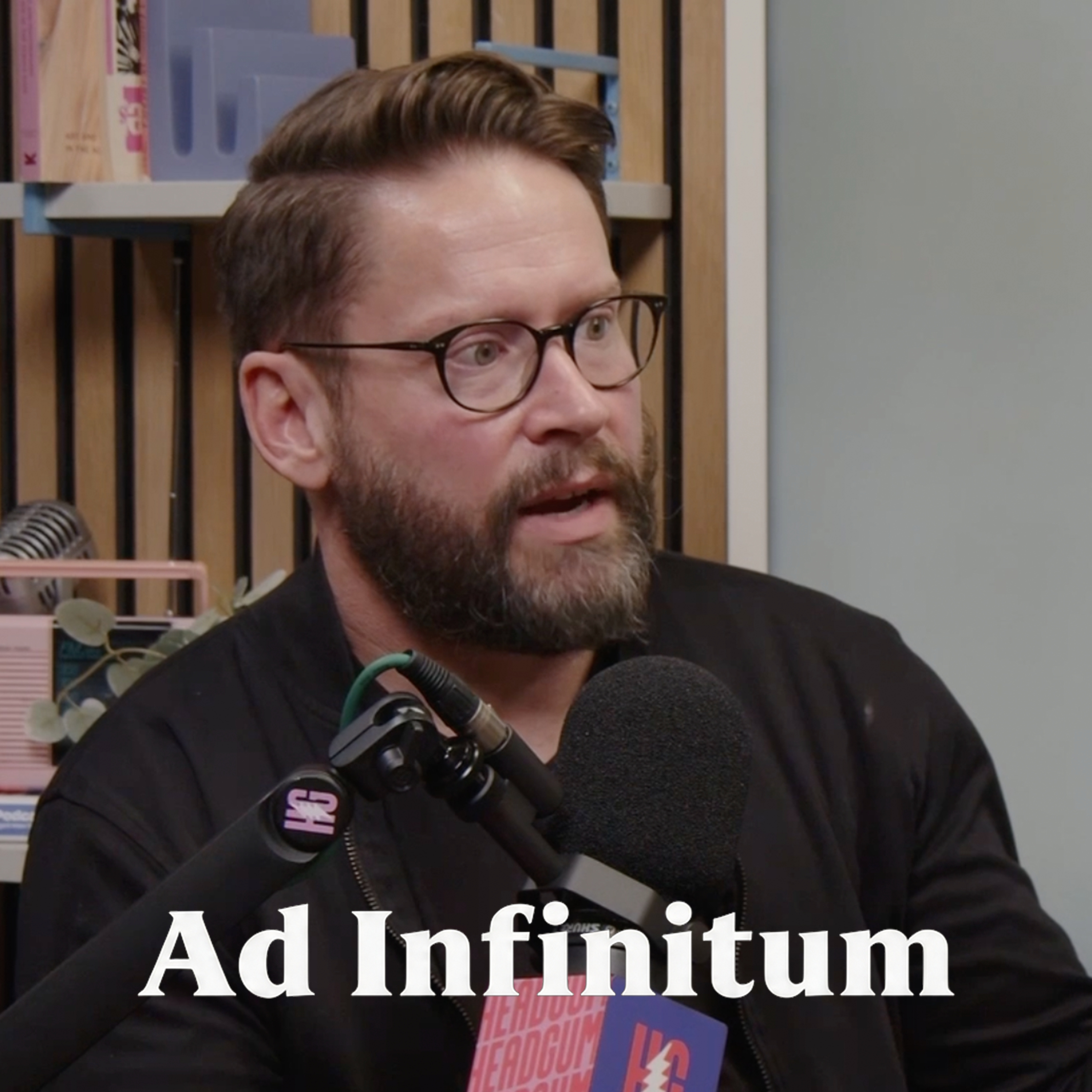
Ad Infinitum S4E01: Two Circles | Dallas Taylor on Podcasting, YouTube, and Creative Identity
About this episode
Ad Infinitum returns for Season 4, and for the first time, we’re on video.
To kick things off, I brought back the very first guest ever on the show: Dallas Taylor, host of Twenty Thousand Hertz, founder of Defacto Sound, and now creator of the fast-growing video channel DallasTaylor.mp3.
In this episode, Dallas shares the moment he almost quit podcasting entirely, and the simple insight that changed everything.
Two circles.
- One for podcast audiences.
- One for YouTube.
That realization led to a completely new way of thinking about media: podcasts, YouTube, TikTok, and Instagram working together as a discovery engine rather than competing formats.
Along the way we discuss:
• Why creators shouldn’t think of themselves as “podcasters” or “YouTubers”
• The psychology of creativity in the age of algorithms
• Why the audience sometimes comes last in the creative process
• How Dallas built a solo production workflow that unlocks impossible access
• Why vertical video and audio storytelling can coexist
• The difference between client work and self-expression
If you care about podcasting, creative work, or the future of media, this conversation is a masterclass in how the landscape is changing, and how creators can adapt without losing the craft.
Ad Infinitum is the podcast devoted to audio ads, the creatives who make them, the thinking behind them, and how to make them work better.
Hosted by Stew Redwine.
Ad Infinitum is Presented by Oxford Road and Produced by Angela Hunter, Caitlyn Spring, & Ezra Fox, written & hosted by Stew Redwine, and sound designed by John Mattaliano, with audio production by Zach Hahn.
Remember: have fun making the ads work.
Get every episode summarized
Each time Ad Infinitum publishes, we email you a written briefing from the transcript — the topics, who appeared, and any specific claims, with the ad reads skipped.
Email me new episodesFree for 3 shows. No card needed.
Hosts & guests
Transcript ready
786 searchable segments. Every word is indexed and playable.
Full transcript
Ad Infinitum — Ad Infinitum S4E01: Two Circles | Dallas Taylor on Podcasting, YouTube, and Creative Identity. Machine-transcribed; use the interactive transcript above to jump the player to any line.
This is ad infinitum. This is ad infinitum. The only podcast solely devoted to audio ads, how they work and how to make them work better. But things are changing. We're on video now, thanks to headgum studios. And I've got our first guest from the first season of ad infinitum, Dallas Taylor, post 20,000 hertz founder of de facto sound. And now Dallas Taylor dot MP3 here to be the first guest on ad infinitum as a video podcast welcome Dallas. Thank you. I want to be on every season. I brought my clicker for edit. That's how I single edits when I'm doing audio. Oh, but we're doing video. So this is a different animal. Okay, that's jarring. Has anyone ever done that on audio? You get? I've never done it. No. Make the cut. Cut it. Oh, gosh. Okay. It's because they can see it in the waveform. That's true. That's the main. The main dude that edits ad infinitum is this guy's a con. Yeah. And I think he told me about
it audio dot expert. And when you think you can just see where you want to do a cut in the waveform and they can go right to those cuts or maybe he's got AI that finds it. I don't know. Yeah. And I happen to get a dog right around the time I started ad infinitum. So I happened to use it with the dog too. Yeah. It's sonic branding. Okay. Yeah. You guys and you could go with that. Yeah. I'm sure to the dog at sonic branding. It's training to behavior. I'm doing something now. It's like when you hear a doctor pep baby. It's good and nice. So you were saying what you think is really at play with that is it's a sign of the times. Yeah. From an advertising standpoint. Right. It reminds me a lot of like Netflix taking YouTube shows like Mark Rober or to be bringing in like YouTube shows. I've been I'm in conversation with kind of more traditional media streamers about licensing my own videos already. And so that's
a huge trend coming in 2026. And I feel like that's kind of the advertising equivalent where if something blows up on TikTok or Instagram or something then the brand can latch onto that and enhance it. And it's like much more delightful and fun and human. And really the buzzword of the universe is authentic. Yeah. And then what was interesting. I was seeing stuff about it. It's Romeo is the young lady. And we'll play it. I have a theme song for Dr. Pepper and it goes like this. Dr. Peppa baby is good and nice. I want to get rid of that. Um, I know of Zach. So hey, Zach. Yeah. Yeah. You got a great domain name. And then his and photo. And this is what's cool because you and I have history. So our head of finance at the time was this guy Mark Piazza. This is a few years ago. And then he had his like nephew was getting into wanted to get into work and he wanted to do audio stuff. And you know
that goes. You've hired a lot of people. You've had a lot of people audition or whatever. And so my kind of way of looking at it is if someone makes one of those personal like connections. I'm like the doors that like go do your best. So he had this guy John Madeliano who I can't remember how John Madeliano is connected to Mark Piazza. And I was like, great. Well, here's Zach con. You know, may the force be with you. And now that's who edits out infinite him is actually John Madeliano with Zach on that's great. And he made it work. Like he he showed up. He apparently impressed Zach. And now he's doing this. What's up Zach? Yeah, exactly. You're killing it. Yeah, it's amazing. I mean, it's like that's something else that I'm seeing. We're hiring some junior people at the agency right now. And you know, it's just like it's like I mean, everybody has a shot. Everybody's got a shot, you know, I mean, when it comes to hiring, like how do you think of that when it comes to create the creative world? And seeing if somebody's got it or not, like how do you assess that?
So I do three things. I run de facto sound, which is my agency, the podcast, 20,000 hurts that's been around for nearly a decade. And then the new video de facto is really the heartbeat of everything. And I have a re I have the most strenuous hiring process on the planet. You're fired. Chief, the planetarium party. Oh, right. You're on fire. I need you to come here. I think of any creative agency anywhere because we I take it, I used to be a trumpet player in symphonies. Yes, I've heard the episode. And when you audition for wind band symphonies anything, you audition blot the judges have a big sheet. So it's a blind audition. It is purely talent-based. And so you walk out, there's a giant sheet and you perform or site read or whatever. So my entire hiring process is like that where we have this form that, so first of all, I only publish jobs on the podcast or any channels that I own because I want people to inherently know what
the spirit and the vibe is to begin with. That's interesting. I don't do. I generally don't go outside of that because it starts to kind of bring in people who have to really like learn hundreds of episodes. And so especially if somebody's going to work on the podcast, they need to know the podcast. It depends on the job. Like there are jobs that I don't put kind of exclusive barriers on. But if it is somebody who's touching the podcast, I do. Because and then there's like this, this form that I make that I'm trying to do everything in my power to get you to not hit submit because we have, when you have, when you're speaking to a large audience, you get thousands and thousands of resumes, right? We have a small team. And so I need the form itself to be very difficult to get through with lots of stops where it's just like, oh, you know, no worries. This isn't right for you, but let's be friends. It's complicated. Very complicated. And so when I look at this, your application is basically an escape room. Intentionally. And so you got to have a great reel. You got to have all these specific things.
So first of all, all the analytic show me around 6,000 people will start it and about a tenth of them will get through it. So that 600 get through it. 600 get through it. And sometimes it's been a thousand or more. So if you get through it, number one is that you have the blind audition. We don't look at names. We don't look at, you know, copy. We don't look at anything other than the link that you submit to you. That's real. So then we weed all of that down to say 50, 40 or 50. And then we start looking at philosophy. We just open up the answers. So again, not the names. We want no inherent bias in our hiring process. And so then it gets kind of, then we start to see their philosophy so that might go from 50 to 40 to 30, maybe 20. And then that's when we start to open up kind of more pieces. You go from 60 to 20. That's where you're listening to what they can do. That's usually like, usually my producer is taking it from kind of the 600 down to maybe 60. And then the internal sound team are now
judging those reels. They're starting to judge philosophy as a full team. Like, I don't pick anybody. It is like a full process that goes through my team before I'm presented with who they think the right candidate is. And so it's just this process of elimination and opening up pieces of it. And the very last thing that we even find out, we don't know what these people look like. We don't know what their genders are. We don't know anything until we're interviewing them. And so then that's just the final process. There's usually about 10. And usually I would say most of the time, it's still the person with the best reel because it's talent-based. It's like if you're going to be the principal trumpet player of the Chicago Symphony, it's just how good you play at the end of the day. And that's usually what it is. And then it's like kind of culture fit. Are we kind of speaking the same language? We're just kind of identifying, are you the right? Can you back up? Can you be presentable to clients? Can you also speak on top of this? And
if you're that good and you're beating out 6,000 people, then usually, you know, the person with the best reel wins. And if you think about it, that communicates something about that person when I can go with me on this. Sure. I think sometimes when it comes to the creative to the arts, right? Or commercial arts, whatever. Potential can look a lot different. You can see the potential for greatness or the potential, but to truly have achieved the ability to form a thing that has the click of a well-made box. A well-written poem has the click of a well-made box to all the internal work that had to have been done, to be able to then externally have the group be able to look at what you did and go, that's well-made. You're probably dealing with a disciplined person who's dealt with a lot of the character defects that can come along with creatives. So what I have seen is like, you'll see where
somebody's got potential. And you're like, man, they could. And it's kind of like, that's a danger spot because it's like, well, do you hire on potential or do you hire on? Oh no, I hire on proof. And the thing is, yeah, potential or proof? I kind of force it in a way where if somebody gets the job, their instinct is to go, thank you for offering this job. And I'm like, literally, it's not me. You pushed yourself through that. You were the one that rose to this. You created the conditions. I created the conditions. I didn't even put you in the final round. I wasn't, of course, at the very, very end, it's just like, okay, yes, the data makes this clear. But I kind of forward, I want everyone who even starts to work for me to know that they earned it. And it's not me saying giving them a chance. It's like, no, they beat 6,000 people to get to this spot. Yeah, it's not like you're giving them the chance to finally be first trumpet. It's a day have already shown they are first trumpet. Yeah, first trumpet doesn't go think the conductor. They earned it. Right. And that, that amount of empowerment when you start your job and knowing
that that's, that's what you beat out. And maybe it was somebody you might be the first, you may be, maybe your first year out of school. And you may have beat people with two decades of experience. It happens all the time. Well, it's funny because we're hired for a copyrighter right now. And that's where I'm at with the team is like, you're going through and like, whittling down. I'm like, you're going to send me one script. I'm going to read one script. That's it for each writer. Yeah. And that's it. That'll be that, that's their performance. You know what I'm saying? I mean, like, like, can you write? It's funny how like many things contempt prior to investigation, right? Is a bar against all knowledge. It's like, what's a radio script? It's talking points. And then it's shockingly difficult. It's kind of like NASCAR. They turn left. They turn left every, you know, it's like, dude, it's way more than it is. But if you find out, it's really complicated. So even just a radio, just a radio script. Well, when you define the definition of done, which is a Dan Martell book that I adore,
I'm sorry, what is this book called? Dan Martell's, oh, I tell everybody what to read it. And now I can't even remember what it is. I just think of him. Anyway, he talks about Dan Martell's book. Dan Martell's book. Bye back your time. Bye back your time. Great book. But he talks about definition of done. And when you explain what the definition of done is, right people will glean from that. Like when you say, I'm going to read one script from your perspective, you go, you have all the tools in the world to find this out. You can listen to any podcast. You can listen to any radio. You can chat GPT. You can do that too. But you can also listen to, you know, you can basically, I'm just saying you do. You could go to any one of those models and go, what makes a great radio? So you have everything that you can to get there. Yeah, or you can just listen to the top advertisers. What I love is that nobody can do that do put a put in a sound design reel with AI right now. You got to do the brute force work. That is the hardest part. I've been using 11 labs a lot. I've got a clone stew for music,
forget it. Just used it for a pitch where it's doing a full song with singing. Like we're, I'm going all in on this on the tool experimenting. I, experimenting for pitches and development is what I would say. But sound design is a one area where it's like, that's, that's tough, man, because you're like, there are specific sounds you want. But then there's also like emotional sound design or whatever. How getting the 11 labs to get with a, with a text prompt to get me the sound back that I want. And then you've got to mix those in. Like that's a difficult prospect. I mean, even like auto mixing, I can, I can, you know, with my expertise here, here, right through it. Now can the average year, maybe not. But I'm also playing at a very, very high level of people with, with brands and agencies and stuff with a very, very keen ear. And there's a, you know, AI can certainly play a role in tool sets and getting, getting us to the place faster. But it definitely cannot replace our creative. And anyway, we test stuff all the time. And it just isn't, isn't anywhere close, especially when you're getting the one out of 6,000
level of talent. So this is what I wanted to touch on. This actually relates to the Dr. Pepper baby is good and nice thing is Romeo took, in one way of looking at it, Romeo took a shortcut in that she puts out on the internet. Hey, here I've got an idea for a jingle for Dr. Pepper, Dr. Pepper baby is good and nice. Like I can't help from singing it. And boom, Dr. Pepper puts it in an ad. And I think of all the, and you've got to have this experience too, like all the pitches in the rationale and the research and still the thing, like sometimes I thought a great show would be all the ads we didn't make. Like all the best ideas that got killed at the last, like at the finish line. And here she got rocketed into the next level of existence. What do you think of that? Like she didn't have to go through any, like I think I actually have kind of an answer. Like she didn't have to go through any, there's no gatekeepers, there's no brief, there's no recess, it's just boom. So I'm on a lot of sonic branding calls or explain exploratory things where brands
will reach out. We want to do a sonic brand. What do you think? When I get into those meetings, I am not pitching them on how we do our process. I am asking all of the questions. I always treat it as I've got to understand this brand now. And if I don't have an idea after 30 minutes here, that just hits, then I'm not even the right fit for it. Or if like if there's just not clarity around there. And so what's great about the Dr. Pepper jingle is that you know someone just threw it out there. She had a great idea. It fits kind of on all levels. It it like just the the jingle, the good and nice. It's just like, that's what Dr. Pepper is. It's like, so you're almost just crowdsourcing this ability for anyone to just say like, I've got the idea to me. This is just incredibly obvious because usually sonic branding is very obvious to the person making it. If it's not obvious, it's hard. And that some of the best sonic brands out there when I've covered them. It has been when people just immediately go, I got it. This is it. And it becomes it.
And so she had the idea. It worked perfectly. Everyone saw it. They all like even, you know, TikTok itself just kind of grew on it sort of playing, you know, sub harmonies and different instruments to it. And everyone believed in it was like, oh, yeah, obviously this makes so much sense. And that's usually how sonic branding works. If I don't have an idea, I'm not just going to like force my way through it. I'm going to go go check with these other sonic branding companies. I don't have it yet. But if I have it, I'll go in all in on it. That's why my idea for blinds.com. We did a TV commercial. I was trying to get them all to say brlines.com. Oh, that makes sense. Thank you. I thought they didn't go with it. Um, no, that's a great idea. Hold on. Brlines.com. And then last night, ironically, I had the like the installation people and the customers saying like, you haven't heard of brlines.com. And it was, it was a fun day on it. So you don't want to do anything else that loosened the cast up. It like loosened everybody up because it's hard to do. It's actually for some people. That's really hard to do. Go like brlines.com.
So we're spending like, and then the actors are all laughing. So it's like, which is there's a right sonic brand? Well, there's a playfulness to sounds. And they delight us. And she did nail it. I also want to say this is like it, you were saying this without saying is with Romeo, it was the click of a well made box. Like she nailed it. She nailed it. And like, that's, I brought Rick Rubens, the creative act because he has so much in his book. And I've been working my way through this this year. My kids gave it to me last year. But now I'm actually reading it almost every morning. I'm also doing, have you heard the artist's way by Julia Cameron? I have not. Oh, it's awesome. So I'm doing the artist's way right now too. And she has you do this thing in the morning where you write three pages of just like free thinking like every morning. And it's one of the best disciplines I've tried where it's like, it's just this dump that you get all that you get. She talks about it this way. And I have, I've experienced this way too. It's like, you're getting the inner critic out
of the way. You know what I mean? But anyway, to get back to Ruben is like, he makes a lot of space for there's a long way to good work. There's a short way to good work. There's many ways to good work. But good work is good work. And I think that's the real thing that's hard to articulate with the Romeo thing is like it, it was, it's, it's, it's good on the face of it. It's good. It works. And then there's, and then there's all the reasons you're saying that like, you know, social media loved it. Dr. Pepper's now in this, this place to go, do we run with it or do we not? Then they're getting thrown shade that they're not working with her in the background. Little did any of the critics know because the internet just, you know, just catches fire. They were working with her, but they're not talking about it because they want, you know, they release it. They need the shade too. That's just all publicity. It's all good for them. Well, there you go. And then like you said, you've got other brands going like, wait, we, you know, sign us up. We're next. And like, who knows? This, this could be one of those cool advertising stories where this is how this, you know,
this lady becomes the next like great sonic branding agency or whatever. Because she just, she's doing it from the heart. I think like sound people have gate kept this whole industry for way too long. And my whole vibe is everyone is into sound. If, I mean, if you need to, if you have, you know, the gift of here, if you have the sense of hearing, correct. Then that is something you can have an opinion on just as much as your paint colors, just as much as the food ingredients that you choose sound is right there. So for her to come up and go, Hey, I've got the jingle right here. Boom. Makes me go like, yeah, that's, that's what it's about. Like I want quote unquote normal people to own sound. And it does match like Dr. Pepper and Dr. Pepper drinkers. Like that does like feel like Dr. Pepper makes me think, okay, if I want to Dr. Pepper, it's like, I'm just chillin and just hanging and just enjoying like a moment. And it's sort of interesting. How do I thought about it this way? But it's also sort of an answer to like energy drinks and how it's
saying like, yeah, energy is like monster or whatever, or even like what liquid death like Dr. Pepper is like, yeah, it's got some caffeine in it. It's got funny tastes like just with Dr. ordered, you know, it's just good and nice. Do do. Yeah, that's what it is. Yeah, it is what it is. Okay, so let's do a little reflection here from the create. And then we'll get into the two circles. There's a circle on the cover of this book. I also, there's a quote from that book that I live by constantly, even in what I do now. Yes, page number, please. Do you know the page number, but I should. He should have Rick Rubin should have done this in chapters and verses for the creators. Yeah, for the way that people talk about this, it absolutely should have like it like, yeah, it's in, you know, habits chapter one, verse 33. Oh, for sure. Yeah, yeah, the way people talk about it, what's the quote? It's the audience comes last. Yes, who comes first? yourself. Yes, the artist. Like what you're making for yourself comes first. Like you, he,
there's no regard for the audience. And that's the way I think about what I make. Well, I love the audience. Don't get me wrong. And I'm glad that they enjoy it. But it is, it plays no bearing in how I make or create things generally. And when I do get stuck into that mindset, I usually don't make my best work. 100% there's a whole dimension of that I want to talk about when it comes to making work for others. But let's talk about in the beginning, create an environment where you're free to express what you're afraid to express. Now, that's like 20,000 hurts. I think of that. That's you Dallas Taylor wanted to do a show about the world's most interesting sounds. And then you're doing Dallas Taylor dot MP3 on YouTube. We'll talk about that. And we're going to talk about all that. To me, I view that more as self expression. But when you're doing de facto sound, and I don't know what's the last automotive company you worked with? Alpha Romeo. Okay, great.
So when you're thinking of doing work for Alpha Romeo, this is where does self expression come out in that, right? You're being commissioned to make art. So a lot of the Rick Rubens stuff. I think it does apply to commercial art. And then maybe I don't even have commercial arts right to client work. That's that's the phrase I'm working for. It applies like you need to sharpen your craft. But at the end of the day, Alpha Romeo is paying you to do the thing. So don't you have to check some of that self expression at the door. And I'll kind of I guess I'll lead with a bit of my answer is that like I have found that when I do create the places in my life to self express and have my own stuff, I'm able to take my learn what I've learned about my craft and how to make a thing and make a box that clicks well and bring it over here to client work. But it's different with client work. Client work I can't it's not first and foremost my expression. Do you view it that way? Absolutely. I believe that client work is a service to them. Similarly to being an attorney for someone.
I can see them outside of themselves and help to translate how I believe they're trying to communicate or taking what they feel and about themselves and communicating that through sound. So I'm more like an advisor to get their voice out. I'm able to analyze what they're trying to do and then use what we do in our expertise to be able to communicate that. It's not my expression. It's a it's how I interpret how they want to be heard. And all the hours you've put in in your workshop working on your thing all those tricks of the trade you've picked up. You've been able to apply in service of their objective. Yeah. And I would even say similarly even if it is some sort of large campaign where they want to sell stuff. I still don't think of the audience first in that. I still think of the voice of the brand first. It's expression because they're they don't have the no brand really has the ability unless they have a robust internal team that's building the
actual UI and their devices or something to communicate its actual voice. They have to rely on experts and the best experts in the field are generally people who are independent and work with lots of them. But they rely on them to project their voice in whatever way it is visually, sonically, musically, or anything. And so it is kind of like getting the Johnny Cochrane of sound and going, okay, you can do magic here, like make a sound great and speak on my behalf. And that's that's kind of more of what it is is like I'm trying to build their voice something that's distinct that feels like them to where the audience kind of latches on and goes up. That's that feels like alpha Romeo or something. Yeah, and often because we're outs or it can be if we're doing our job right, we're on the outside looking and we're creating a mirror, you know, we're a mirror, we're able to see the back of their head like when you get your haircut, like, you know, you've got to use the mirror, we're able to help them get that view on themselves and help them be honest,
which I think is like the most possibly the most important thing ever is just being honest with it and bringing it to life. And in that sense, it's the expression of the brand is what you're saying. The self expression is expressing their brand. The best thing I've ever done to understand how to service brands is to hire designers to express my brands like I didn't design my podcast logo. I hired a branding designer to I didn't design the de facto sound logo and brand standards. I hired a designer to do it. So to see it from my perspective, hiring these visual designers, it made me more it made it more clear of how I do that and my team does that for brands in every piece that we that we work on, whether it's mixing or sound design or sonic branding. Yeah, so it's so that dynamic is so wild because you know, I love Dan Carlin hardcore history, his podcast, and he talks about this period in Roman history where there was five good emperors. And I think of it as like management styles. And I can't there's two that are at the
the extremes. One of them's Hadrian, the other one I can't remember. But the point is that Hadrian who built Hadrian's wall that's up in England that allegedly if you were under Hadrian and let's say you're the governor of Spain, he would go, I'm having a problem over here. Go cool. I'll be there in three weeks. Have a long take it to get there. And then the other one, he would go, oh, that's crazy. You're having a problem in Spain. Well, let me know how it turns out. And what I found is a creative hiring other creatives is I'm more like that. And I find I think I'm treating him the way I want to be treated where it's like I give him the goals. I give him the like John who's editing this is like he adds in sound effects and all this up. But I don't like micromanages that like he's proven he's got the talent. We know what the objective is. And then like let him run with it. Let him do their thing. Where do you net out on that? It depends. I trust when we I'm of the mindset is usually what my company does is a lot of sound design, mixing finishing, making things sound pristine. And I'm general, I generally communicate to clients that we're going
to give you options. Our V1 is not how we see it. Our V1 is to give you options to play with. Here's all the colors we can play with. So in other words, in our world, we're going to intentionally kind of over sound design a bit on V1 to where you have colors and you go, whoa, okay, these are brand new colors I couldn't see before. Ooh, I like that. Oh, wow, that influences how I want to like where I want to put the voice or where how I want the music. You know, why don't we drop the violin in this because something cool is happening over here. And so I don't I try to encourage clients to be like, you know, here's here's a color palette. Now let's start to go from that. Now there are certain situations where we just need to bang and you know, bang it through, get it out. Like it needs to air tonight. So we need to do the final version. We have spreadsheets of every producer and every single client that we work with and their preferences. So we know how to nail that if needed. But if it's something that has a little bit of time, we're going to we're an important part, real important part of that. Like we're going to give them lots of colors to play with.
Yeah, I think I'm similar. It's like I like to I remember we did these like we did a handful of TV spots or net suite. And I for me and my career has been there's a phrase that I hear that early on I heard and I'd get defensive. And as I've been in my career longer now, I go I know I'm on the right track because I've continued to get rewarded. And that phrase is I've never seen anybody do that before. So I've never so with TV production, like I took the whole crew like the keys, like the DP, the director, myself, I think that one I was directing the producer AD production designer. And like we didn't even have full boards and scripts yet. But we knew where we're going to be filming in Austin and they're like, well, I've never seen somebody do it this way before. But I'm saying all this is like, I like to bring in people super early, almost like it's a garage band. And it's like, well, I've got some ideas for like we just pitched a client on some TV actually I'm seeing TV coming back or video. And it's like I like to like it kind of
like what you're saying where it's like it's we're kind of broad at the beginning to figure out you know, where is this thing going to go? And then even the next like it's like we pitched like they loved the strategy. But we pitched like three or four different concepts and none of them landed. And it's like great. That's actually great feedback. Because there's four different things that you go, okay, none of those worked. Then you're able to adjust, which is kind of what I hear you saying. Like do you like, do you like that is what like start and broad and narrowing down in? There's nothing more powerful than like a incredible creative being able to contribute. And I work with different, you know, kind of different types of leaders, creative directors, some that really kind of see themselves as the end all be all of everything and everything else is just kind of like the people who are mopping and doing, you know, or like the day workers a little for them. Yeah, there are people like that. But then there's also people who are experts.
It's like when you travel or when your world view gets larger, you start to realize that there's even more that you don't know. The more you learn, the more you realize you don't know. And so the greatest leaders and the great and creative are the people who go, okay, here's the vision. Here's what I'm thinking. But I need, but everyone in the room has an opinion. I remember I went recently and filmed behind the scenes of the Apple TV show, Pluribus on the mix stage. Everybody says, you know, the others are kind of in sync. But we realized if they were too synchronized, it almost sounded robotic. And they were talking about Vince Gilligan, the director. He did Breaking Bad, Better Call Saul, iconic, one of the most brilliant minds. They were talking about the way that he works is that everyone has a voice. If someone walks in with coffee and and kind of go, oh, like he'll be like, oh, no, no, tell me. What do you think about this? Like there is no separation between quote unquote the lowest and the highest. He wants to hear everyone's feedback no matter what.
And that's where you get brilliance. That's why Vince, I mean, he's brilliant to begin with. But he's brilliant because he's always taking taking an input from other people no matter who they are. And I think those are those are the ones that just rise to the top. And especially moving ahead in the next five, 10 years as AI can kind of mimic better and better and better. I still, I mean, you know, this is a large language. This is a model based off of what has come. But to push things forward, it has to be the best of human creativity. That leads that. You can certainly use the tools, but that's going to be the stuff that rises to the top. I think that I hear doom and gloom on the internet all the time of just like, you can do everything with this. And I'm like, you can, but it's all going to be noise. And it's all going to, like, it's all going to fade into the sameness of the world. But if you're going to do something great, you can kind use it. I use it kind of as a strategist in my pocket. And I go, I didn't think of it that way. What do you think? Oh, you know, this, this, and it kind of puts me in a new human creative space.
But then you kind of expand that into the team that you're working with. And I don't know, it's also like we crave human connection. And it's also just fun to work with humans and hang out with people and get their feedback and let's see it. And what does it hurt to be like, give me your best of your vision on this. It doesn't hurt anything to be like, okay, oh, I didn't think about that. You know, why don't we keep this, this, and this, lose, this, this, and this. Here's why strategy. Because the more, again, the more you even kind of know about your holistic strategy, the more you see other people and see it for how they see it, the more you start to define your strategy. Like you can kind of have, like even now in my videos or the things that I'm doing, I'm still learning 30, 40, 50 videos in what my rules are. And every single one, I'm going, oh, yeah, that doesn't make sense anymore because of this. So yeah, other people's brains are very important. Yeah, I think so too. And that that has been my approach. Like I, that's it, you, you, you exactly described it. It's like I just flashed back to that like
net sweeten in Austin. It's like, I know we're doing a spot about net sweet that the cova's uses net sweet. We're going to be at this store. All the keys are here. It's like, let's go, you know, well, what's the script? Well, I don't really have it yet, but what do you guys think? It's based on that. You know, you might have, you guys might have, because we did a, I bet you did all the mixes and stuff. Yeah. I don't know if it was with you or with somebody else. Well, it's cool. This is awesome. I mean, they do a ton. That guy's awesome. Gosh, I wonder if we worked with you on that or somebody else. To covus is awesome. Yeah. Yes. That's awesome. And it's funny. This relates back to Romeo again with Dr. Pepper Baby. It's good. Nice. Like that idea came from anywhere and reminds me of, and then I want to get into our story about, you know, us and where you're going from audio to video. But we do a big summit every summer where we have a bunch of marketers come out and we talk about what we see is going on in the industry and what's next. And we get to have celebrity guests come out. It's pretty cool. And a couple of years ago, we had Dana Carvey and he said something that really stuck with me and it makes me think of this,
you know, this whole Romeo thing with the Dr. Pepper jingle is he's like, man, for me to get on SNL. We are in this little group. There's like, I don't know, maybe 50 of us who is at the Roosevelt Hotel in Hollywood down in this little space. It's very cool. Very intimate. He's like, for me to get on SNL, he's like, he went through all the steps it took for him to get on SNL. And he's like, this is cool. He's like, I'm doing a podcast now. He's like, now any of you can put your work like, like, I got an SNL and then I was in front of millions of people. Okay. And I had to do all of this to get in front of millions of people. He goes, you can be in front of millions of people tonight. And that's like, I think that's so cool. And I mean, I get maybe it's obvious, but that's what Romeo did, right? There's nothing had to gatekeeper. The only thing was the work and the work went through. And then the place where in my mind, it goes to his man, like, all the work that hasn't gotten made. Well, it's because we're an environment where it's gatecapped. Yeah. So that's that's the game. She's in an environment.
It's not gatecapped. And it was sort of Dana Carve like saying to everybody in the room, like, go forth and conquer. Like you can be on your own SNL tonight. And if it's, if it's good, it'll be rewarded. Do you believe that? Oh, for sure. Yeah. I mean, I grew up. See, I fundamentally believe that too. I think some people are cynical. And they're like, my work's really good, but nobody can see it. I'm like, no, I, I, I fundamentally believe in the fund in the invisible hand of the market. And that good work is rewarded. Yeah. And you do, you do as well. Yeah. I think that as long as you're defining what success looks like, like I, I don't think of quantity as my end goal. Okay. My, I think of quality as my end goal. That's obvious. I would rather have 100,000 very smart, thoughtful people who consume what I'm doing. Then I, I consider what you're doing. So I'm a thoughtful, smart person. You are. Okay. I would hope so. Then a million or a couple million of just kind of general audience. And,
and also, it's like what I'm doing, I can't, it just doesn't lean into that anyway. I just, again, audience comes last. I'm much more focused on what I'm doing is very selfish in a way. To give you a little, I'll give you a little bit of an update, just to where everyone is on the same page. So I'm a sound designer. I worked here in LA at NBC Fox, went to the East Coast, worked at Discovery Channel. All as a sound designer mixer started my agency de facto sound about 10 years ago, works, work a lot with on TV shows and reality and advertising, promos, trailers, all of that. Nowadays, fast forward 10 years, we mix hundreds, if not thousands of trailers, for like Netflix, HBO, car spots, advertising, movies, when my director friends have movies, documentaries, all kinds of stuff. And 10 years ago, started a podcast that was really exploring all of these stories that we hear within the audio community that had never really been told
to a large audience. And that's what I wanted to do was make a podcast about sound that is like a museum of sound, only through sound, that sense, and something that could be this long-living archive for the rest of time that people could dip back into at any moment. Every single episode is evergreen. And, but it's literally following my passions. Like, I greenlight things that I am interested in because, you know, so when I when I lean into it is a selfish endeavor because it's like, I want to know about that thing. So therefore, I lean into it. So started that, started a, you know, did that for nine years and then started going, gosh, the audience is in a, is just if I want to reach people with this kind of good news of sound. Yes, good news. I have to be on the super highways of where they are. And one super highway is podcasting. Other super highways are, you know, you can look around, you can walk outside right now and pick five people who are
all looking at their phones. And yes, you can see that that's where the people where they are. And where they where they are. And I started looking through all the data and I was like, okay, um, what are the monthly active users on, uh, on these different platforms? Hold on. This is where I want to take over the story. Okay. Tell us. Yeah. So you came into the office to meet with me in James and Grazia, the head of strategy. Mm-hmm. About a year ago. About a year ago. And you said, did you know the total size of the LinkedIn audience is what was it? Was it 700 million? I think at the time, it's larger now. Yeah. Okay. So I was like, what is he talking about? You're like, does it? And then you took out, then you grabbed a note pad, which we gave you at the end of the time. You were allowed to keep the pad. Thank you. Yes. Yeah. No problem. You can keep the pad. And you drew two. All you did was like, and you took your time doing it too, but you like drew two circles. You drew a big circle. This is horrible. Yeah. You drew
a big circle. And you drew a little circle. I think that big circle, a little circle. And you're like, this is the podcast audience. This is the YouTube audience. And you're having a moment thinking about that. Yeah. I, it struck me. I've now drawn those circles for lots of people. Well, this circle can't, may I do all my circles? I want more circles. Yes. All right. Hopefully we know. Now we're talking. Okay. All right. So this is where I'm going to start. Okay. So you've got what you see before you set blank piece of paper. Now, these numbers are approximate. I'm not going to chat GPT, but I did look this up recently. All right. Monthly active users on a podcast is about that big. Let's call that 500 million monthly active listeners to a podcast worldwide. I'll co-sign that. Roughly. Now, how many of those 500,000 are listening to 500 million? Oh, yeah, 500 million. Thank you. No problem. How many of those 500 million are listening to conversational,
maybe Joe Rogan comedy. I guess, you know, good hang. Yeah. Sure. A podcast podcast. Yeah. How many of that that of the 500 million? 300 million. 300 million. So then now our. Wait, are you fact checking me? No, let's just say it. We're going to go with it. So now there's my, you know, 200 million. Now, do you actually believe that there's 200 million people listening to high quality narrative podcast? No, no, no, no, no. Okay. So we're going to put that radio large. No, that's 20 million people. 20 million people. 20 million people total who are even interested in what I do. That sounds right to you, right? I think that's right. Yeah. I mean, maybe if I if I asked I were glass, I'd be like, do you have 20 million listeners? I don't think that they do. No, but I'm dividing them out like if you're to spread it out. I'm thinking of NPR, whatever, like, yeah, whatever. Let's call it 20 million. And we're probably high. And what probably is probably less than 10. So we have maybe about this many people we can reach in high quality or like high narrative podcasting, right? And then out of the 500 million that are right here.
Interesting. And a month. And then you've got linked in, which is almost double that at like 900 million linked in, which is hilarious. Yeah. Like more, you know, almost double the amount of people on LinkedIn. And now that's that's more business and kind of with what I do is I'm showcasing people and their craft. So that pie can be a lot bigger for how I actually communicate what I'm doing to people because it's already internationally built into the job that these people are doing. Yeah. Yeah. Yeah. So you've got that. And then let's go with, you know, let's go with TikTok, which I believe is like 1.7 billion. So if we're here, now we're about like this. So there's there's TikTok. That circles bigger, Dallas. That is. And the thing is is these two are now algorithmic. So you can now play into things here and use the algorithms to find people. Whereas here, this is all buy-in. Like this is this little 20 million is just somebody said, Hey, you should check out this podcast. And hopefully you still listen because it's not being served to anyone.
No, like if I do a podcast on wicked, no one who's into wicked finds it. Generally, unless Spotify decides to give it some juice or or or kind of believe it. That's a whole that's one of the big hamps is discoverability. So there's no discoverability, right? These two can be discovered by anyone already. So we're already at like 1.6, you know, two billion people here on TikTok that, you know, I could put a one minute reel out and get 3 million views like in a week. Is that are those numbers you're seeing right now? Sometimes. Yeah. Okay. So then we move on to YouTube. Yeah. Which is which is kind of long for it. I can I can hold it like it's a let's say chalkboard on. Okay. So we got. Okay. So we got this is like the Glenn Bleck show. I need to get a chalkboard. Okay. So this is two. YouTube is is nearly three billion. So there's there's YouTube. Now that is long form, but it's also YouTube shorts and all that. I this is not my this is not my brand is doing charts. So this is weird. No, this is good though. I like it. Again, I'm making use of video. And then we've got the center of the universe. Uh-huh. Which is which is a little bit bigger than
YouTube as of right now. If they could flip flop, which is Instagram. And so this is the potential that I have only, you know, if my if my mission is to get people and the general public into sound and owning it, does this look like the right strategy? Like for me, just to stay right there and only reach those people who are podcast listeners, because I don't like another. This is Instagram. Yeah. This is YouTube. What's interesting is the shape that it's taking is, um, I don't know if this is like you could get into this, but it does sort of look like it's the eye on the front of this beast. Now is it still pointing you in the right direction? Yes. Okay. Now you can also look at this in a different way. This is a funnel. Like if we do this, there we go. Like this is a fine ball. Yeah, it's actually a drain. So this is this is also, you know, you can talk about sales funnels or or being able to go deeper and deeper and deeper. I'd even say the deep, the deepest point of my funnel here is the fact of sound. Like what I do, that's how I actually, it's all actually driving to the
facto. In a way, that's the financial engine. Now, no, not everyone has to, yeah, it's a funnel. So it's, it's basically like this gigantic funnel, at least to be able to pay for it. So you were like, I need to be showing up in Instagram and you, when you drew the two circles for us, it was you two, oh, I got something on the other page. Well, this is what I've, I've realized over the past year, um, can you talk about a year ago? It was existential, wasn't it? I said that I was going to quit the podcast. Right. I mean, that's what you're coming to talk to us about. I couldn't figure out how to make the podcast work with all of this. You thought you had to put it all here. I thought I had to stop this to do this. Now through lots of, um, you know, long sleepless nights, literally, I was able to figure out a workflow that made all of it work all at the same time. So can you unpack that for the listeners, both the creators and the marketers that are listening, like you, the other two circles, I think of if I could use the chart, I've got two circles too. You got two more? I've got two more circles that have relate to this. Did I skip ahead? Oh, no, no, I flipped ahead and now let's get into the two
circles. So the two of these two circles, this is my two circles. This is the inner voice here. We've got psychological and practical, like how I was actually going to, we're going down there. Yeah. So how I had to psychologically reconcile this and how I practically reconciled this. So this is my workflow. This is my mindset. Okay. He ready for this. Which one do you first? Mindset. Is it intentionally a diagram? Are we going to get something in the middle or you just happen to do it? It has to work together. I don't know. I'm making this up as I go along. I kind of like it. I feel like though it needs like. Okay. Mindset. Mindset and workflow. Yeah. But I didn't figure out this until I figured out the workflow. I'm guessing in the middle is that. Okay. So mindset. Okay. So no, I'll start with workflow. I was like, how can I do all of this stuff? Because it was actually the workflow that changed my mindset. I run and wait, but hold on, before you can even get to the workflow question, you first have to, you were trying to work the problem,
can I do both? Can I do both? Yeah. So workflow is the answer to how I would do both? Workflow was the key. Okay. So now let's unpack that. Okay. So the workflow. Workflow is something I think about a lot. I build a lot of playbooks and how we start. What process do we take on every project? I attended your workflow talk at podcast movement. I really should do more of this. I think those are like some of the best talks. So I sat for months figuring out like how do what camera do I use? What mics do I use? How do I shoot? What are what's happening for that to to kind of build something? And so what I decided was I wanted to shoot on an action camera. Something that for my for what I do in YouTube is I go into these like impossible get places. Like for example, I was embedded in at the season 50 finale for two days at SNLs with their audio team. These are impossible gets. Right. Full tour of the wicked on Broadway going inside Walt Disney Imagineering. Now first of all, I leverage the podcast because they all had the opera house.
Sydney Opera House. Bluey. There's tons of stuff. Right. And every one of them for the most part is just like what in the world? Like how did you even get into that? Well, first of all, I leverage the podcast because everyone in the industry knows the podcast and trust the podcast. So that was my access in at least the the the trust. Secondly, I was like, well, how do I do it? Because if I go in there with a big camera and a crew, no one's going to let me an audio person, you know, a camera person all in, it's going to get too big too quickly. And it's too much of a production. It's too it's too disruptive. It's too much of a production. So it had to be me solo. I have to run everything solo. And so I went, okay, an action cam on a stick. I have it right over there. An action camera on a stick with two mics that that that are DJI microphones that feed right to it where it never drops. It's like proprietary and built right in. And at a moment, notice I can just hit record and go. And so I just walk in with just like a tiny little bag and me. It's not threatening or anything.
So I needed to get past the psychology. How do I even like get into these places without it being a big, big like production? And that's how I did it. It's just my micro size everything. So you're you've used psychology twice now. So I'm not in psychology psychology for the for the you're saying resistance on their part resistance on their part that they're going. Yeah, because as soon as you'd go, it's me plus a camera guy and a sound guy and I need to either DSLR and security and yeah, it's even if I had a bigger DSLR camera, they're going to be like that's just, oh, there's a production here. But when I walk in with an action camera that looks good and out. You've demoed it for when we had this conference, the two circles conversation at Oxford Road, you even you had your little camera. Yeah. You had one with you that you were holding with your hand. Yes. Just to show me, I can see you work, you were starting to solve like you were working the solution. Yeah. So I have a gosh, I'm almost tempted to pull it out, but I won't. So okay, so I have that psychology. Psychologically, if I go into these big legacy places that have cameras that are this big, and I'm in there with a camera this big, everyone goes, oh, that's
that's just the that's just digital. That's just the YouTube. No one's going to watch that even though. And they don't wear his with me. Yeah, it's very and also when I when I write sound people who've been doing a job for 20, 30 years, and I want to come in there and feature them, what producer wants to say no to that? Like they've been quietly busting their tail, making this show sound great for 20, 30, 40 years. Who's going to say, oh, no, the guy who features audio people, you can't have that person come in. Yeah. And it's and it's sort of the silver lining of audio being an afterthought. Exactly. Nobody cares until it hits the internet. People care. Yeah. Has that happened? Yeah. I mean, some of the stuff that I've done has like blown up on the internet. Well, but not you I was taking that as like somebody got in trouble. There's been little little things where it's where it was bigger than they've watched bigger than what they thought. They were not trying to like pull one over on anyone, but I just think that I can play the people don't think people that normal people care about sound car. That's what I was saying. Yes. And so I'm
able to get amazing stuff that I know is amazing and we'll blow up on the internet. And it does right because I already know where the good stories are. Anyway, so there's that. So that was workflow. So that was workflow. A little bit more in workflow is how do you reconcile podcast and social media. So I shoot in four by three, six to four K. So basically, how do I reconcile 16 by nine YouTube with vertical knowing I want to do video knowing I want to do video. I can't just do YouTube. I've got a focus on vertical. Well, first of all, action cameras are super wide angle. And that's what I want because I want you to be able to see all of the site that you never get. Yeah. Did you ever stage? I would have that. Well, how do I retain that wide angle on on vertical? Well, I use the action Osmo five from DJI. It gives you the ability to do four K and four by three. So taller and it gives you headroom and footroom and four K. Great. When you throw it into YouTube, you crop it down. Perfect. But when you then we edit our video, but when we go to social, we're able to open it
back up the foot and the head and then crop it in. So you now have the still wide angle. So now we can still preserve that same look, but for short form. So there's that. So you solve that piece. Yeah. Check. I've also discovered that when I'm out in the field, there's a there's a clear difference between what works for the podcast and what works for YouTube. When when I'm following someone around and they're giving me a tour and the inherently people know without having to think about it, that the audience can see what they're doing. So they speak in a completely different way. However, if we go kind of off into a corner and he's like, oh, let me tell you about this time that I had this, you know, the famous person walked in and like the board broke and yada, yada, yada. And then we just sit there and talk for 20 minutes the whole time. I'm just parked because I'm like, this is going to the podcast. This is full podcast material. Like if we just sit and talk, it's going to the pod like the audio only podcast. So there's so when I shoot these things, usually I might, depending on now, if I go in there and I shoot for 45 minutes, it's usually
just going to be a YouTube and social exclusive. But if I go in there and I talk to somebody for maybe an hour and a half, that's when half of that, we're just sitting there talking, we're doing the fire, you know, the around the fire type of chat. It's just I'm capturing audio. I'm capturing video, but I'm going the whole time I'm like, this is the this is the the audio version. And I think this is where a lot of people kind of are missing where how video and podcasting can work coherently as complimentary to each other and not literally the exact same thing. I will complain a little bit because the one ambi that I wanted to be nominated for, which we put in for was best use of video, but we didn't get it. Not even nominated, not even nominated. And when I checked out the nominees, good, good on all of you. But it's like, it's like, it was more like best use of people sitting down with a with a microphone in their face and it looks like a video podcast. But what I'm doing is so far beyond that. Like I'm like capturing two simultaneously, simultaneously simultaneous things that hold hands and expand on each other, where one side goes
audio, one side goes video, but they're not literally the exact same thing. That's what I want to sorry, you didn't get nominated. I'm bummed about it. You're not going to be able to add to the already existing awards on the shelf. It's not about the ambi. It just made me realize that people are still thinking very binary about what a video podcast is. This is where I get to the mindset part. Yeah, that's what I wanted. Great. That's what I wanted to go to mindset here. I realized I had to realize like, I am not a podcaster. That boxed me in. I am not a I'm not a pot. I've never since the beginning of 20,000 Hertz ever identified myself as a podcaster. I've never I've never like told someone, you know, oh, I'm Dallas. And I'm a podcaster. I don't find my identity in being a podcaster. I never have. I'm not a fighter. I've never claimed to be a fighter. What do you think about that? You're an award winning non podcaster. Not a podcast. I don't think about I've never actually it doesn't surprise me. Yeah, because I don't think of you as one either.
It's funny. I had somebody say this to me about a director. I can't remember who they were working with, but it doesn't really matter. Their point was she was saying he's an artist and a director. Yeah. And like you, I view you as like you're an artist. And you make a podcast. That's exactly right. Right. That's the identity where when someone identifies as it, that even is what causes a lot of the churn in the dialogue is they've identified it's like, I'm a biker. I'm a podcaster. And then it's a new spread my gang. And get locked into our identities and even by now that codified language around it. Yeah, it's like, and it's so one of the reasons I bring up the ambies, great people over there. But I'm like, how did you fundamentally miss like that this is like, and I don't mean to my own horn here, but like, this is thinking in a completely new way without any inherent bias of what a podcast is what video is. I'll make a case, maybe they're defending the old model. And I think it's also validation that you're actually
going in the right direction ahead of the curve. Yeah. By not outside the over to the window. Yes. I feel the same way. I when I when I approached the team, because I was like, oh, we're I feel very confident about this one. We got we got nominated for best entertainment podcast, which is awesome. And I'm thankful for it. But that's not what I was going for. I was going, I wanted to make a statement with the audio person, the audio expert who's doing the audio podcast to then come in as being nominated for best use of video. I was trying to make a statement to go, Hey, everyone, the way that you're even thinking about video podcasts is fundamentally flawed in your legacy old person thinking. And so you're that's your mindset. That's my mindset. What is your mindset in brief? Because we got some other stuff we got to cover. My mindset is I do not put my identity in being a podcaster. I do not put my identity in being a YouTuber, Instagram or whatever. I don't care about YouTube. I don't care fundamentally about TikTok. I don't care fundamentally about Instagram. These are merely highways to reach people. And if something else came up, I would use that highway to do it. I'm a I'm I see myself more of just like I'm all I've
always been a sound designer. Like I've been somebody who wanted to craft and create and celebrate sound. Then I use the tools around me to to tell everybody about how cool this is. I don't really have any emotional or identity in the tools. That's why I don't say I'm a podcaster. It's like saying like I'm a megaphone creator or something where I where I you know post my podcast or I'm an Apple podcast creator. Now that's like such a small way of thinking. And I believe we're going into a world now that all of the experts and all of the you know, even kind of older creators are now coming in going. This is a viable place to reach people. And so this is there's a huge shift happening from kind of the people who had the time to talk about this to the experts coming in now and using their expertise to really blast kind of in these different different lanes. So for me, it's these are all just like highways to tell people how cool sound is. Yeah, and we've seen this before, right? When the movies came out, everybody that was in theater, which was a much larger industry, was like, that's low rent. I remember YouTube, I don't know, 15 years ago, there's a
producer that you and I both know that he's like YouTube's the gutter of the internet. And it's just funny, you know, you just put up a whole wall. Well, at that time, it was fine, whatever. But but now it's like it is a what the other thing I think you've done is because your identity is not in it, like I've seen like and I know you, I mean, we've known each other a long time. I kind of view you as a guy who probably would be happy to be in the lab with a pen and a pad, you know, making some nice sounds and all that, not necessarily somebody who wants to make a clown face on a thumbnail for YouTube. Yes. And you're you're doing it. You're doing what has to be done. You know, like are you holding your nose when you do that? Or is it that you're the more actually what I really think is you're smart. And you're like, that's the way that game is one. And without compromising any of your standards, I'm sure you're not. Yeah, well, if I gotta go on make a thumbnail, me going, well, I don't go that far. It looks like it to me. But um, but you know what I'm saying.
So what I'm saying is you have been you have you you did learn how to make it work in that channel. Yeah. So I will say that, um, I think what you're there's this aspect of cringe. Yes, that's what I'm getting care about it all. Like I'm way too old. Like I'm I'm a husband, I'm a father, I'm an expert. I don't the whether or not someone else interprets a thing that I'm doing to be able to blast this as far as I possibly can as cringe has no bearing on the way at whether I do it or not. I don't feel okay, but hang on. Stop because you also make good. You also have such high standards in the work you make. I need like you wouldn't make the core 20,000 Hertz program cringe. I think it just depends on if cringe is completely subjective. Well, help me resolve that then. Um, like something that maybe like a 22 year old who's still struggling with their own identity in the world and trying to keep like cover themselves up may see something that I do as cringe that they wouldn't do. Whereas a, you know, 60 year old creator would go, oh my goodness,
like he's unlocking like my emotions in a way that like is so meaningful to me. So I can't quant I don't I can't you don't trouble yourself with that. I don't trouble I just be myself. Yeah, there you go. Like I'm just I get nerdy and you know, I went to Imagineering and they had the 70 speaker array where they put the ghost host in my head and I'm making the goofiest like jaw dropping things. That is fully me. Like if they if the camera was not on, I'd be doing the exact same thing. I don't care about that. Like I'm just at this point, it's like it feels much more freeing to be exactly who I am than try to pretend to like navigate this world in ways that people think that I'm supposed to. I'm not going to play any of that game. I'm just going to do what I do in the only way that I can. And I think that's the way to be and you've done it and you've done it well. And it's like the still ongoing. Yeah, you're overnight success in YouTube. So to speak. And then that's what I wanted to get into here. Yeah, we got to wrap it up. So before we wrap it up is numbers. So we flash back a year ago, you come to the Oxford Road office, existential.
Do I stop basically real simply? It's do I stop 20,000 Hertz altogether as audio only to switch to YouTube? Then you'd went through all of this work. You actually did the work. I got a lot of counsel to figure out the workflow and the mindset to do both. And you clarified in your own mind that it's this funnel. And I need as much top funnel as I can to get people to the bottom of the funnel. And these social media's are so much bigger that I can bring everything all the way through. What did that? What has that meant for 20,000 Hertz as a show? Download wise. And what has that done for you on YouTube? Download wise. We've seen our numbers increasing because I think people are starting to realize that this is a much more three-dimensional endeavor now than a podcast. There's like other sides of the story when you see it on Instagram, TikTok, whatever, like YouTube. So now they're starting to go, whoa, this is like a like a media
universe now. And that's fun and delightful. And I think the audience has kind of re-engaged and gone, oh, wait, like I'm not going to go to YouTube and literally just see what I just heard here. Like I'm going to go to YouTube and hear this entire story that's emotional that has a beginning middle and end, maybe a hero's journey, while Dallas happened to be on this, you know, with this person. But we're just extracting the audio and making this like beautiful 20,000 Hertz. Like 20,000 Hertz to me is about a real human storytelling. It's not about here's a doohickey and how it works. That's for YouTube most of the time. But then now there's like episodes coming up that are very emotional while we're learning how the doohickey works. And so it's just very, it's not, it's like we kind of templatize certain aspects of it, but it always goes off the rails and we make something like unique and beautiful in its own way every time. And I think just surprising to lights very important for me. How it turned into numbers? Well, since 20,000
Hertz started, we have about 35 million downloads from 2016 November 1st, 2016 when we when when started it. Now that's that's a high, those are high quality. Like 35 million people who I 10 million a year. Yeah. No, not 3.5 million. Yeah, I can do math. So 3.5 million downloads, not people. So you divide that by 26 episodes. Um, then we're pretty solid around 100, 120, thousand, you know, people consistently every time who listen to it. And I think I want to speak to that a little bit because you've articulated that to me before and I'll make it quick is it's funny. There's like in time had 20,000 Hertz started. Let's say four years earlier. It'd be probably a million. Yeah. Or double triple. Okay, double or triple. Let's say it was a timing. Yeah, it's really fascinating to me that podcast as we as we all understand, I'd say the traditional
RSS people on my sort of even audio storytelling, but like old school podcast basically now it's it's mutating and that word is becoming different things. But when we think of what brought us to Joe Rogan, the you can almost peg when a show began and know it's download numbers. Yes. If it if it's still around and it's like and it like let's say you're in the top couple hundred shows. If you tell me what year it started, I can tell you what they've topped out at. Yeah. And that was like a glass ceiling for you. Yeah. And now YouTube is helping you break out of it. Well, the only way to grow the podcast is just to be on other big podcasts and hopefully they send some of their listeners come over to you. But now I can flip that and just basically use all of the algorithms to drive it's own growth. So since I've started this seven months ago, it's a cross platform to spend about 45 million views. So 10 years almost 10 years of the
10 or dot mp3 is 45 million views across all platforms. Okay. As of right now. Gotcha. And that's growing kind of in the back catalog is kind of growing in a different way. The way that all of these platforms grow are just so different than podcasting. Like YouTube is just it's almost like a garden where podcasts. It's just a huge spike. And then it's a trickle. Like it's very hard to ever find kind of even you know, I make evergreen podcasts. It's hard to it's rare that like a back catalog spike will ever happen because it's just so timing based. It's designed for chit chat in the times. Whereas YouTube like it could explode. I have another channel with my company where like three years later, it can go from like 50,000 to like three million views because something clicks in the algorithm because it's constantly testing because it wants to keep people on platform. So I'm designing it in a different way. So yeah, all that to say is like people are now engaged gauge over here learning about the podcast for the first time because a lot of times I'll put in the in the description. Even if a guest brings up over on the podcast, I said this popping up the
the podcast logo. So now all these new people are finding the podcast. So it is now we're fulfilling impressions much faster than ever because of that. And now it's it's just this kind of funnel that's now finding people people over there. Now what I consider a TikTok view equal to a podcast view. No, it's more of like a discovery engine. If somebody's listening to the podcast like that's worth like a hundred, you know, or the thousand TikTok views in my mind because of that intimacy. Oh, no question. Yeah. So like it's still the podcast is like the deepest layer of love and care. But yeah, it's just it's just the other of the video stuff just crushes as far as numbers purely. Well, it's just so cool sitting here now, you know, seven months later where I could see how conflict that you were. I can't even remember what advice we gave you. I can't remember if I pushed you one way or the other. But the coolest for like the circles, the following the circles
theme, I think what is cool is that I think of the Princess bride, the movie, the Princess bride. And I remember in college, I had us read the novel, the Princess bride. And it's still the Princess bride. And it was really good. And it's like the movie the Princess bride is good. And the book the Princess bride is good. And I kind of feel like that's what you're doing. Like you're bringing Dallas Taylor's love of sound and drive to share the love of sound with the world. And you're making it appropriate in each channel. Not just trying to take the shortcut of like or or even, you know, there could be some ego wrapped up in that of like, well, 20,000 Hertz is good. And we're just going to turn it into visuals and YouTube better make that work for me. You instead conformed to the channel. Yes, every platform has one job and that's to keep you on that platform. So I don't use Instagram as a bulletin board to go listen to the podcast. I make Instagram a specific channel to keep you there and build the audience there. Same thing with YouTube, same thing with TikTok, everything. I am just you got to play with the algorithms, not against them. And I mean,
just think about it. If you if you're the Instagram algorithm, would you not bury any bulletin board posts that they you see on your algorithm saying, oh, everyone is leaving the app to go on this one post here. So you go, don't serve that post. That's a bad post. So a lot of people, especially older people, still use Instagram like a bulletin board for something else. And I'm like, no bulletin, it's it is you're not using Instagram to say, hey, my stage is over there. Instagram is the stage treat it as such play with it, not not as like a way to get people to go off. You're never going to grow if you're working against the platforms. Yeah. So you're willing to bring your art to life in these different platforms. And I think the really key thing is that at the heart of it, you know who you are and you know what your message is. The tail's not wagging the dog. Right. Yeah. It's about who I am. It is. And so then it's it does it. That's where
identity comes from. That's where your confidence comes from. That's how you're able to self express. And then oh, that it is brought to people in these different channels. Yeah. What I do, this camera to me is a master key to all of the access and the people and the most interesting stories that have always wanted to get to. And when I go in there, it's the the what you see on YouTube or these channels are the byproduct of me spending, you know, if I if you see a 20 minute YouTube video or some Instagram reels, I probably spent with a lot of these people anywhere from three, four hours to a couple of days. To me personally, what I get out of it is that human friendship and connection because there's so many questions that I'm learning that I don't that are not even appropriate for the camera. So I'm learning about how you know industry works. I'm learning about like, well, how did this happen? How did that happen? I just get I get the uncut version of everything in the most deep, deep level possible. So for when I talk about the audience comes last,
the audience is important. And I want you to see that aspect of it. But there's a reason that the camera is sitting over here. And I'm not doing this because this is what I'm there for. This is just a way to get me in it and to give them that benefit. And so for me, it's like a it completed this entire kind of world for me and it all locked together. And I believe if I'm remembering correctly, what you you are pivotal in that. Because I don't remember I also don't remember exactly what you said. But I remember coming out of our meeting going, I can do this because I feel like it was something in the in the I remember my feelings. I remember specifically walking out of your office and remembering how I felt. It was the first time I had had hope in a long time. Yes! Because I feel what I felt was is that, hey, dude, you're overthinking this thing. You've you've put up a you've put up walls of your own making. You have you had the power to build the walls, you have the power to bring those walls down. That's what I remember walking out with. Heck yes. Well, if I flash back to it, I think it was like do both. I think that's what it was.
It was just like just do both. Yeah, because you're like making it binary. And I'm kind of like, it's an experiment, man. Like, you know, it's like, I try it for six. I mean, like, you don't have to buy it. You're like, you were making it like, it's like, you're about to get on a ship and sail to the new world. You know, it's like, which is good. It's cool. You're that thoughtful. And what I wanted to say before we wrap is, um, thank you. I mean, that's what we're doing video now at headgum studios. Because I'm like always following your lead ad infinitum. You're on the first episode of ad infinitum. Now you're on the first video episode of ad infinitum. So thank you so much. Thank you for listening. And for watching, you can get a free trial of Magellan at Magellan.ai slash ad infinitum. And for all you out there listening to and watching ad infinitum, thank you. And remember to have fun making the ads work.
More episodes
More from Ad Infinitum

Ad Infinitum S4E05: Folgers & Forgers with Claude Buttery on AI, Authenticity &...
Ad Infinitum

Ad Infinitum S4E04: Femfinitum with Team Oxford Road on Women, Work, & Ads That...
Ad Infinitum

Ad Infinitum S4E03 : Buttery Claude
Ad Infinitum

Ad Infinitum S4E02: Guaranteed Human with Rahul Sabnis on AI, Trust & the Future...
Ad Infinitum