About this episode
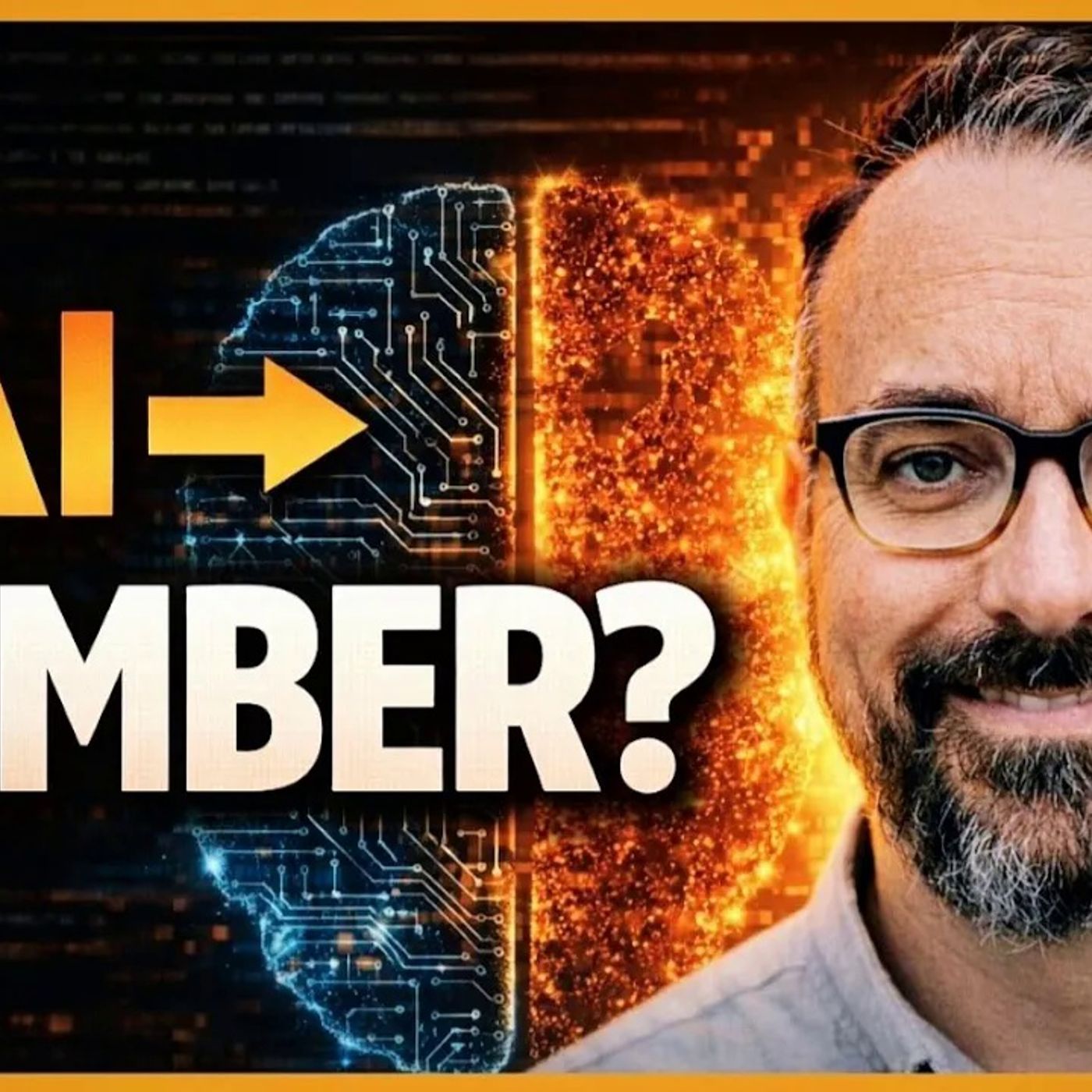
In this episode, Josh Daws examines two competing narratives about artificial intelligence. A recent MIT study suggests that reliance on AI may lead to declining cognitive engagement. But a Harvard study shows the opposite: when used properly, AI can significantly amplify human productivity and ability.
So which is it?
Josh places this debate in historical context, going all the way back to Socrates, who warned that the invention of writing would weaken human memory. He wasn’t entirely wrong—but writing also transformed the world for the better.
Every major technological advancement comes with trade-offs. Some abilities may atrophy, but others expand dramatically.
The real question isn’t whether AI changes us—it’s how we use it.
And for Christians, that question carries even greater weight. Scripture calls us to exercise dominion, not retreat in fear. If AI is a tool, then it must be brought under wise, disciplined, and faithful use.
Are we becoming weaker—or being equipped for greater responsibility?
Watch all of our videos and subscribe to our channel for the latest content >Here<
For blog entries, articles, and much more, visit our website >Here<
Get every episode summarized
Each time Eschatology Matters publishes, we email you a written briefing from the transcript — the topics, who appeared, and any specific claims, with the ad reads skipped.
Email me new episodesFree for 3 shows. No card needed.
Hosts & guests

Transcript ready
204 searchable segments. Every word is indexed and playable.
Full transcript
Eschatology Matters — AI Is Making You Dumber (Study Shows). Machine-transcribed; use the interactive transcript above to jump the player to any line.
You're having a good time, you're out drinking with the boys, now it's time to pay the tab. Well, there are court costs, attorney fees, higher insurance costs, damage to your car, do you why fines? Not to mention the damage to your social life, plan a sober ride or pay the price, drinking and driving costs more than your drinks. It could cost a life. One more at What'sTheDamage.org, brought to you by Virginia DMV. His AI making is dumber. MIT hooked people up to brain scanners, gave them chat GBT and watched what happened. The results were not good. Hi, I'm Josh Dawes, filling in for Alex on this episode of The World View. If you've been on the internet at all in the last year, you've heard the panic.
AI is making is dumber. We're outsourcing our thinking to machines. The fear was already there and then MIT came along with a study that seemed to confirm it. It became one of the most cited pieces of evidence that AI is destroying our ability to think. So let's actually look at what they found. The MIT Media Lab ran a study called YourBrain on chat GBT. They took 54 people, split them into three groups. One group wrote essays using chat GBT, one group used Google, and the third group just their brain, nothing else. For four months, they hooked everyone up to EEG monitors and had them write 20-minute essays on SAT-style prompts. The chat GBT group showed significantly weaker brain connectivity. When they tested recall afterwards, 83% of the chat GBT group couldn't even remember key points from their own essays. English teachers who reviewed the work called the chat GBT essays soulless. All of them read the same. There was no original thought. And if that's where you stopped reading, you'd be terrified.
A lot of people did stop there. The headlines wrote themselves. AI is making its dumber, secular media ran with it, and then Christian commentators began echoing those concerns. Suddenly, this one study became proof that artificial intelligence is destroying the human mind. But if you kept reading, a few things jumped out. First, by the final round, only 18 people were left. That's six people per group, six. This study hasn't been peer-reviewed, which doesn't mean it's wrong, but it means the scientific community hasn't vetted it yet. Everyone's treating it like settled science when, quite frankly, it's not. Second, the lead researcher gave an interview to Time Magazine where she described what actually happened with the chat GBT group. By the third essay, the behavior had devolved into, and this is her quote, just give me the essay, refine this sentence, edit it, and I'm done. This participant, she said, we're happy to just copy and paste chat GBT's output. They let it do their thinking entirely.
And honestly, yeah, of course their brains showed less activity. That's not a breakthrough discovery. That's just how brains work. That's how anybody part works. If you hire someone to do your push-ups, your arms aren't going to get stronger. Now, if the story ended there, you might say, well, fine, but the tool still encourages that passivity, so it's still dangerous. Fair enough. Except the story doesn't end there. The same month that MIT study dropped, June 2025, researchers at Harvard published their own study in scientific reports. This one was peer-reviewed. It featured 194 physics students had a rigorous study design. They tested an AI tutor against traditional classroom instruction, and not some lazy lecture hall either, real active learning with small group work and real-time feedback from the professor. The kind of teaching we would all agree actually works. Now if the MIT study is right that AI is making its dumber, you'd expect the traditional classroom group to outperform.
But the AI tutor group absolutely crushed it, more than doubled the learning gains of the classroom group. And the students using AI reported feeling more engaged, not less. They were more motivated and more invested in the material. Two studies, same underlying technology, completely opposite outcome. What was different? The difference was how the student used the AI. The MIT study let people hand off their thinking. The Harvard study built an AI that wouldn't let you do that. It quizzed you. It challenged you. It pushed back when your answer was wrong. It made you wrestle with the material until you actually understood it. Same tool. One version made people lazier. The other made them sharper. Variable in both cases wasn't the technology. It was the person in how they used it. Whether you showed up to engage or showed up to coast. Now people are going to hear that and say, sure, but if we're asking machine to do things, we could be doing ourselves.
Aren't we just going to lose the ability to do those things? And there's definitely some truth to that. Every powerful tool in history has caused some kind of skill atrophy. Socrates argued that writing would weaken human memory. And you know what? He wasn't wrong. Moral cultures had extraordinary memories. People who wrote things down didn't develop that same capacity. Something was lost. But something bigger was gained. Writing let people interact with far more complex ideas than they could ever hold in their heads. You could lay your thoughts out, examine them, build on them, connect ideas that were too far apart to hold in your head at the same time. Writing didn't make people dumber. It traded one kind of cognitive strength for a much deeper kind of thinking. The sewing machine is another example. Far fewer people can sew by hand today than they could 150 years ago. That skill atrophy. But the sewing machine meant we could close more people at lower cost at a scale that hand sewing never could have reached. Something was lost, but something much larger was gained.
I think AI is the same kind of trait. Some cognitive muscles may get less exercise. That's probably real. But the tool gives you leverage to operate at a level you couldn't reach before. That's what it is. It's a tool. It depends entirely on how you use it. That's what the two studies showed us. And a Christian worldview helps us make sense of that. Doug Wilson puts it well in plot activity. He points out that when Noah worked the wood with the tools, he was doing the same thing Jesus did in his father's shop. And they were both doing the same thing that some other carpenter was doing when he fashioned the cross. They were all working with wood. And that tells us nothing about the sinfulness of the activity. To evaluate a tool, you have to look at the purpose of the tool. As Wilson says, hammers are used to build both brothels and barns. Now that doesn't mean anything goes with AI. The tool being neutral doesn't let us off the hook. So how should we think about it? Well Wilson gets it this too. He says that we have this constant temptation to locate sin in stuff itself.
He says that people can fall into one of two camps. Some look at the stuff and don't see any sin at all, so they assume there isn't any sinful way to use it. Those are the techno files. These would be your Silicon Valley tech bros that see nothing but an optimistic future. Others clearly see that sin is present in how these tools are used, and they conclude that it must be in the stuff, though maybe not the older stuff. Those are the techno folks. And that's exactly what we're seeing with AI right now. All who are fine with the internet, fine with smartphones, fine with social media, suddenly drawing the line right here. As if sin entered the technology at some arbitrary point the way the Amish drew the line in the 19th century. But sin has never been in the stuff. Sin is in us. But so is the calling. Genesis 128 tells us to fill the earth and subdue it. That's a command to build, to cultivate, to bring order out of chaos. Every generation has to figure out what that looks like with the tools God puts in in front of them. Does the risk of passivity with AI exist?
Of course it does. Some people are going to use this tool to coast. Some pastors are going to let chat GPT write their sermons without wrestling with the text. That's real. But it's a character problem, not a technology problem. We didn't ban books because some people read bad ones. What actually concerns me is that a lot of Christian voices on this topic sound indistinguishable from the secular panic. The same fear, the same hand-rigging. Where's the peace? If you believe Christ is reigning, a new technology should not spin you into a panic. It should send us to the workbench. The world is panicking about AI. Let Christians be the calmest people in the room. Not because we don't understand what's happening or because we deny that there's any ethical problems that we need to figure out, but because we know who's on the throne. AI is here to stay. Let's figure out how to use it to further Christ's kingdom. Thanks for watching. You can find me on x at at Josh Dawes. I also write on sub-stack about faith, culture, and technology. And if you're a Christian who wants to understand how to actually use these tools well, I run
a workshop called Taking Dominion with AI. You can find that at TakingDominionWithAI.com. I appreciate you spending some time with me today. At Verbo, we understand that even the best of plans sometimes need a little support. So we plan for the plot twists. Every booking is automatically backed by our Verbo care guarantee, giving you confidence from the very start. Whenever you need help, it's ready, before your stay, through the moments in between, and after your trip. Because a great trip starts with peace of mind, and maybe a good playlist. But we've got the peace of mind part covered. You're having a good time. You're out drinking with the boys. Now it's time to pay the tab. $11,352.47. Wait, what? Well, there are court costs, attorney fees, higher insurance costs, damage to your car, do you why finds? Not to mention the damage to your social life. Plan a sober ride or pay the price. Drinking and driving costs more than your drinks.
It could cost a life. Learn more at What'sTheDamage.org. Brought to you by Virginia DMV.
More episodes
More from Eschatology Matters

The Great Commission Is Bigger Than Personal Evangelism
Eschatology Matters

Was Nero’s Lover a Secret Christian? The Mystery of Claudia Acte
Eschatology Matters

JD Vance on The View: Immigration, Race, and Liberal Double Standards | Richard...
Eschatology Matters

Why Weve Got Discipleship All Wrong
Eschatology Matters