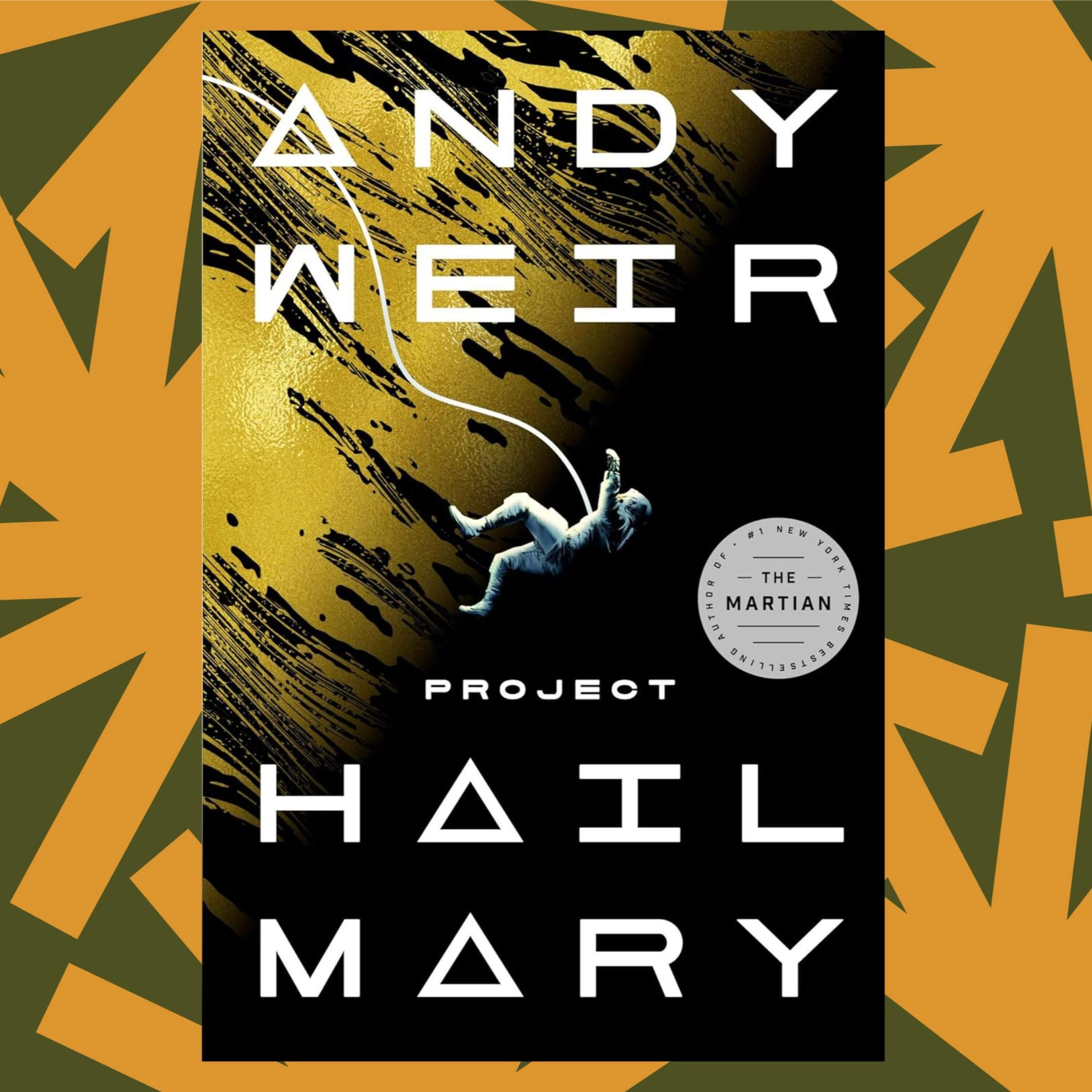
Andy Weir reveals his fun and frantic creative process behind 'Project Hail Mary'
About this episode
To listen to Book of the Day sponsor-free and support NPR's book coverage, sign up for Book of the Day+ at plus.npr.org/bookoftheday
See pcm.adswizz.com for information about our collection and use of personal data for sponsorship and to manage your podcast sponsorship preferences.
NPR Privacy Policy
Get every episode summarized
Each time NPR's Book of the Day publishes, we email you a written briefing from the transcript — the topics, who appeared, and any specific claims, with the ad reads skipped.
Email me new episodesFree for 3 shows. No card needed.
Hosts & guests

Transcript ready
178 searchable segments. Every word is indexed and playable.
Full transcript
NPR's Book of the Day — Andy Weir reveals his fun and frantic creative process behind 'Project Hail Mary'. Machine-transcribed; use the interactive transcript above to jump the player to any line.
Hi, I'm Tim Bidiumius and this is NPR's book of the day. By now, you've probably heard something about Project Hail Mary. The buzzy film, starring Ryan Gosling, has already nabbed the honor of having the highest grossing opening weekend of 2026. But years before the film dominated the box office, it was a best-selling book by writer Andy Weir. In it, the protagonist ends up adrift in space and is tasked with saving humanity. We're spoke about his inspiration for the novel with here and now host Indira Lakshmanan. This message comes from Sony Pictures Classics with a magnificent life. From the imaginative director of the tropics of Belleville comes a new animated film. Marcel Pagnol must relive his colorful past by writing about his own childhood, now playing in select cities. Support for this podcast and the following message come from strawberry.me.
Be honest. Are you happy with your job? Are you stuck in a job you've outgrown or never wanted in the first place? Are your reasons for staying really just excuses for not leaving? Let a career coach from strawberry.me help you get unstuck. Discover the benefits of having a dedicated career coach in your corner and get 50% off your first coaching session at strawberry.me slash NPR. Support for NPR and the following message come from Warby Parker, the one-stop shop for all your vision needs. They offer expertly crafted prescription eyewear, plus contacts, eye exams and more. For everything you need to see, visit your nearest Warby Parker store or head to WarbyParker.com. In the new film Project Hail Mary, Ryan Gosling stars as Ryland Grace, a middle school science teacher who wakes up on a ship in deep space with no memory of who he is, where he is, or how he got there. And he's all alone.
His two crewmates are dead. As his memories return in a series of flashbacks, Grace realizes he's the only survivor of a desperate Hail Mary mission, a last-ditch attempt to save life on Earth. If we do nothing, everything on this planet will go extinct, including us. Dr. Grace, the world is counting on you. Hmm, not big stakes there, huh? How can one man save the planet? Hail Mary opens in theaters this Friday. It's based on the best-selling book by Andy Weir, who joins us now. Andy, welcome to here and now. Hi, thanks for having me. So for those who haven't read your science fiction bestseller, let's fill listeners in on the basics of the plot. The power of the sun is being sucked away by microscopic life forms called astrophage. If they're not stopped and fast, Earth's temperature will drop so low that it can't sustain
life. Ryl and Grace and the rest of the crew are set 11 light years away in a spaceship called the Hail Mary to investigate astrophage and see if it can be stopped. All right, so I have to ask, where did you get the Let's Face It? Pretty depressing idea for the story. Well, let's start off with, I wanted to come up with an idea where humanity gets a hold of some sort of mass conversion-based fuel. Because if we could do that, we could easily colonize the solar system. There's all these amazing things we could do. Then I was like, okay, great. But if they find that fuel, then they use it up, then it's gone. How do you make more? And I said, like, well, maybe the fuel itself can make more. You shine light at it, it'll absorb the energy and make more of the fuel or something. And then I thought, well, that kind of sounds like life, right? Something that absorbs energy and makes copies of itself. It would have to be like alien, but I'm comfortable with that if it's just a microbe. But why would it need to store so much energy inside of a little cell? Why would it need to do that? And where would it get that much energy?
And those two kind of answered themselves, I'm like, well, it could get that energy by living on the surface of stars. And then maybe it needs that energy to spore out to infect other stars, because it's basically like mold. Oh, inside note, in the back of my mind, we'd have to make really sure not to let any of this stuff get onto our Sun. Because that would be catastrophically bad. And then I'm like, oh, wait, no, go back. If that stuff's in our Sun, that's the story. Wow, okay. So that's the weird way I backed into it. I asked what I thought was a simple question. But got a really complicated answer. I have to say, I feel like I just got a view into your creative process. Yes, I always feel like I have to apologize to anyone who sees the inner workings of my mind. It is complicated in there. Well, let's focus on Ryland Grace. He's an unlikely hero for a deep space adventure. He's a middle school science teacher. He's not even an astronaut. We discover in the course of the story that he didn't even want to go on this mission.
So what inspired this character? Well, I wanted to write a character that people could empathize with. And I don't know about you, but I have a tough time empathizing with the really brave characters, because I don't think I'm that brave. I think we all, to some degree, feel this way as we go through life, like unprepared, unqualified, and reluctant. Yet important things are relying on me, so I have to come through. And also, I wanted to make a character for once that wasn't just based on my own personality. My first two books, the characters, are based on aspects of my own personality. Grace, I made up from whole cloth, and I said, okay, what are his central conflicts? How is he going to grow? How is he going to change? Well, you say you made him up, but Ryland Grace actually reminded me of one of your previous heroes, Mark Watney, from the Martian listeners may remember the 2015 movie adaptation of your book that starred Matt Damon. Watney was stranded on Mars when his team was forced to abandon their mission. And what we discover in both stories is that Watney and Grace are kind of regular
guys with a dry sense of humor. They manage to survive against overwhelming odds. They both mageyver the heck out of every problem they face in space. Tell us why this kind of hero appeals to you. There's something that really appeals to me, and I hope to the audience of person versus nature stories. It's interesting when you're watching a movie or a story that has an antagonist in it, you know deep down that that antagonist is going to fail. Probably going to fail. The only question is how much damage they do on the way down, right? And so I find myself in the middle of the movie weirdly rooting for the antagonist because I know he's good at what he's right. So I wanted to get a few good looks in before he goes down. Nobody roots for nature to kill the human. There's no divided royalties. So you immediately go like, okay, this guy needs to survive. Let's see how he does it. We're speaking with author Andy Weir, whose best-selling book project Hail Mary is the basis for the new film starring Ryan Gosling. All right, I hate to drop spoilers,
but if listeners have watched the trailer, they already know that Grace's ship has been sent to a planetary system that's unaffected by astrophage. And he discovers an alien on another ship who's on the same mission and the two decide to work together. Talk a bit about how this part of the story came to you. What were you trying to explore with having two creatures? Let's call them that collaborate across species? Well, I wanted this to be a first contact story right from the get-go. I mean, I was thinking about the, you know, mass conversion fuel, but that was also sort of a mechanism by which I can cause a first contact. Then, as you say, you know, Towsetti is for some reason immune to astrophage. It makes sense that we would send a ship there and I'm like, oh, it makes sense that if there are any other intelligent species around, they would probably come to the same conclusion. So yeah, I wanted it to be about a couple of alien buddies saving their worlds. Well, it is a buddy film. There's a scene from the film where the alien, who Ryan Gosling's character
names Rocky, first comes inside the Hail Mary spacecraft. He's encased in a protective bubble because Rocky and Grace can't breathe from the same atmosphere. And Rocky is eager to see and discover everything he goes barreling through the ship as Grace chases behind him. It's quite humorous. Let's listen. Hi, Grace. You're in a ball. So Rocky, no, Diane, Grace, atmosphere. I come up. Oh, you're coming up. Far and muddy. Detected. Grace and Rocky, big science. How to kill astrophages together. I keep going this way. This room boring. Rocky, buy it. They buy it. They bear it. Good slam. What's that sound here? Okay, so it reminds me of countless buddy movies over the decades. At times, they find each other annoying, but they need to work together and ultimately their friendship becomes so strong. It really transcends life and death. Tell us more about this relationship. Yeah, that's the core of the story is their friendship and their relationship. They're kind of like,
almost in a way war buddies. They're like two soldiers who had to share a fox hole during an assault. They'll be friends for the rest of their lives because they've been through something so catastrophic together. The trauma bonded, I guess. And they also just developed a great friendship with each other working together. It's like, okay, there's you and there's me, and then there's nothing for many light years. So we're going to work together now. Now, obviously as a novelist, you have an incredibly rich imagination. I mean, these were all your ideas. But what was it like to see the images you had in your own head of the Hail Mary spacecraft and of Rocky himself brought to life visually on the screen in IMAX, in high death, what did that feel like? Well, it feels great. You know, it's always amazing to see a bunch of world-class talented people spending a year of their life making something that fell out of my brain come into a reality. I also have one kind of secret hidden advantage that most of their authors
don't have, although someone would say it's a disadvantage, I don't have a very visual imagination. So when I'm writing my story, I don't really see it playing out like a movie. There's just like concepts like Rocky as a blob. I'd worked out his morphology, but I couldn't have told you if his legs were thin or fat or if they were bumpy or smooth or anything like that. And Holly would brought it to life for you. So it all worked out. Well, the nice thing is that when I see it on screen, I don't have the cognitive dissonance that a lot of writers have because they imagine one thing in their head and then on the screen is something else. For me, I'm just like, oh, so that's what it looks like. Now I know. Yay! Well, Project Hail Mary and the Martian both seem to be about maintaining optimism in the face of dire circumstances where death basically seems inevitable, but in both cases, our heroes don't give up. I also noticed that in both of your stories, cooperation that in the end saves the day transcends borders. Now, let's take ourselves back to life
in 2026. We're not exactly living through a moment of cross-border cooperation. And so I have to ask, does your story in a way seem too polyannish in our current geopolitical climate? I, as a person, am probably too polyannish for any point to the history that I've experienced. I am just a very optimistic person. Those books are a reflection of how I see humanity. I really do think that we're an amazing species. And I think that we accomplish great things, and we work together a lot more than people give us credit for. If you look at the pandemic as an example, you have pharmaceutical companies that under normal circumstances would have private armies to guard their secrets, openly sharing everything they had on the disease so that they could collaboratively come up with vaccines as quickly as possible. I mean, it was really a phenomenal period of cooperation for humanity that we somehow look back on and give ourselves like a C-grade on. But I think if you ask historians 200 years from now how well we did, they're going to give us
pretty high marks. Andy Weir is the author of Project Hail Mary, the best-selling book on which the new film starring Ryan Gosling is based, Project Hail Mary the Movie opens in theaters this Friday. Andy Weir, thank you so much for joining us. Thanks for having me. This message comes from Sony Pictures Classics with a magnificent life. Marcel Penoll must write a column about his accomplished past, confront his childhood self, and relive his most cherished memories from the director of the triplets of Belleville in Select Cities, March 27th. This message comes from Prolon, feeling heavy and depleted. Prolon's five-day fasting mimicking diet aims to make it easy to reset your body habits and energy. Developed at USC's Longevity Institute, the goal of Prolon's nutrition program is to rejuvenate you from within by working at
the cellular level to support fat loss, glowing skin, and sharper focus. Get 15% off plus a bonus gift when you subscribe at prolonlife.com slash NPR. Historians, authors, athletes, and more about why people do the things they do. Download the latest episode and subscribe at Schwab.com slash podcast or wherever you listen.
More episodes
More from NPR's Book of the Day

To combat the 'Artificial State,' Jill Lepore says to look to science fiction
NPR's Book of the Day

Author Liane Moriarty on her long-awaited sequel to 'Big Little Lies'
NPR's Book of the Day

New music books take on Paul Simon's 'Graceland' and the history of music and pr...
NPR's Book of the Day

New book evaluates President Biden's legacy as midterm elections approach
NPR's Book of the Day