0:00
And Doug, there's nowhere I wouldn't go to help someone customize and save on car insurance with Liberty Mutual.
0:08
Even if it means sitting front row at a comedy show.
0:12
Hey everyone, check out this guy and his bird.
0:14
What is this, your first date?
0:16
Oh no, we help people customize and save on car insurance with Liberty Mutual together. We're married.
0:21
Mito a human, him to a bird.
0:22
Yeah, the bird looks out of your league anyways.
0:24
Only pay for what you need at Liberty Mutual.com.
0:27
Liberty, Liberty, Liberty, Liberty.
0:30
How to have fun, anytime, anywhere.
0:32
Step one, go to ChambaCasino.com.
0:34
ChambaCasino.com. Got it.
0:36
Step two, collect your welcome bonus.
0:38
Come to Papa, welcome bonus.
0:40
Step three, play hundreds of casino style games for free.
0:43
That's a lot of games, all for free.
0:45
Step four, unleash your excitement.
0:47
ChambaCasino has been delivering thrills for over a decade.
0:51
So claim your free welcome bonus now and live the Chamba life.
0:54
Visit ChambaCasino.com.
0:55
Don't purchase necessary VGW group void.
0:57
We're prohibited by law 21 plus terms and conditions apply.
1:00
Good day, stargazers, and welcome back to Astronomy Daily.
1:06
And honestly, this might be our most packed episode of the season so far.
1:10
Between a rocket still sitting on a pad in Norway, waiting for its shot at history,
1:16
a cargo ship that needed a human hand on the wheel,
1:20
and an entirely different kind of sky show happening over Australian cities last night,
1:26
today really has it all.
1:27
Plus, fresh science after James Webb Space Telescope
1:31
that has astronomers questioning everything they thought they knew about lava worlds.
1:35
We've got news about sealed moon rocks finally giving up their secrets after 50 years.
1:40
And we'll walk you through one of the busiest weeks in global rocketry in recent memory.
1:45
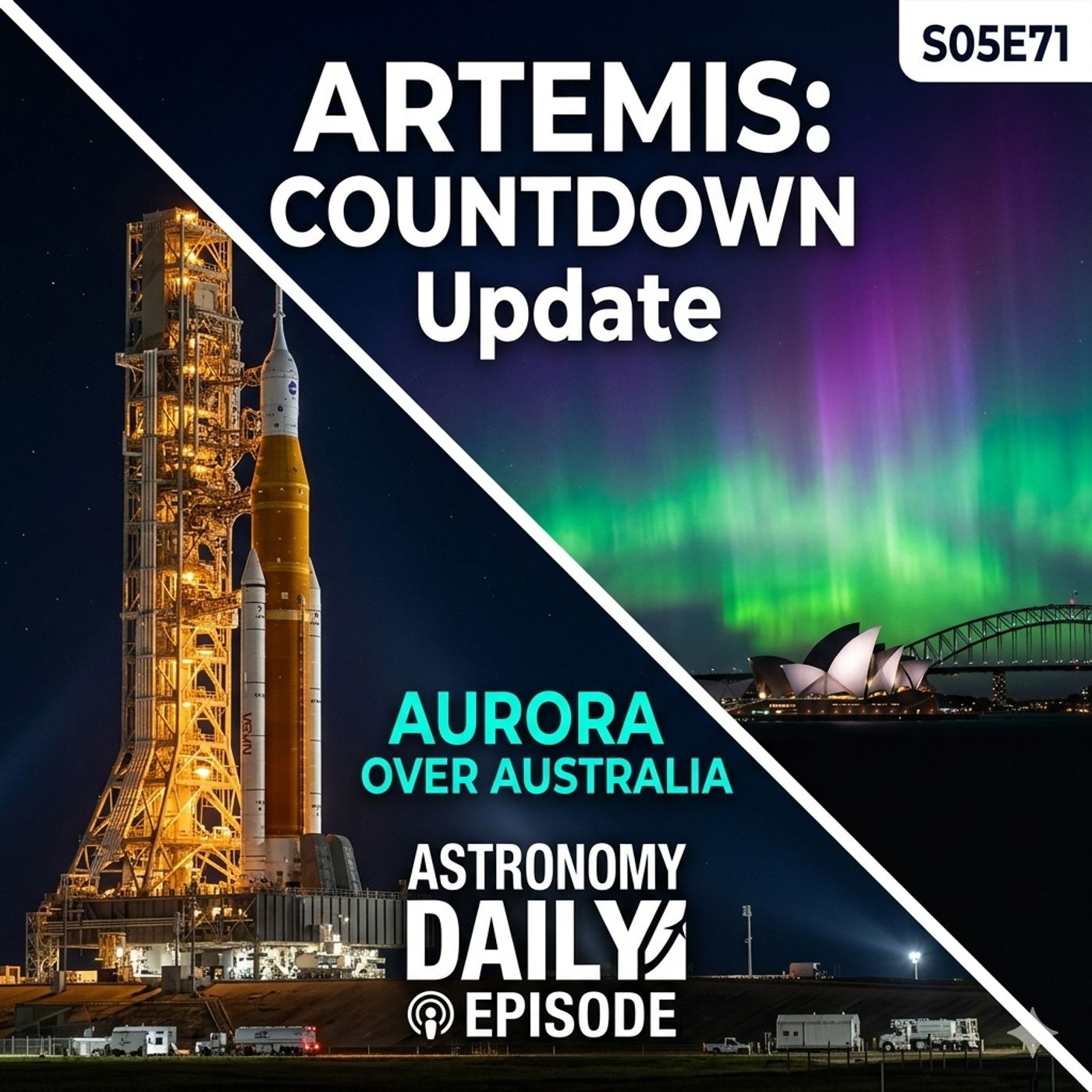
And with less than two weeks to go until the most historic human spaceflight in half a century,
1:52
the countdown to Artemis 2 is well and truly on.
1:56
Though not everyone agrees it should be.
1:58
There's a scientist out there saying NASA should hold off.
2:02
Without further ado then, let's dive in.
2:05
Let's start with the big one.
2:06
As of today, NASA is officially targeting April 1st.
2:10
And yes, we know how that sounds, as the launch date for Artemis 2.
2:14
The 6th day window runs April 1st through to the 6th.
2:18
And just to be clear for anyone just joining us on the show,
2:22
Artemis 2 is the first time human beings will travel to the vicinity of the moon since Apollo 17 in December 1972.
2:31
Over 50 years, this is genuinely historic.
2:36
Or astronauts aboard the Orion spacecraft launched on the Space Launch System or SLS
2:42
from Kennedy Space Center in Florida.
2:44
The crew is Commander Reed Weisman, pilot Victor Glover, mission specialist Christina Coach,
2:49
and Canadian Space Agency astronaut Jeremy Hansen.
2:53
Victor Glover will become the first person of color to travel beyond Earth orbit.
2:58
Christina Coach will be the first woman.
3:01
And Jeremy Hansen will be the first non-American citizen to leave low Earth orbit.
3:07
This mission is full of firsts.
3:09
The crew entered quarantine at Johnson Space Center in Houston on March 18th,
3:14
and they traveled down to Florida on March 27th.
3:17
From there, it's really just a matter of weather, systems, and that launch window.
3:22
Now, the road to get here has had its bumps.
3:25
There were liquid hydrogen leaks, helium flow issue that caused a rollback to the vehicle assembly building just last month.
3:33
Engineers found a blocked seal in a cable connecting the rocket to the ground systems.
3:40
A successful wet dress rehearsal in late February cleared the way.
3:44
And the mission itself, once it launches, will be a 10-day free return trajectory around the moon.
3:50
They'll swing out to about 5,000 miles beyond the lunar surface,
3:54
giving the crew and the world a view of the moon that no human has had since Jean Cernan and Harrison Schmidt were there in person.
4:02
Now, Avery, you mentioned earlier that not everyone thinks this is the right moment to go.
4:07
Yeah, this is a genuinely interesting wrinkle.
4:10
A researcher at Mexico's National Autonomous University, Victor Velasco Herrera,
4:15
has published a new analysis suggesting that we are currently in a window of elevated solar super flare risk.
4:22
His models point to a high activity period running from mid-2025 through to mid-2026,
4:28
focus on the sun's southern hemisphere.
4:31
He's recommending NASA delay the mission until the second half of this year at the earliest.
4:36
And you can see why he'd be concerned.
4:38
We've had a G3 geomagnetic storm this week, which we're going to get to in a moment.
4:43
The sun is extremely active right now.
4:46
Right, though NASA has assessed the risks and all teams pulled go for launch.
4:51
Laurie Glaze from NASA's Exploration Systems Directorate said,
4:55
and I'm paraphrasing, that an incredible amount of work has gone into preparing for this.
5:00
And they've had very open transparent discussions about risk posture and mitigation.
5:05
Though the mission is proceeding, but it does add a certain tension to an already extraordinary story, doesn't it?
5:13
The sun is at the peak of its 11-year cycle.
5:16
We're heading back to the moon, and a scientist is saying, are you sure you want to do this now?
5:22
Humanity doing bold things anyway, feels on brand, honestly.
5:27
We'll have everything you need to watch the launched live in our show notes,
5:32
fingers crossed for April 1st.
5:35
Okay, so speaking of the sun, let's talk about what it's been doing to our skies this week,
5:39
because it has been spectacular.
5:42
A series of coronal mass ejections, or CMEs, that left the sun on March 16th and 18th,
5:49
arrived at Earth around the equinox, and they drove geomagnetic storming to G3 levels on the NOAA scale.
5:56
That's classified as strong.
5:58
And the result were Aurora's visible from an extraordinary range of latitudes.
6:03
We're talking reports of vivid displays from New York, London, Northern France,
6:08
even parts of Scotland lit up.
6:10
And when you see Aurora reports from Scotland, you're already dealing with something significant.
6:15
But the story closest to home for many of our listeners,
6:19
the Aurora Australis was visible across major Australian cities last night.
6:25
The Australian Bureau of Meteorology issued a severe geomagnetic storm warning,
6:31
and the southern lights were reported from Melbourne, Sydney, Brisbane, and Adelaide.
6:38
Sydney is not what you'd call a typical Aurora viewing destination.
6:42
If you were outside last night and happened to look south,
6:45
especially from somewhere with a clear horizon, you may well have caught it.
6:49
As of today, March 24th, conditions are easing.
6:53
We're dropping back to KP3-4, unsettled to active,
6:58
with a slight chance of isolated G1 minor storm intervals.
7:02
So there may still be some activity tonight, but the peak has passed.
7:07
Now, why is March such a good month for Aurora's?
7:10
This is something a lot of people don't know.
7:12
It's called the Equinox Effect.
7:14
Around the March and September Equinoxes,
7:17
the geometry of Earth's magnetic field relative to the solar wind
7:21
becomes particularly favorable.
7:24
The field lines are better aligned to allow charged particles in,
7:28
which means you can get strong auroral activity even from moderate solar events.
7:33
Combined with the current solar maximum, the peak of solar cycle 25,
7:37
and we're living through what could genuinely be the best Aurora viewing period
7:42
until the mid-2030s.
7:44
So if you've been meaning to chase the lights,
7:47
the message from scientists is, this is your window.
7:50
The sun will start winding down from here,
7:53
and the next solar maximum is over a decade away.
7:56
We'll have Aurora forecast lengths in the show notes
7:59
so you can track what tonight looks like from your location.
8:02
I'm sure our producer, who lives in Sydney, will be out and looking up.
8:06
Tyler Reddick here from 2311 Racing.
8:10
Yeah, it's even better with Chamba by my side.
8:13
Race to ChambaCasino.com, let's Chamba.
8:16
No purchase necessary.
8:17
BGW Group, voidware prohibited by law.
8:20
Sponsored by ChambaCasino.
8:21
Hi, this is Alex Cantrowitz.
8:23
I'm the host of Big Technology Podcast,
8:25
a longtime reporter and an on-air contributor to CNBC.
8:28
And if you're like me, you're trying to figure out how artificial intelligence
8:31
is changing the business world and our lives.
8:34
So each week on Big Technology, I bring on key actors
8:37
from companies building AI tech and outsiders trying to influence it.
8:41
Asking where this is all going.
8:43
To come from places like Nvidia, Microsoft, Amazon, and plenty more.
8:47
So if you want to be smart with your wallet, your career choices,
8:50
and meetings with your colleagues and at dinner parties,
8:52
listen to Big Technology Podcast wherever you get your podcasts.
8:56
Now, let's head into deep space and into one of the most
9:00
genuinely surprising pieces of planetary science we've seen in a while.
9:05
James Webb has done it again.
9:07
I love a story where the headline is basically
9:10
scientists found something they were almost certain couldn't be there.
9:14
So the planet in question is called T-O-I-561-B.
9:19
It's a super earth, about twice the mass of our planet,
9:23
orbiting a star around 280 light years away.
9:27
And when we say close to its star, we mean absurdly,
9:31
almost comically close.
9:33
It completes a full orbit in just 10.56 hours.
9:37
A year on this world is shorter than the average working day.
9:41
It orbits at 140th the distance that Mercury sits from our Sun.
9:46
The dayside is in permanent, unrelenting sunlight.
9:50
The planet is likely tidally locked.
9:53
Same face always towards the star, same face always in darkness.
9:58
The surface is thought to be a global ocean of molten rock.
10:02
And under those conditions, extreme radiation, extreme heat,
10:06
extreme proximity to the star.
10:09
The scientific consensus was that any atmosphere this planet might have once had
10:13
would have been stripped away long ago.
10:16
It should be a bare, airless rock.
10:21
A Carnegie Institution's lead team used Webb's near infrared spectroscope,
10:26
near spec, to take the planet's temperature
10:29
by measuring how much light the system emitted
10:32
when TOI-561B passed behind its star.
10:36
If it were a bare rock, the dayside should reach something close
10:40
to 4900 degrees Fahrenheit, around 2700 Celsius.
10:45
Instead, they measured around 3200 degrees Fahrenheit or 1800 Celsius.
10:51
Dill extraordinarily hot, but significantly cooler than expected.
10:56
And the only explanation that fits the data is that there's an atmosphere up there,
11:00
redistributing heat from the dayside to the nightside.
11:04
The lead researcher, Johanna Teska at Carnegie Science,
11:08
described the planet as, and this is a direct quote,
11:11
really like a wet lava ball.
11:13
The idea is that there's a feedback loop happening.
11:16
While little gases bubble up from the magma ocean into the atmosphere,
11:20
while the magma ocean simultaneously pulls some gases back in,
11:24
it's a strange equilibrium.
11:27
What makes this scientifically significant beyond the wow factor
11:31
is what it tells us about rocky planet evolution.
11:34
We've assumed for a long time that small, hot,
11:37
close-in worlds can't hold atmospheres.
11:40
POI-561B suggests the reality is more complicated,
11:44
and potentially more interesting.
11:46
The team is now analyzing the full data set
11:49
to map temperature patterns all the way around the planet
11:52
and try to narrow down what the atmosphere is actually made of.
11:55
Water vapor, carbon dioxide, silicate clouds, all on the table.
12:00
One of JWST's core missions is finding atmospheres around rocky worlds,
12:05
because as far as we know, an atmosphere is a prerequisite for life.
12:10
POI-561B is certainly not habitable in any conventional sense,
12:15
but understanding how a world this extreme hold onto its air
12:19
could tell us a great deal about rocky planets that are far more temperate.
12:24
There's something genuinely poetic about today's next story.
12:28
We're going back to December 1972,
12:31
the last time humans walked on the moon,
12:33
and discovering that some of what they brought home
12:35
has been quietly waiting 50 years to tell us something unexpected.
12:40
The Apollo Next Generation sample analysis program,
12:43
or ANGSA, was set up specifically for this purpose.
12:47
When the Apollo astronauts returned from the moon,
12:49
NASA deliberately sealed some of the samples and set them aside,
12:53
knowing that future scientists with better tools
12:56
would be able to extract more from them
12:58
than the technology of the 1970s ever could.
13:01
And that moment has now arrived for a double drive tube,
13:04
pushed into the lunar surface at the Taurus-Littau region
13:08
by Jean Cernan and Harrison Schmid during Apollo 17.
13:12
A team led by James Dodden at Brown University used a technique
13:16
called secondary ion mass spectrometry to measure sulfur isotopes,
13:21
and what they found was not what anyone expected.
13:24
So, for context, earth and the moon
13:26
have remarkably similar oxygen isotope signatures.
13:30
Scientists have long assumed that sulfur would follow the same pattern,
13:34
that the moon's interior would look chemically similar to earths in this regard.
13:38
Dodden's team expected to confirm that assumption.
13:41
Instead, the volcanic material in the sample
13:44
is strongly depleted in sulfur-33,
13:47
one of four stable sulfur isotopes.
13:50
The values are, in Dodden's own words, very different from anything we find on earth.
13:55
He said he simply wasn't expecting that.
13:58
So, what does it mean?
13:59
There are two leading explanations, and neither is boring.
14:03
The first is that this is evidence of very ancient chemistry,
14:07
sulfur that interacted with ultraviolet light
14:09
in an early thin lunar atmosphere billions of years ago.
14:13
The implication there would be that material somehow cycled
14:17
from the lunar surface into the mantle,
14:19
a kind of proto-plate tectonics,
14:22
on a world we don't think has ever had plate tectonics.
14:25
The second explanation reaches even further back.
14:28
The leading theory of the moon's origin is the giant impact,
14:31
a mar-sized body called fea, collided with the early earth,
14:35
and the debris eventually coalesced into the moon.
14:38
If fea had a very different sulfur composition from earth,
14:42
that signature might still be locked inside the lunar mantle today,
14:45
a fingerprint from a collision that happened four and a half billion years ago.
14:50
The data doesn't currently favor one explanation over the other.
14:54
Dodden is hoping that comparisons with samples from Mars
14:57
and other planetary bodies will help resolve it.
15:00
But the broader message is clear.
15:02
These samples are still yielding genuine surprises,
15:06
decades after they were collected,
15:08
and there are more sealed Apollo containers still to be opened.
15:12
There is something remarkable about the fact that astronauts
15:15
who have been gone for over 50 years are still,
15:18
in a very real sense, contributing to our understanding of the solar system.
15:22
All right, let's do a lap of the launch pads,
15:25
because this week is genuinely exceptional for space activity worldwide.
15:29
NASA Spaceflight.com published their weekly preview,
15:33
and honestly, it reads like a greatest hits of the current space age.
15:37
Let's start with what's already happened.
15:40
SpaceX kicked off the week with the Falcon 9 launch from Vandenberg in California today,
15:45
Tuesday, carrying 25 starling satellites to Sun-Synchronous orbit.
15:49
Booster B1081 flying for the 23rd time,
15:53
routine at this point, but still remarkable when you say it out loud.
15:57
Tomorrow, Wednesday is arguably the biggest single day in the schedule.
16:01
ESAR Aerospace's Spectrum Rocket has its window at 8 p.m. UTC
16:06
from Endoya in Norway.
16:08
We'll talk about that more in the update segment.
16:10
And at 9.14 a.m. UTC, Rocket Labs Electron launches
16:15
from New Zealand's Mahia Peninsula, carrying two ESA Celeste satellites.
16:20
Those are the first of 10 planned navigation demonstration satellites
16:24
that will test positioning technology in low-earth orbit.
16:27
Also, Wednesday, China launches a Chang-Zang 2C from Taiwan,
16:32
payload classified, which will be that rocket's 87th mission overall.
16:38
The CZ-2C has been flying since 1982,
16:42
which puts it in some pretty distinguished company.
16:45
Thursday brings another Falcon 9 from Cape Canaveral,
16:48
carrying 29 starling satellites.
16:51
And this one has a record attached.
16:53
Booster B1067 will be making its 34th flight,
16:57
setting a new record for Falcon 9 booster reuse.
17:01
This rocket first flew in June 2021.
17:04
On a cargo resupply mission to the International Space Station,
17:07
it's now flying for the 34th time.
17:10
SpaceX has fundamentally changed what reusability means.
17:14
Friday is enormous.
17:16
China's commercial launch company, Cass Space,
17:19
flies its Connecticut-1 solid rocket from G1 with an undisclosed payload.
17:23
And Ross Cosmos launches the first-ever flight
17:26
of the Soyuz-5 rocket from Baikonore,
17:29
also called Irteche.
17:31
This rocket is Russia's long-awaited replacement for the Zenit family.
17:35
It carries a mass simulator on this debut flight,
17:38
launching from a pad that hasn't seen an orbital launch since 2017.
17:42
Big moment for Russian launch vehicle development.
17:45
And the week closes out on Sunday with two more.
17:48
ULA's Atlas V-5 launching 29 Amazon Leo satellites from Cape Canaveral
17:54
in its powerful 551 configuration.
17:57
That's five solid rocket boosters for what will be that rocket's 107th overall mission.
18:03
And SpaceX wraps things up with Transporter 16,
18:06
a ride-chair mission from Vandenberg carrying dozens of small satellites.
18:11
That will be SpaceX's 40th Falcon 9 launch of 2026 alone
18:16
and the 73rd orbital launch attempt worldwide this year.
18:20
So, five countries, six different rockets,
18:24
Falcon 9, electron, spectrum, CZ-2C,
18:28
Connecticut 1, Soyuz-5, Atlas V-5,
18:31
launching from California, Florida, New Zealand, Norway,
18:35
two sites in China, and Kazakhstan in one week.
18:39
The age of routine spaceflight is here.
18:42
It's just also occasionally extraordinary.
18:45
Before we wrap, a quick follow-up on two stories we covered yesterday
18:49
because both have had developments today.
18:51
Let's start with the ISS.
18:53
You'll remember that Russia launched the Progress MS-33 cargo ship,
18:58
also called Progress 94 on Sunday from the Baikonur Cosmodrome,
19:03
carrying about two and a half tons of supplies
19:06
for the seven-person expedition 74 crew,
19:09
food, fuel, water, oxygen, the good stuff.
19:13
But there was a complication.
19:15
Shortly after launch, one of the spacecraft's two curves automated docking antennas
19:21
The curve system is the normal hands-off approach,
19:24
the shipguide itself in.
19:26
With only one antenna working, full automation wasn't available.
19:30
So, this morning, ISS commander Sergei Kud-Sverchkov
19:34
took over manually using the Toru system.
19:38
That's the telerobotically operated rendezvous system,
19:41
a control panel inside the Zvezda service module.
19:45
The spacecraft flew itself to within 200 meters of the station
19:49
and from there Kud-Sverchkov guided it in.
19:52
Docking was scheduled for 934 eastern time.
19:56
Ross Cosmos were quick to point out that manual approaches
19:59
are routinely practiced during cosmonaut training.
20:02
This was a contingency, not a crisis.
20:04
And there's a second layer to this story worth noting.
20:07
This was the first launch from Site 31 at Baikonur
20:10
since that pad was damaged during the Soyuz MS-28 launch last November,
20:15
when part of the launch infrastructure collapsed.
20:18
That pad is Russia's only one capable of sending crude missions
20:21
and cargo ships to the ISS.
20:24
Its return to service is genuinely significant.
20:27
We'll keep watching, and with any luck,
20:29
Progress 94 is safely birthed at the Poisk module as you listen to this.
20:34
And on the other story we promise to follow,
20:37
it's our aerospace's spectrum rocket is still on the pad.
20:41
Whether a Andoya pushed the attempt from Sunday, then from yesterday.
20:45
The current window is Wednesday night 8pm to 9pm UTC.
20:49
We'll have an update in tomorrow's episode.
20:51
If it succeeds, it will be the first time a rocket designed,
20:55
built, and launched from continental European soil has reached orbit.
21:00
That is a headline we very much want to be able to read.
21:03
Fingers crossed for SR and the whole European space industry.
21:07
Again, we'll update any new developments in tomorrow's show.
21:10
That is your Astronomy Daily for Tuesday, March 24th.
21:14
We've got a lot of threads in the air right now.
21:17
Artemis 2 approaching its launch window,
21:19
Spectrum waiting for the weather, a sun that doesn't want to sit still.
21:24
So it's a great time to make sure you're subscribed wherever you get your podcast.
21:28
All the sources, links, and reading for today's stories are in the show notes.
21:32
And if today's episode sparks something for you,
21:35
whether it's Aurora Chasing or thinking about those Apollo samples
21:39
or just looking up at the moon tonight and doing the maths on April 1st,
21:43
we'd love to hear from you.
21:45
Find us on Twitter and Instagram at AstroDailyPod
21:48
and on TikTok, X, YouTube, and Tumblr at the same handle.
21:53
The website is astronomydaily.io
21:56
and we're proud to be part of the Bites.com Podcast Network.
21:59
For Anna, I'm Avery, keep looking up.
22:02
And we'll see you tomorrow.
22:07
The star is the toe.
22:15
The star is the toe.
22:23
The star is the toe.
22:28
Tyler Reddick here from 2311 Racing.
22:31
Yeah, it's even better with Chamba by my side.
22:34
Race to ChambaCasino.com.
22:37
No purchase necessary.
22:38
VTW Group, voidware prohibited by law.
22:41
Sponsored by ChambaCasino.
22:43
Every day the world gets a little weirder.
22:46
And a lot more awesome.
22:48
Cool stuff daily takes a look at everything from mining in space
22:52
to the latest in the fight against cancer to how AI is basically changing everything.
22:58
It's all the cool stuff you didn't know you needed to know.
23:02
Join us for cool stuff daily as we take a quick look at science, tech,
23:06
and the wait what stories that make you sound way smarter at dinner.
23:11
Subscribe to cool stuff daily now because the future is happening fast
23:15
and it's way too fun to miss.