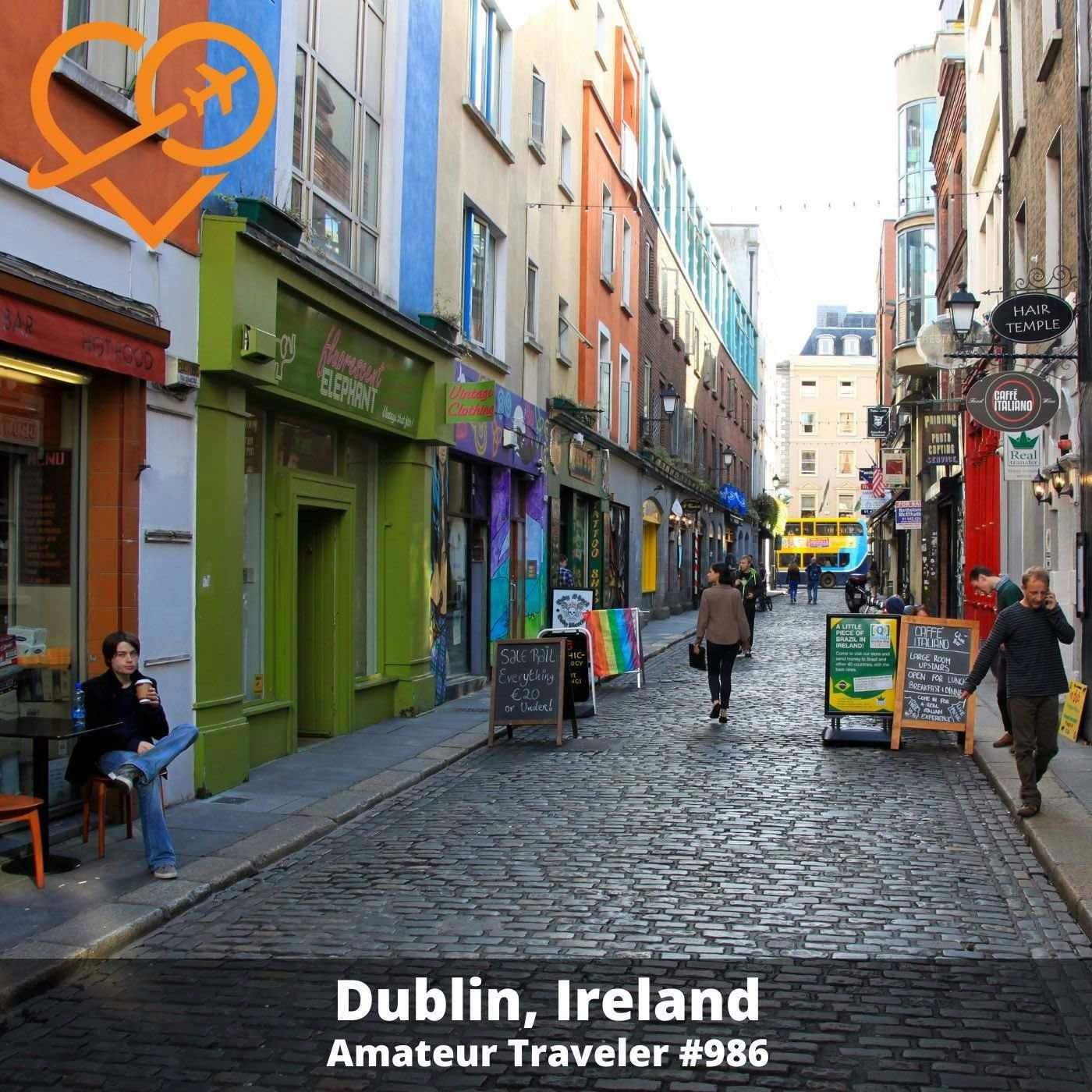
About this episode
Get every episode summarized
Each time Travel with Amateur Traveler Podcast publishes, we email you a written briefing from the transcript — the topics, who appeared, and any specific claims, with the ad reads skipped.
Email me new episodesFree for 3 shows. No card needed.
Hosts & guests
Transcript ready
513 searchable segments. Every word is indexed and playable.
Full transcript
Travel with Amateur Traveler Podcast — AT#986 - Travel to Dublin, Ireland. Machine-transcribed; use the interactive transcript above to jump the player to any line.
This episode is sponsored by Smart Travel, a new podcast from Nerd Wallet. You know that one friend who always finds the best travel deals picks the right cards and somehow ends up in first class for the price of coach. Smart Travel is like that friend, but in podcast form. They cover all things financed like how to book busy season trips without the busy season sticker shock, which airport lounges are worth it and which are basically free wifi and shares, how travel advisors can snag secret perks you don't even know to ask for, and how to get real value from points, not just a tiny reward at checkout. The Nerds at Nerd Wallet know this stuff better than me, and that's why I feel great about recommending the Smart Travel podcast. After all, we nerds have to stick together. Travel smarter and spend less with the help from Nerd Wallet. Follow Smart Travel wherever you get your podcasts. What if I told you that most of the modern day self-help advice you've been hearing could actually make you worse? The key to a better life isn't about feel-good gimmicks
that sound catchy. The mentally stronger podcast gives you access to a licensed therapist who shares science back tools that will actually change your life. Hi, I'm Amy Moran, psychotherapist, mental strength trainer, and international bestselling author. In each episode we cover research back strategies, like how to stop relying on willpower and start creating habits for lasting change. And the five mental strength building exercises you can do from your couch. I also speak to world-class experts like Dr. Nicole Kane, who shares how to permanently heal anxiety by addressing the root cause. With over 200 episodes in our catalog, this podcast is for you if you're ready to crush self-doubt, conquer challenges, and become stronger than ever with therapist-approved strategies that can change your life. Listen to mentally stronger with therapist Amy Moran wherever you get your podcasts. Amateur Traveler Episode 986. Today Amateur Traveler
talks about famous authors, a library, and a revolution, beer and whiskey and immigration, pubs, music, and busking as we go to Dublin, Ireland. This is Chris Christensen from Amateur Traveler, let's talk about Dublin. I'd like to welcome to the show Garvin Rush from DublinTourGuide.ie, who strangely enough has come to talk to us about Dublin. We're having a welcome to the show. Thanks very much for having me, Chris, great to be here. And what is your connection with Dublin, other than obviously that you're a tour guide in Dublin? I'd be the big one, so I grew up in a different part of the country. I grew up in the northwest of the country, County Dunningall, and I went to university near Dublin, so that had me in the area. I've lived in France and Sweden, and obviously did a good bit of traveling over the last 20 or so years as well. But Dublin
is the capital of Ireland, and it's by far the most important city, but people done in Cork might tell you something very different. Why should someone go to Dublin? Well, Dublin and Ireland in general, it's the type of location that if you're coming from North America or you're traveling from any other continent, it's probably not your first destination in Europe unless you have an Irish background, you have Irish ancestry or something like that. A lot of people go to France and Italy, to a continental Europe, maybe stop by over to London. So it's great in that respect because we don't get as many busloads, coachloads of tourists as other destinations. So I feel like Ireland is a destination for those that have a deeper, longer think about where they want to go in Europe. So I like to think that the visitors we get are a higher caliber
anyway. However, small that increases, the caliber level does go up. Now Dublin, it is the capital, it's bigger city in Ireland, and coming to Ireland, it's quite special for anybody, even if you don't have that Irish connection. I've heard people that are Jewish, all right, Jewish Americans, let's say, come to Ireland and they feel a sense of being home. So it has that strange and wonderful and magical air to it. That's Ireland in general. Dublin in particular, so many great things I could say about Dublin, it's a compact city, it's very walkable, pretty much all the attractions that you need to see are nearby. So you could go from one end of the city center to the other, walking in less than 20 minutes. It's very accessible,
it's flat, it's not bustling with people like, let's say London and other, let's say tourist cities in Italy in the middle of summer, right? So it has that sense of breathability, you're not overwhelmed and it's got an incredible amount of charm and history when you're coming to Dublin, you're coming to a place that's interesting on so many levels. Here's a city that was British for over 700 years and has only been Irish officially for 100 years. So we're still in the process in Dublin of coming to terms with that, understanding that and adapting to that, and by that people are trying to understand Dublin as a home, Dublin was British, Dublin is Irish
but without the British parts, it's not Dublin. So you have to have the Irish parts and the British parts to make it Dublin. And you'll see that as you walk around, you'll see the old Parliament building, which is now the rank of Ireland building. It's right in the center, it's right beside Trinity College, and in the pediment, which is the big triangle thing, right? The architectural triangle thing that you'll see atop classical buildings or in this case, neoclassical buildings within that pediment, there still remains the British code of arms, right? In the day when that was the British part of the building in Dublin until 1800 and one. So we left it there because we will not change history by removing a historical element. So there's that sense of respect for history. Obviously, as Irish people, we have a couple of chips on our shoulders,
right? Because our freedom was very hard fought and hard won. Americans, they fought the British once and they won. We tried seven or more times and when we won, it wasn't even a win, it was a draw. So you have all of those elements and Dublin has that aspect to it. So as Irish, it's British, it's old and it's new and it's the people as well. Ireland is still famous in regard to a very friendly place. I'm going to start to get into the itinerary. I get the feel here. Just for those who are listening, I ask Garvin for a paragraph for the answer to why you want to go to Dublin. So my good feeling is you put the quarter in, you got to listen to the whole song. This gives people an idea what it's like going to Ireland and a little bit of the crack here. Yeah, my people are not Irish. They actually are Vikings. There were some of the first tourists in Ireland, but they weren't the best behavior tourists. Let's just say. So what I tell you, are you going to recommend for us, Garvin? Is it a Danish name? Yep. Yeah, because there's a few Danish kings called Cristiana
or Christian. The Danes came for a little visit. It was apparently mostly the Norwegian Vikings that were over here. They called the Norwegian Vikings with whom they were more familiar, the fair foreigners and when the Danish arrived, they called them the dark foreigners. Now that might be a reference to the familiarity, unfamiliarity or the hair. People take it literally. That's funny. The hair, but dovegall is the Irish term for dark foreigner and dovegall becomes Doyle, which is pretty popular, a common Irish name today. I did not know that. Interesting. So basically, Doyle is the Irish version of Christensen. So where are we going to start as we're touring Dublin? All right. As I said, Dublin is a small city center, so you don't need to stay right behind in the middle of the city. If you're staying in a hotel, it's generally a good bet to stay on the south side of the river. So the river is the river Liffey and that very
conveniently divides the city into the north from the south side. It makes it quite easy for navigating. If you get to the river, you know that the river is either going west or it's going east. So stay on the south side of the river. Don't stay in the temple bar area, which is smack-bind in the middle of the city and famously or infamously a very noisy, busy place. It's got a lot of pubs in it. So you're not going to sleep that well there. And if you're not there to sleep fine, but if you want to get a good night's sleep to stay south of that. If you're spending what are we talking about for seven days, is that right, Chris? Yeah. Yeah. Let's say four days in Dublin. Obviously on the first day, you want to see most of the city. Obviously, I run a private tour company. I'm a big proponent of doing any sort of tour of the city. A lot of sites nearby, a lot of everything's accessible. Do that get to see most of the sites, few other attractions that
you could check out on the first day or in subsequent days? Let's talk about what the sites were that I would see, whether I'm doing on a tour or independently, what are the highlights that I'm going to tackle on the first day? This is definitely going to be a long paragraph. I suppose I'll give you my favorite sites in Dublin. Let's start with that. The GPO, the general post office, it was the center or the headquarters of the rebel leaders during the 1916 Easter rising. And this is the rebellion that led to the war of independence, which led to independence in 1922. So that's a big deal. I like to say to people, the GPO for us is like the Boston Harbor for the American Revolutionary War. Also a bit like the LMO because it wasn't a successful stand in the military sense. Yeah, the rebels lost their overwhelms. The building still standing.
It's definitely saddening better than I haven't seen the Alamo, but I don't think it was much of a left. They restored it. They restored it. With the GPO, the walls were pretty thick. The building was built in the 18, but it was the middle of a shell of it was all that was left. So there, there is a great museum about that fight. If you want to learn more about that, of course every Irish person that goes to the educational system learns about that. So it has a lot of weight, a lot of credibility to it. So I love going there. There's a great statue to an Irish mythological hero called Cullin. And I tell a great story about that. My great grand uncle was one of the leaders that fought and was executed for his part in the rebellion. So his name is on the proclamation. So this is, you could say one of the reasons why I feel so strongly about Irish history and the fight for independence. And today you ask questions like, what does that actually mean? Because
it meant a different thing in the 1920s when the struggle was real. How do we interpret that? How do we appreciate that properly today? To remember, but also to take it in the context of not just the 1920s but of today, 2026. That's a post office on the same street, O'Connell street. That's the main street. So it's a wide street. It's a long street. It'd be like the Irish shows Alize. There's Burger King and McDonald's and all the rest. It's not so fun. This McDonald's on the show on Alize. I've actually been to there. So yeah, this is no trouble. It's timber. All right. So you've got a great statue of Daniel O'Connell. Daniel O'Connell is one of Ireland's greatest historical figures. You could compare him to Martin Luther King and Gandhi in the one sentence as I've done. So he's a big deal. You can learn about him. You've got right in the middle of the street the spire. So this was built to welcome in the new
millennium. It is a metal spire. Stay in the steel by the way, 121 meters high. Marks the center of the city and welcomes in Dublin into the new millennium. Or rather, it's a way for the new millennium to bring Dublin along with it. So it's quite different to the classical and Georgian and Victorian architecture that you'd see in Dublin typically. That's big street. Those are important monuments going south then. You're going over the O'Connell bridge and you're looking up the river to the west and you'll be able to see the Hapenny bridge, which is one of these icons of the city. So it's beautiful white bridge. It was one of the first rot iron bridges in the world. Way back in 1816. Yeah, it's one of these charming icons of the city. But going south from O'Connell bridge, you're walking towards Trinity College. So the university itself
was set up by Queen Elizabeth back in 1592. That's a beautiful university. When you come in, most of the architecture you're looking at is from the early to mid-1700s. So it's a lot of new classical buildings and then you go into the old library of Trinity College and it's just full of oak vaulted ceilings, bays where there's still some books in there. They're getting ready to refurbish it and they can't quite come to terms with the idea of closing the doors for a couple years. So they've been delaying that again and again. And now it seems that they're set on closing in 2027. So if you're listening to this, you're interested in going check out the websites, check out some news because they might have moved that forward to 2037. We'll see.
Well, and have they announced what they're going to do with some of the well-known exhibits like the Book of Kells, which a lot of people come to see the illustrated volumes. So they're going to have, this is what we've been told, they're going to have that in a separate building. Okay. And I guess they'll have a fraction of the displays and exhibitions that they have normally accompanying it. So it will be visible, but just the library will be getting fixed up in the meantime. Okay. Beautiful libraries. It's one of the most beautiful libraries in the world. I would say top three, but hey, I haven't been to all the libraries. It's up there. It's on my list as well. I don't know if I ever ranked that list, but yes. Trinity College, if you leave Trinity College, then you're going to the site side and you can pass by bookshop called Hodges Figus. And if you can spell that, you'll get a golden star. So H-O-D-G
E-S, and then separate word, Figus F-I-G-G-I-S. Hodges Figus, it's been going since 1768. Beautiful building, amazing, and quite a large bookshop. So a typical Dublin of things to do is to amble past the display windows and see what the new releases are. Of course, Dublin is quite an important city for literature, because I'm not going to quiz you, but if you know any famous authors, you could tell me. But it's a UNESCO city of literature because of the great contribution that Dublin, in particular, Ireland in general, has made to world literature. So you've got Brahms Stoker who wrote Samuel Beckett, who's regarded as the greatest playwright of the 20th century. You've got Oscar Wilde, another great playwright from, I'd say the 1880s,
1890s, the opposite of Beckett, and that if you go to see Oscar Wilde play, you're going to have a life. So you have some wine, and then there'll be a break, and then maybe you'll have some more wine, and oh, you're having a great evening out. Beckett, have some coffee, bring your no pad, make sure you have two pens, because you'll need to figure out what's happening. Waiting for Godot is his most famous play, and one of the quote is that it's a play where nothing happens. Happens, yes. Yeah, so flippa corn, Oscar Wilde or Samuel Beckett, which one you want to go see? Anyway, huge figure is big names, and probably the biggest of them all is James Joyce, and if you thought Beckett was inaccessible, here's another giant. So his book, the most important book that he was called Ulysses. Ulysses, right? And it's set in Dublin in 1904. It follows Leo
Paul Bloom as he makes his way through the city. So it's a tom of a book. It's thick in more than one way. People attempt to read it. People say they read it, but don't understand what's going on, because it's spectacularly particular to Dublin on the 16th of June, 1904. It is regarded as the greatest work of fiction in the English language. It is adored by university professors and lamented and scorned and hated probably by their students until 50 years pass or so, and they're like, ah, now I get how amazing it is. One interesting time to come to Dublin is on the 16th of June. We call that Bloom's Day after the main character, and people dress up like it's 1904. It's very cool. Ladies wearing the wide dresses and hats, and the gentleman, it's funny,
men's fashion hasn't changed as much. Just wear a hat. We're a suit in a hat and you might fit in. Walking thick, that'd be nice as well. And of course there's readings, there's pilgrimages through the city, following the book, following the chapters. It's very interesting time to come. It's the opposite of St. Patrick's Day. Okay. In terms of the visitor clientele, right? We have on Bloom's Day, you got professors flying over on St. Patrick's Day, you have the spring breakers flying over, right? The students are coming over for St. Patrick's Day. Maybe now it would be a good segue to talk about the different times of the year to come to Dublin. Yeah, that'd be great. Great. So I guess we could start chronologically with St. Patrick's Day, because that's when Dublin and Ireland is in the limelight on the world stage. People that haven't been to Ireland don't realize that St. Patrick's Day in Ireland is more of a family day. You can't buy alcohol
in the shops until after the parade is over. So people come out with their families and it's really a family affair. It's good except for there's a few bad apples, right? That you see and you're like, okay, but most people are there for a sober, fun, joyous time. Now the parade ends, kids go home and then you can do what you want. But that's typically what it's like. It's great to be in Dublin and St. Patrick's Day. See the big parades, it's a special occasion for sure. Of course you're not going to get into any of the pubs unless you're there really early or unless you get out of the city center. But even then it's going to be the most popular time of the year for the publicans. An interesting thing to do is obviously you can see the one in Dublin, but you could go to some nearby commuter towns or smaller towns I cite Dublin and see once they'd be colic because it's happening in the town, but you can see more of a local flair. And nowadays we welcome a tremendous amount of American high school and college
bands that come over and march in the parade, which is great. Oh, interesting. In the past, in the 1950s or 60s in Ireland, every town had its own brass band, but through emigration, the bands slowly disintegrated. So it's good to have these American bands coming back. It's funny. The Irish emigrate to the US and then for a small short time, we bring these bands back just to bump up the St. Patrick's Day parades. Oh, important. We don't color the beer dream. That's the ludicrous thing to do. And oh, very even more important. The Shamrock, the national symbol of Ireland, along with the harp. Technically the harp is the official one, but the Shamrock is three leaves, not four. So if you're ever in Texas and somebody, happy St. Patrick's Day, and it's sent patties with a D with two D's, not with two T's. I've seen this as well. Happy St. Patrick's Day, or if you're not sure, just some Patrick's Day and the Shamrock
with the three leaves, not the four leaves. That's wrong. Yes. Okay. So in the past, that day of trying to, especially wrong on St. Patrick's Day, who at least in story, if not in reality, used the Shamrock as a way of explaining the Trinity to the Irish people. So a four-leaf Clover would not work as well. Contextual. It would work. No. I don't even know what the four version of Trilogy is. A quadrilogy, is that it? Probably, but that's, it takes too long to say. So then you've got Bloomsday or Summer in general, and that's obviously a great time to come. Ireland doesn't get too hot. So typically it won't go higher than 85 degrees as the highest it goes, and it's typically 65 to 75 degrees Fahrenheit. So you're talking 18 to 23 degrees. It's perfect. And it doesn't really get tremendously cold either. April is a great time to come. It's
one of the driest months of the year, which surprises people, because you think of April showers. And that's pretty important if you're going off to the west of Ireland, which is quite rainy. So it's twice as rainy as Dublin, and you might think, oh, that must be incredibly rainy, because Dublin is very wet, right? Dublin gets less precipitation than New York. Huh, I did not know that. Nobody thinks of New York as being spectacularly rainy, yeah. So think of that. Dublin is nice and dry as the driest part of the country. And then let's fast forward to Halloween. So Halloween was invented in Ireland. Halloween is originally sauan, the Irish word. And sauan was Celtic New Year. So the harvest had finished. You're walking up everything, so to speak, for the winter. Who knows? Twitter, you might die, right? So there's a celebration, a big celebration of the year.
And people let bonfires, which is something we still do today in Ireland. And people would drive cattle between the bonfires to purify them and save them from the coming winter. And of course, from all of the demons, because this was the time of the year when the door to the other world was opened. And you would get all of these. We call them fairies. Now, typically today, the word fairy is tinkerbell. That's what people think when they think of fairy, but in Ireland, it's much broader term. You have all these different creatures. Some of them are mischievous, but neutral, like leprechaun, right? That's the most famous one. You're like, oh, leprechaun, the leprechaun will take his revenge on you, because you're literally trying to steal his goals. Who's the bad guy in this interaction? So the leprechaun is in the middle. Then you have good fairies like the banshee, who actually screams in the middle of the night to let you know that
one of your family members is going to die soon. So, okay, I didn't think of that as a good guy, but all right. Yeah. You think, oh, God, they're not causing it. They're the ambulance, basically. They're not causing the accident. They're telling you, they're the ambulance before the accident happens, which is that would be ideal, really. So they affect apparently certain families in Ireland are known to be blessed with a banshee. And what that allows you to do is obviously if you have a sick uncle or father or grandfather or whatever age you are, that tells you, okay, you better go see him. He lives down the country. It doesn't matter. Go and see him because he might already have a day left. That's useful. I would find that useful. And then on the other side, you have malevolent fairies like the doulahan or the headless horseman. Sleepy Hollow, that movie, the headless horseman, that's an Irish fairy originally. Okay. Right.
Anyway, so the only one that kind of got on the cereal boxes, so to speak in America was the leprechaun, but there's several of the fairies and some of them are malevolent. So if you're going out at night at Saoan, at Halloween, you don't want to see these guys and you don't want to be seen more importantly by these malevolent fairies. So what you do is you dress up, right? You dress up like one of these demons. And I like to joke with the doulahan cesian. He's raced towards you on his horse and is, oh, no. That's, no, that's Frank. Yeah, that's Frank. He's probably going off to annoy somebody. They think that you're one of their own. You have in Ireland, you can celebrate Saoan or Halloween. Oh, throughout the country, there's sacred sites, ancient pagan sites that you can go to. And then there's the modern equivalent, the capital of Halloween in Ireland today is dairy. So dairy city up in Northern Ireland. I went there for Halloween
this year. That was great. So they have a parade, a Halloween parade followed by a fireworks display. It's fantastic. We don't really do fireworks at New Year's Eve. We save them for Halloween. Some people, you'll be setting them off throughout September, which is weird if you know that Halloween is the end of October. Yeah. All right. So that's Ireland. In terms of the weather, don't worry much about the weather unless you go into the west. In that case, you're just flipping the coin. And as we say in Ireland, people don't come to Ireland for the weather. Well, you're not going on a sun vacation. You're not lasing around the beach. You're going off exploring all the history and culture and heritage that there is here. It's a small place by American standards. The Republic of Ireland is the size of West Virginia. Yeah. But it's dense. So anywhere you're traveling in Ireland, there's a lot to see. So if you're staying in Dublin, you're going to be in Dublin for preferably two or three nights and then you'd
probably head off to see the rest of the country. If you're using Dublin as a base, that can work, but you're talking about long days. So if you were going to Dublin over to the Cliffs of Moher, which are these famous spectacular Cliffs on the west of the island. A lot of people go there and take that 13-hour day to drive over there, see the Cliffs, go to Galway, and then come back again in the same day. And you're just overly tired. You're pretty much hung over the next day in terms of your energy. So I'm going to pull you back to Dublin because we actually have another show about the Cliffs of Moher. In terms of that finishing up the first day or what you would do the second day in Dublin. Yeah. So on your first day, see most of the city. If you're flying in that day from North America on a red eye, probably don't want to pack in too much on
that first day. Three hour walk in tours, what we do with a break halfway through for coffee, we have five hour tours as well. It's more comprehensive. That's a good jet-lined breaker because you don't know what to do. I would think it's also because you have trouble fitting everything into a three hour tour. It would be my guess here. For sure, yeah. So after that, then on your first day, if you do want to go to Guinness, the Guinness Storehouse, that's the day to do it because you're a bit tired and Guinness, you do that at the end of the day. That's a five o'clock or four o'clock or three o'clock even. In the summer, they're opened a bit later. You could even go at seven o'clock in the summer months. And it's got the aculate of the best tourist attraction in the world. So you can look that up. It won that award. So it says a lot about what the experience is like. It's pretty good. It's pretty good. For me and a lot of locals, the best thing is getting the Guinness and standing on the top floor and looking out and you
have this great 360 view of the whole city. And that's particularly impressive because Dublin is a very low-lying city. There's little skyscrapers. So you can see all the churches and everything else, right? It's a great end to the visit of the Guinness Storehouse. And I have been there, but I'm not sure that everyone can picture what you're talking about. But it's a five-story building, I want to say more museum and bar at this point than factory. Oh, yeah. You won't see any of the beer being made. You'll walk through the experience. You go up each floor. I think the gravity bar might even be the seventh floor. Okay. It's been a few years since I was there. Yeah. But yeah, there's a lot of it. And most buildings in Dublin are four to five stories high. Yep. And they're normal stories, whereas this is a big building.
There's Guinness. There's also Jamison. These are the two big attractions that a lot of people want to go and see. And that's fine. They're good attractions. The downsides are Guinness. You can't see the beer being made. You can see some other breweries in Dublin, craft breweries where you actually get that experience. And likewise with Jamison, in Dublin, they don't make the whiskey there anymore. It's made down in Middleton County, Cork. So if you're looking to see a work in distillery, there's Teeling, which is T-E-E-L-I-N-G, and it is a working distillery in Dublin city. In the same kind of area, in the Liberty's area, which is the old industrial brewing and distilling part of the city. And it's experiencing a resurgence over the last 20 years, more and more of these smaller distilleries and breweries are popping back up, which is great.
So in terms of your options there, I think a lot of people on an itinerary of Dublin will include some drinking, or at least a visit to an alcoholic institution, even if they don't drink. So you've got the beer and Guinness, the whiskey in Jamison, you go to Teeling instead. I'm not going to list all the distilleries here, but there is an interesting one called Pierce Lions. So that's P-E-A-R-S-E, and then separate word lions, L-Y-O-N-S. And it is actually built inside a church, an old church. So that's quite unusual. I find that quite memorable. The tour guide will not just give you a tour of the distillery, but also of the graveyard, and pick and mix a few interesting stories of some of the people buried there since the early 1700s. We're talking about alcohol while we bring that up. And you mentioned the temple bar area, which is a very touristy area.
Wouldn't necessarily be where I would go if I wanted to listen to some traditional Irish music. Where would you send me? The temple bar. I'll give you the pros and the cons, right? It's right in the center. It's convenient. It's got original narrow streets. It's got cobbled streets with heads to the charm. A lot of the pubs are nearly all the pubs are men for tourists. So the design that way, what that means is that you won't really find any locals in them. But because they're men for tourists, what a tourist want, they want traditional Irish music. So you can actually get some pretty good Irish music in the temple bar area. Just walk down the main street with your ears pricked and pop into a pub that sounds good. And most of the pubs will be playing live music from, let's say, 2 p.m. onwards, if not earlier, during the summer. So that's a good thing to do. In fact, at the end of January every year, there's the temple bar
Trad Festival. Trad is short for traditional Irish music. That's a great opportunity for locals and even international music enthusiasts to come to the area and sample some of the greatest musicians in contemporary Irish traditional music. I could say that. A few other pubs outside that area. Generally, the rule, if you're coming to Dublin and you want to go to a pub, stay away from temple bar and you'll get a good pub. You'll get a local pub, you'll get some opals, you got some good gitties, and you'll get authenticity. Because one or two, not all the pubs, well, one or two of the pubs in temple bar are claiming to be very old and are not that old. So if they're saying traditional Irish pub and red neon, it's an oxymoron, isn't it? pubs that you could get proper Trad in include the cobblestone. So the cobblestone in the Smithfield area, Smithfield is a great up and coming area. It's got a lot of cool cafes,
interesting places for brunch. It's a hipster sort of place, but it still got that grit from the 1980s. But it's a lovely place to walk around. The cobblestone was regarded as... That's actually by the Tramison distillery. It's nearby, yeah. But the cobblestone was regarded as a hidden gem in Trad music, but everybody knows about it now. It has known for really the last 10 years. So it's great to come and listen to the music, but you won't be able to see many musicians because there's too many people in there. So I love the cobblestone. I just wish they put the musicians in a different part of the pub. So more people could see them and hear them. So my alternative would be Piper's Corner. Piper's Corner, on the other end of town, it's east of O'Connell Street, and they host Trad Sessions, more of a local crowd there, and far easier to see and hear the musicians playing. Excellent. What other sites would you recommend that we
can't leave Dublin until we've seen what? So I won't mention monuments, but I'll talk specifically about attractions like visitor centers, so to speak. Okay. So there is The Old Library of Trinity College that contains the Book of Kells. You mentioned that. The Nash Museum of Archaeology and History. Okay. That is amazing. That's probably the best attraction in Dublin in terms of the value. Interesting. That's within it. So it has objects that go back in 9,000 years, which is difficult to comprehend. It has the bog bodies, which you heard about these? Oh, sure. Yeah. Yeah. So they're very well preserved in the peat in the bog, and they were discovered in 2003, and they're over 2000 years old, but the hair, the stomach contents, skin, everything
still intact and visible there. The stomach contents are not visible, thankfully. So you've got that. You've got the Epic Museum. So I love this. This is an attraction that's less than 10 years old. It's the Irish Amigration Museum. So it has the word museum, but it's not your traditional dusty one like the National Museum. It's newer. There's a lot of screens. It's very engaging. Easy to spend two hours there, and it tells the story of how so many Irish people left Ireland, and then went to not just to America or Britain, but all around the world and talking about the descendants of Irish people. Obviously, you're talking about JFK, but you're also talking about over a dozen US presidents, talking about Charles DeGal from France, had Irish ancestry, the forefather of Chilean independence, Bernardo O'Higgins, Irish background. The man who created the
Argentinian navy was also an Irish background. So there's all these amazing stories. So that's a great one. I would heavily recommend these four things that I'm telling you about. The museum, the difficulty level is 5 out of 5. The epic museum difficulty level probably 3 out of 5. The next one I'm going to tell you about is Kilmainum Jail. So if you try to spell that, you'll have some difficulty, but just type in Dublin and then type in G-A-O-L. And that'll get you Kilmainham Jail. That is a jail from 1796 or thereabouts, and it's amazing. So it's where so many of the great rebels and Irish figures had been imprisoned over the years. If you go there, you'll hear about like the, it's like going to somewhere in America where, oh, this is where
Martin Luther and Abraham Lincoln and George Washington were all interred at the very time. So it has nearly the whole pantheon of important Irish figures and interred there. And it's where, most importantly, one of the leaders of the 1916 rebellion were executed. Right. Way back in 1916. It's a brilliant place. The guides are fantastic. It's high in demand. So if you're going there, you do need to book online and you should do that a month in advance. You need to check that out. They do release tickets at about, what is it, 9.15 or 9.30 in the morning? So it's a tad early for more I live, but yeah, you're in Ireland and you want to get them online at that stage. So those are my four great attractions in Dublin. Obviously, you could see the two cathedrals, Christchurch Cathedral, St. Patrick's Cathedral. I think they're both fantastic, but you need to
understand the context before you go there. I think a lot of people will go to St. Patrick's Cathedral because they think St. Patrick, Ireland, the Irish or Catholic, the Cathedral must be Catholic. Right. But it's not. Right. And it hasn't been Catholic for 500 years. So it is the National Cathedral, even today in Ireland, which at least up until the 90s was a very Catholic country. It falls in very important to us historically, but St. Patrick's Cathedral is a Protestant Cathedral. So if you go in there, you're going to get a great glimpse into what Dublin was like before Irish independence. So this is showing you the British heritage of Dublin. And it's quite unusual for Irish people to go in there to visit and see, wow, there's British flags in here for British army regiments. And there's monuments to the wars in China and Burma. So at the first time I went in there, I was quite shocked at that. You don't
see that in Catholic churches in Ireland. Of course, besides that, it's a fascinating cathedral in general. You see an old monument of St. Patrick in there, some ancient graves labs. It's just chuck a block full of things. So I'd recommend going to it. But as long as you understand that context, you'll understand the Cathedral. Of course, Dublin has a lot of great green areas. So if you want to take a break, St. Stephen's Green is probably the most beloved part of the city for Dubliners. And in summer, of course, there's events in St. Stephen's Green are more likely Marion Square. So that's M-E or I-O-N. They'll have events in there throughout the summer and particular. And one of the best streets to visit is Grafton Street. And by that, I mean, it's mostly for Dubliners in terms of shopping. So you're not going there for the shopping unless you need to get something real quick in Lululemon, but you're going there for buskers. Going there for
the street performers, which are mostly musicians. And it's great to walk up into the street and see some fella playing a classical guitar. Some of the fella playing some Japanese instrument that I don't know how it works, but it's interesting and I like the diversity. And then you get somebody with a acoustic guitar, of course, playing something that you've heard seven million times on the radio already. And then you get someone playing their own song. So it's good to have the mix. And every Christmas, there's a charity event set up called The Big Busk on Grafton. And it involves artists like Bono and Hozier, who went and answered, playing on the street and just to raise body for charity. Imagine them there on the same level as you. No stage, minimal security. It's a great experience. So that's Grafton Street has that old air where you would have seen
these buskers throughout every street in Dublin back in the day, but Grafton Street is kind of the last holdout. Now, you want to run Grafton Street. As I said, there's going to be a lot of brand shops that you've seen before. But go west of Grafton Street. Go and get lost for a few blocks because that's where you've got the smaller boutique shops. And that's where you'll see some kind of quality locally made or at least locally owned shops. Okay. So I think that works quite well. Excellent. It seems like you've wrapped up what you would do in Dublin. Are there one or two side trips that you would add if I was going to extend my four days in Dublin to seven days? You've got the city center, as you mentioned there. If you want to take nice little day trips from there, both H-O-W-T-H is this peninsula to the northeast of the city center by 40 medits
on the bus or train. And it's a lovely seaside time. So it's great to go there and go to the summit of the peninsula and walk down along the coast. Great way to get some fresh air, just escape the city, feel a bit of space, and then have an Irish coffee in the Abbey Tavern or go have some great seafood. Probably the best place in the area, including Dublin City, for seafood is Hoth. Okay. And if you're a really adventurous, you could go to Lambay Island, which has wild wallabies. Wallabies, this is Australia. I'm sorry. And they're in this island off the coast of Dublin. Yeah. Lambay, L-A-M-B-A-Y. There's also a distillery there. Lambay, distillery, pretty good, if you like your whiskey. But that's something unusual. So obviously, first time visitors, you probably just
want to do the usual stuff, hit the main attractions, check out Hoth in general, and then going south from Dublin, County Wicklow is the next county. And that's a great one if you only have a whistle stop tour in Dublin. If you're only there for a little while, go to Wicklow because that will show you Ireland in miniature in a lot of ways. It's like known as the Garden of Ireland. It's got a national park. There's mountains. There's a lot of greenery in forests. So it's a beautiful place to see the famous 40 shades of green. That's people talk about. It's a wonderful monastic ruin called Glen Da Loth. That's one word. So I'm not going to spell it, but it just happened monastic ruin south of Dublin and you'll find it. And we have a great episode of anybody's interested in following up on that 884 Dublin to Cork Road Trip in Southeastern Ireland that goes through Glen Da Loth and County Wicklow and Waterford and Wexford and such. So I'll send
people over that way. Excellent. I think we're starting to wrap this up. Anything else people really need to know before they get on a plane and head to Dublin? Obviously, dress with the weather. The temperature ranges are quite narrow. So it's not going to be too hot and not going to be too cold. It might rain a little bit, but it doesn't rain a lot when it rains. So it rains a little bit stops and then it's dry again. That's the type of where they expect at least in Dublin. And in terms of let's say interesting places to eat, I'm not going to mention a lot of them, but Ireland is famous for green grass, which means we have great cows or at least happy cows and the milk, the butter is famous. And thankfully, recently, like in the last 20 years, let's say, we have some good ice cream companies is Murphy's. So Murphy's from Western Ireland. That's right. Yeah, it's from Dingo. So maybe it was covered in the show, except you went to Cork, you didn't go all the way to
Kerry. No, I've got we've covered in a different show on Dingo. So they have a parlor in Dublin city. So I'd say making a quest to try to visit as many of these as possible. Great ice cream made with the milk from an Irish breed of corn, which is great rare nominees. So Murphy's ice cream. And I would recommend their Irish brown bread ice cream. Yeah. And also the sea salt would be the my two favorites. Three samples start with the sea salt, then brown bread, and then I always go with the gin, then I haven't had that one. That's quite interesting. And then another one is Butler's chocolate cafe. So that's an Irish chain. And they do a fantastic dark hot chocolate. It's the best hot chocolate I've ever had, dark hot chocolate at Butler's. Yeah, you'll feel satisfied as you're halfway through it. Excellent. As we go to wrap this up, we've got a
couple standard wrap up questions. One is you're standing in the prettiest spot in Dublin. Where are you standing and what are you looking at? That's a tough one. Now it might be if it's William Square. Interesting. Okay. Because they have, so a square, it's got a park that's actually still private. It's the last private park in Dublin. And a lot of the buildings are from nearly all of them are from the 1790s, and they're pretty well preserved. And if you could remove the cars, it almost would bring you back in time. Oh, the interesting. And you're right down there by the canal, where my daughter and son-in-law got engaged. So I have a fondness for that part of the city. Where along the canal, though? Right about a block from there or two blocks from there. I was there. You don't remember a particular part of the canal?
Oh, it's about right by, I would say, a cross from the Mirisville hotel, if I had to guess. Yeah, that's a lovely place as well, because it's a great walk to work if you're walking along the canal there. Yeah. There's always some ducks and herons around there. Yeah, but for me, I think just Dublin-specific, what it's famous for is that architecture from the 1700s, that red brick buildings, townhouses from that period. That's quintessentially old Dublin. Yeah, excellent. She's that one. One thing that makes you laugh and say only in Dublin. I don't know if this is Dublin-specific, but it needs to be an anecdote, right? So I'm there on my bike, and I'm coming towards O'Connell Street, and I'm cycling along, and there's another cyclist beside me, and I said, blade and taxi drivers think they're on the route, and then he
swirves without looking or indicating all over the road, and I'm like, at least the taxi drivers know how to use the road. So I guess, it's funny, people, I think everywhere in the world, people are convicted by the cyclists and the taxi drivers, but it's just the accent, right? Blaying us, they think they're on the road. Excellent. And if you had to summarize Dublin in three words, what three words would you pick? Go, it's interesting to see an Irishman loss for words. So three words to describe Dublin. Yep. I'd go with tone. Okay. Because of the cohesion of the city and the feeling of it, like Irish people are not really used to living in cities. Cities are, for the most part, a foreign introduction to Ireland. So people
like the sense of familiarity and closeness and smallness, and that's why we call it tone, rather than a city. So tone would be one, and I suppose, gritty would be another. Okay. And the third one would probably be real, as inauthentic, right? So there's not that much pretentiousness in Dublin, at least. Dubliners take people down a notch if they have that sort of attitude. Excellent. Excellent. So I suppose I could leave you with one last thing in that respect. People make jokes about Bono from you too. Sure. And they say things like what's the difference between God and Bono. God doesn't walk through the streets of Dublin pretending to be Bono.
And there'd be graffiti. Bono has a big head and things like that. No, I don't believe with them, I like Bono, but these are what like Dubliners say, just because he's successful, right? And people want to take successful people down a notch. So it has that element that makes it real and takes away the pretentiousness. Excellent. Our guest again has been Garvin Rush from DublinTourGuide.ie, and I will put a link to that in the show notes, of course. And if you haven't gotten enough Garvin, I think you could easily get more by booking him as a tour guide on your next trip to Dublin. Anything you would say about that, Garvin, before we wrap it up here? Yeah, thanks, Chris. Yeah, obviously check out the website. We've got the site scene tours, we've got themed tours like pub tour, or if you want to do the opposite of that, a museum's tour. If you can't decide, we've got a combo tour, it's called the sites and pints. So a four tour that's half site scene tour and half pub tour, we also offer driving tours outside
of the city as well. But the main focus is on doing a private, typically we have two to four people, because I like to have a conversation, and I like to connect with people. And you can't really do that in an hour. Yep, excellent. Thanks again for coming on amateur traveler, and sharing what is your obvious love for Dublin. Thanks very much, Chris. A special thanks to the patrons of the show who help support amateur traveler. If you're interested in learning more about what you get by becoming a patron in the show, early access to episodes, no ads, and a monthly Zoom call, go to patreon.com slash amateur traveler. I'm heading out to Central America here too, but the good news is my understanding is we have enough people that the trip to Uzbekistan and Turkmenistan is going to happen. If you're interested in joining us, there's still some room. I hope you can make it. We're going to have a great time for more information. Drop me an email or go to amateur traveler dot com slash trips.
With that, we're going to end this episode of amateur traveler. If you have any questions, send an email to chris2xedgmail.com or better yet. Leave a comment on this episode at amateurtraveler.com. And as always, thanks so much for listening.
More episodes
More from Travel with Amateur Traveler Podcast

AT#1012 - Travel to Detroit, Michigan
Travel with Amateur Traveler Podcast

AT#1011 - Travel to Madrid, Spain
Travel with Amateur Traveler Podcast

AT#1010 - Travel to Northern Portugal
Travel with Amateur Traveler Podcast
AT#1009 - Travel to Virginia (Richmond, Williamsburg, Jamestown, Yorktown)
Travel with Amateur Traveler Podcast