BAC 'Second to None' in Banking & Finances as Financial Sector Sells Off
About this episode
Tyler Ellegard turns to Bank of America (BAC) as the financial sector sees a 10% decline across the board. That said, he sees banks ringing in a rebound. Tyler likes Bank of America in particular with a "second to none" balance sheet and room to expand ROI with AI. Tom White offers an example options trade for the stock.
======== Schwab Network ========
Empowering every investor and trader, every market day.
Options involve risks and are not suitable for all investors. Before trading, read the Options Disclosure Document. http://bit.ly/2v9tH6D
Subscribe to the Market Minute newsletter - https://schwabnetwork.com/subscribe
Download the iOS app - https://apps.apple.com/us/app/schwab-network/id1460719185
Download the Amazon Fire Tv App - https://www.amazon.com/TD-Ameritrade-Network/dp/B07KRD76C7
Watch on Sling - https://watch.sling.com/1/asset/191928615bd8d47686f94682aefaa007/watch
Watch on Vizio - https://www.vizio.com/en/watchfreeplus-explore
Watch on DistroTV - https://www.distro.tv/live/schwab-network/
Follow us on X – https://twitter.com/schwabnetwork
Follow us on Facebook – https://www.facebook.com/schwabnetwork
Follow us on LinkedIn - https://www.linkedin.com/company/schwab-network/
About Schwab Network - https://schwabnetwork.com/about
Get every episode summarized
Each time Schwab Network publishes, we email you a written briefing from the transcript — the topics, who appeared, and any specific claims, with the ad reads skipped.
Email me new episodesFree for 3 shows. No card needed.
Hosts & guests
Transcript ready
80 searchable segments. Every word is indexed and playable.
Full transcript
Schwab Network — BAC 'Second to None' in Banking & Finances as Financial Sector Sells Off. Machine-transcribed; use the interactive transcript above to jump the player to any line.
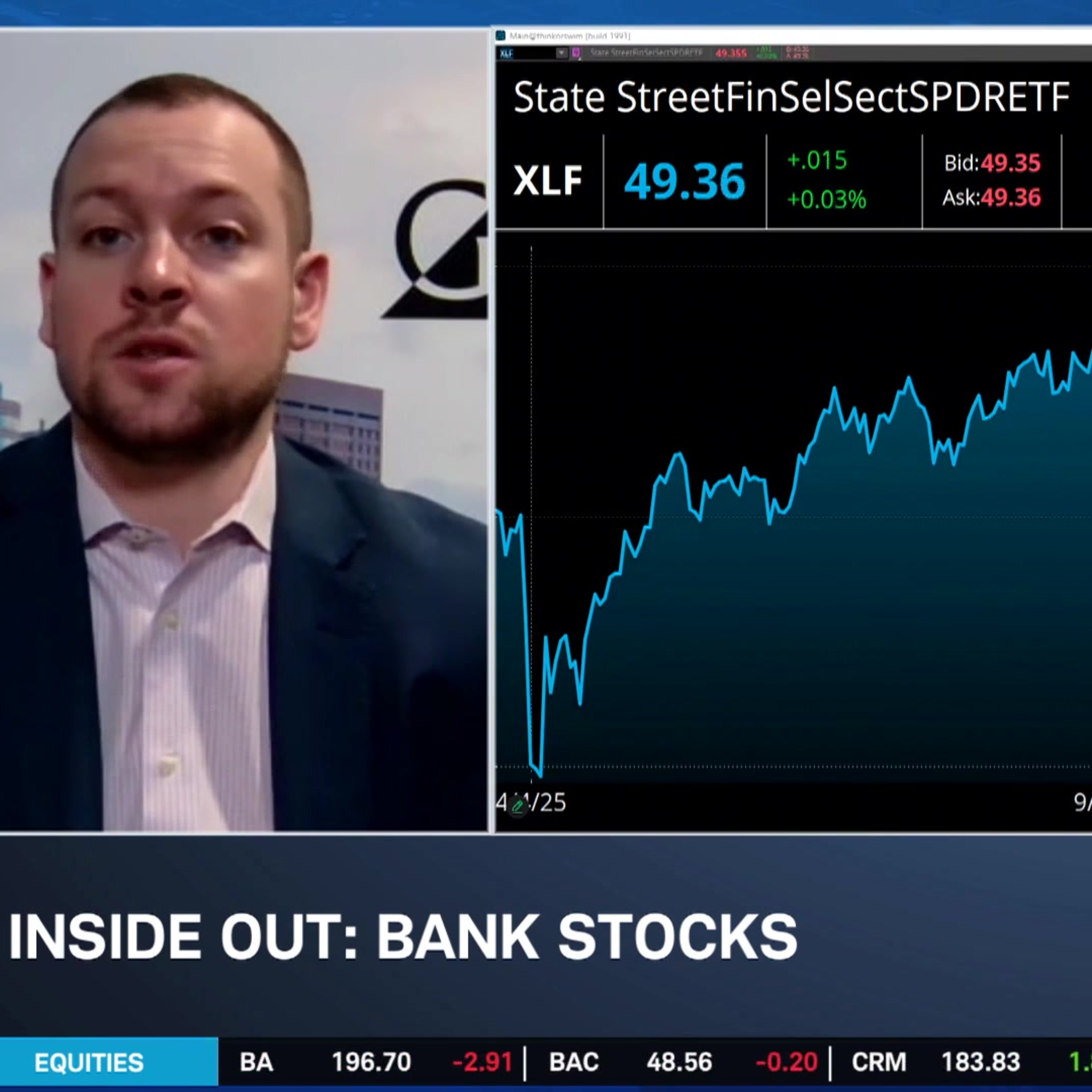
We are back on Morning Trade Live. Let's take a closer look at the financial sector after our performance in 2024 and 2025. The banks have come under pressure to start 2026. The XLF is down 10% so far this year and has come down 13% from its all-time high on January the 6th. Let's go inside out of Big Banks. Joining us now is Tyler Elligard, who's the Senior Portfolio Manager over at Gradient Investments. Tyler, nice to have you on the program. What's going on with financials in 2026? Well, you've had a, as you mentioned, they perform very well last year and I think part of it is the concern over AI and the potential trade that AI could be. We've seen the software stocks pull back quite a bit lately and I think the financials, especially the money center banks are getting caught up in that trade as well because the thesis for a while now for banks has been the AI trade and the loans that the company is going to be taking out to build out these data centers and the overall infrastructure to continue to build out AI in general. And so I think you've just started to see as somewhat
of an unwind of that trade right now as concerns over AI and the future impact that it can have on consumers and employment and everything like that that goes along with it. So I think it's more of just an unwinding trade right now and I think from our perspective it's more of a buying opportunity at this point. Okay, so obviously the banks are going to be the first cab off the rank when we start to get those earnings in about three weeks time. So far the fundamentals have been holding up or what are your expectations? What are we going to be hearing from some of these corporates? Yeah, look, I think there's been a lot of talk, especially from from an entire bank perspective. There's been a lot of talk on more regional banks and the opportunity set that those banks provide. However, we've been more focused on the money center banks like the bank of America's, the Goldman's, the JP Morgan's because they have more of a diverse business. They have more inroads to the AI businesses that are taking out the loans to build out the AI data centers. So I think from an earnings perspective, I think you are going to start to see, especially with the volatility that we've seen in the past couple of weeks, you're going to start
to see strong earnings on not only the trading side, but I think from a M&A perspective, you're going to start to see more higher growth rates on the M&A perspective that as these AI companies become larger and they're acquiring different smaller companies. And so I think you're going to see strong growth rates from the money center banks, which is why we're focused on those rather than the regional banks, which are more focused on the the loan growth profile of consumers. Why do you like Bank of America in particular, versus some of the others? Yeah, look, Bank of America, fantastic company. I mean, the stock has pulled back about 18, 19 percent at this point. And so from a valuation perspective, from the earnings growth expectations of mid-single digits, and they're a bank that so many companies go to from a, especially our trade is more on the AI side, despite the pullback. But I think from an AI perspective, they have inroads into the AI data center play. And so I think Bank of America with the pullback that it's seen
in the growth expectations for the company and the ability for them to shift things around on their balance sheet to create additional return on equity and return on assets, I think, is second to none in the money center bank industry. And so we just feel that Bank of America's poised for a strong performance here from this point forward. And how is a position versus say some of the others with respect to obviously the shifting goalposts with the global repricing of obviously energy and rates and even growth expectations now and any potential for demand destruction that we might see as a result of that? Yeah, I don't know that you're going to see too much of a demand destruction from a Bank of America because they have such a wide breadth of diversification, whether it's retail, whether it's institutional companies and the ability for them to get their abilities out into the investment banking industry as well. I think he's going to just
provide growth overall, separate from any of the smaller regional banks. Again, we like money center banks, so you can talk about the goldmins of JP Morgan's of the world as well. But I think from a Bank of America perspective, I think they're just based on the pullback that they've had, the valuation that they're currently sitting at, I think they're just poised for the best performance in our opinion. Okay, great stuff. Tyler, really appreciate it. Thanks so much for joining us today and giving us a little bit of a setup, of course, as we approach this next earnings season and other banks are fairing. Tyler, Eligard, they're seeing you portfolio manager and gradient investments. Let's trade Bank of America now with Tom White, host of fast market. Walk us through the approach here, Tom. Obviously given just where financials are at right now, the underperforming sector for the year. Yeah, and that comes on the heels of a pretty good 2025. You know, these stocks hit, they're all time highs, a lot of the money center banks at the beginning of the year. And as your guests mentioned, we pulled back about 16% from those record highs that we saw. So maybe some opportunity here, I think the banks need to participate if
we're going to see a rebound in the market, especially after the drawdown. Now, the stock is still up about 3% so far this week, so that's a positive. So I looked at a strategy, they report earnings on the 15th of April. So you've got that event risk out there. I went a little bit more conservative with a covered call strategy here where for every 100 shares of stock you buy, you sell and out of the money call to the upside. Now, the stock pays a 2.3% dividend yield, so you're going to collect some yield due to the dividend because you own the shares in this strategy. And then you're also going to create some yield because you're selling that out of the money call on this one. So I looked at, for every 100 shares of stock you buy, you sell the April 17th monthly options that expire in about three weeks, sell the 50 strike call against that. So you're going to pay a debit of roughly about 4760 on that particular strategy. That's going to be your break even. So you're buying the shares at a discount of 2%. But then you also get to collect that
yield from the call that you're selling above it. So you're buying the shares at a discount, collect that 2.3% dividend yield. Your break even is that level that you're paying for this strategy, 4760 to the downside. And then as you get closer to expiration over the next three weeks, you'll be able to roll or adjust that short call creating credits. That increases that potential profitability on this type of trade and reduces the break even on it. And the idea here is, if you want to own the shares, hey, maybe sell upside calls against that position to increase your return on that strategy. So yeah, this might be a conservative way to look at it. Okay, good look at Bank of America this morning and obviously we are down about 12% as you say, year to date. So has come off a bit, but appreciate it Tom. Thanks so much for breaking down the example trade for us.
More episodes
More from Schwab Network

Stock Market Today: ORCL & ADBE Earnings, AEO Plunges Near 52-Week Low
Schwab Network

Thursday's Final Takeaways: Crude Taps $103 & PPI Hotter than Expected
Schwab Network

Balancing High-Conviction AI With High-Dividend Diversification
Schwab Network

EARNINGS PANEL: ORCL, ADBE
Schwab Network