About this episode
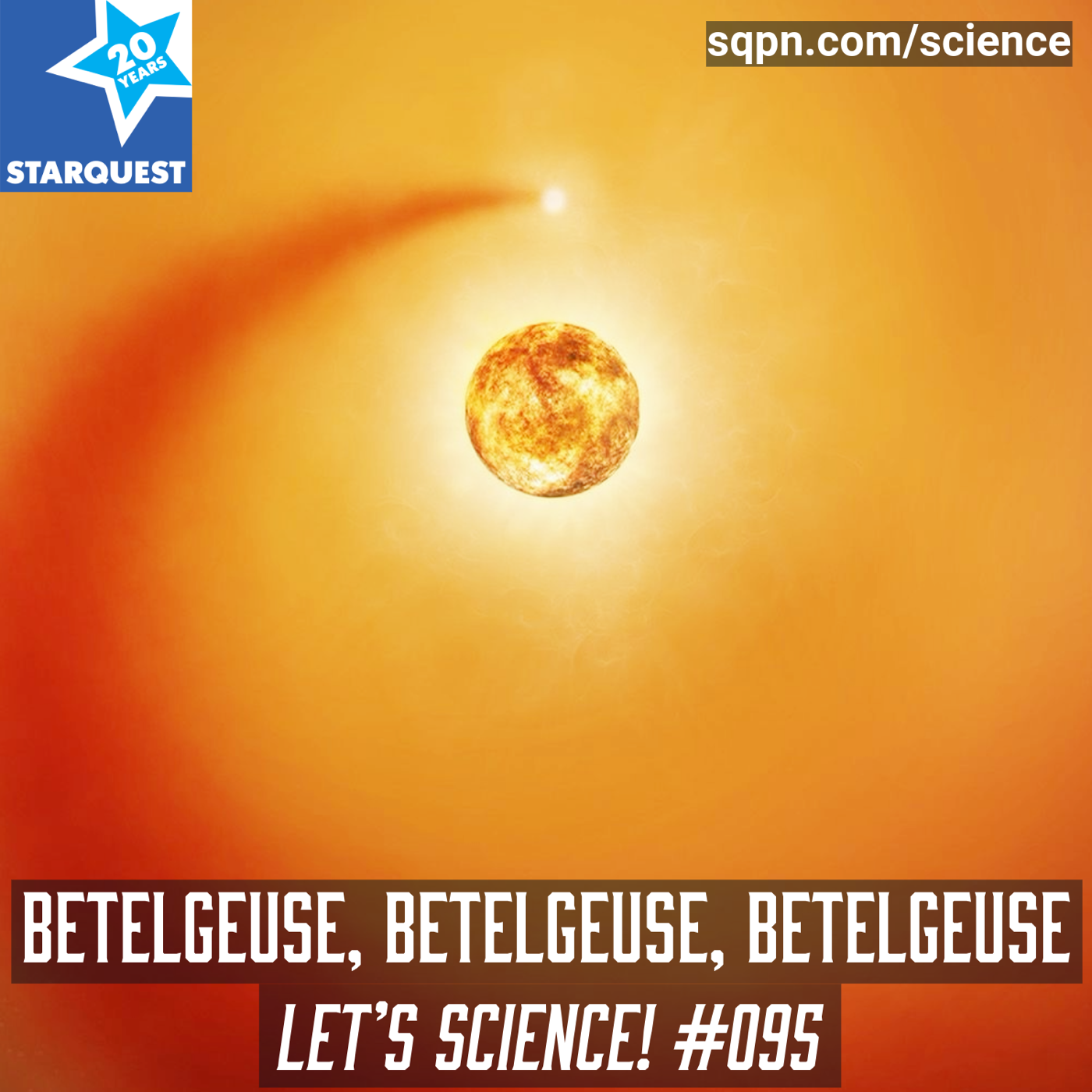
 A massive star dims—then science uncovers a hidden culprit. Could Betelgeuse’s strange behavior be caused by a companion star racing through its atmosphere? Caroline, Lindsay, and Lino unpack the shockwaves, dimming, and supernova future.
The post Betelgeuse, Betelgeuse, Betelgeuse appeared first on StarQuest Media.

Get every episode summarized
Each time Let's Science publishes, we email you a written briefing from the transcript — the topics, who appeared, and any specific claims, with the ad reads skipped.
Email me new episodesFree for 3 shows. No card needed.
Hosts & guests

Transcript ready
305 searchable segments. Every word is indexed and playable.
Full transcript
Let's Science — Betelgeuse, Betelgeuse, Betelgeuse. Machine-transcribed; use the interactive transcript above to jump the player to any line.
The secrets of Let's Science is brought to you by the StarQuest Production Network and is made possible by our many generous patrons. If you'd like to support the podcast, please visit GiveStarQuest.com. We live in a universe of scientific wonders. Every day, scientists are inching towards breakthroughs which can change our lives. We're playing our small part in showing these wonders with you. That's why today is a fine day for science. So let's science. So today, I'm going to talk about, and I'm very wary of saying this more than three times, but it's going to happen. I don't take responsibility of what's going to happen, but I'm going to talk about, feel juice. And I refer to the star beetle juice, okay? So it's a little bit differently, so maybe it's going to be okay.
All right, so feel juice is in the Orion nebula when you look outside. When we see it in the south here, it's like the bottom right hand star. It's beautiful. It's red. It just looks so happy gleaming there. But is a lot going on in this star. So it is the 10th brightest star in our sky, but it's probably actually the most restless star, okay? Monty restless, yeah. It is beautiful to observe with the naked eye and with a telescope. Me and my son enjoy pointing out beetle juice every night when it's not cloudy. And I did manage to take a photo with my telescope, but I mean, you zoom in on it and it's like just bigger than what you'd see with your eyes. So it's nothing too special, but it is definitely red and it's beautiful. Beetle juice is actually a red super giant.
And it's if we're going to get specific, it's classed as a spectral type M1 M2 star. Now what's amazing about beetle juice is actually in the final stages of its stellar evolution. It's actually used up all its hydrogen fuel in its core. And now it's using heavy elements. In other words, it is on its way out. It's dying, okay? So it's also called a variable star, which it means it's brightness fluctuates. Now if you've been watching Beetle juice, you know that a while ago, it was actually really, really bright and dark red. But it did go through a bit of a dimming phase around 2,000, 2,000, 2,000, 19, 2,000, 20. And I do remember seeing that myself. And scientists saw, oh, maybe it's going to blow. But you know, when it does blow, because it's going to go, right? It's going to have a supernova ending. So it's going to, it's going to go, it couldn't go anytime.
So we're seeing any time from tomorrow until about 100,000 years from now. So we don't know. They always say that. Yeah, yeah. The thing is going to supernova. And apparently we will see it pretty well in our sky. All right. Now to understand the scale of Beetle juice, it's size. If it replaced our sun, so if Beetle juice was our sun, the surface would extend past the orbit of Mars and probably reach all the way to Jupiter. So it's about. Oh, goodness me. Yes, that's how it's, and it's nice and fluffy. So it's like got gas lot of gas and dust on it's outside, right? So it's probably about 700 to 1,200 times the size of the sun. And roughly about seven and a half thousand to 1,400 times brighter. So this guy is, it's a bright thing. It's a huge bright thing and beautiful. Now, astronomers know that it has pulses. So it's pulses. It's got a 400 day cycle.
And that is the star physically expanding and contracting. But there is a second longer pulse about 2,100 days. So maybe over six years. But today we're looking at a brand new paper from January 2026, led by Andrea DuPray from the Harvard Smithsonian Centre for Astrophysics. Now, their team has found evidence for a theory that was once considered like crazy. But they're now saying that Beetlejuice is not alone. It's not by itself. It actually has a smaller companion star that orbits it and they've named it Duaha. And it actually orbits it inside the giant outer layers. So to understand, we've got to look at Beetlejuice's chromosphere. So that's the massive glowing mist of plasma that surrounds the star. And this extends to about 270 ms or roughly 6.4 times the star's own radius.
So it's big. Now, the data shows that Duaha, which is like a pre-main sequence star or it's a star that's not fully born. It orbits at a distance of only 2.3 times the star's radius. So it's quite close. It also means that the star is submerged. It's like plowing through the thick hot gas of Beetlejuice's atmosphere. And this is where stuff gets interesting, right? So the companion is moving at 43 kilometers per second. Or while the speed of sound in the gas is only about 6 kilometers per second. So we would say it's moving at like max 7. So it's just like a... Max 7, goodness me! And like a supersonic, create a sonic boom. Yes, Duaha creates a massive shockwave and a dense trailing is called a wake behind it and in the everything else.
So now we can't see Suaha directly because Beetlejuice is just way too bright. So and the companion stars about six magnitude spainter. So what the researchers did was they used spectroscopy. So we know that spectroscopy is like the study of light broken down into its component colors. And this was to find the shadow of its wake in the atmosphere of Beetlejuice. So they used the Hubble Space Telescope and some ground-based observatories. They monitored specific elements like manganese and iron and silicon. And they noticed that after the companion star passes in front of Beetlejuice or they call it a transit, these chemical markers change significantly. So you can imagine it's like a boat moving across a lake. So if you stand on the shore, you'll see a boat pass first and you'll see a few seconds later, you'll see the wake.
So the researchers say you are seeing exactly that. The companions are passes and then a massive wake of dense shocked gas follows it. And it blocks out a certain wave length of light. So they call it circumstellar absorption. And it reaches its peak around the time when the companion star moves to the far side of the star. So this wake is not just a tidy line, it's an expanding cloud. And the paper explains that it spreads out sideways at the speed of sound, which takes about three years, exactly half the orbital period to grow large enough to cover the face of the giant star. So you know, you can see why it would dim. So this helps explain the 2,100-day pulse. When the companion is on the far side of the orbit, its wake has expanded so much that it acts like a thick curtain contributing to the star's dimming. So now we know why it dims, right?
So more importantly, this solves the farcerotator mystery. So beadle juice actually spins faster than a star of its age should. And it believes that Suaha acts like a kind of a swizzle stick that stirs the atmosphere and transfers angular momentum to the diet. And the stirring also helps fling gas out into space at 20 kilometers per second, explaining how beadle juice sheds so much mass as it nears its supernova explosion. Now, so this discovery does change the way we look at supergiants. Okay, it's not something that we've found before. It suggests that maybe many giants may actually have a binary, may actually be in a binary system where they have a smaller star hidden in its gas. So currently Suaha Suaha is tucked behind beadle juice from out the way we're seeing. It's from our perspective. But researchers say that there is a date for its return.
And it should be around August, 2027. So next time you're looking at beadle juice, you can look at it differently, right? So you can look at it at say high speed supersonic chase, occurring deep inside a star. So, you know, it's so cool. I had to share that one because I've been looking at beadle juice for a long time now, just observing it nearly every night. And I know that I did notice the dimming and I was wondering what was happening. And I did read that it's gone a supernova any minute. But no, it's actually because it's got a little star flinging dust out and covering it up. So how's that? Isn't that amazing? I thought it was amazing, anyways. So, wait, so beadle juice is not going to supernova? Is that right or if it still is? Is going to supernova? Yes, but it's got this little star going around. Yeah, right. Not all this dust around it.
Yeah. So last year, Lino, I and Don, we talked about T. Coronet Borealis, which is another star, which is going to know for as well, right? This one, so I'll explain it in two seconds. Do you tell me the similarities and differences just to help me? Because this is really cool, right? So, Coronet Borealis, it knows as every 80 years, right? So it's an explosion, it's dead, right? It's absorbing gas from another companion star that it has inside its atmosphere, but like it's... Next two, right? Next two, yeah. So every 80 years, when it has taken enough gas, and I'm not very scientific, so the way I'm saying it, it will know about. And it becomes a brighter star in the night sky. It just looks a bit brighter than it was before. So, it beadle juice, it's know about, is it the end of beadle juice, or is it a similar kind of situation? Yes. No, so it's not drawing anything from the little star, but, well, not that they're mentioning, it's not the same situation as it's eating the other star. Like, you know, because I have seen documentaries about that,
so like you can get two stars once eating the other one, and that would explain the one you were talking about. But beadle juice is on the way out. So eventually, when everything is exhausted, it is just going to explode. It's going to cause a massive explosion. I know what that feels like, by the way, when you get exhaustive, you must explode. I know exactly how that feels. So, yeah, yeah. And then they say, what will happen to beadle juice once it has exploded? It will then, it will supernova, and then it will either leave behind a neutron star or it will turn to a black hole. Like, so, it's never the end. There's always something else, you know, it's pretty cool. So, interesting, yeah, 2027, because so T. Coronate Borealis was meant to be 2025, and now it's 2026. They said it could be 2027. So, we might have this year of exploding stars next year. We don't even have a bunch of them in the sky.
We could see that. Yeah, even though they all exploded, you know, millions of years ago, really. Oh, well, yeah, exactly. So, you're right about that. What we're seeing is, like, when the light eventually reaches us, but, yeah, it's so true, yeah. I'm still getting my head over that. Yeah, no, no, I'm just going to, like, when you look at, like, like, how long you tell me looking at a star, it's not at the time. It's how many light years and how many things, like, okay, I'm looking at something way in the past. Is that correct? Yeah, yeah, yeah. Even now, it's time is eight minutes ago. So, what we're seeing. Exactly. Yeah. Sorry, just for those, because people can't see, Lino just looked over his shoulder out the window. He's looking at that. They need to go. Yeah, yeah, yeah. They've been, yeah, it's so cool. Oh, wow. So, as another mind-blowing thing, so that means, like, really, bitter juice isn't there anymore already. It's already gone. It could, I mean, it could be. A black hole there. It's just a black hole right now, but we just, yeah. It's really fascinating. Good one, Caroline. It's like blowing stuff.
Yeah, that's good. And astronomy is always mind-blowing to think about, yeah, all the, it's the best. One percent of knowledge we have about space and how much we do is to discover. And my son and I, like, Harry, he's a living and he's just, like, discovered that he loves space. So, we're watching space documentaries all the time and it's just great. I'm learning new stuff all the time. It's so fun. Yeah. We should set up a thing in the future where we ask listeners who have telescopes, just like you've got to share some of their, their friends. Yeah. We should do something like that. That would be great. We'll talk about it. In fact, if you like, I'll show, I can share my Beetlejuice photo. It's not the best, but, you know, you get an idea of what it looks like. Yeah, yeah. We'll find some ways to share you or like, Discord and whatever. Yeah. Awesome. Let's Science is brought to you by StarQuest Media and is a fortnightly podcast that brings you the scientific wonders of our universe from a distinctly Catholic point of view. For more from Caroline, Lindsay, and friends, listen to the StarQuest show,
Catholics of Oz. Find links from today's show at sqpn.com slash science and find the Catholics of Oz at sqpn.com slash Oz. Be sure to follow the show in Apple Podcasts, Google Play, wherever you can find podcasts or on the sqpn YouTube channel. The generous donations of our patrons at sqpn.com slash give make it possible for us to continue let science and all the shows that StarQuest which makes our non-profit mission possible. You can join them by visiting sqpn.com slash give. Join us next time for more scientific wonders and thank you for listening to Let Science on StarQuest. Here's another show on the StarQuest network you're sure to enjoy. The Secrets of Stargate. Find it wherever find podcasts are found or at sqpn.com slash stargate.
More episodes