About this episode
Get every episode summarized
Each time Today, Explained publishes, we email you a written briefing from the transcript — the topics, who appeared, and any specific claims, with the ad reads skipped.
Email me new episodesFree for 3 shows. No card needed.
Hosts & guests
Transcript ready
355 searchable segments. Every word is indexed and playable.
Full transcript
Today, Explained — Betting on the Iran war. Machine-transcribed; use the interactive transcript above to jump the player to any line.
There's a reporter named Emanuel Fabian who's been covering the war in Iran for the times of Israel. Recently, he got a ton of feedback about a tiny article he wrote, but he couldn't figure out why. It was about a missile that exploded just outside the Israeli city, Bait Shemish. I'd appreciate it if you could update your article as in its current form, it does not reflect reality. Someone wanted him to say it was a missile fragment instead of a missile. Weird, because it was a missile, not a fragment. If you could correct the site, you'd be doing me and many others, a great favor. Eventually, the message has got more threatening. You have exactly half an hour to correct your attempt at influence. You will pay the full price for your irresponsible act. Emanuel finally figured out why people were getting so aggressive. They had bet money on how bombings in Israel would play out on polymarket. After you make us lose $900,000, we will invest no less than that to finish you. Betting on the Iran War on Today Explained.
It's true that some things change as we get older, but if you're a woman over 40 and you're dealing with insomnia, brain fog, moodiness and weight gain, you don't have to accept it as just another part of aging, and with midi health, you can get help and stop pushing through it alone. The experts at midi understand that all these symptoms can be connected to the hormonal changes that happen around menopause, and midi can help you feel more like yourself again. Many healthcare providers aren't trained to treat or even recognize menopause symptoms. Midi clinicians are menopause experts. They're dedicated to providing safe, effective FDA-approved solutions for dozens of hormonal symptoms, not just hot flashes. Most importantly, they're covered by insurance. 91% of midi patients get relief from symptoms within just two months. You deserve to feel great. Book your virtual visit today at joinmitty.com.
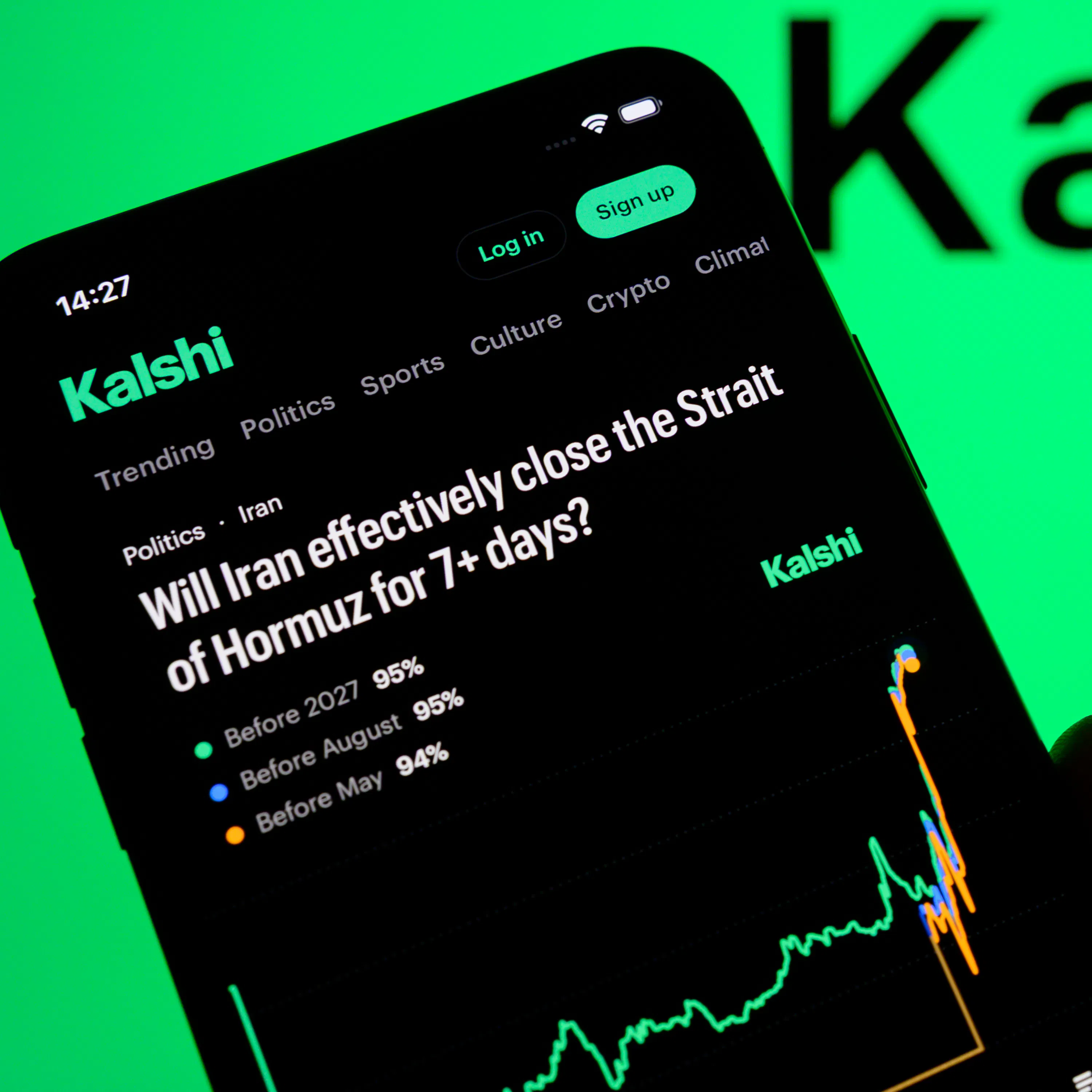
That's joinmidi.com. Today, explain Sean Ramas for him. You've heard us cover prediction markets like Kalshi or Polymarket on the show before. Places you can go to gamble on just about anything. Who's going to win an election? Who's going to hit a three pointer? What Taylor Swift might say on late night TV? These markets harness the wisdom of the crowd. Sometimes regular people are pretty good at guessing what might happen in an election, but also in our economy and culture. And now, maybe in our wars. Prediction markets are making it possible for just about anyone to become a war profiteer. Kate Nibbs from Wired is here to help us pick our jaws up off the floor. You know, you could bet on like when the straight of hormones is going to open. Bet. When will traffic at the straight of hormones return to normal? There was famously this market about whether the supreme leader would remain in power or not. Bet. Ali Hamani out a supreme leader.
There were markets on who to successor was going to be bet. Who will be the next supreme leader of Iran? There are markets I believe on whether there will be troops on the ground. Bet. Will US forces enter Iran by March 31st? There are markets on, you know, who allies will be bet. Which countries will strike Iran by March 31st? Saudi Arabia? The UAE? Qatar? It's almost like anything you think might be a market. Probably is a market. At least on polymarket because Kelshi has some stricter rules. And it's offerings are not quite as morbid. You can't bet on assassinations, for instance, there. But polymarket largely exists outside of the United States. So it's like less beholden to US law or at least that's how it's acting. How much money are people making on these kinds of bets right now, doing now?
Like in all gambling, most people who are participating in these markets are actually losing money. So the winners is like this tiny little percentage. And the winners who are winning big isn't even like smaller slice of that small slice. So we have like a very select group of people who are making in some cases millions and millions of dollars on more. And some of those people making millions and millions of dollars kind of looked suspicious, right? Because I don't know, they made a big bet the night before the war started that we'd be going to war in a few hours and then they made hundreds of thousands of dollars. Yeah, especially because in a lot of those cases, like it wasn't as though they had this long history of just being super smart and savvy at geopolitical contracts. In a lot of these cases, though wallets were just created within days of making these highly suspect trades. And so, you know, a lot of different organizations that like Contrace crypto wallets have been looking at the patterns that are emerging around these war markets and basically saying,
look, we don't know exactly who is doing this, but it's probably insider trading. Well, most people are just sitting around watching the missiles fly across the screen on the news. There are literally people with insider information placing predictions on wars. Yeah, exactly. If you know what's going to happen because there's, there's just no way that these people are popping up out of nowhere to drop a bunch of money and make these incredibly precise bets and profit and then disappear into the ether. It is insider trading on a polymarket or a calcium as it pertains to a war. The United States is fighting in the Middle East. Is that allowed? Is that within the parameters of what's allowed on these betting markets? It seems like it shouldn't be, right? Like it seems morally repugnant. It seems obviously ethically thought, but when it comes to like, what is the definition of insider trading? We typically think of it in terms of like someone having non public material information about a company that will like change how their stocks perform.
It has a very specific definition when you're talking about like SEC stock market stuff. Prediction markets are regulated differently and like there is sort of a fuzziness around what constitutes non public material information. It's like if there's a Google insider who's insider trading, it's kind of obvious, oh, they learned the specific facts about how the company is going to perform. When it comes to prediction markets, it's like there's markets on everything, so who is an insider? And we're seeing this on like even less serious markets, like the bad, bunny, super bowl markets. People are suspecting people of insider trading. In a lot of cases, it was like their cousin was performing as the grass and told them something. Classic scenario. Yeah. Yeah. Yeah. You know, you know when you're cousin's grass. I'm glad you brought up the grossness, the Ick, the moral just basement. It feels like all of this lives in because children are dying in this war as they do in
most wars. Is there anyone out there saying, guys, have we lost our moral compass? Yeah. I mean, I think there's been decently widespread questioning of whether this is good for society. At least in my corners of the internet, I'm seeing a lot of people express discomfort and I think it's completely reasonable. Betting markets and any sort of military conflict need to end. You don't know what kind of corruption can occur there. I've been in women in uniform, I've been put in a harm's way. People like your brother who are traveling Americans abroad and people are betting on this crap. Yo, are people going to die? Yes or no? Yes or no? $10, maybe you get 14. If enough people die, maybe you get 21. And I feel that discomfort too. And it's especially jarring because some of the prediction market boosters in particular, like polymarket CEO have actually come out and said, no, insider trading and war markets
and all this stuff actually could be good for society because it's just allowing us to have access to more accurate information with some of the crowds. I saw that argument and I sat there and I closed my eyes and I tried to understand it and I couldn't really get there. What is the argument? Can you help us understand it? Yes, so the polymarket CEO came out and said at a conference a week or two ago when he was being questioned about this. It's actually good because if there is a market saying where is going to be bombed in Iran next and the people in Iran are following the market and the thing that's in the lead is their hometown, then they could take shelter and not die. That's the argument. A lot of ifs in there. Here's another if. If there's a market where you can make bets on when the United States is going to take various actions in a war and if you're in the United States military and you actually
can influence the outcomes of what the military does in a war, can you place bets on actions that you're about to take or can you do things based on what people are betting on to profit off of the war and thus influence the war based on the market? Yeah, these are real questions that we're having to ask because of this entire situation. It is really wild and like I would bet that that is happening to some degree right now and we're not releasing, you know, Israel investigated two people for how they had traded on a market at some point but we're not seeing that sort of public investigation happening yet in the U.S. Like I'm waiting for it and so far I don't think anyone's been arrested. It's wild. Do you think what's happened in the past couple of weeks and what people have seen with these sort of brand new accounts making tons of money off of a war that's just starting and wildly controversial is going to be the driving force behind some regulation or
does the government feel like this is okay and this is just going to be the new normal for whatever following conflicts we have Cuba, North Korea, who knows? Well, right now the Trump administration is very friendly towards prediction markets. Donald Trump Jr. is an advisor to both Kelshi and Polymarket. The Trump family is planning on launching their own prediction market called truth predict. Like a spinoff of truth social. And the White House hasn't been commenting directly on the prediction market stuff, but the CFTC, the commodity futures trading commission, which is the government agency that regulates these on a federal level. The chairman, Michael C. Ligg, has like come out swinging saying, this is our turf, all of these efforts on the state level to make all of these companies abide by state gambling regulations and to put guardrails up. Those efforts are something we don't stand by.
We actually strongly disagree with them. We have authority to regulate that. So it's not the state's authority to get into regulating our swaps markets, which are a 500 plus trillion national market. These are significant markets that we don't have a role for the states in regulating. I think there's over 50 different lawsuits flying around about this right now. Some of them, the states stand a chance at winning. And so if the states win, it'll set a precedent, and you know, these prediction markets will no longer be able to operate as they currently are, and that could really change things. But other than that, I don't see these being curbed in an evil way soon. Fun. It just seems so... Sometimes I feel like I'm being a sucker by being repulsed by some of this activity, but it makes me, it makes me question my life. Big Sam, maybe you're with Kate, but maybe you're not.
Who's placing these bets to the best of our knowledge when today explain gets back? Support for today explained comes from Vanta. If you run a business, perhaps you've noticed a shift, risk and regulation are increasing, and customers want clear proof of security before they will even consider signing with you. Building that trust is essential closing deals as Vanta, but it's also complex, costly, and time-consuming. Vanta says they can automate that process to bring compliance, risk, and customer trust together on one AI-powered platform. They say they automate the process of achieving and maintaining compliance with over 35 security and privacy frameworks, including SOC 2 ISO 27001 and HIPAA. This helps companies get compliant fast and remain compliant, freeing up time. Instead of getting buried in audits and spreadsheets, Vanta says you get a system that runs
behind the scenes minimizing risk-powering growth. Vanta says that companies such as RAMP and RIDER spend 82% less time on audits with Vanta, not just faster compliance more time for your business to grow. You can get started at Vanta.com slash explain. It's v-a-n-t-a.com slash explained. Vanta.com slash explained. Support for today explained comes from Bombas. Perhaps you want to get in shape this year. Bombas wants to tell you about the all-new Bombas sports socks engineered with sport-specific comfort for running, golf, hiking, skiing, snowboarding, and all-sport. Meanwhile, for the loungers among us, Bombas has non-sport footwear available. But Bombas doesn't just offer sport and non-sport socks. They also offer super soft base layers that they claim will have you rethinking your whole wardrobe, underwear, t-shirts, flexible, breathable, buttery, smooth premium every day. Go choose they say you won't want to leave the house without. Here's Nisha Chital. I've been wearing Bombas
for several years now. I have several pairs. My whole family loves to wear Bombas. I have several pairs of Bombas ankle socks and I have some no-show socks as well that are great for things like loafers and ballet flats. For every item you purchase Bombas says an essential clothing item is donated to someone facing housing insecurity. One purchased, one donated, over 150 million donations and counting. I'm told you can go to Bombas.com slash explain and use code explain for 20% off your first purchase. That's bombas.com slash explain code explained at checkout. This is advertiser content brought to you by Stonyfield Organic. Our cows, them going out to pasture, they love it. They're so excited to go out every day. They weight-rated the door. In fact, we milk them and we just open up the laneway and let them just go right out to pasture. I'm Rhonda Miller Goodrich and I'm a dairy farmer in Cabot Vermont.
Our farm is Molly Brook Farm. We're an organic dairy farm and we are a supplier to Stonyfield. Molly Brook Farm has been in my husband's family since 1835. We started our organic transition in 2015. We had 53 acres of corn ground and of course we had to use herbicides and pesticides and the soil was dead really for all intense purposes. We stopped growing corn and stopped using herbicides and pesticides and we seeded that down to perennial grasses. After that we began to see biodiversity and that soil again. To be organic certified, our cows need to be in pasture at least 120 days. I think the organic practices really benefit our animals. You know, having good feed, good water, a nice light area, that's what's important to us and that's what's important to Stonyfield. Visit Stonyfield.com to find Stonyfield organic yogurt near you.
Hannah Erin Lang writes about the markets for the Wall Street Journal and lately she's been writing about the prediction markets. She just wrote about how Calci in particular is trying to attract more women users because it turns out these prediction markets are mostly frequented by men and it's kind of weird to be like, ooh, check out our markets where the wisdom of the crowd is going to help you understand the world when that crowd is not representative of said world. Yeah, exactly and I think that's what the female traders that I spoke to that are involved with prediction markets and are trying to sort of bring more women into the fold themselves. That's exactly what they mentioned, right? Like this wisdom of the crowd's premise is kind of core to the entire prediction markets pitch, which just means that a group of independent diverse opinions can make better decisions than experts can. So together when we are all involved in the decision making we can make a wise choice because of all of our different views. So it seems strange that that crowd would be overwhelmingly male or not a reflection of what the actual world looks like.
And do we know how the user base on say Calci breaks down between men and women like the ratio? Yeah, so we know that Calci has been trying to reach out to more women and sort of diversify the traders on its platform and those efforts seem to be paying off so far because the company told me that women now account for 26% of the users on its platform. That's up from about 13% 10 months ago. Oh wow. Yeah, that's a big jump. Yeah, yeah, I mean, so still predominantly male. But it's definitely a growing part of the user base. Is that jump due to Calci's recruiting efforts? And if so, what do those recruiting efforts look like? Yeah, so I mean, we know that this is something that Calci has been trying to cultivate really intentionally. So this includes paying users like this female trader named Gigi that we talked to who's super passionate about bringing more women into the space of prediction markets. The way that prediction market platforms are
designed right now appeal to traders and people who are used to betting. What about the rest of the world? We really want to build a truth surfacing machine that can make a more certain future on any topic we need everyone else. And basically, as a part of a broader social media marketing push, Gigi was paid to post about Calci in her bets. There's also been instances where some of the sources I talked to were female users that had encountered Calci on their own, but got connected with the company through a friend that worked there or a friend of a friend that got put in touch with them to kind of give feedback, be a kind of beta user, let them know what appealed to them, and what didn't about the Calci experience. And then Calci is also hosting these in-person events here in New York City that are not necessarily new, but they've been planning some that are a bit more targeted to a more diverse audience when it comes to gender. So for example, like an Oscars Watch Party or a Bachelorette Watch Party versus a Super Bowl Watch Party or something like that.
So those are a few of the tactics that we've heard. And then of course, the company is telling us on the record that there's something that they're doing and something that they want to see more of on their platform. I think it's worth mentioning that these efforts are kind of nascent at best. We spoke to two women who have been a part of Calci's marketing program. They've been paid in the past to post about Calci on social media, but also on their own, they're actively trying to bring more women into this space, just because they feel that there should be more participation there. I swear Taylor Swift will be the number one artist on Spotify this year. Bold call, because the market slightly disagrees. Market, do we like Spotify charts? No, prediction markets, like real money on a line, who will headline Coachella in 2027? This market is basically forecasting pop culture a year ahead before the line up leaks, the rumors had read it or Twitter decides who's having a moment.
And they told us it's slow going. I heard from one of the traders that we interviewed that she went to a New York City mayoral election Watch Party late last year with another one of the female traders that we interviewed for the piece. And she told me that they were the only two women there in the whole crowd except for like girlfriends of other traders. So I think this is still slow going. Why was there such an imbalance between men and women to begin with? Is there something about these sites that are inherently more appealing to dudes? I mean, I think of the three worlds that prediction markets are kind of tangential too, right? You have this world of sports gambling, which is predominantly male. 17,000 dollars! I gotta watch this game. I'll show you later my, I did like a 10 like parlay. If I hit this one for real, I'm be good. You stole me money. And, and you know, this is by virtue of the fact that an overwhelming amount of the volume on
Calche of the trading volume is sports contracts. So, you know, basketball, football, tennis, for example. And yeah, of course, that world has been historically male-dominated. And then you have, say, the world of, of crypto, which, you know, I think is close to prediction markets in the sense that it's another innovative, high-risk piece of the financial world. Crypto contracts also make up a sizeable amount of volume on Calche, like the price of Bitcoin, contracts based on things like that. Bitcoin price at the end of 2026. Bitcoin price on Friday at 5 p.m. Eastern. Will Trump create a national Bitcoin reserve before 2027? And then the other world that this is very close to is that of traditional finance. So, think stocks, options, futures contracts. And, you know, that's historically been extremely male-dominated. And so, when you kind of think about where Calche and other prediction market platforms operate in close proximity to, it, you know, it kind of makes sense
that this is a, you know, a bit of a boys' club to a certain extent, as all of these spaces are and have been historically. So, I think that's primarily what's going on here. And then, you know, Calche's bets, on intended, is that, you know, prediction markets and event contracts are unique enough that they can sort of break through all that and appeal to a new cohort of traders in a way that, you know, traditional financial assets or capital markets haven't been able to yet. Right. So, I think a co-founder of Calche, who's a woman, told you that she wants the market to mirror the U.S. population in a decade, which I'm pretty sure is kind of like a 50-50 population when it comes to gender, more or less. Based on everything you've seen, is that a realistic goal for a market like this, or is that just PR? There is some credibility to the idea at the core
of this, which is that prediction markets and event contracts by virtue of being so straight forward and by reaching into all these different areas of life where capital markets have not previously gone, such as, you know, politics, weather, entertainment, for example, that they can sort of reach people that might not have ventured into, you know, the quote-unquote traditional finance world otherwise. One example I heard from Calche, and this is not to say that women are only trading entertainment or culture markets, but one example would be like the bachelor red. Will you marry me? I will. So, you know, trading on some sort of contracts on, you know, who might win or what's going to happen in a particular episode, you know, that show likely has mostly female audience. So, you know, women might have the expertise to trade on that in a way that a male audience might not. And I also think of things like, like music, we talked to some
prediction market customers who were trading on sort of Taylor Swift, what she might say in an interview on late-night television. So, those are just a couple examples. You know, this is, again, this is not to say that women are only interested in entertainment, culture, music, Calche told me they're also trading politics. You know, they're very interested in weather, for example. But there are some instances in which, you know, female traders might have expertise than a demographic of young men might not. So, I think there's veracity to this idea that prediction markets can sort of cater directly to people's interests and expertise and hobbies in a way that something like an options contract might not. Fair, fair. Do you think to bring this back to where we started in the show today that at this moment where markets like Calche are trying to appeal to women and certainly diversify their user base, the fact that people are betting on, you know, whether or not people are going to die in a war pretty casually is going to hurt
their PR campaign, turn people off, turn people away. Yeah, I mean, I think that this campaign to reach more women and more diverse types of audiences is like, is Calche's way to try to combat that, right? Or is, is a part of a broader effort to be known for something that is different than the types of markets that have attracted a lot of the spotlight or been the focus of a lot of the headlines so far, which is, you know, these war related markets, as you mentioned, which have been reported on in the context of polymarket and Calche, I should note. So, I think that the hope is by diversifying into these other areas, again, sort of beefing up the number of traders, the types of traders and these different types of markets that they can both diversify their business model in a financial sense and also maybe transform public perception as well.
But, you know, I think given the focus on these things, because it is so new and so out there in terms of the world of finance to be able to bet directly on these types of things, I think, you know, my sense is that there might be a long way to go. Read Hannah Aaron Lang at WSJ.com. You can bet on Heidi Mahwadi, who produced the show, Jolly Myers, who edited David Tatashore, and Patrick Boyd, who mixed, and Andrea Lopez Crusado, who fact-checked for us at today's play. you
More episodes


