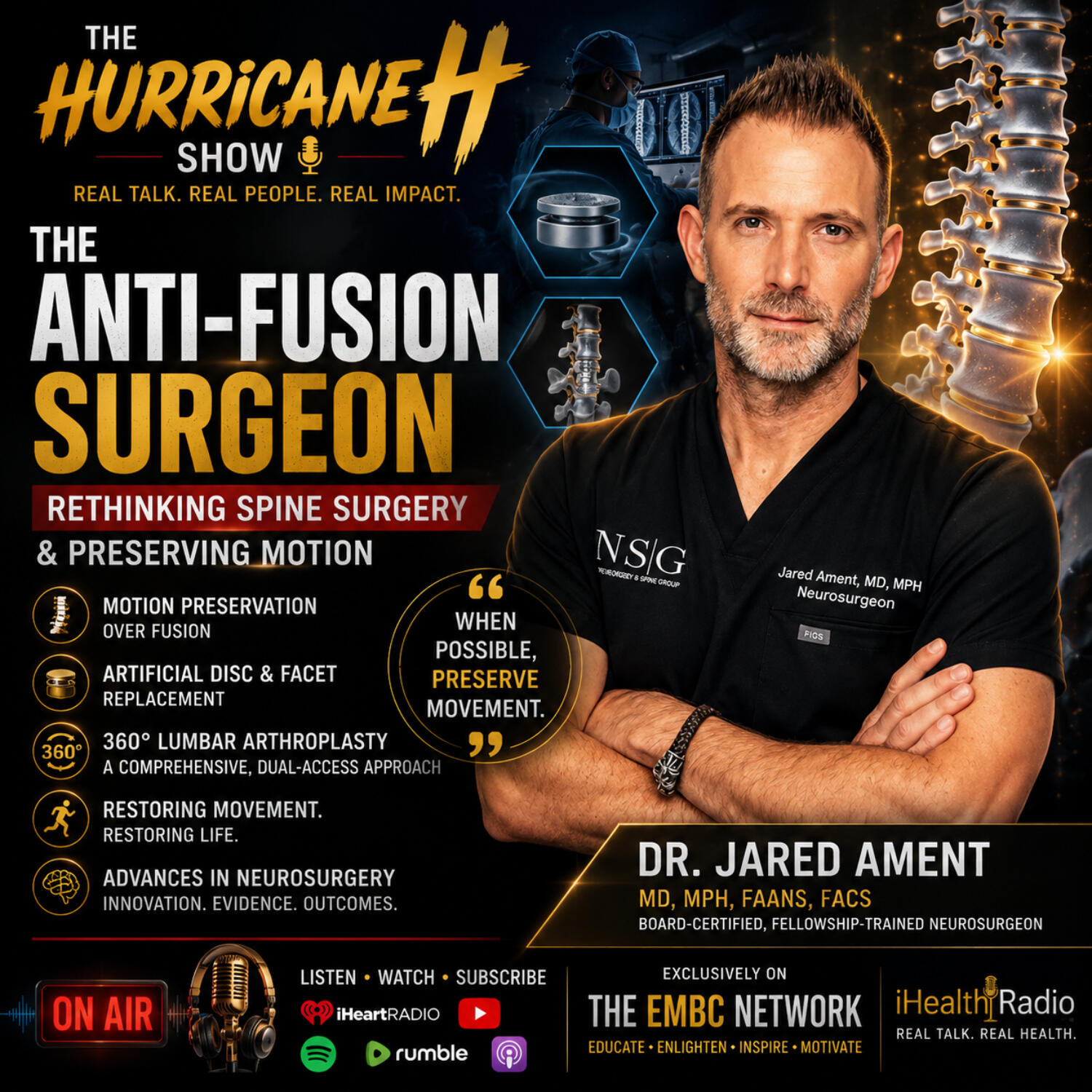
Beyond Spinal Fusion with Dr. Jared Ament
About this episode
Beyond Spinal Fusion with Dr. Jared Ament
The Anti-Fusion Surgeon: Rethinking Spine Surgery & Preserving Motion
What if spine surgery could address pain and instability without automatically sacrificing movement?
In this episode of The Hurricane H Show, Hurricane H sits down with Dr. Jared Ament, MD, MPH, FAANS, FACS, a board-certified, fellowship-trained neurosurgeon known for his work in motion-preserving spine surgery and artificial disc replacement.
Often described as the “anti-fusion surgeon,” Dr. Ament challenges the traditional assumption that spinal fusion must always be the answer for complex spinal conditions. His philosophy centers on preserving natural biomechanics, restoring function, and maintaining movement whenever clinically appropriate.
The conversation explores Dr. Ament’s approach to 360° lumbar arthroplasty, which integrates anterior and posterior surgical strategies, as well as the evolution of artificial disc and facet replacement.
Hurricane H and Dr. Ament also discuss the differences between fusion and motion-preservation surgery, advances in minimally invasive spine procedures, emerging artificial disc technologies, patient selection, recovery, long-term mobility, and the questions patients should be asking before considering spine surgery.
Dr. Ament also shares insights from his work in clinical research, health economics, FDA clinical trials, and international neurosurgical education.
Topics include: spinal fusion vs. motion preservation • artificial disc replacement • 360° lumbar arthroplasty • minimally invasive spine surgery • spinal biomechanics • emerging surgical technologies • patient decision-making • the future of neurosurgery
https://www.instagram.com/drjaredament?utm_source=ig_web_button_share_sheet&stkn=ZDNlZDc0MzIxNw==
🔸www.drjaredament.com
🔸www.NSG-LA.com
🔸www.inifoundation.org
This episode is intended for educational and informational purposes and does not constitute medical advice. Treatment decisions should always be discussed with a qualified healthcare professional.
The Hurricane H Show | THE EMBC NETWORK
Educate. Enlighten. Inspire. Motivate.
Get every episode summarized
Each time THE EMBC NETWORK Featuring: ihealthradio and Worldwide Podcasts publishes, we email you a written briefing from the transcript — the topics, who appeared, and any specific claims, with the ad reads skipped.
Email me new episodesFree for 3 shows. No card needed.
Hosts & guests
Transcript ready
1,139 searchable segments. Every word is indexed and playable.
Full transcript
THE EMBC NETWORK Featuring: ihealthradio and Worldwide Podcasts — Beyond Spinal Fusion with Dr. Jared Ament. Machine-transcribed; use the interactive transcript above to jump the player to any line.
All right, all right folks welcome back to the IHEL channel IHEL Radio. I'm a network here at EMBC Network, video host Eric and H. We're going to have a super discussion today with my guest as you can see he is already on with us and you know I'm going to start with a question. So what if the future of spine surgery isn't about luck in the spine in place but preserving movement. And we're not talking all about you know stuff that is important to us and awareness with today's guest Dr. Jared Amant, the board certified fellowship, trained, newer surgeon known for advanced motion, preserving spine surgery and artificial disc replacement.
We don't got about that stuff that you know that sounds futuristic. He's going to bring us to this closer often described as the anti fusion surgeon. That's interesting we can ask about that Dr. Amant focuses on restoring function while preserving the spine's natural movement whenever possible. I think it includes 360 Lombard atro Plasty and again I can I'm not sure if I say it right we're going to we're going to try to get that from him and innovative approach combining anterior and posterior strategies to preserve motion and natural spine biomechanics. Motion is the key today we'll discuss fusion versus motion preservation artificial disc replacement, advanced spine surgery, patient options and what the future of spinal care could look like. Is it time to everything the way we approach spine surgery let's find out doctor welcome to show me. Thank so much for having good to be here. Listen I know I know we couldn't do it the last time for technical difficulties but we hear and you know we're going to have a good time today but doctor I mean I mentioned a lot of stuff about spine and movement and preservation and anyone that's watching a listen right now we know of someone who has been an accident for example or you know who had serious you know case where you know
they needed surgery now being in healthcare myself in the insurance space one thing that we've been told long time preventative try to avoid surgery and so on so forth but sometimes there's nothing you can do about it. It's a mandatory thing you have to do it to kind of save a life or save motion but again I want to leave it to doctor so doctor before we get into anything else you. Let's bring this close to neural surgery I mean I know last time we spoke you had you know a brain bleed I mean so let's talk about it from that aspect because I mean I mentioned spine but but you do more than just fine let's talk about just general and then we can deep dive into the work you do. Sure sure sure so you know as neurosurgeons we do. I'm here I'm here I just give you all screen. You've been highlighted. So you know look as neurosurgeons any other huge part of our training is fine because it's part of the neural access connected with brain and a huge part is brain and we do a lot of brain surgery a lot of spine surgery and a lot of it's prevented a lot of it is treating you know really bad pathologies.
Most obvious one the people think about is tumors in the brain tumors of the spine degenerative changes are obviously in the spine but you can have degenerative changes in the brain as well but that's usually then falls out of what we can do surgically from the brain standpoint when you have degenerative kind of Alzheimer's dementia. Neurologic non-surgical diseases from a surgical standpoint things like tumor vascular aneurysms infection trauma is a big one number one causes a surgeon to have to act all over the world believe it or not is trauma from car accidents. And you know when I did a lot of work overseas in Ethiopia Sudan still go to Bolivia every year a lot of the trauma neuro trauma that we see is brain trauma TVI traumatic brain injury brain bleeds from car accidents and of course unfortunately spine trauma where you have spine actually get severed and people are paralyzed from trauma.
So that's a big part of what we do tumor is still something that we work with and and trying to treat is a lot of amazing cutting edge research in the neurosurgical space. Tumors can be through the entire nervous system can be peripheral nerves you have a tumor growing on a nerve in the body can have it in spine inside or outside the spine inside or outside of that. When last time we spoke and we weren't able to do the whole show but I had a brain bleed and that was from a fall mechanical fall that was really bad person hit their head very badly and you know you say well people put a fall hit their heads and most kids do this all the time they're okay. It's true and one of the reasons for that you know is that kids have a very full healthy brain so is it much rattling going around you know but as we get older the brain shrinks a little bit and that shrinkage creates this potential space between the brain and the brain. And if that brain is shifting and moving around your older vessels are a little bit weaker people can be on blood thinners and de-quagolids for a reason then suddenly you have a higher propensity to bleed from just something as simple as a fall and obviously much higher risk of a major trauma.
And so you know bleeding like a bruise is set especially it's on the surface of the brain inside the brain is different because it's intrinsic injury to the brain can be a stroke for example but on the outside of the brain the bleeding in of itself is not necessarily a problem unless the bleeding gets too large that it creates pressure and the brain as you can imagine it's like this fine like the nervous system is very sensitive and these things are soft and move and if they have too much pressure squeezing on the brain. And then they're squeezing on that and they can cause injury because it's not a balloon. The skull the calvarium is fixed solid to rigid so if you have something that's growing and growing and growing and putting pressure on the brain which is soft that has nowhere to go because the brain is surrounded by the skull that's where we get a problem. And so in my space the idea is whether we're talking brain and we're talking spine we're talking novel technologies it how do we fix pathology that is somehow flicking our nervous system and the structures of our nervous system and then at a much holistic level which is a big part of my practice and my purpose practice is functional neurosurgery how do we keep the brain and spine and nervous system healthy moving forward as we age as people are in general ageing.
And that's a better living longer. Wow. Dr. you know I'm listening to you and you know I don't know what to say man I just again want to commend you for the work you do and thank you for it for. I mean the way you explain it is so simple and you make it in an easy way for us to comprehend it but it's intensive work. I mean it's very delicate stuff that you deal with here and life threatening that you know at most of the time I think that's the case. I mean there's no joke that you know people always ask why your cortisol also why you stress me with the truth of the matter is is that my day today even though we do research we try to be the cutting edge and the best he gives I ever get from a patient always and it's never a bottle of wine or a bottle of whiskey they always be blast me about it's a picture of my patients doing something they couldn't do before or being with their families you know every year this nurse that I treated for a very complex brain tumor sends me a Christmas card. I have heard of her with her son that she's there with her son's because she's living enough you know those are the best gifts I can ever ask for because so much of my day today is life and death disability life or limb and the stories of hope and success and longevity or even if we can't save someone's life for a long time that they were able to make it to their child's wedding or their child's graduation or those are the things that we live for that's what we do that's why we do what we do.
Well Dr. I mean it's it's it's amazing I know it's rewarding to know that you've made I mean the people that come to you they already in the catastrophic status I mean they've done some serious to trauma to themselves not not by by you know default by I guess intention I mean accidents happen and we know that I mean a full slip of full is big accidents happen we have a lot of them out there in the world and talking about true tumors I mean that's pretty common as I'm I like that. My father towards his lot of a lot of days you know he had an actual prostate cancer that the test and it was all over his spine stuff and I actually did consult with the surgeon and I advised against the surgery because there was nothing he could have done you know he said just let him live his remaining days happy functional because once he would be opened up you know the surgery at his age and the way his status was helped wise you can have you know he would have just said that I'm not going to do it. I was super much more and more like a person that I just we've got a lot of different efforts for the remaining you know few months that he had.
And that was one of the greatest advices that I've received personally you know in a situation like that and you know it made me feel good about it because I knew what we had ahead of us and we had a beautiful time with him until he is gone and yeah, I mean so again those those things the memories that you talking about pictures of stuff that's really like you know how I see it from from a patients side and. I mean, it's amazing because you mentioned that. I've seen those tumors in the spine. I mean, there was like seven of them, you know, large than, you know, and there's nothing you could do. And the doctor says, even if we would open them up, he may be able to move his toes or whatever, but that's about it. He's not gonna walk normal. He's not gonna have, you know, so it was just that. But, you know, for someone who is in the healthy stage, younger and an accident happens, I mean, you would hope for a change for, you know, not that, you know, diagnosis for my case was a little different. It was terminal. But a lot of cases, you know, you wanna hear hope. As you said, the word hope is a big deal. And everybody has hope, you know, that things will work out. And we consult with the best and, you know, hopefully stuff. And you're right.
I mean, you do this and you see it every day. There is a percentage of success that is good. And sometimes, you know, you have those cases where you do your best and there's not much you can do. Now, I don't know how you deal with it from a mental state because you need to, I talk about quarter's old levels. I mean, your mental health has to be like really sharp, dude. I mean, you and your team is amazing working. You know what I mean? A lot of it's training. I mean, I hated my training, right? It was, they say it's like the Navy Seals of Medicine. You know, it's not an exaggeration. But I hated it because I mean, I have issues with authority, I'm told. But at least that's what my wife tells me. But I, but you know, I hated it, but I also learned to love it. And when I look back, truly respect what was done and why it was done, I always thought that they could do things better, but the answer, I mean, it's nice to say that, but I mean, could they have? You know, the irony is, there's mental fortitude that we, I mean, I'm not sure it's healthy, but it's necessary.
You know, you graduate from medical school, you're a doctor. And to get into neurosurgery, you have to be at the top. So you have a chip on your shoulder. You were like, oh, I did it. I'm the best. I'm the top of my class. And you go to neurosurgery and you get in. And you're like, oh, yes, let's go celebrate. And then it starts. And you look around and they look at you. And then literally say, you're an intern. Yeah, you're your first year. You know nothing. I don't care how good you think you are. This is your only job. You go get information and give it to someone who knows what to do with it. And they basically break you down and make you feel, you're up 120 hours a week. You're working 30, 40 hours shifts. And the question's like, this is crazy. It's unsafe. Why? I mean, why? Because they always have your back, right? They're not, they're not letting you, by yourself, but they break you down so that ego is gone.
I mean, it's lots of neurosurgeons that you go, but they break you down first because they're going to build you up because you need to be able to handle the crisis. You need to be able to stay calm. And this is one of the hardest things I've ever had to do in practice. I might have long graduated. If there's a complication that happens, but you have another patient that's next lined up in the operating room. How do you mentally deal with a complication from first patient and switch off so that you can give the second patient your best every time? For the hardest things to do because you're naturally your brain is thinking, you're going over in your head. What did I do wrong? Could I have done something different? How do I help this patient? And yet at that moment, the next patient deserves your best. And it's really challenging. Or the first day you've graduated, you're finished with residency, you're now a neurosurgeon, the training wheels are off. And even when you're a senior resident,
you're doing a lot on your own, but your boss, the attending's always in the back. They're always there. You always have the call friend button, right? But then day one, day one, when you've graduated and you get that call at three in the morning for an emergency head lead. Yeah, it's. There's no one else. Game time, right? There is no one else. And I remember the feeling. I called my wife. And I remember the feeling I was nervous. I was scared. I was shaking. And I thought to myself, this is crazy. I've done this procedure a thousand times, right? During training. This is not even hard. This is a basic thing that we were trained to do. And I'm like this, I'm suddenly on my own. I'm nervous until the moment I start. And it was incredible. And that's why I respect the training, even though I hated the training. Because the moment I started, and I realized this person has only me to save their life. In this moment, everything worked. All the muscle memory, every step,
and that patient lived, the family thanks me and hugged me. And from that moment on, I knew the training was good. I knew the training was right. Pain in the ass, but it was right. Because it gave me the tools, the skills, and the mental fortitude to do what was necessary in the moment to save a life. I mean, I'm listening to you, and Grace and Adam came to my mind from me. You get that question a lot. Derek's got the Gary's shepherd, right? Anything close to that? You guys, it's intense. Over there, there's a lot of drama going on in that series. But I get you. And by the way, you're right. In any level of expertise, when you become a super expert or whatever, that's when you begin. I mean, the closest analogy has nothing to do with the work you do. I mean, obviously, live and dead stuff. But in martial arts, for example, which is a world that have been for a long time. I mean, very known fact that when you get the black belt,
that's when you begin the journey. It's not before. So really, that's kind of the same day. You get out of med school. Yeah, OK. You haven't learned anything yet. Now you start learning the real stuff. But in your case, it's just a mind-boggling concept that you know, just thinking about it. And what you said is that how do you go from one surgery that could be hours, wash out, get reset, and go to the next one, and talking about 30, 40 hours a week, I don't know how you do it. You guys, I mean, I don't know what to tell you. But we need to give you all the things and the rewards in this world because it's amazing. And I know other types of doctors out there doing similar work and fair stuff. But when you talk about surgery, surgery is the ultimate thing. What's up with martial arts? I'm sorry. What's up with martial arts? Did you do? Did you do martial arts? Yes, I did karate, take on dough, and ninja too. So I've only worked here. First job. My first job in high school was a Shota Kon Karate.
I taught all the little kids because I just got my black belt when I was a teenager. But it's funny you say that. I mean, there's this whole concept of the student becomes a master. The master becomes a student. And you learn, you think that you go out all the reins because I agree with you. You become a black belt and you think you're a master. And it's only when you become the black belt. Do you realize the training has just begun? It's a perpetual student mentality. You've only just entered a phase where you're like, I'm now permitted to really learn. Now, when you get to a black belt and you realize, wow, this was just like a stepping stone to this world of how much I don't know. Oh, it's amazing. And yeah, I'm like, this is the same. Neurosurgery is the same. I mean, what people always ask why you do go into neurosurgery, why did you pick something else? And it's for me that it was the challenge of the unknown. It was that we could, for better or for worse, can take out someone's heart and put in a new one, right? We can do a heart transplant. We can do amazing things in other parts of the body. And yet it was the frontier work, the limits.
It was actually the limits that didn't feel constraining but inspiring. It was what we didn't know, how we could be at the frontier of doing something truly revolutionary, cutting edge stuff. That's what excited me about neurosurgery. Well, so, so back, you're a surgeon. I mean, you can do all surgery, right? So just standard, you know, surgery as you can proceed with them all the time. Or once you're a neurosurgeon, that's, oh, there's a difference. Yeah, that's a good question. I mean, the, the, the, the, we gallery wise, it's very weird the way that the, the boards and certification works. I mean, technically you can, as we've a medical license, you can do all kinds of things, but you should have, I mean, the standard of care is your board certified and specialized in an area. That's what you should be focusing on. And frankly, we want to do it safe, just invest with the patient. So medicine in general, all over the world. Now there are some exceptions and they're not industrialized third world setting where you need a kind of doctor that can do it all, right?
There's certainly data to train family doctors to do simple procedures and deliver babies in the middle of rural Africa because no one else. But in general, you know, it's become ultra, ultra specialized. And so you don't want me doing a hernia surgery in the abdomen and nor should I be doing that. You know, there's so much work and focus and effort on really specializing and the ultra focused and nuanced that that's why that's, I mean, this whole board certification thing, that's where it comes from, right? We want people to be, when you're able to and the resources allow for it, ultra focused. It's not, it shouldn't be, in rarely, is a shotgun approach to a disease. This should be sniper where we're really pinpointing, even when we deal with cancers today, right? The idea of cancer treatment is changing. In the past, chemotherapy was the shotgun approach. Willass the entire body with a toxin,
knowing that it should preferentially kill the cancer. But it still runs havoc in the body. Now we're using viral vectors, D&A mRNA, I know it's controversial, but we're using these things to target just the cancer cells and the rest of the body is okay. So it needs a logic. So the idea is precision more than anything. And that goes with specialization. Well, thank you. I think that's a clear clarification for our audiences. And from me personally, and I'm sure that people sometimes mischristually idea that a surgeon can operate on people, but you're right. I mean, you're an expert at what you do. And it's best because that's what you do. I mean, that's to your second nature now. You go somewhere else, it's not. And you go to a different surgeon, will probably be the best, you know, for whatever they do in their specialty. So Dr. Net, you see a lot of trauma. Accidences, you know, the front of all of it, you know, folds and stuff. Car accidents, that's the biggest one, of course. Now, you're known to be described as anti-fusion surgeon.
So let's talk about fusion versus your opinion about what looks like, what that feels. And why do you believe spine fusion is used, when prevent, I guess preventing motion, could be a better option. Yeah, so I mean, look, fusion is like the nasty F word in spine surgery. And it's become that, you know, only because of decades and decades of patients who perceive fusion decades later have horrible horrendous complications. And what you look, the way that I look at it, I mean, there is still an always will be in me for fusion surgeon because you said trauma in situations where there's severe trauma and the spine is unstable. You know, imagine there's a two going through the center of your spine, that's your spinal cord. That's very sensitive, like the brain, right? The brain is surrounded by your skull. The spinal cord is surrounded by the spine, right? Both skeletal structures. But if that tube, you know, you're looking down, you can see my eye, but suddenly there's a trauma
and it's done this kind of translational movement happens in the spine. Can you imagine what happens to that soft tube going through? And so that's where people become paralyzed, where fusion is needed to stabilize the unstable spine, completely legitimate. The issue is what happens if it's not that scenario, which is by the way the majority, let's, as we get older, or even, I see a lot of young athletes, or we're just super hard on our bodies and we're high performance people, professional, semi-professional, athletic people, people in their 30s, 40s, 50s, staying fit, the biohacking thing that's really big right now, right? So what happens if it's a degenerative process and the idea of, you know, you have disc disease, the shock absorber in your spine is just wearing and tearing, the joints in your spine become more arthritic. And those are causing problems, that's causing pain, that's causing sciatical, that people call it nerve pain. Sometimes it's causing people difficulty to walk
because of compression of stenosis, not a severing, but a stenosis of tightening like an artery to the heart that gets clogged and the blood's not going to the heart. Well, the nerves can't fire. Why is it that over the last four decades, the standard of care in those cases, if we couldn't do simple little micro procedures to decompress, to take the pressure off nerves, why is it that the answer was fusion? Well, cause it was thought that when you have a degenerative arthritic process that you have these little micro motions, abnormal motion in the spine that's causing the pain. So if you lock it with rods and screws, you get rid of the pain, often that's correct, you actually do, but what happens when you lock it in place is you take away a natural moving segment of the spine. And so the analogy I often use is, shock absorbers on a car. If you have four shock absorbers on a car and one shock is bad, and let's say you don't fix it, or you do fix it and you duct tape it
or you put a bar there to hold it up, you can still drive the car, it's not comfortable, but you can drive the car, but I always tell people, if one is not working properly, what happens to the other three that are still working properly? If there isn't that symmetry, there isn't that balance, the other three will wear in tear faster. And we see this in the spine, if you fuse one segment together, the level above, the level below, are working overtime. And before you know it, you now have three levels, or four levels, or five levels of disease over the years, with advanced arthritis that shouldn't have happened. And so, you know, I say to patients all the time, 40, 50 years ago, if you had a bad hip or a bad knee, the same thing happened. You got fused, they put a rod through your knee, a rod through your hip, because you took away the moving joint that was painful, but that's not very functional, it's incredibly disabled. Today, no one does that. The standard of care is a new knee or a new hip, right, a hip replacement, knee replacement. And so, it's a sign I'd to think that you would do anything else.
So, when I look at cases that don't need fusion, that don't have this gross instability, and I'm like, wait a second, why do we have to take away motion here? Why can't we remove the arthritis? Why can't we replace the shock absorber? Why can't we do all of those things, but still maintain normal motions? So the spine is healthy. And this technology is not actually that new. There's been artificial discs to replace the shock absorber 30 plus years in Europe. And with several iterations, since many options in the neck and a few in the lower back. And there's also a late something called an artificial facet to remove the arthritic facet joints. And that was actually invented in Israel, with some very high-tech, and they're very good at engineering, biotech engineers. And it's now FDA approved, although it's been in Europe and Germany, it's been for over a decade. And so this idea of fixing a arthritic degenerative wear and tear problem can now be done safely and reliably
with technology that allows the joints to still move, protects the levels above, protects the levels below, and the index level of surgery is still moving so people can still be active and have range of motion. That's the concept. It's not, so people say it's not brain surgery. I mean, it's really not, it's not that complicated of a concept, right? It's, and yet, and this is something we can delve into or not, I truly believe there are decades old of big brother relationships and royalty agreements. Because these fusion companies are massive, multi-billion dollar companies, and they're funding constantly research and education. And so what do you think trainees are being exposed to during their program? All this fusion technology, all this fusion hardware. And so I truly believe that what is being coined as the standard of care, what is being coined as, you know, convention is so archaic and antiquated
and that there is, I hate to say it, almost like sinister forces at play that are kind of perpetuating the norm. I had a colleague who, and I get a lot of hate online for trying to push the envelope. But again, I say, I mean, so did Galileo, so I'm in good company, I guess, right? But I get a lot of hate. And people like, well, this 360 art class that you're doing, I don't think you're just a trial, and so registered clinical trial that we're doing, I don't think you're doing right by patients. And I said, okay, you're a 360 fusion that you're doing for the last 20 years, I don't think you're doing right by patients either. So let's agree to disagree. But it's incredible. I mean, look, there is a doctor daughter, and then the doctor who's, I'm gonna give the name wrong, who's double or something in Europe, and Dr. Daughter of America, and then 40 years ago, 50 years ago, were the first to come up with angioplasty, where you put up a balloon and an artery to the heart to open up all of the plaque. They were shunned by their medical communities. They, the thought of doing that was crazy to the people at the time.
They were almost, yeah, they almost lost their medical licenses, they were thrown out of societies. 40, 50 years later, that technology has been credited with saving over 65 million lives. So I could be wrong in what we're trying to do, but we're doing it in an ethical, safe way, with a research team, with independent review. We have collaborators from around the country that have come on. We're trying to do this research correctly and safely with backups and fail saves. But it's a, you know, I just, my buddy, just, and I just did a little mini podcast together. We rented a podcast studio and just talked amongst ourselves. He's a plastic surgeon who's against the press influence. And I'm a neurosurgeon who's against fusions. And we were both talking about what it's like to be a target in our respective communities, professional circles, because we go against the grain. We go, grends the fold, because we're trying to do better by people. We're not accepting that the standard is necessarily best.
Well, Dr., thank you so much. I mean, you, you, you address a lot of stuff here. And frankly, for example, this is safe house. So we're good. Right. This is the home for the truth. I mean, we, you know, this is what we are open for. The idea is that, you know what? I have no problem with people having different opinions about stuff, but I do want people to receive the information that's available out there and choices that they have to make. That's on them. So, so what you do, what you're doing to me, to me, I would say it's innovative, because you are actually challenging the status quo. You, you're looking at something different to your point. You just give it exactly, you know, the best example. I mean, that's actually standard procedure today when you look at cardiovascular problems. You do the same thing. So, and you, what you said is also true. I mean, industries control certain things. This is a fact. We know it. I mean, I'm in a different space. You know, they're, they're, they got their own strength. I mean, they had the farmer, you know, so all these industries, obviously they, they, they develop these devices and someone has to push them out and the doctors are the ones who utilize them. So I get it. And I don't think, you know, people were surprised by this.
I mean, I think if you're watching or listening, you know that this is the fact. I mean, even medicine, you know, we know doctors prescribed things that aren't given to them, you know. Listen, I used to visit doctors all the time in my job and every day I'm, many were a doctor for our insurance space. You know, we have the farmer reps that are pitching a new drug or, you know, supplying whatever, you know, the, the demo stuff, you know, the little, you know, kids that they give, right? But, but it's a fact, but, but what you said is important. You know, I think that we should have the option. Some people want to do the fusion. Now, I mean, I just listened to you describing it to me. That's actually making your spine stiff and not mobile, not, you know, move, move into, to the right way. Just like I love what you said, the example of shocks, right? Imagine you put the, you know, the shocks and you lock them up. You know, that, that tire is not going to move. It's just going to be like a stiff, you know, you know, wheel, right? The other ones are going to take all the absorption. And so therefore, to your point, they're going to wear into a quicker. It's not, it's a simple concept to comprehend even for someone that is not a doctor, right? And the concept here, what you're saying is, is really the opposite.
You are solving the problem, but allowing the mobility of the person, the motion, you know, which is what you go for. You're trying to bring in, you're trying to bring in natural physiology, right? Like you're talking, you're talking the tire, talking the shock. We want to have a normal function, tire and normal function shock. So even in brain surgery, you're doing tumors, the ideas can go in and get out with the least disruption to the body as possible. Can we go into the spine, fix a problem, and allow it to function physiologically as normally as possible while treating the problem, right? That's the idea. I mean, and again, a lot of these mechanical devices, if one day we could replace them all with little injection and a stem cell and something and you can regrow your natural disc, I'm all for it. You just don't have that technology, right? So the best technology we do, like an artificial disc, can implant like a hip or a knee, at least the concept is to restore normal physiology while treating a problem. Whereas I don't want to treat a problem and then disrupt the physiology.
No, I love it. Thank you for breaking that down because you're right. I mean, the closer to our natural state, the better we're going to perform and life continues. And to me, that's success. If you did that and someone comes out of the surgery with a better performance to whatever their lifestyle is, they can move, they can walk, maybe they can do things that they, maybe not to the level that they did when they had no problems, but at least you get it close. But the other way, it's probably going to be harder to your point. It's going to disrupt the natural flow of things and therefore you're going to have a problem. So again, I'm all for it, doc. And maybe someone seems like Hurricane, what do you have to do with this? I'm just hoping it's still hope you never need it. Of course, I mean, obviously, listen, I mean, but that's the thing. Your work is people, whether they like it or not, this is something that happens. If this was not happening every day, you would not be doing this, right?
You're needed, you know, entity because this stuff is happening more than people think. I mean, we're living, you know, this biker's, there's, you know, accident has happened everything. I mean, hikers, I mean, you name it, things happen. And that's one. And I think the other point I don't want to add to this is that there's also new, I think, you know, based on what I've been doing in this work and I've been listening to and, you know, home guests, even through the nutrition, I mean, our, our bodies are deteriorated differently from maybe our parents and grandparents. I think, you know, I hear that we are, you know, the sodas and stuff, you know, the calcium, you know, is a problem in the bones and the younger folks now are getting weaker and frail, you know, we used to have these problems at a later age. Now we hear this stuff at a younger age. So this is a problem because that's just going to open up more surgeries to the younger folks that may not even have a trauma. They're just weak by the fault because of nutrients and stuff. Yeah, I mean, look, we are living longer. We would like to think we're living better,
but there's certainly what we are, you're right. Okay, we're seeing a change, people, sometimes are, are their nutrients are, or whatever's in our foods, you know, that's a whole other thing, an industry, and big brother and sinister, right? But I mean, it's certainly interesting to see what changes. The other thing, honestly, people say as well, we also have new technologies that detect these things. So a lot of people suffered with pain and things that we didn't even know what was going on. Now we have all these fancy tools and images, we can pick up on everything. So is our brain tumors really happening more often, or are we just detecting them more? That's a hard one to know, to really parse out. But we certainly, the nice thing is that because we can detect these things earlier, and better and safer, MRI is no radiation, right, so MRI is a safe test to detect. Yeah, you know, people don't need to suffer longer. And then on that, you know, train of thought is suffering. And one of my mentors, you know, says this a lot, and again, people's like, oh, surgeons, like a hammer to a nail, you just want to operate, operate, operate, no, I don't want to just operate,
operate, operate, I want to operate when people need it. But I also do not believe this model, you actually mentioned it, surgery is the last resort, surgery is the last resort insurance, you know, do your conservative care, do your physical therapy, do your injections, I'm all for it. But I do not believe people should wait unnecessarily and suffer. I do not believe that if you try things that are high tech band-aids and they really don't give you long lasting relief, especially there's an underlying mechanical issue, these band-aids mask a problem. And if the problem is it gets worse and worse and worse, and you keep masking, masking, masking, I mean, the body's way of telling us there's a problem is pain. And if we just mask it, at some point, the problem gets worse and worse and worse, the surgery or the intervention gets harder, right? So I don't, there is a very important balance. I don't think everyone should get surgery. I think as it is, we do too much for the especially fusion surgery. But I do think there is a balance where, at some point,
you realize this problem is just not going to fix itself and should not be masked. What's nice about some of the stuff we're doing, especially in the motion preservation space, and this is important for your viewers to understand, we've become so ultra specialized at it, a lot of these things are boutique in the sense that it's outpatient surgery. You come in 45 minutes an hour, hour and a half, you leave. These are not long hospitalizations. You're not sitting in bed for a week or two. All of my patients are up walking immediately. I walk with them around the surgical center. First few hours up to surgery. Wow. So it's a more, it changes the narrative, right? It changes the context of, you know, why is someone suffering? I just had a patient crying on a Zoom, who was an out-of-state patient, Zoom called with me crying, thanking me for giving them the opportunity to talk about a novel option, because they've been suffering with this for 12 or 13 years. For 12 or 13 years, why?
I feel for patients who go from doctor to doctor and it's confusing, I feel for them, because different results, different impressions, different recommendations, and it's just circling the drain with this and that that doesn't really provide lasting relief. Well, Dr. Thank you. I mean, this is a big point for audiences and viewers watching and listening. You know, this concept, by the way, when I said surgery is a last resort, I mean, that's what I was told, you know. No, I mean, it's like a last resort tool. That where's that point when we have the ability to help? And I don't think everyone should be rushing to surgery. I don't disagree with it. That's not what I'm saying. It's there's a balance kind of a tipping point here. That's important. No, no, but Dr. I tend to agree with you because to your point, I mean, pain is, you know, only people that go through pain when they understand what pain is. So no one feels you're pain except you, right? And so anyone watching, I'm listening, if you had one small, you know, I don't know, after I did this or you hurt your bone, whatever. I mean, listen, I, in martial arts, I've got broken bones, broken nose.
I mean, you know, I, I, I'm damaged a lot of stuff. And you know, at a certain point, you know, now I'm in the mid 50s. So I had to control how I do things. I just, I, I'm more, you know, careful in my activities than I've always been, but when you're younger, you don't care. I mean, my kids, I struggle with them. To them, everything is like, oh, I can do this. Bro, I mean, I'm just giving you the future because you get to a point, your knees are not the same. You put a lot of wear and tear on them and things like that. You have to be careful. I, I try to avoid, you know, to get to the, the damage zone where you have no choice, but to your point, sometimes if that is what's available. But what I love about you, Sandok, is that there is the alternatives. This is not, you know, the fusion business. What you're doing is, you know, not as, I would say, damaging. It's actually on the, the contrary, it's relieving. It's making a difference in people's, you know, lives. And the sooner they, they would do something like this. I mean, it's like, you're postponing the, it's like basically you can't evade, I mean, there's no way for you to move away from this, you know, situation.
It just basically delaying the, inevitable. I mean, it's like, it's happening. So my, what do it, when you need to, as opposed to making a worst, it will be worse for you as a price that doctor that's, doesn't kind of do the job. And also for them, because now the healing process may, now, I mean, listen, 10 years ago, my healing is not the same as today. So think about it, you know, they can have to think it. You know, so, I mean, again, this, I'm, again, I, I'm just looking at it from a personal view, not even a medical, you know, expert here, but, but that's the thing. So I love what you're saying. And by the way, that, you know, this 360 lumber outro plastic, right? This is, this is the, this is the, this is the, it's your unique concept. This is what you've developed. Now, I think I got the picture, I think I think this has got it. So this is something that we're not using. You are doing something with this point to make it kind of malleable. It's still kind of doing the same function. There's no pressure. So can you describe a little bit more? Sure. Yeah, it's, it's, so the three tests, we started with what we started. Now we're not, we were the first to do it. And we thankfully are not the only ones we open it up to multiple centers. We have a collaboration in Pittsburgh,
at Alleghenium and the academic side. We're doing biomechanics testing with our colleagues at the Cleveland Clinic. But I certainly was the first and have done many more than anyone in the world. And the idea was, and we've been doing it for the last three and a half years, is can we take two FDA approved technologies, an artificial disk, an artificial cassette that were a, a pro only approved and only ever used in isolation, meaning one or the other. And can we, you know, and I'll send you a picture of the model I have that was silly for me, not to bring the model to this. I'm, but I will send you a picture of it so you can, you know, our little video. Can we figure out a way to biomechanically safely use them together? Why? Some people who need a shock absorber, an artificial disk, can't get one because they have two arthritic. They're fissept joints in the back and I'll show this on the video. I'll send it to you. Are two arthritic. So the disk won't work with arthritic joints. Some people who need their arthritic joints replaced can't get one
because in order to use that technology, you need a healthy disk. So what happens if someone has two things, a bad disk and bad joints. And so what we did is we worked with them engineers and, and honestly, the Israelis helped with this is created a device that allows us to calibrate between the artificial disk and the artificial fissept so they work together, meaning that we can solve two problems together at the same segment in the spine. That's all it was. It wasn't really that novel. These devices already existed. I just forgot a way to try to use them together. Well, listen, again, that's innovative. That's different and it's making a difference. And I know that in time, like everything else, right? I mean, like we have this electric car business now. We have these self driving cars now. People are so like, oh my God, I cannot get into a vehicle. I've actually driven next to them. They look cool, man. The guys sit in the back and they just, you know, so it's technology. People are very difficult sometimes to adopt technology, you know, for, especially when it comes to the healthcare stuff, but we have prosthetics.
We have a lot of things now that that we know that exist that couple of decades back. You know, we're like, oh my God, you can't do that. Yeah, that's going to look bad with this or the other. And also people think about costs too. Again, I'm not sure, you know, how comparable the procedure compared to a formal surgery, you know, and doing all the other stuff. I'm sure they, I mean, surgery is going to be very expensive. It depends on, especially if you're in a hospital setting and all that. So it's, you know, all these things are something to think. But what I'm seeing here with what I'm seeing with your work is that you're using what's already available to make a better life for people. And frankly, I mean, I think that's something again to commend you for your new team and your partners because it's, it's kind of changed how some of these folks are going to have. I'm sure they'll come. I mean, yeah, I truly hope so. I mean, in the three and a half years, we're, I mean, 35 patients. We have a few other sites of a few three or four patients. I mean, I've done thousands of our list. I've done hundreds of just artificial sets, but combined, it's been much more limited.
But in that data set, I mean, we have virtually 100% success rate. You know, one patient had to still have back pain, even though the technical surgery was, was great. And that's always, we always, we never, we're learning. We're trying to figure out why, but almost every like 98, 99% of all these patients are three and a half years later, hiking, jogging, kickboxing, skiing, living their lives. And because it's a dual condition, the front and the back of the spine, the disc of the facet, they almost, the only alternative really had always been for these patients would be fusion. And so, I mean, we don't know the long-term data yet. We don't have incredibly large data sets, but we're starting. And we're doing it in an ethical way and we're trying to make the data speak for itself. It's not our biases. Yes, motion seems better than fusion. You even said that seems just simple to comprehend. But we want it to be more than that. Yeah, but we want it to be more than that.
We want the data to speak for itself. Well, numbers, right? I mean, you know, you can't read numbers. You give the right numbers, the right stats and, you know, they're clear and then people start, oh, okay, I know I believe. You know, like, you know, I, on my, on the mental show that we do on the monthly basis, Dr. Hem always refers to science is never wrong. I mean, you know, when you prove it and you show what it is, that's the bottom line. I mean, numbers don't lie. I mean, they, I mean, they could be manipulated, but just in this case, it's the opposite. You want to show the stats, the results of people can see what that looks like in time. And it makes a big difference. And I, let's not, I know this is going to be, you know, just the beginning of the wave. And there will be a transition there. There's, listen, even in dentistry, right? I've used some, what they call it, like the, the, the organic type of dentistry, right? So they use ozone and things like that. So they don't use similar, you know, practices that from traditional. And they're still kind of outlayers in terms of the dentistry space because they're not the mainstream,
you know, procedures, how they operate in, in the clinic. So, so again, but do they exist? Yes. They, they do have a following. They do have a nice little, you know, results for the work. I've used it personally. And it was better than some other standard, you know, procedures that I've had. So, so again, it's, it's to each of those, they say, but, but I think in time, we tend to believe, you know, we tend to start seeing a new trend that makes more sense for our help. And of course, we'll, we'll buy, but again, to your point, the numbers, the stats, the, the, the, the studies that you are doing, are going to make a difference in that. Now, now, is there a good candidate for the artificial displacement and motion or motion preserving surgery? Yeah, great question. So, you know, it's, on a very, very cursory level, you know, patients who are good candidates for artificial displacement have isolated disc problems, whether it be their neck or their lower back, cervical or lumbar spine. It doesn't exist for the thoracic spine. For the thoracic spine in general is more rigid because it has the rib cage attached to it. So, an artificial disc thinks shock absorber.
The disc is causing a problem. The disc is herniating, it's pushing on nerves. The disc isn't functioning. It's really losing its weight and you've got bone on bone grinding. You don't have a disc. You don't have a shock absorber anymore. So, in your neck or your lower back, those are disc replacement candidates, potentially. For an artificial facet replacement, it's only existing in the lower back, the lumbar spine. And those are patients who have bad arthritic joints in their spine, behind the spine, not in the front of the spine. And it's the ones that have both that we potentially say are candidates for the two, the trial with 360 trial. The unique thing about the facet replacement is that in the clinical trials, it got an FDA approved. A lot of patients actually have what we call slips, spondylosteases where the spine had a little slip, a little malalignment. And that because of that malalignment, everyone thought you have to fuse to put it back into position. But depending on the malalignment, if it's not traumatic, depending on the malalignment, this artificial facet will kind of keep you up,
open up the canal, make sure the nerves are free and firing like the blood vessel to the heart, but also keep you from slipping further. And they can do that wall preserving motion. And so, yeah, the candidates, the people who present are usually people with neck pain, shoulder arm, radying, pain, numbness, tingling, and then lower back, same thing, low back pain, rating, tingling, numbness into the legs or the hips or the toes. And often patients describe in the lower back something called the shopping cart sign, where you can walk in your back and your legs just get tired or fatigued or painful, and you have to lean over like on a shopping cart. And if you get relief when you lean over, sometimes those are also good candidates. No, no, no, you mentioned this is like a quick thing. I mean, so what's your average? I mean, you know, it's an outpatient, right? A couple of hours people come in, they get the relief, they get fixed. And what's the healing process? I mean, is it a couple of weeks, you know, to get back into, and does there need for therapy after that?
Yeah, great question. So, you know, everyone's different, but we do have a pretty aggressive protocol. We call it the perioperative optimization protocol. And every patient is up and walking day one. Depending on where it was, the neck lower back, you know, a lot of people, because the muscles are a little bit disrupted, they feel sore. It's not a fusion. There's no race, there's no collar. I want early movement. I tell everyone, the first week, you did have surgery. You're allowed to take a week off of life, but I want you walking up hill. Down you go, you can hit light hikes. After two days, the bandages come off, you can shower. Often, often, often, I will tell patients to get back into life exercises, things like a stationary bike, body resistance only no weights by two or three weeks, by three or four weeks, lightweight, six weeks, weights, three months, no restrictions, which is pretty dramatic trajectory.
If you think about it when a fusion data suggests that you need six to 12 months of healing before you can do high-level activities, and a lot of people will put, and again, I don't know, there's no data even to support this, but a lot of people who get fused end up with a neck brace, a collar, or a brace around the body to stay nice and stiff and rigid. But the difference is, when we do our surgery, when it's motion preservation, very early on, I want you to activate. I want you to relax and use the device and the technology, so it starts mimicking your normal physiology. So there's very early motion, very early activation, and a much faster healing trajectory. Yeah, that's funny. I was looking at you, my mind just went to hybrid, what do you call them? Buy your humans? One of those cyborg concepts, I mean, it's interesting that these things, the technology is really moving fast, and you are an early user of what's available,
and to you point, this stuff is really happening. Do you think that this can be even more, as you guys proceed in this work, you can introduce more technology and more concepts in the biomechanics with, I guess, other artificial stuff that can make the functionality of humans, and I can see people even thinking about super soldiers as a concept of those things. Again, I'm just, you know, I'm a big buck, and I see a lot of stuff, but you know, this could be like almost the edge, and vice versa, someone could be hurt in military action, whatever, you know, and this could be the solution for those things. I think that the applications are going to ever expand, and I think that technology is going to continue to improve. And I mean, that's a difficult conversation, sometimes I have a patient, it's like, wow, if I wait 10 years, will the technology get better? Probably, probably will. I mean, 10 years, a lot will happen, but are you going to suffer for 10 years? Are you not going to do the activities that you enjoy for 10 years?
So, you know, I'm not that type of person that will wait for me personally, and this is also a personal choice. If I have a problem that I think there's a fix for it, it's a good fix, I'm going to enjoy the next 10 years. But will this evolve? Absolutely. I mean, I think we're not there yet, but the world of, you know, stem cells and peptides and exosomes and trying to regrow a natural disc instead of an artificial disc. We are probably 10, 15 years away from those types of things, but I think that even in the space that I'm trying to promote and that I'm a proponent of, it will continue to get better. Absolutely. I mean, that's a very exciting space to be in when we start working with researchers and collaborators and we have a whole research entity where we're doing active research, publishing the literature, getting information out there so that we can make it better for everyone. That's the idea, you know, and we'll be, and at the other, we'll be the first ones, and the literature, the medical literature is problematic because it's always talking about positive things. We need to actually publish negative things.
We need to know what doesn't work also so we can get better. And I think that we call it clinical equipoids. So we have really honest impressions about what we're doing and how to make the good better, the bad, better, or just abandoned the bad and move on and pivot to something else. Well, I think the reason that's happening is still, as you said, this power is behind a lot of these studies and things that can make a difference in how things move. But you're right. It's funny, I just had to meet with my team earlier and I have a concept when it comes to policy and compliance. As long as I know what the don'ts, what the bad stuff is, I can do everything else that's good. And you're right. You establish all the knows and the negatives, then you can focus on the positive and make it happen. That sounds like a very simple math and simple equation. But to be born, it could be very difficult politically and financially because of all the dynamics that can go into any industry. Now, earlier, we talked about the idea of decision.
When someone, patient is told, now you need a spinal fusion. I mean, what should they ask about? I mean, because if I didn't meet you, and someone didn't hear the show right now, and automatically they have this problem and someone said, well, it's time for your spinal fusion. I mean, what should they ask? I mean, or if they're a caregiver and you see a parent or your family members and you're there to make advocacy for them, what would that look like? What question should we ask? Love that question because I think one of the reasons why I do this and go on to shows like yours is education. I think knowledge is power. We want to empower our patients to make the right decision. So look, I'm definitely, I'm not the only one in the world doing motion preservation. I don't want to be. I want people to get the right surgery. But you can, by all means, use this show, use me as a resource. I think that I can see in the bottom of the podcast, scrolling contact information. The one thing we don't have is my personal Instagram. You can look at Dr.
Jared Aiman on Instagram because not to come to me, but I post a lot of videos, teaching and showing and looking at models. And I'm not the only resource. Do some research, say to the doctor who's recommending it because I remember that may be all they have to offer you. Say, thank you so much for the recommendation. I want to just do a little bit of research. Look and see what your alternatives could be. Look and see who the people are that are really proponents of motion preservation. See if you're, you may not be. Fusion may be the only option for you. But I would just take a step back and acknowledge it doesn't have to be the only option. It doesn't have to be what you choose. And take advantage of the fact that a lot of us are going online to really combat add information, misinformation. There's a joke, it's a sad joke, but a through joke. Why are doctors becoming influencers? Because influencers are trying to be doctors, right? I'm trying to
go online, not because I need more business or patience. I'm very happy, very successful. I'm blessed. I don't want to do right by people. I want people to get the right information. And I want people to have the right options for them. And I have the numbers of times I've gone to six, seven, eight, nine doctors and I have 22 different opinions. And I don't know what to do. I feel so badly because the patients just like they're suffering, they're in pain. They can't walk with their loved ones. They can't travel with their loved ones. They can do the things they want to do. They just need good guidance. So I'm trying to let the data guide the message. And I'm trying to put the message out there with people like you. And with the tools that we now have like Instagram and social media, which you know, my 15 year old knows how to do that stuff better than I do. So I mean, Jay and I'm literally trying to help. That's why I know how with misinformation, like giving good information. Well, Doc, I have to say you're doing it. I'm following you. I know your work. And I have to say you're about vitality. You want people to live a better life. Despite of, you know, accidents and trauma that can happen in life. You know,
of course, prevention is a key. Let's do our best. You know, not nutrition and, you know, taking care of yourself. But when shit happens, we got to be able to deal with it. But to that question, I think the problem is that when you go to a provider that's potentially biased or just that's all they, they promote, I mean, true story. This, this was with my, my first child, or my second child. And my wife went to this doctor and he saw her like, oh, you do want a C-section, automatically. And we, we talked to a friend. He's like, do not go. He only does C-sections. That was his, his signature. I mean, from an insurance perspective, just, just for people that are watching, it pays more to be a C-section than to do stuff. And that's really what he was doing. He's basically, you know, opening up, you know, you can preschedule your delivery, voila, and you got a cut. And now you deal with that. And that's it. And then we went to a different doctor and all her deliveries were normal. So I can tell you folks, when you, you see someone always get that second opinion, always look for the options, there is something out there. And the only way to do
is to do the research to find information. And, you know, whether this show, other shows that doctors have been on or any other information. I mean, today with Chad, you know, and all these AIs out there, you can just ask the questions. You'll get the answers. You get the options. But I asked the right questions. Absolutely. That's all there is. By the way, I love the third opinions. I love all that. I think that I caution people when they're six, seven, eight, nine, ten opinions. At some point, also, I think you're not trusting the medical profession, which I understand there's, there's concern there. But you're doing yourself a disservice. Like you had said, you're kicking the can down the road and waiting for what you're asking for so many opinions, like you're hoping the doctor tells you something different. Do yourself a service by getting a second opinion or third opinion. Don't do yourself a disservice by getting 12. Because at some point, you're going to be so confused as a patient. You're not going to actually take care of yourself. And the longer you wait, could be potentially doing more hard. There are the rule of three. I mean, two or three max. People get confused quick. I'm
by the way, we use that in sales training. We use that. You don't show or multiple products, because the minute you show me a lot of things, I'm confused. It's like a buffet. I don't know what to eat. If you give me, if you give me, yeah, if you give me the exact things that I'm as the right questions, you'll get the right answers. Here's your option. ABC. That's it. Multiple choice, but close enough. Then you make the, you know, it's a cost. Is it location? Is it outcome? Whatever. These are things you look for. And then it's done. And you'll probably do better for yourself. And again, look at experts. There's, there's a lot of stuff going on in this world today. And there's innovation in almost every area. This is neurosurgery. This is the top of the line when it comes to, you know, I mean, brain, as far as I mean, you made the joke. It's not brain surgery. Brain surgery is a serious thing. We joke about it like, you know, that's that's outcome. And, you know, talk right? And this is simple, right? It's not brain surgery. Well, it is. It is difficult, but at the same time, you know, there are solutions. And doctor, you know, I'm I'm I is on the cutting edge, I would say of this. I'm a fan. And I'm a fan of innovation. And
really, you know, people deserve to hear what's available to them. And it's up to them to them to make the decisions. We're not forcing opinion or anything on anyone. You're watching, like you don't like what you hear what you see. You can go to the next show and get your information from there. And go to the link. It's a free world. I mean, I love that, right? You know, freedom is a beautiful thing. Well, doctor, so I know we've come to the hour here. And we will have your link. Of course, the Instagram add a two description of the story. So people actually can link out to you as well. Because you operate it, you know, aggressive there. You have a lot of information to, you know, different. Reals. Yeah. So, so yeah, we'll have that. So if you have to change anything in the future and in surgery beyond what you're doing right now, any idea what that would be? Maybe in the next 10 years. Like if you really the idea of world. Yeah, I think in an ideal world, one, I would want fusion to no longer be a standard, but to be a backup. And two, even in the motion preservation space, what I do, I would like it to be more
targeted and more customized. Meaning it really shouldn't be a one size fits all model. I think if we have implants, everything should be 3D printed and custom to the patient. If we can avoid implants and we can use, you know, novel stem cell biologic technology to regrow natural parts. And kind of like people trying to reverse aging with biohacking, can we reverse arthritic changes in the spine naturally? To me, like I said, even when we go into the brain in certain viral vectors to kill the tumor, not have to do a massive brain surgery, the least disruption to the anatomy, the better. So can we make dramatic changes to people's quality of life by disrupting their anatomy the least? Well, listen, I think that's going to happen. It's just a matter of time. I mean, it's like doing this. It's not it's not if it's just when. But that's the fact. I mean, I think to
your point, I mean, there's a lot of good research. I've already said peptides, all this stuff going on the stem cells, you know, there's this growth now. I mean, listen, we hear about artificial fruit that's being, you know, meats and chicken and stuff that's being in the lab. I think we could do that for human stuff too. I mean, I know that their studies out there, I've read some stuff about this but it's we're still kind of early on, but to your point in time, we're moving fast in technology. It's only a matter of time where you get those regenerative, you know, opportunities where you can use some of the natural stuff for the body and it will make it easier. And the lower gisette is like the least amount, you know, of damage to not to disrupt anything from your functionality. That will be the best doctor. Thank you so much for being here today. It's been fun. I know we missed the last time we couldn't do it, but we did it today. I enjoyed this discussion. I was looking forward to it and I know our audiences will benefit from it big time. And by the way, I know that. Thank you. Oh, it's an honor and privilege. And again, for our audiences, folks,
just know this. Do reach out to Dr. if you know someone that may, you know, need some assistance, I'm assuming you do consultations to discuss these things, right? So we can reach out to you. We do online Zoom consultations all the time and I actually have a license to practice in Dubai. And I know you're based in Dubai. So I'm in Dubai quite frequently. But yeah, we zoom online. We do, you know, some very basic kind of meet and greet consultations and the technology today, transferring image files back and forth is super easy. I can look at the anatomy and do some at least initial assessments happily anytime. All right. Well, that's about it. So folks, Dr. Thank you for being with us. Thank you. Folks, this, you're welcome. And folks, this is the end of a show. Hope you had a great time with us. And so I'm here to make sure we'll be talking soon, new day in your show, new topic. Bye for now.
More episodes
More from THE EMBC NETWORK Featuring: ihealthradio and Worldwide Podcasts

The Chemistry of Love - John Gray on Hormones, Attraction & Lasting Passion
THE EMBC NETWORK Featuring: ihealthradio and Worldwide Podcasts

Why We Need NEURODIVERSITY conversation with Valeriya Hjertenaes
THE EMBC NETWORK Featuring: ihealthradio and Worldwide Podcasts

Cell Phones Health ,Dangerous Addictions - Norbert Heuser Roy Coughlan
THE EMBC NETWORK Featuring: ihealthradio and Worldwide Podcasts

Unlocking the Dynamics of Relationships_ Rules, Roles, and Identities
THE EMBC NETWORK Featuring: ihealthradio and Worldwide Podcasts