Loading...
newsdaily
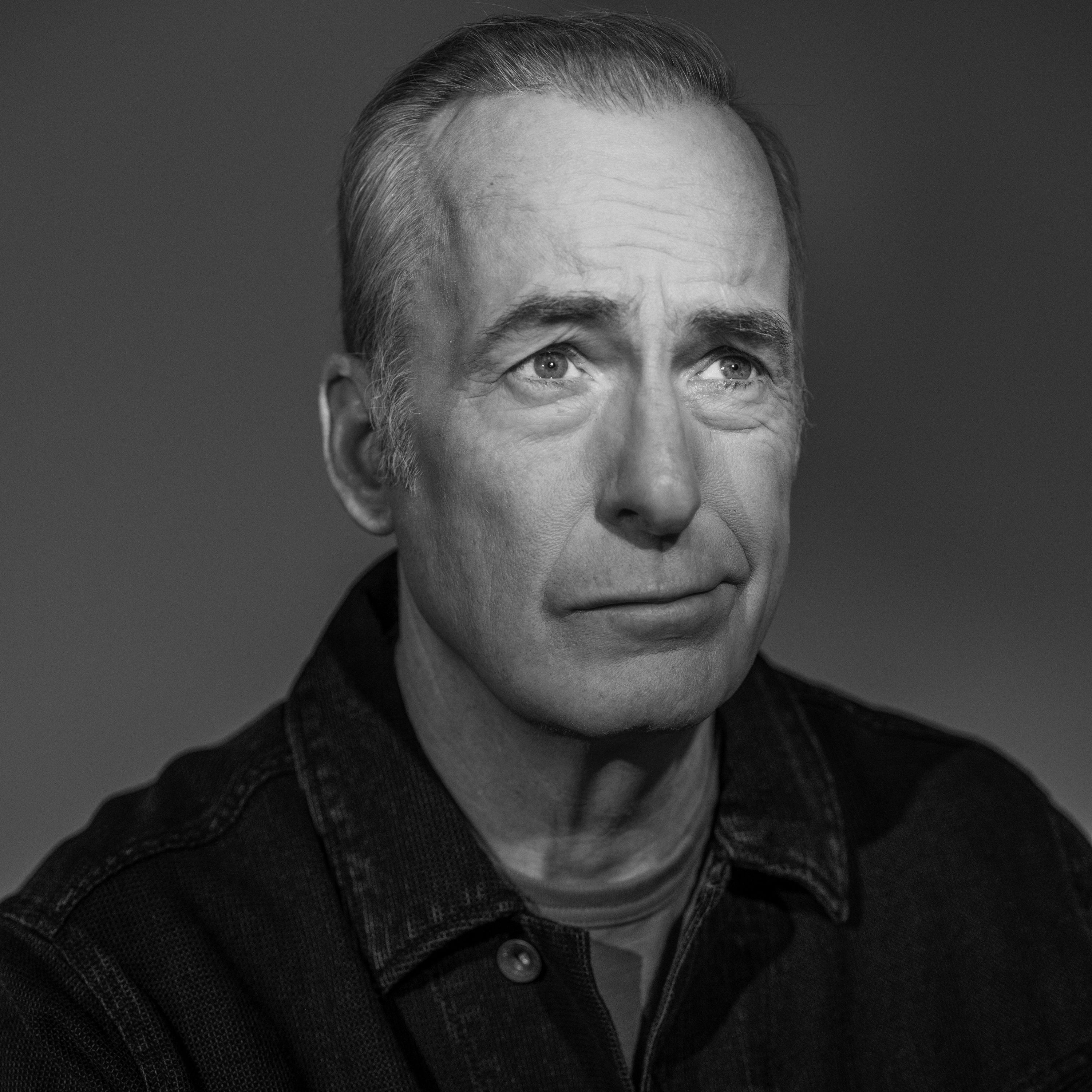
Bob Odenkirk Would Like to Remind You That Life Is a Meaningless Farce
About this Episode
The actor and comedian is keenly aware of humanity’s limitations, but he’s not giving up.
- Thoughts? Email us at [email protected]
- Watch our show on YouTube: youtube.com/@TheInterviewPodcast
- For transcripts and more, visit: nytimes.com/theinterview
Subscribe today at nytimes.com/podcasts or on Apple Podcasts and Spotify. You can also subscribe via your favorite podcast app here https://www.nytimes.com/activate-access/audio?source=podcatcher. For more podcasts and narrated articles, download The New York Times app at nytimes.com/app.
Hosted by Simplecast, an AdsWizz company. See pcm.adswizz.com for information about our collection and use of personal data for advertising.
Hosts & Guests

Transcript
In theory, I knew that this kind of thing can happen in any family.
Upstanding citizens are always turning out to be secret criminals, and I wouldn't even
call my cousin Alan, an upstanding citizen, but it's one thing to know and another thing
to understand.
Alan, murder, me?
What the hell was Alan thinking?
From serial productions and The New York Times, I'm Em Gesson, and this is The Idiot.
Listen, wherever you get your podcasts.
From The New York Times, this is The Interview.
I'm David Marquesi.
Bob Odenkirk has had one of show businesses most wonderfully improbable careers.
After decades as a cult hero in the comedy world, thanks mostly to his 90s sketch series
Mr. Show with Bob and David, he became a mainstream success as of all things a serious dramatic
actor.
First, in a supporting part as the shifty lawyer saw Goodman on Breaking Bad, and then
to further acclaim as the star of that show spin off Better Call Saul.
Lately, his career has taken another turn that few could have seen coming, to action movie
star.
The latest example is called normal.
In it, Odenkirk plays a small town Minnesota share of facing off against among other villains
the Yakuza.
You might think that at 63 years old, Odenkirk would be pretty pleased with the way his career
and life have shaken out.
But you'd be wrong.
Here's my conversation with Bob Odenkirk.
Bob, I think we're good to go if you're good to go.
This is a big production.
As I said to you, we were just sitting down.
It just feels very important in a way that scares the shit out of me, but onwards.
All right, I don't want you to be scared.
There's nothing to be scared of.
It's all in your head.
There's nothing bad that's going to happen.
Oh, there's a lot of my head, yeah, all the bad stuff.
But thank you again for being here.
Just before I was told that we got the green light to start, you were telling me about
a novel you just read.
And how it affected your thinking maybe about something important that happened to you.
So take up where you left off.
Yeah.
So almost four years ago, I had this heart incident.
One of the tributaries to my window maker, Arterie, was shut down completely by a plaque
buildup.
And I was really out and I went to the hospital.
I got to stand, say, I really went down on the set of Better Call Saul.
And it was really scary, especially for everyone around me, not for me, because I don't have
any memory of it.
But I've talked about it many times.
And people have asked me many times how did that affect you?
And I think first people want to hear that you saw a white light, then they would love
to hear that you watched your whole life pass before you on a film reel.
And I kind of wish that happened to me.
That would have been cool, but that didn't happen to me.
It was a blank for me for a week.
I came to essentially a week later.
I came to the next day, but I don't have any memories until a week later.
So I've tried to answer this question to people, wondered how did it impact you?
And I've had a hard time doing it, because I've always felt I don't do justice to the
feeling of it, the experience of it.
Okay.
So then I'm reading this new, this book that novel that's called on the calculation of
volume.
And I'm reading this book, and the character in this book is having a very unique experience
of time.
And she's relating her experience of reliving the same day over and over.
And I come to these passages, and I'm like, that's how I felt.
That's exactly how I felt for weeks after having this heart attack.
And I, there's like a couple of passages in here that I marked because I'm like, I've
never been able to express this to people.
Yeah.
Can you read one?
Yeah.
I'll read you a section to show you what I mean.
She says that in this unfathomable vastness, these infinitesimal elements are still able to
hold themselves together.
She's talking about the world around us and ourselves, that we manage to stay afloat,
that we exist at all, that each of us has come into being as only one of untold possibilities.
She goes on like that, and I marked that whole passage, but then later, and I'll just read
this one section, I had a day to go, and I went with it.
There was no plan.
There was an outline, one which I could follow, floating gently.
There was no goal, no prey to be caught.
I was not a circling raptor, a vulture, a shark, a big cat poised to spring.
I was not on my guard.
This was something else.
I was on a journey on my way home, I thought.
I was traveling on an open ticket with no itinerary.
I journeyed through the minutiae of the streets in a universe replete with minor incidents,
a host of objects and occurrences and sensations all crowded together in my memory.
Well, there's a few more passages, but gosh, to hit upon that and think, that's what I should
tell people.
I just couldn't believe how much these couple passages expressed this way of living that
had something to do with experiencing time, obviously this term being present, but it
took no effort and how amazing it was.
It was really a beautiful way to live in the world, and I knew it would go away, too.
This is going to go away a little at a time as I go forward, and I have to try to remember
it.
I have to try to live this way.
I just, the degree of freshness to the world around me and the amazement of that and
the beauty of it was something I got to be in.
So I thought that might come up that question, and since I just happened upon this, these
passages I wanted to share them.
Yeah, it was going to come up, but something else I was interested in about that experience
is related to what you just described, the awareness that that feeling of being present
was going to fade.
How effectively can you get that back?
I was going to finish your sentence without ketamine, or some mind-altering drug.
I think you can, I really do.
Honestly, just reading those passages made me go, all right, right, right, right, right.
That's what's going on here.
That's how I can be in the moment and live in the world.
It's still close enough to my sense of, I can get there.
I think I should challenge myself to do it more, but even the burden of saying I should
challenge myself immediately starts to ruin it with guilt and responsibility.
As she says in the book, no, I'm not a raptor, I'm not, I'm not ready to sprint.
I'm not a jungle cat, ready to spring, I'm not, we live in a world that is about achievement.
You don't want to live without purpose, but all we're about is getting, and it seems
to be the only way to feel of value is becoming a millionaire.
So you want to be a millionaire.
What's that?
Who wants to be a millionaire?
Who wants to be a millionaire?
Well, I guess everybody, but who wants to be happy about that for a TV show?
Well, in a weird way, it's possible that the path to being a millionaire is clearer than
the path to being happy.
Oh, it surely is.
It surely is, yeah.
And of course, most people think being a millionaire is what makes you happy, but just go talk to a millionaire.
Well, you're a millionaire.
I would guess.
Sure, sure.
Did that make you happier?
There's no question that the security that you feel from not being afraid of a health
issue or housing, whatever, you know, is a great comfort and helps you to be more at
peace with life.
There's no question it should help you.
It's just not as much help as you think it should be.
I mean, yes, you can eat steak every night, I guess, but then you get sick of steak.
You know, there was a clip of you from an interview that I saw earlier this year that's been
kicking around my head since I saw it.
And it's you were being interviewed by Mike Burbiglia.
And he asks you, if there's anyone you're jealous of or something like that.
Yeah.
And the way you answer the question was by saying you're jealous of anyone who has young kids
at home, because when you had young kids at home, you had no questions about what your
purpose was.
You know, it's like your job was to take care of the kids and do dad stuff.
Is it the case that you understood that in the moment?
I did.
Or you only understood that in retrospect?
No, no, I understood it in the moment.
I absolutely knew this was the best time I'll ever have in my life.
No question.
I also, I've got to add that it's not just a sense of feeling valued and feeling purposeful.
It's entertainment.
There's nothing more entertaining than a little kid.
So I knew like that this could be the best thing you could do.
And I still think that way.
I wish, you know, it's funny.
I left that interview with Mike Burbiglia and I didn't think about that specific quote,
but I did talk, think about that section of the interview.
And I thought, I think they'll cut that out because isn't that kind of depressing that
this guy who has had so much achievement in his career that really should be the most
rewarding thing and is missing a chapter of his life that is gone now.
They cannot come back.
I mean, you can be a grandparent and sure that's great.
But he's obviously saying the best thing, the best chapter of my life is behind me.
And I know that.
That's kind of sad to say.
And I always feel bad when I see people who are doing well, well, enough to be interviewed
and talk to and they seem kind of depressed.
I'm always like, oh, come on, can't you be happy?
You know, but what can I say?
I was just being honest.
That's how I feel.
I feel like there's nothing I can do.
I can't sit down to try to write a great movie or learn a wonderful script or.
Direct something or I don't, there's nothing.
Climb a mountain.
There's not a freaking thing I can do that is going to match the value that I felt for life
of being a parent of kids between zero and, you know, usually around 14, 15.
They're like, they're done with you.
I think it would have been more depressing if you said the thing that brought you the
most value and purpose in your life was being a better call Saul.
I met your kids hearing that answer.
You know, it's funny.
I have so many people, obviously there's, this is the biggest thing I did was better call
Saul so far and I can't imagine doing anything bigger than that either.
But I just forget that I was in this show completely.
I mean, I lived so much of my life before that and I lived it and I achieved things that
I cared about a great deal almost to a strange extent when I was writing my memoir.
I wrote so much about sketch comedy and I called it comedy, comedy, comedy drama because
I was worried that people would go, oh, this is the better call Saul guy.
I'm going to read about his journey to being on that show and it's like, no, I'm going
to talk about, you know, 45, 50 years of caring about and writing sketch comedy.
I'm barely going to talk about the thing that you know me from because that was such
a small part of my life and still when I was writing the book, I was thinking, there's
something wrong with this guy.
It's an interesting thing to, you should write, anybody should write their memoir when
they get around 50 and you may see what I saw.
We're like, this guy's like a, and we all are, but this guy's like a broken toy.
He's got something wrong with him and he keeps going in this one direction.
Like I'm writing about me and I'm like, will you give it up already?
You know, you've already been on Saturday Night Live as a writer, give it up, stop.
Even after Mr. Show, I'm still doing, you know, trying to help Tim and Eric are being
a part of all this sketch type comedy.
And I just think, well, there's nothing to say, but there's something wrong with me and
I don't know what it is and it makes me go in this one direction.
You know, the idea that you were sort of like a broken toy that kept pursuing sketch comedy.
Yeah.
I'm glad you did because I've really gotten a lot out of your comedy over the years.
And to such an extent, that's still when I watch a movie like Normal or the Nobody Films.
I'll have moments where I think, well, it's weird that Bob Odenkirk is like blowing
people away in these movies.
It's very weird.
What cultural itch do you think these kinds of action movies that are about an unassuming,
middle-aged man who's sort of inner hero comes out?
What itch are they scratching?
Why are they proving to be so successful right now?
Well, I've thought about this a lot.
I'm not sure I'll do my best.
It's wish fulfillment.
It's wish for, let's say, first of all, an evil that is so clear and obvious that it's
worthy of our anger, which these movies do, especially the Nobody Movies.
There's a point in both movies where you trip over into James Bond Land.
And a real guy who's been established and who has tensions and sensitivities and struggles
that feel very real.
And that's partly because of it's me playing them, and I'm not magically delicious.
I'm not super handsome, young, muscled up any of that.
You can relate to all these things are very grounded at moments.
And then there comes this point in the movie where that guy, you, are living in a movie.
And you can do things that you can only do in a movie.
The same thing happens in normal true, but it's normal is a little elevated from the
get go.
I would say it's a little like inside of a snow globe world right from the start, whereas
the Nobody Films make a real attempt to be living in the world, you know?
And so I think we go through life.
There are frustrations everywhere.
There are big ones and small ones.
There are ones that have to do with our inner lives that we simply can't sort out easily.
And you can't act on those frustrations in a physical way.
You can't do that.
We can't live in that world.
We have to be decent to each other in a movie you can do it.
So you did Breaking Bad and Better Call Saul.
And there was sort of an indisputable popular success to that stretch of work.
And prior to that, when people would talk about Bob Odenkirk, it was often attached
to a term like cult success or cult favorite, which of course is a backhanded compliment
for like not really successful at all.
But prior to this big career, like double bump you had sort of relatively late, did you
have moments where you thought like, I don't know if I'm going to get the success I want
or I don't know if the career is really working.
I did have doubts and concerns, but they weren't about that.
I didn't.
My bigger problem was once I was finished with Mr. Show, which was so much of what I wanted
to try to achieve in sketch comedy like what now.
I got a chance to do it.
I got a chance to do it really well.
I got total freedom to do it and incredible support.
David Cross and I couldn't be better partners for what we did.
Now what?
Now what do you want to do?
That's going to drive you through the next 20 years of a career.
And I was lost because I had already achieved in sketch comedy and with the cult success that
I had, I had achieved everything that I was aiming at.
That's what I was aiming for.
We put, what gives your life purpose now?
Trying to find the next thing to do that will give it purpose.
Trying to find the next thing that will feel rewarding and impactful and of value.
You have had the opportunity to work with people that I would consider comedic geniuses,
like people like Jeanine Garoflo or Chris Elliott, who had success but kind of never went
gangbusters.
Yeah.
And then you've also worked with people like Ben Stiller, Adam Sandler, Jack Black, who
got as big as someone in comedy could reasonably expect to get, do you have any understanding
of why that person and not that person?
These are some things sort of innate that leads to massive success.
I think that some of the people I've known who have great talent and haven't achieved
what you might call a massive success that might be on the level of their talent, my
experience of those people is that they don't really want it.
There comes a level, a point in their journey where they see this thing and they go, oh yeah,
I don't want that much pressure.
I don't want that many people looking at me.
I want this many people.
I want 15 million people, not 800 million people.
I do think there's like everybody has a sense of this threshold.
Look, when my kids were about eight and 10 years old, we were out of vacation and I remember
we were in a supermarket and we were getting lunch and somebody came over to talk to me because
they knew me from Mr. Show.
And this was before Breaking Bad and I thought, this is the perfect level of success because
I can go out in the world and be myself.
And if there's a person in the room who knows who I am, I can tell you who they are.
They will have a tattoo from one of my shows.
They will love me a lot.
And then everyone else in the room will not know me at all.
And I can just be myself.
And then with Breaking Bad, then you get into a level of, now I'm in an elevator at
the mall and everyone in this elevator knows who I am.
But the difference between how they know me is wildly varied.
One of those people knows how I look at the world.
The person who's watching Mr. Show, they know how I see the world.
The person who knows better called Saul, that's just not, not even close.
They don't know me.
They know this character I played that's not me at all.
And yet I appreciate that they like that work and that they know me and I'm thankful.
And yeah.
So I think when you ask about that, part of the question is, is there a choice?
Do you get to see this thing coming your way?
And do you get to choose, I'm going to go ahead and be more famous.
And then I'm going to live in a world where there's a little bit of this courtesy between
who I am and how I'm known.
I get why people go, no, thank you.
I'm going to say in my little or world where when you know me, I know how you know me.
And that means something to me that I'm okay with.
I don't know if this whole chapter of our interview is weird.
I think weird is good.
I think weird is good.
Okay.
But something I've seen you mention a few times is this idea that sketch comedy tends to
be a younger person's game a little bit.
Yeah.
Do you find that at, you're what, 63 now?
Yeah.
Is your relation to sketch comedy different than it used to be?
Well, it is simply because I've spent the last 15 years doing drama and action.
And I've, and I've had to think a lot about those things.
So for instance, my friend David Kross and I are working on a project right now and it's
a play.
I did Glen Gary Glen Ross.
And while I was doing that play, I was thinking a lot about the mechanics of a play because
that play is perfect.
That play is a machine.
It's a machine of drama.
It's a machine of laughter.
It's unbelievable.
It's tight as can be.
And so just being a part of it, thinking about it, I started to see, you know, some of
the, you could say the mechanics of it and think about how great they were and how maybe
I could try to steal some of those.
You know, and make something too in that world that might have some value and might work.
And similar to when I was at Saturday Night Live for four years and I didn't help all
that much.
I pitched some jokes that Robert Smigel would use occasionally I had a sketch that would
get on.
But basically I sat around listening to Al Franken and Jim Downey and Robert Smigel and
Conan O'Brien and Jack Handy and Bonnie and Terry Turner.
And I watched these people write great sketches and my brain went, oh, I see what they did.
Oh, I see what you did.
And it kind of deconstructed it.
And then I used it to make Mr. Show.
So David and I are writing a play and we'll see if we get there.
But you know, our great desire to make it is to make it, it's kind of got sketch comedy
in it.
But it's not a sketch, it's, it's something more hopefully.
And but we want to, we want to make it a sketch because it's too fun and sketches are
over in five minutes and they're done and you get to move on to the next idea.
So I still, I still have an instinct for it, but I now, I do feel what I've said is true
that doing sketch comedy when you get older is a little strange.
It's a little, like, it's like a young person's energy is right for it.
It fits.
And when you get older, it's like, what are you doing?
What are you doing being so silly and what are you doing being so?
It becomes, I don't, and it loses something.
So what's comedy that speaks to you now where you are in your life?
Oh, boy, honestly, the comedy that speaks to me most right now is a thing called on cinema.
It's a pretend movie review show that is on the internet by my friend Tim Heideker.
And it's again, you know, for me, sketch comedy and this is kind of a sketch comic thing
but it's drawn out and slowed down.
And I think sketch comedy, I'm sorry to say it, is the most profound expression of human
existence.
There is really, I don't think any Kubrick movie or Freudian analysis or Shakespeare or
Shakespeare says as much about how humans operate and what is the ultimate problem with
us as a species, then sketch comedy.
And I wish it was not true.
I wish the drama, grand drama.
I wish that we were worthy of being taken apart and observed in subtle and complex ways.
But I don't think so.
I think that ultimately there is nothing more profound about people than you can say in
a sketch.
Our fucking idiots, people are sadly limited, so limited that you can, you can define them
and you can share everything that's important about them in four minutes.
Well, maybe this is related, maybe this is related.
Right near the end of your memoir, you write that, you know, show business is not curing
cancer and that it's a distraction.
Yeah.
And the way you put it is, which is inarguably key to life on earth because life on earth
is so bleak and painful.
Yeah.
And the only best response to that is to look away, yeah.
You want me to repudiate that statement?
I wondered if you were being sarcastic when you wrote that because it struck me as bleak.
Pretty bleak.
Too sad.
I don't know what to say, man.
Pretty much do think that's true, but I do think that obviously I think there's joy
and reward in being alive and in the ways in which we look away.
And whatever way in which you find to transform that horror, the horror, the horror, and whatever
way you find to transform that into something good, entertaining, beautiful, comforting to
another person, helpful, that's beautiful and that's the joy of life is turning shit
into gold, comedy gold, well, whatever gold you can make it into, whatever kind of alchemy
you can do is, I guess to me, that's the good part.
Now, little kids, and if we want to go back to where you started, yes, that's what I was
going to do.
Yeah.
They do that by kids do that by being alive, by watching them be alive, you, I think you
feel that, that magic that when you come to fully grasp life and it can be taken away
from you a bit by bit until it's all gone, but you can reconnect with it and, yeah, I don't
know.
I mean, one of the challenges of this interview was I have no unified field theory of myself.
I'm a bit of, as you can see from my career, I kind of go in a lot of directions and I
don't have a very solid justification for the whole thing.
I can't characterize the whole thing and the only thing I could say is there's a risk, there's
a great risk that I am willing to take, I think, because I don't think much of myself.
In other words, let's say I made a huge ask of myself in trying to do action films.
Well, so what?
So what?
I mean, I can still do comedy and claw my way back, I guess.
We should end on that note.
Yeah, but I hope I didn't make an ask of myself.
I think that the bigger question for me is, what do I do now?
Well, I guess I just do what I've always done.
Look for the next thing that seems curious, worthwhile, surprising.
I'll find a hard time beating action movies.
I can tell you that.
I will have a hard time finding anything I can pursue that is as far away from where
I started as that genre of film.
Like Art House, I guess.
Does that still exist?
I don't think that exists anymore.
After the break, I talk to Bob again and he tells me the problem he sees with some of
today's most popular comedy.
It's definitely about low-hanging fruit, big time.
It's like literally on the ground, it's fruit that's on the ground rotting.
Like that shit up and eat it.
Hey, I'm Joel.
And I'm Juliette from New York Times Games.
And we're out here talking to people about games.
Do you play New York Times games?
Yes, every day.
Do you have a favorite?
Connections.
It just makes you think.
I feel like it gives me elasticity.
We eat four groups of four.
This is actually a pretty cool game.
What's your favorite game?
The Cross Magic.
The Cross Word.
I do it in my brother.
We get Thursday sometimes.
But I don't know.
I couldn't do Thursday in my eye.
I feel like I'm learning.
I feel like I'm accomplishing something.
I like the do-do-do-do-do-do-do-do-do-do.
When you finish it, my family does wordle.
And we have a huge group chat.
Like my grandma does wordle.
Your grandma does wordle.
Oh, every day.
Yeah.
Do you have a wordle hot take?
You should start with the word the strategically bad
to make it more fun.
All of these games are so fun, because it's like a little five
to 10 minute break.
I love these games.
Yeah.
New York Times games subscribers
get full access to all our games and features.
Subscribe now at nytimes.com slash games for a special offer.
Bob, thank you for talking to me again.
I appreciate it.
Yeah.
Happy to do it, David.
Thanks for the interest.
I appreciate it.
Yeah.
Something I was curious about is, you know, we talked a little
about the beginnings of your career in the 90s,
with kind of what people called the alternative comedy scene.
Yeah.
And back then, I think it was pretty clear to people
what alt comedy was alternative to.
Sure.
You know, it was alternative to a kind of like slick show
busy style of comedy that was sort of the dominant form
of comedy at the time.
And I wonder, do you think there, as far as you can tell,
is there any sort of alternative comedy now?
Like, what is the comedy that someone would be rebelling
against right now?
Well, this is going to sound weird, but probably,
what do they call it, the bro, the manosphere style?
Manosphere comedy was, was, because I think we're starting
to put it in the past already, which is great.
But I think the manosphere comedy was the reactionary
comedy movement of the last five years.
And I don't think it has a lot of depth to it,
so it's kind of running past pretty quickly.
It's dissipating.
But it was a powerful movement.
It seems to me of the last five years.
What's next, I don't know, but you're not wrong.
What I call the alternative comedy scene, and what I came up
in after working at Saturday Night Live,
and in this world of Jeanine Graffalo Margaret Cho,
Kathy Griffin, Patton Oswald, Greg Barrett, David Cross,
and then that became, and then Mark Marin,
and that kind of infiltrated comedy slowly
over about five years, and then it kept proliferating,
and then it became podcasts.
But then it just became all of comedy,
and I think the format of podcasts really lent itself
to a lot of what we were doing,
which was more impromptu, genuine, personal sharing,
and then now it's everywhere.
Why do you not find what we're gonna call
Manosphere Comedy to be particularly interesting or funny?
Oh, well, it's definitely about low-hanging fruit.
Big time.
It's like literally on the ground.
It's fruit that's on the ground rotting.
Pick that shit up and eat it, throw it at people.
I don't have a lot of opinions on those guys.
It's more of a, it's a movement that I'm happy to see
transforming into something else and disappearing,
or dissipating, you could say.
Why do you think it's dissipating?
That's not necessarily the sense I get.
Cause it's dead end.
It's just gonna be boring after a while.
It's like, let's use the stage to be as crude as we can be
and as clumsy and o-fish as we can be.
And that's kind of funny always.
That's funny to hear that voice.
I think it's funny to hear that voice,
but not from everybody and it's not.
I don't think anything you do on a stage is a performance.
That sounds obvious.
But in other words, if you wanna say something honest,
then you should get off a comedy stage.
If a lot of comedians get credited for being honest
or they get lambasted for the things they stay in their act
and are asked to explain that or justify it
or pilloried for it.
And the bottom line to me is if you're on that comedy stage,
that's a show.
You are not you.
You are pretending to be a person named you.
Everything you say is of construct, everything.
If you don't like that and you wanna tell an audience
something genuine, earnest and honest,
then get off that stage.
Cause that stage is only a show.
It is not real and it is not genuine and it is not direct.
No matter how much you act like it is.
And so I just think we have to,
I wish everyone saw it that way.
Then if you know that, if you know that
when you watch anyone do a play or any kind of performance,
then you can safely watch almost anything
and talk about it afterwards and let it,
whatever that does for you, whether it's cathartic
and lets that voice out of your head
or whether you could point to that voice now
and argue about it, whatever that is,
it can offer, it can have a lot of benefits.
But the problem we got into there was comedians
and maybe the alt comedy scene led us to it
with a degree of self-revelation that was being done.
A sense that whatever set on that stage is incredibly genuine
and a direct look, thing is the internet is hers.
I'm gonna ramble here for a second, keep going.
One of the reasons the internet has hurt is
you can tape somebody at 2 a.m. at a comedy club
and put them on TV and you're watching them at 10 a.m.
at your breakfast table.
That's not right, because that thing was said at 2 a.m.
in New York with a bunch of drunk, rowdy people
after you talk for 45 minutes already.
So whatever, did I help clarify anything?
I think the distinction you're making
about if a comedian or performer is saying something
in sort of a performance context
that should change how we receive the thing they're saying.
Presumably that applies to podcasts also, right?
It's still like a Joe Rogan or an Andrew Schultz.
That's he, I'm not sure it applies to that.
But why not?
Those are performed in the podcast.
At some point you have to give people a place
to speak honestly and directly,
like you and I are doing right here.
You know, this is not me doing a character.
And I think it, I don't know how to delineate the line,
but there has to be a line.
This is something I feel strongly about
and I'm never gonna get everyone to agree.
Yeah, no, I'm even trying to understand exactly
like how those distinctions make a difference.
Like, you know, I don't know what say,
I'm just gonna pick a comedian who I think
thinks of what he does as expressing honesty and truth
is, you know, if you talk to someone like a,
if you were to ask someone like a Dave Chappelle,
are you talking honestly to your audience?
I think he would say, well, yeah,
that's what I do and that's what comedians do.
And you're saying that's not, you don't think he would.
I don't, no, I think he'd say I'm performing.
I really do.
I mean, we should ask him.
But, you know, my friend David Cross gets on stage
and he says crazy stuff.
And he doesn't believe everything he says.
He just knows it's a point of view
that is funny to express and that to some extent,
people need to hear or be surprised by
to get some perspective on their own point of view.
And yeah, so I just, I'm just thinking
everybody has to understand what that line is.
It got blurred in a way that I think
was very damaging to what we can do as artists.
We need to be able to do and say crazy shit.
But it's also interesting because I think you're saying
that sort of the flip side or sort of the negative repercussions
of the legacy of the alternative comedy
was that it's emphasis on authenticity
or seeming authenticity led people
to almost give too much credence
to what comedians were saying in a way
that led to this line blurring and led to some,
sort of like sensoriousness in a way
that's damaging to comedy, that's interesting.
But, and I'm also saying that it goes two ways.
It's the audience has to chill out and watch it
as a performance, but the performer,
if they really have something to say,
should not be doing it there or should not,
it's not that they shouldn't do it there.
It's that if they really want people to understand it
directly, they should get off that comedy stage
and say it somewhere else where it's me talking,
genuinely me and not for laughs, not for the sake of laughs.
There's sort of like a holistic observation
I want to make about the conversation so far.
And it's one that kind of before the camera started rolling
before we hit record, you yourself actually kind of alluded to,
I think you said, sorry if I was being negative
or something earlier, but sort of thinking back
to what we talked about previously,
you talked about how the best times in your life
or when your kids were little,
those times are over.
The art form you love the most, sketch comedy,
that's a young man's game.
I asked you sort of like a life philosophy question
and you're sort of like, you know, it's all kind of a farce.
And now, you know, I know maybe middle age
is a time of a certain degree of like resignation
or acceptance, but is there anything that you're,
that in your life are working now
that you think like uniquely,
well, this is great or, or, you know,
I'm looking forward to this thing that might come
or is it kind of just like a managed decline?
God, I'm sorry to be a bummer.
No, this is real, it's real.
Yeah.
I have a, I have a new avenue opened up in front of me
with a dramatic act in.
This was something that I moved into slowly,
starting with barely doing some of it in Breaking Bad
and then numerous other projects
and then Better Call Saul was like this big, you know,
jump off a cliff and then you could argue
that action film making is conceptualizing
that dramatic intensity sometimes
to a pretty humorous extent.
And then Glen Gary Glen Ross was a really exciting discovery
and challenge and I feel like I've found a new avenue
here to work in that I'm excited by that is something
that at least attempts to address life
in a more sensitive and a way with some deeper resonance
than sketch comedy can do.
But yeah, if you wanna hear something positive,
here's my positive, hit me, we gotta keep trying.
In the face of what I consider the limitations
of being a person which are strict
and seem immutable and there's no way around.
So what, we gotta keep trying.
I don't know what the future is if we don't hope
to try to be better than we are right now.
So yeah, so I do have some, I do have some wind
beneath my wings.
All right, good, good.
A little bit, just a draft.
There's a breeze beneath my wings.
You know, but you just alluded to with Glen Gary Glen Ross
and maybe with some other work doing stuff
that has some more resonance than the silly stuff.
But you know when we spoke before,
you thought that sketch comedy was the best vessel for.
I know David and I thought about what I've said a lot
and I think it's true.
And I'm sorry to say that I still think it's true.
But within that, we gotta keep trying.
I'm not giving up.
It is all I'm saying is I'm not giving up.
But I'm afraid to say, you know, look,
my hope lies in some kind of evolutionary
growth for the human creature.
But without that or until that happens
and I don't know how that happens,
we all have to take some, we all need more vaccines
to change our DNA.
Well, who thinks that's a bad thing?
Have you met a human being?
Whatever it takes to change our DNA or RNA or whatever,
any DNA, let's start changing it
because it doesn't work the way it is.
That's a good thing.
Everybody get more vaccines.
If that's what they do, if they change our DNA or RNA
or however those two are associated,
let's take lots of them and make this creature a better creature
because where we're at, I do stand by what I said.
I think a comedy in the end,
all the philosophy in the world,
all the theories in the world,
all the hope in the world,
all the grand, the greatest poets ever lived.
All the great poetry, existential thinking
about it.
Bertha Franklin's voice.
Yeah, all of Abraham Lincoln's speeches
and it all boils down to Shakespeare's sounded fury, you know,
signifying nothing.
And you might as well laugh at it.
I mean, I do think in the end that's what we're going to have to do
until we change.
Wait, Bob, if what you're saying is true and sketch comedy
is the best way or is best able to encapsulate the human condition,
what is the most profound sketch you've ever seen?
Talk show at sea.
It's a Jerry Springer show.
We did it on Mr. Show and they're on a lifeboat
and they're dying.
They have no food or water.
And they're still arguing about who is in love with who
and who got who pregnant.
And that to me, that sketch, that's humanity.
You're dying, you're going to die.
We have no fresh water, we have no food.
And they're going, hey, cheated with her.
I love him.
And it's really, really awesome.
And to me, I don't know what else to say.
That's the world that I see.
You know, I really enjoyed speaking with you.
And I appreciate you taking all the time.
And I hope that the sort of pitiful little fart-like draft
beneath your wings is able to carry you far into the future.
It will, it will.
Don't forget, I also have my kids are so wonderful.
And so, you know, there's lots to look forward to.
I, yeah, there's lots to look forward to.
That's Bob Odenkirk.
His new movie, Normal, is in theaters now.
To watch this interview and many others,
you can subscribe to our YouTube channel
at youtube.com slash at symbol the interview podcast.
This conversation was produced by Seth Kelly.
It was edited by Paola Newdorf, mixing by Sophia Landman.
Original music by Diane Wong, Rowan Nemistow,
and Marion LaZana.
Photography by Devin Yalkin.
The rest of the team is Priya Matthew,
Wyatt Orm, Joe Bill Munoz, Eddie Costas,
Ketlin O'Brien, and Brooke Mentors.
Our executive producer is Allison Benedict.
I'm David Marquesi, and this is the interview
from the New York Times.
You


