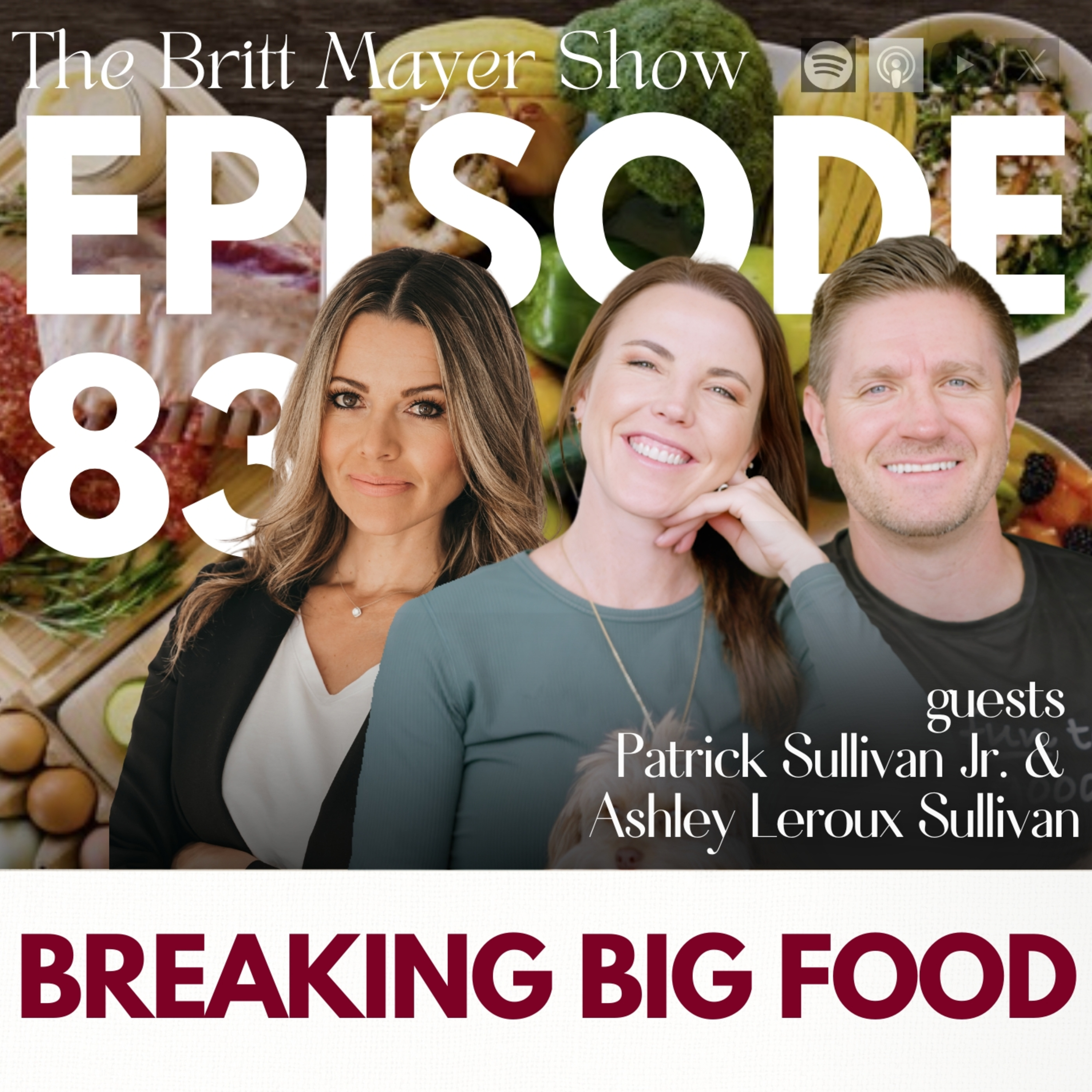
Breaking Big Food | Patrick Sullivan Jr. and Ashley Leroux Sullivan | ep 83
Get every episode summarized
Each time Rooted Wings publishes, we email you a written briefing from the transcript — the topics, who appeared, and any specific claims, with the ad reads skipped.
Email me new episodesFree for 3 shows. No card needed.
About this episode
“I'm your host Brit Mayor and here we talk about culture, politics, faith, and health and the stories that matter most to you in a world that is incredibly noisy. We cut through the noise to bring you the most important stories.”From the transcript
Join us as we explore the shocking rise of "Big Food", its impact on health, and practical steps to reclaim our food system through grassroots efforts, informed choices, and community building. Experts Ashley and Patrick share insights from their documentary 'Breaking Big Food' and their journey of creating a healthier food future.
About Patrick & Ashley:
Husband & wife business partners, Patrick Sullivan Jr. and Ashley Leroux Sullivan, aka. "Pashley" are the executive producers of a new feature documentary titled, “Breaking Big Food: How The American Food System Went Rotten, and How It's Being Revived”, which was released on Apple TV & Amazon Prime Video on January 15, 2026. They also just opened the cutest little coffee shop in Scottsdale called, “Firefly Organic Coffee & Market”, featuring 3rd party tested, mold-free organic coffee.
More:
Where to watch the "Breaking Big Food" documentary:
Visit Firefly Organic Coffee & Market in Scottsdale, AZ:
https://FireflyCoffeeShop.com
Purchase Firefly Organic Coffee Beans:
https://www.jigsawhealth.com/products/firefly-organic-coffee-beans
Subscribe to The Britt Mayer Show here, share this episode and please leave a good review. On Spotify, Apple Podcasts, X & YouTube. All linked here:
https://wearerootedwings.com
This Episode is Brought to You By:
Resistance Candles. 100% Made in the USA & nontoxic! Resistance Candles is built on the intersection of tradition, beauty, and rebellion. Each candle reflects the values we live by: freedom, personal sovereignty, truth, tradition, and faith. Use code ROOTEDWINGS for 10% off:
https://resistancecandles.com/collections/american-heritage?el=brittmayer
Check out Britt’s fave things with exclusive community discounts. This helps fund the independent journalism of Rooted Wings so we can keep bringing you news and analysis that is not bought and is faithfully, consistently independent:
https://rootedwings.substack.com/p/favorite-things
Please subscribe, leave a good review and share across all platforms so we can keep delivering truth to a world gone mad.
The Britt Mayer Show on Spotify, Apple Podcasts, X & YouTube.
Producer/PR Inquiries: [email protected]
Get every episode summarized
Each time Rooted Wings publishes, we email you a written briefing from the transcript — the topics, who appeared, and any specific claims, with the ad reads skipped.
Email me new episodesFree for 3 shows. No card needed.
Hosts & guests
Transcript ready
559 searchable segments. Every word is indexed and playable.
Full transcript
Rooted Wings — Breaking Big Food | Patrick Sullivan Jr. and Ashley Leroux Sullivan | ep 83. Machine-transcribed; use the interactive transcript above to jump the player to any line.
Welcome back to the Brit Mayor Show. I'm your host Brit Mayor and here we talk about culture, politics, faith, and health and the stories that matter most to you in a world that is incredibly noisy. We cut through the noise to bring you the most important stories. Today we are diving into an incredible conversation about reclaiming our health from a corrupted food system. My guests today are Patrick Sullivan, Jr. and Ashley Leroux Sullivan. They are the powerhouse couple and they are so sweet. Behind Jigsaw Health and they are the executive producers of the powerful documentary Breaking Big Food, which you have to watch. It is so, so good. This film exposes how Big Tobacco hijacked our food supply in the 1980s, engineering addictive, ultra-processed foods that have fueled obesity, diabetes, autoimmune issues, and more. But they don't stop there. They spotlight inspiring local David's who are fighting back against these goliaths with clean, real food. Patrick and Ashley are going to share what they are doing, their journey, and how you can also reclaim the health of your family and how together we can break Big Food. You're going to love this conversation. Please like,
subscribe, and share wherever you are listening, and let's get started. Thank you so much for joining for this really important conversation. You guys are on mission to expose Big Food, Big Food, and not only that, but your leading by example, in how we break up Big Food. I'm just so excited because it's one of my favorite topics. It's good, healthy food, and you guys are leading the way. First, I thought it would be really important to just define what is Big Food. Well, I think we can all know it when we see it. It's the packaged food that doesn't exactly look like what grandma and grandpa would have ever eaten. It's a great answer, Patrick. That is a really good answer. So it's not like the cute little microgreens that you get and the beef and chicken. This is something totally different.
That is the kind of food you want to be eating, not only because it's healthier for you, but you're helping most likely to support local farming. And local farming is really important for the environment. It's really important for the economy. It's really important for food safety in America. So we in America started with real food. And then at some point, there was a shift into the dominance of Big Food. So why don't we walk through where everything went very, very wrong. Well, one of the things we learned in the making of breaking Big Food was three important facts. In the 1980s, Big Tobacco was finally getting rolled up, let's say. As a result, Big Tobacco was like, well, what are we going to do with all this money? How about we buy some food companies? In 1985, RJ Reynolds, the makers of camel cigarettes purchased an abysco for $5 billion, billion with a B. In 1989, Philip Morris, the makers of marble cigarettes, they purchased
craft food for $13 billion. And that's just two examples of some of the largest M&A transactions that happened during the 1980s with Big Tobacco buying food companies. And wouldn't you know it by the 1990s? Big Tobacco controlled about 40% of the American food supply. What could go wrong, right? I mean, that's it's shocking. And I think there are a lot of people right now who are saying, wait, what? What happened? So why? Why did this happen? Why did Big Tobacco go in? I know you said no pun intended. They were rolling up. But why did they move into the food market? Well, it's somewhat speculative. It is covered by Callie Means, who's featured in our documentary. And he talks about how when the surgeon general was essentially putting the kibosh on, okay, no more of this four out of five doctors choose camel cigarettes. Sigarettes are dangerous. We're going to let the American people know. Big Tobacco had this
glut of money and a need to find something else. So they kind of turned themselves to, well, what can we do with these food companies that make these interesting food like substances? Could we make them cheaper? Could we make them more addictive? Could we make them brighter color more colorful? Now, is this where the term ultra processed comes in when we're talking about food? Is this the the connection for the audience who's thinking, okay, we're really trying to peg it. What is big food? Is this where we get the term ultra processed from? Well, interestingly enough, I know RFK Jr. the head of HHS has been talking about we will have from the federal government a definition of ultra processed food. I believe he said by April, which is according to my clock next month. It'll be very interesting. Yeah, it'll be very interesting to see how they define it because what that could lead to is potentially
front of label packaging that has sort of scores or like a red light, yellow light, green light kind of thing. But if you think about what happened with Big Tobacco in the 80s, what they were really fighting against was labeling. They didn't want to have to put black box warning labels on their cigarettes because they were worried, oh, we'll lose customers that way. We'll lose customers if they know what this product really does. And here we are, history doesn't ever repeat itself, but it does seem to rhyme. It's really interesting actually what you're saying because if ultra processed food that in the definition there requires a warning for the American public, then it's like, well, Big Tobacco was able to skirt this long, but now this could deal a huge blow. And that would also parlay over to subsidies. And this alliance that we have with government subsidizing big food, which has been a huge issue. Why don't you guys talk a little bit about that? This alliance
between government and big food. Well, and in particular, the SNAP program, the supplemental nutritional assistance program, food stamps is what we closely, I was on I'm I was a food stamp baby. So back in the 90s, my mom was a single mom. And it was before they had the debit cards that are kind of innocuous. My mom had like the bright colored food stamps. And I remember being I mean, it gave me grit. I was like raised in the hood. So I'm thankful for it. But I remember being in the front of the supermarket and her having to pull out these ridiculously like glow in the dark colored food stamps to buy our food. So I'm wall aware of the limitations of what you can buy and can't buy with food stamps. Well, that's just part of the thing over the years. The definition of what you can buy with food stamps has changed. And one of the things again to refer back to Callie is he's talked about how somewhere between 10 and 15% of the entire SNAP budget has gone
to pay for sugary soda drinks. Wow. That's not necessarily what we the taxpayers want to help our neighbors who are in need purchase. That's not nutrition. That's not right because it's not nutrition. And and what your mom was buying for you in the 90s was still probably a lot less processed than what's on store shelves today. Yeah, I actually I feel like and it could have been my mom just be asking us kids when we wanted the sugary stuff. But I feel like she would say there were certain things that we just we simply couldn't buy like there were boundaries put on healthy foods and then what wasn't healthy couldn't be covered with food stamps. I don't know where that all stands right now. But I do want to get to the core of it that it's important for the audience to understand that there is an unholy alliance between our government subsidizing big food, which is largely backed by these giants who used to be the tobacco giants and just
shifted into big food, which to me is it's extremely impactful. Kelly means has a quote in your documentary, which I would recommend everybody watch it, especially now that breaking news, the Basharat season is no longer going to air. I didn't even know that that was still a thing, but it's just that news just broke. So you have time now to watch this documentary. And I watched it. It is so so good. It's a short watch, but it's really it lays out everything that's gone wrong in American food. But this is what one of the quotes I pulled from Cali. He said big food manipulates big government leading to garbage in our grocery stores, which may in fact be the culprit lurking behind the horrifying health statistics in America over that same time period, which would be the last 40 years. What do you guys make of that? I mean, amen, amen. Yeah, I mean, if history has shown us anything at all, it is that we cannot rely on government to make things healthy for us. Amen. Amen. Okay. So that gets us big food, big pharma, big anything.
Thank you, big pharma, because this is where it all comes full circle. We are finally realizing I feel like the curtains kind of lifted and we've seen behind the to the wizard behind the machine that something is very wrong in modern America. And there are a lot of these large conglomerates who have risen to power without us really realizing it. We think, you know, that the government cares about our health. Well, Dave shielded the pharmaceutical companies, and then the vaccine schedule has exploded since the 80s when that pharma shield was put on. Now we're realizing, oh my goodness, there's an alliance between big ultra processed food and these tobacco giants. And how is that? How is that health? So I think we're starting to see behind the curtain. One statistic that you mentioned, Patrick, that I just want to reiterate is that 70% of snap dollars, part of a roughly 100 billion dollar program for the lowest income, 15% of Americans. That was me. No shame in that game. Go toward ultra processed foods, effectively subsidizing junk food on a massive, massive scale. Now in connection to that,
there are nearly 10,000 chemicals allowed in US food under the quote-unquote generally recognized as safe, self-approved loophole, many of which are banned or restricted in European countries and Canada, but our tax dollars are paying for our most vulnerable to consume that. Something seems very wrong. It is very wrong. In the late 90s, I believe it was, the FDA was just overwhelmed trying to keep up with approval of, let's call them food chemicals. And they allowed something known as grass, GRAS, which stands for generally recognized as safe, essentially enabling industry to self-police and self-declare. Well, we think this petroleum-based food die, we think it's safe. So no longer was the impetus to prove safety on the companies that made the products. Rather,
it was on the, really, the trial lawyers to prove harm. And that's very difficult. What's interesting. And it takes a long time too. We've won that. Exactly. It takes a long time. And unfortunately, a lot of damage can happen during those years or decades. I was going to give a shout-out to the food babe who has posted quite a few different memes on Instagram and X about, you know, but I ate that as a kid. And I'm fine. And I'm fine. And, you know, referring to like gatorade from the 1980s. Or fruitloose. Or fruitloose. Even McDonald's French fries, you know. And showing the ingredients then from 30, 40 years ago versus the ingredients now. And showing, wow, the list got a lot longer. And also food babe pointing out that the fruitloose sold in Canada in New Zealand and Europe sure are a lot more dull looking than the fruitloose sold here in America.
Ashley, why is that? Oh, well, they're not allowed to use red dye 40 for one. They're, you know, coloring their foods with beet like beets and, you know, carrots and things like that turmeric. Meanwhile, America's allowing red dye 40 in foods because it's generally recognized as safe Ashley. But not in cosmetic when they outlaw that because it causes cancer. It's so fascinating. And I think that this is where Cali means has been so helpful because he does come from the lobbying background. So he's able to pull back the curtain even on that and show how powerful these lobbies are who have been really protecting our food becoming just garbage toxic poison that would make those European countries completely shudder if they were to come here and see what we are feeding our school children. It's it's appalling. I want to shift into asking you guys specifically about this documentary that again, I think everybody should see breaking big food. So good. But I want to shift into knowing what you guys put out in this documentary and some of what we just talked about.
How do we break big food? It seems like a pretty monolithic goliath task to try to break up something that is so heavily lobbied and it's protected by so many unholy alliances. So how do we how do we break it? The only way I can think of is to vote with our dollars. So I don't literally start supporting local stop spending money with the big process food companies stop buying the crap. Just when when they stop seeing the dollar bills roll in, they change their capitalists. They understand they're going to change their methodology to serve where the demand lies. If you can't afford all organic, which is totally understandable, it is expensive, especially right now. Try to go for the things that are on the dirty dozen fruits and vegetables that have like the bananas that have a peel that can protect the fruit avocado, things like that. But also I think people, Americans
need to look a little bit closer at the budget and say, is there anywhere I can carve out where I used to be spending money on fruit snacks and I used to be spending money on maybe Doritos or these protein shakes or whatever that are quote unquote healthy that really if you read the ingredient labels aren't. And how do I transfer some of that budget more to the whole foods? And I think people might be surprised. I mean, spend a little less at Starbucks too, right? Okay, okay, shot taken. Okay, what are the what are the most offensive appalling foods that I am currently purchasing for my family that you would say that is where you need to make the shift? Are you buying lunchables for, you know, sending your kids to school? Are you buying fast food? The fast is convenient, but it's hardly food. And probably there are other things along those lines that if you look at, okay, if we embrace that food is one of the things that like all animals need
to survive, if you turn it from sort of live to eat to live to a live to eat and you start to kind of fall in love with the process of, huh, what could I do with these fresh tomatoes? What could I do with these foreign fresh eggs? And really almost simplifying your diet, simplifying the different kinds of foods that you're buying to be, let's just call what RFK has said, eat real food. And you can do a lot with ground beef and it's when you're you're prioritizing these nutrient dense foods, you eat a lot less of it. Your body says, okay, I'm satiated, I'm good, I've got nourishment here. So even if you can't do the organic grass fed beef or whatever, whole foods are still way better than ultra processed foods, just do the best you can. Yeah, I agree, I think that's good. You featured a ton of really interesting characters in this
documentary and I want to talk about a couple of them that really stood out to me. I pulled a few that I just I fell in love with. So one of them, and I want to talk to you guys about something interesting that this cowboy said, Tim Peterson, Arizona grass fed beef company shout out to them. He raises grass fed beef from start to finish on pasture. And I think in the documentary, it's like millions of acres, which is so crazy that he's got it. Yeah, they have over a million acres of pasture land. Yeah, it's amazing. I want to go see it, but he was telling you in this documentary that his meat supplies higher nutrient, dense quality meat directly to local businesses and consumers, but there are no shortcuts. And he was talking about how often with the cows on his millions of acres, he won't see them for six months. They're just out there grazing and doing their thing. And then eventually one of the cowboy season and checks on him is this the way of the future? Are we going to see a radical shift from big food where you have cows jammed together without
ever seeing daylight and injected with Lord knows what back to where we started, which was the wild wild west, the cowboy spirit of rate. They were the backbone. The cowboys were the backbone of early America. Do you think we're going to see a shift now that the work that you guys are doing, Callie means RFKJ is exposing what a disastrous experiment big food has become? I mean, I think old is the new new. I would love to believe that as Ashley was talking about, we as consumers from the bottom up really do make a difference in the marketplace by how we vote with our wallet. And certainly we need changes from the top down. We do need new regulations in place. We need petroleum based food dies to be outlawed. And in fact, that's happening. RFK junior is making big strides there, but really the biggest changes happen when a bunch of
David's overcome the Goliaths by voting different with our wallet. And I totally believe that industry that farmers that food providers will be there to fill the void because the market hates a vacuum. And one of the things that we have found at our own little firefly organic coffee and market is providers now finding us like, oh my gosh, I can't believe you've created this amazing coffee shop. I bake organic sourdough bread. Are you could I shop? Could I have this here? I make what's the Arizona churn culture? Oh, organic breastfed butter. Amazing, you know. And they're like, we have been, we it's like the middle man that brings the suppliers and meets them with the consumers that are like looking to us, firefly to be a filter of these providers.
So in the documentary, one of the other people that we've that we featured was Amber from Ethelaine Bakery who got her cottage license and started to bake this delicious organic sourdough bread. And one of the things she makes for us is these organic sourdough cinnamon rolls that are crazy. Crazy good. And becoming world famous. And what we have found is as our demand is like growing, Amber can't keep up. But what's great is another supplier that also has these amazing organic sourdough English muffins. She's like, oh, I would love to provide for you guys. So it's this great like ecosystem that's forming. And part of the documentary, our goal was to inspire this kind of activity across all of America because we really need to rebuild the food system from the ground up on a local level. Yes. That's one of my notes that I wrote while watching this was
this documentary, what you guys share. And we're going to get into exactly what you are doing because you didn't just cut a cool documentary. You're actually living what you are preaching, which is so cool. But I wrote down that your documentary is so empowering rather than defeatist. You aren't saying we're waiting on the government. We're waiting on anti-trust action. You are already taking this from the grassroots and saying this actually is the path forward. And this is how we can bring about change as we hope and push for proper legislation and for the government to get their act together, which there's a lot of hope with RFKJ. You know, we have to hope he's the best shot we've ever had. But you guys are actually doing something about this. So I do want you to share with us during your documentary. You weren't just shooting a documentary and meeting all these amazing people. But you guys were also building a mini market and a coffee shop that I cannot wait to visit. So share what your idea was in creating this and how it can
be replicated, how this isn't just a standalone one off. But this actually could be a way that we break big food. Well, actually, why don't you talk about the mold test? So right as we started to begin to work on this documentary, I had done a series of health tests for myself, one being a toxin test. I wanted to see what environmental toxins my body was having a hard time detoxing. And surprisingly, three different types of mold showed up on that test. I was shocked. I was like, I don't even eat blue cheese. Like, where is this coming from? And it said from food derived sources. So it wasn't like something I was breathing in. So as I went down the rabbit hole, I realized one of my favorite consumable items, coffee is one of the most one of the biggest culprits of mold and mycotoxins because the sheer fact that it's usually grown in very human conditions. So as I went down that rabbit hole, I said to Patrick, we have an afternoon latte habit and I really love
going to a cafe to have my afternoon lattes. And I really don't know if the coffee that we're consuming is mold for your not, you know, this could be part of the issue. And so I said, why don't we just open up our own? Because that's what every normal person does. Why we should just open up our own and do all the tests and find some non moldy coffee. That's what everyone does. Exactly. Well, as owners of a nutritional supplement company, we've been third party testing our supplements for years. Like it's always been a core value of ours to make sure we triple test everything. And I said, well, let's find a coffee we love. Let's make sure it's USDA certified organic. It's shade grown, it's specialty grade, single origin, all those things. But then we're going to go the extra step and we're going to send it away and make sure that it has no mold. Mycotoxins heavy metals because people need educated on this as a real like it's an issue, right? And they don't understand why they feel so crappy. I mean, there's so many people that feel crappy. And if this can
help solve a solve for some of that, right? It's all of a piece of someone's puzzle. I felt so inspired to do so. And so we started to build out the Firefly organic coffee shop. And as we were interviewing places like Good Living Greens and Fountain Hills, Jill and Jeremy that have this micro market where they're basically sourcing from all these local farmers that got raw milk, they've got grass fed beef and farm fresh eggs. And it's such an amazing resource for the community. We were like, okay, what if we made it coffee shop and market and we can carry these things as like in another part of town, it's basically another community, you know, it's someone in Arizona, but it's like, I feel like all these little communities need these micro markets so they can easily get them, right? It's the convenience that we're trying to provide this good food to. It's the access is it can be a barrier to entry in all of this because as a mom, you're like, I'm already busy. I'm not running for me out to Julian an hour away to pick up my beef. And then
I'm going to have to go over here to pick up my sourdough. And then it's just not convenient. So I'll just go to the supermarket, you know, or I'll go to Costco. But what you're doing is you're like, well, this is actually a way that we can pull it all together under one roof. We're going to highly vet everything that we carry. I wanted to ask you about that, Ashley, is the the vetting process? How do you vet what you bring in so that moms like me don't have to go in and get dizzy like we do at Costco trying to read and figure everything out? Well, I personally vet every single thing that we bring into the shop. I try to go local as much as possible. But at the very least, the nutrition labels aren't going to have seed oils or gums or weird chemicals or preservatives in them. It's like the cleanest things I can find that are like unique, right? We've got like a simply sweets, like a gummy that has like, it's actually really clean label. So people can go, oh my gosh, I can actually give my kids these little candies once in a while or whatever. And, you
know, it's actual free. Yes. So it's just very unique items that are just very clean label. I love that. And I do think that we're seeing a trend in this direction. There's a little outdoor market that's just up the street for me. And they have a very similar philosophy. And so when I go, I know that they've already pre-vetted everything. Everything is local. You know, it's not going to come from overseas. And it's up to the standards that I would choose for, you know, if I had to go out and find everything. The one thing that keeps going through my mind, though, is the cost. So walk me through how as this replicates, and I think you cover it in your documentary a little bit, is as this idea replicates. And we see more and more of these mini markets pop up, which is happening. How does that actually bring the cost barrier down on real good food and take the money away from big food? Well, a couple of things. One, I think that, you know,
economics always works. When there is demand, supply will find a way to reach it. And one of the women that we feature in the documentary, Tiffany Lilly, she started with one chicken in her backyard. Oh, she was hilarious. She loves those little chickens. Everybody loves the chicken lady. Yeah. And she started as an experiment with her daughters. They were homeschooled. And she's like, okay, we'll, you know, figure out what it's like to raise chickens. Well, now her farm, inspire farms. Her tagline is we inspire farms one backyard at a time. And the reality is, as we get closer to our food and start caring more about our food, you'll see, I think, a natural progression of people saying, wait a second, you mean I could make money selling farm fresh eggs from my backyard from chickens that are basically eating clean nutrition. Okay, that's interesting. So I like to think that the big screen TV is hopefully a good model for what will happen
economically. If you think back 20 plus years ago, a big screen TV was $15,000 or whatever, some kind of outrageous, but it was such a cool thing that everybody wanted to have. And rich people started buying them, which created economies of scale, which created a market. And now a big screen TV is like $500 at Costco. So I really believe in market forces that will fix the current cost problem. And I also think that we will begin to see more changes with big food, because they are capitalists as well. They are responding already to seed oil as an issue, where you're starting to see like Doritos in avocado oil, yeah, with no food coloring, with no food coloring. And you're like, okay, they are paying attention. Why? They're public companies. If they have a decline of 10% in revenue, they will lose their minds. And if we the consumers are voting
different with our wallet, we will force them to make more changes. The other thing I think that comes up over and over again is that in the cost discussion is the fact that food that is ultra processed is artificially cheap, because it's basically all on the basis of subsidized corn. So in the US Farm Bill, we spend, I don't know how many billions of dollars, subsidizing farmers to grow corn and soy, the bulk of which is used for basically ingredients, either feed at feed lots or high fruit dose corn syrup and other ways, other things they can derive from that corn. So fast food or other ultra processed food is cheap only because the government currently has their thumb on the scales making it cheap. So I also have hope that at
a higher level, the government will potentially look at some subsidies for farmers who want to invest in converting monocrop farms, you know, where they were growing soy or corn into regenerative organic farms, and a shout out to one of the documentaries that inspired us, the biggest, the biggest little farm, which came out in about 2017. And it really shows this amazing transition that this, you know, family went on taking monocrop land over the course of seven years to regenerative organic where, where it's like now it's nature working together in symbiosis to create food. Yeah, you know, it's interesting. As you're talking to, I think something has shifted over the last few years where we, we are such a fast-paced society, but there has been some sort of a slowdown, even Gen Z data showing them pulling off of online
activity. They're not wanting the short little tweets anymore. They're wanting to get back into classics. It's just interesting that something is happening culturally that is very significant, where they're, I've said this before, my producer and I were talking about it, like a rebellion against the machine. There's always a rebellion against the machine, right? Well, the machine right now is this unholy alliance with all these major corporations at the behest of our government and making us feel safe. And so you can keep your fast, busy little lifestyle, but you're really a hamster on a wheel. And the rebellion against that is the slow movement, the getting back into the classics, not wanting the, the short tweets, wanting a bigger attention span, wanting more value in the hours that we have. Even goes into, we don't want to outsource our health anymore. We want to take control and be stewards over our own health. We don't want to just shortcut it, you know, and oh, we'll just go to the doctor real quick and get a vaccine and call it today. It's like, no, we want to actually look at food as medicine. And what can I eat that will provide the best
longevity for my, it's just, it's interesting that there's something happening back. Yeah. Yeah. And I think that it's a revolutionary moment for us. Yeah. Unconstitutional taxation has always met the same response when power reached into pockets without consent. Americans gathered by candlelight, read the fine print and chose refusal. Laws that were meant to justify theft were torn apart. Receipts were burned. Cargo was thrown into water while tyranny stood on the dock, demanding obedience that it no longer had. I am so excited about this new candle by resistance candle taxation is theft. You can light this candle in the spirit of that rejection. And as a reminder, that theft doesn't become moral because it wears a seal. I love the quote by Frederick Bostier. When plunder becomes a way of life for a group of men, they create for themselves a legal system that authorizes it. This little candle is our rejection of taxation that has become theft. Go grab this candle at resistancecandals.com. Taxation is theft has a really nice ring to it.
And grab a few so you can give them as gifts. Resistancecandals.com and use code rooted wings. At Firefly, I would say the single largest demographic that we see are Gen Z young moms. And it really gives me a lot of hope for the future. Oh, that is so hopeful. What has the response been since opening you open Firefly a few months ago? What has the response been? Yeah, it's been incredible to see the way that the community has responded and supported us actually. It's like when people walk in and they look at the things that we have on the shelves and they look at the mold free coffee and the organic milks and all the things that we have. They're like, are you kidding me? This is what I've been looking for and dreaming about. Yeah. And I've found it and thank you for understanding and seeing me. Thank you for being my people. You know, it's amazing how many health influencers have come in and done amazing reels for us to help us spread the word. I mean, we didn't even ask. Like, we haven't
spent any money on advertising. Wow. And somehow in this weird little nondescript office park, we've got like this, like just thriving community of people that are that come in all the time. They're regulars and they tell their friends and they're so enthusiastic about it. It's beautiful to see it. What you guys have also done that I think is noteworthy is you've created community. You haven't just created a spot where you can go pick up some groceries. You've actually created a community vibe where people can come and they can bring their friends and then they can also shop for some really good high quality food to bring back home. And even that is like, we're just going back to the basics where you know your neighbor, you know your community, you know, you're not just on Instacart, grabbing some stuff real fast because it's cheap and affordable. One thing I wanted to ask you guys to cut out for our audience and really explain it is the idea of beef because beef is such a super food. And this was covered in your documentary
that you can actually buy like a quarter cow, a half cow, and it's not like a real living cow. If this is like the meat, you can buy it. It's not a bet. But there's this movement and I've done this. So you can buy like a quarter of a cow and then you get all the cuts and all the good stuff. It's all packaged and it ends up in a deep freezer. So it's there for you ready to go. And then you can pull it out and make meals as you go throughout the months. But how this is way more affordable than going to the grocery store and buying the cheap meat. You can actually buy regenerative pasture raised high quality beef for less when you buy it that way, then going to grocery store and getting cheap cuts. Yeah, buying it in bulk, right? We're all sort of aware of that. You know, you're saving the producer on packaging and on shipping and refrigeration and one of the great people that we featured in Breaking Big Food was AJ Richards and Brooke Ens,
the co-founders of FromTheFarm.org. And they like to describe it as like Airbnb of farms, where you can find from a directly from a farmer a quarter cow or a half a cow. And when you're buying it up on a per pound basis in a large bulk quantity, you're paying actually less than what you would spend at the grocery store. Now, you are going to need a place to store that beef. So you might have to buy, you know, a couple of hundred bucks on a freezer where you can put in the garage. So worth it. Yeah, it's made a life life changing for me to have a second cheap freezer in the garage. It's made a huge difference. Yeah, you we bought one on Amazon. They they delivered it. We plugged it in. Next thing, you know, easy peasy. Yeah, no, I think that it's it goes along the same lines as what we were talking about, you know, how do we forward, you know, this to eat this way? It's at first, you kind of get sticker shop because you're like, wait, how much is a half a cow? And then
you're like, all at once, you know, it. But if you actually do the math, it does save you money over the year. So it takes a little bit of extra time to maybe budget for it. But, you know, if you just pair down the things that are non-essential, like the foods that really aren't nutrient dense and you prioritize the things that are. And I think you'd be surprised what you actually can budget for when you just pair it down. And you'd be surprised how many meals you can do with ground beef as the the star protein. And ground beef is phenomenal for you. It's a super food. When I was going through infertility issues before my first, I was on like an almost vegan-ish diet. I thought it was really super healthy. And when in desperate, it was my last Hail Mary before we went into like full on trying to figure this out medically. So when visited an nutritionist and she asked me my diet and I told her what we were doing. And she was like, I'm not going to see you back again
until you're eating eggs and red meat. Like give yourself a month on that. And I was pregnant right away. And this was after six months of just trying and trying. And after all, it's not so romantic. Or you're like, why? But yeah, it was, I believe my food was really preventing me from being able to carry a healthy pregnancy. So it's fascinating just to see the way that food is designed to be medicine and to keep us healthy. And no wonder why the government would come in and create an unholy alliance to keep people sick that then hands them over to the pharmaceutical industry. It's like I said, it's just this unholy alliance. Okay, I want to ask you guys for families who are listening to all this. And they're thinking, okay, give me some direction where do I start? I want to, I'm all in. I love what you guys are talking about. I understand that it has been captured in terms of what I see at the grocery store. But where do I start? How do I begin this process? I always like to recommend that you start learning how to read a nutrition label.
I think educating yourself on what ingredients you really need to avoid as much as possible is a great place to start. We actually created a resource that dirty doesn't ingredients to avoid that are the most commonly found in your salad dressings and your sauces, your hummus, your chips, the everything. What would it be? Give me like your top five. What are the top offenders that we should be avoiding? Well, I'm just going to go to break that big food.com right now and download the PDF. It's been a while since we've created this sheet. I can't remember exactly what it is. But the good news about this sheet sheet is you can download it. You don't have to put your email. You don't, we don't ask you for anything. It's literally just a free resource that you can download, put it on your fridge, and then, you know, have it to reference. And you'll start to learn as you go along. But high fructose corn syrup is one of the top. I mean, they love to sneak that in. Artificial sweeteners, superlose, aspirate, sweeten low, all those things that are like, oh, it's sugar free. If it says sugar free,
red flag goes up in my mind. Usually it's going to be a cheap gut destroying sweetener that is just absolute garbage. Artificial colors, anything with a yellow five or red die 40. Stay away from anything with color in the name is anything to number. Yes. And then, you know, look out for natural flavors. Those can be tricky. I think sometimes, sometimes they're fine, but they don't actually have to disclose to you where the natural flavors really come from. So I don't really take a chance with it. I tend to stay away from the specifically savory foods. Yes. So savory foods with natural flavor almost certainly use MSG monosodium glutamate, which is that snuck in under the natural flavors. Correct. Of savory foods. Yes. Wow. I didn't know that. Yeah. Carriguing and that's another big one. That's an emulsifier. And then all the gums, like, you'll find it's especially like ice cream and stuff. I'm like, why are they putting these in ice cream?
It should be like three and four ingredients. But then you've got like three types of gums in there. And you're like, it's just reefs have it on your gut. I mean, there's it's no wonder why people are walking around with so many gut issues. And these types of ingredients are really a big contributor to that. I think that's great that you guys have that little cheat sheet. So a mom can even take that when she goes to the grocery store, you know, and just have it right in front of her, so she knows what to avoid. That is extremely helpful. I, one of the things that I have done for my family. And then I want to ask you guys what your plates look like currently. What's your, what's your average meal like? But one of the things that was life changing for me. And I've shared it before, but I think it's worth bringing up again, was we bought into the West and A price style of real traditional eating when I was having infertility issues. So that would have been like 13, 14 years ago. And it was very complex. I mean, we went into the gaps diet and then from that reset, I was staring down the barrel of all these recipes that were so intense and took so much time
and I would labor in the kitchen. I never left the kitchen. And it was overwhelming and took so much time. Well, a few years ago, I don't know, as something broke inside me in a really good way. And I created this framework, which has served us so well over the last few years. And I call it deconstruct the plate. And I throughout all the recipes, I got rid of all of the Pinterest boards and all of the fancy reels that showed impossible recipes. And I just broke it down to a really high quality protein that's nutrient dense regenerative, a good vegetable that is in season. And then some sort of a good healthy carbohydrate. So we'll do rice or I'll have some potatoes from the local farmers market, whatever is in season. And then we kind of mix it up with fun sauces that are really easy to come by that include like a few handful of clean ingredients. That has served us. It has been life changing. So well, it has given me so much time back. My family never complains that they eat the same thing more than once, even though they do shocker. You know, and then I'll usually do like a big meal for dinner. So I'll do ground beef.
Like what Patrick was saying, you know, a bunch of ground beef. And then in the morning, so that'll be for dinner over rice with some salsa. And then in the morning, I'll throw it with some eggs and some sliced avocados and call it a day. And then I can pack it with my husband for lunch with like a hummus. And he's he's so happy. So I think that for moms who are thinking that this can be really overwhelming, it doesn't have to be. You can deconstruct the plate and you can make it really simple. But I want to know what your guy's food food life looks like. I mean, I think that what you just described as brilliant, it's really very close to how weed, I mean, it's almost identical. We kind of rotate the same, you know, six meals every week. You usually go out to dinner once a week or something like that. But it is always centered around a high quality protein. And yeah, we do a lot of organic white rice or potatoes or good quality sourdough bread. Yes. And if we don't get sick of it, I look forward to stir fry night, you know, and figuring out, and I don't just of course buy any stir fry sauce. I look at the labels or I
make my own concoction and it doesn't take much just to flavor it a little bit. And it does, it's so freeing once you just kind of get rid of the clutter of like, I don't need all these sauces. I don't need all these dressings. Like let's just get back to like the grass bed butter, the olive oil, you know, and the food just let it shine for what it is. Breakfast is also go ahead. Go ahead. I want to hear what your breakfast is. All right. Well, I'm going to say breakfast is pretty darn simple. Uh, it's eggs. Usually four two for her two for me, but then I usually get some of her eggs. And then we like, uh, what's the brand of the kabasa that we get? Uh, we like Peterson. Yeah, it's good. What is this kabasa? What is kabasa? It's like, um, kind of like a Polish sausage. Oh, they also make a great breakfast sausage. So I just kind of find the the cleanest, um, pro, you know, breakfast protein. Um, sometimes we'll do like a grass, actually, Arizona grass rice beef has a good breakfast sausage. Yeah, that we make. Um,
and we kind of usually batch cook that so that we have it ready. So we'll either do that and with some sourdough bread for breakfast or, uh, we're like, some cinnamon creamed honey. The local honey. Yeah, local honey. Yeah. So great. And then lunch is even simpler. Uh, we, we get a lot of prepared protein from here locally, eat clean phoenix. Um, and they will do like protein and books. So we love to get their clean salmon while caught salmon. We usually just put it in a bowl with some microgreens, some local microgreens. We do Spanish olives and some cherry tomatoes, a little olive oil, lemon juice, salt and pepper and like that's, that's lunch. So somehow, somehow we got tricked into thinking fast food means it has to be in a package and made by someone else in the middle of the grocery store with God knows what ingredients, but it really, it's like, no, like you can create a lunch like you just said, that is so simple and really doesn't take many ingredients and you're getting nutrient dense food at every meal. I have found two that one. We have a breakfast like what you just
described. We are so satiated and have so much energy like up through lunchtime, but when we skip out and we, cause yeah, we're human and sometimes like the kids have cereal, not with food dye, but sometimes they have an organic cereal that has way too much sugar and they are crashing by noon and I home school. So I hear it. They're like, I need, I need food. I'm like, you need protein because I was lazy, but um, it's, I love just sharing this with you guys and seeing what you guys have not only created in the documentary to bring awareness, but what you're living out and leading in real time before we let you guys go. I do want to ask what if, um, you had to tell the audience what should they focus on? What is a nutrient dense item that they can pick up this week? Why don't you include this? I know we've talked about beef, but is there anything else that you would say, this is a great starting point for you when you go to the grocery store this week to, to try to grab and try it, try it, try to incorporate this into your meal planning this coming
week. I mean, I'm always going to say raw milk, but not everyone has really access to it. Not in California. They took all the good things from us out here. We have to black market that in. It will change, but man, um, raw milk is really a super food in my opinion. It's so nutrient dense and, um, so much better on the digestion than the pasteurized milk. Um, but again, that can be hard to come by. Um, but if you want to, if you ever get a chance to try it, I do highly recommend to try that. But I think just high quality eggs, whatever you can get, eggs are, they can be good for breakfast, lunch or dinner. Yep. It's such an easy versatile powerhouse to be able to just make very quickly and easily. I think with the egg thing, didn't in the documentary, wasn't there some conversation about with your egg lady who was so hilarious, but something about how people would come to her and say, I'm allergic to eggs. I can't do eggs. And then she's like, well, try my eggs. And it was something with the corn diet. Yeah. Most chickens are fed like a corn and soy diet. So if you have, um, an
issue with corn or soy, because the chicken ate it, you are eating their egg of the chicken. So it's like, it's not like what we eat. We are not what we eat. We are what we eat eats. You gotta go a little further, um, because it really does matter. And that's why the grass fed, grass-finished beef is so good is because they're not being fed, you know, glyphosate and all the pesticides and whatnot, um, and just grains, right? I just love you guys. I love what you're doing. I love your efforts on this front. Patrick, I want you to close us out before we roll into your trailer and just share some encouragement for the moms and the dads who are listening to this and who are thinking, okay, my eyes are open. I see what you guys are talking about and you're going to see even more in the documentary, but just to give some encouragement about how this is the path forward if we're going to reclaim our health in America for our children and our grandchildren and that we really do have a shot at this. I'm reminded of a story that Jordan
Peterson told of a woman that's at a party and she's looking really depressed and sad and somebody comes up to her and says, you know, like, why are you so sad and depressed? And she's like, well, I can't decide if the world is against me or if I'm doing something wrong myself, but I hope it's me because then I can change it. And what I'm reminded of that story is in this case, our health outcomes, we have so much to do with the outcome. We are not victims. We are in control of so much of our health and so much of it starts with what we eat and what we choose to put in our bodies and what we choose to feed our families. So knowledge is power, but action is really where you get the difference. If you start with the dirty dozen ingredients to avoid as your first place to start, once you do that, you're going to gain a superpower. You're going to go from level one
to level two and be like, oh, I know that BHT is something I should stay away from. That's a new super power. The next levels are, oh, I found this local farmer that actually does sell raw milk or has farm fresh eggs. I am going to buy coffee that doesn't have mold in it. I understand that organic food means it wasn't sprayed with glyphosate. So this knowledge does become power. And as you vote with your wallet, you change the market, which changes it for the rest of America. It's so good, you guys. Okay, Ashley, I am going to throw it to you one more time because I want you to do the heart to heart for mamas who are listening and just to encourage them in just this new direction of breaking big food from a practical perspective. Well, I know that moms are classically overwhelmed with so many things and decisions, so much responsibility on your shoulders of like taking care of the family, making sure everybody's
well fed. And it's like, it's a very personal mission. And so first, I just want to say like mind your stress and be easy on yourself. Take small steps. Just do one upgrade at a time. You don't need to go to the pantry and just like purge everything all in one day. That's what we all want to do because we're crazy like that. But you don't need to do that because the stress pillar of health is really a very, very important one. And it's about direction, not perfection. That's really what I want to say that again, real sweet people with this about direction, not perfection. And to remember that our bodies are a miracle and they're quite resilient. So one imperfect thing is not going to make the difference. It's the 80, 20 rule, do the best you can as often as you can start with the labels. And you're cute little chicken lady. She was so cute at the end of your documentary. She was talking about how happiness is also a part of our overall health. And if we're so stressed out about our food and you know, the labels and the overwhelm,
then we lose out on the happiness. And that's a huge component of our health. So we also have to be happy. And I think she even said, so sometimes I eat something just because it makes me happy. And I just love that. I love that. I think that that is the 80, 20. Okay. You guys are absolutely wonderful. I want you to tell everyone how they can find you. Everything will be in the show notes audience. So you can go check out the show notes after this. But I want you to wait until you see the trailer. And you hear Ashley and Patrick share where you can find their gorgeous little firefly shop that I am going to visit. I can't wait to come visit you guys out in Scottsdale and then everything else you're doing. We can't wait to share an afternoon latte with you at Firefly. Yes. All of the things that we have been talking about today can be found on breaking big food.com, including links to Apple and Amazon to watch the documentary links to socials for jigsaw health where you can find firefly organic beans as well as links to firefly organic coffee
and market and come visit us in Scottsdale. We'd love to see you. And I didn't know that you can actually get your beans online. That's. Yes. Wow. All my California audiences rejoicing right now. So you can you can go check out the show notes. Okay. Guys, we are going to roll this great trailer for breaking big food, which is going to show you how breaking big food happens through direct farm to consumer business partnerships. It's voting with dollars, building community networks, rejecting the ultra process default by making real food accessible and delicious again. You guys are going to love this. Check it out. The fact is the American food system is broken and it's killing us. This is Cali means. Cali means. Cali means. Former Coca-Cola consulting. Cali means. We have a dysfunctional food system where it is cheaper to get ultra-process food than whole food, but through crazy subsidies and we're being poisoned by design. The entire system is rigged so that it is almost impossible to not make bad choices. When you eat this ultra-process
food you want to eat more of it. You know whether that's addiction or not it sounds to me like it's addiction. No one can eat just one. I was living off of fast food and frozen foods if anyone said oh that food is not making you feel good I would have said no that's not true because I had just gotten used to not feeling good. We spend 4.9 trillion dollars now a year on health care. The result of that is we rank 49th in life expectancy. This is lifestyle in juice. This is food induced. No one person can make the change that we need. We can't break big food dollar for dollar because they have the dollar. This is a collaborative effort by the American people. Clearly something isn't working and it has to do with our food system.
More episodes
More from Rooted Wings
Is AI Going to Extinct All Humans In A Decade?! Facts vs Fear
Rooted Wings
One Year Without Charlie Kirk & The War On Reality | Dr. Frank Turek | ep 92
Rooted Wings
Tops 2 Books of Summer 2026
Rooted Wings
Gavin Newsom Under Investigation?
Rooted Wings