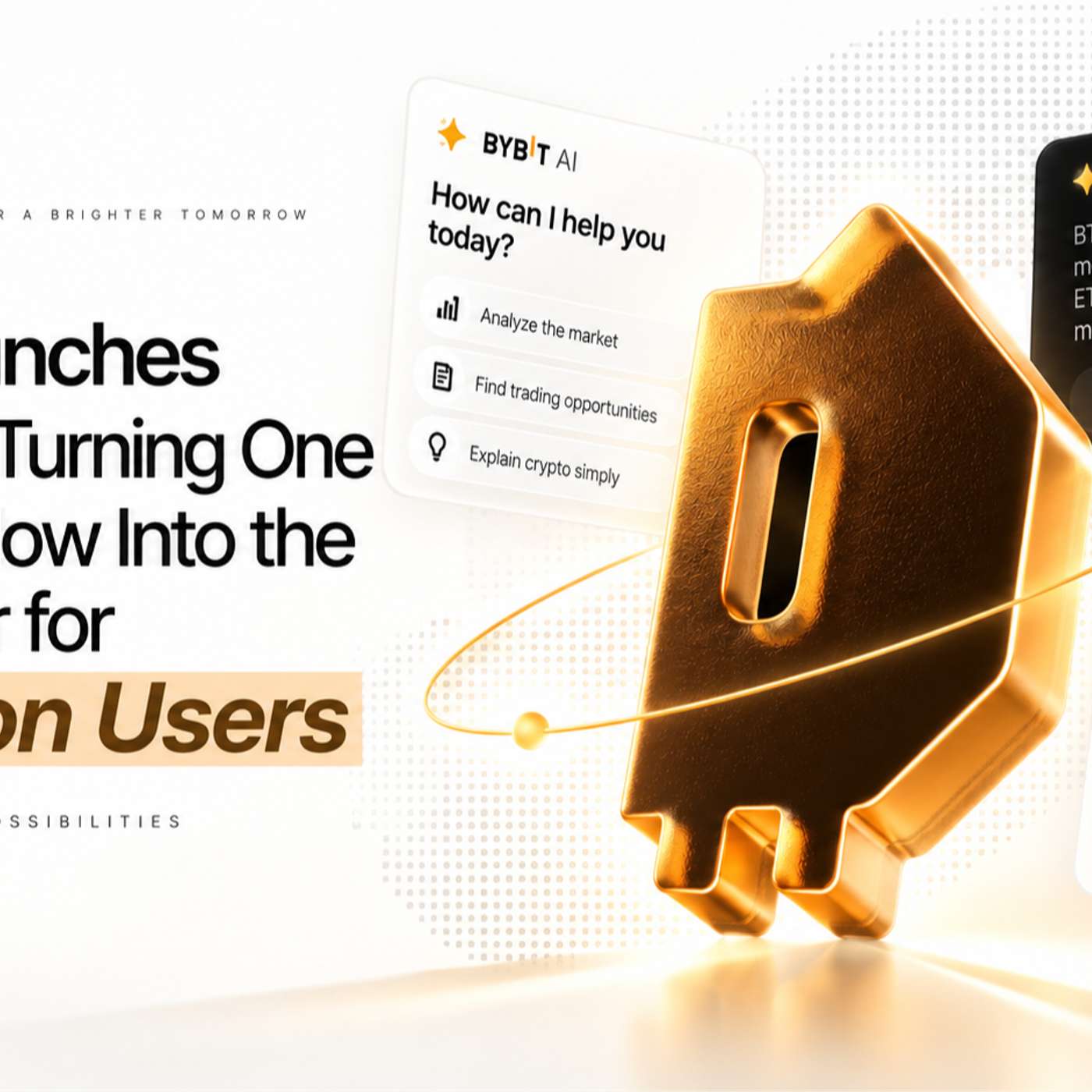
Bybit Launches Bybit AI, Turning One Chat Window Into the Front Door for 80 Million Users
About this episode
This story was originally published on HackerNoon at: https://hackernoon.com/bybit-launches-bybit-ai-turning-one-chat-window-into-the-front-door-for-80-million-users.
Bybit launches Bybit AI, a conversational assistant that executes trades, manages accounts and handles support for 80 million users inside one chat window.
Check more stories related to undefined at: https://hackernoon.com/c/undefined.
You can also check exclusive content about #bybit, #web3, #blockchain, #ai, #crypto-exchange, #good-company, #trading, #bitcoin, and more.
This story was written by: @ishanpandey. Learn more about this writer by checking @ishanpandey's about page,
and for more stories, please visit hackernoon.com.
Bybit launched Bybit AI on 9 September 2026, a conversational assistant inside the Bybit app that lets users state what they want in plain language and have the assistant carry out the action, from checking balances and placing trades to opening support cases. At launch it covers spot, futures and options trading, Bybit Earn, Copy Trading, Trading Bot, Loan, P2P, the Bybit Card, Spot X, the Rewards Hub and notification management, with customer support handled by the assistant working alongside human agents. Activating the feature creates a dedicated sub-account isolated from the user's main balance, with no API key or manual setup required. Bybit has also set out a roadmap to connect trading, earn, loans, card and support through a unified Open API.
What is Bybit AI? A conversational assistant inside the Bybit app that interprets plain-language requests and carries out the corresponding action across trading, account management and customer support.
What can Bybit AI do at launch? It covers spot, futures and options trading, Bybit Earn, Copy Trading, Trading Bot, Loan, P2P, the Bybit Card, Spot X, the Rewards Hub and notification and subscription management, plus customer support alongside human agents.
Is Bybit AI safe to use with my main balance? Activating Bybit AI creates a dedicated sub-account that is isolated from the user's main balance, so the assistant only operates on funds the user has placed in it.
Do I need an API key to use Bybit AI? No. Activation creates the sub-account automatically with no API key or manual setup.
How is Bybit AI different from Bybit's AI Trading Skill? AI Trading Skill, released in March 2026, lets external assistants such as ChatGPT, Claude and Gemini reach Bybit through 253 API endpoints. Bybit AI is the assistant inside the Bybit app itself.
Get every episode summarized
Each time The Good Tech Companies publishes, we email you a written briefing from the transcript — the topics, who appeared, and any specific claims, with the ad reads skipped.
Email me new episodesFree for 3 shows. No card needed.
Hosts & guests
Transcript ready
152 searchable segments. Every word is indexed and playable.
Full transcript
The Good Tech Companies — Bybit Launches Bybit AI, Turning One Chat Window Into the Front Door for 80 Million Users. Machine-transcribed; use the interactive transcript above to jump the player to any line.
This audio is presented by Hacker Noon, where anyone can learn anything about any technology. Bybit launches Bybit AI, turning one chat window into the front door for 80 million users by Ashahn Pondy. What does an exchange look like when the menu disappears? For most of the last decade the answer to almost every question a trader had was a screen. One for spot, one for futures, one for their own products, one for the card, one for the loan desk and one, buried several taps deep for support. On Wednesday, Bybit, the second largest cryptocurrency exchange in the world by trading volume, replaced that arrangement for its 80 million registered users with a single conversation. Bybit AI is a conversational assistant that lives inside the Bybit app and unifies the exchange's core services, beginning with trading and customer support, behind one chat interface. A user describes what they want in plain language, the assistant interprets the intent and then carries out the underlying action on the user's behalf, whether that is checking a portfolio balance, placing a trade or opening a support case. At launch it covers spot, futures
and options trading, Bybit Earn, Copy Trading, Trading Bot, Loan, P2P, The Bybit Card, SpotX, the rewards hub and notification in subscription management, with a roadmap to connect trading, Earn, Loans, Card and Support through a unified open API. Ben Joe, Bybit's co-founder and chief executive, demonstrates the product in a live stream on 9 September. The customers were ready before the exchanges were nothing about talking to a machine about money as new to the people Bybit is building for and the proof sits in the servicing logs of the largest consumer bank in America. Bank of America launched Erika in June 2018 as a helper inside its mobile AP PAN the assistant took four years to reach its first billion interactions. The second billion arrived 18 months later in April 2024, the third took 16 months and by the bank's March 2026 Digital Engagement Report the cumulative count had passed three. Two billion, with 20. Six million clients using the assistant nearly 700 million times in 2025 alone. More than 98%
of clients get what they need from Erika within 44 seconds on average and the bank's digital chief has since cited a running total above three. Four billion, the shape of that curve is the point because it steepens rather than flat ends. Every year that a conversational assistant handles more of a customer's financial life, the customer hands it more and the acceleration comes from expanding what the assistant can do rather than from marketing what it already does. Erika began by finding transactions and ended up inside Merrill and the bank's corporate cash pro platform. Bybit AI starts with trading and support and is explicitly built so that other business lines can plug into the same conversation, which is the same expansion path with the middle eight years removed. The interface went mainstream first the second thing that happened while exchanges were still building dashboards is that the chat window became the most used piece of software on the planet. Chad GPT went from roughly 50 million weekly active users in January 2023 to 900 million by February 2026 and by late July it was reported to be nearing a billion, handling around
two. Five billion prompts a day. The detail that matters for an exchange is where Bybit's own user base sits on that chart. Chad GPT crossed 80 million weekly users in the middle of 2023, three months before Bybit shipped its first chatbot, which means that every one of the 80 million people who have registered with the exchange since 2018 has spent the last three years being trained, for free and by someone else, to type what they want and expect Amishine to do it. That is why the launch is better read as an interface decision than as an AI feature. The bar for a financial assistant is no longer a bank's 2018 chatbot but the general purpose model on the same phone and a product that asks users' to learn menus is competing with one that does not. The support half of the launch carries the same logic. Gartner expects a genetic AI to resolve 80% of common customer service issues without human intervention by 2029 and puts the labor cost that conversational AI removes from contact centers at 80 billion dollars in 2026 alone against a baseline in which only about one. Six percent of contact
center interactions were automated when the forecast was made. Bybit's decision to keep human agents in the loop rather than replace them reflects the other half of the same research, which finds that only 14% of issues resolve through static self-service and that customers reach for people the moment and answer is not enough. The assistant's job is to make that moment rare. What the assistant is deployed on-tone interface is only as valuable as the surface behind it and Bybit's surface has expanded faster than almost any venue in the industry. Bybit ended 2022 with about 10 million registered users. It passed 40 million in August 2024, 50 million 40 days later, 70 million in May 2025, 78 million by October and 80 million at the close of 2025, an eightfold expansion in three years. Market share moved with it. Block schools traced Bybit's share of top 10 exchange volume from one. 56% in January 2023 to eight. 39% by that December and past 10% by May 2024. Coingueco's full year 2025 tables put Bybit's second among
centralized exchanges at eight. One percent of spot volume and its second quarter 2026 report is Bybit at 10. 0% the only venue other than Binance in double digits in a quarter when top 10 spot volume fell 27. 9% on the derivative side, Coingueglass ranks Bybit among the top three by first quarter volume and first in the second tire by open interest and token insight records the exchange's spot share of its own activity rising from 12% to 25% across the second quarter, which means the assistant arrives as the user base is diversifying rather than concentrating. The product coverage at launch maps directly onto that surface. Spot future sand options or the volume engine, earn and loan are the balance sheet products, copy trading and trading bot are the retail on ramps, P2P and the Bybit card are either fiat edges and the rewards hub is the retention layer. Putting all of 10 behind one intent parser is a distribution decision as much as an engineering one because a user who has only ever traded spot can now discover a savings product by asking a
question rather than by finding a tab. The security design is the part most likely to be underapported, activating Bybit AI creates a dedicated sub account that is isolated from the user's main balance so that whatever an assistant does it does with capital the user has deliberately placed in front of it. There is no API key to generate and no manual configuration, which removes the single most common way retail users have historically compromised their own exchange accounts and it caps the consequences of any model error by construction rather than by detection. That is the same architectural answer Binance reached in August with its per agent sub accounts and the industry converging on a blast radius model within a single month is a stronger signal about where regulators will land than any statement either exchange has made. Commentary image placeholder, Rockman John, CTO, Bybit, on the single interface architecture and the open API roadmap. Three years, two eras. One exchange present in both Bybit is not the first exchange to put AI in front of customers and it is not the first this year to let AI act on an account. What it is, uniquely, is the only
major venue with a product in both generations of the technology. The first wave arrived in the spring and summer of 2023 when crypto. Com launched Amy, Binance put a research assistant into its academy and Bybit shipped tools GPT in June and trade GPT in September. The latter combining a large language model with the exchange's live market data to answer trading and technical questions. Every product in that wave explained, none of them acted, then came 27 months in which the underlying models learned to call tools and no exchange shipped an assistant that could place an order. The second wave is entirely a 2026 story. Coinbase introduced agentic wallets in February and Coinbase for agents in June. Bybit released its AI trading skill in March, exposing 253 API endpoints so that Chad GPT, Claude, Gemini and other external assistants could trade and manage assets on a user's behalf. Crack and publish the command line tool with a built-in MCP server the same month. OKX shipped its agent trade kit on the second of June in an AI marketplace at
the end of that month in Binance launched agent OS on the 20th of August. Read carefully, those launches split into two different distribution strategies and Bybit AI is the moment one exchange decided to run both. Agent OS, the agent trade kit and Bybit's own March release are outbound. They let an assistant these are already runs somewhere else reach into the exchange. Bybit AI is inbound. It puts the assistant inside the app, where the 80 million people who do not ruin a coding agent or configure an MCP client already are. The outbound path serves the power user and the developer, while the inbound path serves everyone else, so the exchange that holds both ends of that funnel is the one that gets to see which end actually generates flow. Binance has the outbound end and a user base of 300 million. Bybit now has both ends, deployed onto a user base that grieve a fold in the three years between its first Chadbot and its first Copilot. The other thing chart 4 shows is who kept shipping. Bybit has three launches on it, one in each era and one bridging them, which is not the record of an exchange reacting to a competitor's
August announcement. Products that Parcy intent across a dozen business lines are not built in three weeks and the architecture described at launch, in which infrastructure provides the connections and individual business lines plug into a single interface, is an internal platform decision that predates any of this summer's news. The market it is compounding into the commercial case for putting the assistant at the center rather than at the edge rests on how large the layer it occupies is about to become and on that question the research houses disagree only about the exact slope. Date-Intel-O-Value's conversational AI in banking at $12.4 billion in 2025 and has it reaching $68. 9 billion by 2034, a compound rate of 18. 9% a year in which customer support is already the largest application at 31. 7% of revenue and Asia Pacific is the fastest growing region. The wider categories move faster still. Mordor Intelligence puts AI in FinTech at $30 billion in 2025 and $99.09 billion be 2031, a 22% annual rate. The business research company
has AI in banking growing from $15. 32 billion to $67.74 billion by 2030 at 34, 7% a year in markets and markets projects the broadest measure AI across finance at $190.33 billion by 2030 at 30, 6% a year. Within those totals, market research future singles out natural language processing as the fastest rising layer at a 22. 4% compound rate driven specifically by conversational banking. Every one of those forecasts was built on a banking industry that adds conversational assistance to existing channels. Bybit AI is the inverse, an exchange making the conversation the channel and plugging everything else into it. If the forecasters are right about direction and they agree on direction to a degree rarely seen in market sizing, then the venue that owns the conversation captures the growth of every product line behind it in the five. Sixfold expansion in conversational banking over the next nine years becomes a floor on the strategic value of the interface rather
than a ceiling. What to watch the honest read on Bybit AI is that the exchange has made the interface itself product and that choice carries three tests the next 12 months will apply. The first is Breadth of Use. An assistant that gets used for balance checks and support tickets is a very good help desk and an assistant that gets used to move capital between spot. Earn in a copy trading strategy is a different kind of company because it means the conversation has become the place where product discovery happens. The mix of intents the assistant receives in its first quarter will say more about the strategy than the roadmap does in THE sub account design means Bybit will be able to measure that mix precisely. The second test is the open API roadmap. Trading, Earn, Loans, Card and Support arriving under one programmable surface would complete the architecture the launch describes, where infrastructure provides the connections and every business line plugs into the same interface and it would turn Bybit AI from afferent end into a routing layer that any future product inherits on the day it ships. The sequence in which those
services arrive will reveal which lines the exchange believes conversational access changes most. The third test is the one the whole category turns on, which is whether users trust an assistant with a balance that matters. Bybit has answered the structural half of that question by giving the assistant a walled sub-account and no API key, so that the user decides how much capital sits in front of the model and can decide differently at any time. The behavioral half will be answered by 80 million people over the coming year and the exchange that ship ate a chatbot in 2023. An agent gateway in March and a co-pilot in September has positioned itself to be the venue where the answer is measured first. Bank of America needed 8 years and 3 billion conversations to establish that people will run their financial lives through a chat window. Bybit is starting that clock with the interface already familiar, the surface already built in THE isolation already in place and the only remaining variable is how quickly its users decide to stop tapping and start asking. Don't forget to like and share the story, vested interest disclosure. Hacker Nune has
reviewed the report for quality, but the claims herein belong to the author. Hashtag dyor. Thank you for listening to this Hacker Nune story, read by artificial intelligence. Visit hackernune.com to read, write, learn and publish.
More episodes
More from The Good Tech Companies

Protection Funds, Insurance and FDIC/SIPC: What Actually Covers What
The Good Tech Companies

Credible Captain Launches Independent Consumer Review Platform Focused on Transp...
The Good Tech Companies

4 Ways to Win a Hackathon (None of Them Is Writing Code)
The Good Tech Companies

Tokenized Stocks vs Real Stocks vs Stock Futures: Wall Street Without Walls and...
The Good Tech Companies