Loading...
newsdaily
Calls for the school meals programme to be extended to second-level schools according to new report
About this Episode
The Oireachtas Education committee has been looking into the providion of school meals. Fianna Fáil's Cathal Crowe chairs the committee on education and youth. He joined Rachael.
Hosts & Guests
Transcript
Free school meals should be available in all second level schools, but more work is needed
on issues like portion size and the elimination of highly processed foods. Those are among the
recommendations from the Eroctor's Education Committee, which has been looking at the provision
of school meals. The scheme has become a contentious one because of complaints by some parents
that their children won't eat the food provided. Others argue that it's the best way to ensure
that children from the most disadvantaged backgrounds get a good meal. Vienna Falls
called Crow, chairs the committee on education and youth, and he joins us now. Good afternoon.
Good afternoon Rachel. What's the main problem you have identified with the scheme as it works
or doesn't work at the moment? Well firstly, we've been doing a body of work in our
committee for many months. We've had witnesses, we've had students, we've had teaching unions,
parents, nutritionists, dietitians. We also went to Finland, a small group of the cross-party
bases went to Finland to see how their system operational since the 1940s works. Generally,
it's seen that the school meals program is a positive thing. Needs refinement and all things should,
you know, nothing should stay a static in public policy and we're recommending a number of changes.
We see good practice and we see it as an equalizer in terms of young people growing up that they
have a good, nutritious meal in the middle of the day. But we're recommending things here like,
firstly, one of the big changes, we feel it should move perhaps from the department of social
protection over to the department of education. Just from a simplistic point of view, we think it's,
it doesn't need to be straddling two departments. We feel that we should simplify procurement.
And then from a delivery point of view, we feel that going forward, new school designs,
not existing once you catch a shoehorn, everything into a school environment,
it's a teacher myself for years. But when we're designing new schools, I think we need to design
spaces where in which children can actually eat and have food. It shouldn't be just pushing the
books to one side of the desk and having your lunch hours of the top of that day. We should be
developing a positive food culture. I've also, just Rachel, as a member of the committee, put forward
a proposal that we scrap water charges in school. It doesn't make sense to me that we're giving
free meals, which is a really good thing. But yes, the water flowing in the taps, which the children
drink at lunchtime is charged. I think we need to abolish those charges. One concern, as I'm sure
you're aware, one concern many parents and teachers have is the amount of waste at the moment. So,
how can that be tackled? Yeah, it is an issue. And yet we have seen some schools have a really good
system. Many schools send home the lunches and some have compostable facilities on site.
When our committee went to Finland, sometimes simplicity is the best way of solving many problems.
So, in Finland, the day we were there, instead of having 14 or 15 choices in the menu, there were
two choices. And those two choices were standardized across the city of Helsinki. All food was served on
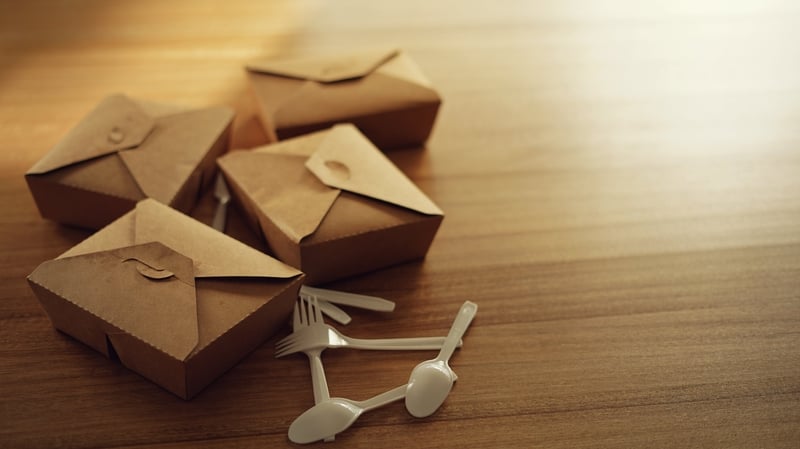
plates with knives and farks. Navi-enforcing, kind of the takeaway culture that has, you know,
gotten a grip of Western countries in recent years, they were having it in the traditional way,
knife-fark plate. The plates are washed in the school in a dishwasher facility. So, that's a very
simple way. That's the way many households eat, not all households eat, but that's the way many
households eat. And we think that should be looked at. But schools have themselves devised.
Many principles came forward and told us of their systems, quite simply involves most children
taking home on eating lunches or boxes. Isn't there a danger that they're just going to go into
the bin at home? Yeah, but the other point our committee's raised, and I've discussed this with
the minister, is that portion size needs to be looked at. In that model in Finland, they go up to
the bamboree in their school. The child serves or gets assistance in serving their food. In Ireland,
it's a standardized portion. So, the child in June-Rinfans, the five-year-old is eating the same or
at least is served the same size portion as the adolescent in six-class who could be playing
loads of sport and doing Irish dancing, burning off energy. So, I think there needs to be, we need to
look at how portions are served at different class levels. That certainly needs to be in the mix
as well, and it's central to our report. Kyle Crow, thank you very much for joining us this afternoon.
More from News at One
View all episodes →
Dublin based relative of a man imprisoned in Iran says family live in fear as he...
News at One
Apr 3, 2026·5:09·failed
A man has appeared before the High Court in connection with the murder of Robbie...
News at One
Apr 3, 2026·2:22·failed

Three nuns escaped from a care home to return to their convent in Austria
News at One
Apr 3, 2026