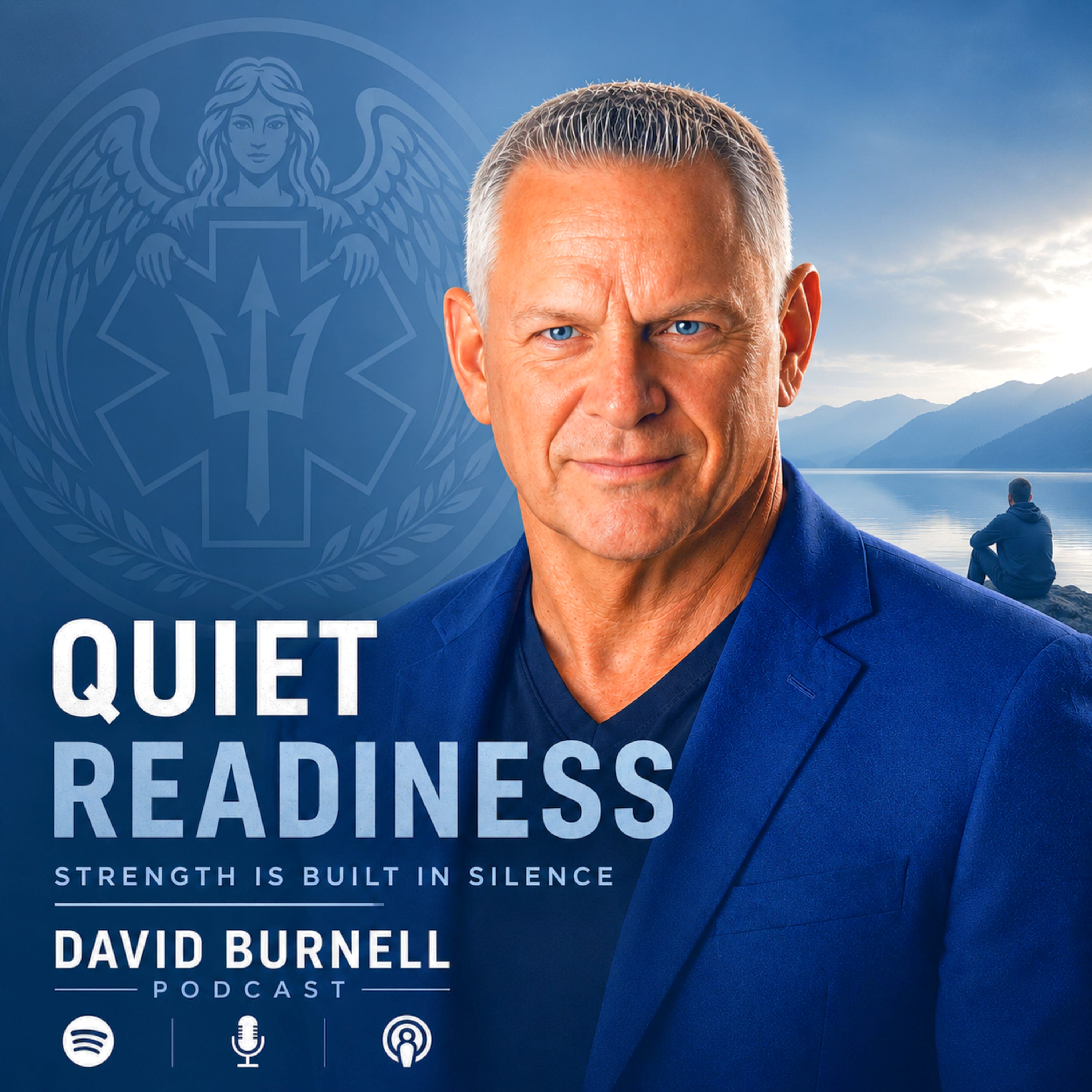
Quiet Readiness: Calm in the Storm by Managing Trauma and Crisis Stress
About this episode
In a world where traumatic events unfold in real time across our screens, the human mind is being exposed to more crises than ever before.
But how do we process it?
In this episode of Quiet Readiness, David Burnell sits down with longtime friend and crisis-response specialist Jeffrey Denning — a r
etired law enforcement officer, federal agent, and mental-health professional who has spent years helping first responders recover after critical incidents.
Together they discuss:
• The hidden cost of repeated trauma exposure• Why first responders experience cumulative stress• The psychological impact of witnessing violence• The dangers of isolation and social media trauma loops• The practical disciplines that restore mental balance
Drawing from decades of operational experience and clinical work, Denning shares simple but powerful tools for maintaining mental readiness: sleep, exercise, connection, gratitude, and purposeful service.
Because resilience is not accidental.
It is practiced.
Get full access to David Burnell at davidburnell.substack.com/subscribe
Get every episode summarized
Each time Echo Valor Podcast publishes, we email you a written briefing from the transcript — the topics, who appeared, and any specific claims, with the ad reads skipped.
Email me new episodesFree for 3 shows. No card needed.
Hosts & guests

Transcript ready
69 searchable segments. Every word is indexed and playable.
Full transcript
Echo Valor Podcast — Quiet Readiness: Calm in the Storm by Managing Trauma and Crisis Stress. Machine-transcribed; use the interactive transcript above to jump the player to any line.
calm in the storm, managing trauma and crisis stress. There is a moment after every crisis, when the adrenaline begins to fade, the noise quiets, and the human mind is left alone with what it has just witnessed. For first responders, soldiers, rescue workers, dispatchers, investigators, and others who serve in hard places, that moment does not come once. It comes again and again, sometimes hundreds of times over the course of a career. Today, I want to talk about something we do not discuss nearly enough, how human beings process crisis and how we recover from it. A while back, I sat down with a close friend of mine, Jeffrey Denning. Jeff is a retired law enforcement officer, a federal agent, and a crisis response professional who has spent years helping agencies and individuals recover after critical incidents. He has served around the world, worked in counter-terrorism,
and holds advanced degrees in counseling and military special operations. But more important than the credentials is this. He has sat in the rooms where people face the worst days of their lives, and he has helped them begin to put the pieces back together. When we spoke, the conversation began with a simple question, how does repeated exposure to trauma affect the human mind? Jeff made an important point. Trauma is rarely just one event, more often it is cumulative. Over years of service, people in helping professions witness tragedy again and again, fatal accidents, violence, death, grief, broken families, shattered bodies, and terrible loss. Every one of those experiences leaves a small imprint. Eventually, those imprints begin to stack. Psychologists often refer to this as post-traumatic stress. Jeff prefers a different phrase.
He calls it responder exhaustion. And I understand why, because the reality is this, anyone repeatedly exposed to tragedy is eventually going to feel the weight of it. That is not weakness. It is not failure. It is simply how the human brain and body work. In fact, the diagnostic manuals used by psychologists specifically identify repeated exposure to death and trauma as one of the strongest predictors of psychological stress. Police officers, firefighters, dispatchers, search and rescue teams, medics. Even the people who review reports, hear recordings or process the aftermath. All of them are affected, sometimes directly, sometimes indirectly, but always in some way. And today there is a new factor amplifying all of this, the internet. For most of human history, people did not witness tragedy on demand. Violence was rare, distant or hidden. Today, people can watch real violence unfold on their phones over and over
again. Children, teenagers, adults, scrolling through footage of death, fear, bloodshed, and destruction. The brain cannot always distinguish between witnessing something firsthand and witnessing it repeatedly through a screen. The body still reacts. The heart rate rises. Stress hormones flood the system. The nervous system shifts into fight or flight. And when that happens again and again, the body becomes exhausted. So how do we recover? Jeff offered a remarkably simple answer. We return to the fundamentals of human health, sleep, nutrition, exercise, and connection. These sound basic, but they are powerful. Exercise, for example, is one of the most effective natural regulators of stress hormones. Even 30 minutes of repetitive activity, walking, running, cycling, mowing the lawn, hiking can help the brain reset. It gives the body a rhythm, and that rhythm often
helps the mind settle. Sleep is equally critical. After traumatic events, the mind often struggles to rest. Thoughts race, images return. The body stays alert. But restoring healthy sleep patterns is essential for recovery. Without rest, everything becomes harder. Then there is connection. This may be the most important factor of all. After trauma, many people instinctively isolate. They withdraw, they stop talking. They assume nobody understands. But isolation often deepens stress. Human beings heal through connection, not always through long conversations, not always through therapy language or complicated explanations. Sometimes just sitting in the presence of someone you trust, a spouse, a friend, a partner, a child, a colleague, a brother is enough to help calm the nervous system. Even silent companionship can be medicine. There are other practices that help
as well. One of them is gratitude. Research has shown that intentionally reflecting on positive experiences can significantly improve emotional resilience. Our brains tend to hold onto negative experiences like Velcro, while positive experiences slide away like Teflon. Gratitude helps rebound balance that tendency. It trains the mind to notice the good that still exists, even in difficult seasons. And then there is service. Helping others is one of the most powerful ways to help ourselves heal. When we lift someone else, our own burden often becomes lighter. Jeff shared a powerful observation during our conversation. There are people all around us carrying invisible wounds. Some of them are emotional amputations, loss, trauma, loneliness, pain, shame, despair. And many of those wounds are hidden so well that no one around them realizes how serious they are.
Sometimes the smallest gesture can change a life, a message, a check-in, a conversation, a simple expression of care. Jeff told me about a man who had reached the edge of despair. He had placed a shotgun in his mouth and was ready to end his life. Then someone knocked on the door, a friend he had agreed to help. That interruption saved his life. That story stays with me. Because the truth is every person we meet may be carrying something heavy and we rarely know the full weight of what they are carrying. That is why quiet readiness matters. Not just readiness for physical threats, but readiness of the mind, the discipline of calm, the habit of compassion, the willingness to regulate ourselves and support those around us. In a noisy and chaotic world, sometimes the greatest act of strength is simple kindness. So take care of yourself. Get outside, move your body, drink water, sleep. Step away from the constant feed of noise. Talk to people you
trust. And if you can reach out to someone today, send a message, make a call, tell someone they matter because resilience does not happen in isolation. It happens together. This is David Bernel, and this has been Quiet Readiness. Stay ready, stay steady, and take care of one another.
More episodes