Loading...
news
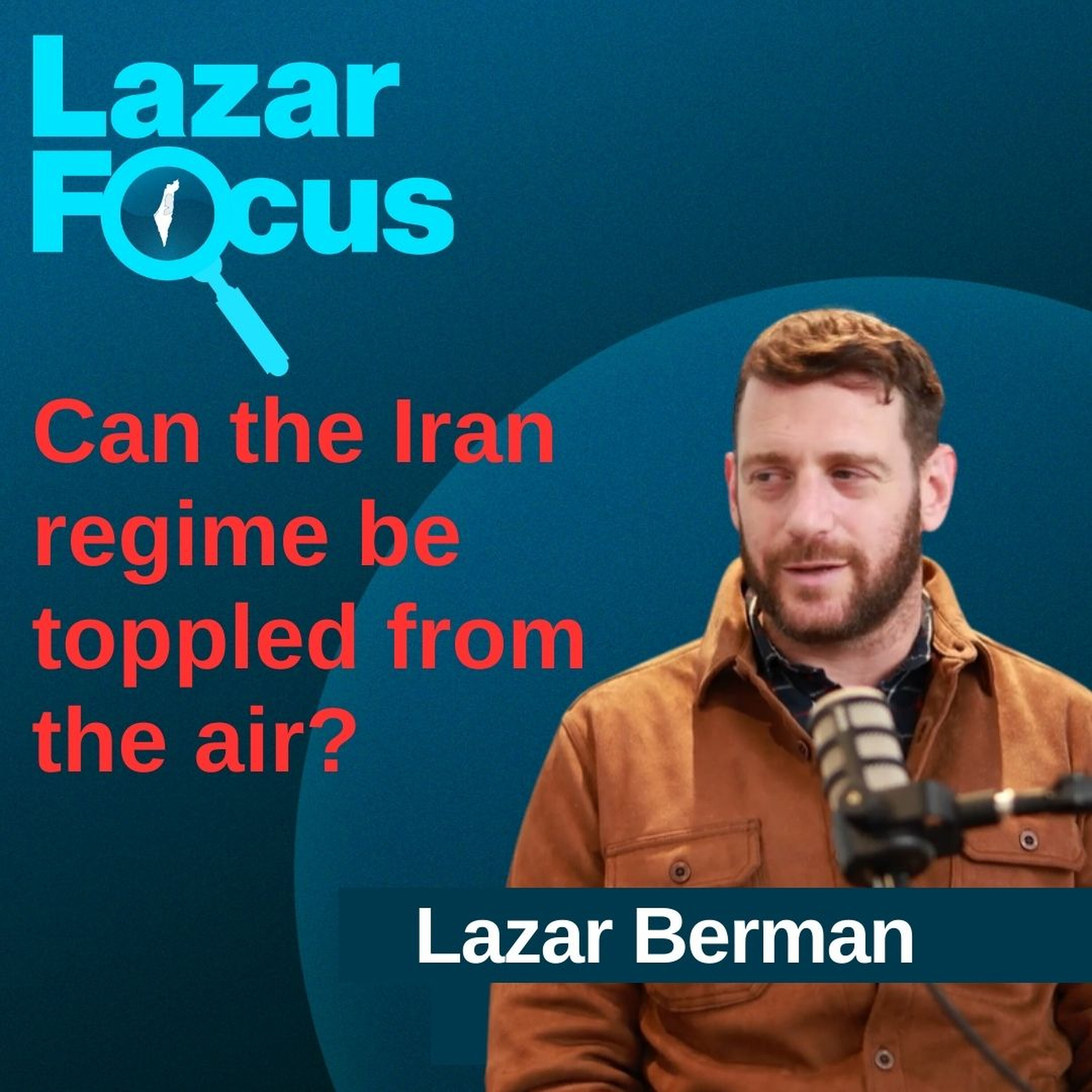
Can the Iran regime be toppled from the air?
About this Episode
Welcome to The Times of Israel's Lazar Focus. Each Friday, join host diplomatic correspondent Lazar Berman for a deep dive into what's behind the news that spins the globe.
We are one week into a stunning US-Israel bombing campaign against the Islamic Republic. Senior Iranian leaders, including Supreme Leader Ayatollah Ali Khamenei, have been eliminated, and Iran's ability to attack its neighbors and to defend itself has been severely damaged.
But it is still fighting, and launching attacks on countries across the region.
What are US President Donald Trump and Prime Minister Benjamin Netanyahu trying to achieve in this war? And if it is regime change, is that even possible without sending in ground troops?
A possible way to thread that needle -- to avoid committing US or Israeli forces but to still take ground from the Islamic Republic -- is to use local opposition forces. The Kurds are being talked about as a possible vanguard of ethnic uprisings against the regime.
That is probably overambitious. There are only a few thousands Iranian Kurds under arms, and they have ample reasons to be wary of American promises.
Still, every day that goes by sees the US and Israel degrade Iranian forces, while they gain more freedom of action over the country. But there is still a long way to go before Trump and Netanyahu can consider ending the campaign while still achieving their goals.
Lazar Focus can be found on all podcast platforms. This episode was produced by Gabriella Jacobs and video edited by Ari Schlacht.
See omnystudio.com/listener for privacy information.
Hosts & Guests

Transcript
Hello, and welcome back to LaserFocus.
I am your host, LaserBerman, and this is a special wartime edition of the LaserFocus
podcast.
We are on day six of the joint U.S.-Israeli air campaign against Iran.
Of course, that campaign has widened to include much of the Middle East even beyond.
What we are going to do here today is try to give you a deeper understanding, something
that you can't just get from reading the headlines.
We are going to talk about where the campaign stands now, where it might go in the future.
How much of the region, including Arab countries, are reacting and how they might react?
What the potential is for perhaps a Kurdish rebellion in Iran?
And many other aspects that I hope will deepen your understanding of this very important
historic and complicated time.
And to do it, I am happy to be here with Sony, you know, very well, Amanda Borshaldan,
hi, Amanda.
Hi, Laser, thank you so much for letting me join you, and I have so many questions for
you.
I'm especially excited to talk to you about the Kurds that I've been bugging you about
this whole week in the office.
So thank you for allowing me the time to ask you about them.
But just to begin with, Laser, let's start with, how is the war going?
Give us your assessment of the war as it stands right now.
Absolutely.
So there's different levels when you assess a military campaign.
There's tactical, operational, and strategic, and let's talk briefly about all those because
I think it's pretty instructive.
Specifically, which is the level that, let's say, the soldier sees the soldier himself.
It's going incredibly, it couldn't be going better.
The Israel has not lost any soldiers so far, which is pretty incredible.
The U.S. has unfortunately lost six soldiers and had several others injured in terms of
what they are doing in the air to the Iranians.
They are doing whatever they want.
There's no ability for the Iranians to get in the way of American or Israeli air operations.
That means they have air superiority now, and they're talking about air supremacy, which
means they will totally rule the skies in the coming days.
That is absolutely significant, very impressive when you think about how far some of these pilots
are flying.
In terms of what they are doing on the ground, they're absolutely taking apart Iranian centers
of gravity for their military, they're killing commanders, including very senior commanders,
of course, Supreme Leader Ali Khamenei, but also top generals.
When you go lower, some of those are even more important, people who are actually making
the decisions, the tactical decisions on the battlefield, people who are in charge of
the fire of rockets, people who are in charge of forces on the ground.
All of this is very, very significant, and like I said, it's going very well.
U.S. Secretary of War Pete Hegs said yesterday made a point that it was only a couple days
into the campaign.
Everyone's trying to say, oh, why hasn't Iran fallen apart yet?
It's very, very early here in Israel, we're used to short campaigns, not the one in Gaza,
but in general, very short campaigns.
But let's be honest, this is still the early go into this campaign, and tactically, U.S.
and Israel are doing things that have never been done before.
This will be studied in the future.
If we move up to the strategic level, which is kind of the higher level of goals, how
they meet the political goals, that gets a little bit more complicated.
That's too early to tell.
It's also, we can talk about this a bit later, it depends what the goals are.
If the goal is to bring down the Iranian regime, obviously that hasn't happened yet, and
it's not clear that that is indeed an explicit war aim, though everyone wants that to happen.
In terms of damaging Iran's ability to strike its neighbors, you see that Iran is still striking,
but there seems to be trends where it's having a difficult time carrying out some types
of attacks, but it's certainly still able to strike.
Then you talk about the nuclear campaign, well, we're going to have to assess that after.
It was already very damaged.
We'll see if it stops Iran's ability to even work on nuclear weapons, if any further
damage is done.
So again, so far on the tactical level, it's going very well on the strategic level.
It's way too early to tell, and that also depends what the goals of the campaign are.
I went to pick up on a phrase that you said a couple times on the ground, what's happening
on the ground, and what is remarkable about this campaign so far is that there aren't any
American or Israeli troops as far as we're hearing on the ground.
So we're talking about attacks from the air, from the sea, there was of course that very
dramatic submarine attack on the frigate, the war frigate.
I just wonder if, once we know the truth, the two goals of this war are if it is possible
to carry it out without going on the ground.
Sure.
That's a very big question.
So there is the question of regime change, and let's go into that for a minute.
Regime change means changing the people who are ruling the country.
Now some people could say the regime's already changed because the person on top of the regime
has changed because he's dead, but that doesn't mean the regime has changed.
The regime is still there, the Islamic regime is still in power, they are still running
things, they are still able to operate, they are still able to carry out attacks, they
are still able to suppress any dissent if it raises its head.
So the regime is still there.
There have been plenty of examples of regime change, including in Israel and the US's own
military history.
So if you're on talk about Israel, you could look at the campaign in Lebanon, 1982, where
that turned out to be a regime change event, but it was a ground operation because we
went all the way to Beirut, we're able to push for the installation of friendly Christian
leaders.
The US, of course, has had a lot of success with getting regimes changed.
If you want to think about World War II, Japan, Germany, successful regime change, and
regimes that have been democratic, pro-Western, very friendly, very successful since then,
that is kind of the gold standard.
If you think about more recently, there's the Iraq and Afghanistan experiences after 9-11,
2001.
The regime change part was actually very quick and very effective.
There was a very big air campaigns followed by a ground invasion, which went very, very
smoothly, very quickly.
The problem there was what comes next, and that's where US forces have really, really
struggled, and that is something that is really driving the way the US people think about
these wars in the Middle East, and, of course, the way Trump does, that they don't want
another nation-building exercise in another Middle Eastern country that costs a lot of blood
and treasure when there's plenty of priorities back in the US that need to be dealt with.
The question is, without the ground element, because there was a serious ground element
and everything I spoke about.
Then you could say no, there wasn't, but that was a nuclear weapon that was dropped
on Japan, and, of course, the US ground troops were starting to island hop and take away
Japanese islands, but they really hadn't made it to the home islands.
Can just air force, air power alone, like you correctly noted, is being used in this
campaign?
Can that bring down a regime?
Most experts would say no.
When you look at different examples, they would usually look at the 2000 US campaign in Libya,
so that led to the downfall of Muammar Kadathi, but, of course, there were rebel groups on
the ground that ultimately did the work on the ground that caught him and executed him
in a pretty brutal fashion, and a lot of that was actually captured on camera.
The experience that a lot of people turned to and point at, especially right after it happened,
was the Kosovo campaign, which is a NATO campaign against the Serbian forces that were
in Kosovo carrying out real atrocities in 1999, and the air campaign succeeded in its goals.
It got the Serbian troops to give up its presence in Kosovo, and the next year led to the
downfall of Slobodan Milosevic.
Why that is a case that actually makes this even more problematic, this idea that you can
bring about regime change or achieve your goals just from the air, is that it took 78 days
to do it, so that's a lot longer than we're thinking about from this campaign.
There was a threat of a NATO ground invasion, and there was troops on the ground from the
Kosovo Liberation Army, so there is actually these militia forces on the ground.
Some people say, well, the Serbians retreated once they had continued to kill and rape
for 78 days, and they said, okay, we've done enough, now we can retreat.
So I think if that is the kind of case that proves that you can achieve these things
from the air, it's not a very strong case.
But then we have to get into the question of what are the aims of this campaign?
If you look on the Israeli side, I think the Israelis, especially Netanyahu, but also
so, and I spoke to one of his advisors today, his spokeswoman, Shosh Kodrosian, they've
been pretty consistent, actually, to their credit, that they're going after the nuclear,
after the ballistic missiles, taking away Iran's ability to threaten the region.
They have not said that they are trying to achieve regime change by themselves, by themselves.
What they say is we want to create the conditions for the Iranians to decide that that's what
they want to do and to do with themselves.
So it's very clear they want regime change to happen.
They don't think that they can do it themselves, Israel doesn't think they can do it themselves.
And therefore they are couching it in these words.
And if it doesn't happen, they can say, okay, we never promised that's up to the Iranians.
That's, I think that's consistent and that's reasonable.
The US, given this administration, has been a little bit more all over the place.
Vice President Vance, who kind of is more sympathetic to the isolationist, when did the party
said that Trump has a very clear set of goals and he's not going to let this go on for years and years.
And he focused, I think it was the first day of the war.
He said, it's just a nuclear issue that's all he talked about.
Now you've heard Trump at different times seem to go more toward the regime change side, right?
He has said that he has to choose who's going to be next and this regime has to go.
He's also said all sorts of things like that.
But at the other, on the other hand, he has also explicitly said,
and some senior officials have said, including Pete Higgs at the war secretary,
that this is not about regime change, while also hinting that the Iranians can do it themselves.
So at times it's been very similar.
I think the American discourse on this from the leadership is getting more and more consistent.
They're kind of finding their message.
And it is becoming more and more similar to Israel's.
So it's focusing on the nuclear, on the ballistic, on the proxies at times,
and is not explicitly calling for regime change.
Of course, one other just little note here that for Israel,
which seems to have thought clearly about how it wants to present its war aims,
which is in and of itself determined by what they wanted the enemy to hear
and also domestic politics, but they've been consistent.
They also kind of have to make sure that they're in line with the Americans.
So it's been, I think, a challenge kind of running after this moving target,
the Americans, but so far again, the Israelis have not had to change too much.
It looks like the Americans, the way they're talking about it,
are moving close toward a joint position.
So again, early in the war, and I think we're coming to a more consistent framing
from both sides of the war aims.
I know we have to go to a break soon, but I just want to ask you one follow-up question
about Vance, and do you think that it's his military record
that dictates his personal policies that he's expressing now?
So he did serve in the overseas, he served in Iraq,
I believe in Afghanistan as well.
I don't think that's what's dictating it.
There, I think in the generation of Americans that served there,
which obviously was not most Americans, but they kind of grew up
in that era that is certainly something that colors the way that they see it.
I think his most driving concern is J.D. Vance,
and how he chooses a lane that will get him to the presidency in 2028.
Let's not forget, he started out as a very, very fervent anti-Trump Republican,
who was the darling of Democrats.
When they wanted to see a Republican who could talk about the blue-coiler experience,
but in a way that he's a Yale-educated award-winning author,
that was exactly what the Democrats wanted when they wanted to kind of interact
with the Republican.
Well, he's moved since then.
Once he understood that Trump was the future of the party,
he's become very pro-Trump, obviously.
And he seems to have found a lane in which the isolation is to Winger the Party,
which there's plenty of excellent and really people that are concerned,
but there's also the Tucker Carlson Winger the Party,
which is millions of Americans.
And he's close with Tucker Carlson.
He has not denounced him, even when Tucker Carlson had that very
sequest kind of interview with Nick Fuentes,
anti-Semite, who used racist terms against Vance's own life.
Vance did not denounce Carlson, so he denounced Fuentes after.
So I think that is what is driving Vice President Vance,
how to be the party's flag bearer in 2028.
But before we go to the next question, we're going to take a quick break.
This episode is brought to you by Jewish communal fund,
the preferred donor-advised fund of the Jewish community for over 50 years.
Charitable giving should be impactful and efficient.
That's why many people choose to give through a JCF donor-advised fund.
A donor-advised fund is like a personal charitable bank account.
You contribute a minimum of $5,000 now,
receive an immediate tax deduction, then recommend grants to thousands of charities,
Jewish and secular on your own timeline.
JCF simplifies your philanthropy, maximizes your tax efficiency,
and ensures your giving reflects your values.
In fact, each year, a portion of JCF's revenue is directed to support
Jewish causes in the US and Israel.
Move away from the paperwork scramble toward a more strategic approach to giving
support by opening a JCF fund today.
Visit JCFNY.org or call us at 212-752-8277.
And we're back.
Laser, you know what I'm going to ask you now.
I actually don't.
OK, you said because I've been hounding you in the office the whole week,
and I'm so curious about the courts.
And you have a lot of experience with the Iraqi courts.
And everyone is talking about the courts as one element in creating these conditions
for regime change.
So let's back up slightly and tell us, give us a bit of a, you know,
once over who are the courts to begin with.
So the Kurds are the largest ethnic group in the world without their own state.
We're talking about 40 million people.
They're spread between Iran, Iraq, Iraq, Syria, and Turkey,
that most live in Turkey.
They're mostly Sunni Muslim.
There are some Shiites.
There are some Yazidis.
There are some Jews here in Israel.
And they generally tend to be oriented toward the West.
They certainly have a very long beef, let's call it, with Arabs.
And they also have reasons to be very hostile
to the Iranian, the Islamic Republic, even though culturally and linguistically,
they're part of the broader Persian sphere.
So they also have this No Ru's holiday as their new year and the beginning of the spring.
Their language, the Kurdish language and its various strains is a West Persian language.
So it's almost mutually intelligible.
But at the same time, they really do not like the Islamic Republic.
That being said, the Kurds are very split amongst themselves.
So what has kept them from really advancing toward independence is the fact,
or one of the factors is the fact that they have a trend of cooperating with an enemy
of their Kurdish rivals to get rid of the rivals.
But that means they're actually harming the Kurdish people.
Now Iraqi Kurds are the most organized and have the strongest legal
autonomy.
I live there and work there for a time.
And there is a long connection with Israel.
So in the 60s and 70s, Israeli Mossad and Parachup officers were there and helped direct
and fund and supply a series of successful rebellions against the centrally Iraqi government,
including against Saddam Hussein.
That has since mostly dried up.
There's also been significant American support for the Kurds.
And if you want to think about the 91st Gulf War, 2003, Northern Iraq was really run by
the Peshmerga, these Kurdish forces.
And that was a big force multiplier on the ground for the Americans.
And also in Syria, there's the YPJ, YPG, the Syrian forces who have carved out an autonomy
there.
But they feel like the Americans have turned against them.
And now are supporting this new Ahmadashara government and are kind of forgetting all the
help that the Kurds did in being the most effective fighting force against ISIS.
So just because America asks and Trump has called various Iranian and Iraqi Kurdish leaders
doesn't mean that they're going to immediately jump because they remember those feelings
of betrayal.
Now let's talk about the Iranian Kurds.
We're talking about 9, 10 million people out of 85 million or so.
At least it's about 10% of the country in the northwestern parts along the border with
Iraq.
The year there is a range of armed opposition groups who last month came together, six of
them came together to make a joint coalition that opposes the continued rule of the Islamic
Republic.
That doesn't mean these groups are especially bigger powerful.
We're talking about a couple thousand of fighters in the biggest group and unknown numbers
of fighters in the smaller ones.
So it's not like there are tens of thousands of fighters ready to go.
A lot of them are over the border in Iraqi Kurdistan.
So they have a safe haven there.
But the Iraqi Kurdistan government, so the KRG, the Kurdistan region government has an
uneasy standoff, but an understanding with the Islamic Republic that they are going to
host some of these opposition groups, but they're going to make sure that there are no
attacks from Iraqi Kurdish territory onto Iran.
That might have, that might be changing because the Iranians are striking inside of Iraqi
Kurdistan.
There are also U.S. bases there.
So it's a question, how much the Kurds are going to trust the Americans?
How much is being done on the ground by Mossad and CIA?
What the actual fighting capabilities of the Iranian Kurds are?
Because the Iraqi Kurds are good fighters just because the Syrian Kurds have proven themselves
doesn't mean the Iranian Kurds are that organized or capable.
And it's certainly not enough to bring down the regime if we're talking about, let's say
at most, 10,000, 15,000 fighters, believe me, Iran can bring that to bear on the ground.
If you want just an interesting historical, you know, something to think about is that with
only a few, less than 10, Israeli advisers on the ground, I believe it was 1972.
There was, in the midst of one of the Kurdish rebellions against the Iraqi government,
in a Iraqi division was moving against the Kurds in the mountains, called Mount Handarin.
And the Israeli advisers created this defensive plan that had the Kurds absolutely wipe out
the Iraqi division.
So with the right type of fighting, whether on the defensive in the mountains, with the
right type of leadership, it is possible to take on these organized militaries.
But it's a question of, you know, who's going to get there for us?
What the Iranians will do and how willing the Iranian Kurds are to fight?
Will that cause an uprising of the other minorities?
He keeps listing, you know, the Baluchis and the Arabs and the Azeris and all these other
groups.
Well, there's a lot of tension between the minority groups as well.
They have their own separatist groups, but getting them to cooperate is really a big
task.
I think if the regime is going to fall, it's going to be the Persians in Iran, about 50%
of the countries, in Tehran, in the big cities, that's what's going to bring it down and
not all sorts of minority groups on the outskirts of the country.
I'm going to ask you a really naive question.
Please.
That's what I'm here for.
That's what I'm here for.
Right.
So, laser, we heard about a missile pointed to Turkey the other day.
And I think you just said that Turkey holds the greatest number of Kurds.
And I wonder if there could be some kind of connection.
Could this have been some kind of message to this Kurdish population as well?
No.
I don't think so.
First of all, the Iranians say that they did not fire at Turkey.
I tend to believe them on this one.
No, I'm not a sympathizer to this regime.
It makes no sense to attack Turkey.
First of all, Turkey is part of NATO.
So that could invoke Article 5 or at least get these Europeans who are being very on the
fence.
We're going to send defensive this.
I could say, okay, now we have to get involved because NATO is being attacked.
Also, Turkey is a very good military, right?
Israel is very aware of that, a very capable Air Force, it has a big ground force.
That's not something that Iran wants to bring into this fight, especially because Turkey
is the NATO country that is most opposed rhetorically to what's happening in Iran.
So it doesn't make a lot of sense.
I think that some of the attacks into Iraqi Kurdistan have been that logic, but not into
Turkey.
It's hard for me to believe that Iran is intentionally firing at Turkey.
It could have been a misfire, it could have been some rogue outfit, but I really, it would
surprise me if they are that, if their calculations are that bad to bring a big bad Turkey into
the fight.
Okay, it also surprised me.
So I was trying to give some kind of benefit of the debt there in terms of strategy, but
it's also surprised me, frankly, how often they've been firing, Iran has been firing on
the Arab nations surrounding it.
So let's talk about this right now.
This has been Iran's stated policy for years.
Their idea is that they cannot obviously defeat the Americans.
They can't defeat the Israelis.
They can cause pain to the Israelis, which is nice in their book, but they're not going
to get Israel to stop doing this.
They cannot force a ceasefire.
Iran wants a ceasefire.
What they can do, and what they have said they will always do, is to raise the cost for
everybody in the region and everybody in the world.
So you say to me, how can they raise the cost for everyone in the world?
Well, their threats against shipping in the straits of Hormuz, where at least 20% of
the world's fossil fuel goes through.
Well, that's a fuel that China needs from Iran.
That is going to spike energy costs for China, for Russia.
Everyone's going to feel that pinch.
For the Gulf Arab countries, and even beyond countries like Jordan, the idea is that they
have spent decades investing in this image of a safe tourist site, a safe place for international
corporations to headquarter, and a place of moderation and a place of investment.
Now how did they maintain that over the years with American defenses, but also increasingly
in recent years with having open channels to Iran?
So even the Saudis who are Iran's other big rival in the region besides Israel, they since
2019 have had a diplomatic dialogue with Iran.
The UAE, also very close to Israel, does not like Iran, but Dubai and Iran have had very
close economic ties.
These countries have all come under significant attack by Iran, and if you look at the numbers,
it's much more in terms of numbers than Israel.
So that means that Iran's focus is on the Gulf countries, the Arab countries, and not
on Israel.
They're softer targets.
They don't have the same type of defenses, they're closer.
You don't have to use these longer range ballistic missiles of which there are less.
You can use shorter range, you can use drones, and just a few strikes on the business airports
in the world on some hotels is really shaking up these countries.
Now, what effect is it going to have on these Arab countries?
Now we might think, okay, it's obvious, Iran is the big bad enemy, Iran is attacking
these countries, Israel's not attacking these countries, they did strike in Qatar once
or remember in September, but I don't think anyone feels that Israel is going to be doing
anything close to anything that can even be compared to what Iran is doing.
But so far you haven't really seen a change of strategy by these Gulf countries, it could
change in the future.
But for now, they continue to maintain diplomatic dialogue with Iranians, even though it's
very tense and they decry these aggressions.
But even so, you don't see that there's been a huge shift, they want this war to end, they
want to get back to quiet in the region's stability.
That might change because Iran has surprises us in terms of the ferocity of the attacks
on these countries, and at some point they're going to hit something unacceptable.
I think that would either be a mass casualty event, or hitting core natural gas or oil
facilities, especially for the Saudis, that would really change it.
Surprisingly, Iran has really been hitting Qatar hard as well, which we see as this frenemy,
this very problematic country, not that close to Israel in many ways, but obviously has
a lot of intelligence cooperation, especially over the hostages.
Well they have been hit very hard by Iran as well, how this will all shake out, it's
not clear yet.
It's conceivable that at least some of the Gulf states will make the conclusion that
Iran is a threat, that it's a bigger threat than they thought, and the smartest thing to
do right now is to get closer to America, closer to Israel, and to improve their defense
capabilities.
And I think it's time for another break, and then we'll come back with our final question
from Amanda.
I believe the world is fundamentally perfect, and the world is fundamentally broken.
This is adapting the future of Jewish education.
Join me, Samantha Vanacore-Minorat of the Jewish Education Project, and CEO David Brightman
every week with an expert guest as we discuss the biggest challenges, nuances, and opportunities
in Jewish education.
Israel is a miracle, but Israel is also a country.
Israel is the thing.
I think Iranian Jews are the way American Jews were in the 1960s and early 70s.
Adapting isn't just a podcast, it's where the boldest ideas for securing our Jewish future
through the power of education come to life.
Listen wherever you get your podcasts.
And we're back.
Laser, I think the question on so many people's minds, I know on mine, is how long can we
expect this war to last?
As you mentioned, Israel likes to fight a very fast war.
We're very well known for a six-day war, supreme victory, very quick and clean.
But where are we standing now?
We're six days into this war.
It doesn't look like it's reaching a conclusion.
What are you thinking?
Yeah, so we fought the six-day war, but we also fought a 12-day war.
And that 12-day war ended much earlier than we would have wanted.
If you remember that image of Trump waking up in the morning at the White House coming
out, his tie was around his neck.
He was in a bad mood.
And he said, Israel, can I curse on this?
It's your podcast later.
We're going to do it.
I apologize to everyone back home and to my mother.
Israel doesn't know what the fuck it's doing.
That's what he said.
He was here.
I've never held that word before.
Israel wanted to carry out additional operations, but they stopped.
I am sure that Israel doesn't want to carry out another campaign, which starts out so
promisingly and then doesn't achieve at least a lot of the goals.
You saw reports that Iran rebuilt a lot of its ballistic missiles, even some of its
nuclear capabilities.
This is different.
Now you have America and Israel find side-by-side really overwhelming Iran to stop prematurely,
I think, would be seen by the Israelis as a major mistake.
What you're hearing from the Americans is even more explicit.
You heard yesterday from Pete Hegseth that more American power is coming.
This is only going to get bigger.
We're only at the beginning.
Right now the focus is largely on achieving air supremacy and taking out Iran's ability
to strike Israel and other allies, including America itself, American troops itself.
That's where things stand after.
Once you've achieved that, then you can get to work on taking apart the regime as much
as you can from the air, trying to create those conditions that they talked about for
taking over, doing long-term damage even further to the besiege, to the IRGC and using
your intelligence, creating spaces where you can get more intelligence assets on the ground
to try to fument something if that's what they want to do.
I think it would be premature and I think that they also see it as premature to stop in
the coming days.
The question is whether Iran can cause an economic damage that gets the Americans to start
criticizing Trump, whether they can cause enough damage to the Gulf Arab countries to get
them to pressure the Americans.
So far it's backfired, like I said, and whether they can go for a bit kill more American
troops, which might get Americans to say, why are we back in the situation where our
sons and daughters are dying in another Middle Eastern war?
Of course you hear kind of from the anti-Semitic fringe.
This is where the Israel started and they're having the Americans fight for us.
All of those are possibilities, but so far it hasn't happened yet, but those are things
to look out for.
That's really Iran's only chance.
You know, let's hope it's not able to achieve those things.
There is an expectation, maybe a hope, that it's ability to fire on Israel, if we're talking
about Israel right here, will fall off.
I think we've seen some fall off.
These aren't major swarms and major volleys like we saw last June.
They're still able to cause alarms consistently throughout the day.
And night, please.
And night, that's true, that's true.
But usually much, much smaller, one or two rockets may be a drone from the north.
But can that be their strategy to cause terror and exhaustion?
I don't think that's their chosen strategy.
I think this is what they're able to do as long as they're able, and they're certainly
trying to preserve their ability to fire for weeks.
But to not cause damage through the kind of damage that they're able to cause last
time is a failure for them.
Of course, it is an achievement that disrupts the Israel's economy and you certainly do
hear some tiredness among some Israelis, but that is not at all showing that they learned
how to overwhelm Israeli defenses.
I think they will continue to fire.
Some unfortunately will continue to get through.
The more people go to shelters, listen to what they're supposed to do, the better off
will be.
But I think we're in this for a couple more weeks at least.
Thank you, Lisa.
You have stated my curiosity for now.
And that's one I'm here for.
So thank you, Amanda, for joining me on laser focus and facilitating this discussion.
Thank you to Ellie Katzoff behind the cameras in many other places as well for producing
and thank you to Ari Schlacht for editing.
We will be back next week with another probably wartime edition of laser focus.
For now, stay safe and Shalom.


