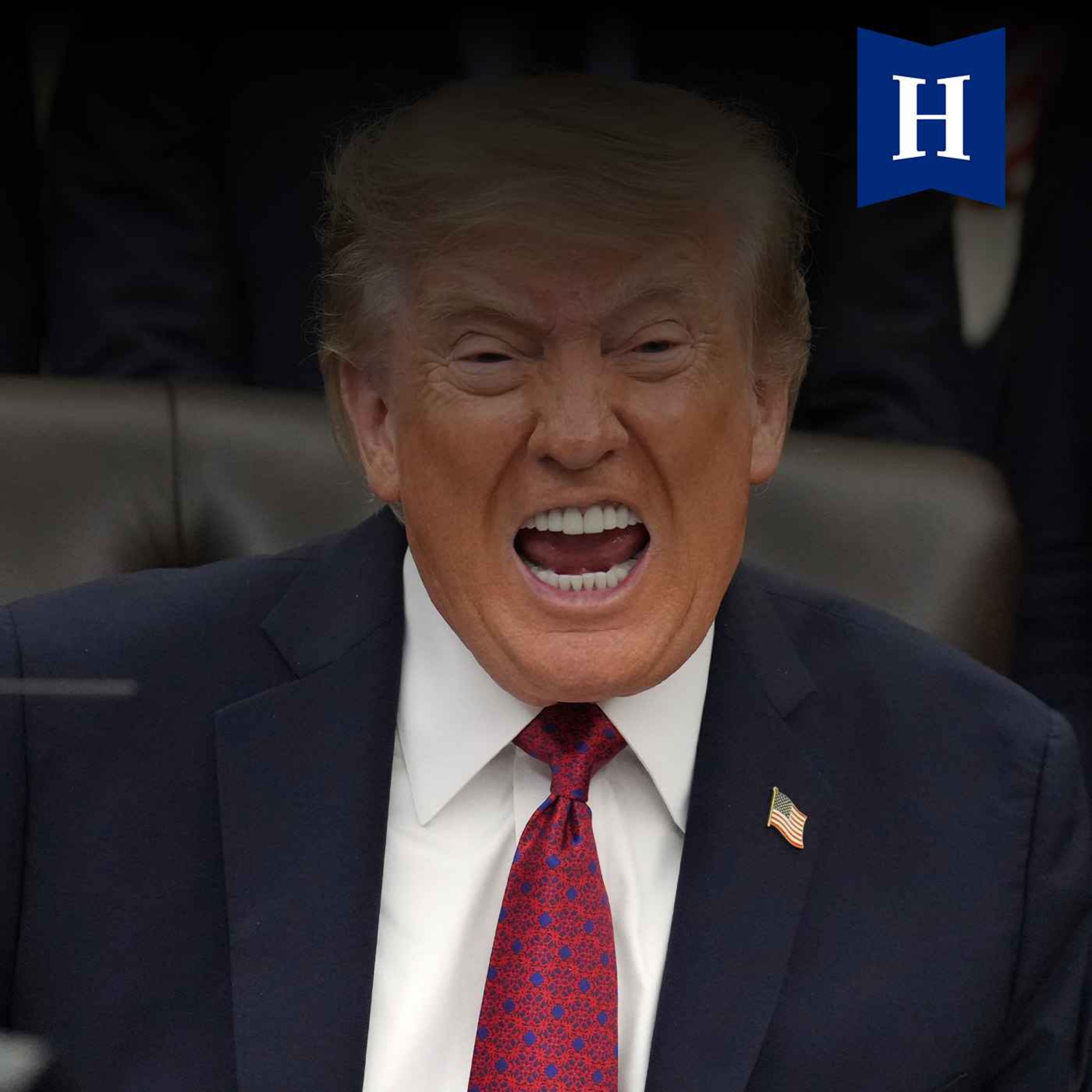
Canada-U.S. trade war escalates: Is Carney making a historic mistake?
About this episode
Rudyard Griffiths and Sean Speer analyze the escalating Canada-U.S. trade war as Canadian counter-tariffs take effect. They discuss President Trump's increasingly erratic behaviour, the risk of economic escalation beyond tariffs to include visa restrictions and business licenses, and whether Canada should deploy asymmetrical responses like restricting critical minerals and energy exports. Speer argues the Carney government's decision to reject the August deal may prove the most consequential choice defining Canada's economy for years to come.
The Hub is Canada’s fastest growing independent digital news outlet.
Subscribe to The Hub’s podcast feed to get our best content when you are on the go:
https://tinyurl.com/3a7zpd7e (Apple)
https://tinyurl.com/y8akmfn7 (Spotify)
Follow The Hub on X: https://x.com/thehubcanada?lang=en
CREDITS:
Daphne Liang - Producer and Editor
Rudyard Griffiths and Sean Speer - Hosts
Jacquelyn Martin/AP Photo - Photo Credit
Hosted on Acast. See acast.com/privacy for more information.
Get every episode summarized
Each time Hub Podcasts publishes, we email you a written briefing from the transcript — the topics, who appeared, and any specific claims, with the ad reads skipped.
Email me new episodesFree for 3 shows. No card needed.
Transcript ready
145 searchable segments. Every word is indexed and playable.
Full transcript
Hub Podcasts — Canada-U.S. trade war escalates: Is Carney making a historic mistake?. Machine-transcribed; use the interactive transcript above to jump the player to any line.
12-01 this morning Canadian counter-terricks went into effect. The trade war takes another notch up in terms of intensity and some disturbing social media posts by the U.S. President. How break it all down? I'm joined this morning by Sean Spirman, my co-founder and editor-larger, the hub. Hey Sean. Yes, I too feel a bit of, I don't know, just the wilderness this morning. And let's begin with this bizarre video that has appeared on the social media feeds of the U.S. President. We'll play it now, get it up on the screen as you and I talk. Sean, I mean this, again we expect this president to troll, but there's just something disconcerting about this. Who knows what it says about his own mental state? It's the implied
violence of this, the, the ugliness of this moment, just so unnecessary, so uncalled for. What do you make of it all? Yeah, the, the, the great Democratic Senator Daniel Piotr-Mona-Han famously referred to the idea of defining devancy down the notion that as our expectations fell, the social behavior would fall accordingly and it just seems Rudger, like this president and this White House consistently undershoot our expectations. You know, this is about the lowest of the low when it comes to the Canada-US relationship depicting the president hitting Mark Carney with a hockey stick. It, I think in a way, captures the challenge for the government in dealing with a presidency in a White House that is increasingly unhinged and inclined to some type of confrontation
with Canada, your respective of the evidence and the facts. On the other hand, as we've talked about for the better part of the past couple of weeks, it's also a reminder that as these retaliatory tariffs take effect, we can count on further escalation from the White House and the risk, of course, is that Canada's economy spins out of control. I think that is what people need to keep in mind as much as we are revolted by the behavior of this president. Yeah, well said, Sean. Um, um, Shane Loesplug, I have a piece in the hub this morning, triple w dot the hub dot CA, just on what might happen next. And Sean, I agree with you. I think there's a real danger of a Escalatory spiral. This seems to be the pattern that this president has followed in disputes with China, Europe, Japan and elsewhere. How do you think that could play out over the coming days?
As we went into tonight's retaliatory last night's retaliatory tariffs from Canada, the White House already telegraphing that a response would be forthcoming. The question again, it seemed that a debate in the White House, you never know with these leaks, as to whether that would be a maximal response, a calibrated response. What's your instinct of what could happen next? What do you think Canadians are going to see in the next 24 or 48 hours in the weeks to come? A couple of points worth underscoring for our audience. The first is this is a president who feels himself constrained with his options in Iran, where the Iranian regime has kind of stood him down. And at this stage, absent ground troops of that conflict seems to be stuck in something of a paralysis that has exposed the way that the president's weakness. The same goes for the relationship with China. There are just kind of inherent limits given the significance of China's
economic and security player to lean on the Chinese regime. And so in that sense, Roger, I worry a bit that Canada isn't just subject to the president's kind of erratic instincts, that in a way we become the target for all of his frustration and for all of his sense that he has been embarrassed and weakened. And so in that sense, I really do think we should take for granted that we are going to be the subject of a kind of maximalist response. Tracing to my second point, you worry a bit, Roger, that the current government sees this through the lens of escalating retaliatory tariffs. They tariff 20 or 30 odd billion dollars of Canadian exports. We do the same on the American side and on and on we go. I worry a lot and we saw a bit of a window under this over the weekend with some posts from the president that the response that the White House
is considering isn't limited to tariffing Canadian exports. But they start to draw on other instruments and tools that they're disposal running from visa policy all the way to licenses for Canadian businesses to operate on the US and everything in between. I really do think that we would be naive if we think that this will only come in the form of a retaliatory response with respect to tariffs. I worry Roger to turn it to you because you've done some thinking on this. How significant a blow it could be Canada's economy if the White House is prepared to go if one can use the phrase nuclear. Yeah. Well, in my essay today in the hub, I mean, Sean, that's kind of exactly where I went is that Canada should be similarly thinking about asymmetrical responses. Right now, today, we've done in a sense what I think China and other
countries suggest early on in their trade fights with Trump doesn't work, which is to match one to one. The reason China was able to bring this president to heal was able to go from, I think, at the height of something ridiculous, 148 percent tariff on Chinese goods to an effective rate today of 12.5 percent was that they threatened rare earth materials, critical minerals and US access for companies and including the US military. That brought this president to the table with G and G continues to hold that threat over this president, over the US economy, over the American defense industrial complex. And boy, China certainly has figured out a way to manage Donald Trump. These things are risky, Sean, so I want your advice on this because I'm in my piece. I do try to calibrate and provide some caution here and urge our leaders to think about this in careful steps.
But now that we're in this fight, and you know, you and I didn't want this, we thought we hope that barring some sovereignty, busting demand at the 11th hour or two plus weeks ago, we should have taken this deal as fraught as it was to avoid precisely the risks, the big existential risks of a war with the world's largest superpower. Let's remind ourselves of who we're going up against here. But now that we've gone down, now that we've chosen door B and we're in this fight, I think we got to think about how to, if not winning, per se, but how do we bring this like China did to something that reflects our interests in again, a massively asymmetrical negotiation on on every front, military, economic, technological. And I think Sean, that leads me reluctantly with, with a great sense of apprehension and little enthusiasm that we have to start
thinking about our own asymmetrical fight, which would mean putting our equivalent of rares on the table, things like crude oil, things like our own critical minerals and aluminum steel and other inputs into the US military industrial complex. I know you're not a fan of this either, but Sean, is this kind of where we have to go to head off an escalatory spiral that could do deep scarring lasting damage to the entire Canadian economy for years to come. Yeah, the reason I was drawn to your analysis, Roger, is because it's motivated by the goal of trying to resolve this trade war as quickly as possible. There are, there are others who argue Roger that Canada should be in a wait and see mode, that maybe the midterms become a juncture where the negotiation environment changes, maybe the 2028 presidential election is
another. I've come to the view, Roger, that both of those underlying assumptions are at best unreliable and at worst would leave Canada seriously damaged by the time that any type of deal was finally resolved. In other words, we don't have the luxury of waiting. We need to try to, you know, to use Markarnney's word, catalyze as quickly as possible of returns in the negotiating table. And at this point, putting marginal tariffs on 20 or $30 billion of exports on a $30 trillion economy just seems to me to be a response that will won't be painful enough to induce a change on the part of the Trump administration, but will be big enough to induce an escalation. And so you're right, you know, what's the old adage if you don't go to war? You shouldn't want to go to war, but if you go to war, you have to be, have a plan to end it quickly. It seems to me that that
is an operating assumption that really should be front of mind for the Prime Minister and his team. Yeah, Sean, the unfortunate thing is like we're now in this fight. And, and, you know, it's a corny adage. It's an old adage, but, you know, don't show up to a, you know, a gun fight with a knife. Yes. We know that the Americans will escalate this. And what are we going to do, Sean? Match them again. I mean, the president has threatened and we'll get this latest tweet up on the screen. He's threatened to Bombardier, which is one of Canada's major aeronautics, aeronautics companies saying in effect that, you know, what's the wording here? You know, we're going to ban the sale of Bombardier jets in, in the United States. So I guess, you know, the president's oligarch friends can fly around on US built Gulf streams. This is just one example. I think of
your point this morning. And we can wrap up here because I want you to reiterate it. This is not just about blanket tariffs. The US toolbox can and likely will, it already is if this Bombardier threat has followed through on attacking specific companies who are critical to Canadian industry. In the case of Bombardier, like our leader in aerospace, their equivalent of our Embraer, our Airbus. This is the company that we put all of our eggs in. I think with way too many subsidies over the years, but I'll be it. That's what we've done. We built up Bombardier, into this so-called national champion. Sean, what happens next? What if the banks are targeted? What if banking licenses are, if not revoked, are threatened in the weeks to come? There are so
many different critical Canadian industries that rely on access to the US market. And I worry that this Bombardier tweet is just a taste of, again, the asymmetrical warfare that's going to begin. Precisely. There's a ton of Canadian capital in the US market. As you say, there's a ton of Canadian businesses with offices there. There are visa issues. There are tax treaties. I mean, if the hockey video captures the president's mindset right now, I worry, Roger, that all bets may be off. And it kind of comes to a bigger point that I've been thinking about. And as you kindly mentioned, broadly reflected in an article I published today at the hub. Roger, I'm a millennial. Some of our millennial own Gen X listeners and viewers may recall the choose your own adventure novels that you used to read as a kid. You'd get to a page and it would tell you you'd have to make a choice about which the next page to go to. And of course, what would you do, Roger? You would choose one
and read it through. And then you'd come back and read the alternative to see what the alternative scenario may be. You had that option when you read those novels. You don't have that kind of option in the world of policymaking. Choices stack on top of each other. And so I really do think, Roger, that the decision to walk away from the carning career deal a couple of weeks ago will be the most consequential decision of the carning government, one that will define his government and one that will define Canada's economy for the years to come. We can't go and play it back six months or a meter from now. We are now in a new environment. We've chosen our adventure. And as you say, Roger, we've got a series of difficult but necessary choices before us up against the president that seems determined, particularly as he feels we can other parts around the world to kind of demonstrate his strength. And this is going to be painful as the
prime minister said today. And I just hope in hindsight, Roger, that we don't regret that we didn't choose the other path available to us because unfortunately at this point it's probably too late. Yeah. Yeah. And look, as you said, we've chosen our adventure worth through door B, but you know, let's get the terms of the August 22nd deal out for us to debate so that we're informed as this war continues as the costs escalate. Let's understand what Dora could have might have looked like, even as a bait, not if we ever go through it again, but just to understand for all of us because we're flying in the dark right now, what was the framework of what we were willing to consider? I don't know if that should just Sean be held by a coterie of select advisors to the prime minister and the government. I think given we're all going to bear the price of this this trade war that we should all be fully informed together about the state of play on August 21st
and everything that's happened since and everything that will happen over the weeks and let's not hope months to come. Sean, great to have you on today's hub hit. We're as you see, renaming hub hits for the next while hub hits trade war. We're going to be at you with content via our podcast channel and our YouTube channel each and every day under the hub hits banner. We will focus exclusively on this trade war. You'll get Sean and my regular analysis and also Canada's top experts, economists, former politicians and political figures. We're going to bring you a selection of the country's sharpest minds to break down Canada's fight with Washington and this temperatures president. Look for that in hub hits each and every day from today forward. I'm Rud your Griff, publisher of the hub until next time. Bye bye.
More episodes
More from Hub Podcasts

9/11, Europe, and the fight over immigration
Hub Podcasts
How much slack is left in the global oil market?
Hub Podcasts

Canada’s low-quality trade war debate
Hub Podcasts

Andrew Coyne says we are at war, but is that true?
Hub Podcasts