About this episode
How_China_broke_the_end_of_history
Get every episode summarized
Each time ÆON imminent 🧬 🌀 publishes, we email you a written briefing from the transcript — the topics, who appeared, and any specific claims, with the ad reads skipped.
Email me new episodesFree for 3 shows. No card needed.
Hosts & guests


Transcript ready
499 searchable segments. Every word is indexed and playable.
Full transcript
ÆON imminent 🧬 🌀 — CCCP > CCP. Machine-transcribed; use the interactive transcript above to jump the player to any line.
Imagine for a second, right, that you're playing this massive, incredibly complex board game. Oh, okay. Like a deeply strategic one. Exactly. Like, you've been playing for hours and hours, and you've been told that the rules are completely settled. Right. The final moves have been made, the game is basically over, and you won. Nice. I like winning. Right. History itself has reached its final permanent destination. But then, right, as you're, you know, packing up the pieces and calculating your final score, another player sits down, yeah, a player with a 5,000 year old strategy, and they just flip the board entirely and say, ah, actually we're playing something else. That is, yeah, that's quite the image. I mean, what happens when the ultimate theory of global politics, like this arrogant assumption that the West had reached the end of history, gets completely derailed by an ancient civilization deciding to just, you know, be itself again. That's the big question, isn't it? It really is. So, welcome to the deep dive. Today, we are pulling from this incredibly dense, just fascinating transcript of a video
by the Danube Institute. Yeah. It's titled, ah, the era of re-civilization, unknown, knowns. Right. And it features this really in-depth dialogue with David Duenbury about a major piece that was recently published in American Affairs. It's a heavy one, for sure. Oh, totally. Our mission today is to basically map out this massive geopolitical and honestly philosophical argument about where the West is heading. Yeah. And why all the shiny utopian predictions from the 1990s basically failed. Exactly. And bizarrely enough, what we might actually learn from a 16th century Jesuit priest. Which is, I mean, that's a twist I didn't see coming. But before we jump into all that, I do need to set a really crucial ground rule for you listening. Good go. Because we are waiting into some deeply politically charged waters today. We really are. We're going to be discussing ideologies ranging from Marxism to neo-conservatism to liberal democracy. So our role here is just to act as your scouts. Right.
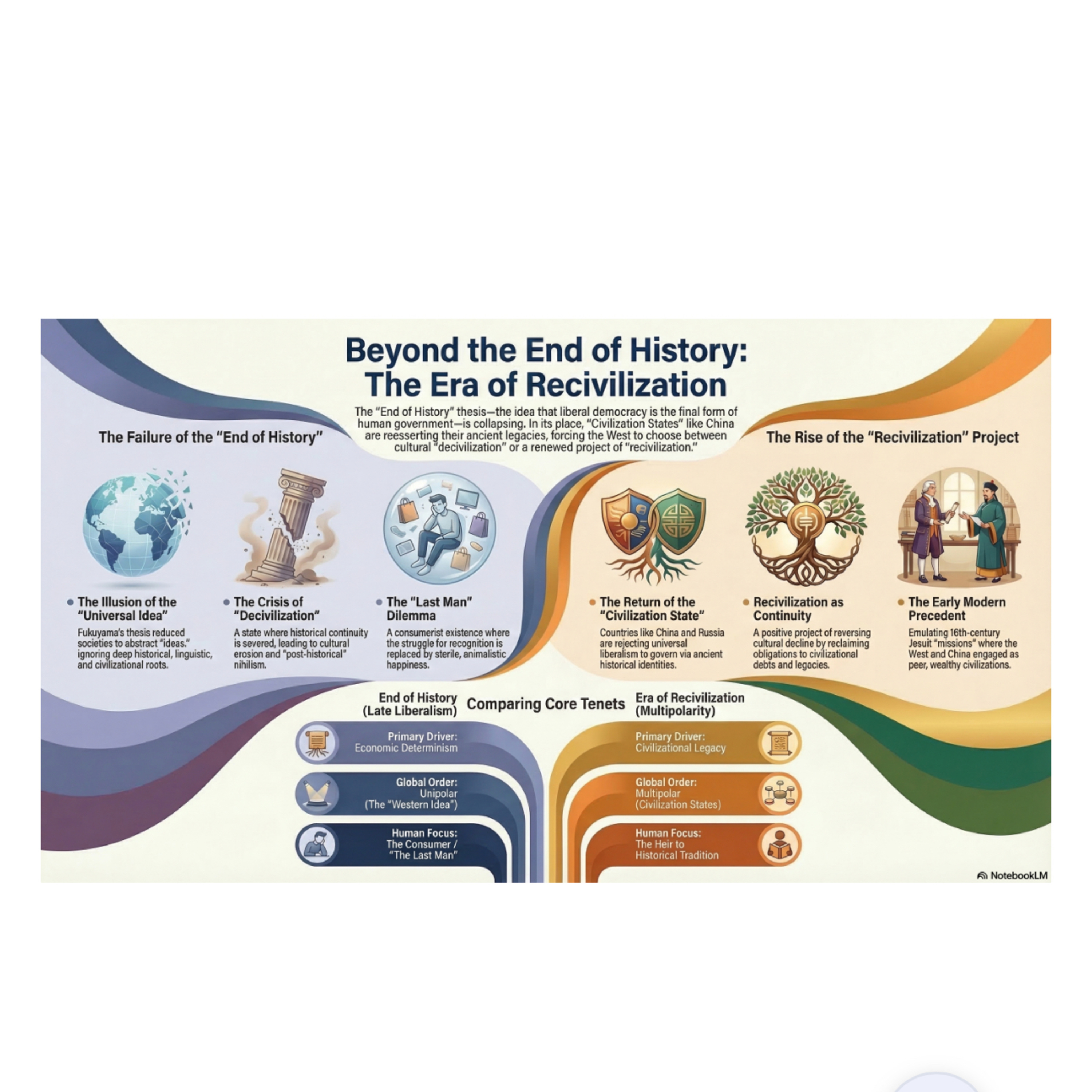
Exactly. We are impartially mapping this complex ideological terrain. So you can understand the arguments that are shaping the world right now. We're not taking any sides. Right. Exactly. We are not endorsing any specific political viewpoint today. We're just reporting on the theories presented in the source material. So with that out of the way, let's unpack this. If you listen to the rhetoric coming out of Western capitals over the last few years, the vibe has definitely shifted. Oh, completely. The optimistic language of the late 20th century has just vanished. It really has. Why are politicians suddenly using words that sound like they belong in a post-apocalyptic movie? Well, we're looking at a fundamental shift in how leaders talk about the future. I mean, French President Emmanuel Macron actually captured this perfectly in the summer of 2023. Right. What did he say again? He started using this very specific, deeply unsettling term to describe societal trends in France. He called it de-civilization. De-civilization. Wow. That is a heavy word.
It really is. He was pointing to this pervasive, creeping anxiety that the fundamental social contract is just unraveling. Right. But the origin of this term is actually highly controversial. And the source notes that Macron was likely drawing on the work of figures like Renaud Camus. And he's a pretty controversial guy, right? Dary. He's heavily associated with the far right in France. So the fact that a centrist establishment figure like Macron felt compelled to borrow this kind of apocalyptic vocabulary. It really tells you something profound about the current psychological state of the West, doesn't it? Exactly. Yeah. So widespread consensus that our cultural and political legacy is fracturing. Yeah. It implies a literal unspooling of the social fabric. It's like, well, it's the feeling that society is this incredibly complex piece of hardware. I don't know. Right. And the underlying architecture is failing. We are just dealing with a few software bugs anymore. No. The motherboard itself is cracking under the strain. That's a great way to put it.
But interestingly, the authors of our source material counter this modern doom loop by reviving a completely different term. Okay. What's the counter term? They reach back to the historian Thomas Carlisle. He used a specific word during the restoration period right after the chaos of the French Revolution. Oh, interesting timing. Yeah. And the word was recivilization. Recivilization. Okay. So it's framed as a deliberate, positive project then. Exactly. The argument is that instead of throwing the whole machine out the window or just, you know, resigning ourselves to an inevitable collapse. We need to intentionally reinstall the classic stable software that we know actually works. You've got it. We are heirs to a massive political and cultural legacy. We aren't tasked with creating a functioning world from scratch. Right. We just have to remember how the old one worked. Yeah. But to figure out how we rebuild, I mean, we first have to ask why we feel like we're collapsing in the first place, right? Exactly. Like, if we are descivilizing, what exactly was the original destination we thought we
were sailing toward? Well, to answer that, we really have to look back at the sheer hubris of the late 20th century. The 1990s. Yes. Specifically, Francis Fukuyama's famous 1989 thesis, the end of history. Ah, right. I mean, you hear this term thrown around all the time. But what did he actually mean by it? So Fukuyama looked at the impending collapse of the Soviet Union and he argued that humanity's ideological evolution had reached its final, permanent endpoint. And that endpoint was Western liberal democracy. He claimed that all the massive bloody questions of human governance had essentially been answered once and for all. Wow. So the grand ideological wars were just over. That was the idea. Everything from 1989 onward would just be administrative maintenance. We would just be, you know, tweaking tax rates and managing trade agreements forever. I mean, if you lived through the 1990s, you definitely remember this exact five. Oh, for sure. The Berlin Wall falls and there is this pervasive, almost arrogant optimism. Yeah, this feeling that the West had finally solved the human equation, but looking at thousands
of years of human struggle and just declaring the game over in 1989, I mean, it seems almost comically naive now, right? It does seem naive today, but it was incredibly bold at the time. And Fukuyama was actually building on a very deep philosophical foundation. Okay. Where did he get this idea? He was drawing heavily on a 1930s philosopher named Alexandra Kochev. Oh, shit. Right. I've provided this highly influential reading of the 19th century philosopher Hagle. Okay. We were going deep into the philosophy here. We are, but it's essential to understand Kochev argued that human history actually began with a primal, deeply violent psychological confrontation, a violent confrontation, like over resources. No, actually, he called it the master slave dialectic. If you imagine two early humans meeting in the state of nature, history kicks off with them engaging in a struggle to the death. Okay. But if not for food or territory, what are they fighting for? They are fighting for pure recognition, recognition, like status.
Exactly. They want their own human dignity validated by another consciousness. So one survives with his dignity intact. He becomes the master and the other one. The other submits to save his physical life. He becomes the slave. Kochev argued that all of human history, every war, every revolution is driven by this fundamental asymmetrical desire to be recognized by others. Okay. Wait. Isn't it incredibly reductionist to say all of human history is just two guys hitting each other with sticks demanding validation? It is definitely a stark view. I mean, the source material actively pushes back on this, right? It points out that this framework entirely ignores love. Oh, completely. It ignores family structures, religious devotion, artistic creation. Every other profound human motivation is just erased. It basically paints humanity as these sterile, status-obsessed actors. Yeah. It is a remarkably bleak, atheistic view of humanity. It strips away all transcendent meaning.
But in this crazy part, Fukuyama took this exact premise in Iran with it. He argued that liberal democracy is the ultimate final solution to this ancient problem. Because it theoretically provides universal recognition. Exactly. By granting equal rights, civil liberties, and the right to vote to absolutely everyone, the old master slave dynamic is finally dissolved. Because everyone is legally recognized as equal. Right. And therefore, the engine of history just stops running. Wow. Okay. But the source material highlights a really fascinating kind of hidden mechanism in Fukuyama's theory, right? Yes. His methodology was essentially Marxist. That is wild to me. The philosopher who wrote the ultimate victory lap for Western liberal capitalism was secretly using a Marxist playbook. It sounds like a contradiction, but both Marx and Fukuyama were strict economic determinists. Meaning they thought economics drives everything. Yes. They both believe that underlying economic development dictates the shape of human society. Marx thought economic development inevitably leads to a worker's revolution and communism.
Right. Fukuyama took the exact same dialectical machinery, but just swapped the product at the end of the assembly line. So he argued that economic development inevitably creates a wealthy consumer society. Yep. And that consumer society inevitably demands the political freedoms of liberal democracy. So what does this all mean for us today? Because if the end of history was supposed to be this paradise of universal recognition, why does the current reality feel so hollow? That is the crucial question. I mean, if we solve the human equation, why are Western leaders panicking and using terms like de-civilization? Well, this brings us to a psychological diagnosis raised by both Kojev and Fukuyama. It's the concept of the last man. Yeah. That sounds ominous. They both harbored a deep anxiety that if the grand historical struggles that forged human character actually ended, we might lose our humanity all together. Oh, I see. Like, if there are no great causes left to fight for. Exactly. No profound ideological battles.
Humanity might just sink into consumerist nihilism. A completely sterile existence. Right. Where we just pursue base comforts, scrolling through screens, accumulating goods. A return to a sort of animality, as they put it. I mean, think about your own daily routine. Or the endless doom scrolling that kind of defines modern life for so many of us. Yeah, it's relatable. The source suggests that the unsettling trends of de-civilization we feel today, like the burnout, the institutional distrust, the social fracturing, might just be the last man attempting to function in a system that lacks any deep, transcendent meaning. That's a powerful way to frame it. And society is reduced to nothing but economics and administrative management, the human spirit stars. And eventually, people lash out. Fukuyama and Kojava essentially predicted this exact psychological malaise decades ago. It's like Fukuyama thought he had prescribed a universal global diet, right? He believed everyone on Earth would eventually just eat liberal democratic fast food, buy consumer goods, and stay perfectly content.
But that's not what happened. No. Some massive countries looked at the menu, realized how nutritionally devoid and spiritually empty it was, and entirely rejected it. And that rejection is exactly why we are now witnessing the end of the end of history. We are watching the collapse of the unipolar world order. That brief era where the West was the undisputed hegemon dictating the rules, it's over. And the source notes that while the recent war in Ukraine violently accelerated this collapse, it didn't cause it, right? No, it didn't. The deeper long term reality is a return to multi polarity, which means a world with multiple competing power centers. Exactly. And multi polarity is not some terrifying new aberration. It was the historical norm for essentially all of human civilization before the Cold War. Right. It's just history returning to its baseline. But the ultimate proof that Fukuyama's global fast food menu failed isn't just the power is fracturing. No, it's how the developing world behaved when it actually gained wealth.
Because Fukuyama's entire theory rested on a very specific mechanical prediction for countries like China, didn't it? It did. China is the ultimate test case that completely shattered his model. Okay, what did he predict would happen? Fukuyama explicitly predicted that as China economically developed and integrated into global trade, a massive middle class would emerge. Which did happen. It did. He believed that as China's brightest students went off to study at Ivy League universities in the West Harvard, Yale, Stanford, they would inevitably absorb Western cultural values. Because according to his Marxist style machinery, you cannot maintain a complex, wealthy consumer society without it eventually democratizing. Exactly. The belief was absolute. They thought money and Western education would dissolve China's historical authoritarian identity and seamlessly turn it into a liberal democracy. But that is literally the exact opposite of what happened. It completely failed. They got incredibly rich. They created that massive consumer middle class.
They sent their future leaders to the Ivy League and then they completely reversed course. They explicitly rejected the liberal democratic model. And the source points to a vital figure to understand this pivot, right? Wing hunting. Yes, wing hunting. He is widely considered the central ideological architect of China's current governance model. And he actually studied in the US, didn't he? He did. He spent time at places like Stanford during the late 80s and early 90s. Wow. So right at the peak of the end of history optimism. Exactly. He observed it up close. He even wrote a book about his experiences called America against America. What did he think of it? Well, he looked at Western democracy and he didn't see a utopia of universal recognition at all. What did you see? About extreme individualism, he saw profound social alienation, massive inequality and a culture that commodified absolutely everything while losing its historical feather. Wow. So he basically looked at the crashing operating system and decided, yeah, we are not installing
this on Chinese hardware. That's a perfect analogy. He realized that importing Western democracy meant importing Western social decay. So what did they do instead? Rather than returning to China to tear down the old system and build a Western democracy, elites like Wang helped craft a system of governance that deliberately reaches past their Marxist revolutionary period. Reaches back to what? All the way back to China's ancient 5,000 year old roots. Today, the Chinese Communist Party officially promotes the revival or renaissance of civilization. They are aggressively returning to the concept of being a civilizational state. Yes. Civilizational state derives its legitimacy very differently than a democracy. Right. It's not about four-year election cycles or individual rights. No. It's about its ability to maintain historical continuity, cultural harmony, and the long-term stewardship of a distinct civilization. So the economic determinism completely backfired. The West assumed wealth would buy a Western liberal mindset, but instead, instead, economic
development gave China the resources and the confidence to just be China again. That is wild. They looked at their own 5,000-year developmental path and decided it was fundamentally superior to a 250-year-old Western experiment. And this creates an immediate, existential problem for the West. Absolutely. Because if China is successfully executing this top-down revival of civilization and effectively breaking the unipolar world order, how are we supposed to respond? Well, our source argues that viewing this purely through the panic, adversarial lens of a new Cold War is actually a mistake. Okay. So what's the alternative? To navigate a multipolar world, we need to completely broaden our historical horizon. We need to look back to how the West and China interacted before the West dominated the globe. Before the 19th and 20th centuries. Exactly. The authors take us all the way back to the early modern period, the 16th and 17th centuries. An era that modern Western foreign policy entirely forgets about. We really do suffer from a severe historical amnesia because during the 16th and 17th centuries,
China was vastly wealthier, more populous, and in many ways more administratively sophisticated than Europe. Really? More sophisticated than Europe? Yes. Even Adam Smith, the father of modern Western economics, explicitly noted in the wealth of nations that China was richer than any part of Europe. That's incredible. So when Westerners arrived in Beijing during this era, they weren't arriving on gunboats to dictate the rules of history. They were arriving in a superior, highly ordered, opulent empire. Here's where it gets really interesting because the key figures leading this interaction were the Jesuit missionaries, right? Specifically a man named Mateo Ricci. Mateo Ricci. He is framed in the source material as like the ultimate intellectual exchange student. He really was. He didn't show up with the arrogant assumption that he possessed the final answers to human governance. Right. He showed up to learn. And because of that, Mateo Ricci is kind of a foundational blueprint for how to interact with a civilizational state. How did he approach them? He engaged with the Chinese imperial court on level ground.
He rigorously studied their language. He wore the robes of a Confucian scholar, and he deeply analyzed their governance. And he actually found a lot of common ground, didn't he? He found incredible commonalities between the deeply held principles of Western natural law, which is the idea that there is an objective moral order in the universe discernible by human reason. Exactly. He found commonalities between that and ancient Confucian philosophy, which prioritizes cosmic and social harmony. But they didn't agree on everything, obviously. No, of course not. The source notes they had profound, rigorous debates over deep theological concepts, like original sin, which is pretty central to the Western understanding of flawed human nature. Right. But Ricci recognized Chinese civilization as being just as highly developed and sophisticated as ancient Greece. And the exchange of ideas flowed in both directions because I found fascinating. The source points out a historical fact that completely upends how we think about Western
capitalism. It really does. The West borrowed massive foundational concepts from China, and we've simply erased it from our collective memory. Yeah, the very concept of laissez-faire economics, the absolute bedrock of Western free markets, has documented roots in Chinese philosophy. Wait, really? The bedrock of Western capitalism is Chinese. It's a stunning historical connection. It comes from the philosophical concept of Wuwei. Wuwei? What does that mean? It translates roughly to non-action or effortless action in harmony with the natural order. And this heavily influenced European enlightenment thinkers. How did it make its way into economics? It used like Francois Kissnay and the French physiocrats actually translated this Chinese concept of non-interference into the economic doctrine of laissez-faire. Oh, wow. So the flow of information and governance strategies used to be bidirectional. Yes. But during the century of humiliation in the 19th century when China weakened, and then the unipolar dominance of the 20th century when America surged.
The West just forgot how to learn from the East. Exactly. The authors argue that today, instead of treating China solely as an adversarial Marxist threat, the West needs to recognize it as a historical nation embarking on a massive project of re-civilization. And given our own internal anxieties about de-civilization, we should probably be analyzing their mechanics. We absolutely should be. But that presents a massive intellectual challenge for you listening and for Western leaders. A huge challenge. If we admit that we need to learn from China's re-civilization playbook, their focus on historical continuity, deep cultural roots, and long-term societal harmony. How do we critically import those ideas of governance without losing the core Western values we are supposedly trying to save? Right. Because we cannot simply copy a system that suppresses individual liberty. No, obviously not. But ignoring a civilizational state that is actively trying to solve the exact problem of cultural decay that we are facing seems like a recipe for our own collapse.
It requires an immense amount of intellectual humility, which is something the end of history era completely stripped from Western strategic thinking, completely. It means acknowledging that our societal operating system might require patches developed by someone else. That's a tough pill to swallow for a lot of people. It is. But the source proposes that natural law might once again serve as a mediating bridge just as it did for Mateo Ricci centuries ago by focusing on our shared human nature. Yes, focusing on the objective requirements for human flourishing rather than purely relying on economic metrics and consumerism. Right. So we might find a way to authentically stabilize our own societies. Exactly. We have to figure out how to be a civilization again rather than just an economy. Well, we have covered a massive amount of ground today. We really have. We started by diagnosing that deep post-apocalyptic anxiety of de-civilization that is currently gripping Western leaders. Yep. The unspooling of the social fabric. Then we dismantled the flawed arrogance of the end of history, this illusion that consumerism
and democracy had permanently solved the human condition. While completely ignoring the spiritual starvation of the last man. Right. And we watched that illusion shatter against the reality of a returning, multipolar world, driven by China confidently rejecting the West to reclaim its ancient identity as a civilizational state. That's a totally different ballgame now. It is. And finally, we realized that to navigate this new era, the West has to look back. Both to our own forgotten philosophical legacy and to a time when we met the East, not as masters, but as equals eager to learn. You know, I want to leave you with a final lingering question inspired by this whole idea of a government-led cultural revival. Oh, I like a good parting thought. What is it? If a massive state apparatus, whether it is in the East today or eventually here in the West, decides to artificially engineer a re-civilization based on ancient historical models, how much of that resulting culture is actually authentic? Oh, that's a great point. Right. Where is the line between a genuine human renaissance that bubbles up organically from the people and
a top-down administration simply dressing up in historical cosplay to maintain political control? Historical cosplay. Wow. And perhaps more importantly, what happens to the everyday citizen who looks at this grand state mandated historical reenactment and decides they simply don't want to play along? That is a brilliant unsettling thought to carry with you because just when you think you know the rules of the board game and just when you think the final moves have been played, history has a habit of flipping the board entirely. Thank you for joining us on this deep dive. Keep questioning the narratives, keep looking beneath the surface of the daily news, and we will see you next time.
More episodes


