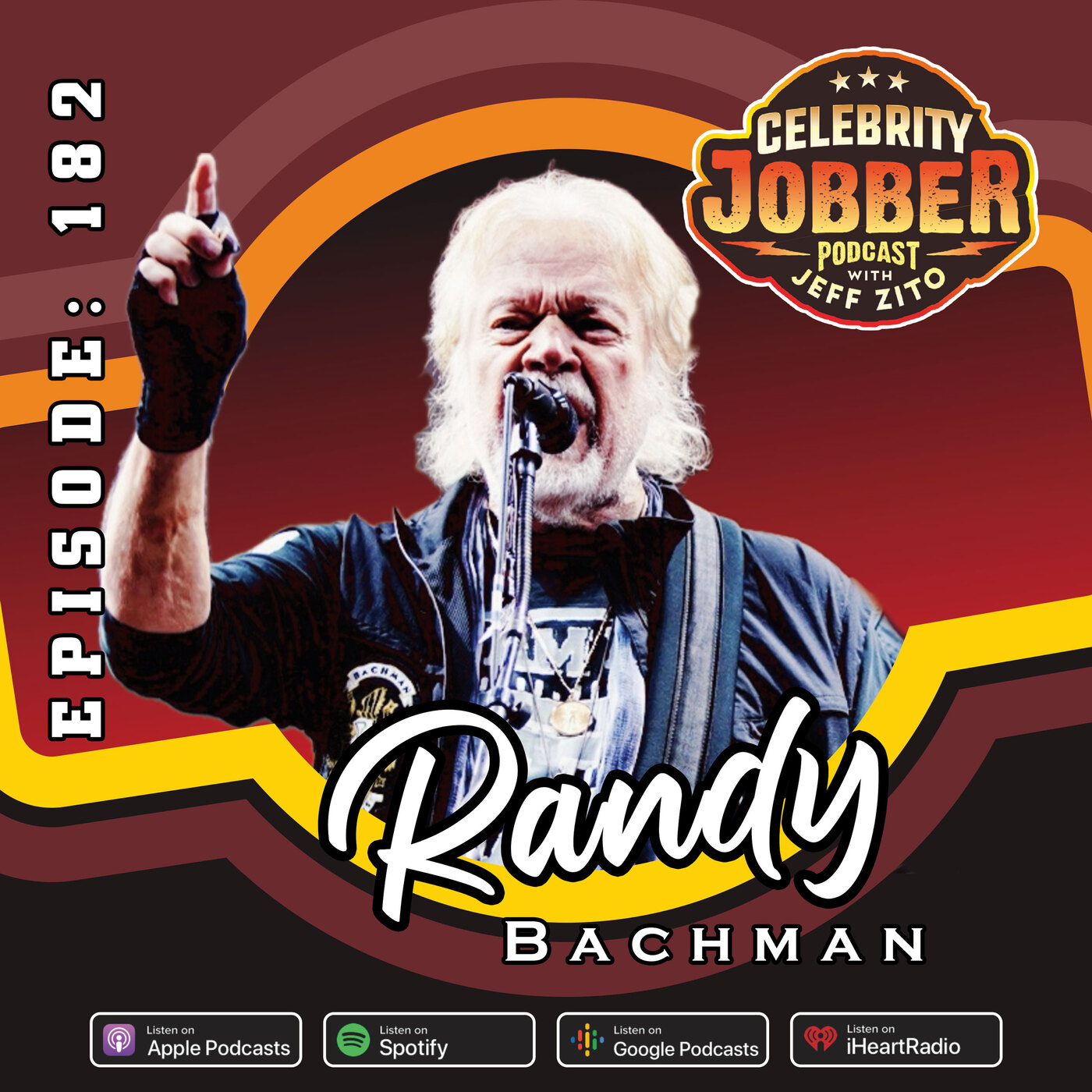
Celebrity Jobber with Jeff Zito - Randy Bachman
About this episode
Randy Bachman is on Celebrity Jobber with Jeff Zito this week. What type of work would Randy be doing if not for being a Canadian guitarist, singer, songwriter, and founding member of the bands The Guess Who and Bachman–Turner Overdrive? Many celebrities will tell you that if not for that one lucky break or meeting, they would have been working as a janitor, like Jim Carrey, or an armadillo exterminator, like Matthew McConaughey. In other words, they may have been just a jobber.
Get every episode summarized
Each time Celebrity Jobber Podcast with Jeff Zito publishes, we email you a written briefing from the transcript — the topics, who appeared, and any specific claims, with the ad reads skipped.
Email me new episodesFree for 3 shows. No card needed.
Hosts & guests

Transcript ready
1,004 searchable segments. Every word is indexed and playable.
Full transcript
Celebrity Jobber Podcast with Jeff Zito — Celebrity Jobber with Jeff Zito - Randy Bachman. Machine-transcribed; use the interactive transcript above to jump the player to any line.
This message is brought to you by the Capital One Venture X card. Venture X offers the premium benefits you expect, like a $300 annual Capital One travel credit, for less than you expect. Elevator earned with unlimited double miles on every purchase, bringing you one step closer to your next dream destination. Plus, enjoy access to over 1,000 airport lounges worldwide. The Capital One Venture X card. What's in your wallet? Terms apply, lounge access is subject to change. See Capital One dot com for details. On Instagram, celebrity underscore jobber underscore podcast, or the YouTube channel which is youtube.com slash the at sign celebrity jobber.
Also, at celebrity jobber on sub stack. So subscribe to sub stack for some bonus content and a lot of other stuff. What would happen to these people if they didn't get their big break if they weren't famous? What would they be doing? You know, what was life and, you know, like, what was life like before fame for some of these people? You know, most just held regular jobs and were regular people. We're about to hear a really incredible story. This guy is 80 years old and men. He can tell a story and he's got a lot to tell. As you know, the guest who is back on tour and I'm talking about the real band, Randy Beckman and Burton Cummings, back together on tour right now, theguesswho.com for tour dates near you. Gonna talk about the beginning from when Randy was a little kid. I mean, all the way back to like three years old. That's where this story starts, believe it or not. You know, it's pretty huge to get a record deal and get a hit song with one band, let alone two.
So it happened two times with Randy Beckman, first with the guest who, and then with Bachman Turner overdrive, BTO. And what about jobs outside of music? What was Randy's first job or if he had several different jobs? We're about ready to hear the whole story from the guest who and Bachman Turner overdrive. The one and only Randy Beckman is my guest this week on Celebrity Jobber. The Celebrity Jobber podcast with Jeff Zito. If you like what you hear, please subscribe, give a five star rating and leave a review. Check out all our past episodes on Apple Podcasts, Spotify, or wherever you put it. What if these celebrities weren't famous? What would they have become? What was their first job? We're about to find out. Hey, Randy. How's it going? Great. It's funny, you know, I usually have a term I usually call rock and roll time and that's, you know, usually 15 minutes late.
But here you are, proven me, proven that theory wrong two minutes early, pretty incredible. I'll sign off and come back in 15. I want to disappoint you. Definitely not disappointed in waiting to speak with you for a long time. And I do want to thank you for taking the time to speak with me. Is it true us Americans have been mispronouncing your name for over 50 years? Yes, but you've been mispronouncing everything for 50 years. You heard the song, you say tomato, tomato, potato, potato. Right. That's in dots at the backman Bachman. Okay. So you just you just responded to Bachman. No big deal. You didn't correct anybody. You didn't want to make us feel bad. Is that what it was? Here's what I say. This is Randy Bachman from Bachman Turner over. That's great, man. Tell me what was it back in in the good old days when you were a young boy growing up in Canada. What made you want to get into rock and roll?
What was it? Well, I grew up as a classical kid. I started a classical violin. I was five and it was royal conservatories. You got to play Chopin and Tchaikovsky and all this stuff. And it was pretty good. And I turned like 14. And it's a very boring life because it's all classical. And the world is changing. And in addition to a symphony orchestra, the junior Winnipeg Junior Symphony School Orchestra and realized I wasn't as good as the classical people there. And I wanted to break out. And so I quit. And the next day after I quit, I went home and said to my mother, I'm not playing violin anymore. I'm quitting. What are you going to do? I said, I have no idea. The next day I saw Elvis Presley on TV. And I said, what is that? Because TV was brand new about. And this was like 1950s in Winnipeg. Well, that's called rock and roll. That's called guitar. And that's called Elvis Presley. That's insane. Everybody's screaming at the guy. What's going on? That's what rock and roll. You do whatever you want. You can dance and shake and scream and yell.
I said, well, I want to do that. My cousin's had a guitar. So I said, how do you play this? They showed me three things on the guitar. I picked up and played it. And they said, how can you play this? So easy. I said, well, a lot of violin. All you play is melody. I've been playing melody since I was five. I'm now 15. So for 10 years, I can play lead on this guitar. It's just like a violin. He said, oh, you're the guitar player. I started a band. It was Chad L. in the reflection. We became the guest too. Here I am. Oh, wow. Unbelievable story. And I heard there was a chance meeting with the legendary Les Paul, where you tried to actually buy a ticket to go into a show. But you were too young. Well, I just saw the other side of Winnipeg was at a supper club, a nightclub. I didn't realize that. And I didn't tell my parents I was going. A young, you can't. Or else they won't let you go, right? You're 15. Right. Les Paul and Mary Ford had three songs in the top 10 by Acadios and a couple others. How high the moon and stuff like that. So I go, I get on the bus, I go to the other side of Winnipeg,
which is a three bus transfers across town. And I go to the club. It's like 530 at night. And I said, I've come to see the Les Paul, he says, you can't get in. It's a supper club. We serve alcohol here. Unless you have an adult with you in Booker Table, you can't get in. You're kidding. So I'm sitting out front kind of disheveled, sitting at the bus stop. And a black Cadillac pulls up the window rolls down. I'm sitting there holding a Les Paul, Mary Ford album. The window rolls down. It says, hi, kid. Wow. And I look at Les Paul, he says, what are you doing? It's not, I came to see your show, but I can't get in. He's, I'll get you in, carry my guitar. We go in the back of the supper club. He said, you can't go out there. They won't let you go, but you can stay here in the kitchen. And so they had big swinging doors on the kitchen, where waiters are going through with trays, with food on. And swinging doors had big round windows, so they wouldn't smash into each other and knock the trays out of each other's hand. And beside me backstage, with five apex tape recorders, all stacked up that he, all his music was on. And he controlled the mall with a controller on his guitar.
He called it the Les Paul Verizon. And he had this Paul Verizon switch that would start the tape recorders, and he would go explain to the audience, here's how I play rhythm, and he would play that. Here's how I play the lead. Here's how Mary Ford sang. Mary Ford walked around to each table, and serenaded each table, like you would do with a Mary Archie band. Right. And it was amazing. Wow. And when the whole thing was done, and I'm so on beside, I'm beside his tape record, but all I see is rear end. And he's wearing a tuxedo. And Mary Ford's wearing like a white prom dress, you know, big, fairly dress. And their son, Gene, is playing drums. He's keeping rhythm going. That's why I see the whole show that way. When it's all done, he comes back to his hole. This kid, he has me, his guitar, and he wipes his Browdy goes that he does his own core. And that was that. Unbelievable. And then I hear years later, you run into him again. I'm with BTO. I'm opening with for Van Halen. And we're in New Jersey outside of New York at the National Colosseum. And Les Paulco is going to say hi to Eddie. And he comes up to me and Sammy Hagre is in the band at that time. Les Paulco is actually, and he says,
do I know you? And I said, Rancho Don Carlos, one of the biggest. Oh, kid, do you remember that lick? And I said, yeah. He showed me the lick and how high the moon. He said, I'm playing at the Aridium Club tour. And I'd come on down. So I go down to the Aridium Club. He calls me up on stage. We play how high the moon. He says to me, let's do one of yours, kid. I go, what? Oh, yeah, don't you have that. Yeah, I play taking care of business. And Les Paul play guitar with me. And then I went a few years later, I go to Neil Young's birthday in LA at the troubadour. And Neil comes up to me and says, you know that story of trouble at Les Paul? And I go, yeah. And he says, you don't realize, I was at that show. And I said, really? He said, yeah, but my mother booked a table. Oh, you already did. I sat at the front table. I saw Neil. I saw Les Paul's fingers play. You saw his rear end as he was walking around. Unbelievable. What were your parents musical, Randy? No, but they did everything to get the kids out of the ghetto. So I had violin lessons. And my son and my brother had accordion lessons. And my brother had drum lessons. And we became the heart of Bach and Chernodov. But they added up my buddy Fred Turner. After the guest who, I started a band with my brothers.
We became the three Bach wins and the Turner. And my brothers have now passed away. But I'm the last surviving guy. And I continue on as BTO. Celebrity jobber. The Celebrity jobber podcast with Jeff Zito. So you won a singing contest at three years old. By five years old, you started playing classical violin. And I asked you if your parents were musical people. You said, no, but they did all they could to get the kids out of the ghetto. What did you mean by that number one? And number two, what did your parents do for work? My mother was a mother. She had four sons. Believe me. It's a big job. Four boys is a big job. And you know, it's an ad hill. And my dad was an optician. You know, I glassed guy. Because my parents were not well off. We didn't live in a ghetto. It was a Ukrainian Polish Jewish kind of ghetto where all the poor people lived on the other side of the train tracks. Whereas Winnipeg with the downtown with the, I don't know, the more British
or the more upper class. You needed a way out. I was either playing hockey, you know, stopping pucks or shooting pucks, shooting hoops, hitting home runs, playing an instrument, being an actor, being an athlete, excelling at something to get you out of there. Or else you're going to stay there and marry your high school sweetheart and have four kids and go to the same game at the same old, same old, same old, same old. For some people, that's really good. Sometimes I long for that. There's a nice thing about the comfort zone of that. And then part of me wants to join the Rock and Roll Circus and go around the world, which is what I did. So what kind of music were your parents into? The music they would play and they would go and see that would come to Winnipeg would be the Benny Goodman Orchestra, Tony Bennett, Barbara Streisand, you know, when they were teenagers and when they were 20 or something, whatever. But they'd always play this music in the house on 78s. And they always had a great guitar solo, like Charlie Christian or something,
is playing the guitar solo in Grand Slam. When I learned that right off the bat, I didn't know who it was. It doesn't say who it is on a 78. And I would just kind of get that in my head. Yeah. So that's kind of what happens. So if I was to say school really wasn't your thing, would that be accurate? Well, it was my thing until about grades through eight or nine. I was an eight student, eight plus student. I did everything perfect. I mean, literally everything. I'm playing violin. Because my parents had to scrape up the money for my lesson, which is like $2 a week. This was like big money for them. My dad was making $50 a week then. So for me to take that money and get a lesson, a lesson, I literally had to practice every morning, half an hour violin, 730 in the morning before school. And when I came home after school at four, before I could change it to my play jeans. Because then you had good jeans or to school and play jeans or to home. Yeah. I had to practice another half an hour. So I practiced an hour a day violin. At the age of five and it becomes a part of your routine.
It becomes music. It's mathematical. It's physical. It's brain-to-fingers. A coordination, everything like that. And on a violin, what do you play? Lead. It's a lead instrument. It's like a flute. Like a pickle. You're playing the lead. I get invited to join our audition for the Winnipeg Junior Symphony. 85 kids are auditioning. This is on the other side of Winnipeg. The Upper East Side, where Neil Young lived at his high school, Crescent High, or Calvin High, that was it. And I go there. And now I've been playing, I'm 14. I've been playing for like for nine years. We're playing a piece, auditioning. As we get into the piece, it's a most art piece. I'm auditioning for second violin, which is a big deal. Because first violin takes over when the conductor's not there in the second, like then leads everything else. And it gets to a certain part of the song and there's top, top, top, and everybody stops playing. The conductor says bar 32, second violin.
It's an E flat. Let's take it from the top. I don't know what he's talking about. I don't know what bar 32 is. I don't know what an E flat is. It's lost. I had a teacher that she would put up, she'd a music in front of me show pan or something, or Mary had a little lamb or whatever. She'd play it first. And she'd say, okay, no, you're a turn. And I would play it because I had heard it in my head. So I learned to play by ear. So now what I'm trying to play with is symphony, junior symphony. And he said, let's take it from the top. When we go to the top, we go to bar 32 again, which I now realize, I know where it is. I didn't know there was like eight bars, eight bars, eight bars. I didn't know what he meant. Right. And we get to it again. I play the same note. And he says, stop. Second violin, can you play an E? Yes. It's an open string in the violin. Can you play an E flat? I'm stumped. How can you go any lower than an open string? Mathematician, I don't realize that on the string before that. You go ta-da-da-da-da-da-da-da-da-da-da. And you go up the next string. At that moment, I don't do it. I say, no. So there's 80 kids laughing at me. I pack up my violin. I'm in tears. I've got a little six-and-bust ticket.
I go home the other side of Winnipeg. Takes me an hour to get home on the bus. I go in the house. It's like, no, it's not noon on Saturday. My mother says, well, that's it. Are you in the symphony? I go, no, I'm never playing again. What do you mean? I said, I can't play violin. I said, you can. Well, I can't play with the other kids. I don't know what I'm doing. But I'm never going to play it again. They were all laughing at me. So she figures out, get over it. I say, I'm never touching it again. The next day, her sister comes over. Her sister's 10 years younger than her. She's my Google hit band, who's maybe 18 or 19. And they together watch Elvis on television. We have a little black and white TV. They're watching this little thing. And they're screaming. And I'm living with my father's going, oh, let's discuss it. I'm like, what is that? Why is this green black? Well, he's shaking his hips. What does that mean? Like, I'm a violin player. You stand a certain way, and you play with it on the page. And they go, well, that's called rock and roll. That's called Elvis Presley. And that's called the guitar. And I go, I want to do that. It's wild. I want to go wild. Could classical violin, when you're adjudicated a couple of times a year, and it's royal conservatory,
you have to stand a certain way. You can't rest your elbow like the country guys are caging. You have to stand a certain way. It's all up, stroking down, stroking. You've got to play everything perfectly. And I want it to do something wild. So is that when you made the move to guitar? I had two cousins chipped in to get a guitar. So one of them would use it Saturday from noon to noon. And then the other would be use it Saturday from noon to noon. So they took turns. They were both going away fishing. And I said, can I borrow you guitar? I wanted to play guitar. I just saw Elvis on TV. I wanted them to play that. And they go, yeah, yeah, yeah, sure. So they'd lend me the guitar, which is still on the wall to this day. They'd go away for the weekend. I just did the radio. I could play whatever's on the radio at the time, which is 16 tons, 10-seeing or any Ford. I walked the line, Johnny Cash, Hound Dog. There's beginning of rock and roll and rock ability carparkens doing blue-sweights shoots and stuff like that. They come home after two days and they say, well, okay, what have you learned? Then I start to play everything. They go, what? How did you figure this out? What are you playing? I don't know what I'm playing. I find a note. I hear it in my head. I find it.
I play it. And they go, well, that's pretty amazing. Can you play a chord? And they go, well, what's a chord? There's a bunch of notes that are in harmony. So yeah, I can go, da, da, da, da, da, da, da, da, I can play it. Yeah, I started to play lead guitar like out of the blue. Then you learn the chords to back up what you're playing. Then I heard from my brother that the best band in town in Winnipeg, the top teenage band who played all the high school dances. And in Winnipeg at the time, this is like the early 60s all the way through the 60s. The drinking age was 21. So nobody went to nightclubs. Everybody went to a high school dance. When there's a high school dance, there was not 150 kids there. There was 450 kids. Everybody who was 20 or 21 who couldn't go to the club came to the high school dance. So we had kids from 14 to about like 24 all of their dancing together. And if you couldn't dance, a bigger chick would take and teach you. You stand here and do this and I'll twirl around. You'll look cool. And then you slow dance with me. Get them to bear hug you. Also around the floor. But that was that was the scene. So all these bands were playing and playing. I heard the top band in town, Alan and the silver tones. We changed their names to chat Alan and the reflections.
Needed a guitar player. And my brother was working with Jim Kale, who was the bass player in the band. He said, you want to go on a district for this band? I said, yeah. He said, learn this. They gave me an EP, which is, you know, a four song, a 45 with four song by the shadows. And it was man and mystery, contiki and four instrumentals. And so I'm learning the rhythm. And then I go to my first rehearsal with them. The lead guitar player is playing the lead. He breaks the string. And I finish playing the lead. And they go, what? You can play this. Yeah, I was going to play the all the lead. I can play all the rhythm and all the lead. Would you want to be the new lead guitar player? I said, okay, great. That's why I came. I play a lead instrument. Right. And then we got the song Shake On Over from Johnny Ked and the Pirates in England, which is number one in 1961 in England. We're in 1963, 64 in Winnipeg. And Shake On Over was a heavy riff, guitar riff, and bass tune, too, too, too, so heavy, which inspired John Paul Jones and John Deacon and all the other guys who enjoyed John Antues. So all the other guys who became bass player were inspired in England by Shake On Over. He record this song with one microphone.
And we sent it into a record label in Toronto, quality records. And they say we love this song. It sounds very British, but you can't use the name Reflexions. A band called a song just like Romeo and Juliet was out by the Reflections. We wanna release this. It sounds very British. and there was the mystery out of the time that Joe Meek had recorded the tell star in his building, in the hallway with this thing, and that was the number one instrumental around the world, and that Joe Meek had recorded his out of party with guys from the stones and the Beatles and the Fentonet and everybody all playing together as party, and they couldn't put their name on the record because they were with different bands with the stones with other labels. So, quality records wanted to put it out and just put out a white label that said, shaken all over and guess who, because we couldn't use the name reflections, we couldn't find the name. Was it mean? Meanwhile, find the name. Okay, we're just going to put guess who, and as people are writing in that, you might, because to try to find a new name for a band then, in the 60s, was really, really tough. Every butterfly and every bird was taken up by the do-up,
the Orioles, the Sparrows, the Ravens, you know, on and on, and then the girls named the Sirell, the crystal, the run out, they were all used by their names, we couldn't find the name. So, they put out 50 CDs, 50, 45s to 50 radio stations with guess who on it and shaken all over. That's it. Wow. It goes to number one. Everybody's floating in the radio station. Well, I heard from my cousin, Brian Jones on guitar. I heard his George Harrison playing bass for the first time, and it becomes this urban myth that who are the guess who? And we're floating radio stations going, it's me, it's us. It's Randy Beckhamton. No, it's not as Brian Jones playing league guitar. Wow. I didn't know that. That goes to number one in Canada. It gets leased by Scepter Records in New York City. Scepter Records is owned by Florence Greenberg. Her partner is Paul Cantor. They're really tight Jewish, smart people. They're in the music business there. They're a block from the Brawl Building. They have Scepter Records and Scepter Studios. On Scepter Records is the Kingsman, Louis Louis, Dion Warwick, Chuck Jackson, Maxine Brown,
the songwriters are Ashford and Simpson, Backer Rack and David, they're pitching songs to the on-work. All they know, we're there hanging out recording our album. So we have this mentorship by Nick Ashford and Valerie Simpson and Bert Bakker and how these guys are wearing penny loafers that are out of, they're just on a jewelry art. They're wearing t-shirts and penny loafers. We're real pennies and loafers and all that stuff. And they're there playing message to Michael and everything, so for Dion Warwick and we're hearing all this stuff. It's really, really inspiring. We get asked to do the Kingsman, Louis Louis II or 1965. We've got Shake On Over, we've got one hit song, but we are a radio band. Most bands when you're starting, you play what's on the radio, you copy what's on the radio. But we get asked by Florence Greenberg, who wrote Soldier Boyne, manages Cherelles. Could I back to Cherelles? Could we back the crystals? Could we back the run at the three or four chicks who sing their demos with a studio band? And when they get it on the radio, there's no band. There's just the three girls. So can we play the do-run run? Can we play
he's a rebel? Of course we can. We sound like the record. So we went out at the guest who we would open the show with Shake On Over, back to the crystal, the run at the single hits, and then we'd close it, keep, close it with Shake On Over like 40 minutes later. Oh wow. We got to meet and tour. And for us being from Winnipeg and we're all white and we're all either Ukrainian, Polish or Jewish. Right. And a black person is a hero to us. It's like Joe Lewis, the boxer, the champion of the world, he's black. Ray Charles, he's black. You know, BB King, he think black guys are like super hero. So us blacking, backing the black chicks was a thrill. It was phenomenal. Except it's now the mid 60s, and everywhere we go, there's a race riot. Okay. For black guy dances with a black chick and gets in a fight. We're told if a fight starts, never stop playing that song. Play that song forever, until the police come in. Because if you stop playing, they're good to notice there's a skirmish and the whole place would be in a mad fight, black and against white, whatever. Right. So we're touring with the, with the charell, like I said, the, the, the, the, pop staples, the staples singers.
Okay. We're touring with the staples singers. We're both in two station wagons. We pull in to get gasoline or thing, and the guy comes over the shotgun and she's sitting there and he goes, you can come in here. You can't. He points at our car and they can't. So we say, what do you want? We go and bring them hamburgers out from a Howard Johnson's or something. For us, this was amazing. And then you play New York, Chicago, Minneapolis. There's race riots in your dance. And you've got to keep playing the song until the police come in and break it up. We went through that whole thing. It was quite an amazing thing. But in the tour, on the tour with the Kingsman, do you know what I'm the Belmonts? I mean, the most, the greatest do I've been. I mean, her, her, her, her, that, that, that, that, all those big, run around Sue. That was it. We're all the big hits at the time. And the Kingsman, Louis, Louis and Jolly Green joined. Everywhere, this is the rock and roll summer. Right. We come home after that summer. The lead singer, Chad Allen, wants to quit the band. Nobody knows who he is. We're called Guess who? That was the time of the Abbott Castello. Who's on first? Who's on first? Who's on first? What's on second? Yeah, that's right. Yeah, but who's on first? Yeah, you're
right. No, what's that whole thing? And every time they say, who are you, where they can, then the who started up shortly after that? And then the wonder who came up with Frankie Valley in the fourth season. And then question Mark and the mysterious. There was all these Abbott and Castello jokes going on. Oh, I bet. So are these singers that I'm leaving? I'm going, I'm going back to school. I went to back to University, Manitoba. When we left town that summer, the next band taking our place, fighting to take our place was New Young and the Squires, Burton Cummings and the Devrons, Fred Turner and the Rock and Devils. I still see those guys today. I was at Neil's birthday party in November. I still see Fred Turner. I'm German, Burton Cummings at the Guessu, the four of us guys that made it out of Winnipeg out of the ghetto. We got out. And then so I go to my dad and I say, I want to go see this band called the Devrons. His lead singer spoke really good. He's been playing piano since he was five. I've been playing instruments since I was five. I don't want a guy to learning an instrument. I want a guy who knows his instrument. We can just hear a record and play it. Right. I say his name is Burton Cummings. He goes, Oh, I went to school with his mother, Rhoda. Let me give her a call. He calls Rhoda Cummings.
Rhoda, I go over to my dad takes me to see Rhoda and she says, Okay, I know you're a big brother. You've got three younger brothers. Burton is 17. He cannot play with you, but I will sign his contract if you will promise to pick him up before a gig or rehearsal and then bring him home after. I don't want him hanging out with all the friends getting high and getting drunk and all this stuff. So I say, Okay, I'll be a big brother to him and Burton joins the band. We start to write together. We take a summer and go to Regina. And at that point, we see Tony Mitchell for the first time. She just married Chuck Mitchell. Our name is Joni Anderson. She married Chuck Mitchell. We see them play. I meet a woman there who I marry. I go to her house to pick her up for our first date. I sit down. I write the beginning to these eyes. It's originally called these arms because I'm waiting for her for our first date. Now, I'm in a room with only a piano and a plant in the culture. There's no radio and no TV. I sit at the piano and go boom, boom, boom. These arms long to hold you. I'm trying to sink to her upstairs, right? She's not she's not ready. We're missing our date. I want to show to Burton coming to go. That's a great beginning. But let's let's make these arms long to hold you
the second line. And let's get a better first line. Okay. These eyes cry every night. These arms long to hold you again. Then let's get to the Thomas Wayne thing, which was so called tragedy. The Hurtons on me because it's we're in Winnipeg learning English language. But we're getting stuff that's on stuff from Chicago, New York. And we're getting black line. We'd like the Hurtons on me. You never heard that before. Right. To put it in a song like the Hurtons on me. And I'll never be free. That was like really big deal for us. You know, so and every night we listen to WLS and WNOE, which is New Orleans and Chicago with a little rocket radio with a thing like this, a little earphone you put in your ear. There was no speaker. So you could go to bed. You plugged this thing into your wall, go to bed and put in your ear and your parents would think you were asleep. You're laying there and listening to WNOE, Chicago. You're hearing blues records because that night ticked beyond he would be playing blues like by the guy BB King and all this stuff. How in wolf Henry, you never heard this in Winnipeg. It was like a country rock town, like middle of the wheat field of the mid of the plains. So we had a great growing up there.
And there was a hundred bands in Winnipeg working at that time because of all the high school, that all the burn mischievous and all the community centers. And you couldn't get in a nightclub until you were 21. The celebrity jobber podcast with Jeff Zito. The celebrity jobber podcast with Jeff Zito. So Chad Allen leaves the band, goes back to college. You go to college, majored in business administration. Did you have any clue of what you were going to use that degree for? I already knew I was a musician. I didn't want a normal job. I hated normal jobs. I had a couple. My dad got me a couple of jobs. What were they? Well, he was an optician, which a dispensing optician. So they actually would make your glasses. They would carve them in a machine with water and all this stuff. So you'd go and pick a frame. You send them the frame. They take out your things that aren't prescription. They then put them in a machine that trace them. They put them in a you deliver. So I got, I was 14. You get a bus pass. You get on the bus free. You take all the prescriptions to the opticians. They grind the glasses. Then you take it back
in a little briefcase on the, to all the doctors, the eye doctors downtown would then give you your glasses with your new prescription. They polished them up. So I did like two runs in the morning, two runs in the afternoon of that. I hated it. I made 20 bucks a week. I go out on a Friday night, make 20 bucks playing a high school. So my dad, the money doesn't make sense here. I'm working my tail off from seven in the morning till five or six at night. I go and play two hard dance. I get the same amount of money. This went on for my whole life. Right. But when I wanted a guitar, a certain guitar, I went and worked, I dealt, had a paper wrote, I mowed lawns or three houses, a pretty rich people. I get ten bucks a lawn. I worked at a car wash from six in the morning till six at night every Saturday for ten bucks, working 12 hours for ten dollars. And then go home and have a shower. Go to my gig and make 20 bucks playing a high school. I made more money playing in the band for less time. Right. So I pretty much knew my destiny. I didn't want to get another normal job where your paycheck's $22 after a whole weekend. And they deduct money for unemployment insurance
or something that I'm not okay. That kind of thing. So it didn't make any sense. My dad got me a job selling shoes, bad shoes, which probably doesn't even exist. They were BAT, a shoe store. And because I was the new young guy and I'm like 14, they gave me the old farm ladies that came in. And we're talking bobbos, big legs, legs like telephone poles, calluses on their feet. And I'm trying to fit them or or they'd give me the new hot chick that came in who sits down and you're looking at these legs and they've got a short skirt and they're putting their feet up and you've got your feet and you're you're putting on. So I was like, God, you normally you normally get a new reaction right. And you can't stand up. You're in the you're in the shoe store. You can't stand up and go get the other shoes. I mean, it's like unbelievable. That's great. I went and started that at five o'clock. At seven thirty they gave me a break for fifteen minutes. I was supposed to work the line. I left at seven thirty and never went back. I got on a bus with my guitar. I went to my gig plate. Made thirty bucks came my came home that night. My dad said,
what happened? You didn't go back to work. I said, I hated it. He said, well, here's your paycheck of twelve dollars. They took off three bucks. I said, look, Dad, I made fifteen bucks. I made twenty bucks. I'm going to make twenty bucks tomorrow night. I'm making more at the bank. He said, you win. Got it. So they were pretty supportive of of your musical dream. Yeah. Well, when you're poor, you can't neglect good, honest money. Right. I wasn't selling dope. I wasn't stealing. I was going playing. I was using the music lesson that they gave me that they paid for for five years. I wasn't playing violin, but I'm playing it on guitar. Right. You hear that we hear my solo in American woman. It's like I'm playing a viola. You know, I'm a cello. Do do do do. Do do do. Like I'm playing. I'm blowing the instrument. It's interesting. So so when you're telling this fantastic story about, you know, joy, the time you joined the band all all the way until American woman hits number one back in 1970. Was there a moment like a monumental moment?
Because you gave me a lot of them when you told that story. But is there one moment that you can think of between between the time you started in the band, the time American woman hits number one in 1970? Was there a big break, a moment that changed everything for you to where, you know, success was on its way? Well, I've had a lot of people say to me, what is the path to success? And I say failure, failure, failure, failure. Keep going, failure, failure. Keep going. And suddenly, you don't fail in your success. You keep doing it and doing it until you get better than the other guy. The other guy who laughed at you or beat you up and you got your little violin, you're going to your violin practice. They call you a sissy. They're the guys who come to your dance later when you're rocking and rolling and they say to their girlfriend, oh, I went to school with him. Yeah, I'm going to raise my high school buddy. Yeah, you're the guy who used to beat me up. You know, that kind of thing, right? So I remember grade one. I strive five and a half when I start
grade one because of the age difference. And this is up in Winnipeg. And they do, and there's 40 kids in age class. There's a lot of kids in each class. So in the first day of school, they do a seating plan. So the teacher will have a sheet of paper in front of her and it's row one desk, one desk. So she knows your name as Iris Smith and your Johnny Jojo. And what's your name? What does your dad do? And what do you want to be when you grow up? My name is Randy Backman. My dad's an optician. I'm a musician. But what do you want to be when you grow up? I'm a musician. Yes. What do you want to be when you grow up? I run home. It's the first day of school. My mother's doing the laundry. We lived a block from, I lived a block from the school. I go in the house, it's like 10 in the morning. She's, what are you doing home? I just left you at school. I said, I'm quitting. She said, what do you, you can't quit school? It's the first day of grade one. I said, I keep answering the question. I keep getting it wrong. She said, what's the question? It's like, what do you want to be when you grow up? And I say, I'm a musician. I've been playing violin for like a half a year now. I've been singing. You know, you're, you're my sunshine and beautiful brown eyes. I am a musician. She said, okay, she takes my violin. We go back to school.
She says to the teacher, he is a musician. I play Zardas by showpan or something. The class of applause, I'm accepted as a musician. I knew my whole life I was going to be a musician. I didn't like working. I didn't like school, but I was good at school until I discovered guitar, and then I didn't practice an hour a day. I practiced four and five and six hours a day. I would take it to bed and sleep, and I wake up in the middle of the night and play it. I had a record player where I wouldn't even turn on the volume or just hear from the needle. I'd hear Bodidly Chuck Berry, you know, all this stuff that I'd get records from Chicago. We'd go on tour. I went to the radio stations. Everything they threw away, they'd give to me. They only played like pop music and a little bit of country. They throw away all the R&B stuff they got. And so I, I mean, I have this obsession with learning all the music I could learn and to try to be like the moment I saw Elvis on TV. Then that got relives later on the same Ed Sullivan show with the Beatles. They get relives later with the Beach Boys. They get relives over, or US and nobody, a truck driver,
a kid from Liverpool, a kid from West Carolina, Winnipeg, from the North End. You can be an Elvis. You can be a John Lennon. You could be a Brian Wilson. You could be it. These guys are proven it. So you go out and you prove it and you fail and you fail and you fail. How do you write a hit song? I've been out that question a million times. It's really easy. You write 100 songs. And if you're lucky enough to get one out of there, guess what? You're one hit wonder. If you have two, if you have three, you're an accomplished songwriter, you keep trying and trying. And I also learned this recently, everything that happens in your life, it doesn't happen to you because if it does you're a victim. It happens for you, changing that one word to that happened for me. I'm going to get over this. I'm going around that guy. I'm going to crush that guy. He said no again. He threw me out. He won't let me go out with his daughter or he won't let me do this or that. I'm going around this guy and you go around the obstacle. And so you learn that it happens for you. So you become stronger and your dream becomes more defined in your head and you'll be getting more focused,
more focused, more fun and screw the world. This is what I'm going to do. So in Chad Allen, up the band, the band broke up. I had a meeting, Burton Cummings joined a week later. The guest who was resurrected and knew lead singer, a punk four years younger than us. When you're 19, that's somebody's 14. They're a punk, right? Okay. But I like, I like this punk attitude. You know, it's like, you know, and he was like, he could sing Danny Boy. He could also sing House of the Rising Sun. Do you know what I mean? He could scream and he could sing balanced. He had a beautiful Irish voice and which also had the roughage of Eric Burton at the time. Or Stevie Winnwood, who was brand new with the Spencer Davis group. Then we went to Inva in 67. We had a record that made the top 20 in Billboard. It was called His Girl. We're so naive and stupid. We got on a plane with new equipment and new suits. We were 40 grand in the hole. Oh, man. We flew to England with no contract. We walked into King Records owned by Philip Solomon, who also owned the pirate radio station there. He would have had a British mob stir scene, whatever you want to call them. And he offered us a weekly salary and he said we would be the next
Beatles. So this was in 1967. So we're there with Burton Comedy, Jim K. L. Me and Gary Peterson and the four of us are there. And he offered us a certain amount of money, 400 bucks a week. We're going to be the new Beatles. He's going to send us on tour in Australia, on all over the world. Everywhere the Beatles meant. Okay, great. So is the 400 a week each? No, it's 400 a week for the four of you. Oh, how about a record sales? What do we get per record sale? What don't you understand about 400 a week? That's the deal. Take it away. If you have no contract here, you have no gigs. You can't even pay for your hotel. You've got four rooms in a hotel. Wow. What are you going to do? I didn't even need to talk to the band. We walked out. You didn't? No, we walked out. A lot of kids wouldn't do that. We walked out. We had nothing. If you got nothing, you got to give it all away. Whatever you're going to get, you're going to be giving it away. This guy controlled the pirate radio. He owned the record label. He owned everything. So what did you do? I get the band together. I say, okay, we got to get out of our hotel rooms. We got four rooms at the Regent Palace. They're in Piccadilly Circus. Let's all move into one room.
They have a little tiny bed there. Let's push them together. We'll sleep this way on the beds. Okay. Four of us can. And you guys go out all night. We stay home all day. We'll sleep at night. You guys sleep during the day. We'll trade this room. And then with your room, you've got free breakfast in England, the full breakfast. So we made friends with all the maids. So when they would collect a breakfast straight, you hung a thing on your door. Full breakfast or you just want an oatmeal or whatever. For two solid weeks, we stayed in one room. We ate bacon sandwiches for two solid weeks. So they'd bring us all the bacon of the toast in England is cold anyways. Like the butter doesn't melt on it. It's just like like like lard. We ate bacon sandwiches for two weeks. We hung out. They went to Mills Music, which published Shaken All Over. And so we met Tony Hill or there who was the main press. And he said, you guys are a great band. And you're smart enough to walk out and fill up Solomon. Good for you because he's a crookie. Shout to me. Shout that everybody else. I'm doing a session a couple days. You want to come and be the band. I'll give you a chart. Just a chord chart. You'll play the chord. And if you want to sing the demo great, I've got two songwriters. But I can't pay you. But if you bring two of your songs, record four
songs, you can have them all. They're just demos for me. But you want to take them back to Canada. And so you've recorded in England. So you're not a complete failure. So we go in there. They give us two songs. This time long ago, Ms. Felicity Gray, I write a song overnight call. There's no getting away from you. And Burton, I don't know what to do. We get Neil Young song that he had just played for us called flying on the ground is wrong. We're in the Buffalo Springfield first album. We record we're the first band to record a Neil Young song other than Springfield or Neil Young. We record flying on the ground is wrong. We go then home home to Winnipeg broken. No gigs, nothing. But four songs that we sent to quality records and trying to go, this is great that you sound like the beat of these song like the fortunes. This song this time longer goes a great song. Flying on the ground is a great song. It's Neil Young glove. I love this whole thing. After that, the song came out. We had a big fight with our management. And I said, you guys said that there were no contract, no guarantees, no money. We're now 40 grand in the whole. We don't know what to do. We've got to break up. I've got to go and sell shoes, I've got a job as a messenger boy again to start mowing lawns. Right. We walk on this management deal. He told us the FO. No one's ever told us this. We're like 18, 19 years old. We
not even heard this language. And we get out and I say to the band, well, I can't think of any more guys I'd like to be at a band with than you guys. So now that we've broken up with our manager, let's just see what happens. Let's go back in the circuit. And two days later, I get a call from a guy named Larry Brown, who's producing a weekly TV show in Canada called Let's Go. It's on every single day of the week at five o'clock. So every kid in Canada is watching this. On Monday, it's from Halifax. The band there is Ann Murray and her band. Then it goes to Ottawa, Montreal. The band there's Jay being the playboys or who become Mash McCann goes to Toronto. The host of the Toronto show is Alex Trebek, who's from jeopardy right now. Alex Trebek. Okay. And the band there is, you know, another hit band comes to Winnipeg. It's us. Goes to Calgary at the Stam Peters. It goes to Vancouver. It's the Chessman, who become Chilowac. So this show in 1967, 68 on CBC, every single day from a different city. We were on every Thursday, but he says to me, we want you to play the hit parade. And when
we know you could play it really good, can you read charts? And I said, of course, of course, we can't. I can't read music. I said, I'm a loose doing the charts. He said, oh, guy, need Bob. I said, okay, I know Bob. Bob look at me and says, no, I'm not supposed to know this because we're supposed to show up Monday and they're going to put charts in front of us. We have to play four songs because we're backing up other singers. And we're also doing what we are on the rest of the hit parade. We're backing up different singers. And so Bob McMillan says, yeah, I've done daydream believer. I've done a solitary man. I'm doing last train to Clarksville and that's so I say to Burton, we got to get some money. Gather all your drink bottle. Then if you collected Coke bottles, you got two cents a bottle. We take down a hundred, a couple hundred bottles. We get enough for a dollar. We buy two, two forty-five and learn them. They're going Monday morning and they put the chart in front of us and we go, the producer comes out of the room and he goes, you can't read a note, can you? As what do you mean? He says, you have the chart upside down. Oh hilarious. Okay, you got us. We can't read a note. He said, yeah, but you
were talking about what you saw them like the record. So if you could just do this, write yourself a quarter, you can learn it. You've got the gig. We've got that gig for two years. It went on for 35 weeks a year with repeats in the summer. So suddenly we're in every household in Canada, every Thursday, and everybody from Halifax to Victoria knows about the guests who in Winnipeg. Burton Cummings becomes an expert singer. I become an expert guitar player because I'm now copying Hendrix and Cream and Glenn Campbell who's playing all the Beach Boys. So Burton now copies Mick Jagger, Steve Windwood, Ray Charles, we're copying everything and we're doing it perfectly. That was like the Beatles stopping going on the road and going to Abbey Road every day and recording and recording and recording and recording. So in that period of time in two years, we do like 70 shows where we're playing hit songs over and over and over and over. And finally the producer came and said, if you guys can write your own songs that are good enough to fit in between Ruby Tuesday and Lady Madonna and I get around, you will put your own songs
on the television show. So in the middle of this half hour show where we're doing the hit parade, we put it in a new song and we put it in no time. We put in these eyes song for writing. A guy in Toronto who does commercials for Coca-Cola Jack Richardson, here's these eyes, calls us up is that to hit song. I'll mortgage my house, so I'll take it to New York to film a studio in our studios and we'll record an album, write a whole album. So we write a whole album and on there is these eyes and then from that on it's boom. That was it. That was the big break. That was the moment that changed your lives. The Celebrity Jobber podcast with Jeff Sido. Celebrity Jobber. A two-parter here, Randy, at the height of your success in 1970, number one single, you leave the band. I wanted to know why you left the band. Was it health reasons? Was it what the other guys were getting into that you weren't quite on board with? I wanted to know why you decided to leave number one, number two. What did you do in the three years between when you
left the guest who and when BTO became something? Well, the reason I left you stated them all. We were all going different directions. We started when we were teenagers and when you start to turn twenty-twenty-one, you have different ideas on politics, religion, music, girls, dope, drinking, whatever. Well, what really with a catalyst was every single night after the gig I'd have a gall bladder attack and I didn't know what it was. Well, you just get this pain right in the middle like somebody turning a knife in your chest and you're vomiting blood, both ends. You're sitting on a toilet and throwing up in the back of blood and my roadie would take me into the hospital and they'd say, okay, we need to keep you overnight. We'll give you some stuff to drink. We'll x-ray your insides and see what's wrong. And my roadie would say, well, we've got to drive 200 miles to play Pittsburgh. Then we got to drive to Cleveland. We got to drive to Toledo. We're on the road. We had five days off. I said, I got to go home. I went home to my doctor, drank the berry and found out I had 12 or 14 gallstones with the pain every time after the gig.
You'd have a greasy cheeseburger then or something on a coke and then your gallbladder starts up. So you said, you need to have a gallbladder thing and I'll schedule it for August. What do you mean August? This is like, this is April. I need this now. He said, well, unless you're an emergency, you're scheduled for like middle of August. I can be an emergency. I'll just go and have a coke on a cheeseburger right now. Don't do that. I said, look, I've got to go back and play one more gig with this band and we've hit number one. We're probably going to be taking a break. We've been on the road for months and months and it's at the Fillmore East. I've got to play the Fillmore East. He said, okay, all you can eat is lettuce, saltine crackers with no salt, sugar-free jello, and skim milk. Can you do that? Yeah. I said, yeah, I could do that. Talk about weight loss stuff. Oh, man. And so I took that. I went and played the Fillmore with the guest food with my last gig, May of 1970. Came home, waited, had to leave town because suddenly the number one band, I'm the idiot. I leave the band or I got thrown out whoever said what. So I go on and I produce a couple of bands because
I've had the experience now in England, recording with Tony Hiller, recorded Regent Sound there. I recorded Phil Ramon today and I recorded Hallmark in Toronto. And I've got this, I don't know credibility that I know what I'm doing there. And learning from Phil Ramon, I'm telling you it's like probably the best thing in the world that could ever happen to anyone. And I find myself at like 11 o'clock every night wanting to do something. You gear up for your whole gig on stage, which is starting eight or nine o'clock or 10 o'clock and you go on and you have this energy. It's your football game. It's your Friday night football or Monday night football week. I found my wife said to me, you've got to start another band because I was going crazy every single night because all my life I had practiced and been recorded and played and practiced and recorded and played. Nobody went to play with me. I'm the loser who quit the band, the number one bad in the world. So I go to my three younger brothers who I, you know, taught to play. My brother, Robbie played drums on pots and pans with wooden spoons and those round Oglevy Quaker oats, a porridge. We'd cut those in different things and put them to, and those are his Tom Choms.
We cut the Brave Belt album with no drums. I had a borrower set of drums for Robbie who used to playing pots and pans and was nearly young who came back to Winnipeg. He had left Buffalo Springfield. He didn't know what they just had a solo album coming out. He just said, let me just do whatever you want. But don't try to copy the guess who and I didn't. You can't beat Burton's voice. You can't beat the momentum you've got of American woman. And no time and all he had had had after he had after it and they're getting bigger and bigger and bigger. You can't compete with that. So do something different. I said, well, I love the Springfield, I love Poco. I got a pedal steal of violin and accordion. I did two country rock albums called Brave Belt. He'll gotten me the deal with a more awesome and reprise record. So I'm down in L.A. I'm doing doing that whole thing and I do two albums for them. I'm into the third album and putting up my own money. They call me back and say, we've hit the bottom line. We can't accept your third album. We're going to have to let you go. And I go, oh, really? And so we don't have a record deal. I got my couple of brothers and I also got Fred Turner in the band at the time because
he's a great vocalist as well. And I've got the third album cut, Brave Belt 3. I sent it to 22 labels. This takes me a year and a half. Then you sent out an album of seven and a half inch reels. And I get passed on by everybody. I got beautiful letters of past from Jack Holtzman Alexa with the butterfly from A&M from her balpert with the trumpet in the middle, but the A&D&M. And I've got all these wonderful letter heads saying, we pass. You're not right for a band at the time. I'm ready to call it quits and go and sell shoes again. No. Suddenly I get a call. It's from Charlie Fash FACH from Mercury Records in Chicago. And he says, you remember you had a meeting with me last year? I said, yeah, and what I told you about your band, Brave Belt is to put your name on it. Nobody knows what Brave Belt means. Put your name backman on there. Guys look for a name they recognize you. If you've written some hits, you've been in a venue. You've got to mention that. So I used the name backman. Okay. I was like, let's read backman's in a turner. He says, okay, call yourself backman turner.
So at the time, there's seals and croffs and brewer and shipley. Two guys with mandalins and acoustic guitars doing folk music. We call ourselves backman turner. People are booking us in coffee houses. We're showing up with amplifiers because Fred can now sing like John Fogarty. We're doing creating the clear water to stone the bill and our own original stuff. We're blowing these little coffee cups off the table. When everybody passes Charlie Faskall, he says, remember, you had the, when you had the meeting, I told you when you're sending out your new record, write your name on the front in red sharpie. Don't use black sharpie. And I said, Charlie, I've got it right here. This is your Mercury letterhead. You passed on our album in January. He said, oh, that was Bud Scopa. He took over my office for a while while I was at meet them in cans and first the name showed in me them then cans. And we got a new budget in February. So I'm back now with my new budget. And I was clearing off my desk. All the tapes that came in are going into the trash. One didn't get into the can. It fell on the floor. It had backman on it and read. I'm playing it right now. And then the background here, give me your money, please, which is side one cut one. He's put on
real one. He said, is the whole album like this? Oh, yeah, it's a new kind of heavy pop rock and roll. I'm trying to reinvent myself going nowhere with two country rock album like Polkos gone. Flying breeder breathers are gone. It's like a pass. They think the birds are gone. Flying, you know, sweetheart, the roadie. It's all over. It's going to have your stuff. And he said, well, I'm flying to LA on Saturday. I'll play this from A&R Media. I want to sign you. We just lost your ride. I'm taking my chance. I'm signing Rud Stewart. We just left the faces and I'm signing you. He calls me Saturday morning. And he says, you've got to deal. How much you got in the album? I said, I got about 90 grand in the album, being guy's salary. So they don't get another day job. I want them to practice every day. And he said, well, I can't give you that. But I can give you a three album deal over five years. And I'll give you like 75 in albums. You can recoup your money from that. Okay. And it's okay. That's a deal. We sign. We sign it. It comes out. Nobody plays the album. It's too new. It's too heavy rock. It's like nobody understands what we're doing it. We get a call from Scott Shannon. Who's the right? Who's a program director in St. Louis,
Missouri. Oh, okay. So this is for Tampa. This is before New York. This is in his in his hometown. This is when he was a young kid. This is K. She radio with a pig with a headphone K. She radio. And he says, my name is Scott Shannon. I'm the PD here. We are having a rock and roll weekend. Where we're going to play the girl can't help it rocker on the clock, clock, and hard day, night or something like that. And we just lost our band. So it's had a driving movie theater. Everybody would be driving in their car. They'll have beer. They'll have hot dogs. And we're going to have a stage with bands playing in the morning. It's dark. We'll play the rock and roll movie. It's a long weekend. And if you guys will come and play, you've only got eight songs out. Everybody will know every song. We've got two. We're going to play one of your songs in every rotation. I can't pay you any money. I said, forget the money. We'll come. We go to a truck stop in Detroit. A Charlie Fatcher said to me, get a new name. I'm not putting break belt on this album. And you can't be called back and turners too much like seals and crops that had diamond girl. Remember all those hits they had. And one took over the line with Brewer and Shipley. So we're paying at the truck stop in Detroit. And I say to Fred Turner, look at this. A magazine called
Overdrive. Look at the full of the middle. It's not a naked chick. Right. Inside of a guy's truck with leopard skin. And we got a little stereo. They got a little lunch box. I said, this is a great name for an album. Fred said, it's a great name for the band. Our music is all overdrive. So all I have is a napkin. So I write down on the napkin because napkins are like this right there in those tall something. I write down the ockman, then Turner and overdrive under it. So I can't write it outside. We're just between the cash register and I'm paying. I'll call Charlie Fatcher next morning saying, I got a name for the band. Bach, Turner, overdrive. He goes, wow, that is so strong, strong syllables. It's way too long. I look at the napkin and I go, how about BTO? That's it. Chicago with CTA then. Bobby sells the natural CS and then end. You know what I mean? And Ariel Speedwagon was just coming out. And initials were like the ELO like the big thing. So all this happens synergistically at once. We play for Scott Shannon. And then from there from St. Louis, we start to get played in New Orleans. We started to play the sister station start to play. It becomes a hit album.
We hook up with Don Fox who runs the warehouse in New Orleans. He has to come down there and play Marty grow a week for a whole week. And we're playing with other brand new bands who no one's heard of. Who are the Dubie brothers? Peter Frampton, Zizi Top who were only just put out in the Grange and us who got nothing out. We have no single though. And then we came out and let it ride after that. And so we're still friends with all these guys. I just got a thing from Patrick Simonson. Congratulations on your year of rock and roll Burton Cummings. What are you doing? The rest of the year for September on I'm with BTO touring my face off this year. This is like I'm this is my dream. My two childhood bands that hit number one with both bands with album and single sold as many records with BTO that I did with Gessu in half the time. I didn't have to leave because of the circumstances of things fall apart and things don't hold that center does not hold. And here I am today. Wow. And now I'm back with both bands with both original guys touring for the fans. Yeah. It's incredible. The Gessu.com, by the way, coming somewhere near you. These guys
are all, you know, a full tour for my listeners in Detroit, coming to Pine knob in in July. My listeners in New Jersey. There's a few different dates. One in Atlantic City. There's one in Home Dell this summer with the Gessu. Burton Cummings is back. You couldn't ever expect lightning to strike twice, Randy. And it did. And then 50 summer years later, us Americans are still pronouncing your name wrong. I'm calling you Randy Bachman. But we figured it out. At least I at least I did the last time we chatted. So what an incredible story. And I'm so glad that you're not selling shoes. I think you are too. The Gessu.com on tour with Burton Cummings. And of course, BTO will continue to tour. Yeah, plans to continue that. Yeah. The last Gessu gig is August the 23rd
at the PNE, which is the Pacific National Exhibition in Vancouver. And we played there many times since the late 60s. I mean, there was a big deal from Winnipeg to come play Vancouver, because it was the West Coast. Like we were farm guys like from Iowa. That's what Winnipeg was like. It's like Minnesota, North Dakota. North's going to be a really big deal. And after that, I'm with the BTO and we have plans to go to Japan and tour the states all down south. Because in the States, in September and October, all the state fairs are ending. I mean, harvest is later down south. In Canada, we have our Thanksgiving in October in the States. It's in November, right? Because the whole seasons are later. So we've got a lot of state fairs to play in gigs for play. September, October, November in the States at BTO. Randy, so awesome. Again, you're so gracious with your time. I really do appreciate it. Great luck. The rest of the way. Thank you. I send my best to Burton. And until next time. All right. Thanks, man. Bye. Thank you very much. I mean, I asked for 20 minutes. The guy gave me over an hour. I can't believe it. And just
an incredible storyteller. I mean, what a vivid memory that he has. Father was an eye doctor. Mother was a stay-at-home mom for kids. And you know, from the time he was just a little kid, he considered himself a musician. I mean, classically trained violinist considered himself a musician at the age of five years old. When I asked Randy about the big break, okay? He tells like a 16-minute story. But he doesn't jump around. It's in a perfect chronology where basically he's playing this hit parade, as they called it, versus a traveling show. They're playing a lot of different people's songs. And it ends up becoming a television show in Canada. And they say, hey, if you have any of your own songs, we'll we'll put them in between. One of those songs ends up being these eyes. A guy in Toronto who does commercials for Coca-Cola. Here's the song These Eyes. Calls Up Randy says this is a hit song, mortgages his house, takes them to record an album.
Of course, these eyes is on the album. And that was it. That was the guess who. And then, you know, for Randy, lightning strikes twice for this guy. He quits the guess who, because he's having health problems. And the other guys in the band are all going in different directions in life, in politics, smoking dope, whatever. Takes three years off, produces some other albums. And then forms another band with his brothers and Fred Turner. The very famous DJ Scott Shannon, early in his career in St. Louis. Contacts Randy says, hey, we had a band back out of a show that we're doing will play your songs on the radio if you can come here and play a concert. So they play the show. The station plays the record. Other stations start playing the record. They change the name from Brave Bell to Bachman Turner overdrive. And as they say, the rest is history. Randy Bachman has another number one album with another band. It's just an incredible story. And by the way, his first job was running errands for his father, who is an eye doctor. And then, of course,
he tells the story about selling shoes to mostly big farm ladies. But the occasional hot chick would come in with her nice legs and Randy would remember getting a boner. And not being able to go into the back room to get the right size shoe for. Oh, just awesome. And thank you so much for checking out another episode of the Celebrity Jobber podcast on Apple Podcast Spotify iHeart or wherever you listen to podcasts, please subscribe. We love a five star rating. And of course, if you could please leave a review. You can check out past guests and episodes online at celebrity jobber dot com. And don't forget the guest who dot com for tour dates coming near your town this summer. I think Randy Bachman knew he was going to be a musician from the time he was five years old. I don't think I know. He told us. But he mentioned several times during the interview. He needed to make this work because he did not want to go back to selling shoes. Oh, that was so great.
Randy Bachman from the guest who and Bachman Turner overdrive. And that'll do it for this episode of the Celebrity Jobber podcast. Thanks again for listening. I'll see you next week. I'm Jeff Zito. The sun shining birds are singing and all feels right in the world. Until the season changes and suddenly you lose your motivation to get out of bed. In fact, one in five people experience some form of depression no matter the season or time of year. At the American Psychiatric Association Foundation, our vision is to build a mentally healthy nation for all because we want you to live your best life and be your best you all year round. Please visit mentallyhealthynation.org to learn more.
More episodes
More from Celebrity Jobber Podcast with Jeff Zito

Celebrity Jobber REWINDS - Tommy Shaw
Celebrity Jobber Podcast with Jeff Zito

Celebrity Jobber with Jeff Zito - Duane Betts
Celebrity Jobber Podcast with Jeff Zito

Celebrity Jobber REWINDS - Mark Harmon
Celebrity Jobber Podcast with Jeff Zito

Celebrity Jobber with Jeff Zito - Ryan Stiles
Celebrity Jobber Podcast with Jeff Zito